DEMOGRAPHIC RESEARCH
VOLUME 28, ARTICLE 41, PAGES 1199-1212
PUBLISHED 11 JUNE 2013
http://www.demographic-research.org/Volumes/Vol28/41/ DOI: 10.4054/DemRes.2013.28.41
Descriptive Finding
Patterns of contraceptive use among
Mexican-origin women
Kari L. White
Joseph E. Potter
© 2013 Kari L. White & Joseph E. Potter.
This open-access work is published under the terms of the Creative Commons Attribution NonCommercial License 2.0 Germany, which permits use, reproduction & distribution in any medium for non-commercial purposes, provided the original author(s) and source are given credit.
1 Introduction 1200
2 Data and methods 1201
2.1 Data 1201
2.2 Statistical analysis 1202
3 Results 1203
4 Discussion 1207
Patterns of contraceptive use among Mexican-origin women
Kari L. White1
Joseph E. Potter2
Abstract
BACKGROUND
Mexican women in the United States (US) have higher rates of fertility compared to other ethnic groups and women in Mexico. Whether variation in women’s access to family planning services or patterns of contraceptive use contributes to this higher fertility has received little attention.
OBJECTIVE
We explore Mexican women’s contraceptive use, taking into account women’s place in the reproductive life course.
METHODS
Using nationally representative samples from the US (National Survey of Family Growth) and Mexico (Encuesta National de la Dinámica Demográfica), we compared the parity-specific frequency of contraceptive use and fertility intentions for non-migrant women, foreign-born Mexicans in the US, US-born Mexicans, and whites.
RESULTS
Mexican women in the US were less likely to use IUDs and more likely to use hormonal contraception than women in Mexico. Female sterilization was the most common method among higher parity women in both the US and Mexico, however, foreign-born Mexicans were less likely to be sterilized, and the least likely to use any permanent contraceptive method. Although foreign-born Mexicans were slightly less likely to report that they did not want more children, differences in method use remained after controlling for women’s fertility intentions.
1 Health Care Organization & Policy, University of Alabama at Birmingham, U.S.A.
E-mail: [email protected]. 2
CONCLUSION
At all parities, foreign-born Mexicans used less effective methods. These findings suggest that varying access to family planning services may contribute to variation in women’s contraceptive use.
COMMENTS
Future studies are needed to clarify the extent to which disparities in fertility result from differences in contraceptive access.
1. Introduction
Hispanic women have the highest fertility rates in the United States (US) relative to other racial or ethnic groups (Martin et al. 2012). According to recent estimates, the Total Fertility Rate for Hispanic women was 2.4, compared to 1.8 for whites (Martin et al. 2012). Mexican-origin women, who compose the largest group of Hispanics in the US, have notably higher fertility than other Hispanic sub-groups (Martin et al. 2012; Pew Hispanic Center 2011). The fertility rates of Mexican-origin women in the US are also higher than those of non-migrants in Mexico (Frank and Heuveline 2005). One factor contributing to these different rates is the higher fertility of foreign-born Hispanic women relative to Hispanic women born in the US (U.S. Census Bureau 2008).
Previous studies have attributed these high fertility rates to immigrants’ preferences for larger sized families, and to the negative selectivity (i.e., lower levels of education) of migrants (Frank and Heuveline 2005; Landale and Oropesa 2007; Unger and Molina 1998; Wilson 2009). Parrado (2011) demonstrated that the higher levels of observed fertility among foreign-born Hispanic women - and Mexicans in particular - is a result of both the demographic composition of immigrants, as well as the nature of Mexican migration to the US. Compared to their US-born counterparts of similar age, Hispanic immigrants are more likely to be married and thus more likely to have children. In addition, the fertility rates of immigrant Hispanic women are biased upward as a result of the high probability of first birth experienced in the initial years after migration.
more limited for foreign-born women, and undocumented women in particular, because they do not qualify for many of these services.
A few studies have noted that Mexican non-migrant and immigrant women use different types of methods (Hirsch and Nathanson 2001; Minnis 2010). However, only one of these studies relied on nationally representative samples, and neither accounted for women’s place in the reproductive life course which may affect their contraceptive use. In this exploratory paper, we conduct a standardized comparison of contraceptive use for women in three groups—non-migrant women in Mexico, foreign-born Mexican women, and US-born Mexican-origin women—that controls for women’s place in the reproductive life course.
2. Data and methods
2.1 Data
We used data from the 2009 Encuesta Nacional de la Dinámica Demográfica (ENADID, National Survey of Demographic Dynamics) and the 2002 and 2006-2010 cycles of the National Survey of Family Growth (NSFG), nationally representative surveys conducted in Mexico and the US, respectively. The 2009 ENADID included a module for reproductive aged Mexican women ages 15 to 54 that assessed women’s pregnancy and fertility histories, contraceptive practice, fertility preferences and marital status. Overall, 100,515 women completed the module. Of these, we excluded 5,328 women who spoke an indigenous language since indigenous Mexican women have markedly different patterns of fertility and contraceptive use (Galindo et al. 2007; Miranda 2006), and account for a very small fraction of migrants to the US. We considered the remaining women to be Mexican non-migrants since less than one percent reported US migration experience.
Using data from both sources, we assessed women’s age, parity, educational attainment, and fertility intentions, measured at the time of the survey. We considered women to have a secondary-level of education or more if they had at least 12 years of schooling and a high school diploma in the US or 3 years of preparatoria or the equivalent in Mexico. We included women who reported that they did not know if they wanted more children in the same category as women who stated that they wanted more children; less than two percent of women in these surveys reported they did not know if they wanted more children. If the woman or her partner had been sterilized, she was categorized as not wanting more children.
In the NSFG, we also examined women’s insurance status as a marker of access to family planning services. Women’s insurance status was categorized as private insurance, public insurance (e.g., Medicaid or other public or government insurance) or no insurance. While it is possible to make distinctions between the private and public health sector in Mexico, it is difficult to make this information operational in the ENADID in a way that yields a sample comparable to the NSFG.
Finally, we examined women’s current contraceptive use. To address differences in the response options between surveys, as well as the small numbers of women reporting particular methods, we categorized women’s current method as: female sterilization; vasectomy; IUDs or implants; hormonal methods such as oral contraceptive pills, injectable contraceptives and patches; male condoms; other methods (e.g., withdrawal, rhythm/calendar methods, diaphragms, female condoms, foam/jelly/cream) or no method. Women who reported using more than one method were assigned to the category for the most effective method used.
We restricted the samples in both data sources to women who were married or in a cohabiting union, had at least one child, and who were not pregnant at the time of the survey. Women missing information on their socio-demographic characteristics, current method use and fertility intentions were omitted from analyses (ENADID: n=325; NSFG: n=2). In the ENADID, we also excluded women older than 44 years of age (n=12,221) to create a sample that was comparable to the NSFG. Overall, 36,022 Mexican non-migrants, 708 foreign-born Mexican women, 431 US-born Mexican-origin women and 3,294 whites were included in our final sample.
2.2 Statistical analysis
want more children, we restricted the sample to women using contraception who had two or more children, as only a small percentage of women of Mexican-origin with one child reported that they did not want additional children. There were 20,679 Mexican non-migrants, 362 foreign-born Mexican women, 230 US-born Mexican-origin women and 1,845 white women who met these criteria and were included in this analysis. All analyses were conducted separately according to data source and nativity/ethnicity using Stata 11.0 (StataCorp, College Station, TX) and accounted for the weighting and sampling designs of the surveys.
3. Results
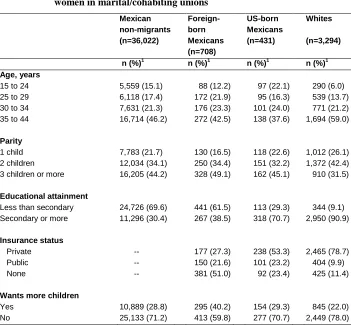
Among women of Mexican-origin, non-migrants and immigrants are largely similar in age, while US-born women are somewhat younger than their Mexican-born counterparts (Table 1). All three groups of women of Mexican-origin are younger, and are also more likely to have three children or more than white women. In addition, women of Mexican-origin in all groups have lower levels of education than white women, with the lowest levels of secondary education observed for non-migrants, followed by foreign-born and US-born women. Among women in the US, foreign-born women are less likely to have private or public insurance than US-born women and white women. Finally, a higher percentage of Mexican immigrants report that they want additional children than are either non-migrant or US-born Mexican women. All three groups of Mexican-origin women are more likely to want additional children than white women.
The percentage of women using specific contraceptive methods varies at each parity (Figure 1). For example, Mexican non-migrants with one or two children are more likely to use IUDs/implants and, at all parities, are less likely to use hormonal methods than women in the US. Additionally, compared to non-migrant women in Mexico of similar parity, a higher percentage of immigrants report condoms as their primary method.
Table 1: Frequency of characteristics of parous Mexican-origin and white women in marital/cohabiting unions
Mexican non-migrants (n=36,022)
Foreign-born Mexicans (n=708)
US-born Mexicans (n=431)
Whites
(n=3,294)
n (%)1 n (%)1 n (%)1 n (%)1 Age, years
15 to 24 5,559 (15.1) 88 (12.2) 97 (22.1) 290 (6.0) 25 to 29 6,118 (17.4) 172 (21.9) 95 (16.3) 539 (13.7) 30 to 34 7,631 (21.3) 176 (23.3) 101 (24.0) 771 (21.2) 35 to 44 16,714 (46.2) 272 (42.5) 138 (37.6) 1,694 (59.0)
Parity
1 child 7,783 (21.7) 130 (16.5) 118 (22.6) 1,012 (26.1) 2 children 12,034 (34.1) 250 (34.4) 151 (32.2) 1,372 (42.4) 3 children or more 16,205 (44.2) 328 (49.1) 162 (45.1) 910 (31.5)
Educational attainment
Less than secondary 24,726 (69.6) 441 (61.5) 113 (29.3) 344 (9.1) Secondary or more 11,296 (30.4) 267 (38.5) 318 (70.7) 2,950 (90.9)
Insurance status
Private -- 177 (27.3) 238 (53.3) 2,465 (78.7) Public -- 150 (21.6) 101 (23.2) 404 (9.9) None -- 381 (51.0) 92 (23.4) 425 (11.4)
Wants more children
Yes 10,889 (28.8) 295 (40.2) 154 (29.3) 845 (22.0) No 25,133 (71.2) 413 (59.8) 277 (70.7) 2,449 (78.0)
Data Source: ENADID 2009; NSFG Cycles 2002 and 2006-2010.
Note: 1
Reported percentages are weighted, reflecting the sampling designs for the Encuesta Nacional de la Dinámica Demográfica and National Survey of Family Growth.
Figure 1: Current contraceptive use among Mexican-origin and white women, by parity
Data sources: ENADID, 2009; NSFG Cycles 2002 and 2006-2010
Note: 1
Hormonal methods include oral contraceptive pills, injectables and patch. 2
Other methods include withdrawal/rhythm/other calendar methods, sponge, female condom, diaphragms/cervical caps, and foam/jelly/cream.
Among women with two children, a lower percentage of immigrant women stated that they did not want more children than Mexican non-migrants (Figure 2). Additionally, a lower percentage of women of Mexican-origin in all groups reported that they did not want more children than did white women. Among women with three or more children, immigrants were less likely to report that they did not want more children than were women in the other three groups.
Permanent contraceptive methods, especially female sterilization, are the most widely used among women who do not want more children, but there are notable differences across groups and parity in both the overall prevalence, as well as type, of permanent method used (Figure 3). For example, use of female sterilization increases with parity, but is higher among non-migrant Mexicans than among Mexican-origin women in the US and whites. Additionally, vasectomy is reported more often by white women than by other groups.
0% 10% 20% 30% 40% 50% 60% 70% 80% 90% 100%
1 child 2 children ≥ 3 children
Figure 2: Percent (95% confidence interval) of Mexican-origin and white women who do not want more children, by parity
Data Source: ENADID 2009; NSFG Cycles 2002 and 2006-2010.
Use of reversible methods of contraception also varies between non-migrant Mexican women and immigrants who do not want more children. Similar to results reported for all women, immigrants with two children are less likely to use IUDs/implants than their non-migrant counterparts. Furthermore, a higher percentage of immigrants who have two children or more use hormonal methods or rely on condoms as their primary method than do to non-migrant women of similar parities.
0 20 40 60 80 100
Pe
rc
ent
of w
o
me
n
2 children ≥ 3 children
Figure 3: Current contraceptive use among Mexican-origin and white women who do not want more children, by parity
Data Source: ENADID 2009; NSFG Cycles 2002 and 2006-2010.
Note: 1 Hormonal methods include oral contraceptive pills, injectables and patch. 2
Other methods include withdrawal/rhythm/other calendar methods, sponge, female condom, diaphragms/cervical caps, and foam/jelly/cream.
4. Discussion
We found that non-migrant women in Mexico were much more likely than women of Mexican origin in the US to use IUDs and implants, which are more effective at preventing pregnancy with typical use than hormonal methods (Peipert et al. 2011; Trussell 2011). Additionally, while female sterilization was the most common method among higher parity women in both the US and Mexico, we found that immigrant women were somewhat less likely to be sterilized, and the least likely to use any permanent method than women in the other three groups. Together these results indicate that women of Mexican origin in the US tend to rely on less effective methods of contraception than women in Mexico at similar parities. This is particularly notable for immigrants, whose contraceptive preferences are likely to be quite similar to those of non-migrant Mexican women.
0% 20% 40% 60% 80% 100%
2 children ≥ 3 children
Other2
Condoms
Hormonals1
IUD/Implant
Vasectomy
Sterilization
Parity
100
60
40
20
0 80
This pattern of contraceptive use among immigrant women might be interpreted as reflecting a difference in childbearing preferences (Unger and Molina 1998; Wilson 2009). But even though we found that Mexican immigrants were slightly less likely than women of similar parities in other groups to report that they did not want more children, there were still clear differences in women’s use of the most highly effective and permanent methods of contraception, after limiting our sample to women who did not want more children.
Why might variation in method mix result from different levels of access to family planning services? In Mexico, IUDs and female sterilization are widely accessible through a network of public clinics at no cost to the woman. In contrast, these methods are not widely offered in the US public sector, due to limited funding and the higher upfront costs of these methods (Centers for Disease Control and Prevention 2011; Lindberg et al. 2006). Given immigrant women’s limited eligibility for publicly funded contraceptive services, they may rely on less effective contraceptive methods, even if they do not want more children (Potter et al. 2012; Thurman and Janecek 2010).
Differences in women’s contraceptive use may also reflect medical norms. The initial priorities for Mexico’s national family planning program, which later became institutionalized in medical practice, emphasized the use of IUDs and, among older and higher parity women, female sterilization (Potter 1999). In contrast, the IUD was rarely used in the US after the 1970’s because of studies linking its use to reproductive infections and infertility (Hubacher 2002), and only recently has IUD use begun to increase (Kavanaugh et al. 2011). Additionally, concern about post-sterilization regret may lead some US providers to dissuade younger women from being sterilized even though women may have strong motivations for not wanting more children (Hillis et al. 1999; Lawrence et al. 2011; Potter et al. 2012). Thus, unlike their counterparts in Mexico, women of Mexican origin in the US may be unable to get a desired sterilization, leading to frustrated demand for the procedure (Potter et al. 2012; Thurman, Harvey and Shain 2009).
Future studies could compare non-migrant and immigrant women’s contraceptive preferences directly, as well as their abilities to realize those preferences. Additionally, researchers should examine the barriers that women of Mexican origin face accessing highly effective methods in the US, particularly women without insurance or those who rely on the public sector for reproductive health care. Given differences in public funding for family planning services in states with large Mexican-origin populations, such as Texas and California (James et al. 2009), it would also be useful to assess how these barriers and women’s experiences accessing contraception vary across settings (White et al. 2012). Together with longitudinal information on subsequent births, these studies would clarify the extent to which disparities in the fertility of Mexican-origin women is attributable to differences in contraceptive access.
5. Acknowledgements
References
Centers for Disease Control and Prevention (2011). Contraceptive methods available to patients of office-based physicians and Title X clinics-United States, 2009-2010. Morbidity and Mortality Weekly Report 60(1): 3–4.
Frank, R. and Heuveline, P. (2005). A crossover in Mexican and Mexican-American fertility rates: Evidence and explanations for an emerging paradox. Demographic Research 12(4): 77–104. doi:10.4054/DemRes.2005.12.4.
Galindo, A.M.C., Bancet, C.M., Bringas, H.H.H., Hernández, G.A., and Arenales, R.A.F. (2007). La salud reproductiva de la población indígena. In: La salud reproductiva en México: Análisis de la Encuesta Nacional de Salud Reproductiva 2003. México, D.F.: Secretaría de Salud, Universidad Nacional Autónoma México Centro Regional de Investigaciones Multidisciplinarias: 175–190.
Hillis, S.D., Marchanks, P.A., Tylor, L.R., and Peterson, H.B. (1999). Post-sterilization regret: Findings from the US Collaborative Review of Sterilization. Obstetrics and Gynecology 93(6): 889–895. doi:10.1016/S0029-7844(98)00539-0.
Hirsch, J.S. and Nathanson, C.A. (2001). Some traditional methods are more modern than others: Rhythm, withdrawal and the changing meanings of sexual intimacy in Mexican companionate marriage. Culture, Health, and Sexuality 3(4): 413–428. doi:10.1080/13691050110074228.
Hubacher, D. (2002). The checkered history and bright future of intrauterine contraception in the United States. Perspectives on Sex and Reproductive Health 34(2): 98–103. doi:10.2307/3030213.
Institute of Medicine (2009). A review of the HHS family planning program: Mission, management and measurement of results. Washington, D.C.: The National Academies Press.
James, C.V., Salganicoff, A., Thomas, M., Ranji, U., Lillie-Blanton, M., and Wyn, R. (2009). Putting women's health disparities on the map: Examining racial and ethnic disparities at the state level. Los Angeles, CA: Henry J. Kaiser Family Foundation.
Kavanaugh, M., Jerman, J., Hubacher, D., Kost, K., and Finer, L.B. (2011). Characteristics of women in the United States who use long-acting reversible contraceptive methods. Obstetrics and Gynecology 117(6): 1349–1357.
Landale, N.S. and Oropesa, R.S. (2007). Hispanic families: Stability and change. Annual Review of Sociology 33: 381–405. doi:10.1146/annurev.soc.33.04 0406.131655.
Lawrence, R.E., Rasinski, K.A., Yoon, J.D., and Curlinm, F.A. (2011). Factors influencing physicians' advice about female sterilization in USA: A national survey. Human Reproduction 26(1): 106–111. doi:10.1093/humrep/deq289.
Lindberg, L.D., Frost, J.J., Sten, C., and Dailard, C. (2006). The provision and funding of contraceptive services at publicly funded family planning agencies: 1995-2003. Perspectives on Sexual and Reproductive Health 38(1): 37–45.
Martin, J.A., Hamilton, B.E., Ventura, S.J., Osterman, M.J.K., Wilson, E.C., and Mathews, T.J. (2012). Births: Final data for 2010. National Vital Statistics Report 61(1).
Minnis, A. (2010). U.S. Migration and reproductive health among Mexican women: Assessing the evidence of health selectivity. Field Actions Science Reports Special Issue 2: 1–7.
Miranda, A. (2006). Are young cohorts of women delaying first birth in Mexico? Journal of Population Economics 19(1): 55–70. doi:10.1007/s00148-005-0046-7.
Parrado, E.A. (2011). How high is Hispanic/Mexican fertility in the U.S.? Immigration and tempo considerations. Demography 48(3): 1059–1080. doi:10.1007/s13524-011-0045-0.
Peipert, J.F., Zhao, Q., Allsworth, J.E., Petrosky, E., Madden, T., Eisenberg, D., and Secura, G. (2011). Continuation and satisfaction of reversible contraception. Obstetrics and Gynecology 117(5): 1105–1113. doi:10.1097/AOG.0b013e318 21188ad.
Pew Hispanic Center (2011). The Mexican-American boom: Births overtake migration. Washington, D.C.
Potter, J.E. (1999). The persistence of outmoded contraceptive regimes: The cases of Mexico and Brazil. Population and Development Review 25(4): 703–739.
doi:10.1111/j.1728-4457.1999.00703.x.
Thurman, A.R., Harvey, D., and Shain, R.N. (2009). Unfulfilled postpartum sterilization requests. Journal of Reproductive Medicine 54(8): 467–472.
Thurman, A.R. and Janecek, T. (2010). One-year follow-up of women with unfulfilled postpartum sterilization requests. Obstetrics and Gynecology 116(5): 1071–1077. doi:10.1097/AOG.0b013e3181f73eaa.
Trussell, J. (2011). Contraceptive failure in the United States. Contraception 83(5): 397–404. doi:10.1016/j.contraception.2011.01.021.
U.S. Census Bureau (2008). Fertility of American women: 2008 [electronic resource]. Washington, D.C.: US Census Bureau. [http://www.census.gov/hhes/fertility/ data/cps/2008.html].
Unger, J.B. and Molina, G.B. (1998). Contraceptive use among Latina women: Social, cultural, and demographic correlates. Women's Health Issues 8(6): 359–369.
doi:10.1016/S1049-3867(98)00030-9.
White, K., Grossman, D., Hopkins, K., and Potter, J.E. (2012). Cutting family planning in Texas. New England Journal of Medicine 367(13): 1179–1181.
doi:10.1056/NEJMp1207920.