R E S E A R C H
Open Access
Development of a novel DNA sequencing
method not only for hepatitis B virus genotyping
but also for drug resistant mutation detection
Fanjun Wang
1,2†, Lili Lu
3†, Changshun Yu
2, Zhanwu Lv
2, Xuelian Luo
1, Chao Wan
1, Zhaohui Hu
2, Qinyi Zhu
2,
Youping Deng
3*, Chuyu Zhang
1*From
The 2011 International Conference on Bioinformatics and Computational Biology (BIOCOMP
’
11)
Las Vegas, NV, USA. 18-21 July 2011
Abstract
Background:In HBV-infected patients, different genotypes of the hepatitis B virus influence liver disease
progression and response to antiviral therapy. Moreover, long-term antiviral therapy will eventually select for drug-resistant mutants. Detection of mutations associated to antiviral therapy and HBV genotyping are essential for monitoring treatment of chronic hepatitis B patients.
Results:In this study, a simple method of partial-S gene sequencing using a common PCR amplification was established for genotyping clinical HBV isolates sensitively, which could detect the drug-resistant mutations successfully at the same time.
Conclusions:The partial S gene sequencing assay developed in this study has potential for application in HBV genotyping and drug resistant mutation detection. It is simpler and more convenient than traditional S gene sequencing, but has nearly the same sensitivity and specificity when compared to S gene sequencing.
Background
Eight distinct genotypes (A to H) of hepatitis B virus (HBV) have been identified, and this classification is based on the distance of the nucleotide sequence from the viral genome of 8% or greater [1,2]. These genotypes also have a distinct geographical distribution, while genotypes B and C are more common in China. Since genotypes of HBV influence liver disease progression and response to anti-viral therapy in HBV-infected patients, several methods have been developed for genotyping of HBV strains [3], these include sequence analysis; microarray (DNA-Chip) [4,5]; reverse hybridization [6]; restriction fragment length polymorphism (RFLP) [7]; serological assays and geno-type-specific PCR assays [8,9]. These techniques have the
disadvantage that they are based on specific hybridization of HBV DNA, and nucleotide changes can interfere with this process and subsequent sequence analysis. For exam-ple, RFLP and multiple PCR methods might give wrong results even for a single base mutation. Serological assay has a low cost and does not rely on PCR amplification, but it is still subjected to the effects of specific base mutation. INNO-LiPA HBV genotyping assay has the limitation of high cost, and also its likelihood to be affected by the spe-cific binding site mutant gene [10,14]. Sequence analysis is definitely the most accurate method and not subject to these constraints, but it is also the most labor intensive technique and needs nested PCR to increase the sensitivity.
As we all know, there are several antiviral therapies– such as interferon; pegylated interferon or nucleotide/ nucleoside analogs–widely used to treat HBV infection. None of these therapies can eradicate HBV infection and all often induce drug-resistant mutants. As a result, HBV genotyping and the detection of mutations that confer * Correspondence: [email protected]; [email protected]
†Contributed equally
1State Key Laboratory of Virology and College of Life Sciences, Wuhan University, Wuhan 430072, P.R. China
3Wuhan University of Science and Technology, Wuhan 430081, P.R. China Full list of author information is available at the end of the article Wanget al.BMC Medical Genomics2013,6(Suppl 1):S15 http://www.biomedcentral.com/1755-8794/6/S1/S15
drug resistance help select an appropriate treatment strategy and monitor the treatment. However, there are a limited number of methods that enable simultaneous genotyping and mutation detection. In this study, we used the partial S-gene sequencing using common PCR to genotype HBV, which is simpler and more sensitive compared with the S-gene sequencing.
Partial S-gene sequencing means sequencing part of the S gene from 370 nt to 861 nt. This part of the S gene we chose is relatively conserved and has many drug-resistant mutant sites, so it could be used in both HBV genotyping and in analysis of HBV drug resistant mutation.
Results and discussion
Phylogenetic tree analysis
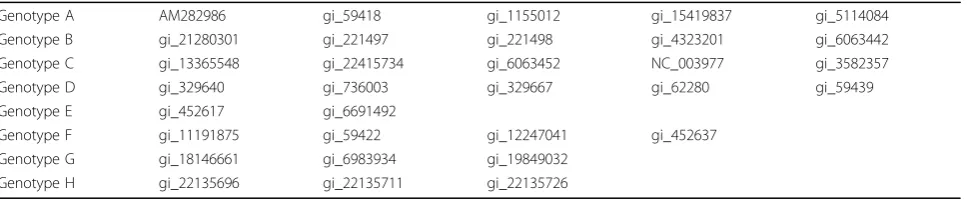
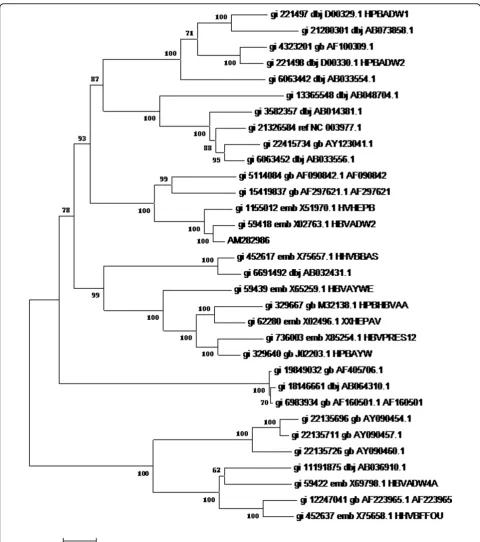
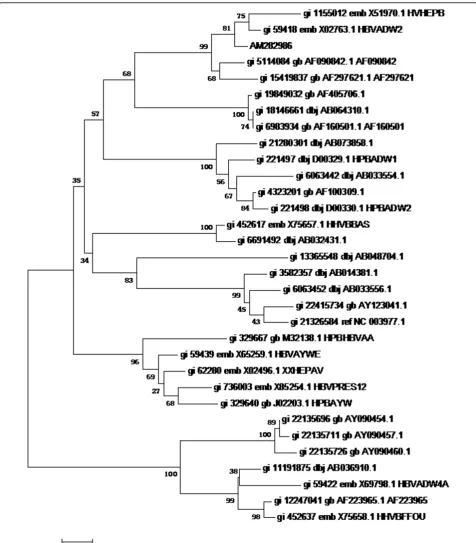
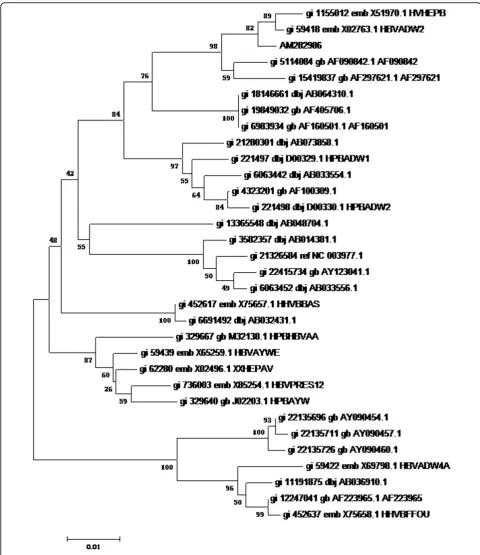
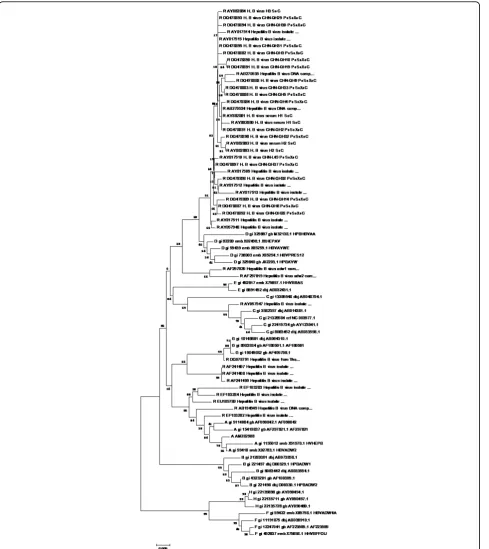
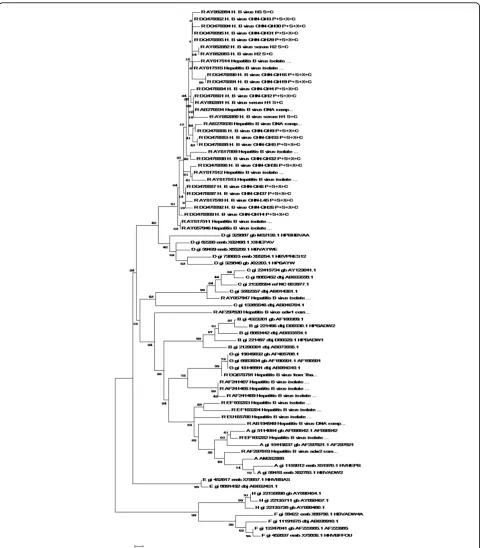
First, phylogenetic tree analysis was used for testing the possibility of HBV genotyping using partial S gene sequen-cing. Reference sequences from 32 HBV genomes of eight different genotypes were used (shown as Table 1). Soft-ware MEGA4 was used to analyze these genomes to get the phylogenetic trees of genome sequencing; S gene sequencing and partial S gene sequencing respectively. All these sequences could be genotyped successfully by partial S gene sequencing. The results of phylogenetic tree analy-sis indicated that the partial S gene sequencing had nearly the same phylogenetic tree as that of the S gene sequen-cing (shown as Figure 1, 2, 3).
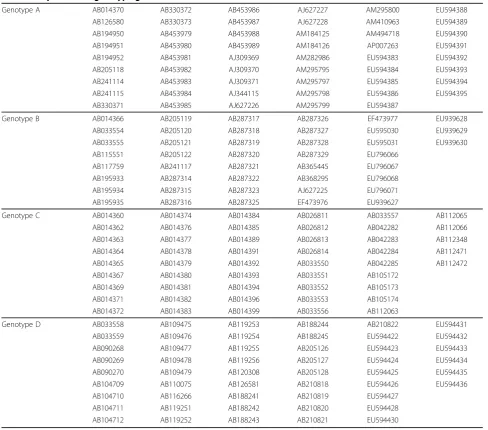
To further evaluate the effect of partial S gene sequen-cing, 53 HBV genotype A samples; 43 HBV genotype B samples; 50 HBV genotype C samples and 51 HBV geno-type D samples were genogeno-typed using partial S gene sequencing and S gene sequencing respectively (shown as Table 2). Compared the results of these two methods, we found that the results of partial S gene sequencing are consistent with S gene sequencing, except one sample, EU939630. From further recombinant analysis, we found that EU939630 was a C/B recombinant strain (shown as Figure 4).
Sensitivity of partial S gene sequencing
147 HBV-positive (HBV copies were more than 500 copies/ml) serum samples were sequenced by partial S
gene sequencing, 2 of which could not to be sequenced, so the sensitivity of our partial S gene sequencing was 98.64%.
Application of partial S gene sequencing in recombinant HBV isolates
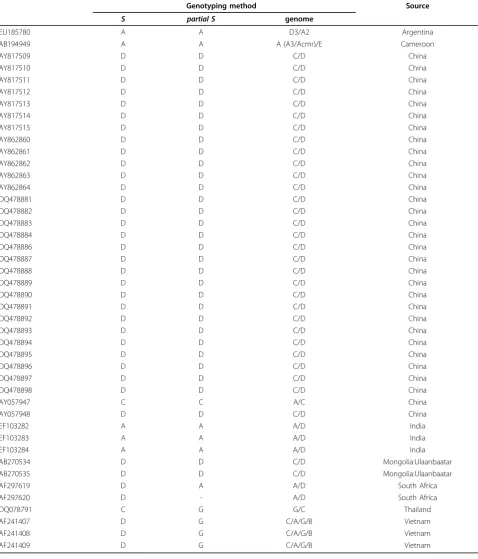
Next, we evaluated the application of partial S gene sequencing in HBV recombinant isolates (shown as Figure 5 and 6). 44 recombinant HBV isolates were col-lected as shown in Table 3. The genotyping results indi-cated that there were 38 samples with the same results using partial S gene sequencing and S gene sequencing. Other 6 samples had different genotyping results by these two methods, which were isolated from South Africa (2/6); Thailand (1/6) and Vietnam (3/6) respec-tively. One sample from South Africa (AF297620) failed to genotype by partial S gene sequencing, as there was a recombinant site in its S region (shown as Figure 7) which was analyzed by Simplot software and NCBI Viral genotyping tool.
Drug-resistant mutations analysis
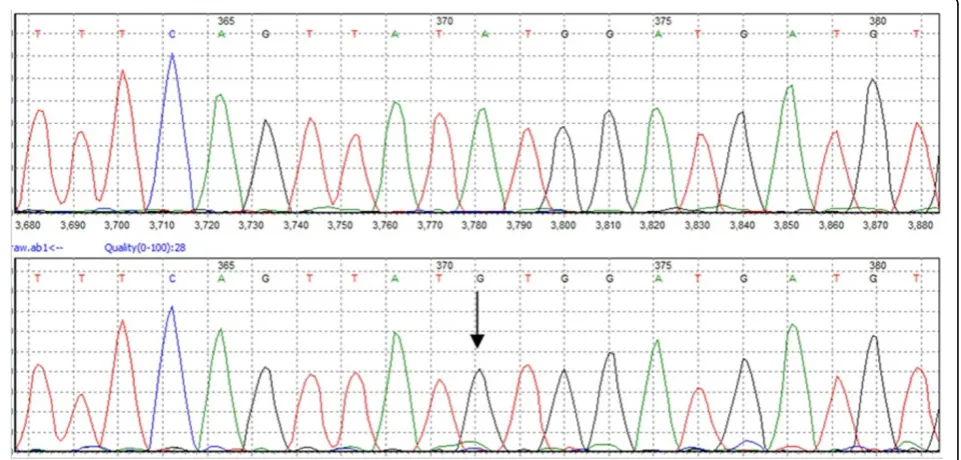
The part of the S gene we chose for sequencing has many drug-resistant mutant sites, which means it had potential for use in analysis of HBV drug resistant mutation. To evaluate this, we analyzed all possible sites of resistance mutations (V521L; A529V; A529T; T532A; S550I; rtL180M; rtM204V/I; N584T and K589E) of 147 HBV-positive serum samples [16]. Through partial S gene sequencing we detected rtM204V mutation in one sample successfully (shown in Figure 8), meaning the partial S gene sequencing could be used in both HBV genotyping and in analysis of HBV drug resistant mutation.
Conclusions
HBV genotyping and the detection of drug resistance mutations are important for monitoring the treatment of chronic hepatitis B, but there are a limited number of methods for the simultaneous detection of HBV geno-types and drug resistance mutations [11,13]. We have established a partial S gene sequencing method to geno-type HBV isolates as well as detect drug resistance mutations at the same time. To testify the sensitivity of
Table 1 Reference sequences for genotyping
Genotype A AM282986 gi_59418 gi_1155012 gi_15419837 gi_5114084
Genotype B gi_21280301 gi_221497 gi_221498 gi_4323201 gi_6063442
Genotype C gi_13365548 gi_22415734 gi_6063452 NC_003977 gi_3582357
Genotype D gi_329640 gi_736003 gi_329667 gi_62280 gi_59439
Genotype E gi_452617 gi_6691492
Genotype F gi_11191875 gi_59422 gi_12247041 gi_452637
Figure 1 Phylogenetic tree map of HBV genome sequencing. 32 HBV genomes of eight different genotypes were sequenced by HBV genome sequencing, and software MEGA4 was used to analyze these genomes to get the phylogenetic trees of genome sequencing.Tree Inference: [Method: Neighbor-Joining;Phylogeny Test and options: Bootstrap (1000 replicates; seed = 100000)];Include Sites: [Gaps/Missing Data: Complete Deletion];Substitution Model: [Model: Nucleotide: Maximum Composite Likelihood;Substitutions to Include: d: Transitions + Transversions;Pattern among Lineages: Same (Homogeneous);Rates among sites: Uniform rates]
Wanget al.BMC Medical Genomics2013,6(Suppl 1):S15 http://www.biomedcentral.com/1755-8794/6/S1/S15
Figure 2Phylogenetic tree map of HBV S gene sequencing. 32 HBV genomes of eight different genotypes were sequenced by HBV S gene sequencing, and software MEGA4 was used to analyze these genomes to get the phylogenetic trees of HBV S gene sequencing.Tree
Figure 3Phylogenetic tree map of HBV partial S gene sequencing. 32 HBV genomes of eight different genotypes were sequenced by HBV partial S gene sequencing, and software MEGA4 was used to analyze these genomes to get the phylogenetic trees of HBV partial S gene sequencing.Tree Inference: [Method: Neighbor-Joining;Phylogeny Test and options: Bootstrap (1000 replicates; seed = 100000)];Include Sites: [Gaps/Missing Data: Complete Deletion;Codon Positions: 1st+2nd+3rd];Substitution Model: [Model: Nucleotide: Maximum Composite Likelihood;
Substitutions to Include: d: Transitions + Transversions;Pattern among Lineages: Same (Homogeneous);Rates among sites: Uniform rates] Wanget al.BMC Medical Genomics2013,6(Suppl 1):S15
http://www.biomedcentral.com/1755-8794/6/S1/S15
our partial S gene sequencing, 147 clinical serum sam-ples were used, and 145 samsam-ples could be sequenced successfully by this assay, with a sensitivity of 98.64%.
The part of S gene we chose for sequencing has many drug-resistant mutant sites, and we detected all possible mutant sites in this region of 145 samples and found the rtM204V mutation in one sample. That means the partial S gene sequencing could be used in analysis of HBV drug resistant mutation.
To evaluate the potential of partial S gene sequencing for use in HBV genotyping, the phylogenetic tree analysis was used. From the phylogenetic tree mapping, we found that the partial S gene sequencing had nearly the same phylogenetic tree map to that of the S gene sequencing (shown as Figure 2 and 3). This means partial S gene sequencing has the possibility to be used as a promising
method in HBV genotyping. To further demonstrate this, 197 HBV positive serum samples of four different geno-types (A, B, C, and D) were genotyped using partial S gene sequencing and S gene sequencing respectively (Table 2). Although at least eight HBV genotypes have been reported, the major HBV genotypes in China are B and C [12,15]. Genotypes A and D are found in a very small pro-portion of Chinese patients, and genotypes E, F, G, and H have not been reported in China. As a result, we only eval-uated the performance of partial S gene sequencing assay for genotypes A, B, C, and D in our study. We found the results of partial S gene sequencing were consistent with S gene sequencing, except one sample, EU939630, which was proved to be a C/B recombinant strain. From this, we have proved that this assay could specifically detect mutant and wild-type HBV in clinical serum samples.
Table 2 Sequences for genotyping verification
Genotype A AB014370 AB330372 AB453986 AJ627227 AM295800 EU594388
AB126580 AB330373 AB453987 AJ627228 AM410963 EU594389
AB194950 AB453979 AB453988 AM184125 AM494718 EU594390
AB194951 AB453980 AB453989 AM184126 AP007263 EU594391
AB194952 AB453981 AJ309369 AM282986 EU594383 EU594392
AB205118 AB453982 AJ309370 AM295795 EU594384 EU594393
AB241114 AB453983 AJ309371 AM295797 EU594385 EU594394
AB241115 AB453984 AJ344115 AM295798 EU594386 EU594395
AB330371 AB453985 AJ627226 AM295799 EU594387
Genotype B AB014366 AB205119 AB287317 AB287326 EF473977 EU939628
AB033554 AB205120 AB287318 AB287327 EU595030 EU939629
AB033555 AB205121 AB287319 AB287328 EU595031 EU939630
AB115551 AB205122 AB287320 AB287329 EU796066
AB117759 AB241117 AB287321 AB365445 EU796067
AB195933 AB287314 AB287322 AB368295 EU796068
AB195934 AB287315 AB287323 AJ627225 EU796071
AB195935 AB287316 AB287325 EF473976 EU939627
Genotype C AB014360 AB014374 AB014384 AB026811 AB033557 AB112065
AB014362 AB014376 AB014385 AB026812 AB042282 AB112066
AB014363 AB014377 AB014389 AB026813 AB042283 AB112348
AB014364 AB014378 AB014391 AB026814 AB042284 AB112471
AB014365 AB014379 AB014392 AB033550 AB042285 AB112472
AB014367 AB014380 AB014393 AB033551 AB105172
AB014369 AB014381 AB014394 AB033552 AB105173
AB014371 AB014382 AB014396 AB033553 AB105174
AB014372 AB014383 AB014399 AB033556 AB112063
Genotype D AB033558 AB109475 AB119253 AB188244 AB210822 EU594431
AB033559 AB109476 AB119254 AB188245 EU594422 EU594432
AB090268 AB109477 AB119255 AB205126 EU594423 EU594433
AB090269 AB109478 AB119256 AB205127 EU594424 EU594434
AB090270 AB109479 AB120308 AB205128 EU594425 EU594435
AB104709 AB110075 AB126581 AB210818 EU594426 EU594436
AB104710 AB116266 AB188241 AB210819 EU594427
AB104711 AB119251 AB188242 AB210820 EU594428
Figure 4Genotype and recombinant analysis results of EU939630. A: Genotype results of 43 HBV genotype B samples using partial S gene sequencing, 42 samples of which had been genotyped correctly except one, EU939630. The arrow indicates EU939630 was genotyped as HBV genotype C by partial S gene sequencing. B: Recombinant analysis result of EU939630. From the recombinant analysis, we found that EU939630 was a C/B recombinant strain.
Wanget al.BMC Medical Genomics2013,6(Suppl 1):S15 http://www.biomedcentral.com/1755-8794/6/S1/S15
Figure 5Phylogenetic tree map of HBV recombinant strains using S gene sequencing. 44 recombinant HBV isolates were collected to draw the phylogenetic tree map of HBV S gene sequencing by the method described above.Tree Inference: [Method: Neighbor-Joining;
Figure 6Phylogenetic tree map of HBV recombinant strains using partial S gene sequencing. 44 recombinant HBV isolates were collected to draw the phylogenetic tree map of HBV partial S gene sequencing by the method described above.Tree Inference: [Method: Neighbor-Joining;Phylogeny Test and options: Bootstrap (1000 replicates; seed = 100000)];Include Sites: [Gaps/Missing Data: Complete Deletion];
Substitution Model: [Model: Nucleotide: Maximum Composite Likelihood;Substitutions to Include: d: Transitions + Transversions;Pattern among Lineages: Same (Homogeneous);Rates among sites: Uniform rates]
Wanget al.BMC Medical Genomics2013,6(Suppl 1):S15 http://www.biomedcentral.com/1755-8794/6/S1/S15
Considering that the recombinant strain might disturb genotyping effect, we evaluated the application of partial S gene sequencing in 44 HBV recombinant isolates (Table 3). 43 samples could be genotyped correctly by partial S gene sequencing method, meanwhile, S gene sequencing
genotyped 41 samples successfully. That means partial S gene sequencing had the potential to take the place of S gene sequencing in the field of HBV genotyping.
Based on these findings, we could draw the conclusion that the partial S gene sequencing assay developed in this
Table 3 Genotype results of 44 HBV recombinant strains
Genotyping method Source
S partial S genome
EU185780 A A D3/A2 Argentina
AB194949 A A A (A3/Acmr)/E Cameroon
AY817509 D D C/D China
AY817510 D D C/D China
AY817511 D D C/D China
AY817512 D D C/D China
AY817513 D D C/D China
AY817514 D D C/D China
AY817515 D D C/D China
AY862860 D D C/D China
AY862861 D D C/D China
AY862862 D D C/D China
AY862863 D D C/D China
AY862864 D D C/D China
DQ478881 D D C/D China
DQ478882 D D C/D China
DQ478883 D D C/D China
DQ478884 D D C/D China
DQ478886 D D C/D China
DQ478887 D D C/D China
DQ478888 D D C/D China
DQ478889 D D C/D China
DQ478890 D D C/D China
DQ478891 D D C/D China
DQ478892 D D C/D China
DQ478893 D D C/D China
DQ478894 D D C/D China
DQ478895 D D C/D China
DQ478896 D D C/D China
DQ478897 D D C/D China
DQ478898 D D C/D China
AY057947 C C A/C China
AY057948 D D C/D China
EF103282 A A A/D India
EF103283 A A A/D India
EF103284 A A A/D India
AB270534 D D C/D Mongolia:Ulaanbaatar
AB270535 D D C/D Mongolia:Ulaanbaatar
AF297619 D A A/D South Africa
AF297620 D - A/D South Africa
DQ078791 C G G/C Thailand
AF241407 D G C/A/G/B Vietnam
AF241408 D G C/A/G/B Vietnam
study could be applied in HBV genotyping and drug resistant mutation detection. It might be an ideal choice for HBV genotyping for it is simpler and more conveni-ent than traditional S gene sequencing while it has nearly the same sensitivity and specificity as S gene sequencing.
Methods
Serum samples
Serum samples are collected from four hospitals: the Second People Hospital of Guangdong Province, the First Affiliated Hospital of Guangzhou Medical College, Guangzhou Overseas Chinese Hospital, and Guangzhou Huadu Ren-Ai Hospital. All these serum samples were
collected in compliance with the Helsinki Declaration, and all the patients who provided serum samples were voluntary. This study was approved by the Institutional Review Board of Wuhan University. All specimens were sampled from sterile blood vessels (excluding anticoagu-lant) and stored at -20°C.
Sequencing
HBV DNA was isolated from serum (QIAamp DNA Blood Mini Kit, QIAGEN, Hilden, Germany) according to the kit instructions. A product of 491 base pairs of partial S gene was amplified with the primers F (sense, 5’- TCGCTGGATGTGTCTGCGGCGTTTTAT-3’) and
Figure 7Recombinant analysis results of AF297620. AF297620 was failed to be genotyped by partial S gene sequencing because it had recombinant sites in partial S gene region.
Figure 8Drug resistant mutation analysis by partial S gene sequencing. Through drug resistant mutation analysis of 147 HBV positive serum samples using partial S gene sequencing, one sample was found to be rtM204V mutation. The arrow indicates the A is replaced by G. Wanget al.BMC Medical Genomics2013,6(Suppl 1):S15
http://www.biomedcentral.com/1755-8794/6/S1/S15
R (antisense, 5’- ACCCCATCTTTTTGTTTTGTTAGG-3’) using a PCR protocol as follows: 12 min at 95°C, 35 cycles of 1 min at 94°C, 1 min at 52°C, 1 min at 72°C, and a final elongation step of 7 min at 72°C, using the AmpliTaq Gold amplification system.
Phylogenetic tree analysis
To testify the feasibility of the partial S gene sequencing used for HBV genotyping, 32 different genotypes of the HBV (http://lancelot.otago.ac.nz) genome sequence were chosen as the reference sequences (shown in Table 1). Three different DNA sequencing methods were used to genotype serum samples for phylogenetic tree mapping: whole genome sequencing, S gene sequencing and par-tial S gene sequencing.
Authors’contributions
Fanjun Wang designed this study; Lili Lu and Youping Deng drafted and revised the manuscript; Changshun Yu, Zhanwu Lv participated in the collection of clinical samples and gene sequencing; Xuelian Luo, Chao Wan participated in the phylogenetic tree analysis; Zhaohui Hu, Qinyi Zhu participated in acquisition of data and data analysis; Youping Deng gave final approval of the version to be published; Chuyu Zhang participated in the design of the study and the general supervision of the research group.
Competing interests
The authors declare that they have no competing interests.
Acknowledgements
This article has been published as part ofBMC Medical GenomicsVolume 6 Supplement 1, 2013: Proceedings of the 2011 International Conference on Bioinformatics and Computational Biology (BIOCOMP’11). The full contents of the supplement are available online at http://www.biomedcentral.com/ bmcmedgenomics/supplements/6/S1. Publication of this supplement has been supported by the International Society of Intelligent Biological Medicine.
Author details
1State Key Laboratory of Virology and College of Life Sciences, Wuhan University, Wuhan 430072, P.R. China.2Guangzhou Kingmed Center for Clinical Laboratory, Guangzhou 524035, P.R. China.3Wuhan University of Science and Technology, Wuhan 430081, P.R. China.
Published: 23 January 2013
References
1. Norder H, Courouce AM, Magnius LO:Complete genomes, phylogenetic relatedness, and structural proteins of six strains of the hepatitis B virus, four of which represent two new genotypes.Virology1994,198:489-503. 2. Norder H, Hammas B, Lee SD, Bile K, Courouce AM, ushahwar IK,
Magnius LO:Genetic relatedness of hepatitis B viral strains of diverse geographical origin and natural variations in the primary structure of the surface antigen.J Gen Virol1993,74:1341-1348.
3. Bartholomeusz A, Schaefer S:Hepatitis B virus genotypes: comparison of genotyping methods.Rev Med Virol2004,14:3-16.
4. Tang XR, Zhang JS, Zhao H, Gong YH, Wang YZ, Zhao JL:Detection of hepatitis B virus genotypes using oligonucleotide chip among hepatitis B virus carriers in Eastern China.World J Gastroenterol2007,13:1975-1979. 5. Vernet G, Tran N:The DNA-Chip technology as a new molecular tool for
the detection of HBV mutants.J Clin Virol2005,34(Suppl 1):S49-S53. 6. Osiowy C, Giles E:Evaluation of the INNO-LiPA HBV genotyping assay for
determination of hepatitis B virus genotype.J Clin Microbiol2003, 41:5473-5477.
7. Chattopadhyay S, Das BC, Hussain Z, Kar P:Hepatitis B virus genotypes in acute and fulminant hepatitis patients from north India using two different molecular genotyping approaches.Hepatol Res2006,35:79-82. 8. Chen J, Yin J, Tan X, Zhang H, Zhang H, Chen B, Chang W, Schaefer S,
Cao G:Improved multiplex-PCR to identify hepatitis B virus genotypes A-F and subgenotypes B1, B2, C1 and C2.J Clin Virol2007,38:238-243. 9. Liu WC, Mizokami M, Buti M, Lindh M, Young KC, Sun KT, Chi YC, Li HH, Chang TT:Simultaneous quantification and genotyping of hepatitis B virus for genotypes A to G by real-time PCR and two-step melting curve analysis.J Clin Microbiol2006,44:4491-4497.
10. Zeng G, Wang Z, Wen S, Jiang J, Wang L, Cheng J, Tan D, Xiao F, Ma S, Li W, Luo K, Naoumov NV, Hou J:Geographic distribution, virologic and clinical characteristics of hepatitis B virus genotypes in China.J Viral Hepat2005,12(6):609-17.
11. Degertekin B, Hussain M, Tan J, Oberhelman K, Lok AS:Sensitivity and accuracy of an updated line probe assay (HBV DR v.3) in detecting mutations associated with hepatitis B antiviral resistance.J Hepatol2009, 49:695-701.
12. Wang Z, Huang Y, Wen S, Zhou B, Hou J:Hepatitis B virus genotypes and subgenotypes in China.Hepatol Res2007,37(Suppl 1):S36-41.
13. Wang YZ, Xiao JH, Liu LG, Ye CY, Shen HY, Xu TM, Zhu KZ:Simultaneous detection of hepatitis B virus genotypes and mutations associated with resistance to lamivudine, adefovir, and telbivudine by the polymerase chain reaction-ligase detection reaction.Braz J Infect Dis2011,15(6):560-6. 14. Ali MM, Hasan F, Ahmad S, Al-Nakib W:Comparative evaluation of
INNO-LiPA HBV assay, direct DNA sequencing and subtractive PCR-RFLP for genotyping of clinical HBV isolates.Virol J2010,7:111.
15. Pas SD, Tran N, de Man RA, Burghoorn-Maas C, Vernet G, Niesters HG: Comparison of reverse hybridization, microarray, and sequence analysis for genotyping hepatitis B virus.J Clin Microbiol2008,46(4):1268-73. 16. Stuyver L, Locarnini SA, Lok A, Richman DD, Carman WF, Dienstag JL,
Shinazi RF:Nomenclature for antiviral-resistant human hepatitis B virus mutations in the polymerase region.Hepatology2001,33:751-757.
doi:10.1186/1755-8794-6-S1-S15
Cite this article as:Wanget al.:Development of a novel DNA sequencing method not only for hepatitis B virus genotyping but also for drug resistant mutation detection.BMC Medical Genomics20136 (Suppl 1):S15.
Submit your next manuscript to BioMed Central and take full advantage of:
• Convenient online submission
• Thorough peer review
• No space constraints or color figure charges
• Immediate publication on acceptance
• Inclusion in PubMed, CAS, Scopus and Google Scholar
• Research which is freely available for redistribution