R E S E A R C H A R T I C L E
Open Access
Effectiveness of isosorbide dinitrate in
cyanide poisoning as a function of the
administration timing
Ophir Lavon
1,2*, Amit Avrahami
3and Arik Eisenkraft
4Abstract
Background:Better and safer antidotes against cyanide poisoning are needed. Prior study has shown a favorable
effect of isosorbide dinitrate (ISDN) on the survival of cyanide-poisoned rabbits when administered as early as 1 min after poisoning. The aim of the current study was to further evaluate the efficacy of intravenous ISDN administered in clinically relevant timing for first responders.
Methods:A comparative animal study using 24 rabbits in 4 randomized study groups was performed. Animals
were poisoned with intravenous potassium cyanide (1 mg/kg). Animals in Group 1 served as controls and received no treatment. Groups 2–4 animals were treated intravenously with ISDN (50 μg/kg) after poisoning; one group after 3 min, another group after 5 min and the last after 7 min. Animals were observed for 30 min after poisoning. The study endpoints included survival rate, clinical status, blood pressure, pulse per minute, blood lactate and pH.
Results: Five of 6 animals (83.3%) from every treatment group survived the whole observation period while
all control untreated animals died. All the rabbits collapsed immediately after exposure, showing rapidly deteriorated vital signs with lactic metabolic acidosis (peak blood lactate levels of 18.1 to 19.0 mmol/L on average at 10 min post exposure). Vital signs, clinical scores, and blood gases of treated rabbits gradually improved.
Conclusion: Poisoned rabbits showed improved short-term survival following the administration of ISDN up
to 7 min after lethal cyanide poisoning of. We see a potential for ISDN as an antidote against cyanide poisoning.
Keywords: Cyanide, Isosorbide dinitrate, Antidote, Poisoning, Animal
Background
The toxic chemical cyanide is frequently used in dif-ferent industries [1, 2]. Cyanide poisoning poses an imminent threat in various scenarios, both intentional and accidental [1, 3, 4]. Currently used antidotes have several major limitations. The expensive Hydroxoco-balamin exerts its effects when given intravenously, and within 10 to 15 min [5]. Another intravenously
administered antidote is sodium thiosulfate, which also acts as a relatively slow antidote [6]. Nitrites have significant adverse reactions such as hypotension and profound dose-dependent methemoglobinemia. They also have relative contraindications in certain scenarios and populations [3, 6]. In a similar way, dicobalt edetate is given intravenously and has several safety issues [1, 6].
In a previous study we demonstrated that administra-tion of intravenous isosorbide dinitrate (ISDN) within 1 min after lethal cyanide poisoning of rabbits improved their survival with full recovery of blood gases, vital signs and clinical scores [7].
* Correspondence:[email protected]
1
Clinical Pharmacology and Toxicology Unit, Carmel Medical Center, 7 Michal St., Haifa 3436212, Israel
2Rappaport Faculty of Medicine, Technion-Israel Institute of Technology, Haifa, Israel
Full list of author information is available at the end of the article
ISDN, is a nitrate used pharmacologically as a vaso-dilator for angina (heart-related chest pain), congestive heart failure, and esophageal spasms [8].
The aim of the current work is to test whether the effi-cacy of intravenous ISDN depends on the timing from poisoning to therapy.
Methods
We have conducted a clinically relevant animal study using a methodology previously reported [7]. Twenty four rabbits were studied, divided into 4 study groups. Group 1 animals were not treated after poisoning and served as controls. The animals of groups 2–4 were treated intravenously with ISDN (50μg/kg) after poison-ing; group 2 after 3 min, group 3 after 5 min and the group 4 after 7 min. These doses are weight-equivalent to human doses. The study endpoints included survival rate, clinical status (presented by a score that was devel-oped for our previously reported study), pulse per mi-nute, BP (blood pressure), blood lactate, and pH. The observation time was up to ½ an hour. Prior to the start of each research day the poison solution and the medi-cation were specially prepared in a method previously reported [7]. Appropriate vascular accesses were pre-pared in the rabbit ear. Arterial blood probe was at-tached to monitor the vital signs. This monitoring system was successfully used in our previously reported study [7].
The calculated cyanide poison dose was intravenously injected. The ISDN was intravenously administered 3, 5 or 7 min after poisoning (depending on the study group). During the continuous observation, outcomes were recorded in time points set in advance; vital signs every minute, clinical score at 0, 1, 2, 3, 4, 5, 7, 10, 15, 30 min, and blood sample at 0, 2, 5,10, 15, 30 min. The clinical score included 6° from death (0) to fully alert and moving (5). Blood sampling and la-boratory analysis was completed in a previously re-ported method [7].
Comprehensive data analysis was conducted using SPSS Statistics version 22, IBM®.
Results
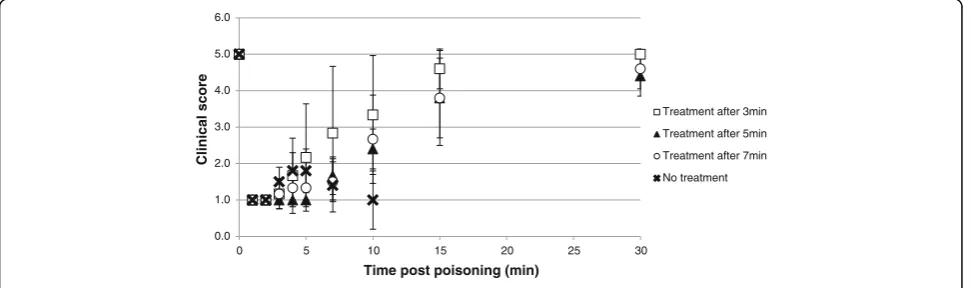
Five of 6 rabbits (83.3%) from every treatment group survived the whole 30 min observation period. All un-treated animals died. The single animal per treatment group that did not survive died in the time range of 8 to 13 min after poisoning; the untreated control animals died in a median time to death of 8 min (range 2 to 15 min). All rabbits collapsed within 1 min of exposure, with the clinical score falling sharply from 5 to 1. All rabbits showed generalized tonic-clonic convulsions, most probably seizures, within 25 to 40 s of exposure; clinical status then deteriorated into complete unrespon-siveness. The animals treated 3 min after poisoning had a trend for better clinical scores when compared to ani-mals receiving the treatment later, from 4 min after ex-posure and until the end of observation. This was not statistically significant when evaluated with One-Way ANOVA test. Time vs. average clinical scores are shown in Fig. 1.
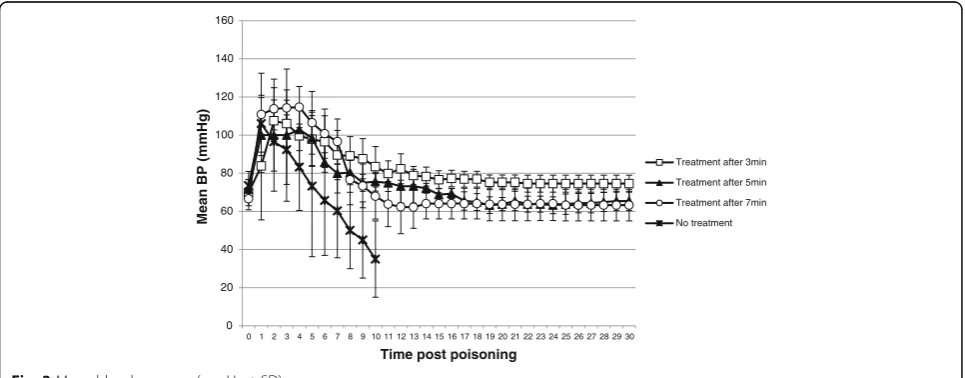
We found a considerable drop in pulse post exposure from average pulse rates of 240–272 per min pre-exposure to 66–104 per min after 1 min. Mean BP in-creased from average values of 67–74 mmHg before poisoning to 84–111 mmHg 1 min after intoxication. Steady improvement of BP and pulse to baseline levels was found in all treated rabbits, while several variations were seen between groups. Pulse values at 4 to 8 min post intoxication were significantly higher in the 3 min group compared to the other groups (p< 0.05, One-Way ANOVA). Average mean BP and pulse data are pre-sented in Figs. 2 and 3.
Shortly after poisoning, blood pH increased, represent-ing a self-limited phase of hyperventilation, and then fallen to profound acidosis. Steady improvement was ob-served in all treated rabbits, yet baseline pH levels were not reached until the end of the observation period.
0.0 1.0 2.0 3.0 4.0 5.0 6.0
0 5 10 15 20 25 30
Clinical score
Time post poisoning (min)
Treatment after 3min
Treatment after 5min
Treatment after 7min
No treatment
Animals treated 3 min post exposure had significantly higher and closer to normal range pH values at the 15 and 30 min after poisoning time points (p= 0.012 and
p= 0.038, respectively, One-Way ANOVA). Results of blood pH are shown in Fig. 4.
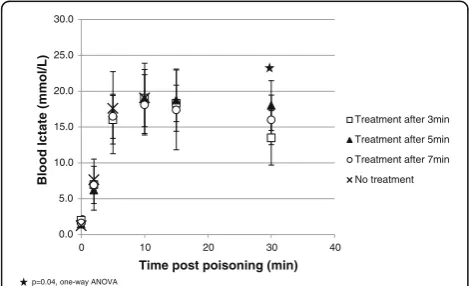
We found a gradual increase in lactate levels, peaked 10 min after poisoning in all groups. A slow return to-wards baseline levels was found in all treated rabbits but it did not return to baseline until the end of the observation period. Lactate levels were significantly lower and closer to normal range in the 3 min treatment group compared to the other later treated groups at 30 min post poisoning (averages 13.5 vs. 17.3 and 18 mmol/L,p= 0.04, One-Way ANOVA). Average lactate results are presented in Fig. 5.
Discussion
The study results demonstrate clear effectiveness of intravenous ISDN administered up to 7 min after lethal
cyanide poisoning in increasing the short-term survival of poisoned rabbits. This observation strengthens previ-ous study results that showed survival improvement with ISDN given 1 min after cyanide poisoning in rabbits [7]. The importance and contribution of the current study is the evidence it provides for ISDN clin-ical effectiveness in a realistic time frame for first re-sponders (estimated to be several minutes) and its relevance as an antidote for cyanide. ISDN effectiveness was demonstrated in clinically relevant doses (50μg/kg), supporting its role as a potential medical countermeas-ure in emergency clinical settings.
The vital signs (both pulse and BP) and clinical scores of the treated rabbits improved steadily after receiving the drug while untreated animals deteriorated until death. Earlier treatment (3 min after poisoning) im-proved relatively faster the clinical status of the animals back to baseline. Statistically significant difference 0
50 100 150 200 250 300 350
0 1 2 3 4 5 6 7 8 9 10 11 12 13 14 15 16 17 18 19 20 21 22 23 24 25 26 27 28 29 30
Pulse (per
min)
Time post poisoning (min)
Treatment after 3min
Treatment after 5min
Tretment after 7min
No treatment
p<0.05, one-way ANOVA
Fig. 2Mean pulse (beats per min ± SD)
0 20 40 60 80 100 120 140 160
01 23 45 67 89 10 11 12 13 14 15 16 17 18 19 20 21 22 23 24 25 26 27 28 29 30
Mean BP
(mmH
g
)
Time post poisoning
Treatment after 3min
Treatment after 5min
Treatment after 7min
No treatment
between the 3 min group and the other two treatment groups was calculated for the pulse values at 4 to 8 min after poisoning; this may be an evidence for the super-iority of early treatment. Nevertheless, there were no sta-tistically significant differences between the treatment groups in any of the other clinical endpoints including clinical scores, BP values and pulse rates beyond 8 min post poisoning. This represents meaningful and benefi-cial effects of ISDN administration up to 7 min post poi-soning, not only on mere survival but also on clinical parameters.
The recovery of blood lactate and pH levels in the treated rabbits was less obvious than the improvement of the clinical endpoints but still evident. Baseline values were not achieved up to the end of the observation period. It seems that metabolic improvement is lagging after the clinical course. Perhaps a longer duration of observation will demonstrate full improvement of pH and lactate to normal range. Significant differences in pH (at 15 and 30 min post poisoning) and lactate (at 30 min post poisoning) levels were observed between the earlier treated animals to the other two treatment
groups; early treatment is superior in improving lactic metabolic acidosis after cyanide poisoning. Yet, even later treatment of up to 7 min after poisoning resulted in the improvement of acidosis.
The presented animal model correlates well with a human poisoning. The main mechanism of cyanide poi-soning in humans and other mammals include the inhib-ition of cytochrome oxidase C and the impairment of the aerobic metabolism in the mitochondria [1]. Cyanide toxicity occurs because this compound strongly binds to metals, inactivating metalloenzymes such as cytochrome c oxidase [2]. cyanide causes apoptotic cell death that is caspase-dependent and associated with mitochondrial membrane depolarization and cytochrome c release [9].
Lethal Cyanide poisoning exerts a distinctive clinical course [7, 10]. This was clearly demonstrated in the current study. Exposure to cyanide leads to a drastic ini-tial elevation of BP, probably due to vasoconstriction. This sharp increase in afterload can increase the oxygen demand and the heart’s load, thus impairing cardiac output. This may lead to myocardial ischemia and bradycardia.
Another prominent clinical observation was the early development of seizures. Cyanide, through disruption of brain glutamatergic transmission, induces apnea and sei-zures [11]. In rats, within 30 s after exposure to cyanide, glutamate levels increase in several brain regions [12]. Inward currents produced by the NMDA receptor which can potentiate glutamatergic activity are also enhanced by cyanide [13].
Nitrates are rapidly reduced to nitric oxide (NO) in blood and in tissues, in a NO synthase-independent pathway [14, 15]. The production of NO is increased gradually as oxygen tensions falls [16, 17]. NO leads to vasodilatation, that can improve vascular bed ischemia, via the relaxation of muscle cells [18, 19]. Vasodilatation reduces the afterload (arterial pressure) and the preload (the pressure of the blood returning to the heart) [20]. NO may also increase the oxygen supply to the heart, through reduction of coronary spasm. The administra-tion of nitrates as ISDN in acute coronary events, ame-liorates myocardial ischemia by improving coronary flow and decreasing cardiac workload [21, 22]. Phenoxyben-zamine and chlorpromazine — other vasodilators—can also improve survival after exposure to cyanide [23–25]. NO-induced vasodilatation seems to have a beneficial role in cyanide intoxication.
The severity of the lactic acidosis as expressed by the blood lactate and pH levels was not different between treated and untreated animals in the study while a clear difference was observed regarding the vital signs’ dy-namics. It seems that the circulatory improvement of the treated animals was better predictive and correlated with their survival compared with their metabolic status. Fig. 4Mean blood pH (± SD)
0.0 5.0 10.0 15.0 20.0 25.0 30.0
0 10 20 30 40
Bl
ood l
ctate
(mmol
/L)
Time post poisoning (min)
Treatment after 3min
Treatment after 5min
Treatment after 7min
No treatment
p=0.04, one-way ANOVA
This supports the suggested mechanism of action of ISDN in cyanide exposure, improved circulation.
NO has direct antagonistic effect on cyanide in the mitochondrial electron transport chain, as it competes with it for binding to cytochrome c oxidase [26, 27]. Leavesley et al. demonstrated in an animal model that addition of exogenous NO attenuated cyanide inhibition of cytochrome c oxidase [27]. The same was observed when sodium nitrite was used as the source of NO that interacted directly with the binding of potassium cyanide with cytochrome c oxidase to reverse toxicity [28]. Also, it seems as if NO protects enzymatic systems from cyan-ide inactivation via a mechanism involving the formation of an enzyme-nitrosyl cyanide complex [29].
Brain NMDA-receptor hyperactivity reduction is an-other potential mechanism of NO protection in cyanide poisoning. NO+ ion protects from excessive stimulation of the NMDA receptor by binding to its redox regula-tory site [30]. This may attenuate repeated seizures as seen in the current study after ISDN administration.
The direct and independent antidotal activity of NO in cyanide poisoning is probably a more important and faster mechanism of nitrites and nitrates as cyanide antidotes than methemoglobin formation. Several animal and hu-man studies showed that nitrites (sodium and amyl) im-proved survival in cyanide poisoning without forming significant levels of methemoglobin [7, 11, 31–33]. Production rate of methemoglobin by nitrites is rela-tively slow in humans [34]. The reported early recov-ery of severe cyanide poisoned victims following nitrite treatment is too fast to be explained by methemoglobin formation [31, 35, 36].
While nitrates in therapeutic doses do not form methemoglobin, they were not considered relevant for cyanide poisoning. However, as it is shown and proven that NO antagonism is a principle mechanism in cyanide treatment, nitrates should be incorporated in the proto-cols implemented in cyanide exposure and poisoning particularly in the field setup or in mass casualty incidents.
Nitrates present several advantages over currently used antidotes. Nitrates are an approved, safe, and low cost treatment, easily available and widely used; particularly in cardiac patients [37–40]. There are various rapidly absorbed formulations with easy and effective applica-tion in pre-hospital setups, even by laymen [38]. Nitrates have no significant interactions with other cyanide anti-dotes or resuscitation medications [37, 38].
The study has several limitations. It is a limited num-ber rabbit study with a short-term follow up period. Ex-posure to cyanide was achieved in the intravenous route, which is not the usual human exposure route. The in-vestigators were not blinded to the control and treat-ment groups.
Conclusion
Intravenous administration of ISDN up to 7 min after minimally lethal cyanide poisoning improved the short-term survival of poisoned rabbits. ISDN shows marked potential as an antidote for cyanide poisoning. Further research is needed to evaluate the effectiveness of ni-trates in other modes of delivery, different animal models and poisoning scenarios.
Acknowledgements
The authors acknowledge Dr. Gary Rockwood for his helpful comments.
Funding
The study was funded by the Israel Ministry of Defense.
Availability of data and material
Crude data files of the study results are available upon request to the author of correspondence.
Authors’contribution
OL conceived the study; OL and AA designed the trial; OL and AE obtained research funding; OL, AA and AE performed the study; OL completed the statistical analysis; OL drafted the manuscript, and all authors contributed substantially to its revision. OL takes responsibility for the paper as a whole. All authors read and approved the final manuscript.
Competing interests
The authors declare that they have no competing interests.
Consent for publication
Not applicable.
Ethics approval
The study was approved by the Rappaport Faculty of Medicine Institutional Animal Care and Use Committee.
Author details
1Clinical Pharmacology and Toxicology Unit, Carmel Medical Center, 7 Michal St., Haifa 3436212, Israel.2Rappaport Faculty of Medicine, Technion-Israel Institute of Technology, Haifa, Israel.3Pre Clinical Research Authority, Technion-Israel Institute of Technology, Haifa, Israel.4Institute for Research in Military Medicine, Faculty of Medicine, Hebrew University, Jerusalem, Israel.
Received: 9 September 2016 Accepted: 4 February 2017
References
1. Vogel SN, Sultan CH, Jeneyck RP. Cyanide poisoning. J Toxicol Clin Toxicol. 1981;18:361–83.
2. Luque-Almagro VM, Moreno-Vivián C, Roldán MD. Biodegradation of cyanide wastes from mining and jewellery industries. Curr Opin Biotechnol. 2016;38:9–13.
3. Lavon O, Bentur Y. Does amyl nitrite have a role in the management of pre-hospital mass casualty cyanide poisoning? Clin Toxicol. 2010;48:477–84. 4. Tarantino G, Capone D, Finelli C. Exposure to ambient air particulate matter
and non-alcoholic fatty liver disease. World J Gastroenterol. 2013;19:3951–6. 5. Thompson JP, Marrs TC. Hydroxocobalamin in cyanide poisoning. Clin
Toxicol. 2012;50:875–85.
6. Marrs TC. Antidotal treatment of acute cyanide poisoning. Adverse Drug React Acute Poisoning Rev. 1988;4:179–206.
7. Lavon O. Early administration of isosorbide dinitrate improves survival of cyanide-poisoned rabbits. Clin Toxicol. 2015;53:22–7.
8. Zhao N, Xu J, Singh B, Yu X, Wu T, Huang Y. Nitrates for the prevention of cardiac morbidity and mortality in patients undergoing non-cardiac surgery. Cochrane Database Syst Rev. 2016;8:Art No. CD010726.
10. Vick JA, Froehlich HL. Studies of cyanide poisoning. Arch Int Pharmacodyn. 1985;273:314–22.
11. Sun P, Borowitz JL, Kanthasamy AG, Kane MD, Gunasekar PG, Isom GE. Antagonism of cyanide toxicity by isosorbide dinitrite: possible role of nitric oxide. Toxicology. 1995;104:105–11.
12. Persson SA, Cassel G, Sellström A. Acute cyanide intoxication and central transmitter systems. Fundam Appl Toxicol. 1985;5:S150–9.
13. Patel MN, Peoples RW, Yim GK, Isom GE. Enhancement of NMDA-mediated responses by cyanide. Neurochem Res. 1994;19:1319–23.
14. Zweier JL, Wang P, Samouilov A, Kuppusamy P. Enzyme-independent formation of nitric oxide in biological tissues. Nat Med. 1995;1:804–9. 15. Cosby K, Partovi KS, Crawford JH, Patel RP, Reiter CD, Martyr S, et al. Nitrite
reduction to nitric oxide by deoxyhemoglobin vasodilates the human circulation. Nat Med. 2003;9:1498–505.
16. Giraldez RR, Panda A, Xia Y, Sanders SP, Zweier JL. Decreased nitric-oxide synthase activity causes impaired endothelium-dependent relaxation in the postischemic heart. J Biol Chem. 1995;272:21420–6.
17. Oestergaard L, Stankevicius E, Andersen MR, Eskildsen-Helmond Y, Ledet T, Mulvany MJ, et al. Diminished NO release in chronic hypoxic human endothelial cells. Am J Physiol Heart Circ Physiol. 2007;293:H2894–903. 18. Ignarro LJ. Endothelium-derived nitric oxide: pharmacology and relationship
to the actions of organic nitrate esters. Pharm Res. 1989;6:651–9.
19. Egashira K. Clinical importance of endothelial function in arteriosclerosis and ischemic heart disease. Circ J. 2002;66:529–33.
20. Wennmalm A. Endothelial nitric oxide and cardiovascular disease. J Intern Med. 1994;235:317–27.
21. Gray R, Chatterjee K, Vyden JK, Ganz W, Forrester JS, Swan HJ. Hemodynamic and metabolic effects of isosorbide dinitrate in chronic congestive heart failure. Am Heart J. 1975;90:346–52.
22. Chatterjee K. Hemodynamic effects of nitrates in chronic heart failure and myocardial infarction. Nouv Presse Med. 1980;9(34 Suppl):2404–9. 23. Dodson RA, Burrows GE, Isom GE, Way JL. Mechanism of chlorpromazine
antagonism of cyanide intoxication. Proc West Pharmacol Soc. 1975;18:348–50. 24. Way JL, Burrows G. Cyanide intoxication: protection with chlorpromazine.
Toxicol Appl Pharmacol. 1976;36:93–7.
25. Burrows GE, Way JL. Antagonism of cyanide toxicity by phenoxybenzamine. Fed Proc. 1975;35:250–1.
26. Shiva S, Huang Z, Grubina R, Sun J, Ringwood LA, MacArthur PH, et al. Deoxymyoglobin is a nitrite reductase that generates nitric oxide and regulates mitochondrial respiration. Circ Res. 2007;100:654–61. 27. Leavesley HB, Li L, Prabhakaran K, Borowitz JL, Isom GE. Interaction of
cyanide and nitric oxide with cytochrome c oxidase: Implications for acute cyanide toxicity. Toxicol Sci. 2008;101:101–11.
28. Leavesley HB, Li L, Mukhopadhyay S, Borowitz JL, Isom GE. Nitrite-mediated antagonism of cyanide inhibition of cytochrome c oxidase in dopamine neurons. Toxicol Sci. 2010;115:569–76.
29. Pintus F, Spanò D, Bellelli A, Angelucci F, Forte E, Medda R, et al. Nitric oxide, substrate of Euphorbia characias peroxidase, switches off the CN(−) inhibitory effect. FEBS Open Bio. 2012;2:305–12.
30. Lipton SA, Choi YB, Pan ZH, Lei SZ, Chen HS, Sucher NJ, et al. A redox-based mechanism for the neuroprotective and neurodestructive effects of nitric oxide and related nitroso-compounds. Nature. 1993;364:626–32. 31. Johnson WS, Hall AH, Rumack BH. Cyanide poisoning successfully treated
without 'therapeutic methemoglobin levels'. Am J Emerg Med. 1989;7:437–40. 32. Cambal LK, Swanson MR, Yuan Q, Weitz AC, Li HH, Pitt BR, et al. Acute,
sublethal cyanide poisoning in mice is ameliorated by nitrite alone: complications arising from concomitant administration of nitrite and thiosulfate as an antidotal combination. Chem Res Toxicol. 2011;24:1104–12. 33. Dias-Junior CA, Gladwin MT, Tanus-Santos JE. Low-dose intravenous nitrite
improves hemodynamics in a canine model of acute pulmonary thromboembolism. Free Radic Biol Med. 2006;41:1764–70.
34. Pluta RM, Oldfield EH, Bakhtian KD, Fathi AR, Smith RK, Devroom HL, et al. Safety and feasibility of long-term intravenous sodium nitrite infusion in healthy volunteers. PLoS One. 2011;6:e14504.
35. Lam KK, Lau FL. An incident of hydrogen cyanide poisoning. Am J Emerg Med. 2000;18:172–4.
36. Wurzburg H. Treatment of cyanide poisoning in industrial setting. Vet Hum Toxicol. 1996;38:44–7.
37. Seifert SA. Nitrates and nitrites. In: Dart RC, Cavarati EM, McGuigan MA, Whyte IA, Dawson AH, Seifert SA, et al., editors. Medical Toxicology. 3rd ed. Philadelphia: Lippincot Williams & Wilkins; 2004. p. 1177–8.
38. Murad F. Drugs used for treatment of angina: organic nitrates, calcium channel blockers and beta-adrenergic antagonists. In: Gilman AG, Rall TW, Nies AS, Taylor P, editors. Goodman and Gilman's the pharmacological basis of therapeutics. 8th ed. New York: Pergam Press; 1990. p. 764–73. 39. Abrams J. Beneficial actions of nitrates in cardiovascular disease. Am J
Cardiol. 1996;77:31C–7C.
40. Nossaman VE, Nossaman BD, Kadowitz PJ. Nitrates and nitrites in the treatment of ischemic cardiac disease. Cardiol Rev. 2010;18:190–7.
• We accept pre-submission inquiries
• Our selector tool helps you to find the most relevant journal
• We provide round the clock customer support
• Convenient online submission
• Thorough peer review
• Inclusion in PubMed and all major indexing services
• Maximum visibility for your research
Submit your manuscript at www.biomedcentral.com/submit