L E T T E R T O T H E E D I T O R
Open Access
Letter to the editor: blood processing and
sample storage have negligible effects on
methylation
Kira Groen
1,2, Rodney A. Lea
2,3, Vicki E. Maltby
1,2, Rodney J. Scott
2,4,5and Jeannette Lechner-Scott
1,2,6*Abstract
DNA methylation is a dynamic epigenetic mechanism. Researchers aiming to assess archived DNA samples are expressing concern about the effect of technical factors on methylation, as this may confound results. We reviewed recent reports examining this issue in blood samples and concluded that variation in collection, storage, and processing of blood DNA confers negligible effects on both global methylation and methylation status of specific genes. These results are concordant with studies that have investigated the effect of sample storage and processing on methylation in other tissues, such as tumour, sperm, and placenta samples.
Keywords:Methylation, Blood, Processing, Storage, DNA extraction
Introduction
DNA methylation can be thought of as punctuation for the genome, whereby the interpretation of genes can change via DNA-based markers that do not include vari-ation in actual DNA sequence. For example, it has long been known that methylated CpGs at transcription start sites (TSSs) of genes can inhibit gene expression inde-pendent of any variation in the DNA sequence (e.g. single-nucleotide variants and copy number variants) [1]. Such mechanisms have been associated with a num-ber of cancers [2, 3]. Similar to DNA sequence variants, methylation can be inherited across generations (e.g. imprinting) but is also dynamic and can be modified by environmental factors. The ability of methylation status to be moulded by different environmental exposures has provided the attractive notion that methylation acts as an interface between genes and the environment, accounting for complex disease susceptibility. Epigenome-wide association studies (EWASs) involve surveying DNA methylation status at CpGs across the entire genome in an effort to determine differences asso-ciated with complex disease outcomes. With the
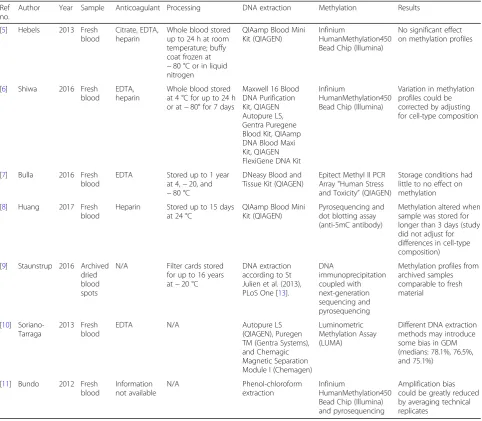
realisation that the genome-wide association study (GWAS) approach is hitting unsatisfactory limits in terms of explaining disease risk and pathology and the advent of array-based and next-generation sequencing-based (e.g. bisulphite sequencing) technologies at rea-sonable cost, many researchers are now embarking on EWAS. For EWAS, investigators are looking to make use of the very large patient DNA banks that have been collected to help understand the trait of interest. How-ever, since methylation is dynamic, obvious questions arise about factors that may influence methylation change other than the main hypotheses and whether or not these factors need to be controlled for. While age, sex, cellular heterogeneity of blood cells, lifestyle, and medication use are known sources of biological variabil-ity in DNA methylation profiles [4], variation in the way DNA has been collected, processed, and stored is less well understood and needs to be addressed. The follow-ing summarises current evidence on this topic, focussfollow-ing on blood samples. An overview of the referenced studies can be found in Table1.
Sample collection Anticoagulants
The use of different anticoagulants is unlikely to introduce any significant variation in methylation
status. There were no differences in CpG
* Correspondence:[email protected]
1
School of Medicine and Public Health, University of Newcastle, Callaghan, NSW 2308, Australia
2Centre for Information Based Medicine, Hunter Medical Research Institute,
New Lambton Heights, NSW 2305, Australia
Full list of author information is available at the end of the article
methylation of blood collected into EDTA, heparin, and citrate [5]. These results were consistent with the comparison of multiple biobank protocols that used blood collected into sodium heparin and EDTA in a multivariate analysis [6]. Different anticoagulants (citrate, heparin, and EDTA) did not affect DNA yield or quality [5].
Sample storage
Duration and temperature (whole blood and buffy coat storage)
While DNA yields, which may influence method selec-tion for methylaselec-tion assays, appear to be negatively affected by sample storage at higher temperatures and by the act of freezing the sample, comparable methyla-tion profiles have been obtained across a range of blood storage conditions [5–7].
DNA yield and quality
DNA yield from EDTA whole blood may be negatively af-fected by storage at room temperature and 4 °C for longer than 24 h [6,7], as well as by freezing the sample prior to DNA extraction [7]. No differences in DNA yield or qual-ity were observed between samples frozen over different durations or at different temperatures (−20 and−80 °C), including storage in liquid nitrogen [5,7]. The addition of the DNA stabilising agent DNAgard Blood Solution (Biomatrica) improved DNA yields when added before storage (for samples stored at−80 °C), or prior to thawing (for samples stored at−80 and−20 °C) [7]. Different stor-age and transport conditions did not affect DNA quality assessed by Nanodrop 2000 UV–Vis Spectrophotometer (Thermo Scientific) [6], gel electrophoresis [6], or Bioana-lyzer (Agilent) [8]. Additionally, DNA yield and quality of biobank samples stored for 13–17 years were still Table 1Summary of referenced studies
Ref no.
Author Year Sample Anticoagulant Processing DNA extraction Methylation Results
[5] Hebels 2013 Fresh blood
Citrate, EDTA, heparin
Whole blood stored up to 24 h at room temperature; buffy coat frozen at
−80 °C or in liquid nitrogen
QIAamp Blood Mini Kit (QIAGEN)
Infinium
HumanMethylation450 Bead Chip (Illumina)
No significant effect on methylation profiles
[6] Shiwa 2016 Fresh blood
EDTA, heparin
Whole blood stored at 4 °C for up to 24 h or at−80° for 7 days
Maxwell 16 Blood DNA Purification Kit, QIAGEN Autopure LS, Gentra Puregene Blood Kit, QIAamp DNA Blood Maxi Kit, QIAGEN FlexiGene DNA Kit
Infinium
HumanMethylation450 Bead Chip (Illumina)
Variation in methylation profiles could be corrected by adjusting for cell-type composition
[7] Bulla 2016 Fresh blood
EDTA Stored up to 1 year at 4,−20, and
−80 °C
DNeasy Blood and Tissue Kit (QIAGEN)
Epitect Methyl II PCR Array“Human Stress and Toxicity”(QIAGEN)
Storage conditions had little to no effect on methylation
[8] Huang 2017 Fresh blood
Heparin Stored up to 15 days at 24 °C
QIAamp Blood Mini Kit (QIAGEN)
Pyrosequencing and dot blotting assay (anti-5mC antibody)
Methylation altered when sample was stored for longer than 3 days (study did not adjust for differences in cell-type composition)
[9] Staunstrup 2016 Archived dried blood spots
N/A Filter cards stored for up to 16 years at−20 °C
DNA extraction according to St Julien et al. (2013), PLoS One [13].
DNA immunoprecipitation coupled with next-generation sequencing and pyrosequencing
Methylation profiles from archived samples comparable to fresh material
[10] Soriano-Tarraga
2013 Fresh blood
EDTA N/A Autopure LS
(QIAGEN), Puregen TM (Gentra Systems), and Chemagic Magnetic Separation Module I (Chemagen)
Luminometric Methylation Assay (LUMA)
Different DNA extraction methods may introduce some bias in GDM (medians: 78.1%, 76.5%, and 75.1%)
[11] Bundo 2012 Fresh blood Information not available N/A Phenol-chloroform extraction Infinium HumanMethylation450 Bead Chip (Illumina) and pyrosequencing
comparable to fresh material [5]. One small study found a decrease in leukocyte DNA yield after storage at room temperature for 3.5 days, but acknowledged that this decrease was highly correlated to a reduction in leuko-cytes [8]. Thus, DNA yield per cell likely remained stable.
Methylation
EDTA whole blood (n= 8) analysed immediately, stored at −20 °C, −80 °C, or at room temperature (following the addition of DNAgard Blood Solution) for up to 1 year, showed less than 1% variation in DNA methylation across all conditions. DNA was extracted with the DNeasy Blood and Tissue Kit (Qiagen), and methylation was assessed across the 22 genes repre-sented on the Epitect Methyl II PCR Array “Human Stress and Toxicity” (Qiagen). The addition of the DNA stabilising agent did not affect methylation [7]. Notably, this study showed that methylation status of limited genes was maintained, yet changes in methylation status of other genomic regions cannot be excluded [7]. Stor-age of whole blood and buffy coats for 24 h to several months at 15 to −80 °C, or in liquid nitrogen, intro-duced minimal bias in DNA methylation that could largely be corrected for by cell-type composition adjust-ments in a multivariate study [5, 6]. Prior “bench time”, leaving whole blood samples at room temperature for up to 24 h prior to separation of individual blood components (plasma, buffy coat, and erythrocytes), was also assessed and revealed minimal (0.6%) variation in CpG methylation [5]. A small study (n= 10) by Huang et al. [8] showed a change in methylation at a specific site after whole blood storage for 7 days at room temperature, as well as a decrease in global DNA methy-lation (GDM) for different whole blood storage condi-tions. While this study highlights the need to exert caution when not working with fresh material, the authors did not account for differences in cell-type com-position, despite acknowledging a decrease in total leu-kocytes after storing whole blood at room temperature and reduced temperature for 3 days [8].
Long-term storage (13–17 years) of blood collected into both citrate and EDTA and stored in both liquid nitrogen and at −80 °C did not significantly affect methylation profiles despite evidence of some scatter. However, comparable samples from the same individual analysed immediately after collection were not available and variability could be of inter-individual origin [5]. Even DNA methylation (assessed by DNA immunopre-cipitation coupled with next-generation sequencing, MeDIP-seq, Illumina) of dried blood spots stored at room temperature for up to 16 years was comparable to samples stored for 4 years, and freshly collected samples, highlighting the stability of the methylome throughout long-term storage [9]. The majority of identified
differences were located in repetitive regions, which are known for genetic variability. Noting that dried blood spot cards were not from the same individual and indi-viduals were not age- and sex-matched, differences are likely a result of inter-individual variability, rather than technical noise introduced by long-term storage [9].
Processing Cell composition
As expected, cell-type composition affected whole blood and buffy coat GDM and should be adjusted for comparability. Comparing major Japanese biobank blood collection protocols, Shiwa et al. [6] determined that pre-analytical bias could be accounted for when adjust-ing methylation profiles determined by the Infinium HumanMethylation450 Bead Chip array (Illumina) (450K array) for cell-type composition. For adjustments, cell-type composition was determined by flow cytome-try. Importantly, the study noted that storage of samples at 4 °C for 24 h affected buffy coat cell-type compos-ition, decreasing lymphocyte and increasing granulocyte counts [6]. It is our opinion that cell composition should be determined soon after sample collection to obtain reliable results.
DNA extraction
extraction methods were much smaller than inter-individual differences [6].
DNA yields affect methylation assay selection, yet low DNA yields from whole blood extractions may be overcome by separating out buffy coats prior to extraction [6].
Bisulphite conversion and whole genome amplification Many DNA methylation assays require bisulphite converted DNA, yet bisulphite conversion causes DNA degradation. Consequently, DNA amplification is required. As DNA methylation status is lost during standard DNA amplification, bisulphite conversion must precede amplification, potentially increasing the risk of bias. Using a multiple displacement whole genome amp-lification method, whole genome ampamp-lification caused a significant decrease in reliably detected methylation sites compared to unamplified bisulphite-converted DNA. Equally, lower input of amplified bisulphite-converted DNA (10 vs. 50 ng) also resulted in a decrease in methy-lation signal determined by the 450K array (Illumina). Results were validated by pyrosequencing of randomly selected genes, and correlation between the two methods was high (R= 0.921). Variation was greatest in genomic regions showing neither hyper- nor hypo-methylation; however, averaging of technical triplicates was able to greatly reduce amplification bias [11].
Conclusions and future directions
While sample collection, storage temperature, and stor-age duration showed negligible effects on DNA methyla-tion, variation in bisulphite conversion may alter methylation at some loci. It is therefore our opinion that highly standardised protocols including technical repli-cates and clearly defined parameters for each of the
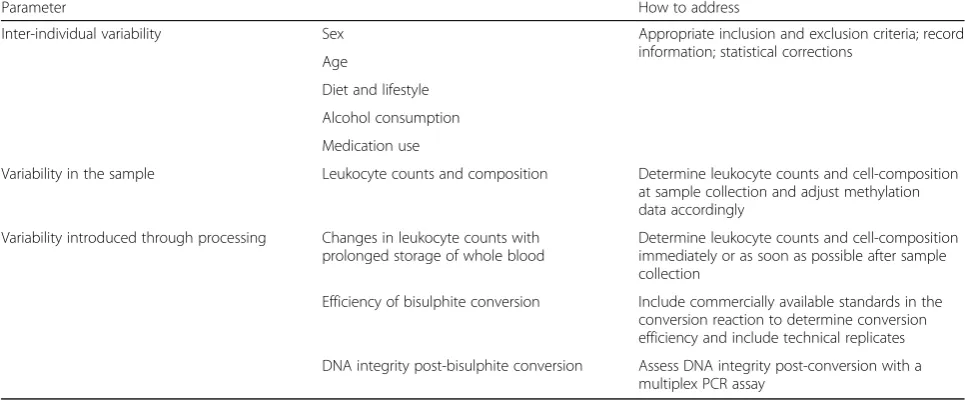
collection and processing steps constitute the best practices for robust and accurate DNA methylation studies. However, results obtained from differently stored and processed samples may also be acceptable, as long as differences in cell-type composition and tech-nical variation are taken into account. Some variation is to be expected when performing any methylation assay, and care should be taken not to interpret technical vari-ation as biological difference. Nonetheless, the discovery of highly accurate DNA methylation biomarkers (e.g. methylation age [12]) would not have been possible if sample processing or storage had a significant effect on methylation profiles. Critical parameters to be consid-ered when performing any methylation assay are sum-marised in Table2. Increased confidence in methylation results may be achieved through replication in other laboratories and centres.
As a number of the studies included in this letter used loci-specific methylation assays, the question whether some loci are more susceptible to variation introduced by processing and storage remains to be answered.
Abbreviations
450K array:Infinium HumanMethylation450 Bead Chip array (Illumina); DNA: Deoxyribonucleic acid; EDTA: Ethylenediaminetetraacetic acid; EWAS: Epigenome-wide association study; GDM: Global DNA methylation; GWAS: Genome-wide association study; LUMA: Luminometric methylation assay; PCR: Polymerase-chain reaction; TSS: Transcription start site
Acknowledgements
K Groen is funded by a scholarship from the University of Newcastle. VE Maltby is funded by fellowships from Multiple Sclerosis Research Australia and the Canadian Institute of Health Research. R Lea is partially funded from the Multiple Sclerosis Research Australia Bioinformatics Platform Scheme.
Funding
Not applicable. Table 2Critical parameters for epigenome-wide association studies
Parameter How to address
Inter-individual variability Sex Appropriate inclusion and exclusion criteria; record information; statistical corrections
Age
Diet and lifestyle
Alcohol consumption
Medication use
Variability in the sample Leukocyte counts and composition Determine leukocyte counts and cell-composition at sample collection and adjust methylation data accordingly
Variability introduced through processing Changes in leukocyte counts with prolonged storage of whole blood
Determine leukocyte counts and cell-composition immediately or as soon as possible after sample collection
Efficiency of bisulphite conversion Include commercially available standards in the conversion reaction to determine conversion efficiency and include technical replicates
DNA integrity post-bisulphite conversion Assess DNA integrity post-conversion with a multiplex PCR assay
Availability of data and materials
Not applicable.
Authors’contributions
KG and RL summarised available literature and drafted the letter. VEM edited the letter. RS and JL-S edited the letter and supervise the research group. All authors read and approved the final manuscript.
Ethics approval and consent to participate
Not applicable.
Consent for publication
Not applicable.
Competing interests
Professor J Lechner-Scott’s institution receives non-directed funding, as well
as honoraria for presentations and membership on advisory boards from Sanofi Aventis, Biogen Idec, Bayer Health Care, Merck Serono, Teva, Roche, and Novartis Australia. The other authors declare that they have no compet-ing interests.
Publisher’s Note
Springer Nature remains neutral with regard to jurisdictional claims in published maps and institutional affiliations.
Author details
1
School of Medicine and Public Health, University of Newcastle, Callaghan, NSW 2308, Australia.2Centre for Information Based Medicine, Hunter Medical
Research Institute, New Lambton Heights, NSW 2305, Australia.3Institute of Health and Biomedical Innovations, School of Biomedical Science, Queensland University of Technology, Kelvin Grove, QLD 4059, Australia.
4School of Biomedical Sciences and Pharmacy, University of Newcastle,
Callaghan, NSW 2308, Australia.5Division of Molecular Genetics, Pathology North, John Hunter Hospital, New Lambton Heights, NSW 2305, Australia.
6
Department of Neurology, John Hunter Hospital, New Lambton Heights, NSW 2305, Australia.
Received: 4 January 2018 Accepted: 6 February 2018
References
1. Jones PA. Functions of DNA methylation: islands, start sites, gene bodies
and beyond. Nat Rev Genet. 2012;13(7):484–92.
2. Sengupta PK, et al. DNA hypermethylation near the transcription start site of
collagen alpha2(I) gene occurs in both cancer cell lines and primary
colorectal cancers. Cancer Res. 2003;63(8):1789–97.
3. Jiang J, et al. Hypomethylated CpG around the transcription start site
enables TERT expression and HPV16 E6 regulates TERT methylation in
cervical cancer cells. Gynecol Oncol. 2012;124(3):534–41.
4. Chen W, et al. MethylPCA: a toolkit to control for confounders in
methylome-wide association studies. BMC Bioinformatics. 2013;14:74.
5. Hebels DG, et al. Performance in omics analyses of blood samples in
long-term storage: opportunities for the exploitation of existing biobanks in
environmental health research. Environ Health Perspect. 2013;121(4):480–7.
6. Shiwa Y, et al. Adjustment of cell-type composition minimizes systematic
bias in blood DNA methylation profiles derived by DNA collection protocols. PLoS One. 2016;11(1):e0147519.
7. Bulla A, et al. Blood DNA yield but not integrity or methylation is impacted
after long-term storage. Biopreserv Biobank. 2016;14(1):29–38.
8. Huang LH, et al. The effects of storage temperature and duration of blood
samples on DNA and RNA qualities. PLoS One. 2017;12(9):e0184692.
9. Staunstrup NH, et al. Genome-wide DNA methylation profiling with
MeDIP-seq using archived dried blood spots. Clin Epigenetics. 2016;8:81.
10. Soriano-Tarraga C, et al. DNA isolation method is a source of global DNA
methylation variability measured with LUMA. Experimental analysis and a systematic review. PLoS One. 2013;8(4):e60750.
11. Bundo M, et al. A systematic evaluation of whole genome amplification of
bisulfite-modified DNA. Clin Epigenetics. 2012;4:22.
12. Horvath S. DNA methylation age of human tissues and cell types. Genome
Biol. 2013;14(10):R115.
13. St. Julien KR, Jelliffe-Pawlowski LL, Shaw GM, Stevenson DK, O’Brodovich
HM, Krasnow MA, Dewan A. High Quality Genome-Wide Genotyping from Archived Dried Blood Spots without DNA Amplification. PLoS ONE. 2013; 8(5):e64710.
• We accept pre-submission inquiries
• Our selector tool helps you to find the most relevant journal
• We provide round the clock customer support
• Convenient online submission
• Thorough peer review
• Inclusion in PubMed and all major indexing services • Maximum visibility for your research
Submit your manuscript at www.biomedcentral.com/submit