Journal of Applied Linguistics and Language Research Volume 3, Issue 3, 2016, pp. 224-246
Available online at www.jallr.com ISSN: 2376-760X
* Correspondence: Mohsen Jafarpour, Email: [email protected] © 2016 Journal of Applied Linguistics and Language Research
Portfolio Assessment and Process Writing: Its Effect on EFL
Students’ L2 Writing
Fattaneh Pourverdi Vangah
M.A. in TEFL, Tabriz Islamic Azad University
Mohsen Jafarpour * Ph.D. Student of TEFL, Tehran University
Maedeh Mohammadi
M.A. in TEFL, Payame-Noor University of Rasht
Abstract
The current study aimed at investigating the effect of portfolio assessment on Iranian EFL learners’ L2 writing proficiency. This study followed a quasi-experimental design. First, a total number of 30 female EFL learners who were learning English at a language institute in Rasht, Iran served as sampling. Oxford Placement Test (2004) was used to ensure the homogeneity of the participants. Then they were randomly divided into two groups: one experimental group (N=15) and one control group (N=15). Portfolio assessment was used to check the students' writing in the experimental group while the control group followed a traditional assessment. After 22 sessions of treatment, two IELTS writing tasks adapted from samples of IELTS writing tests as pre- and post- tests were given to the both groups. The mean scores were compared by running both independent and paired samples t-tests to investigate the possible differences between the two groups in terms of their writing proficiency. The results indicated that while the two groups were homogeneous in terms of their writing proficiency before the treatment phase, the experimental group outperformed the control group in the post-writing test.
Keywords: portfolio assessment; writing proficiency; writing processes; EFL learner
INTRODUCTION
A quick review of the history shows that there is a close interrelationship between language teaching and testing in a way that it is impossible to break this bond. Along with the growth of English second language (ESL) teaching and learning, traditional approaches of assessment were applied by most language instructors. However, nowadays there is great interest in focusing on students' hidden ability to be revealed under a stress-free environment.
in the classroom. As language teaching has moved in the direction of learner-centered approaches, testing and assessment have begun to incorporate the measures for learner-centered tasks (Brown, 2000). In order to compensate for the limitations of using standardized tests, educational administrators have tried to use a mixture of formal and informal assessment techniques for monitoring students' progress. In effect, there is a growing need for alternative assessments. Although there is no single definition of alternative assessment, there are some labels that can distinguish it from traditional standardized testing (Huerta-Macias, 1995). These labels include performance assessment, authentic assessment, portfolio assessment, informal assessment, contextualized assessment, and assessment by exhibition (Garcia & Pearson, 1994; cited in Huerta-Macias, 1995).
Portfolio assessment, one of the alternative assessment techniques, reveals the integrated form of formal and informal assessment. Hamp-Lyons (l994) labeled portfolio an excellent pedagogical tool interweaving assessment with instruction. The use of portfolio assessment has been considered as a potential answer to the shortcomings of both the indirect writing test and the more direct timed-essay assessment. These regards can be seen as a great evidence for the necessity of applying a new well-organized approach like portfolio assessment in evaluating writing skills. In traditional method of assessing papers, the teacher is the only reader who edits the paper for grammatical and mechanical mistakes while it contrasts with the sole theory of assessment which states that students need to realize that their paper is their own property.
In writing skill, by making students familiar with using the portfolio approach in the classroom, we can measure their learning progress and real performance, and provide feedback to their shortcomings in a well-organized way. They would also have evidence of their own works which would reflect their actual day-to-day learning activities.
An effective strategy to produce a piece of writing is experiencing writing processes. Monitoring and assessing these writing processes may be dependent on the students' mastery of the writing product skills, and ultimately on proficiency in writing in general. Considering the framework of language teaching and learning, writing skill has been considered the most challenging skill of EFL learners to master. We call writing a difficult task since the writer should be able not only to generate and organize ideas, but also to translate these ideas into a readable text. By writing skill, students would reveal their level of spelling, punctuation, dictation, word selection, grammar usage, mental knowledge etc.
widespread in both first and second language writing programs as a means of evaluating writing proficiency.
According to Cooper (1997), the use of portfolio-based assessment is now well-established as a valuable assessment tool. Cooper and Love (2000) state that portfolio based assessment can include evidence from several sources; it can help educators overcome many assessment difficulties, especially in the area of equity and moderation; it provides a richer picture of the student, so it is pedagogically efficient. Hamp-Lyons and Condon (2000) argue that "portfolios provide context, which has long been claimed to be particularly discriminatory against non-native writers" (p.61). Hedge (2000) maintained that portfolio assessment was seen as a more comprehensive collection of students' writing ability than one essay composed under limited conditions. In 2002, Sang and August pointed out that being pressed for the time of writing, students' focus would be directed just to the product issues of writing and they cannot focus on the skills needed for L2 process of writing at the same time. Dysthe (2008) claimed that it seems more logical to evaluate students' writing ability by portfolios instead of only one impromptu timed writing sample of students; portfolio will also provide teachers with a better situation to make informed judgments about students' writing ability. In addition, it enables teachers to provide ongoing feedback that informs both teachers and students.
Despite the potential benefits of portfolios, using writing portfolios is not common in the Iranian EFL context. Students are usually given numerical grades for their final writing assignment which may not be true indicators of their writing ability and the teachers are not in a position to make appropriate judgments about the development of their students as writers.
Considering the process of writing and using portfolio as a method of assessment of learners' writing proficiency, the purpose of this study was to investigate writing ability of students influenced by the portfolio-based assessment. Therefore, the study seeks answers to the following research question.
Does portfolio assessment have any significant effect on improving learners' writing progress?
LITERATURE REVIEW
Portfolio assessment
In fact, portfolio assessment is defined as an “ongoing process involving the student and teacher in selecting samples of student work” (Hancock, 1994, p.4) “during a specific period of time [and] according to predetermined criteria” (Birgin, 2003, p.22) to show how much the writing has progressed (Applebee & Langer, 1992; Hancock, 1994) as well as how much the students have put effort into it (Paulson, Paulson & Mayer, 1991). It is also defined as "the procedure used to plan, collect, and analyze the multiple sources of data maintained in the portfolio" (Moya & O'Malley, 1994, p.14).
Writing process
Kroll (1997) argues that the main focus in writing instruction is on the process of creating writing rather than the end product. Therefore, attention has shifted from the finished product to the whole process with its different stages of planning, drafting, revising, and editing. It enables students to talk about their writing at every step of the writing process.
Seow (2002) classified the various activities that occur during writing and identified six major writing processes:
1) Planning is a pre-writing activity that stimulates thought for getting started, it deals with the input in long-term memory which then produces a conceptual document as the output. Planning involves generating and organizing ideas in mind, and goal setting activities.
2) At the drafting stage, the writers are focused on the fluency of writing and ignore the grammatical accuracy or neatness of the draft. Translating takes the conceptual plan for the document and produces text expressing the planned content.
3) In responding, the text produced so far is read with modifications to improve it (revise) or correct errors (proofread). Responding intervenes between drafting and revising. It is the teacher's quick initial reaction to student's drafts. Response can be oral or written.
4) Revising includes meta-cognitive processes that link and coordinate planning, translating, and reviewing. Revising is not only checking for language errors, it is to improve global content and the organization of ideas in order to make the writer's intention clearer to the reader.
the part of the process of making clear and unambiguous communication to an audience.
6) Evaluation shows an analytical score to students based on specific aspects of their writing ability or holistic scores based on the global aspects of their texts. Students need to be aware of the criteria for evaluation that should include overall interpretation of the task, audience feeling, relevance and organization of ideas, format of text, structure and grammar, spelling and punctuation, range of vocabulary, and communicational needs. A numerical score or grade should be given based on the purpose of evaluation.
Rating process
There are four different types of scoring methods for assessing writing: analytic, holistic, primary trait, and multiple traits. Huot (1990) argued that the most common scoring method that has high inter-rater reliability coefficient is holistic scoring which refers to a single grade based on the whole understanding and comprehension of a written text. However, according to Conrad (2001), Hamp-Lyons and Condon (2000) reached the conclusion that it is quite doubtful that a portfolio can be assessed holistically as a single entity. Instead it seems that readers will assess the components of texts individually and weigh each of them in the light of others or in comparison to each other's text in order to get to a final decision on the portfolio's quality. It is also clear that readers often do not consider all texts and components of the portfolio equally without having read all of its component, and readers may get to a judgment of a given portfolio's quality without having read all of its parts.
It is clear that designing a rubric for a single sample writing assessment on a given topic is much easier than designing a rubric for describing levels of writing ability on different genres of writing in a portfolio without the standard topics. Specific rubrics can be used only for a few genres of writing while for greater genres of writing the general rubrics should be used. The main problem with a general rubric is that the terms which are used in the descriptors are really hard to define and drawing a clear distinction between the standards of quality in the descriptors is so challenging (Callahan, 1995).
The origin of portfolio concepts
Portfolio is not a new concept in the assessment system. In the constructivist post-method era, assessing the learning process was preferred over testing the outcome as a great change for the incompatibility of product assessment (Moya and O'Mally, 1994). Hedge (2000) believed that assessment and instruction are totally related to each other since assessment is collaborative process for measuring students' ability and gathering enough information which helps teachers to modify and design a more appropriate instructional method.
It is the alternative assessment that provides a strong link between teaching and assessing through feedback that teachers provide by monitoring. Self-assessment, portfolio assessment, student designed tests, learner-centered assessment, and project and presentation are some common forms of alternative assessment. They have appeared in reaction to unsatisfactory results of traditional assessment and separation of assessment and teaching. Applying portfolio as an assessment method is considered as one of the most famous alternatives in assessment.
Regarding portfolio planning, it should be mentioned that a portfolio is not a collection of a student's work haphazardly over time. Barton and Collins (1997) pointed out that it is important to decide the purpose, evidence consisting of portfolio, and the assessment criteria in developing a portfolio.
Conferencing in portfolio
In portfolio assessment strategy, conferencing is being considered as an effective way of sharing and developing assessment. It takes the form of collaborative discussion between the students and the teacher in classroom in order to clarify the real aim of writing process for the students and remove the obstacles of learning. Conferencing can be applied in several forms such as: individual or one by one student, several students in groups, or even the whole class.
According to Farr and Tone (1998), the portfolio conferences give the best chance to both students and teacher to sit down one-to-one and talk about the students' textual mistakes and show them how to write it in a better way.
student recognize their strengths and weaknesses. Moreover, students can experience making real life decisions by conferencing and keeping a portfolio. Ownership of their work
Kroll (1991) stated that conferencing would help the teachers to remove the misunderstanding that the students might have about their written feedback on a text that have been mentioned in the class. In conferencing, the teacher meets with the students individually and should make an atmosphere to confer with students on a one-on-one basis after that the students' written text represented.
The basic pattern of conference is proposed by Graves (1985, p.148), in this way: a) The student comments on the draft.
b) The teacher reads or reviews the draft.
c) The teacher responds to the student's comments. d) The student responds to the teacher's response. Self and peer assessment
In recent years, interest in the use of nontraditional forms of assessment directs a change from old methods to new ones like focusing on meaning rather than form, emphasizing on process rather than product, and following learner-centered rather than teacher-centered approach. According to Farr and Tone (1994), among the alternative assessments, portfolio combines instruction with assessment that follows self-reflection and self-evaluation. It involves collecting samples to show the improvement through record keeping and conferencing with teachers and peers. It helps the students to assess their own success and change to be a better learner by reflecting on their language learning strategies, what they are learning and how they are learning it. It enables students to be independent learners who have great motivation for progress.
As students are challenging with self-assessment, they learn how to cooperate with other students, share ideas, and ask for help if it is necessary. They need to feel the ownership of their learning process and then go through it by making meaning, revising their understanding, and sharing meaning with others. Peer assessment enables learners to develop skills in learning environment and gives students the chance of being responsible for monitoring, analyzing and evaluating their text in both sides of product and process views. It also helps the students to think more cognitively, be more self-centered, active and flexible learners toward a deep approach, and be social students who can make relationship with group members easily.
Advantages of using portfolio assessment
class, revision strategies etc. They are also free to select from their works the pieces they want to include in their portfolios (Gallehr, 1993; cited in Penaflorida, 2002). Hamp-Lyons and Kroll (1996) stated that the fluency of several set of skills would govern the portfolio tests and the main advantage of these kinds of test is that they could be objectively and reliably scored. All dissatisfactions and negative reactions to the traditional indirect writing tests led to the use of more direct assessments in the form of timed-essay exams. However, an initial problem with the essay exams is that they are not as reliable as indirect writing tests in scoring. Another issue is related to the validity of these tests. Other issues concern test design, such as sudden development and time limitations.
Portfolio assessment changed the traditional grading of writing and introduced a new grading system whereby the teacher shares control and works collaboratively with students (Collins, 1992). It increases students' motivation and to give them a sense of autonomous learning (Crosby, 1997). It also gives a more comprehensive portrait of students' writing ability than one essay composed under limited circumstances (Hedge, 2000). Moreover, it helps teachers to provide ongoing feedback that informs both teaching and learning (Dysthe, 2008).
Applebee and Langer (1992) believed that portfolios of students' work suggest one of the best tools for assessment of writing for two reasons: (I) they usually contain a variety of different samples of student work, and (2) they make it easy to separate evaluation from the process of instruction.
In an action research study conducted by Ozturk and Cecen (2007) at Foundation University, in Istanbul, Turkey it was shown that portfolio keeping was beneficial in overcoming writing anxiety, and that experiences with portfolios might affect the participants' future teaching practices positively.
Iran was also the context of some studies which confirmed the significant positive effect of portfolio assessments on overall writing performance (e.g., Elahinia, 2004; Nezakatgoo, 2011; Sharifi & Hassankhah, 2010; Taki & Heidari, 2010), on writing research papers (e.g. Niami’s, 2010), on learners’ self-assessment, and satisfaction with the method of assessment (e.g. Taki & Heidari, 2010), and on EFL students' Essay writing, overall writing ability, and also on sub-skills of focus, elaboration, organization and vocabulary, and learning of English writing (e.g. Ghoorchaei, Tavakoli, & Nejed Ansari, 2010)
Techniques for developing portfolio assessment strategy
Hamp-Lyons and Condon (2000) believed that, in portfolio assessment, there was a great need to consider both reliability and validity since without standards for application and results, portfolio assessment will become unfair and it enhances the subjectivity that teachers relate to evaluation. In reliability, raters should consider the real performance rather than scores without any preset criteria. The main problem of reliability in portfolio assessment is inter-rater reliability and consistency of scores since teachers are not used to this new approach of assessment. They also claimed that reliability depended on raters’ agreement, and only when there was a high rate of reliability, scores could be considered valid. In fact, when a well-defined scoring guide or rubric was developed by raters, portfolio could be used to support a grade. In their opinion, a well-organized portfolio should have the following characteristics in summary:
Collection: portfolio should be able to measure the students' progress over different areas and needs to include more than a single sample.
Range: portfolio assessment asks the students to provide a wide range of topics in different genres to explore their writing ability.
Context richness: considering the matter of assessment process, students' experiences are vital factor that need to be discovered.
Delayed evaluation: students are being given another chance to revise their works before the final assessment.
Selection: students have the right to select their own works for making a portfolio.
Student-centered control: it is the students' responsibility to learn the points.
Reflection: students are able to self-assess their texts and reflect on their own works little by little as they go on.
Improvement: portfolio can reveal the students' growth in a specific area over a great time.
Development: portfolio exhibits the progress of every piece of text after the treatment and assessment processes.
Farr and Lowe (1991) believe that a good portfolio should include a wide range of student's work and not only the best ones which are picked up by students or teachers. Comments and reflection of teachers should be kept in portfolio. Moreover; students' writing activities are collected in the portfolio, including unfinished projects.
organization and development, fluency of ideas, description, and mechanics. Moya & O'Malley (1994) introduced five main characteristics of portfolio assessment strategy:
1) Comprehensive: the contents of portfolio should reveal a wide range of students' knowledge in different areas and be rich in meaning for audience.
2) Systematic: in designing a portfolio, first of all the goal and purpose should be considered and then a careful planning need to be applied.
3) Informative: the gathered evidence in portfolio should be as meaningful as possible to teachers, students, parents and everyone else who is involved in this process.
4) Tailored: portfolios need to include items that are related to their focus.
5) Authentic: portfolios should design activities which are related to real-life situations and this enables the students to write better about tangible topics. METHOD
The Design of the study
This study followed a quasi-experimental design since the classes were intact groups and it was almost impossible to arrange a true experimental design in language institutes' classroom for the researcher. In order to carry out the experiment of the present study, two classes were randomly selected. One class was assigned to serve as an experimental group (portfolio) and the other class as a control group (non-portfolio). The pretest-posttest results revealed the differences between these two groups. The mean of gained scores of the control and experimental groups were compared and tested for statistical significance. Moreover, the students' progress was revealed through the portfolio they have collected since it was a qualitative study, too.
Participants
Participants, who participated in this study, included 30 female EFL learners. They were divided into two groups (one experimental and one control group). The participants were studying Summit1 by Sallow and Asher (2006).
Both groups in this study were taught by the same teacher in order to provide the uniformity of instruction; actually. The subjects were learning English at a language institute in Rasht. Their age ranged between16 and 30. All of them were attending the English class twice a week about 3 hours per week during a semester.
Instruments and material
Measure of L2 proficiency (Oxford placement test)
Oxford Placement Test (2004) was used to determine the proficiency level of participants. It consists of 100 multiple choice questions of grammar with scores' interpretation sheet in order to determine EFL learners' proficiency level. This test was administered at the first session of both classes before the treatment period in order to ensure the homogeneity of both the experimental and the control group.
Portfolio assessment model
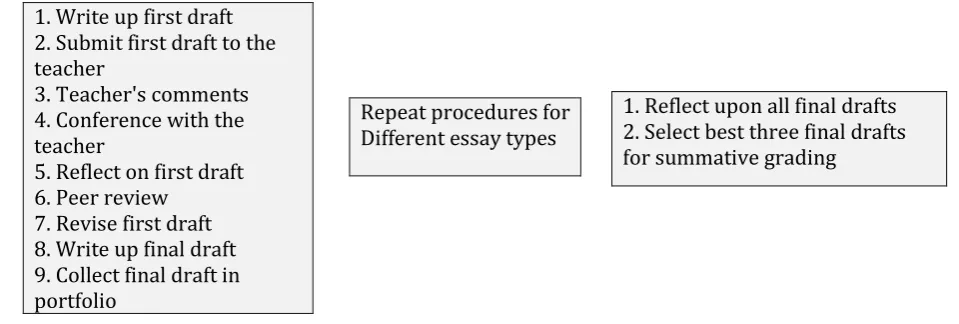
The portfolio assessment model used in this study was based on the "classroom portfolio model" and consisted of three procedures: collection, selection and reflection, as suggested by Hamp-Lyons and Condon (2000).
Figure 1. Portfolio assessment model
Analytic scoring rubric
The modified version of Wang and Liao's (2008) as a writing scoring rubric was used in this study, which consisted of five subscales: focus, elaboration, organization, convention and vocabulary, each with five levels.
IELTS writing test
In order to compare the effect of treatment on students' writing performance, two IELTS writing tasks were adapted from samples of IELTS writing tests as pre- and post- tests. Students were given a discussion topic to write about it during 45 minutes. The topics were selected based on the students' interests, age, and intended lessons to explore their ideas. Here, students were supposed to present their point of view with convincing evidence, challenge an alternate point of view, focus on topic and avoid irrelevancies, communicate in a style that is easy to follow and cohesive, and use English accurately and appropriately.
1. Write up first draft 2. Submit first draft to the teacher
3. Teacher's comments 4. Conference with the teacher
5. Reflect on first draft 6. Peer review
7. Revise first draft 8. Write up final draft 9. Collect final draft in portfolio
Repeat procedures for Different essay types
Data collection and analysis procedure
The portfolio model which was applied in this study was based on the "classroom portfolio model" since its main focus was on learning rather than final assessment and the portfolio procedures composed of collection, selection and reflection, as recommended by Hamp- Lyson and Condon (2000).
The teacher introduced the purpose and design of portfolio assessment to the students of experimental group at the beginning of the semester. The students were supposed to write about different genres of writing such as; comparison and contrast, letter writing, description form and argumentative ones. The book's content provides students with writing structures, format, and some generated ideas related to topic, key words and a writing model which shows students how to write at home.
The students submitted their first draft for having the teacher's comments. The teacher read their texts carefully, and wrote her comments under each assignment. So, the students found out their weaknesses and had the chance to edit and rewrite their drafts for two more times. Their third draft was their final text for getting a mark. Moreover, the students were able to consult with their teacher to have her comments in one-to-one conferencing during the class. They were also asked to have peer assessment, self-assessment or reflect on their writing in the classroom and evaluate their strengths and weaknesses. Then, at home, the students revised, edited and rewrote their texts in response to peer and teacher feedback.
The control group followed traditional assessment. The teacher explained the writing structure of every lesson explicitly. Here, students were asked to write their first and only text for getting a mark. In contrast to experimental group, the students had no chance to edit or rewrite their texts into better ones.
There were two groups of participants: Experimental Group and Control Group. They were divided in two groups of 15 students who received treatment during 22 sessions (11 weeks). The instructional material and methods were the same in both groups by the same teacher.
At the beginning of the experiment, in order to make sure that the participants were at the same level in terms of foreign language writing ability, a standard writing proficiency test from Oxford placement book was given as a pre-test. After that, the students in the experimental group were controlled by portfolio based instructional procedures over 22 sessions. Instruction followed the writing as a process approach as far as possible while in the control group, with a traditional (non-portfolio) method of evaluation, the teacher gave comments on each essay or written text and then a score was given at once.
assessment according to the feedback they received. They had this chance for all of texts and then they should have submitted their papers after three careful drafts while the control group would wrote only once on each topic.
In experimental group, the students were encouraged to extensively revise and edit their papers and all drafts, pre-writing and evidences of revision were included in portfolio to help the students to reflect upon their writing processes. After the treatment period, the post-test was given to measure the students' progress. It was a standard essay-writing test, which was selected from IELTS writing book. Their writings were checked based on a rubric by two raters who were familiar with the scoring rubrics. Therefore, the inter-rater reliability was checked.
To assess the participants’ writing ability, Wang and Liao's (2008) analytical scoring rubrics were used by two raters who were familiar with the scoring rubrics. The correlation between the two raters was examined through running a Pearson correlation to the scores of composition tests.
At the end of the term, a post-test was given to measure the students' progress. To compare the mean scores of control and experimental group, independent and paired samples t-tests were applied to the results of the post-test to examine the possible differences between the two groups. The post-test was a standard essay-writing test based on a topic in a specific time 30-45 minutes.
RESULTS
To ensure the participants were roughly at the same level of general language proficiency, Oxford placement test (OPT) was administered to 30 EFL subjects.
An independent sample t-test was run to check whether there was any significant difference between the means of the two groups. As illustrated in Table 1 and Table 2. The two groups turned out to have homogeneous variances, F=0.098, p= 0.75. Therefore, with equal variances assumed, the t-test results indicated that there was no significant difference between the mean scores of the two groups on the OPT test, (t= 0.14, sig=0.88) and thus, the two groups were proven to be homogeneous in terms of their general language proficiency at the beginning of the study.
Table 1. Group Statistics for the results of OPT test
Group N Mean Std. Deviation Std. Error Mean
OPT score Experimental 15 134.1333 8.60122 2.22082
Table 2. Independent samples t-test for the results of OPT test Levene's
Test for Equality of
Variances
t-test for Equality of Means
F Sig. T df Sig.
(2-tailed) Mean Difference Std. Error Difference 95% Confidence Interval of the
Difference
Lower Upper
OPT Score
Equal variances
assumed
.098 .75 .14 28 .88 .466 3.26 -6.22 7.16
Equal variances
not assumed
.14 27.8 .88 .466 3.26 -6.22 7.16
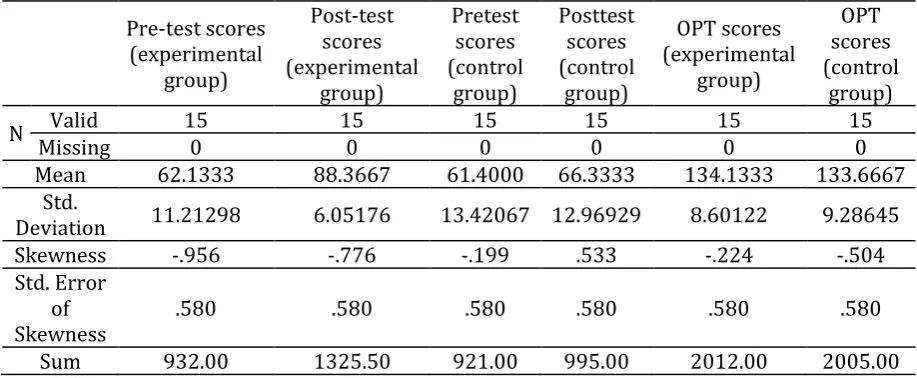
Before running the statistical tests including independent samples t-test, Skeweness analysis was done to check the normality assumption. The results of the Skewness analysis, as it is displayed in Table 3, obtained by dividing the statistic of Skewness by the standard error revealed that the assumption of normality was observed in the distribution of the scores (-.956 for the pretest scores of the experimental group, -.776 for the posttest scores of the experimental group, -.199 for the pretest scores of the control group, .533 for the posttest scores of the control group, -.224 for the OPT scores of the experimental group, and -.504 for the OPT scores of the control group ). The results indicate that the distribution is symmetric.
Table 3. The results of the Skewness analysis
Pre-test scores (experimental group) Post-test scores (experimental group) Pretest scores (control group) Posttest scores (control group) OPT scores (experimental group) OPT scores (control group)
N Valid 15 15 15 15 15 15
Missing 0 0 0 0 0 0
Mean 62.1333 88.3667 61.4000 66.3333 134.1333 133.6667
Std.
Deviation 11.21298 6.05176 13.42067 12.96929 8.60122 9.28645
Skewness -.956 -.776 -.199 .533 -.224 -.504
Std. Error of Skewness
.580 .580 .580 .580 .580 .580
Sum 932.00 1325.50 921.00 995.00 2012.00 2005.00
Table 4. Inter rater Correlation for the pre-test scores of the experimental group
Rater 2 pre-test experimental
Rater 1 pre-test experimental group
Pearson Correlation .984**
Sig. (2-tailed) .000
N 15
**. Correlation is significant at the 0.01 level (2-tailed).
Table 5. Inter rater Correlation for the pre-test scores of the control group
Rater 2 pretest control
Rater 1 pre-test control group
Pearson Correlation .990**
Sig. (2-tailed) .000
N 15
**. Correlation is significant at the 0.01 level (2-tailed).
Table 6. Inter rater Correlation for the post-test scores of the experimental group
Table 7. Inter rater Correlation for the post-test scores of the control group
rater2posttestcontrol
Rater 1 posttest control
Pearson Correlation .951**
Sig. (2-tailed) .000
N 15
**. Correlation is significant at the 0.01 level (2-tailed).
As the tables of inter rater correlation show, there was a strong correlation between the two raters’ scores both for the pre and post-test of writing test of the two groups (p ≤.05). Given the similarity of ratings by the two raters, the average of the two raters’ scores was used as the respondent's final writing score.
Table 8. Group Statistics for the pre- test scores of the control and experimental groups
Group N Mean Std. Deviation Std. Error Mean
Pre-test scores Experimental 15 62.1333 11.21298 2.89518
Control 15 61.4000 13.42067 3.46520
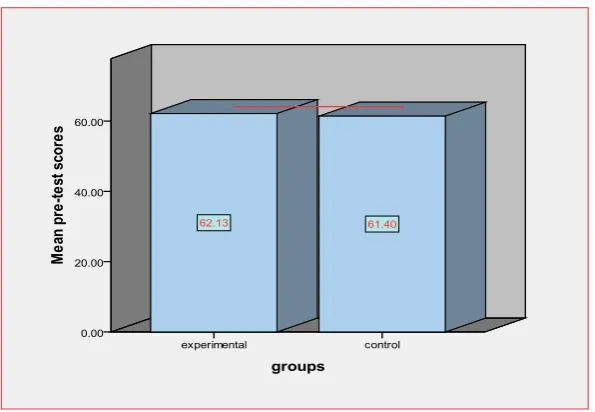
Table 8 shows that there is no significant difference between the mean scores of the two groups in pretest of writing proficiency (62.1333 - 61.4000 = 0.7333), that is: the control and experimental groups were almost at the same level of proficiency in terms of
writing ability in the administered writing test at the beginning of the study.
Rater 2 posttest experimental
Rater 1 post-test experimental group
Pearson Correlation .950**
Sig. (2-tailed) .000
N 15
Figure 2. The comparison between the two groups on writing pre-test at the beginning of the study
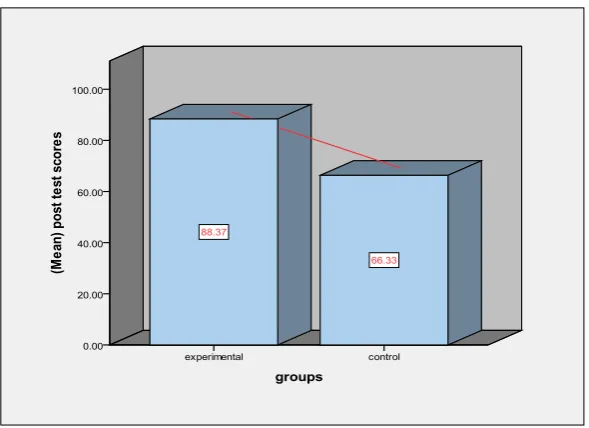
As far as the research question is concerned an independent t-test was run to the results of the writing post-test to compare the experimental and control groups. The results revealed that portfolio assessment affects the writing proficiency of the two groups differently (t=5.96, 0.00 <.05). In fact, the learners’ performance in the experimental group (Mean =88.36) far outweighed that of the control group (Mean =66.33) in posttest (Table 9).
Table 9. Group Statistics for the post-test scores of the control and experimental groups
Group N Mean Std. Deviation Std. Error Mean
Post-test scores Experimental 15 88.36 6.05 1.56
Control 15 66.33 12.96 3.34
Table 10. Independent Samples Test for the post- test scores of the control and experimental groups
Levene's Test for Equality of
Variances
t-test for Equality of Means
F Sig. T Df Sig.
(2-tailed)
Mean Difference
Std. Error Differe nce
95% Confidence Interval of the
Difference
Lower Upper
Post test scores
Equal variances
assumed
7.28 .01 5.96 28 .00 22.03 3.69 14.46 29.60
Equal variances not
assumed
Figure 3.The comparison between the two groups on writing post-tests
The results of independent samples t-test for the post-test in Table 10 indicated that there was a significant difference between the two groups in their post- test (p<.05). The experimental group considerably outperformed the control group in the post-test. The results indicate that portfolio assessment had been effective in improving students’ writing proficiency score in the experimental group. In other words, portfolio assessment affects Iranian EFL learners’ writing proficiency.
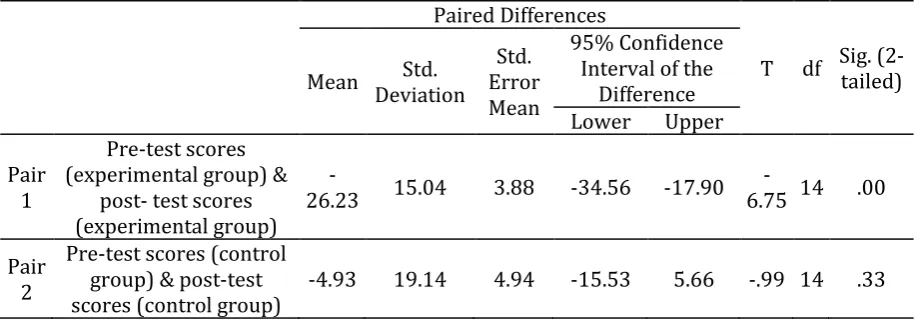
Moreover, in order to investigate the students’ progress within groups, two paired t -tests were also run, which showed the participants’ progress in pre-test and post-test (tables 11 & 12).
Table 11. Paired Samples Statistics for the two groups in pre and post tests
Mean N Std. Deviation Std. Error Mean
Pair 1 pre-test scores (experimental group) 62.13 15 11.21 2.89
post-test scores (experimental group) 88.36 15 6.05 1.56
Pair 2 Pre-test scores (control group) 61.40 15 13.42 3.46
Post-test scores(control group) 66.33 15 12.96 3.34
The mean score of the experimental group has been improved from 62.13 in pre- test to 88.36 in post-test; that of the control group has changed from 61.40 in pre- test to 66.33 in post- test.
As depicted in tables 11 and 12, both control and experimental groups had progressed in the post-test. Based on the result of paired t-test, this progress is statistically significant only for the experimental group but not for the control group (P experimental group <0.05, P control group≥.05). In other words, the experimental group made a considerably higher progress as compared to the control group in the post-writing test.
Table 12. Paired t-test for the two groups in pre and post tests Paired Differences
T df Sig. (2-tailed)
Mean Std.
Deviation Std. Error Mean
95% Confidence Interval of the
Difference
Lower Upper
Pair 1
Pre-test scores (experimental group) &
post- test scores (experimental group)
-26.23 15.04 3.88 -34.56 -17.90
-6.75 14 .00
Pair 2
Pre-test scores (control group) & post-test scores (control group)
-4.93 19.14 4.94 -15.53 5.66 -.99 14 .33
DISCUSSION
In this study, the results of data analysis results indicated that there was a significant difference between the control and experimental groups in terms of their writing proficiency. In other words, participants in the experimental group seemed to have improved their writing proficiency after receiving portfolio assessment. The results are in line with earlier findings in the literature. It is consistent with the findings of most of the studies conducted in Iran, Yurdabakan and Erdogan (2009), and Fahed Al-Serhani’s (2007)
The positive effects of portfolios on students' writing might be due to the "opportunities they afford students to become actively involved in assessment and learning" (Genesee & Upshur, 1996, p.99). In line with Murphy (2006), learning processes can be improved if formative assessment procedures are applied appropriately.
Portfolio assessment could be used in writing classes not only to resolve the teaching-testing incoherence (Walker & Perez Riu, 2008) prevalent in most EFL writing classes and but also to improve students' achievement in writing ability.
This method is consistent with what Moya and O'Malley (1994) have suggested that a single measure is incapable of estimating the variety of skills, processes, knowledge and strategies that combine to determine student progress.
In sum, this study demonstrated the formative and collaborative potential of portfolio assessment to help students improve their English writing ability. The method confirmed the impact of writing portfolios on Iranian EFL learners’ writing ability. The results showed that portfolio assessment as a process-oriented teaching and assessment tool improved the students' overall writing ability.
CONCLUSION
process-oriented portfolio program. They revisited, reflected on and revised their writing during the term and put their selected pieces of writing in their portfolios.
In line with the constructivist approach in which formative assessment procedures are incorporated into teaching and learning (Hagstorm, 2006), assessment was viewed as a process designed for learning rather than a product separated from learning.
Writing portfolios can be used in EFL classes as a mechanism whereby learning, teaching and assessment are linked. They can be used to improve the development of EFL students' writing ability. Students' writing performances during the term should be the target of evaluation. In fact, assessment should be seen as a process which helps students as they move toward their writing goals.
Based on the findings of the current study, portfolio assessment technique has a significant positive effect on EFL learners' overall writing ability. It is an effective instructional technique as well as assessment tool and can provide evidence of knowledge, and skills. In addition, portfolio assessment can offer authentic information about the progress of students and can be used as a means of helping students to overcome their writing anxiety in foreign or second language learning.
Using portfolio assessment technique allowed students to create a bridge between their teacher and themselves. The teacher can use portfolio assessment technique to analyze student growth and use the information for decision making regarding future instruction. It was also concluded that portfolio can be used as a teaching technique in writing classes to improve students' writing ability. It can be used to encourage and motivate weak writers.
This study suggested the formative potential of portfolio assessment to help students to improve their English writing ability. Students who participated in this investigation significantly favored the portfolio system. They considered the portfolios to be good tools for examining learning processes and learning a foreign language.
Content of student portfolios was mostly chosen and designed in accordance with personal preference, suggesting student ownership and active participation.
Challenges mainly resulted from the tendency toward the traditional testing, difficulties with heterogeneous classes, students’ complain, and anxiety over learning deficiencies. Overall, this study reinforced findings of previous studies (Chen, 1999, 2000; Hsieh, 2000) that portfolios are a dynamic device to facilitate learning and ownership development. Nevertheless, some confusion and doubt emerged during its implementation process, and the development of portfolio pedagogy was constantly inhibited by the traditional procedures.
relevant literature showed that portfolio was a good tool that helped raise the students’ awareness of learning strategies which facilitated their learning process and enhanced their self-directed learning.
This study suggests that nowadays, when the traditional notion of assessment is not so successful, widespread use of portfolio assessment, especially on the high school level, is out of the question for Iranian EFL students.
IMPLICATIONS
Emerging concerns and issues suggest that when integrating a new assessment system into curriculum, practitioners should take into account that: Portfolio assessment involves much more than the collection and organisation of materials. In fact, it can be an example of promising innovation in learning and teaching.
Teachers should create a professional support so as to sustain innovative pedagogical attempts. Experiments in any innovation contain moments of success and failure, especially at the beginning. Sustaining collaborative support is indispensable. Over the course of this study, the collaborative support system made possible the investigation of portfolio use in the context where traditional testing culture was dominated. Explicit criteria and procedures for peer assessment are needed. Students may be concerned about peer assessment affected by friendship marking or their incapability for the task. Portfolio assessment technique is a promising authentic assessment technique for EFL writing classes. Through proper application, portfolio assessment technique has the potential to increase instructor professionalism through active and meaningful involvement in student assessment. It can be a perfect assessment tool as well as instructional instrument in EFL educational setting.
Students need specific guidelines and support to engage in critical reflection and evaluation. Although students were required to reflect on their learning constantly in the study, some reflections appeared narrow or shallow. They might need a longer time to perceive their change in learning and acquire critical self-evaluation skills. Small groups can be arranged to ask students to examine one another’s portfolio on a regular basis, explain difficult or interesting parts of learning, and discuss and exchange ideas of how to select, reflect on, and collect portfolio entries. Peers are often a more helpful and meaningful source of advice to students. In sum the following implications can be drawn from the present study:
Portfolio assessment can promote the students' sense of personal involvement and serious responsibility
Portfolio assessment can provide opportunities for students to use language within day-by-day work
Portfolio assessment can set clear targets for language learning for the EFL students
REFERENCES
Applebee, A. N., & Langer, J.A. (1992). Integrating the language arts. In the writer's craft (teacher's edition). Evanston, IL: McDougal, Little & Company.
Barton, C. & Collins, A. (1997).Portfolio Assessment: A Handbook for Educators. NewYork: Dale Seymour Publications.
Birgin, O. (2003). Investigation of the Application Level of a Computer Based Portfolios. Unpublished Master’s Thesis, Karadeniz Technical University, Trabzon.
Brown, H. D. (2000). Principles of language learning and teaching. 4th ed. New York: Longman, Addison Westley Inc.
Callahan, S. (1995). Portfolio expectations: Possibilities and limits. Assessing Writing, 2 (2), 117- 151.
Chen, Y. M. (1999). A portfolio approach to EFL university writing instruction.
Proceedings of the 16th National Conference on English Teaching and Learning in the
Republic of China (pp. 313-332). Taipei: Crane Publishing Co., Ltd.
Chen, Y. M. (2000). Learning writing as writers: A portfolio writing curriculum for EF university first-year students. Proceedings of the 17th Conference on English
Teaching and Learning in the Republic of China (pp. 294-309). Taipei: Crane
Publishing Co., Ltd.
Collins, A. (1992). Portfolios in Science Education: Issue in Purpose, Structure and Authenticity. Science Education,76 (4), 451-463.
Connor-Linton, J. (1995). Looking behind the curtain: What do L2 composition ratings really mean? TESOL Quarterly, 29, (4), 762-765.
Cooper, T. (1997). Portfolio assessment: a guide for students. Perth: Praxis Education. Cooper, T., & Love, T. (2000). Portfolios in university-based design education. In C. Swann & E. Young (Eds.), Re-inventing Design Education in the University (pp. 159-166). Perth: School of Design, Curtin University
Crosby, C. (1997). Portfolio assessment in the Korean ESL writing classroom. Thai
TESOL Bulletin, 10(2). Retrieved August 13, 2015, from
http://www.thaitesol.org/bulletin/1002/100204.html
Conrad, C, J. (2001). Second language writing portfolio assessment: The influences of the assessment criteria and the rating process on holistic scores. Retrieved November 10, 2014 from http: //www.Carla.Umn .deal resources/working papers/
Dysthe, O. (2008). The challenges of assessment in a new learning culture. In A. Havnes & L. McDounald (eds.), Balancing dilemmas in assessment and learning in
contemporary education (pp. 15-32), New York: Routledge.
Elahinia, H. (2004).Assessment of writing through portfolios and achievement tests. Unpublished M.A thesis, Teacher Training University, Iran.
Fahed Al-Serhani, W. (2007).The effect of portfolio assessment on the writing
performance of EFL secondary school students in Saudi Arabia. UnpublishedM.A
thesis, Taibah University, Saudi Arabia
assessment: Helping students evaluate their progress as readers and writers. Orlando: Harcourt Brace &Company.
Farr, R., & Tone, B. (1998). Portfolio and performance assessment: Helping students
evaluate their progress as readers and writers (2nd ed.). United States: Harcourt Brace & Company.
Grace, C. (1992). The portfolio And Its Use: Developmentally Appropriate Assessment of Young Children. Eric Digest. ED351150.
Graves, D. R. (1985). In D. Murray, Writer teaches writing, 2nd ed. Boston, MA: Houghton Mifflin.
Genesee, F. & Upshur, J. A. (1996).Classroom-based evaluation in second language
education. Cambridge: Cambridge University Press.
Ghoorchaei, B., & Tavakoli, M., & Nejad Ansari, D. (2010). The impact of portfolio assessment on Iranian EFL students' essay writing: A process-oriented approach.
GEMA Online Journal of Language Studies, 10 (3), 36-46.
Hagstorm, F. (2006). Formative learning and assessment. Communication Disorders
Quarterly, 28 (1), 24-36.
Hamp-Lyons, L. (1994). Interweaving assessment and introduction in college ESL writing classes. College ESL, 4 (1), 43-55.
Hamp-Lyons, L., & Condon; W. (2000). Assessing the portfolio: Principles for practice,
theory and research. Cresskill, NJ: Hampton Press.
Hamp-Lyons, L., & Kroll, B. (1996). Issues in ESL writing assessment: An overview.
College ESL, 6 (1), 52-72.
Hancock, C.R. (1994). Alternative Assessment and Second Language Study: What and Why? ERIC Clearinghouse on Languages and Linguistics, Washington, DC: Center for Applied Linguistics.
Hedge, T. (2000). Teaching and learning in the language classroom. Oxford: Oxford University Press.
Huerta-Macias, A. (1995). Alternative assessment: Responses to commonly asked questions. TESOL journal, 5, 18-10.
Huot, B. (1990). Reliability, validity, and holistic scoring: What we know and what we need to know. College Composition and Communication, 41 (2), 201-213.
Hsieh, Y. F. (2000).Implementation of portfolio assessment in a sixth grade EFL classroom Master thesis. National Taiwan Normal University.
Kroll, B. (1991). Teaching writing in the ESL context. In C. Murcia (Ed.), Teaching English
as a Second Language. New York: Newbury House.
Kroll, B. (1997). Second language writing: Research insights for the classroom. (6thed.). Cambridge: Cambridge University Press.
Moya, S., & O'Malley, J. M. (1994). A portfolio assessment model for ESL. The Journal of
Educational Issues of Language Minority Students, 13, 13-36.
Nezakatgoo, B. (2011). The effects of portfolio assessment on writing of EFL students.
English language teaching, 4 (2), 231-241.
Niami, M. (2010). The impact of writing portfolios on improving the process of writing research papers. Asian EFL Journal, 2 (1), 1-11.
O'Malley, J. M., & Pierce, V. L. (1996). Authentic Assessment for English Language
Learners. Reading, MA: Addison- Wesley.
Ozturk, H., & Cecen, S. (2007). The effects of portfolio keeping on writing anxiety of EFL students. Journal of Language and Linguistic Studies, 3 (2), 219-230.
Paulson, F.L., Paulson, P. R & Meyer, C. A. (1991). What Makes a Portfolio? Educational
Leadership, 48, 60-63.
Penaflorida, A.H. (2002). Nontraditional forms of assessment and response to student writing: A step toward learner autonomy. In J.C. Richards, & W.A. Ranandya (eds.). Methodology in language teaching: An anthology of current practice (pp.344-53). Cambridge: Cambridge University Press.
Seow, A. (2002). The writing process and process writing. In J. C. Richards, & W. A. Renandya (eds.). Methodology in language teaching: An anthology of current practice (pp.315-20). Cambridge: Cambridge University Press.
Sharifi, A., & Hassankhah, J. (2010). The role of portfolio assessment and reflection on process writing. Asian EFL Journal, 11 (2), 194-220.
Sommer, R.F. (1989). Teaching writing to adults. San Francisco: Jossey-Bass. (1992). The
writers craft. (teacher's edition.) Evanston, IL: McDougal, Littell & Company.
Taki, S., & Heidari, M. (2010). The effect of using portfolio – based writing assessment on language. Learning: The case of young Iranian EFL learners. Journal of English
Language Teaching, 4 (3), 192-196.
Walker, R. & Perez Riu, C. (2008). Coherence in the assessment of writing skills. ELT
Journal, 62 (1), 18-28.
Wang, Y. H. & Liao, H. C. (2008). The application of learning portfolio assessment for students in the technological and vocational education system. Asian EFL Journal,
10 (2), 132-154.
Yurdabakan, I. & Erdogan, T. (2009). The effects of portfolio assessment on reading, listening and writing skills of secondary school prep class students. The Journal of