doi: 10.15171/rdme.2019.022 https://rdme.tbzmed.ac.ir
Evaluation of a research methods course for clinical residents
Maryamalsadat Kazemi Shishavan1,2*ID, Mahasti Alizadeh3,2ID1Medical Education Research Center, Tabriz University of Medical Sciences, Tabriz, Iran
2Department of Community and Family Medicine, Faculty of Medicine, Tabriz University of Medical Sciences, Tabriz, Iran 3Social Determinants of Health Research Center, Health Management and Safety Promotion Research Institute, Tabriz
University of Medical Sciences, Tabriz, Iran
Introduction
The Accreditation Council for Graduate Medical Education (ACGME) encourages residency programs to emphasize research, leadership, and public health in the curriculum, in addition to standard and specialty-specific requirements.1 “Citations per faculty” is one of
the criteria accepted by most worldwide organizations to rank universities, persuading university program directors to include scholarly activities in all educational programs to increase publication rates among medical students and residents.2-10 Evidence shows various barriers
toward residents’ research; however, there are reports of
successful results, and often benefits are more than merely an increase in publications. Residents with research training are more satisfied with their careers and deliver better patient care.7,10-12 Various published curricula exist
with research training objectives. Systematic reviews of these curricula have reported several features of residency programs incorporating research education, such as research director involvement, protected research time, research requirements, research mentor, support from research assistants or biostatisticians, IT support, research funding availability, pay for performance incentives, and celebration of accomplishments. These are the principal
*Corresponding author: Maryamalsadat Kazemi Shishavan, Email: [email protected]
PPuubblliisshhiinngg G Grroouupp
TUOMS
Article Type:
Original Research
Article History:
Received: 15 Dec. 2019 Accepted: 23 Dec. 2019 epublished: 30 Dec. 2019
Keywords:
Program evaluation Research curriculum Kirkpatrick’s model Resident education Mandatory research Scholarly activity
Abstract
Background: Residency programs generally carry out various educational interventions
to improve residents’ publication records. Since an intervention may not produce the same effect in different locations, evaluating the effectiveness of individual interventions is essential for examining progress in this field of study. Authorities at the Tabriz University of Medical Science (TUOMS) proposed a research training program targeting a rise in residents’ scholarly activity and publications; this study aimed to evaluate the program and share the findings and experiences.
Methods: Questionnaires were sent to 182 residents and the heads of all clinical departments.
Evaluators used Kirkpatrick’s four-level model and Stufflebeam’s Context, Input, Process and Product model for data gathering and analyzing. Focus group discussions (FGDs) and in-depth semi-structured interviews were done with faculty members, executive staff, and residents to complement the survey results. Data were summarized and categorized using quantitative and qualitative analysis.
Results: The participation rate for residents and heads of departments were 76 (41.7%) and 14
(70%), respectively. At the end of the course, residents assessed their knowledge and research skills as weak or medium in most of the subjects. A total of 182 (100 %) residents prepared thesis proposals. Only 82 (49.1%) residents completed their thesis, and 19 (11.3%) published papers. Generally, participants were not satisfied with the course. Barriers noted were: mandatory topics for theses, an intensive course with a one-month duration, a lack of consideration of practical subjects, high cost of the course, and failure to achieve an increase in publications.
Conclusion: The self-assessment results of increased knowledge and research skills did not
indicate improvement. Mandatory participation in the course did not result in the expected publication increase.
Article info
components of research courses; however, there are no statistically significant differences in the mean primary outcome for any single intervention.10 Authorities at the
Tabriz University of Medical Science (TUOMS) proposed a research training curriculum to accelerate the process of completing research proposals and increase the number of publications by clinical residents.13-15 This study was
designed to evaluate this research education program and assess the outcomes.
Materials and Methods
Participants
Participants were TUOMS clinical residents who enrolled in September 2015, heads of clinical departments and faculty research committees, the vice chancellor for research and technology, the chancellor for finance and administration, and research and technology office executive staff.
Program
The “research curriculum” was a mandatory one-month training program. Residents were asked to leave their clinical departments and join the program during their first year of residency. Participants took morning classes and workshops to learn research methodology. Residents could consult with methodology experts during afternoon sessions.
Administrators ran the program in five independent courses from November 2015 to April 2016, with 20-30 residents participating each month. At the beginning of the course, each resident was assigned a mentor in his/her specialty field. The mentor provided a research idea, and the residents worked on developing a proposal. At the end of the course, the residents defended their proposals.
Program objectives
The main objective was ensuring that all residents completed their thesis proposals at the end of the course. The second objective was for all residents to defend their thesis by the end of their residency program. They were expected to publish at least one article during their residency.
Program evaluation
To assess the effectiveness of the research curriculum, we used Kirkpatrick’sfour-level Training Evaluation Model as the central framework.16 Since evidence proposed
limitations in the critique of completeness of Kirkpatrick’s model, we enhanced the evaluation framework with constructs from Stufflebeam’s Context, Input, Process, and Product (CIPP) model.17,18 According to Kirkpatrick’s
model, we evaluated participant reaction to the program, learning, and transformation of knowledge to practice using online-administered questionnaires (Telegram Bot) along with focus group discussions (FGDs) and semi-structured interviews. To assess the outcomes, we used
the deputy of research and technology report for program satisfaction, final publications, and completed theses.
We sent separate questionnaires to residents and heads of departments. The resident survey had several parts, including self-assessment of knowledge, skills, application of evidence-based medicine, and curriculum duration. Some questions were scored based on a 5-point Likert scale from 1 = very strongly disagree to 5 = strongly Agree. The skill self-assessment questions were scored based on a 4-point Likert scale from 1=weak to 4=excellent. The questionnaire for heads of departments included assessing their overall opinion toward achieving program objectives that were scored based on a 3-point scale from 1=disagree to 3=agree. The authors exported the results of the surveys as an Excel worksheet.
A paper-based questionnaire was sent to research and technology office executive staff. The survey contained questions assessing their view on the numbers and quality of the thesis proposals and additional workload according to program execution and duration of the curriculum. Medical education experts determined the validity of questionnaires.
We conducted nine focus groups comprising 37 residents recruited from ten clinical residency programs (Internal Medicine, Neurology, ENT, Pediatrics, Emergency Medicine, Psychiatry, Infectious Disease, Surgery, and Obstetrics & Gynecology) to evaluate the research program by answering semi-structured open questions. The research committee of ten participated in another focus group. The authors also interviewed heads of departments, who agreed to participate in the interview, the vice chancellor for research and technology, and the chancellor for finance and administration. All FGD sessions were held in departments or faculty conference rooms.
Results
Residents
A total of 182 residents enrolled in the research curriculum, and 76 residents (41.7%) completed the survey. During FGDs, residents shared the following reasons for non-participation: loss of interest, mistrust, and time constraints due to residency obligations. They expressed that most residents felt that program evaluations were useless in their context, and there was no trust in improvement.
Usefulness of the curriculum and overall satisfaction
However, residents postulated that the program duration was too long, and stated that most of the lessons focused on theoretical content rather than practical subjects. They mentioned that compulsory research ideas and mandatory supervisors were the main drawbacks of the program. Box 1 outlines the strengths and weaknesses of the curriculum from the residents’ perspective.
Knowledge and skills
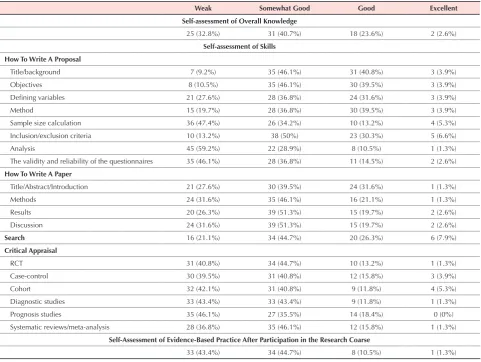
Most of the residents who answered the survey assessed their overall knowledge as “somewhat good” (40.7%) or “weak” (32.8%). Self-assessment for skills was mostly marked as “weak” and “somewhat good,” especially in statistical skills. Table 1 summaries the self-assessment results.
According to the FGDs, residents believed that the educational content of the curriculum was not enough to increase their knowledge and skills in conducting proper research and performing statistical analysis.
Motivation for research
A total of 48 (63.1%) participants who answered the survey believed that conducting research was an essential skill for their profession 32 (42.1%) were neutral, and 4 (5.2%) disagreed with the statement. FGDs result confirmed that most residents do not consider research a priority since they are mostly involved in clinical work, and if they have spare time, they need to study for annual or board exams. Residents believed that lacking financial support for research was also a significant barrier to doing research. Residents maintained that sometimes they needed to hire help to execute their research. Additional expenses made
them feel less enthusiastic about research projects. Most of the residents were not considering research as part of their future careers. Taking the month-long course did not increase the majority of residents’ motivation for doing research (increased in only 26 [34.2%]).
Heads of departments
Fourteen (70%) of heads of departments participated in the survey. They believed that their residents achieved sufficient skills for writing a proposal (50%), that the research program helped them complete their proposals in time (64.2%), and that participation in the program improved the quality of the proposals (71.4%). Table 2 summaries the survey results. Evaluators categorized the compilation of the in-depth interviews as follows:
Necessity of research for clinical residents
Most heads of departments believed that a clinician does not need to be a professional methodologist. If authorities mandate research in residency programs, there is an increased probability of observing fabrications and falsifications, and resources will be wasted on unnecessary and low-quality research. Some felt that it could be possible to promote faculty rankings by mandating research in residency programs, but this would, in turn, affect the perceived importance of teaching and learning of “must-knows” in clinical settings. They also stated that timely completion of proposals does not guarantee the quality of the final report.
Compulsory research ideas
Heads of the departments felt that residents should be involved in all parts of the research process, from postulating a clinical question to reporting the results, and it was not fair for the residents to be obligated to work on an idea that they might not be interested.
Program duration
Seven (50%) of heads of departments thought that the program duration was too long. Most felt that a clinical resident should not be out of his/her clinical setting for an entire month, especially in their first year of the residency program.
Difficulties with department schedules
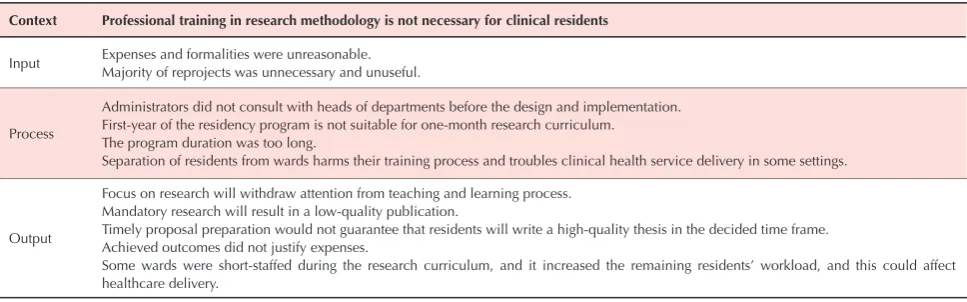
Each month, due to the research curriculum, some departments faced scheduling problems (64.2%). Heads of the departments asserted that the clinical workload in the wards is enormous, and because some residents left for the research curriculum training each month, the wards were understaffed. The remaining residents had to cover more shifts and stay after hours. The surgical and internal medicine departments faced more difficulties than the other departments. Table 3 summarizes the views of the heads of departments on the research curriculum using the CIPP framework.
Box 1. Strengths and weaknesses of the curriculum from the residents’ perspectives
Advantages
1. The program provided an opportunity to learn about research and how to conduct one
2. Residents from different fields of practice get to know and work with each other
3. All the residents finished their proposals by the end of the program
4. Residents were not on-duty or on-call for a month 5. The reception was excellent
Disadvantages
1. Residents had to work on titles that their departments chose for them
2. Departments assigned a supervisor for each resident without asking them
3. The most of educational content of the program was impractical
4. The duration of the program (one month) was too long 5. Residents departed from clinical practice for one month 6. Implementation of the program did not affect overall
Research committee and executive staff
Research committee members believed that the proposals were not of high quality compared to previous proposals. From their perspective, the first year of residency is not suitable for deciding on the title for a thesis. Focus group participants all agreed that residents should be involved in choosing the titles of their proposals.
Research deputy executive staff felt that their workload had increased due to this program implementation. They received more proposals compared with the same time frame as in previous years, but there was no improvement in the quality of proposals. The deputy of finance believed that it was not reasonable to allocate resources to the
objective of increasing the quantity of publication when there were other pressing priorities.
Publication results
At the end of the residency program, 82 (49.1%) of residents completed their thesis, and 71 (42.5%) defended. There were 19 publications altogether, 15 (8.98%) indexed in ISI journals.
Discussion
The results of the program evaluation in the reaction level of the Kirkpatrick model showed that participants and other stakeholders were not generally satisfied with the Table 1. Residents Self-assessment of overall knowledge and skills improvement after participating in the research course (n = 76)
Weak Somewhat Good Good Excellent
Self-assessment of Overall Knowledge
25 (32.8%) 31 (40.7%) 18 (23.6%) 2 (2.6%)
Self-assessment of Skills How To Write A Proposal
Title/background 7 (9.2%) 35 (46.1%) 31 (40.8%) 3 (3.9%)
Objectives 8 (10.5%) 35 (46.1%) 30 (39.5%) 3 (3.9%)
Defining variables 21 (27.6%) 28 (36.8%) 24 (31.6%) 3 (3.9%)
Method 15 (19.7%) 28 (36.8%) 30 (39.5%) 3 (3.9%)
Sample size calculation 36 (47.4%) 26 (34.2%) 10 (13.2%) 4 (5.3%)
Inclusion/exclusion criteria 10 (13.2%) 38 (50%) 23 (30.3%) 5 (6.6%)
Analysis 45 (59.2%) 22 (28.9%) 8 (10.5%) 1 (1.3%)
The validity and reliability of the questionnaires 35 (46.1%) 28 (36.8%) 11 (14.5%) 2 (2.6%) How To Write A Paper
Title/Abstract/Introduction 21 (27.6%) 30 (39.5%) 24 (31.6%) 1 (1.3%)
Methods 24 (31.6%) 35 (46.1%) 16 (21.1%) 1 (1.3%)
Results 20 (26.3%) 39 (51.3%) 15 (19.7%) 2 (2.6%)
Discussion 24 (31.6%) 39 (51.3%) 15 (19.7%) 2 (2.6%)
Search 16 (21.1%) 34 (44.7%) 20 (26.3%) 6 (7.9%)
Critical Appraisal
RCT 31 (40.8%) 34 (44.7%) 10 (13.2%) 1 (1.3%)
Case-control 30 (39.5%) 31 (40.8%) 12 (15.8%) 3 (3.9%)
Cohort 32 (42.1%) 31 (40.8%) 9 (11.8%) 4 (5.3%)
Diagnostic studies 33 (43.4%) 33 (43.4%) 9 (11.8%) 1 (1.3%)
Prognosis studies 35 (46.1%) 27 (35.5%) 14 (18.4%) 0 (0%)
Systematic reviews/meta-analysis 28 (36.8%) 35 (46.1%) 12 (15.8%) 1 (1.3%)
Self-Assessment of Evidence-Based Practice After Participation in the Research Coarse
33 (43.4%) 34 (44.7%) 8 (10.5%) 1 (1.3%)
Results are presented in frequency and percentages.
Table 2. Heads of departments survey results for their opinion on objectives achieved after implementing the research coarse (n=76)
Disagree Neither Agree Nor Disagree Agree
Residents achieved sufficient skills to write a proposal 4 (28.5%) 3 (21.4%) 7 (50%)
Residents achieved sufficient skills to write an academic paper 4 (28.5%) 10 (71.4%) 0 (0%)
Research program helped residents complete their proposals in time 3 (21.4%) 1 (7.1%) 9 (64.2%)
Participation in the research program increased the quality of the proposals 3 (21.4%) 1 (7.1%) 10 (71.4%)
Residents apply EBM in their practice 5 (35.7%) 4 (28.5%) 5 (35.7%)
program. Although most recent similar programs did not measure satisfaction as a primary outcome, participants often reported positive reactions to these research courses such as a rise in research interest,19 valuable research
experience,2,20,21 and exposure to qualified learning
program.22
Findings from the evaluation of the “learning” level revealed that most participants did not reach a satisfactory level of knowledge and skills in research. Statistics were scored as the weakest field. Residents reported a lack of statistical knowledge as a principal barrier for research4,19
and providing the availability of a biostatistician has helped residents increase publication levels.14,23
While examining the third level, behavior change, evaluators concluded that several barriers prevented clinical residents from engaging in scholarly activities, which mainly included mentorship, funding, constrained time, and attitude towards publications.
Mentorship is an influential factor in a thriving research experience.10,20,24,25 Prior studies have reported a lack of
proper mentoring as a significant barrier for research.4,8
Residents of TUOMS were less motivated to do research due to 1) mandatory research topics and 2) advisors/ mentors.
Time for research is crucial in clinical residency.4,8,10,25,26
In the TUOMS research program, a protected one month period during the first year of residency was allocated to proposal writing, but program directors did not consider a similar protected time for research execution. Although one month of protected time helped residents complete proposals, it caused understaffed wards, scheduling difficulties, and residents missing some clinical experience. Most residents preferred to engage in clinical tasks and to learn clinical skills rather than conduct research; Silcox et al reported similar attitudes in anesthesiology residents.27
Though there are reports for correlation between research time and academic output,28 the meta-analysis did not
show a significant difference in publication rate in programs offering research time.
Funding was another factor influencing residents’ motivation for research. Prior studies have documented
the importance of funding in residents’ research. However, Zimmerman et al showed that available funds did not significantly increase publication rate.10 Time
restriction and lack of funding, combined together as primary barriers, cause reduced participation of residents in research projects and lower publication rates.
Authorities of TUOMS felt that tying research to graduation might promote resident publications; however, a recent meta-analysis did not support this.10
We did not examine the difference between publication rates of this program and previous years, but we showed that only 10.4% of residents published their studies. Similar programs reported an increase in the publication rate2,20; some reported that despite participating in the
training program, residents did not engage in research projects as expected.21,29,30 We could not find a criterion
to assess sufficient publication rates; most programs aim to enhance residents’ scholarly activity, that is, increasing the number and rate of publication. Other studies have not reported a high-quality publication rate, nor have they used a quality assessment tool to evaluate proposals, theses, or papers. There is evidence that poor design, misconduct, flawed analysis and reporting causes waste in medical research.31,32 Elessi et al stated that this waste
is a reflection of weak research training and insufficient mentoring; learning evidence-based skills is more beneficial than acquiring skills for performing research for most clinicians, and it may be more beneficial to lessen the expectation that all health-care professionals should do research.32 Adopting the recommendations of Elessi et
al, we suggest an evidence-based practical skills course as a mandatory course before entering residency programs. Then, clinical residents could get online/classroom learning experience based on their needs during the residency program. Curriculum designers should tailor learning objectives, materials, and course duration for a specific specialty. Promoting engagement in high-quality scholarly activities such as evidence-based journal clubs could promote residents’ interest in research.12,33
The study had some limitations. The response rate was lower than expected, but the interviews and FGDs
Table 3. Heads of departments view on the research curriculum using CIPP framework
Context Professional training in research methodology is not necessary for clinical residents
Input Expenses and formalities were unreasonable. Majority of reprojects was unnecessary and unuseful.
Process
Administrators did not consult with heads of departments before the design and implementation. First-year of the residency program is not suitable for one-month research curriculum. The program duration was too long.
Separation of residents from wards harms their training process and troubles clinical health service delivery in some settings.
Output
Focus on research will withdraw attention from teaching and learning process. Mandatory research will result in a low-quality publication.
Timely proposal preparation would not guarantee that residents will write a high-quality thesis in the decided time frame. Achieved outcomes did not justify expenses.
mitigated this problem to the degree that the results could be generalized to all participants. Data was not collected on the research knowledge, skills, and attitudes of the residents before participating in the program (baseline). Since all residents enrolled in the program, we could not compare their outcomes with a control group. Zimmerman et al have reported that most previous research also did not use historical or concurrent controls to assess the program’s effectiveness.10
Conclusion
Although the research program achieved its primary goal (i.e., completion of research proposal), not all residents defended theses nor published a paper. Overall, mandatory research topics, assigned advisors, long duration, and less practical topics in the research course and unsupported research expenses shaped residents’ less-positive attitudes toward conducting research. Understanding and careful consideration of medical evidence will lead to better patient care and career satisfaction among medical professionals. Evaluating research programs will help directors to provide a better learning experience for residents.
Ethical approval
Before each focus session, the authors provided timely and sufficient participant information. Participants were free to leave the groups or interviews as they desired. The interviewers assured participants about information confidentiality and asked their permission for voice recording. Participants signed a consent form before the interviews. They could ask to withdraw their information from the study.
The Medical Education Review Committee approved the study. The authors consulted the TUOMS Committees for Medical and Health Research Ethics, but a formal application was not considered necessary by the committees because they regarded the study as an evaluation project. The vice-chancellor of research and technology consented to the evaluation process as the program director. Informed written and oral consent was obtained from all participants before participation in the study.
Competing interests
The authors declare they have no competing interests
Authors’ contributions
MK and MA conceived the article. MK and MA collected and analyzed the data, perform interviews, and interpreted the data; MK is responsible for writing the first draft. Both authors revised the subsequent draft and read and approved the final version of the manuscript.
Acknowledgment
The authors would like to acknowledge the TUMOS research program director, executive staff, and all the
residents, heads of departments who participated in the study.
References
1. Accreditation Council for Graduate Medical Education. ACGME common program requirements. Available from: https://www.acgme.org/What-We-Do/Accreditation/ Common-Program-Requirements. Accessed December 25, 2019.
2. Abdulrahman M, Ahmed A, Carrick FR. Implementing resident research program to enhance physicians research in the United Arab Emirates. Int J Appl Basic Med Res. 2019;9:75-9. doi: 10.4103/ijabmr.IJABMR_183_18. 3. Lennon RP, Oberhofer AL, McNair V, Keck JW. Curriculum
changes to increase research in a family medicine residency program. Fam Med. 2014;46:294-8.
4. Natalwalla S, Mathur S, Farrugia M, Yudin M. Evaluating a resident research program: the experience and the output. J Obstet Gynaecol Can. 2019;41:727. doi: 10.1016/j. jogc.2019.02.215.
5. Oliver JJ, Ross JM, Davis WT, NG PC, Long B, Weymouth WL, et al. The Development of an Emergency Medicine Resident Research Program in the United States Military. Mil Med. 2019;184(11-12):e622-5. doi: 10.1093/milmed/ usz071.
6. Ranking QWU. QS World University Ranking. Available from: http://www.iu.qs.com/university-rankings/world-university-rankings/. Accessed December 25, 2019. 7. Seales SM, Lennon RP, Sanchack K, Smith DK. Sustainable
Curriculum to Increase Scholarly Activity in a Family Medicine Residency. Fam Med. 2019;51:271-5. doi: 10.22454/FamMed.2019.906164.
8. Truong HT, Chan JJ, Leong WL, Sultana R, Koh DL, Sng BL. Interest and experience of anesthesiology residents in doing research during residency training. Indian J Anaesth. 2019;63:42-8. doi: 10.4103/ija.IJA_543_18.
9. Wolfe J, Wolfe J, Smith K, Yoho R, Vardaxis V. A Strategic Plan for Increasing Scholarly Activity Among Medical Students, Residents, and Faculty. J Am Podiatr Med Assoc. 2018;108:292-303. doi: 10.7547/16-014.
10. Zimmerman R, Alweis R, Short A, Wasser T, Donato A. Interventions to increase research publications in graduate medical education trainees: a systematic review. Arch Med Sci. 2019;15:1-11. doi: 10.5114/aoms.2018.81033.
11. Hebert RS, Levine RB, Smith CG, Wright SM. A systematic review of resident research curricula. Acad Med. 2003;78:61-8. doi: 10.1097/00001888-200301000-00012.
12. Takahashi O, Ohde S, Jacobs JL, Tokuda Y, Omata F, Fukui T. Residents’ experience of scholarly activities is associated with higher satisfaction with residency training. J Gen Intern Med. 2009;24:716-20. doi: 10.1007/s11606-009-0970-4.
13. Kichler K, Kozol R, Buicko J, Lesnikoski B, Tamariz L, Palacio A. A structured step-by-step program to increase scholarly activity. J Surg Educ. 2014;71:e19-21. doi: 10.1016/j.jsurg.2014.08.008.
14. Mayo MJ, Rockey DC. Development of a successful scholarly activity and research program for subspecialty trainees. Am J Med Sci. 2015;350:222-7. doi: 10.1097/ maj.0000000000000489.
scholarship during child and adolescent psychiatry residency. Acad Psychiatry. 2012;36:443-7. doi: 10.1176/ appi.ap.11110199.
16. Kirkpatrick DL, Kirkpatrick JD. Four Levels: an overview. In: Evaluating training programs: the four levels. 3rd ed. San Francisco: Berrett-Koehler; 2012. p. 21-6.
17. Bates R. A critical analysis of evaluation practice: the Kirkpatrick model and the principle of beneficence. Eval Program Plann. 2004;27:341-7. doi: 10.1016/j. evalprogplan.2004.04.011.
18. Stufflebeam DL. The relevance of the CIPP evaluation model for educational accountability. Available from: https://eric.ed.gov/?id=ED062385. Accessed December 25, 2019.
19. Mansi A, Karam WN, Chaaban MR. Attitudes of Residents and program directors towards research in otolaryngology residency. Ann Otol Rhinol Laryngol. 2019;128:28-35. doi: 10.1177/0003489418804565.
20. Anandarajah G, Gupta P, Jain N, El Rayess F, Goldman R. Scholarly development for primary care residents. Clin Teach. 2016;13:415-21. doi: 10.1111/tct.12463.
21. Alhaider SA, Alshehri HA, Almedhesh SA. Research training, productivity and challenges among trainees of pediatric residency programs across Saudi Arabia. Int J Pediatr Adolesc Med. 2015;2:70-4. doi: 10.1016/j. ijpam.2015.06.005.
22. MacMaster FP, Cohen J, Waheed W, Magaud E, Sembo M, Langevin LM, et al. The psychiatry resident research experience. BMC Res Notes. 2016;9:486. doi: 10.1186/ s13104-016-2290-1.
23. Alweis R, Wenderoth S, Donato A. Effectiveness of iterative interventions to increase research productivity in one residency program. J Community Hosp Intern Med Perspect. 2015;5:29203. doi: 10.3402/jchimp.v5.29203. 24. Wood W, McCollum J, Kukreja P, Vetter IL, Morgan CJ,
Hossein Zadeh Maleki A, et al. Graduate medical education scholarly activities initiatives: a systematic review and meta-analysis. BMC Med Educ. 2018;18:318. doi: 10.1186/
s12909-018-1407-8.
25. Solaja O, Skinner TAA, McGregor TB, Siemens DR. CanMEDS scholars: A national survey on urology residents’ attitudes towards research during training. Can Urol Assoc J. 2018;12:E191-6. doi: 10.5489/cuaj.4927.
26. Atreya AR, Stefan M, Friderici JL, Kleppel R, Fitzgerald J, Rothberg MB. Characteristics of successful internal medicine resident research projects: predictors of journal publication versus abstract presentation. Acad Med. 2018;93:1182-8. doi: 10.1097/acm.0000000000002164. 27. Silcox LC, Ashbury TL, VanDenKerkhof EG, Milne B.
Residents’ and program directors’ attitudes toward research during anesthesiology training: a Canadian perspective. Anesth Analg. 2006;102:859-64. doi: 10.1213/01. ane.0000194874.28870.fd.
28. Yang G, Zaid UB, Erickson BA, Blaschko SD, Carroll PR, Breyer BNJTJou. Urology resident publication output and its relationship to future academic achievement. J Urol. 2011;642-6. doi: 10.1016/j.juro.2010.09.097.
29. Bateman EA, Teasell R. Publish or Perish: research productivity during residency training in physical medicine & rehabilitation. Am J Phys Med Rehabil. 2019;98:1142-6. doi: doi: 10.1097/phm.0000000000001299.
30. Busaidi IS, Shaqsi SZ, Alawi AK, Sinani S, Al-Kashmiri A. Characteristics, trends, and factors associated with publication among residents of Oman medical specialty board programs. J Grad Med Educ. 2019;11:104-9. doi: 10.4300/jgme-d-19-00252019;11:104-9.
31. Glasziou P, Chalmers I. Research waste is still a scandal. BMJ. 2018;363:k4645. doi: 10.1136/bmj.k4645
32. Elessi K, Albarqouni L, Glasziou P, Chalmers I. Promoting critical appraisal skills. Lancet. 2019;393:2589-90. doi: 10.1016/S0140-6736(19)30346-0.