23
INTERNATIONAL JOURNAL OF ADVANCES IN ENGINEERING RESEARCH
A NOVEL IRRIGATION SYSTEM AUTOMATION
USING WIRELESS SENSOR NETWORK
R. Rajaragavi Teaching Fellow,
Anna University college of Engineering , Pattukkottai
ABSTRACT
An automated irrigation system was developed to optimize water use for agricultural crops. The system has a distributed wireless network of soil-moisture and temperature sensors placed in the root zone of the plants. A gateway unit handles sensor information, triggers actuators, and transmits data to a web application. An algorithm was developed with threshold values of temperature and soil moisture that was programmed into a microcontroller-based gateway to control water quantity. The system was powered by photovoltaic panels and had a duplex communication link based on a cellular-Internet interface that allowed for data inspection and irrigation scheduling to be programmed through a web page. The automated system will have water savings of up to 90% compared with traditional irrigation practices. Because of its energy autonomy and low cost, the system has the potential to be useful in water limited geographically isolated areas.
Index —Automation, cellular networks, Internet, irrigation, water resources, wireless sensor networks (WSNs).
I. INTRODUCTION
24
INTERNATIONAL JOURNAL OF ADVANCES IN ENGINEERING RESEARCH
volumetric water content of the substrate drops below a set point [6]. Other authors have reported the use of remote canopy temperature to automate cotton crop irrigation using infrared thermometers. Through a timed temperature threshold, automatic irrigation was triggered once canopy temperatures exceeded the threshold for certain time accumulated per day.
Automatic irrigation scheduling consistently has shown to be valuable in optimizing cotton yields and water use efficiency with respect to manual irrigation based on direct soil water measurements [7]. An alternative parameter to determine crop irrigation needs is estimating plant evapotranspiration (ET). ET is affected by weather parameters, including solar radiation, temperature, relative humidity, wind speed, and crop factors, such as stage of growth, variety and plant density, management elements, soil properties, pest, and disease control [8]. Systems based on ET have been developed that allow water savings of up to 42% on time-based irrigation schedule [9]. In Florida, automated switching tensiometers have been used in combination with ET calculated from historic weather data to control automatic irrigation schemes for papaya plants instead of using fixed scheduled ones. Soil water status and ET-based irrigation methods resulted in more sustainable practices compared with set schedule irrigation because of the lower water volumes applied [10]. An electromagnetic sensor to measure soil moisture was the basis for developing an irrigation system at a savings of 53% of water compared with irrigation by area of 1000 m2 of pasture [11]. A reduction in water use sprinklers in an under scheduled systems also have been achieved, using soil sensor and an evaporimeter, which allowed for the adjustment of irrigation to the daily fluctuations in weather or volumetric under scheduled systems also have been achieved [12].A system developed for malting barley cultivations in large areas of land allowed for the optimizing of irrigation through decision support software and its integration with an infield wireless sensor network (WSN) driving an irrigation machine converted to make sprinkler nozzles controllable. The network consisted of five sensing stations and a weather station. Each of the sensing stations contained a data logger with two soil water reflectometers, a soil temperature sensor, and Bluetooth communication. Using the network information and the irrigation machine positions through a differential GPS, the software controlled the sprinkler with application of the appropriate amount of water [13]. Software dedicated to sprinkler control has been variously discussed [14].
A data acquisition system was deployed for monitoring crop conditions by means of soil moisture and soil, air, and canopy temperature measurement in cropped fields. Data were downloaded using a handheld computer connected via a serial port for analysis and storage [15]. Another system used to achieve the effectiveness of water management was developed based on a WSN and a weather station for Internet monitoring of drainage water using distributed passive capillary wick-type lysimeters. Water flux leached below the root zone under an irrigated cropping system was measured [16]. There are hybrid architectures, wireless modules are located inside the greenhouse where great flexibility is required, and wired modules are used in the outside area as actuator controllers [17].
25
INTERNATIONAL JOURNAL OF ADVANCES IN ENGINEERING RESEARCH
appropriately in real time for a wide range of applications [18], considering the requirements of the deployed area, such as terrestrial, underground, underwater, multimedia, and mobile [19]. These applications involve military operations in scenarios of battlefield, urban combat, and force protection, with tasks of presence, intrusion, ranging, imaging, detection of chemical, toxic material, biological, radiological, nuclear, and explosive [20], [21]. In addition, sensor networks have been used in health care purposes for monitoring, alerting, assistance, and actuating with security and privacy to support real-time data transmission [22]. Vital sign monitoring, such as ECG, heart rate, body temperature, has been integrated in hospitals and homes through wearable or e-textile providing reports and alerts to personal in case of emergency and tracking the location of patients within the hospital limits [23]. WSNs have been used to remote monitor healthcare of dependent people at their homes through several biomedical sensors such as ECG, blood pressure, body temperature [24], and body motion [25]. Home applications comprised wireless embedded sensors and actuators that enable monitoring and control. For comfort and efficient energy management, household devices have been controlled through sensors that monitor parameters such as temperature, humidity, light, and presence, avoiding waste of energy [26].
Sensor networks have been used for security purposes, based on several sensors such as smoke detectors, gas sensors, and motion sensors, to detect possible risk situations that trigger appropriate actions in response, such as send an alert to a remote center through wireless communication [27]. In industrial environments, WSNs have been installed to provide real-time data acquisition for inventory management, to equipment monitoring for control with appropriate actions, reducing human errors and preventing manufacturing downtime [28], [29]. For example, industrial WSN have been implemented to motor fault diagnosis [30] and for the monitoring of the temperature-sensitive products during their distribution has been proposed [31]. In addition, there are wireless systems for structural identification under environmental an operational parameters, such as load in bridges [32]. In environmental applications, sensor networks have been used to monitor a variety of environmental parameters or conditions in marine, soil, and atmospheric contexts [33]. Environmental parameters, including humidity, pressure, temperature, soil water content, and radiation with different spatial and temporal resolution and for event detection such as disaster monitoring, pollution conditions, floods, forest fire, and debris flow is continuously monitored [34]–[36]. Applications in agriculture have been used to provide data for appropriate management, such as monitoring of environmental conditions like weather, soil moisture content, soil temperature, soil fertility, mineral content, and weed disease detection, monitoring leaf temperature, moisture content, and monitoring growth of the crop, automated irrigation facility and storage of agricultural products [37]– 39].
26
INTERNATIONAL JOURNAL OF ADVANCES IN ENGINEERING RESEARCH
and operation techniques. The selection of a microprocessor becomes important in power aware design. Modern CMOS and micro-electro-mechanical systems (MEMS) technologies allowed manufacturers to produce on average every three years a enhance generation of circuits by integrating sensors, signal conditioning, signal processing, digital output options, communications, and power supply units [42], [43]. For example, the parallel combination of a battery and a supercapacitor has been used to extend the runtime of low-power wireless sensor nodes [44].
Energy harvesting mechanisms have been employed, in cases where it is difficult for changing or recharging batteries, hence this strategy has involved combining it with efficient power management algorithms to optimize battery lifetime.
Power harvesting is a complementary approach that depends on ambient energy sources, including environmental vibration, human power, thermal, solar, and wind that can be converted into useable electrical energy [45]–[47]. On the other hand, several strategies have been implemented to reduce power consumption, such as power-aware protocols, resource and task management, communication, topology control and routing, models based on events, and congestion control mechanism to balance the load, prevent packet drops, and avoid network deadlock using a combination of predeployed group keys that allow the dynamic creation of high security subnetworks and optimizes energy efficiency of sensor networks [48], [49].
For instance, energy-saving strategies have been achieved through scheduling [50], [51], sleep or wake up schemes, and adaptive radio frequency (RF) in nodes, and choosing a network configuration [52]. There are also algorithms to maximize the network coverage ratio with a predefined balance the energy consumption in the whole WSN , to reduce both the transmission and the computational loads at the node level and to estimate online the optimal sampling frequencies for sensors.
In a wireless node, the radio modem is the major power consuming component; recently, wireless standards have been established with medium access control protocols to provide multitask support, data delivery, and energy efficiency performance. In this paper, the development of the deployment of an automated irrigation system based on microcontrollers and wireless communication at experimental scale within rural areas is presented. The aim of the implementation was to demonstrate that the automatic irrigation can be used to reduce water use. The implementation uses a photovoltaic powered automated irrigation system that consists of a distributed wireless network of soil moisture and temperature sensors deployed in plant root zones. Each sensor node involved a soil-moisture probe, a temperature probe, a microcontroller for data acquisition, and a radio transceiver; the sensor measurements are transmitted to a microcontroller-based receiver.
27
INTERNATIONAL JOURNAL OF ADVANCES IN ENGINEERING RESEARCH
Internet connection allows the data inspection in real time on a website, where the soil-moisture and temperature levels are graphically displayed through an application interface and stored in a database server.
This access also enables direct programming of scheduled irrigation schemes and trigger values in the receiver according the crop growth and season management. Because of its energy autonomy and low cost, the system has potential use for organic crops, which are mainly located in geographically isolated areas where the energy grid is far away.
II. AUTOMATED IRRIGATION SYSTEM
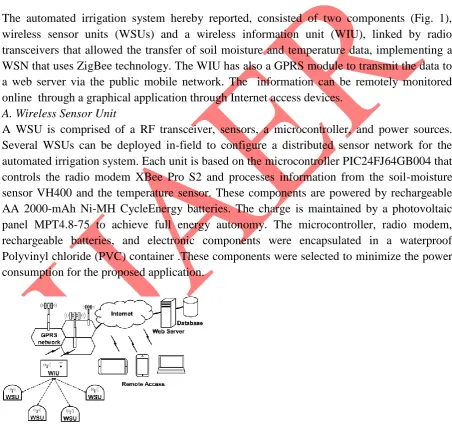
The automated irrigation system hereby reported, consisted of two components (Fig. 1), wireless sensor units (WSUs) and a wireless information unit (WIU), linked by radio transceivers that allowed the transfer of soil moisture and temperature data, implementing a WSN that uses ZigBee technology. The WIU has also a GPRS module to transmit the data to a web server via the public mobile network. The information can be remotely monitored online through a graphical application through Internet access devices.
A. Wireless Sensor Unit
A WSU is comprised of a RF transceiver, sensors, a microcontroller, and power sources. Several WSUs can be deployed in-field to configure a distributed sensor network for the automated irrigation system. Each unit is based on the microcontroller PIC24FJ64GB004 that controls the radio modem XBee Pro S2 and processes information from the soil-moisture sensor VH400 and the temperature sensor. These components are powered by rechargeable AA 2000-mAh Ni-MH CycleEnergy batteries. The charge is maintained by a photovoltaic panel MPT4.8-75 to achieve full energy autonomy. The microcontroller, radio modem, rechargeable batteries, and electronic components were encapsulated in a waterproof Polyvinyl chloride (PVC) container .These components were selected to minimize the power consumption for the proposed application.
Fig. 1. Configuration of the automated irrigation system
1) Single-Chip PIC24FJ64GB004: A 16-bit microcontroller with 44-pins and nanoWatt XLP
28
INTERNATIONAL JOURNAL OF ADVANCES IN ENGINEERING RESEARCH
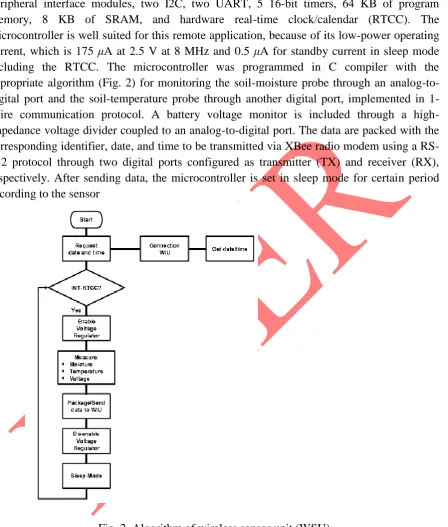
peripheral interface modules, two I2C, two UART, 5 16-bit timers, 64 KB of program memory, 8 KB of SRAM, and hardware real-time clock/calendar (RTCC). The microcontroller is well suited for this remote application, because of its low-power operating current, which is 175 μA at 2.5 V at 8 MHz and 0.5 μA for standby current in sleep mode including the RTCC. The microcontroller was programmed in C compiler with the appropriate algorithm (Fig. 2) for monitoring the soil-moisture probe through an analog-to-digital port and the soil-temperature probe through another analog-to-digital port, implemented in 1-Wire communication protocol. A battery voltage monitor is included through a high-impedance voltage divider coupled to an analog-to-digital port. The data are packed with the corresponding identifier, date, and time to be transmitted via XBee radio modem using a RS-232 protocol through two digital ports configured as transmitter (TX) and receiver (RX), respectively. After sending data, the microcontroller is set in sleep mode for certain period according to the sensor
Fig. 2. Algorithm of wireless sensor unit (WSU)
sampling rate desired, whereas the internal RTCC is running. This operation mode allows energy savings.
When the WSU is launched for first time, the algorithm also inquires the WIU, the date and time to program the RTCC, and periodically updates it for synchronization.
29
INTERNATIONAL JOURNAL OF ADVANCES IN ENGINEERING RESEARCH
ZigBee technology is based on short range WSN and it was selected for this battery-operated sensor network because of its low cost, low power consumption, and greater useful range in comparison with other wireless technologies like Bluetooth , UWB, and Wi-Fi [67]. The ZigBee devices operate in industrial, scientific, and medical 2.4 GHz radio band and allow the operation in a so-called mesh networking architecture, which can be differentiated into three categories: 1) coordinator; 2) router; and 3) end device module to establish communication between a WSU and the WIU because of its long-range operation and reliability of the sensor networking architecture. The XBee-PRO S2 is a RF modem with integrated chip antenna, 20-pins, and 13 general purpose input/output (GPIO) ports available of which four are ADC. It can operate up to a distance of 1500 m in outdoor line-of-sight with 170 mA of TX peak current and 45 mA for RX current at 3.3 V and power-down current of 3.5 μA. The XBee radio modem of each WSU is interfaced to the host microcontroller through its serial port.
The WSUs were configured such as end devices to deploy a networking topology point-to-point based on a coordinator that was implemented by the XBee radio modem of the WIU. An end device has the following characteristics: 1) it must join a ZigBee PAN before it can transmit or receive data; 2) cannot allow devices to join the network; 3) must always transmit and receive RF data through its parent; 4) cannot route data; and 5) can enter low power modes to conserve power and can be battery powered.
3) Soil Sensor Array:
The sensor array consists of two soil sensors, including moisture and temperature that are inserted in the root zone of the plants. The probe was selected to estimate the soil moisture because of low power consumption (<7 mA) and low cost. The probe measures the dielectric constant of the soil using transmission line techniques at 80 MHz, which is insensitive to water salinity, and provides an output range between 0 and 3.0 V, which is proportional to the volumetric water content .The sensor was powered at 3.3 V and monitored by the microcontroller through an ADC port. Soil temperature measurements were made through the digital thermometer .The sensor converts temperature to a 12-bit digital word and is stored in 2-B temperature registers, corresponding to increments of 0.0625 °C. The temperature is required through a reading command and transmitted using 1-Wire bus protocol implemented in the microcontroller through one digital port. The thermometer has accuracy over −10 °C to +85 °C temperature range and a unique 64-bit serial number.
The sensor is a 3-pin single-chip package that was embedded in a metal capsule and sealed in a waterproof PVC cylindrical container. To calibrate the soil moisture, several samples were prepared with 1 kg of dry soil from the crop area. Its composition was loamy sand with 80% sand separate, 4.5% clay separate, and 15.6% silt separate. The soil water holding capacity was of 20.7% corresponding to measured output voltage of 1.45 V. The temperature sensors were calibrated through a reference mercury thermometer, with 0.1 °C divisions and a range from −1 °C to 51 °C. The thermometer and the temperature sensors were placed in an insulated flask filled with mineral oil at 10 °C and 40 °C.
4) Photovoltaic Cell: To maintain the charge of the WSU batteries, a solar panel was
30
INTERNATIONAL JOURNAL OF ADVANCES IN ENGINEERING RESEARCH
voltage of the three rechargeable batteries. A Schottky diode is used to prevent the solar module and to drain the battery when is in the dark. The solar panel is encapsulated in a 3-mm clear polyester film with dimensions of 94 3-mm × 75 3-mm. This flexible panel was mounted on a PVC prismatic base (100 mm × 80 mm × 3.17 mm) that is fastened in the upper part of a PVC pole allowing for the correct alignment of the photovoltaic panel to the sun. The stick is 50 cm of length and 12.5 mm of diameter; the lower end of the pole had a tip end to be buried.
B. Wireless Information Unit
The soil moisture and temperature data from each WSU are received, identified, recorded, and analyzed in the WIU. The WIU consists of a master microcontroller PIC24FJ64GB004, an XBee radio modem, a GPRS module MTSMC-G2-SP, an RS-232 interface MAX3235E, two electronic relays, two 12 V dc 1100 GPH Livewell pumps for driving the water of the tanks, and a deep cycle 12 V at 100-Ah rechargeable battery L-24M/DC-140 which is recharged by a solar panel of 12 V at 130 W through a PWM charge controller SCI-120. All the WIU electronic components were encapsulated in a waterproof PVC box. The WIU can be located up to 1500-m line-of-sight from the WSUs placed in the field.
1) Master Microcontroller:
The functionality of the WIU is based on the microcontroller, which is programmed to perform diverse tasks, as is shown in Fig. 3. The first task of the program is to download from a web server the date and time through the GPRS module. The WIU is ready to transmit via XBee the date and time for each WSU once powered. Then, the microcontroller receives the information package transmitted by each WSU that conform the WSN. These data are processed by the algorithm that first identifies the least significant byte of a unique 64-bit address encapsulated in the package received. Second, the soil moisture and temperature data are compared with programmed values of minimum soil moisture and maximum soil temperature to activate the irrigation pumps for a desired period. Third, the algorithm also records a log file with the data in a solid state memory 24FC1025 with a capacity of 128 kB, including soil moisture and temperature, the battery voltage, the WSU ID, the date, and time generated by the internal RTCC. If irrigation is provided, the program also stores a register with the duration of irrigation, the date, and time. Finally, these data and a greenhouse ID are also transmitted at each predefined time to a web server through HTTP via the GPRS module to be deployed on the Internet web application in real time.
31
INTERNATIONAL JOURNAL OF ADVANCES IN ENGINEERING RESEARCH
Fig 3. Algorithm of the master microcontroller in the WIU
field in the database. This link is bidirectional and permits to change the threshold values through the website interface; scheduled watering or remote watering can be performed. The WIU has also a push button to perform manual irrigation for a programmed period and a LED to indicate when the information package is received. All the WIU processes can be monitored through the RS-232 port. The WIU includes a function that synchronizes the WSUs for monitoring the status of each WSU. If all WSUs are lost, the system goes automatically to a default irrigation schedule mode. Besides this action, an email is sent to alert the system administrator.
2) GPRS Module:
32
INTERNATIONAL JOURNAL OF ADVANCES IN ENGINEERING RESEARCH 3) Watering Module:
The irrigation is performed by controlling the two pumps through electromagnetic relays connected with the microcontroller via two optical isolators. The pumps have a power consumption of 48 W each and were fed by a 5000-l water tank. Four different irrigation actions (IA) are implemented in the WIU algorithm:
1) fixed duration for manual irrigation with the push button;
2) scheduled date and time irrigations through the web page for any desired time;
3) automated irrigation with a fixed duration, if at least one soil moisture sensor value of the WSN drops below the programmed threshold level;
4) automated irrigation with a fixed duration, if at least one soil temperature sensor value of the WSN exceeds the programmed threshold level.
C. Web Application
Graphical user interface software was developed for real-time monitoring and programming of irrigation based on soil moisture and temperature data. The software application permits the user to visualize graphically the data from each WSU online using any device with Internet (Fig. 4).Besides the soil-moisture and temperature graphs, the web application displays the total water consumption and the kind of the IA. The web application also enabled the user direct programming of scheduled irrigation schemes and adjusting the trigger values in the WIU according to the crop species and season management. All the information is stored in a database. The web application for monitoring and programming was coded in C# language of Microsoft Visual Studio 2010. The database was implemented in SQL Server 2005.
Fig. 4. Web application of the automated irrigation system
III. IRRIGATION SYSTEM OPERATION
33
INTERNATIONAL JOURNAL OF ADVANCES IN ENGINEERING RESEARCH
out by the system because of the soil-moisture or temperature levels, regardless of the scheduled irrigation (IA-2). All data were uploaded each hour to the web server for remote supervision.
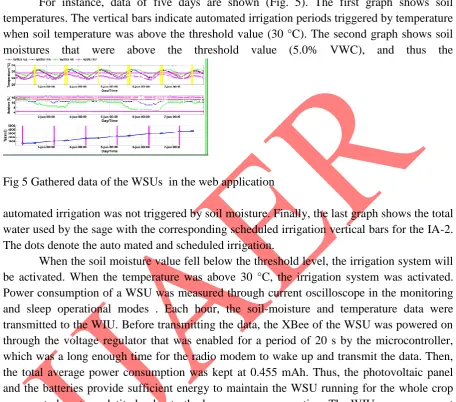
For instance, data of five days are shown (Fig. 5). The first graph shows soil temperatures. The vertical bars indicate automated irrigation periods triggered by temperature when soil temperature was above the threshold value (30 °C). The second graph shows soil moistures that were above the threshold value (5.0% VWC), and thus the
Fig 5 Gathered data of the WSUs in the web application
automated irrigation was not triggered by soil moisture. Finally, the last graph shows the total water used by the sage with the corresponding scheduled irrigation vertical bars for the IA-2. The dots denote the auto mated and scheduled irrigation.
When the soil moisture value fell below the threshold level, the irrigation system will be activated. When the temperature was above 30 °C, the irrigation system was activated. Power consumption of a WSU was measured through current oscilloscope in the monitoring and sleep operational modes . Each hour, the soil-moisture and temperature data were transmitted to the WIU. Before transmitting the data, the XBee of the WSU was powered on through the voltage regulator that was enabled for a period of 20 s by the microcontroller, which was a long enough time for the radio modem to wake up and transmit the data. Then, the total average power consumption was kept at 0.455 mAh. Thus, the photovoltaic panel and the batteries provide sufficient energy to maintain the WSU running for the whole crop season at almost any latitude, due to the low energy consumption. The WIU average current consumption is minimum of 80 mAh in operational mode However, the total average power consumption was ∼4 Ah per day considering the two irrigation pumps. The automated irrigation system implemented is a cost-effective alternative for agriculture.
IV. CONCLUSION
The automated irrigation system implemented was found to be feasible and cost effective for optimizing water resources for agricultural production. This irrigation system allows cultivation in places with water scarcity thereby improving sustainability.
34
INTERNATIONAL JOURNAL OF ADVANCES IN ENGINEERING RESEARCH
be expensive. The irrigation system can be adjusted to a variety of specific crop needs and requires minimum maintenance. The modular configuration of the automated irrigation system allows it to be scaled up for larger greenhouses or open fields. In addition, other applications such as temperature monitoring in compost production can be easily implemented. The Internet controlled duplex communication system provides a powerful decision-making device concept for adaptation to several cultivation scenarios. Furthermore, the Internet link allows the supervision through mobile telecommunication devices, such as a Smartphone. Besides the monetary savings in water use, the importance of the preservation of this natural resource justify the use of this kind of irrigation systems.
REFERENCES
[1] W. A. Jury and H. J. Vaux, “The emerging global water crisis: Managing scarcity and conflict between water users,” Adv. Agronomy, vol. 95, pp. 1–76, Sep. 2007.
[2] X. Wang, W. Yang, A. Wheaton, N. Cooley, and B. Moran, “Efficient registration of optical and IR images for automatic plant water stress assessment,” Comput. Electron.
Agricult., vol. 74, no. 2, pp. 230–237, Nov. 2010.
[3] G. Yuan, Y. Luo, X. Sun, and D. Tang, “Evaluation of a crop water stress index for detecting water stress in winter wheat in the North China Plain,” Agricult. Water Manag., vol. 64, no. 1, pp. 29–40, Jan. 2004.
[4] S. B. Idso, R. D. Jackson, P. J. Pinter, Jr., R. J. Reginato, and J. L. Hatfield, “Normalizing the stress-degree-day parameter for environmental variability,” Agricult. Meteorol., vol. 24, pp. 45–55, Jan. 1981.
[5] Y. Erdem, L. Arin, T. Erdem, S. Polat, M. Deveci, H. Okursoy, and H. T. Gültas, “Crop water stress index for assessing irrigation scheduling of drip irrigated broccoli (Brassica oleracea L. var. italica),” Agricult. Water Manag., vol. 98, no. 1, pp. 148–156, Dec. 2010. [6] K. S. Nemali and M. W. Van Iersel, “An automated system for controlling drought stress and irrigation in potted plants,” Sci. Horticult., vol. 110, no. 3, pp. 292–297, Nov. 2006. [7] S. A.O’Shaughnessy and S. R. Evett, “Canopy temperature based system effectively schedules and controls center pivot irrigation of cotton,” Agricult. Water Manag., vol. 97, no. 9, pp. 1310–1316, Apr. 2010.
[8] R. G. Allen, L. S. Pereira, D. Raes, and M. Smith, Crop Evapotranspiration-Guidelines
for Computing Crop Water Requirements—FAO Irrigation and Drainage Paper 56. Rome,
Italy: FAO, 1998.
[9] S. L. Davis and M. D. Dukes, “Irrigation scheduling performance by evapotranspiration-based controllers,” Agricult. Water Manag., vol. 98, no. 1, pp. 19–28, Dec. 2010.
[10] K. W. Migliaccio, B. Schaffer, J. H. Crane, and F. S. Davies, “Plant response to evapotranspiration and soil water sensor irrigation scheduling methods for papaya production in south Florida,” Agricult. Water Manag., vol. 97, no. 10, pp. 1452–1460, Oct. 2010.
35
INTERNATIONAL JOURNAL OF ADVANCES IN ENGINEERING RESEARCH
[12] O. M. Grant, M. J. Davies, H. Longbottom, and C. J. Atkinson, “Irrigation scheduling and irrigation systems: Optimising irrigation efficiency for container ornamental shrubs,”
Irrigation Sci., vol. 27, no. 2, pp. 139–153, Jan. 2009.
[13] Y. Kim, R. G. Evans, and W. M. Iversen, “Remote sensing and control of an irrigation system using a distributed wireless sensor network,” IEEE Trans. Instrum. Meas., vol. 57, no. 7, pp. 1379–1387, Jul. 2008.
[14] Y. Kim and R. G. Evans, “Software design for wireless sensor-based site-specific irrigation,” Comput. Electron. Agricult., vol. 66, no. 2, pp. 159–165, May 2009.
[15] D. K. Fisher and H. A. Kebede, “A low-cost microcontroller-based system to monitor crop temperature and water status,” Comput. Electron. Agricult., vol. 74, no. 1, pp. 168–173, Oct. 2010.
[16] Y. Kim, J. D. Jabro, and R. G. Evans, “Wireless lysimeters for real-time online soil water monitoring,” Irrigation Sci., vol. 29, no. 5, pp. 423–430, Sep. 2011.
[17] O. Mirabella and M. Brischetto, “A hybrid wired/wireless networking infrastructure for greenhouse management,” IEEE Trans. Instrum. Meas., vol. 60, no. 2, pp. 398–407, Feb. 2011.
[18] I. F. Akyildiz, W. Su, Y. Sankarasubramaniam, and E. Cayirci, “A survey on sensor networks,” IEEE Commun. Mag., vol. 40, no. 8, pp. 104–112, Aug. 2002.
[19] J. Yick, B. Mukherjee, and D. Ghosal, “Wireless sensor network survey,” Comput.
Netw., vol. 52, no. 12, pp. 2292–2330, Aug. 2008.
[20] M. Winkler, K.-D. Tuchs, K. Hughes, and G. Barclay, “Theoretical and practical aspects of military wireless sensor networks,” J. Telecommun. Inf. Technol., vol. 2, pp. 37–45, Apr./Jun. 2008.
[21] M. P. Durisic, Z. Tafa, G. Dimic, and V. Milutinovic, “A survey of military applications of wireless sensor networks,” in Proc. MECO, Jun. 2012, pp. 196–199.
[22] M. C. Rodríguez-Sánchez, S. Borromeo, and J. A. Hernández-Tamames, “Wireless sensor networks for conservation and monitoring cultural assets,” IEEE Sensors J., vol. 11, no. 6, pp. 1382–1389, Jun. 2011.
[23] G. López, V. Custodio, and J. I. Moreno, “LOBIN: E-textile and wireless-sensor-network-based platform for healthcare monitoring in future hospital environments,” IEEE
Trans. Inf. Technol. Biomed., vol. 14, no. 6, pp. 1446–1458, Nov. 2010.
[24] J. M. Corchado, J. Bajo, D. I. Tapia, and A. Abraham, “Using heterogeneous wireless sensor networks in a telemonitoring system for healthcare,” IEEE Trans. Inf. Technol.
Biomed., vol. 14, no. 2, pp. 234–240, Mar. 2010.
[25] G. X. Lee, K. S. Low, and T. Taher, “Unrestrained measurement of arm motion based on a wearable wireless sensor network,” IEEE Trans. Instrum. Meas., vol. 59, no. 5, pp. 1309– 1317, May 2010.
[26] D.-M. Han and J.-H. Lim, “Smart home energy management system using IEEE 802.15.4 and ZigBee,” IEEE Trans. Consum. Electron., vol. 56, no. 3, pp. 1403–1410, Aug. 2010.
36
INTERNATIONAL JOURNAL OF ADVANCES IN ENGINEERING RESEARCH
[28] M. Bertocco, G. Gamba, A. Sona, and S. Vitturi, “Experimental characterization of wireless sensor networks for industrial applications,” IEEE Trans. Instrum. Meas., vol. 57, no. 8, pp. 1537–1546, Aug. 2008.
[29] V. C. Gungor and G. P. Hancke, “Industrial wireless sensor networks: Challenges, design principles, and technical approaches,” IEEE Trans. Ind. Electron., vol. 56, no. 10, pp. 4258–4265, Oct. 2009.
[30] L. Hou and N. W. Bergmann, “Novel industrial wireless sensor networks for machine condition monitoring and fault diagnosis,” IEEE Trans. Instrum. Meas., vol. 61, no. 10, pp. 2787–2798, Oct. 2012.
[31] A. Carullo, S. Corbellini, M. Parvis, and A. Vallan, “A wireless sensor network for cold-chain monitoring,” IEEE Trans. Instrum. Meas., vol. 58, no. 5, pp. 1405–1411, May 2009. [32] A. Araujo, J. Garcia-Palacios, J. Blesa, F. Tirado, E. Romero, A. Samartin, and O. Nieto-Taladriz, “Wireless measurement system for structural health monitoring with high time-synchronization accuracy,” IEEE Trans. Instrum. Meas., vol. 61, no. 3, pp. 801–810, Mar. 2012.
[33] P. Corke, T. Wark, R. Jurdak, H. Wen, P. Valencia, and D. Moore, “Environmental wireless sensor networks,” Proc. IEEE, vol. 98, no. 11, pp. 1903–1917, Nov. 2010.
[34] L. M. Oliveira and J. J. Rodrigues, “Wireless sensor networks: A survey on environmental monitoring,” J. Commun., vol. 6, no. 2, pp. 143–151, Apr. 2011.
[35] H.-C. Lee, Y.-M. Fang, B.-J. Lee, and C.-T. King, “The tube: A rapidly deployable wireless sensor platform for supervising pollution of emergency work,” IEEE Trans. Instrum.
Meas., vol. 61, no. 10 pp. 2776–2786, Oct. 2012.
[36] H.-C. Lee, A. Banerjee, Y.-M. Fang, B.-J. Lee, and C.-T. King, “Design of a multifunctional wireless sensor for in-situ monitoring of debris flows,” IEEE Trans. Instrum.
Meas., vol. 59, no. 11, pp. 2958–2967, Nov. 2010.
[37] N. Wang, N. Zhang, and M. Wang, “Wireless sensors in agriculture and food industry— Recent development and future perspective,” Comput. Electron. Agricult., vol. 50, no. 1, pp. 1–14, Jan. 2006.
[38] D. D. Chaudhary, S. P. Nayse, and L. M. Waghmare, “Application of wireless sensor networks for green house parameters control in precision agriculture,” Int. J. Wireless Mobile
Netw., vol. 3, no. 1, pp. 140–149, Feb. 2011.
[39] P. Mariño, F. P. Fontan, M. A. Dominguez, and S. Otero, “An experimental ad-hoc WSN for the instrumentation of biological models,” IEEE Trans. Instrum. Meas., vol. 59, no. 11, pp. 2936–2948, Nov. 2010.
[40] M. Johnson, M. Healy, P. van de Ven, M. J. Hayes, J. Nelson, T. Newe, and E. Lewis, “A comparative review of wireless sensor network mote technologies,” in Proc. IEEE
Sensors, Oct. 2009, pp. 1439–1442.
37
INTERNATIONAL JOURNAL OF ADVANCES IN ENGINEERING RESEARCH
[42] M. R. Frankowiak, R. I. Grosvenor, and P. W. Prickett, “A review of the evolution of microcontroller-based machine and process monitoring,” Int. J. Mach. Tool Manuf., vol. 45, nos. 4–5, pp. 573–582,Apr. 2005.
[43] C. Kompis and P. Sureka, “Power management technologies to enable remote and wireless sensing,” ESP KTN, Teddington, U.K., Tech. Rep., May 2010.
[44] M. T. Penella and M. Gasulla, “Runtime extension of low-power wireless sensor nodes using hybrid-storage units,” IEEE Trans. Instrum. Meas., vol. 59, no. 4, pp. 857–865, Apr. 2010.
[45] W. K. G. Seah, Z. A. Eu, and H.-P. Tan, “Wireless sensor networks powered by ambient energy harvesting (WSN-HEAP)—Survey and challenges,” in Proc. 1st Int. Conf. Wireless
VITAE, May 2009, pp. 1–5.
[46] Y. K. Tan and S. K. Panda, “Self-autonomous wireless sensor nodes with wind energy harvesting for remote sensing of wind-driven wildfire spread,” IEEE Trans. Instrum. Meas., vol. 60, no. 4, pp. 1367–1377 Apr. 2011.
[47] E. Sardini and M. Serpelloni, “Self-powered wireless sensor for air temperature and velocity measurements with energy harvesting capability,” IEEE Trans. Instrum. Meas., vol. 60, no. 5, pp. 1838–1844, May 2011.
[48] I. Marin, E. Arceredillo, A. Zuloaga, and J. Arias, “Wireless sensor networks: A survey on ultra-low poweraware design,” in Proc. WASET, vol. 8. Oct. 2005, pp. 1–6.
[49] S. Kolli and M. Zawodniok, “Energy-efficient multi-key security scheme for wireless sensor network,” in Proc. IEEE 34th Conf. LCN, Oct. 2009, pp. 937–944.
[50] J. Lin, W. Xiao, F. L. Lewis, and L. Xie, “Energy-efficient distributed adaptive multisensor scheduling for target tracking in wireless sensor networks,” IEEE Trans. Instrum.
Meas., vol. 58, no. 6, pp. 1886–1896, Jun. 2009.
[51] P. Györke and B. Pataki, “Energy-aware measurement scheduling in WSNs used in AAL applications,” IEEE Trans. Instrum. Meas., vol. 62, no. 5, pp. 1318–1325, May 2013.
[52] R. Yan, H. Sun, and Y. Qian, “Energy-aware sensor node design with its application in wireless sensor networks,” IEEE Trans. Instrum. Meas., vol. 62, no. 5, pp. 1183–1191, May 2013.