MATHEMATICAL MODELLING IN THE RIVER
POLLUTION
AHMAD ZAKI BIN MOHAMAD AMIN
A dissertation submitted in partial fulfilment of the requirements for the award of the degree of Master of Science (Engineering Mathematics)
Faculty of Science
Universiti Teknologi Malaysia
iii
This is my present to my beloved parents Haji Mohamad Amin Bin Apah, Arwah Hajah Sulbah Binti Abdul Rahman, Ahmad Fauzi Mohamad Amin, Fadhil Mohamad Amin, Ahmad Fuad Mohamad Amin, Mastura Binti Mohamad Amin,
iv
ACKNOWLEDGEMENT
Alhamdulillah, all praise to Allah for giving me the strength health and patience throughout this whole process of completing my dissertation. This study is the result of the efforts of many individuals. Therefore, I would like to owe special thanks to a number of people who had helped through my study both direct and indirectly.
I would like to take this opportunity to express my greatest appreciation and honor gratitude to my supervisor Prof Madya. Dr. Shamsuddin bin Ahmad, co-supervisor, Dr. Yeak So Ho and all examiners for their continuous guidance, constructive comments, invaluable advices and their efforts and suggestions in helping me throughout these two semesters to complete my proposal together with my thesis. This study would have not been possible if not for everyone constant assistance and guidance.
v
ABSTRACT
vi
ABSTRAK
vii
TABLE OF CONTENTS
CHAPTER TITLE PAGE
DECLARATION ii
DEDICATION iii
ACKNOLEDGEMENT iv
ABSTRACT v
ABSTRAK vi
TABLE OF CONTENTS vii
LIST OF TABLE ix
LIST OF FIGURES x
LIST OF SYMBOLS xi
1. INTRODUCTION
1.0 Introduction 1
1.1 Introduction of Water Quality Models 1
1.1.1 Pollutions 2
1.1.2 Water quality standards 2 1.1.3 One Dimensional Advection Diffusion of
River Pollution in Semi Infinite Media
4
1.2 Problem Statement 7
1.3 Objectives 8
1.4 Scope 8
1.5 Significance of The Study 8
1.6 Report Structure 9
2. LITERATURE REVIEW
2.0 Introduction 10
2.1 Previous Studies 10
2.2 General one-dimensional advections diffusion equations
11
2.3 The specific one-dimensional advection diffusion equations
viii
3. RESEARCH METHODOLOGY
3.0 Introduction 14
3.1 Transport Issues 14
3.1.1 Modelling Advection-Diffusion 15 3.1.2 Continuity Equation 16 3.1.3 Diffusive and Advective Mass Flux 18 3.1.4 Initial and Boundary Conditions 20
4. ANALYSIS TECHNIQUES
4.0 Introduction 21
4.1 One Dimensional Advection Diffusion of river Pollution in Semi Infinite Media.
(Problem 1: Fast flow)
21
4.1.1 The Initial value problem (IVP) for pure convection is
21
4.1.2 Solution Inverse Laplace transforms 25 4.1.3 Results and discussion 27 4.2 One Dimensional Advection Diffusion of river
Pollution in Semi Infinite Media. (Problem 2 : Slow flow)
28
4.2.1 The Initial value problem (IVBP) 28 4.2.2 Solution Inverse Laplace transforms 31 4.2.3 Results and discussion 33 4.3 One Dimensional Advection Diffusion of river
Pollution in Semi Infinite Media. (Problem 3 : Fast and Slow flow)
34
4.3.1 The Initial value problem (IVBP) 34 4.3.2 Solution Inverse Laplace transforms 37 4.3.3 Results and discussion 39 4.4 Compare graphs the result 𝑡 40
5. CONCLUSION AND RECOMMENDATIONS
5.0 Introduction 41
5.1 Conclusion 41
5.2 Recommendation 42
ix
LIST OF TABLE
TABLE NO. TITLE PAGE
1.1 Excerpts of INWQS by Malaysia Environment
x
LIST OF FIGURES
FIGURES NO. TITLE PAGE
4.1 Concentration profile for different values of t with t 0.6
,t0.8,t 1.0, t 1.5 27
4.2
Concentration profile for different values of 𝑡 with
𝛼 = 0.5, 𝑘 = 2.0, and 𝜎 = 0.5. 33
4.3 Concentration profile for different values of 𝛼 = 0.5, 𝑘 = 2.0, 𝑉 𝑡 with
0 = 2.0 and 𝜎 = 0.5. 39
xi
LIST OF SYMBOLS
𝑡 - Time
𝑥 - Position
𝜎 - Diffusion Coefficient 𝑉0 - Velocity of the river
1
CHAPTER 1
INTRODUCTION
1.0 Introduction
This chapter will briefly discuss on the dissertation flow from the study of background, problem statement and objectives of the study. Hence, it follows by the scope of study, significant of the study and study overview. Each subtopic is related with each other to make the readers easier to understand the dissertation.
1.1 Introduction of Water Quality Models.
2
Water quality modelling involves the prediction of water pollution using mathematical simulation techniques. A typical water quality model consists of a collection of formulations representing the physical situation of pollutants in water. Laplace method is used to calculate the solution of the model and then interpreted and validated the solution accoding to the physical situation.
1.1.1 Pollutions
The existence of foreign substance in air and water affected the quality of air and water. Air pollution, water pollution and land pollution are other different kinds of pollution that were found in our environment. The reduction of the quality of air and water effects the living organisms in the medium by A. R. A. Baginda and Z. Zainudin (2009).
Water and air are discharged from industries contributes to water and air quality. The discharged material contains acids, alkalis, salts, poisons, oils and harmful bacteria. Other than industry, the mining and agricultural wastes also contribute to the pollution. Sewage disposal from domestic and farm often allowed to pollute the rivers. In the water pollution, there are point source and a nonpoint source pollutant. The pollutant solute transport can be modelled in term of partial differential equation known as advection-diffusion equation.
1.1.2 Water quality standards
3
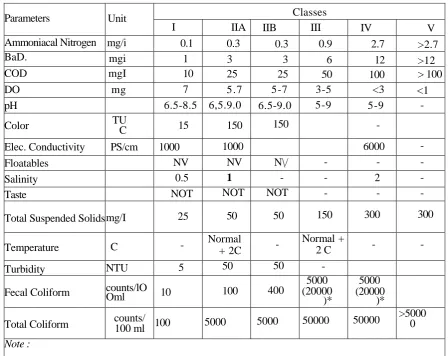
According to Malaysia Environment Quality Report (2006), in 1985 the government undertook a national study. The study was carried out in four phases with the intention of developing a national “benchmark” of water quality. Over 120 psycho-chemical and biological parameters were reviewed in the study. At the end, The Interim National Water Quality Standards (INWQS) defined six classes of polluted that is I, IIA, IIB, III, IV, V. (refer to table 1.1)
Table 1.1 Excerpts of INWQS by Malaysia Environment Quality Report (2006)
Parameters Unit Classes
I IIA IIB III IV V
Ammoniacal Nitrogen mg/i 0.1 0.3 0.3 0.9 2.7 >2.7
BaD. mgi 1 3 3 6 12 >12
COD mgI 10 25 25 50 100 > 100
DO mg 7 5.7 5-7 3-5 <3 <1
pH 6.5-8.5 6,5.9.0 6.5-9.0 5-9 5-9 -
Color TUC 15 150 150 -
Elec. Conductivity PS/cm 1000 1000 6000 -
Floatables NV NV N\/ - - -
Salinity 0.5 1 - - 2 -
Taste NOT NOT NOT - - -
Total Suspended Solids mg/I 25 50 50 150 300 300
Temperature C - Normal + 2C - Normal 2 C + - -
Turbidity NTU 5 50 50 -
Fecal Coliform counts/lOOml 10 100 400 (200005000 )*
5000 (20000
)*
Total Coliform counts/ 100 ml 100 5000 5000 50000 50000
>5000 0
Note :
4
1.1.3 One Dimensional Advection Diffusion of River Pollution in Semi Infinite Media
Suppose we consider that a chemical substance is being poured at a constant rate into a straight, narrow and clean river that flows with a constant velocity. The concentration 𝑢(𝑥, 𝑡) of substance at a distance 𝑥 downstream at time 𝑡 is the solution of initial value problem (IVP).
𝜕𝑢 𝜕𝑡 = 𝜎
𝜕2𝑢
𝜕𝑥2 − 𝑣0
𝜕𝑢
𝜕𝑥− 𝑘𝑐, 𝑥 > 0, 𝑡 > 0
𝑢(0, 𝑡) = 𝛼 = Constant, 𝑡 > 0,
𝑢(𝑥, 0) = 0, 𝑥 > 0,
𝑢(𝑥, 𝑡) → 0, 𝑥 → ∞
5
Case 1: The river is slow, then the convection term is much smaller than the diffusion term. The PDE becomes
𝜕𝑢 𝜕𝑡 = 𝜎
𝜕2𝑢
𝜕𝑥2, 𝑥 > 0, 𝑡 > 0
𝑢(0, 𝑡) = 𝛼 = Constant, 𝑡 > 0,
𝑢(𝑥, 0) = 0, 𝑥 > 0,
𝑢(𝑥, 𝑡) → 0, 𝑥 → ∞
Case 2: The river is fast, then the PDE
𝜕𝑢
𝜕𝑡 = −𝑣0 𝜕𝑢
𝜕𝑥− 𝑘𝑐, 𝑥 > 0, 𝑡 > 0
𝑢(0, 𝑡) = 𝛼 = Constant, 𝑡 > 0,
𝑢(𝑥, 0) = 0, 𝑥 > 0,
6
Case 3: We consider the initial value problem (IVP):
𝜕𝑢 𝜕𝑡 = 𝜎
𝜕2𝑢
𝜕𝑥2− 𝑣0
𝜕𝑢
𝜕𝑥− 𝑘𝑐, 𝑥 > 0, 𝑡 > 0
𝑢(0, 𝑡) = 𝛼 = Constant, 𝑡 > 0,
𝑢(𝑥, 0) = 0, 𝑥 > 0,
7
1.2 Problem Statement
Environmental pollution issues related to water quality are very important. To study the water pollution we need to study the suitable mathematical model. For that purpose we consider the one dimensional advection diffusion equation of river flow.
Consider very long river with the substance already uniformly distributed in it from source of the river up to the observation point 𝑥 = 0 assume that both diffusion and convection effects significantly. The concentration 𝑢(𝑥, 𝑡) of substance at a distance 𝑥 downstream at time 𝑡 is the solution of the initial value problem (IVBP):
𝜕𝑢 𝜕𝑡 = 𝜎
𝜕2𝑢
𝜕𝑥2− 𝑣0
𝜕𝑢
𝜕𝑥− 𝑘𝑐, 𝑥 > 0, 𝑡 > 0
𝑢(0, 𝑡) = 𝛼 = 𝑐𝑜𝑛𝑠𝑡𝑎𝑛𝑡, 𝑡 > 0,
𝑢(𝑥, 0) = 0, 𝑥 > 0
8
1.3 Objectives
The objectives of this research are:
1. to derive the mathematical model of river pollution.
2. to solve the mathematical model of river pollution using Laplace method.
3. to analysis and interpret the solution of the mathematical model.
1.4 Scope
We only use mathematical modelling of river pollution in terms of Partial Differential Equation. The analytical solution of the model is calculated using Laplace transforms.
1.5 Significance of The Study
9
1.6 Report Structure
The report of this dissertation is written as follow:
i. Chapter 2
Literature Review. All previous studies are assembled in this chapter, including the theories, models and method.
ii. Chapter 3
Mathematical Modelling. The derivation and solution of the model are explained clearly.
iii. Chapter 4
Analysis Techniques. The methods of Laplace transform method are used to get the solution of the models.
iv. Chapter 5
Results and Discussion. The solutions from previous chapter in terms of graphs are used to analyze the problems.
v. Chapter 6
43
REFERENCE
A. R. A. Baginda and Z. Zainudin (2009),“Keynote Paper : Moving Towards Integrated River Basin Management (IRBM) in Malaysia”, The Institution of Engineers, Malaysia (IEM), Proceedings, 11th Annual IEM Water Resources Colloquium, ISBN 978-967- 5048-46-3.
Articles Department of Environment Malaysia (1985), “Development of Water Quality Criteria and Standards for Malaysia”.
Articles Department of Environment Malaysia (2007), “Malaysia Environmental Quality Report 2006”, In : Chapter 3 : River Water Quality, Sasyaz Holdings Sdn Bhd, pp. 24.
C. N. Sawyer, P. L. McCarty and G. F. Parkin, (2003) “Chemistry for Environmental Engineering and Science : Fifth Edition”, In : Chapter 22 : Dissolved Oxygen, McGraw-Hill Professional., USA.
F. E. Cellier (1991), Continuous System Modeling, Springer - Verlag, New York. Gerhand H. Jirka, (2004), Advective Diffusion Equation, Institute for Hydromechanics
University of Karlsruhe
Guerrero J S P, Pimentel L C G, Skaggs T H and van Genuchten M Th 2009 Analytical solution of the advection–diffusion transport equation using a change-of variable and integral transform technique; Int. J. Heat Mass Transfer 52 3297–3304.
H. S Govinda Rao, (2009), Advanced Engineering Mathematics, Inderpuri, New Delhi – page 149
Jamaluddin. T, Zainal. A. A, (2012), Mathematical Method, Lecture Note, Universiti Teknologi Malaysia.
Dilip Kumar Jaiswal, Atul Kumar, Raja Ram Yadav (2011), Analytical Solution to the One-Dimensional Advection-Diffusion Equation, Journal of Water Resource and Protection, 76-84
Ogata and Banks 1961; Ogata 1964; Thormann and Mueller (1987), Solution of the Advection-Dispersion Equation: Continuous Load Of Finite Duration