NETWORK INTRUSION ALERT CORRELATION CHALLENGES
AND TECHNIQUES
IDS gel reportee Maheyzah Md Siraj, Siti Zaiton Mohd Hashim
positive
Faculty of Computer Science and Information System, ofalertl
Universiti Teknologi Malaysia,
IDS
em
81310 Skudai, Johor, Malaysia.deteetec Email: {maheyzah.sitizaiton}@utm.my
activitic alerts c
non-int Abstract: Many organizations implement Intrusion Detection Systems (IDS) as the first line of
fromer defense for their security systems. Up to now, the researchers have developed IDS in many
IDS alE computer environments. Having detected the signs of intrusions, IDS trigger alerts to report them.
undersl These alerts are presented to human analyst to be evaluated and initiates adequate responses. But,
manually analyzing those alerts are tedious, time-consuming and error-prone. The reasons for
Realizi this: (1) the number of alerts is enormous, and (2) most of them are false alerts. A promising
f
System (lDRS: method to automate the alert analysis is finding the correlation between alerts, and such system is/; ttlerts
indepene known as Alert Correlation System (ACS). One of the major applications of alert correlationThese
alerts wi (AC) is attack diagnosis. Interestingly, researchers have different kind of views to define theIntrusive ReSJl concept of AC. Furthermore, a various types of techniques have been proposed in AC: (1) to
reduce the false alerts, and (2) to find causality relationship between alerts to extract the strategies of attacker. This paper discussed the challenges of ACS and the most importantly presents a review of techniques and solutions proposed in the course of the last ten years, while comparing their advantages and limitations. The survey is followed by the presentation of potential future
This ~
research directions in this area.
the fundamen problems face Keywords: information assurance and security, alert correlation, alert analysis, intrusion
This is follm detection, preventive system.
discussing tht worth to look 1. INTRODUCTION
Intrusion Detection Systems (IDS) have been extensively used by researchers and practitioners to maintain trustworthiness in computer environments [1,2]. A major problem in the IDS is the guarantee for the intrusion detection. This is the reason why in many cases IDS are used together with a human expert (or analyst). In this way, IDS is actually helping the human expert and it is
Jtlld 20, BII. 2 (Dlsember 2008) JumaI I ekDologl Mliklumat
NETWORK INTRUSION ALERT CORRELATION CHALLENGES
AND TECHNIQUES
Maheyzah Md Siraj, Siti Zaiton Mohd Hashim
Faculty of Computer Science and Information System, Universiti Teknologi Malaysia.
81310 Skudai, Johor, Malaysia.
Email: {maheyzah.sitizaiton}@utm.my
Abstract: Many organizations implement Intrusion Detection Systems (IDS) as the first line of
defense for their security systems. Up to now, the researchers have developed IDS in many
computer environments. Having detected the signs of intrusions, IDS trigger alerts to report them.
These alerts are presented to human analyst to be evaluated and initiates adequate responses. But,
manually analyzing those alerts are tedious, time-consuming and error-prone. The reasons for
this: (1) the number of alerts is enormous, and (2) most of them are false alerts. A promising
method to automate the alert analysis is finding the correlation between alerts, and such system is
known as Alert Correlation System (ACS). One of the major applications of alert correlation
(AC) is attack diagnosis. Interestingly, researchers have different kind of views to define the
concept of AC. Furthermore, a various types of techniques have been proposed in AC: (1) to
reduce the false alerts, and (2) to find causality relationship between alerts to extract the strategies
of attacker. This paper discussed the challenges of ACS and the most importantly presents a
review of techniques and solutions proposed in the course of the last ten years, while comparing
their advantages and limitations. The survey is followed by the presentation of potential future
research directions in this area.
Keywords: information assurance and security, alert correlation, alert analysis, intrusion
detection, preventive system.
1. INTRODUCTION
Intrusion Detection Systems (IDS) have been extensively used by researchers and practitioners to
maintain trustworthiness in computer environments [1,2]. A major problem in the IDS is the
guarantee for the intrusion detection. This is the reason why in many cases IDS are used together
with a human expert (or analyst). In this way, IDS is actually helping the human expert and it is
JIHd20, Btl. 2 (Dtsember 2008) Jumil IekDologl Mliklumat
NETWORK INTRUSION ALERT CORRELATION CHALLENGES
AND TECHNIQUES
Maheyzah Md Siraj, Siti Zaiton Mohd Hashim
Faculty of Computer Science and Information System, Universiti Teknologi Malaysia.
81310 Skudai, Johor, Malaysia.
Email: {maheyzah.sitizaiton}@utm.my
Abstract: Many organizations implement Intrusion Detection Systems (IDS) as the first line of
defense for their security systems. Up to now, the researchers have developed IDS in many
computer environments. Having detected the signs of intrusions, IDS trigger alerts to report them.
These alerts are presented to human analyst to be evaluated and initiates adequate responses. But,
manually analyzing those alerts are tedious, time-consuming and error-prone. The reasons for
this: (1) the number of alerts is enormous, and (2) most of them are false alerts. A promising
method to automate the alert analysis is finding the correlation between alerts, and such system is
known as Alert Correlation System (ACS). One of the major applications of alert correlation
(AC) is attack diagnosis. Interestingly, researchers have different kind of views to define the
concept of AC. Furthermore, a various types of techniques have been proposed in AC: (1) to
reduce the false alerts, and (2) to find causality relationship between alerts to extract the strategies
of attacker. This paper discussed the challenges of ACS and the most importantly presents a
review of techniques and solutions proposed in the course of the last ten years, while comparing
their advantages and limitations. The survey is followed by the presentation of potential future
research directions in this area.
Keywords: information assurance and security, alert correlation, alert analysis, intrusion
detection, preventive system.
1. INTRODUCTION
Intrusion Detection Systems (IDS) have been extensively used by researchers and practitioners to
maintain trustworthiness in computer environments [1,2]. A major problem in the IDS is the
guarantee for the intrusion detection. This is the reason why in many cases IDS are used together
with a human expert (or analyst). In this way, IDS is actually helping the human expert and it is
not reliable enough to be trusted on its own. Among the limitations of current IDS that lead to the
research of alert correlation (AC) include:
I) IDS generates a huge number of alerts [3-9]. For example, in [8] "five IDS sensors
reported 40MB of alert data within ten days, and a large fraction of these alerts are false
positives". This problem is acknowledged by practioners [2] that "IDSs trigger thousands
of alerts per day".
2) IDS cannot ensure that all alerts reflect actual attacks. The 'true positives' (i.e., attacks
detected as intrusive) alerts are usually mixed with 'false positives' alerts (i.e., benign
activities detected as intrusive) [10-13]. Worse, only I% of the enormous amount of IDS alerts corresponds to unique attacks. The remainders are false positives (i.e., alerts on
non-intrusive actions), repeated warnings for the same attack, or alert notifications arising
from erroneous activity or configuration artifacts [8,9].
3) IDS alerts bring low-level information [13]. This make human analyst hardly to (directly)
understand the security state of the protected network and study the attack strategies [14].
Realizing of this shortcoming, IDS will be upgraded to Intrusion Detection and Response
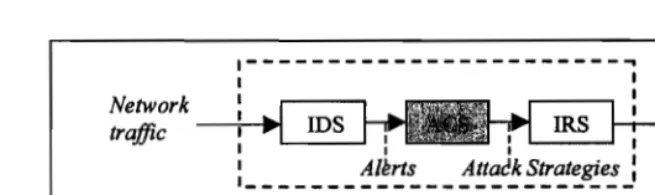
System (IDRS)[ 1]. Briefly, as shown in Figure I, once the intrusion is detected, IDS will raise
alerts independently (for each attack), though there may be logical connections between them.
These alerts will be processed and analyzed using Alert Correlation System (ACS) to facilitate the
Intrusive Response System (IRS). IRS is responsible to plan and develop effective response
mechanisms. Automation of ACS is very important not only because to achieve a reliable and
accurate response plans, but to reveal the continuously changing attack strategies. On the other
hand, details on the taxonomy ofIRS can be found in [17], and also its survey in [18].
This paper is focused on the second part of IDRS, the ACS. In specific, Section 2 defines
the fundamental concept and its conceptual framework. Section 3 discusses the AC issues and
problems faced by researchers. Section 4 explores the existing ACapproaches and techniques.
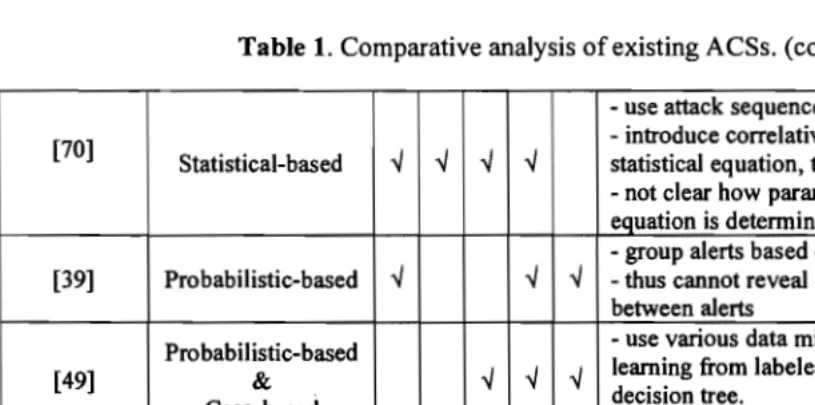
This is followed by Section 5 which presents comparative analysis of existing ACSs while
discussing their advantages and drawbacks. Section 6 proposes open research problems that are
worth to look into in the area of AC. Finally, Section 7 concluded this paper.
hhd 20, Btl. 2 (Dtsember 2008) Jumal I eknologl Miiklumat
not reliable enough to be trusted on its own. Among the limitations of current IDS that lead to the
research of alert correlation (AC) include:
I) IDS generates a huge number of alerts [3-9]. For example, in [8] "five IDS sensors
reported 40MB of alert data within ten days, and a large fraction of these alerts are false
positives". This problem is acknowledged by practioners [2] that "IDSs trigger thousands
of alerts per day".
2) IDS cannot ensure that all alerts reflect actual attacks. The 'true positives' (i.e., attacks
detected as intrusive) alerts are usually mixed with 'false positives' alerts (i.e., benign
activities detected as intrusive) [10-13]. Worse, only 1%of the enormous amount of IDS alerts corresponds to unique attacks. The remainders are false positives (i.e., alerts on
non-intrusive actions), repeated warnings for the same attack, or alert notifications arising
from erroneous activity or configuration artifacts [8,9].
3) IDS alerts bring low-level information [13]. This make human analyst hardly to (directly)
understand the security state of the protected network and study the attack strategies [14].
Realizing of this shortcoming, IDS will be upgraded to Intrusion Detection and Response
System (IDRS)[l]. Briefly, as shown in Figure 1, once the intrusion is detected, IDS will raise
alerts independently (for each attack), though there may be logical connections between them.
These alerts will be processed and analyzed using Alert Correlation System (ACS) to facilitate the
Intrusive Response System (IRS). IRS is responsible to plan and develop effective response
mechanisms. Automation of ACS is very important not only because to achieve a reliable and
accurate response plans, but to reveal the continuously changing attack strategies. On the other
hand, details on the taxonomy ofIRS can be found in [17], and also its survey in [18].
This paper is focused on the second part of IDRS, the ACS. In specific, Section 2 defines
the fundamental concept and its conceptual framework. Section 3 discusses the AC issues and
problems faced by researchers. Section 4 explores the existing ACapproaches and techniques.
This is followed by Section 5 which presents comparative analysis of existing ACSs while
discussing their advantages and drawbacks. Section 6 proposes open research problems that are
worth to look into in the area of AC. Finally, Section 7 concluded this paper.
Jihd 20, Btl. 2 (Dtsember 2008) Jamal I eknologl Miiklumat
not reliable enough to be trusted on its own. Among the limitations of current IDS that lead to the
research of alert correlation (AC) include:
I) IDS generates a huge number of alerts [3-9]. For example, in [8] "five IDS sensors
reported 40MB of alert data within ten days, and a large fraction of these alerts are false
positives". This problem is acknowledged by practioners [2] that "IDSs trigger thousands
of alerts per day".
2) IDS cannot ensure that all alerts reflect actual attacks. The 'true positives' (i.e., attacks
detected as intrusive) alerts are usually mixed with 'false positives' alerts (i.e., benign
activities detected as intrusive) [10-13]. Worse, only 1%of the enormous amount of IDS alerts corresponds to unique attacks. The remainders are false positives (i.e., alerts on
non-intrusive actions), repeated warnings for the same attack, or alert notifications arising
from erroneous activity or configuration artifacts [8,9].
3) IDS alerts bring low-level information [13]. This make human analyst hardly to (directly)
understand the security state of the protected network and study the attack strategies [14].
Realizing of this shortcoming, IDS will be upgraded to Intrusion Detection and Response
System (IDRS)[l]. Briefly, as shown in Figure 1, once the intrusion is detected, IDS will raise
alerts independently (for each attack), though there may be logical connections between them.
These alerts will be processed and analyzed using Alert Correlation System (ACS) to facilitate the
Intrusive Response System (IRS). IRS is responsible to plan and develop effective response
mechanisms. Automation of ACS is very important not only because to achieve a reliable and
accurate response plans, but to reveal the continuously changing attack strategies. On the other
hand, details on the taxonomy ofIRS can be found in [17], and also its survey in [18].
This paper is focused on the second part of IDRS, the ACS. In specific, Section 2 defines
the fundamental concept and its conceptual framework. Section 3 discusses the AC issues and
problems faced by researchers. Section 4 explores the existing ACapproaches and techniques.
This is followed by Section 5 which presents comparative analysis of existing ACSs while
discussing their advantages and drawbacks. Section 6 proposes open research problems that are
worth to look into in the area of AC. Finally, Section 7 concluded this paper.
I---~
I I
Network traffic
I
I
: :
I
I-t-I - . I
Response plans
I
1 All!rts Attack Strategies :_
IDRS
Figure 1. An Intrusion Detection and Response System (IDRS).
2. ALERT CORRELATION
A promising technique to analyze intrusion detection (ID) alerts is called Alert Correlation [10,
15,16]. In reality, ID community has brought the idea of managing alerts from the network
surveillance where alert correlation is first used in order to reduce the workload of the analysts
[19]. Computer networks produce thousands of alerts per day that make the task of the network
surveillance and alert management difficult [20]. Based on this observation and the actual need
for alert analysis and assessment, [19] introduced AC to cope with this phenomenon. Any tool or
software system that based on the AC processes is known as Alert Correlation System (ACS).
First, let we define correlation. In the field of mathematics and statistics, correlation is a
simultaneous change in value of two numerically valued random variables [21]. The, positive
correlation between cigarette smoking and the incidence of lung cancer for instance. Such
statistical correlation is not appropriate for ID, since the researchers do not model alert streams by
means of random variables. Correlation in analyzing alerts, however, has no consistent definition
and has been used differently by researchers and IDS vendors [12]. Other definition of correlation
based on a dictionary by [21] is a causal, complementary, parallel, or reciprocal relationship,
especially a structural, functional, or qualitative correspondence between two comparable entities,
for example a correlation between drug abuse and crime. However this definition is not very
precise [12].
Precisely, the correlation in the field of alert analysis concerns finding relationships
between alerts generated by a single (or multiple) data sources and coupling this information with
additional knowledge [12]. It is a process that analyzes the alerts produced by one or more IDSs
and provides a more succinct and high-level view of occurring or attempted intrusions [13]. AC is
a challenging task in security management. Moreover, an ACS should effectively reduce the alert
redundancy, intelligently analyze alerts and correctly identify the attack strategies. In fact, the goal
of correlation would be to present the information generated by IDS in a meaningful way, i.e., a
way which can be easily understood and processed by a human analyst and helping himlher
JIhd 20, BII. 2 (Dlsember 2008) Jumal Ieknologl Milklumat
I
In:
i
~I[
I 0_ ..•
Network traffic
I---~
I I
I I
I I
I I - r - - '
I : I
I All!rts Attack Strategies : 1
-IDRS
Response plans
Figure 1. An Intrusion Detection and Response System (IDRS).
2. ALERT CORRELATION
A promising technique to analyze intrusion detection (ID) alerts is calledAlert Correlation[10, 15,16]. In reality, ID community has brought the idea of managing alerts from the network surveillance where alert correlation is first used in order to reduce the workload of the analysts [19]. Computer networks produce thousands of alerts per day that make the task of the network surveillance and alert management difficult [20]. Based on this observation and the actual need for alert analysis and assessment, [19] introduced AC to cope with this phenomenon. Any tool or software system that based on the AC processes is known as Alert Correlation System (ACS).
First, let we definecorrelation.In the field of mathematics and statistics, correlation is a simultaneous change in value of two numerically valued random variables [21]. The, positive correlation between cigarette smoking and the incidence of lung cancer for instance. Such statistical correlation is not appropriate for 10, since the researchers do not model alert streams by means of random variables. Correlation in analyzing alerts, however, has no consistent definition and has been used differently by researchers and IDS vendors [12]. Other definition of correlation based on a dictionary by [21] is a causal, complementary, parallel, or reciprocal relationship, especially a structural, functional, or qualitative correspondence between two comparable entities, for example a correlation between drug abuse and crime. However this definition is not very precise [12].
Precisely, the correlation in the field of alert analysis concerns finding relationships between alerts generated by a single (or multiple) data sources and coupling this information with additional knowledge [12]. Itis a process that analyzes the alerts produced by one or more lOSs and provides a more succinct and high-level view of occurring or attempted intrusions [13]. AC is a challenging task in security management. Moreover, an ACS should effectively reduce the alert redundancy, intelligently analyze alerts and correctly identify the attack strategies. In fact, the goal of correlation would be to present the information generated by IDS in a meaningful way, i.e., a way which can be easily understood and processed by a human analyst and helping himlher
JIhd 20, BII. 2 (Dlsember 2008) Jumalleknologl Milklumat
Network traffic
I---~
I I
I I
I I
I I - r - - '
I : I
I All!rts Attack Strategies : 1
-IDRS
Response plans
Figure 1. An Intrusion Detection and Response System (IDRS).
2. ALERT CORRELATION
A promising technique to analyze intrusion detection (ID) alerts is calledAlert Correlation[10, 15,16]. In reality, ID community has brought the idea of managing alerts from the network surveillance where alert correlation is first used in order to reduce the workload of the analysts [19]. Computer networks produce thousands of alerts per day that make the task of the network surveillance and alert management difficult [20]. Based on this observation and the actual need for alert analysis and assessment, [19] introduced AC to cope with this phenomenon. Any tool or software system that based on the AC processes is known as Alert Correlation System (ACS).
First, let we definecorrelation.In the field of mathematics and statistics, correlation is a simultaneous change in value of two numerically valued random variables [21]. The, positive correlation between cigarette smoking and the incidence of lung cancer for instance. Such statistical correlation is not appropriate for 10, since the researchers do not model alert streams by means of random variables. Correlation in analyzing alerts, however, has no consistent definition and has been used differently by researchers and IDS vendors [12]. Other definition of correlation based on a dictionary by [21] is a causal, complementary, parallel, or reciprocal relationship, especially a structural, functional, or qualitative correspondence between two comparable entities, for example a correlation between drug abuse and crime. However this definition is not very precise [12].
Precisely, the correlation in the field of alert analysis concerns finding relationships between alerts generated by a single (or multiple) data sources and coupling this information with additional knowledge [12]. Itis a process that analyzes the alerts produced by one or more lOSs and provides a more succinct and high-level view of occurring or attempted intrusions [13]. AC is a challenging task in security management. Moreover, an ACS should effectively reduce the alert redundancy, intelligently analyze alerts and correctly identify the attack strategies. In fact, the goal of correlation would be to present the information generated by IDS in a meaningful way, i.e., a way which can be easily understood and processed by a human analyst and helping himlher
discover attacks and incidents. It is important to notice that the goal of correlation tasks is to help
the human operators as much as possible, but not to replace them.
2.1 Conceptual Framework
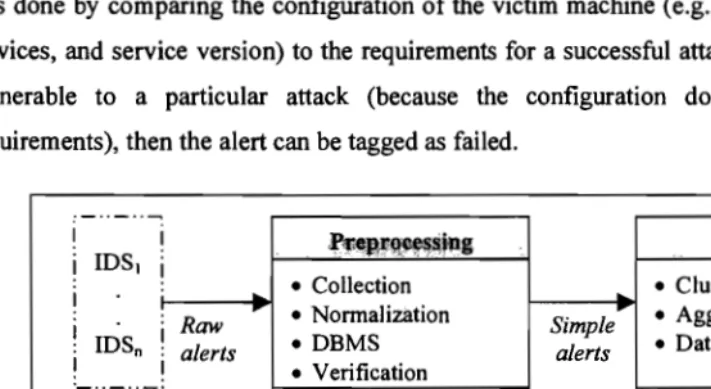
The ACS framework consists of several operations. Generally, the operations for an ACS
framework in accordance with the literature reviewed in this research area are illustrated in Figure
2. Refering to Figure 2, in the Preprocessing phase, raw alerts are collected from one or many
IDSs and converted to a standard format (or known as normalization), called Intrusion Detection
Message Exchange Format (IDMEF)[22]. The alerts with all its attributes are then stored in a
Database Management System (DBMS). To ensure the alerts are true positives, verification
which is defined as the process of verifying the success of attacks is essential. Proposed by [23],
it is done by comparing the configuration of the victim machine (e.g., operating system, running
services, and service version) to the requirements for a successful attac~. When the victim is not vulnerable to a particular attack (because the configuration does not satisfy the attack
requirements), then the alert can be tagged as failed.
~alysis
IDS.
• Collection • Clustering
Raw ~ • Normalization Simple ~ • Aggregate/Merge
• DBMS • Data Mining
alerts alerts
• Verification
;
i
..
_
.._
.._
.._
..
...,
: j. / ,~'~;r:'>: 1.~'" " . :t.::,.:. :[
.>!.
'A~,)i~Jl~',.,..
Hyper alerts II
Response and preventive mechanisms
• Knowledge-based
• Causal relationship ~
I I Attack • Pre-condition and
~ I scenarios Post-condition rules
L .• _ •• _ •• _ .. _ •• _:
Figure 2. The framework of Alert Correlation System (ACS).
The main goal of Analysis phase is usually to get rid of most of the false alerts, not
forgetting to merge the redundant alerts. To do this, similarity-based clustering [4] can detect
redundancies and emerge the cluster as hyper alerts. Whilst in [8], researcher groups alerts based
on the same root causes. The future load of alerts could be reduced by removing the most
predominant and persistent root causes.
Jmd
26,
Bu. 2 (Dlsember 2008) Jumal I eknologl Maklumatdiscover attacks and incidents. Itis important to notice that the goal of correlation tasks is to help
the human operators as much as possible, but not to replace them.
2.1 Conceptual Framework
The ACS framework consists of several operations. Generally, the operations for an ACS
framework in accordance with the literature reviewed in this research area are illustrated in Figure
2. Refering to Figure 2, in thePreprocessing phase, raw alerts are collected from one or many
lOSs and converted to a standard format (or known as normalization), called Intrusion Detection
Message Exchange Format (IDMEF)[22]. The alerts with all its attributes ar~then stored in a Database Management System (DBMS). To ensure the alerts are true positives, verification
which is defined as the process of verifying the success of attacks is essential. Proposed by [23],
it is done by comparing the configuration of the victim machine (e.g., operating system, running
services, and service version) to the requirements for a successfulattac~. When the victim is not vulnerable to a particular attack (because the configuration does not satisfy the attack
requirements), then the alert can be tagged as failed.
.. • Collection
1 - - - . 1
Raw ~ • Normalization
alerts • DBMS • Verification
..
~ Simplealerts
• Clustering • Aggregate/Merge • Data Mining
~..
_
.._
.._
.._
.....,
I
I Response and preventive
I mec anlsmsh ' .1<ll....1 - - - l
I I Attack
~
I
scenariosL .• _ •• _ •• _ .. _ •• _:
>! ,.
';;~~~Il~',. ','
• Knowledge-based• Causal relationship . .
-• Pre-condition and Post-condition rules
Hyper alerts
Figure 2. The framework of Alert Correlation System (ACS).
The main goal ofAnalysis phase is usually to get rid of most of the false alerts, not
forgetting to merge the redundant alerts. To do this, similarity-based clustering [4] can detect
redundancies and emerge the cluster as hyper alerts. Whilst in [8], researcher groups alerts based
on the same root causes. The future load of alerts could be reduced by removing the most
predominant and persistent root causes.
Jmd 26,
Bu.
2 (Dlsember 2008) Jumal Ieknologl Miiklumatdiscover attacks and incidents. Itis important to notice that the goal of correlation tasks is to help
the human operators as much as possible, but not to replace them.
2.1 Conceptual Framework
The ACS framework consists of several operations. Generally, the operations for an ACS
framework in accordance with the literature reviewed in this research area are illustrated in Figure
2. Refering to Figure 2, in thePreprocessing phase, raw alerts are collected from one or many
lOSs and converted to a standard format (or known as normalization), called Intrusion Detection
Message Exchange Format (IDMEF)[22]. The alerts with all its attributes ar~then stored in a Database Management System (DBMS). To ensure the alerts are true positives, verification
which is defined as the process of verifying the success of attacks is essential. Proposed by [23],
it is done by comparing the configuration of the victim machine (e.g., operating system, running
services, and service version) to the requirements for a successfulattac~. When the victim is not vulnerable to a particular attack (because the configuration does not satisfy the attack
requirements), then the alert can be tagged as failed.
.. • Collection
1 - - - . 1
Raw ~ • Normalization
alerts • DBMS • Verification
..
~ Simplealerts
• Clustering • Aggregate/Merge • Data Mining
~..
_
.._
.._
.._
.....,
I
I Response and preventive
I mec anlsmsh ' .1<ll....1 - - - l
I I Attack
~
I
scenariosL .• _ •• _ •• _ .. _ •• _:
>! ,.
';;~~~Il~',. ','
• Knowledge-based• Causal relationship . .
-• Pre-condition and Post-condition rules
Hyper alerts
Figure 2. The framework of Alert Correlation System (ACS).
The main goal ofAnalysis phase is usually to get rid of most of the false alerts, not
forgetting to merge the redundant alerts. To do this, similarity-based clustering [4] can detect
redundancies and emerge the cluster as hyper alerts. Whilst in [8], researcher groups alerts based
on the same root causes. The future load of alerts could be reduced by removing the most
predominant and persistent root causes.
c
For Correlation, a common approach is defining rules or knowledge to determine the relationship between two alerts, as proposed in [4,7,24,25]. They predefined set of pre-condition and post-condition rules for each alerts, based on the observation that most attacks consists of many stages. Thus, alert whose post-conditions contribute to pre-conditions of the next alert can be correlated as previous alert preparing for the next one. These relationships construct attack scenarios and reveal the next goals of attacker (Le., via observation of attack graphs). In a result, response and preventive mechanisms can be planned and developed to avoid the damage from escalating and to stop the attack at earlier stage.
3. CHALLENGES AND PROBLEMS
We classified four categories of main research issues and presented its related problems in the research of AC. They are in the following:
I) Improving Quality ofAlerts (reducing redundant and false positives alerts thru alert post-processing),
2) Constructing Attack Scenarios,
3) Extracting Attack Strategies to Predict Attacker's Next Goal, and
4) Other Issues.
con1 3.1 Issue 1 : Improving Quality of Alerts
ofit
It is known that current IDSs generate massive amount of alerts, not only because of the
Prol redundant alerts, but also the mixing of false alerts (Le., false positives and/or false negatives).
recc:
This situation contributes to low quality alerts. In fact, it has been estimated that up to 99% of
detc
alerts reported by lOSs are not related to security issues [8,9,26]. Reasons for this include the
Fin
following as mentioned in [27]:
inje
Runtime limitations : In many cases an intrusion differs only slightly from normal activities,
ad~
sometimes even only the context in which the activity occurs determines whether it is
to
intrusive. Owing to harsh real-time requirements, IDSs cannot analyze the context of all activities to the extent required [28].
Specificity of detection signatures : Writing signatures for lOSs is a very difficult task [29]. In
vu
some cases, the right balance between an overly specific signature (which is not able to the capture all attacks or their variations) and an overly general one (which recognizes
[2: legitimate actions as intrusions) can be difficult to determine.
pa
llud 20,
Bu.
2 (Dlsember 2008) lurnal 1eknologi Maklumat For Correlation, a common approach is defining rules or knowledge to determine the relationship between two alerts, as proposed in [4,7,24,25]. They predefined set of pre-condition and post-condition rules for each alerts, based on the observation that most attacks consists of many stages. Thus, alert whose post-conditions contribute to pre-conditions of the next alert can be correlated as previous alert preparing for the next one. These relationships construct attack scenarios and reveal the next goals of attacker (Le., via observation of attack graphs). In a result, response and preventive mechanisms can be planned and developed to avoid the damage from escalating and to stop the attack at earlier stage.3. CHALLENGES AND PROBLEMS
We classified four categories of main research issues and presented its related problems in the research of AC. They are in the following:
1) Improving Quality ofAlerts (reducing redundant and false positives alerts thru alert post-processing),
2) Constructing Attack Scenarios,
3) Extracting Attack Strategies to Predict Attacker's Next Goal,and
4) Other Issues.
3.1 Issue1 :Improving Quality of Alerts
It is known that current IDSs generate massive amount of alerts, not only because of the redundant alerts, but also the mixing of false alerts (Le., false positives and/or false negatives). This situation contributes to low quality alerts. In fact, it has been estimated that up to 99% of alerts reported by IDSs are not related to security issues [8,9,26]. Reasons for this include the following as mentioned in [27]:
Runtime limitations : In many cases an intrusion differs only slightly from normal activities, sometimes even only the context in which the activity occurs determines whether it is
intrusive. Owing to harsh real-time requirements, IDSs cannot analyze the context of all activities to the extent required [28].
Specificity of detection signatures :Writing signatures for IDSs is a very difficult task [29]. In some cases, the right balance between an overly specific signature (which is not able to capture all attacks or their variations) and an overly general one (which recognizes legitimate actions as intrusions) can be difficult to determine.
Jlhd 20,
Bu.
2 (Dlsember 2008) Jumal 1eknologi MliklumatFor Correlation, a common approach is defining rules or knowledge to determine the relationship between two alerts, as proposed in [4,7,24,25]. They predefined set of pre-condition and post-condition rules for each alerts, based on the observation that most attacks consists of many stages. Thus, alert whose post-conditions contribute to pre-conditions of the next alert can be correlated as previous alert preparing for the next one. These relationships construct attack scenarios and reveal the next goals of attacker (Le., via observation of attack graphs). In a result, response and preventive mechanisms can be planned and developed to avoid the damage from escalating and to stop the attack at earlier stage.
3. CHALLENGES AND PROBLEMS
We classified four categories of main research issues and presented its related problems in the research of AC. They are in the following:
1) Improving Quality ofAlerts (reducing redundant and false positives alerts thru alert post-processing),
2) Constructing Attack Scenarios,
3) Extracting Attack Strategies to Predict Attacker's Next Goal,and
4) Other Issues.
3.1 Issue1 :Improving Quality of Alerts
It is known that current IDSs generate massive amount of alerts, not only because of the redundant alerts, but also the mixing of false alerts (Le., false positives and/or false negatives). This situation contributes to low quality alerts. In fact, it has been estimated that up to 99% of alerts reported by IDSs are not related to security issues [8,9,26]. Reasons for this include the following as mentioned in [27]:
Runtime limitations : In many cases an intrusion differs only slightly from normal activities, sometimes even only the context in which the activity occurs determines whether it is
intrusive. Owing to harsh real-time requirements, IDSs cannot analyze the context of all activities to the extent required [28].
Specificity of detection signatures :Writing signatures for IDSs is a very difficult task [29]. In some cases, the right balance between an overly specific signature (which is not able to capture all attacks or their variations) and an overly general one (which recognizes legitimate actions as intrusions) can be difficult to determine.
Dependency on environment: Actions that are normal in certain environments may be malicious
in others [30]. For example, performing a network scan is malicious unless the computer
performing it has been authorized to do so. lOSs deployed with the standard
out-of-the-box configuration will most likely identify many normal activities as malicious.
As a result, the problem of false positives is critical in 10 and has received considerable
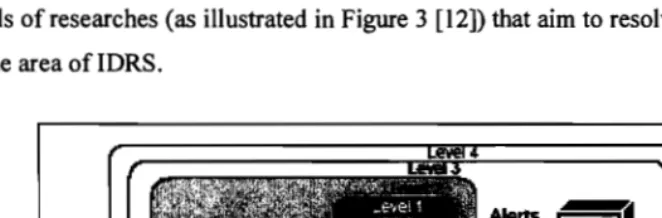
attention from researchers as well as practitioners [12] in different levels. There are four different
levels of researches (as illustrated in Figure 3 [12]) that aim to resolve the false positives problem
in the area of IDRS.
10 Analyst
Figure 3. Evolution of the scope for addressing false positives problem.
Levell - Improving IDS themselves. Most of the efforts focused on building better sensors, Le.,
sensors that detect more intrusions or sensors with very low fal~:-positive rates. In
contrast to building general, all-purpose lOSs, specialized lOSs focus on particular types
of intrusions or attacks promising very low false-positive rates. For example in [31], they
proposed a network-based IDS that exclusively focus on low-level attacks such as
reconnaissance scans and denial-of-service attacks. Billygoat [32], differently, focuses on
detecting worms and viruses. Whilst [29] and [33] focus on introducing better signatures.
Finally, researchers in [34,35] proposed lOS targeted at detecting application-level SQL
injection attacks. Note that these special-purpose lOSs need to be complemented by
additional lOSs to achieve a comprehensive attack coverage, which then creates the need
to deploy and maintain a heterogeneous network of complementary lOSs.
Level 2 - Leveraging the Environment. By using information about the environment (provided by
vulnerability scanners, OS-fingerprinting or asset databases), IDSs can better understand
the environment and significantly lower their false-positive rates. For example" work by
[28] showed that without knowing how target hosts handle certain anomalies in network
packets, intruders can efficiently use fragmentation to avoid being detected by
network-lIM 20, Bli. 2 (Dlsember 2008) lurnaI Ieknologl Maklumat
Dependency on environment: Actions that are normal in certain environments may be malicious in others [30]. For example, performing a network scan is malicious unless the computer performing it has been authorized to do so. lOSs deployed with the standard out-of-the-box configuration will most likely identify many normal activities as malicious.
As a result, the problem of false positives is critical in 10 and has received considerable attention from researchers as well as practitioners [12] in different levels. There are four different levels of researches (as illustrated in Figure 3 [12]) that aim to resolve the false positives problem in the area of IORS.
10 Analyst
Figure3. Evolution of the scope for addressing false positives problem.
Levell - Improving IDS themselves. Most of the efforts focused on building better sensors, Le., sensors that detect more intrusions or sensors with very low fal~::-positive rates. In contrast to building general, all-purpose lOSs, specialized lOSs focus on particular types of intrusions or attacks promising very low false-positive rates. For example in [31], they proposed a network-based IDS that exclusively focus on low-level attacks such as reconnaissance scans and denial-of-service attacks. Billygoat [32], differently, focuses on detecting worms and viruses. Whilst [29] and [33] focus on introducing better signatures. Finally, researchers in [34,35] proposed lOS targeted at detecting application-level SQL injection attacks. Note that these special-purpose lOSs need to be complemented by additional lOSs to achieve a comprehensive attack coverage, which then creates the need to deploy and maintain a heterogeneous network of complementary lOSs.
Level2 -Leveraging the Environment. By using information about the environment (provided by vulnerability scanners, OS-fingerprinting or asset databases), lOSs can better understand the environment and significantly lower their false-positive rates. For example" work by [28] showed that without knowing how target hosts handle certain anomalies in network packets, intruders can efficiently use fragmentation to avoid being detected by
network-)dId20, BII. 2 (Dlsember 2008) lurnaI IeknoIogl Maklumat
Dependency on environment: Actions that are normal in certain environments may be malicious in others [30]. For example, performing a network scan is malicious unless the computer performing it has been authorized to do so. lOSs deployed with the standard out-of-the-box configuration will most likely identify many normal activities as malicious.
As a result, the problem of false positives is critical in 10 and has received considerable attention from researchers as well as practitioners [12] in different levels. There are four different levels of researches (as illustrated in Figure 3 [12]) that aim to resolve the false positives problem in the area of IORS.
10 Analyst
Figure3. Evolution of the scope for addressing false positives problem.
Levell - Improving IDS themselves. Most of the efforts focused on building better sensors, Le., sensors that detect more intrusions or sensors with very low fal~::-positive rates. In contrast to building general, all-purpose lOSs, specialized lOSs focus on particular types of intrusions or attacks promising very low false-positive rates. For example in [31], they proposed a network-based IDS that exclusively focus on low-level attacks such as reconnaissance scans and denial-of-service attacks. Billygoat [32], differently, focuses on detecting worms and viruses. Whilst [29] and [33] focus on introducing better signatures. Finally, researchers in [34,35] proposed lOS targeted at detecting application-level SQL injection attacks. Note that these special-purpose lOSs need to be complemented by additional lOSs to achieve a comprehensive attack coverage, which then creates the need to deploy and maintain a heterogeneous network of complementary lOSs.
Level2 -Leveraging the Environment. By using information about the environment (provided by vulnerability scanners, OS-fingerprinting or asset databases), lOSs can better understand the environment and significantly lower their false-positive rates. For example" work by [28] showed that without knowing how target hosts handle certain anomalies in network packets, intruders can efficiently use fragmentation to avoid being detected by
based IDS. Addressing these concerns, Active Mapping [36] builds profiles of the
environment, which can then be leveraged by IDSs. Context signatures [33], on the other
hand, can understand application-level protocol interactions and thus detennine the
impact of an attack. A similar effect can be achieved by correlating alerts with
vulnerabilities for instance in [13,37].
Level 3 - Alert Post-processing. This level uses alerts generated by IDS as input and tries to
improve their quality by processing them. This includes systems using data mining and
so-called ACSs. For example in the data-mining space, Julisch [8] showed how root
cause analysis can be used to effectively discover large groups of false positives and
remove up to 70% of reoccurring false positives in the future. Moreover, AC, in addition
to false positives, addresses another problem of IDS, namely, the redundancy in alert
stream. ACSs (e.g., [4,13,38,39]) aim at producing high-level alerts and thus reduce the
total number of alerts the IDS generates.
Level 4 - Analyst's Involvement. Alerts generated by IDSs are passed to the human analyst to be
analyzed in real time or with only a short delay. Very few related work on this level.
Examples of such work are in [12,40, and 41]. Pietraszek [12] introduces a novel
paradigm of using machine-learning techniques to reduce the number of false positives in
ID by building classifier learning from a human analyst and assisting in the alert
classification.
Building better IDS (as in Level 1) that has a small number of false positives is an extremely difficult task [27]. Using vulnerability scanner (as in Level 2) will leave the network at
a high risk because it can also be used by an attacker to gather infonnation about potential targets
to identify some vulnerability that could be exploited to start an intrusion scenario [42]. While
analyst's involvement (as in Level 4) could bring some delay (time-consuming) and unreliable as
human's knowledge and experience is vary tu one and another. Because of these reasons, a more
practical solution to reduce the number of false positives in ID is to work on the IDS alerts, by
using alert post-processing (Level 3) or known as analysis algorithms [43]: such as data mining
and machine learning [27,44], data cleansing [45], data aggregation [38], and AC [7,39,46,47].
Thus, the main problem in this issue is "how to filter out the false positives alerts and
aggregating/grouping the redundant alerts". Technically, false alerts will be discarded and
hhd 20, Bli. 2 (Dlsember 1008) ]umaL lekJloLogl Miiklumat
based IDS. Addressing these concerns, Active Mapping [36] builds profiles of the environment, which can then be leveraged by lOSs. Context signatures [33], on the other hand, can understand application-level protocol interactions and thus detennine the impact of an attack. A similar effect can be achieved by correlating alerts with vulnerabilities for instance in [13,37].
Level 3 - Alert Post-processing. This level uses alerts generated by IDS as input and tries to improve their quality by processing them. This includes systems using data mining and so-called ACSs. For example in the data-mining space, Julisch [8] showed how root cause analysis can be used to effectively discover large groups of false positives and remove up to 70% of reoccurring false positives in the future. Moreover, AC, in addition to false positives, addresses another problem of IDS, namely, the redundancy in alert stream. ACSs (e.g., [4,13,38,39]) aim at producing high-level alerts and thus reduce the total number of alerts the IDS generates.
Level 4 -Analyst's Involvement. Alerts generated by lOSs are passed to the human analyst to be analyzed in real time or with only a short delay. Very few related work on this level. Examples of such work are in [12,40, and 41]. Pietraszek [12] introduces a novel paradigm of using machine-learning techniques to reduce the number of false positives in
ID by building classifier learning from a human analyst and assisting in the alert classification.
Building better IDS (as in Level 1) that has a small number of false positives is an extremely difficult task [27]. Using vulnerability scanner (as inLevel2) will leave the network at a high risk because it can alsobeused by an attacker to gather infonnation about potential targets to identify some vulnerability that could be exploited to start an intrusion scenario [42]. While analyst's involvement (as inLevel4)could bring some delay (time-consuming) and unreliable as human's knowledge and experience is vary to one and another. Because of these reasons, a more practical solution to reduce the number of false positives in10is to work on the IDS alerts, by using alert post-processing(Level 3) or known as analysis algorithms [43]: such as data mining I
and machine learning [27,44], data cleansing [45], data aggregation [38], and AC [7,39,46,47]. Thus, the main problem in this issue is "how to filter out the false positives alerts and aggregating/grouping the redundant alerts". Technically, false alerts will be discarded and
Jlhd 20, BII. 2 (Dlsember 2008) Jumai I ekriologl Miikiumat
based IDS. Addressing these concerns, Active Mapping [36] builds profiles of the environment, which can then be leveraged by lOSs. Context signatures [33], on the other hand, can understand application-level protocol interactions and thus detennine the impact of an attack. A similar effect can be achieved by correlating alerts with vulnerabilities for instance in [13,37].
Level 3 - Alert Post-processing. This level uses alerts generated by IDS as input and tries to improve their quality by processing them. This includes systems using data mining and so-called ACSs. For example in the data-mining space, Julisch [8] showed how root cause analysis can be used to effectively discover large groups of false positives and remove up to 70% of reoccurring false positives in the future. Moreover, AC, in addition to false positives, addresses another problem of IDS, namely, the redundancy in alert stream. ACSs (e.g., [4,13,38,39]) aim at producing high-level alerts and thus reduce the total number of alerts the IDS generates.
Level 4 -Analyst's Involvement. Alerts generated by lOSs are passed to the human analyst to be analyzed in real time or with only a short delay. Very few related work on this level. Examples of such work are in [12,40, and 41]. Pietraszek [12] introduces a novel paradigm of using machine-learning techniques to reduce the number of false positives in
ID by building classifier learning from a human analyst and assisting in the alert classification.
Building better IDS (as in Level 1) that has a small number of false positives is an extremely difficult task [27]. Using vulnerability scanner (as inLevel2) will leave the network at a high risk because it can alsobeused by an attacker to gather infonnation about potential targets to identify some vulnerability that could be exploited to start an intrusion scenario [42]. While analyst's involvement (as inLevel4)could bring some delay (time-consuming) and unreliable as human's knowledge and experience is vary to one and another. Because of these reasons, a more practical solution to reduce the number of false positives in10is to work on the IDS alerts, by using alert post-processing(Level 3) or known as analysis algorithms [43]: such as data mining I
and machine learning [27,44], data cleansing [45], data aggregation [38], and AC [7,39,46,47]. Thus, the main problem in this issue is "how to filter out the false positives alerts and aggregating/grouping the redundant alerts". Technically, false alerts will be discarded and
grouped redundant alerts are merged into a meta-alert, so that the number of alerts left to be
analyzed is decreased.
3.2 Issue 2 : Constructing Attack Scenarios
In situations where there are intensive intrusions, not only will actual alerts be mixed with false
alerts, but the amount of alerts will also become unmanageable. As a result, it is difficult for
human users or IRSs to understand the alerts and take appropriate actions. Therefore, it is
necessary to develop techniques to construct attack scenarios (or steps that attackers use in their
attacks) from alerts and facilitate intrusion analysis [48]. In conjunction with that, the main
problem is "how to relate the alerts to one another so that they can build relationship to reveal
the step-by-step attack scenarios ". Thus, human analyst will understand what are the step by step
(previous) attacks has been launched in order to make the next attack is successful. Several AC
methods have been proposed to address this problem. They are:
Similarity-based approach [39,44] correlates alerts based on the similarities between alert
attributes. The similarity between attributes is detennined by the similarity function
defined. Though they are effective for correlating some alerts (e.g., alerts with the same
source and destination IP addresses), they cannot fully discover the causal relationships
between related alerts.
Data mining approach [49] bases AC on attack scenarios specified by human users ot learned
through training datasets. Obviously, these methods are restricted to known attack
scenarios. A variation in this class uses a consequence mechanism to specify what types
of attacks may follow a given attack, partially addressing this problem [38].
Causal relationship approach [4,7,24,25] is based on the cause-effect idea. It correlates alerts if
the pre-condition of some later alerts are satisfied by the consequences of some earlier
alerts. This approach can potentially uncover the causal relationship between alerts, and
is not restricted to known attack scenarios.
Pre-conditions and post-conditions approach is usually depends on rules or predefined
knowledge. Templeton and Levitt [24] propose a requires/provides mpdel (JIG SAW) for
modeling chains of network exploits. The model links exploits into scenarios, with earlier
Jthd 20, Bil. 2 (Dlsember 2008) JumaI I eknologl ¥liklumat
grouped redundant alerts are merged into a meta-alert, so that the number of alerts left to be
analyzed is decreased.
3.2 Issue 2 : Constructing Attack Scenarios
In situations where there are intensive intrusions, not only will actual alerts be mixed with false
alerts, but the amount of alerts will also become unmanageable. As a result, it is difficult for
human users or IRSs to understand the alerts and take appropriate actions. Therefore, it is
necessary to develop techniques to construct attack scenarios (or steps that attackers use in their
attacks) from alerts and facilitate intrusion analysis [48]. In conjunction with that, the main
problem is "how to relate the alerts to one another so that they can build relationship to reveal
the step-by-step attack scenarios ". Thus, human analyst will understand what are the step by step
(previous) attacks has been launched in order to make the next attack is successful. Several AC
methods have been proposed to address this problem. They are:
Similarity-based approach [39,44] correlates alerts based on the similarities between alert
attributes. The similarity between attributes is determined by the similarity function
defined. Though they are effective for correlating some alerts (e.g., alerts with the same
source and destination IP addresses), they cannot fully discover the causal relationships
between related alerts.
Data mining approach [49] bases AC on attack scenarios specified by human users or learned
through training datasets. Obviously, these methods are restricted to known attack
scenarios. A variation in this class uses a consequence mechanism to specify what types
of attacks may follow a given attack, partially addressing this problem [38].
Causal relationship approach [4,7,24,25] is based on the cause-effect idea. Itcorrelates alerts if
the pre-condition of some later alerts are satisfied by the consequences of some earlier
alerts. This approach can potentially uncover the causal relationship between alerts, and
is not restricted to known attack scenarios.
Pre-conditions and post-conditions approach is usually depends on rules or predefined
knowledge. Templeton and Levitt [24] propose a requires/provides mpdel (JIG SAW) for
modeling chains of network exploits. The model links exploits into scenarios, with earlier
Jthd 20, BIi. 2 (Dlsember 2008) JumaI I eknologl ¥liklumat
grouped redundant alerts are merged into a meta-alert, so that the number of alerts left to be
analyzed is decreased.
3.2 Issue 2 : Constructing Attack Scenarios
In situations where there are intensive intrusions, not only will actual alerts be mixed with false
alerts, but the amount of alerts will also become unmanageable. As a result, it is difficult for
human users or IRSs to understand the alerts and take appropriate actions. Therefore, it is
necessary to develop techniques to construct attack scenarios (or steps that attackers use in their
attacks) from alerts and facilitate intrusion analysis [48]. In conjunction with that, the main
problem is "how to relate the alerts to one another so that they can build relationship to reveal
the step-by-step attack scenarios ". Thus, human analyst will understand what are the step by step
(previous) attacks has been launched in order to make the next attack is successful. Several AC
methods have been proposed to address this problem. They are:
Similarity-based approach [39,44] correlates alerts based on the similarities between alert
attributes. The similarity between attributes is determined by the similarity function
defined. Though they are effective for correlating some alerts (e.g., alerts with the same
source and destination IP addresses), they cannot fully discover the causal relationships
between related alerts.
Data mining approach [49] bases AC on attack scenarios specified by human users or learned
through training datasets. Obviously, these methods are restricted to known attack
scenarios. A variation in this class uses a consequence mechanism to specify what types
of attacks may follow a given attack, partially addressing this problem [38].
Causal relationship approach [4,7,24,25] is based on the cause-effect idea. Itcorrelates alerts if
the pre-condition of some later alerts are satisfied by the consequences of some earlier
alerts. This approach can potentially uncover the causal relationship between alerts, and
is not restricted to known attack scenarios.
Pre-conditions and post-conditions approach is usually depends on rules or predefined
knowledge. Templeton and Levitt [24] propose a requires/provides mpdel (JIG SAW) for
modeling chains of network exploits. The model links exploits into scenarios, with earlier
exploits supplying the prerequisites for the later ones. The requires part corresponds to
the action preconditions/causes, and the provi'!es part corresponds to the action effects.
They describe a language for specifying exploits and point out that relating seemingly
innocuous system behavior to known attack scenarios can help discover new exploits.
And, they do not consider combining their attack scenarios into attack graphs. However,
several problems make it difficult for JIGSAW to be a practical AC technique. First,
JIGSAW requires all the preconditions of an attack to be satisfied in order to consider its
consequences. This is theoretically acceptable; however. it has a negative impact on AC
in practice. In particular, if the IDS fails to detect one of the attacks that prepare for later
attacks, JIGSAW will miss the opportunity to correlate the detected attacks.
The MIRADOR [4,25] approach also correlates alerts using partial match of
pre-conditions and post-conditions of attacks, which are derived from attack database
described in LAMBDA [25], and uses 'ontology rules' to represent the implication
relationships between predicates. An additional notion of abductive correlation has been
introduced in [4] to deal with attacks missed by IDS.
The work closest to MIRADOR is the AC method by [7,48]. They used rule-based AC
which pre-requisites and consequences of the each alerts need to manually define.
Intuitively, the pre-requisite of an intrusion is the necessary condition for the intrusion to
be successful, while the consequence of an intrusion is the outcome of the intrusion if it is
successful. Once the pre-requisite of a certain attack is detected by the correlation engine,
it would be possible to predict the consequence ofthe attack. In the same way, it might be
able to merge them and consequently detect a higher-level correlated attack. They use
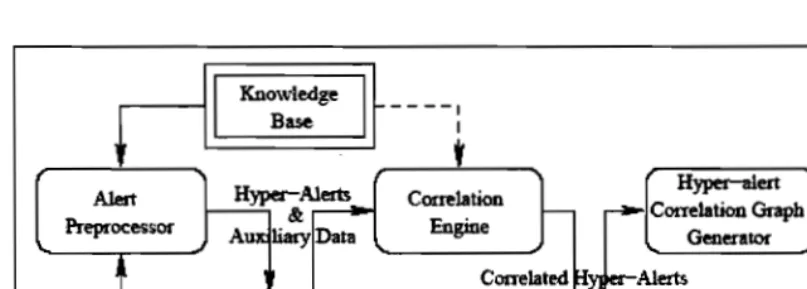
SQL commands for processing the rules and perform AC. Their architecture [7] is shown
in Figure 4. It consists of a knowledge base, an alert preprocessor, a correlation engine, a
hyper-alert correlation graph generator, and a visualization component. All these
components except for the visualization component interact with a Daiabase Management
System (DBMS), which provides persistent storage for the intermediate data as well as
the correlated alerts. To save development effort, they use the GraphViz package [50] as
the visualization component to generate attack graphs.
hhd 20, Bli. 2 (Dlsember 200k) lumal Ieknologl Maklumat
exploits supplying the prerequisites for the later ones. Therequires part corresponds to
the action preconditions/causes, and theprovi'!espart corresponds to the action effects.
They describe a language for specifying exploits and point out that relating seemingly
innocuous system behavior to known attack scenarios can help discover new exploits.
And, they do not consider combining their attack scenarios into attack graphs. However,
several problems make it difficult for JIGSAW to be a practical AC technique. First,
JIGSAW requires all the preconditions of an attack tobesatisfied in order to consider its consequences. This is theoretically acceptable; however, it has a negative impact on AC
in practice. In particular, if the IDS fails to detect one of the attacks that prepare for later
attacks, JIGSAW will miss the opportunity to correlate the detected attacks.
The MIRADOR [4,25] approach also correlates alerts using partial match of
pre-conditions and post-conditions of attacks, which are derived from attack database
described in LAMBDA [25], and uses 'ontology rules' to represent the implication
relationships between predicates. An additional notion of abductive correlation has been
introduced in [4] to deal with attacks missed by IDS.
The work closest to MIRADOR is the AC method by [7,48]. They used rule-based AC
which pre-requisites and consequences of the each alerts need to manually define.
Intuitively, the pre-requisite of an intrusion is the necessary condition for the intrusion to
be successful, while the consequence of an intrusion is the outcome of the intrusion if it is
successful. Once the pre-requisite of a certain attack is detected by the correlation engine,
it would be possible to predict the consequence ofthe attack. In the same way, it might be
able to merge them and consequently detect a higher-level correlated attack. They use
SQL commands for processing the rules and perform AC. Their architecture [7] is shown
in Figure 4. It consists of a knowledge base, an alert preprocessor, a correlation engine, a
hyper-alert correlation graph generator, and a visualization component. All these
components except for the visualization component interact with a Daiabase Management
System (DBMS), which provides persistent storage for the intermediate data as well as
the correlated alerts. To save development effort, they use the GraphViz package [50] as
the visualization component to generate attack graphs.
hhd 20, Bli. 2 (Dlsember 200k) Jumal Ieknologl Maklumat
exploits supplying the prerequisites for the later ones. Therequires part corresponds to
the action preconditions/causes, and theprovi'!espart corresponds to the action effects.
They describe a language for specifying exploits and point out that relating seemingly
innocuous system behavior to known attack scenarios can help discover new exploits.
And, they do not consider combining their attack scenarios into attack graphs. However,
several problems make it difficult for JIGSAW to be a practical AC technique. First,
JIGSAW requires all the preconditions of an attack tobesatisfied in order to consider its consequences. This is theoretically acceptable; however, it has a negative impact on AC
in practice. In particular, if the IDS fails to detect one of the attacks that prepare for later
attacks, JIGSAW will miss the opportunity to correlate the detected attacks.
The MIRADOR [4,25] approach also correlates alerts using partial match of
pre-conditions and post-conditions of attacks, which are derived from attack database
described in LAMBDA [25], and uses 'ontology rules' to represent the implication
relationships between predicates. An additional notion of abductive correlation has been
introduced in [4] to deal with attacks missed by IDS.
The work closest to MIRADOR is the AC method by [7,48]. They used rule-based AC
which pre-requisites and consequences of the each alerts need to manually define.
Intuitively, the pre-requisite of an intrusion is the necessary condition for the intrusion to
be successful, while the consequence of an intrusion is the outcome of the intrusion if it is
successful. Once the pre-requisite of a certain attack is detected by the correlation engine,
it would be possible to predict the consequence ofthe attack. In the same way, it might be
able to merge them and consequently detect a higher-level correlated attack. They use
SQL commands for processing the rules and perform AC. Their architecture [7] is shown
in Figure 4. It consists of a knowledge base, an alert preprocessor, a correlation engine, a
hyper-alert correlation graph generator, and a visualization component. All these
components except for the visualization component interact with a Daiabase Management
System (DBMS), which provides persistent storage for the intermediate data as well as
the correlated alerts. To save development effort, they use the GraphViz package [50] as
the visualization component to generate attack graphs.