Extractive Multi-Document Summarization with Integer
Linear Programming and Support Vector Regression
Dimitrios Galanis, Gerasimos Lampouras and Ion Androutsopoulos
Department of InformaticsAthens University of Economics and Business Patission 76, GR-104 34 Athens, Greece
[email protected], [email protected], [email protected]
A
BSTRACTWe present a new method to generate extractive multi-document summaries. The method uses Integer Linear Programming to jointly maximize the importance of the sentences it includes in the summary and their diversity, without exceeding a maximum allowed summary length. To obtain an importance score for each sentence, it uses a Support Vector Regression model trained on human-authored summaries, whereas the diversity of the selected sentences is measured as the number of distinct word bigrams in the resulting summary. Experimental results on widely used benchmarks show that our method achieves state of the art results, when compared to competitive extractive summarizers, while being computationally efficient as well.
1 Introduction
A multi-document summarization system aims to generate a single summary from an input set of documents. The input documents may have been obtained, for example, by submitting a query to an information retrieval engine and retaining the most highly ranked documents, or by clustering the documents of a large collection and then using each cluster as a set of documents to be summarized. Although evaluations with human judges also examine the coherence, referential clarity, grammaticality, and readability of the summaries (Dang, 2005, 2006; Dang and Owczarzak, 2008), and some of these factors have also been considered in recent summarization algorithms (Nishikawa et al., 2010b; Woodsend and Lapata, 2012), most current multi-document summarization systems consider only the importance of the summary’s sentences, their non-redundancy (also called diversity), and the summary length (McDonald, 2007; Berg-Kirkpatrick et al., 2011; Lin and Bilmes, 2011).
Anextractivemulti-document summarizer forms summaries by extracting (selecting) sen-tences from the input documents, without modifying the selected sensen-tences. By contrast, anabstractivesummarizer may also shorten or, more generally, rephrase the selected sen-tences. In practice, the additional processing of the selected sentences may only marginally improve or even reduce the perceived quality of the resulting summaries (Gillick and Favre, 2009), though recent work has produced abstractive summarization methods that perform better than extractive ones (Berg-Kirkpatrick et al., 2011; Woodsend and Lapata, 2012). Nevertheless, the difference in the performance of extractive and abstractive summarizers is often small, and abstractive summarizers typically require more processing time, as well as tools and resources (e.g., reliable large coverage parsers, paraphrasing rules) that are often not available in less widely spoken languages. Hence, it is still worth trying to improve extractive summarizers, at least from a practical, application-oriented point of view.
Many multi-document summarizers, especially extractive ones, adopt a greedy search when constructing summaries. For example, they may rank the sentences of the input documents by importance, and then iteratively add to the summary (and remove from the ranked list of input sentences) the sentence with the highest importance score, until the maximum allowed summary length has been reached, possibly discarding sentences that are too similar to sentences already included in the summary. Recent work has shown that adopting more principled optimization methods based on Integer Linear Programming (ILP), instead of greedy search, can lead to summaries that are better or at least comparable to those of state of the art summarizers (McDonald, 2007; Gillick and Favre, 2009; Nishikawa et al., 2010a). In this paper, we introduce a new extractive multi-document summarization method that uses
in Berg-Kirkpatrick et al.’s method. We show that ourILPmethod achieves state of the art
ROUGEscores (Lin, 2004) on widely used benchmark datasets, when compared to Berg-Kirkpatrick’s and other competitive extractive summarizers, also outperforming two greedy baselines that use only the importance scores of theSVR. For completeness, we also discuss and compare against the abstractive version of Berg-Kirkpatrick et al.’s summarizer, and the state of the art abstractive summarizer of Woodsend and Lapata (2012).
Section 2 below discusses previous work onILPmethods for summarization. Section 3
presents our ownILPmodel, after first introducing theSVRmodel of sentence importance and the greedy baselines. Section 4 presents the experiments that we conducted and discusses their results. Section 5 concludes and proposes directions for further research.
2 Related work
The firstILPmethod for summarization was proposed by McDonald (2007). It constructs summaries by maximizing the importance of the selected sentences and minimizing their pairwise similarity, as shown below. No sentence ordering is performed.
max
x,y n X
i=1
imp(si)·xi− n X
i=1 n X
j=i+1
sim(si,sj)·yi,j (1)
subject to:
n X
i=1
li·xi≤Lmax (2)
and (fori=1, . . . ,nandj=i+1, . . . ,n):
yi,j−xi ≤ 0 (3)
yi,j−xj ≤ 0 (4)
yi+xj−yi,j ≤ 1 (5)
Here,nis the number of sentences in the input documents;imp(si)is the importance score
of sentencesi;liis the length ofsi;sim(si,sj)is the similarity of sentencessiandsj; andLmax
is the maximum allowed length. Thexivariables, jointly denotedx, are binary and indicate
whether or not the corresponding sentencessiare included (selected) in the summary. The yi,jvariables, jointly denotedy, are also binary and indicate whether or not bothsiandsj
are included in the summary. Constraint 2 ensures that the maximum total length is not exceeded. Constraints 3–5 ensure that the values ofxi,xj, andyi,jare consistent (e.g., if yi,j=1, thenxi=xj=1; and ifyi,j=0, thenxi=0 orxj=0).
McDonald showed experimentally that theILPmodel above achieves betterROUGEscores (Lin, 2004) than a greedy method that attempts to maximize the same objective (1). However, McDonald also showed that theILPmodel above corresponds to anNP-hard problem and is,
therefore, intractable for a large number of sentences. A set of experiments by McDonald confirmed that the model does not scale up well in practice, mostly because of theO(n2) yi,jvariables that are used to model the redundancy between sentences. Furthermore, the
so called ‘concepts’ are actually word bigrams, all the word bigrams of the documents to be summarized. Each bigram has a weightwithat indicates its importance. TheILP
objective (6) of Berg-Kirkpatrick et al. prefers summaries with many important concepts, i.e., summaries whose bigrams have a large sum of weightswi; belowbiare binary variables
indicating which bigrams (|B|in total) are present in the summary. An additional constraint, not shown here, ensures that the maximum allowed summary length is not exceeded.
max
b,c h(b,c) =maxb,c |B| X
i=1 wi·bi+
|C| X
i=1 ui·ci=
|B| X
i=1 (WT
·Φi)·bi+ |C| X
i=1 (UT
·Ψi)·ci (6)
Berg-Kirkpatrick et al.’s model also takes into account the possible subtree cuts (deletions) of the parse trees of the sentences of the input documents. The cuts give rise to different compressions (shortenings) of the sentences; hence, Berg-Kirkpatrick et al.’s summarizer is an abstractive one. In the objective (6),uiare the weights of the possible subtree cuts of all
the sentences of the input documents, andciare binary variables indicating which cuts (|C|
in total) are used. Additional contraints, not shown above, ensure that the values ofbiand ciare consistent. Overall, Berg-Kirkpatrick et al.’s method aims to produce summaries that
contain many important bigrams, while also performing many desirable subtree cuts. The weightswianduiare themselves estimated as weighted sums of features, i.e.,wi= WT·Φ
i, whereΦiis a feature vector describing the bigram of the binary variablebi, andW
is a vector of feature weights; similarly,ui=UT·Ψi, whereΨiis a feature vector describing
the subtree cut of the binary variableci, andUis a vector of feature weights.1The feature
vectorΦiincludes, for example, the frequency of the corresponding bigram in the documents
to be summarized, and the minimum sentence position (e.g., 3rd sentence in a document) of the sentences that contain that bigram in the input documents. The features ofΨishow,
for example, if a relative clause or a temporal phrase was cut.
Berg-Kirkpatrick et al. use a structured Support Vector Machine (SVM) (Vapnik, 1998; Tsochantaridis et al., 2004) that assigns to each candidate summary the scoreh(b,c)of the objective function (6), givenWandU. During training, theSVMsearches for the values ofW andUthat allow it to prefer the gold summary (of each training set of input documents) to all the other possible summaries (of the same input documents) by a margin determined by a loss function. Berg-Kirkpatrick et al. use a bigram recall loss function similar toROUGE-2 (Lin, 2004). The loss function causes more emphasis (larger margin) to be placed on preferring the gold summaries to other summaries that share many bigrams with the gold ones. The learntWandUare then used in the objective (6).
Berg-Kirkpatrick et al. report that their full method achieves higherROUGEscores than an extractive version of their method (without the subtree cuts, i.e., without sentence compression) with no significant decrease in grammaticality (when sentence compression is used), unlike other work (Gillick and Favre, 2009), where sentence compression was found to reduce grammaticality. The extractive version of Berg-Kirkpatrick et al.’s method omits the second term of Formula (6), as in the previous work of Gillick and Favre (2009). As already noted, the extractive version of Berg-Kirkpatrick et al.’s method has the best previously published results in extractive multi-document summarization.
1Berg-Kirkpatrick et al. (2011) use different terminology. A minor difference from their description of their
More recently, Woodsend and Lapata (2012) proposed anILP-based method that forms a summary by maximizing the objective function shown below. The objective function combines the importancefB(z)of the bigrams in the summary’s sentences, the saliencefS(z)
of the parse tree nodes of the summary’s sentences, and a unigram language modelfLR(z), which penalizes sentences containing words that are unlikely to appear in summaries; we do not discussfLR(z)further to save space.
maxzfB(z) +fS(z) +fLR(z) (7)
The argumentzcollectively denotes binary variableszi, onezifor each node of the parse tree
of each sentence of the input documents. Eachzishows whether or not the corresponding
node has been retained or deleted. By deleting nodes, the method can compress sentences; hence, this is also an abstractive summarization method. ThefB(z)component is the same
as in Berg-Kirkpatrick et al.’s work (fB(z) =Pi|B=|1wi·bi). Additional constraints ensure that
a bigram can be selected only if at least a parse tree node that subsumes it has been selected, that the maximum summary length is not exceeded etc.
To compute fS(z), Woodsend and Lapata train a linearSVM, with separating hyperplane WT·Φ
i=0, to predict whether or not a sentencesiof an input set of documents would
be selected by a human creating a summary. ThefS(z)score, defined below, is the sum of
the trainedSVM’s predictions, for all the phrases that correspond to the retained parse tree nodes of the input sentences;Φiis a feature vector describing each retained phrase, with
features indicating, for example, if the phrase was obtained from the first sentence of an input document, if it contains pronouns etc.;Ware the feature weights learnt by theSVM.
fS(z) = X
i
(WT·Φi)·zi (8)
A secondSVMis trained to exclude sentences that are too long, contain quotations etc. The predictions of the secondSVMare used to add hard constraints to theILPmodel, rather than
including the predictions in theILPobjective function (7).
The method of Woodsend and Lapata optionally employs a quasi-synchronous tree grammar (QSTG), to generate candidate compressions and paraphrases of the source sentences. The QSTGgrammar is learnt from aligned summary and source sentences. When the grammar is used, the rest of the method does not operate only on the sentences of the input documents, but also on rephrasings of these sentences, produced by the grammar. Hence, in its full form, the method of Woodsend and Lapata is abstractive not only because it can delete tree nodes of the parse trees, but also because it can rephrase sentences using the grammar. It can be turned into an extractive summarization method by disabling theQSTGgrammar and
3 Our method
In this section, we first discuss ourSVRmodel that assigns importance scores to the sentences of the input documents, and two greedy baseline summarizers that use theSVRwithoutILP.
We then introduce ourILPmethod, which jointly maximizes the importance and diversity of the selected sentences, while respecting the maximum allowed summary length.
3.1 The SVR model of sentence importance
A Support Vector Regression (SVR) model aims to learn a functionf :Rn7→R, which
will be used to predict the value of a variable y∈Rgiven a feature vectorX∈Rn. In
particular, givenltraining instances(X1,y1), . . . ,(Xl,yl), anSVRmodel is learnt by solving
the following optimization problem (Vapnik, 1998);Wis a vector of feature weights;φis a function that maps feature vectors to a new vector space of higher dimensionality to allow non-linear functions to be learnt in the original space;C>0 andε >0 are given.
min
W,b,ξ,ξ∗ 1 2kWk
2 +C
l X
i=1
ξi+C l X
i=1
ξ∗i (9)
subject to (fori=1, . . . ,l):
WT·φ
(Xi) +w0−yi ≤ ε+ξi (10) yi−WT·φ(Xi)−w0 ≤ ε+ξ∗i (11)
ξi ≥ 0 (12)
ξ∗i ≥ 0 (13)
The goal is to learn a linear (in the new space) function, whose prediction (value)WT·
φ(Xi)+w0for each training instanceXiwill not to be farther thanεfrom the target (correct)
valueyi. Since this is not always feasible, two slack variablesξiandξ∗i are used to measure
the prediction’s error above or below the targetyi. The objective (9) jointly minimizes the
total prediction error andkWk, to avoid overfitting.2
In our case,Xiis the feature vector of a sentence andyiis the sentence’s importance score.
During training, the target score yiof each sentences, i.e., the score that theSVRshould
ideally return, is taken to be the average of theROUGE-2 andROUGE-SU4 scores (Lin, 2004) ofs, comparingsagainst the corresponding gold (human-written) summaries; the latter are included in the training datasets that we used. We took the average ofROUGE-2 andROUGE
-SU4, because they are the two most commonly used measures to automatically evaluate machine-generated summaries against gold ones. Roughly speaking, both measures compute the bigram recall of a summary (or individual sentence) being evaluated against multiple gold summaries (provided by different human authors), butROUGE-SU4 also considers skip bigrams with a maximum distance of 4 words between the words of each skip bigram. Both measures have been found to correlate well with human judgements in extractive summarization (Lin, 2004). Hence, training theSVRto predict the averageROUGE-2 and
ROUGE-SU4 of each sentence can be particularly useful. Intuitively, a sentence with a high
ROUGEscore has a high overlap with the gold summaries; and since the gold summaries
contain the sentences that human authors considered most important, a sentence with a highROUGEscore is most likely also important. This is why we view ourSVR, which attempts to predict theROUGEscore (averageROUGE-2 andROUGE-SU4) of each sentence,
as a component that assigns an importance score to each sentence.
The idea to useROUGEduring training is also present in the work of Berg-Kirkpatrick et al. (Section 2). TheSVMthat Berg-Kirkpatrick et al. use, however, in effect attempts to separate (prefer) the gold summaries from the other possible summaries;ROUGE(more precisely, a modified version ofROUGE-2) is included in theSVMas a loss function to force theSVMto
place more emphasis on separating gold summaries from other possible summaries with highROUGEscores. By contrast, theSVRthat we use attempts to directly output theROUGE
score of each sentence. Furthermore, theRBFkernel that we use in theSVRallows the SVRto learn non-linear functions, whereas the linearSVMof Berg-Kirkpatrick et al. can learn only linear functions. We also note that the twoSVMs used by Woodsend and Lapata (Section 2) perform binary classification (not regression), attempting to separate sentences that a human would include in a summary from sentences that would not be included. The (unsigned) distance from the learnt separating hyperplane of the firstSVMis included in the objective function of theILPmodel, in effect treating the distance as a confidence score.
We believe that our use of a regression model (SVR) is a better choice, because the distance from anSVM’s separating hyperplane is often a poor confidence estimate. We also note that the secondSVMof Woodsend and Lapata contributes only hard constraints to theILPmodel,
without taking into account theSVM’s confidence.
We include the following features in the feature vectorXof each sentences:
• Sentence positionSP(s):
SP(s) =pos(s,d(s)) |d(s)|
wherepos(s,d(s))is the position (sentence order) of sentencesin its documentd(s), and|d(s)|is the number of sentences ind(s).
• Named entitiesNE(s):
NE(s) =lenn(s) (s)
n(s)is the number of named entities ins, andlen(s)is the number of words ins.3 • Levenshtein distanceLD(s,q): The Levenshtein Distance (Levenshtein, 1966) between
the user’s queryqand sentences; insertions, deletions, and replacements affect entire words. In the datasets we experimented with, the documents to be summarized were relevant to a queryq, which was always available.
• Word overlapWO(s,q): The number of words shared by the queryqand sentences, after removing stop words and duplicate words from bothqands.
• Content word frequencyCF(s)and document frequencyDF(s): We use these measures as defined by Schilder and Ravikumar (2008).CF(s)is defined as follows:
CF(s) = Pcs
i=1pc(wi) cs
wherecsis the number of content words in sentences,pc(w) =mM,mis the number
of occurrences of content wordwin the input documents, andMis the total number of content word occurences in the input documents. Similarly,DF(s)is defined as:
DF(s) = Pcs
i=1pd(wi) cs
wherepd(w) =dD,dis the number of input documents the content wordwoccurs in,
andDis the number of all input documents.
Experiments on the development set (see below) confirmed that all the features have a positive impact, i.e., the results are worse, if any of the features are removed.
3.2 The baseline summarizers
We compare against two greedy baselines that use theSVRmodel of sentence importance, but notILP. The first one, calledGREEDY, uses the trainedSVRmodel of the previous section
to assign importance scores to all the sentences of the documents to be summarized. It then ranks the sentences by decreasing importance score and constructs the summary by iteratively selecting (and removing from the ranked list of sentences) the sentence with the highest importance score that fits in the summary space left.
The second baseline, calledGREEDY-RED, operates in the same way, but it also takes into account redundancy. When a new sentence (with the highest importance score among the remaining sentences in the ranked list) is about to be added to the summary, its cosine similarity (computed on words) to all the sentences that have already been included in the summary is computed. If the similarity between the new and any of the already selected sentences exceeds a thresholdt, the new sentence is discarded and a new iteration starts, where the next sentence of the ranked list of remaining sentences is considered. In our experiments,twas determined by tuningGREEDY-REDon development data (see below).
3.3 Our ILP summarization model
Instead of directly using the importance scorefSVR(si)of each sentencesi, as returned by
theSVRmodel of Section 3.1, we normalize it using the maximum and mimimum values that theSVRmodel returns for thej=1, . . . ,nsentences of the input documents:
ai=
fSVR(si)−minjfSVR(sj)
maxjfSVR(sj)−minjfSVR(sj)
(14)
The objective (15) of our summarizationILPmodel sums the normalized relevance scoresai
andbjindicate which sentencessiand which word bigramsgj, respectively, are present in
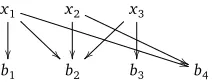
the summary; see Figure 1 for an example of the relations between thexiandbjvariables.
max
b,x λ1·imp(S) +λ2·div(S) =maxb,x λ1· n X
i=1 ai kmax·xi+
λ2· |B| X
j=1 bj
n (15)
n X
i=1
li·xi≤Lmax (16)
X
gj∈Bi
bj≥ |Bi| ·xi, fori=1, . . . ,n (17) X
si∈Sj
xi≥bj, forj=1, . . . ,|B| (18)
Again,liis the length of sentencesi,Lmaxis the maximum allowed summary length, and nis the number of input sentences. imp(S)is normalized to[0, 1]using the maximum
number of sentenceskmaxthat can be included in the summary. To estimatekmaxwe divide
the maximum available spaceLmaxby the length of the shortest input sentence. We also
dividediv(S)byn, which causesdiv(S)to range mostly in[0, 1]in our experiments. The
values ofλ1andλ2are tuned on development data. We setλ1+λ2=1. Constraint 16
guarantees thatLmaxis not exceeded. The other two constraints are explained below: • Constraint 17:Biis the set of bigrams that appear in sentencesi,|Bi|is the cardinality
ofBi,gj ranges over the bigrams inBi, andbjis the binary variable that shows if
bigramgjhas been selected. If a sentencesiis selected (xi=1), then all of its bigrams
must also be selected, i.e.,Pgj∈Bibj=|Bi|and Constraint 17 holds. If sentencesiis
not selected (xi=0), then some of its bigrams may still be selected, if they occur in
another selected sentence; hencePg
j∈Bibj≥0 and Constraint 17 holds again. • Constraint 18: Again, bjis the binary variable that shows if gjhas been selected.
|B|is the total number of (distinct) bigrams of theninput sentences;Sjis the set
of sentences that bigramgj appears in; andxiis the binary variable that shows if
sentencesihas been selected. If a bigramgjis selected (bj=1), then at least one
sentence that contains that bigram must also be selected; hence,Psi∈Sjxi≥1 and
Constraint 18 holds. If bigramgjis not selected (bj=0), then none of the sentences
that contain it may be selected; hence,Ps
i∈Sjxi=0 and Constraint 18 holds again.
In preliminary experiments, we noticed that ourILPmodel above, calledILP1, tended to
select many short sentences, which had a poorROUGEmatch with the gold summaries. To address this issue, we developed an alternativeILPmodel, calledILP2, whose objective function (19) rewards longer sentences by multiplying their importance scoresaiwith their
lengthsli(in words). The constraints ofILP2 remain as inILP1 (Constraints 16–18).
max
b,x λ1· n X
i=1 ai·
li Lmax·xi+
λ2· |B| X
j=1 bj
x1
**
x2
''
x3
~~
[image:10.420.151.257.74.115.2]b1 b2 b3 b4
Figure 1: There are 3 sentences (corresponding to the binary variablesx1,x2,x3) containing
4 word bigrams (corresponding to variablesb1,b2,b3,b4). For example, sentences1contains
the first, second, and fourth bigrams; and if sentencess1ands2are selected (x1=1 and x2=1), then the bigrams they contain must also be selected (b1=1,b2=1,b4=1).
4 Experiments
We now present the experiments that we performed, starting from the datasets we used.
4.1 Datasets and experimental setup
We used the datasets ofDUC2005,DUC2006,DUC2007, andTAC2008 (Dang, 2005, 2006; Dang and Owczarzak, 2008).4 Each dataset contains document clusters. Each cluster
contains documents relevant to a query (a question or topic description), which is also given. For each cluster, a summary not exceeding a maximum allowed length has to be produced, so that the summary will provide an answer to the corresponding query. Multiple reference (gold, human-authored) summaries are also provided per cluster. Table 1 provides more information on the datasets we used. For our experiments, we extracted all the sentences from the documents of each cluster, discarding sentences shorter than or equal to 7 words. We also applied a small set of cleanup rules to remove unnecessary formatting tags.
dataset documents clusters reference word limit
per cluster summaries (in words)
DUC2005 25–50 50 4–9 250
DUC2006 25 50 4 250
DUC2007 25 45 4 250
TAC2008 10 48 4 100
Table 1: Datasets used in our experiments.
TheSVRmodel of sentence importance (Section 3.1) was trained on the sentences ofDUC
2006 (i.e.,DUC2006 was our training dataset) and it was used to assign importance scores to the sentences of the clusters ofDUC2005,DUC2007, andTAC2008. For each document
cluster, we used then=100 sentences with the highest importance scores as input to the baseline andILPsummarizers of Sections 3.2 and 3.3.
We note thatILPproblems are in the worst case (for the most difficultILPproblems)NP
-hard. OurILP1 andILP2 models (Section 3.3) are generalizations of the 0-1 Knapsack problem, which is known to beNP-hard; hence, our models also constituteNP-hard problems. Nevertheless, very efficientILPsolvers are available.5 In the worst case, the off-the-shelf
solver that we use finds a solution (forILP1 orILP2, per summary) in 1.25 seconds and
4Consult alsohttp://duc.nist.gov/andhttp://www.nist.gov/tac/.
5We use the implementation of the Branch and Cut algorithm of theGNULinear Programming Kit (GLPK);
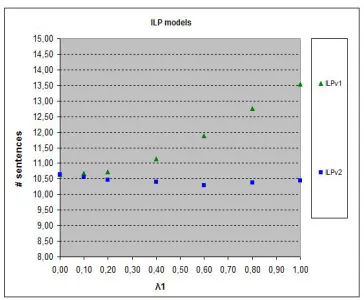
[image:10.420.100.308.322.393.2]Figure 2:ROUGE-2 scores of the two versions of ourILPmodel onDUC2007 data, used as
development data, with theSVRmodel of sentence importance trained onDUC2006 data.
0.9 seconds in theDUC2007 andTAC2008 datasets, respectively. The solver takes more
time inDUC2007 than inTAC2008, becauseDUC2007 summaries are longer (cf. Table 1) and, therefore, the search space is larger. This efficiency is mostly due to the fact that the xiandbjvariables ofILP1 andILP2 are in the order of hundreds and grow approximately
linearly to the number and size (word bigrams) of the input sentences, as opposed to the quadratic (to the number of sentences) growth of the number of variables in McDonald’s model (Section 2). Berg-Kirkpatrick et al. (2011) report very similar execution times; they report that the solver they use finds the solution of their extractive formulation in less than a second for most summaries ofTAC2008 andTAC2009. Our method (ILP1 orILP2) takes on average 10–11 seconds to form each summary, including the time to read and preprocess the input documents, formulate theILPmodel etc. By contrast Woodsend and Lapata (2012) report that their method takes 55 seconds on average for each summary, though presumably this also includes parsing the input and applying theQSTGgrammar.
4.2 Experiments on development data
To determine which of the two versions (ILP1 orILP2) of ourILPmodel performs best and to tune their parameters, we experimented on theDUC2007 dataset, i.e., we used theDUC
2007 dataset as our development data; recall that theDUC2006 dataset was used as training
data in all cases. We used 11 different values ofλ1(λ2=1−λ1) in bothILP1 andILP2, and
we evaluated the generated summaries usingROUGE-2. The results of these experiments are presented in Figure 2.ILP2 is better thanILP1 for all values ofλ1, and its bestROUGE-2
score is obtained forλ1=0.4 (λ2=0.6). The fact that the best results were obtained for
non-zeroλ1andλ2values also shows that both the sentence importance component (SVR)
Figure 3: Average number of sentences selected by the two versions of ourILPmodel on
DUC2007 data, used as development data, with theSVRmodel trained onDUC2006 data.
with the reference summaries, which is whyILP1 performs worse thanILP2. Figure 3 also shows thatILP2 selects approximately the same number of sentences for allλ1values; this
is becauseILP2 tends to always select relatively long sentences and, hence, the number of selected sentences that fit in the available space cannot vary as much as inILP1.
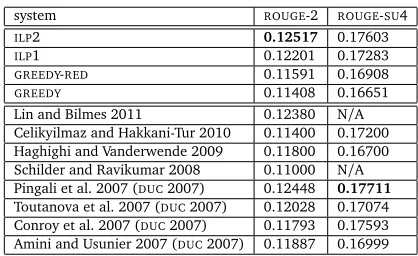
In Table 2, we present theROUGEscores of the two versions of ourILPmodel (forλ1=0.4)
on theDUC2007 dataset, along with the corresponding scores of theGREEDYandGREEDY-RED
baselines (Section 3.2), which use only theSVRwithoutILP. We also show the scores of
several state of the art systems, both extractive and abstractive, as they were reported in the corresponding articles; more recently published results are shown first. OurILP2 model has the best reportedROUGE-2 score on theDUC2007 dataset, and the second bestROUGE-SU4
score, though one should keep in mind that theDUC2007 dataset was our development set.
4.3 Experiments on test data
We then evaluatedILP2 withλ1=0.4, which was our best system in the experiments on the
development data (DUC2007), against the systems with the highest publishedROUGEscores onTAC2008 andDUC2005 data, our two test datasets.6The results of these experiments
are listed in Tables 3 and 4, respectively. On theTAC2008 dataset (Table 3), the most recent
of the datasets we experimented with, ourILP2 method achieves the second bestROUGE-SU4 score and the second bestROUGE-2 score, following the method of Woodsend and Lapata with theQSTGgrammar enabled, and the abstractive (full) method of Berg-Kirkpatrick et al., respectively (see Section 2). OurILP2 method performs better than the method of Woodsend and LapatawithouttheQSTGgrammar, even though the method of Woodsend and Lapata
is still an abstractive one, even without theQSTGgrammar (it can still delete parse tree nodes), whereas our method is purely extractive. If we exclude abstractive summarizers, ourILP2 method has the bestROUGE-2 andROUGE-SU4 scores.
system ROUGE-2 ROUGE-SU4
ILP2 0.12517 0.17603
ILP1 0.12201 0.17283
GREEDY-RED 0.11591 0.16908
GREEDY 0.11408 0.16651
Lin and Bilmes 2011 0.12380 N/A
Celikyilmaz and Hakkani-Tur 2010 0.11400 0.17200
Haghighi and Vanderwende 2009 0.11800 0.16700
Schilder and Ravikumar 2008 0.11000 N/A
Pingali et al. 2007 (DUC2007) 0.12448 0.17711
Toutanova et al. 2007 (DUC2007) 0.12028 0.17074
Conroy et al. 2007 (DUC2007) 0.11793 0.17593
[image:13.420.111.320.68.196.2]Amini and Usunier 2007 (DUC2007) 0.11887 0.16999
Table 2: Comparison of ourILPmethod against greedy baselines that use the sameSVR
model of sentence importance withoutILP, and against other state of the art summarizers on DUC2007 data (our development dataset). OurILPmethod was trained onDUC2006 data.
On theDUC2005 dataset (Table 4), ourILP2 method has the best reportedROUGE-2 and
ROUGE-SU4 scores. Berg-Kirkpatrick et al. and Woodsend and Lapata provide no results of
their systems for this dataset. They also provide no results for the more recentTAC2009 dataset, because they used it as their training set. We did not experiment with theTAC2009 dataset, because our main competitors have not published results for that dataset. We used pairedt-tests (p<0.05) to check if the differences between the scores ofILP2 and
the other systems were statistically significant. In Tables 3–4,+and−denote the existence or absence of statistical significance, respectively. Unfortunately, the tests were possible only when comparingILP2 against the few systems we hadROUGEscores for per topic.
5 Conclusions
We presented a newILPmethod (in two versions) for multi-document summarization. Our method jointly maximizes the importance of the sentences it includes in a summary and their diversity, without exceeding a maximum allowed summary length. To obtain an importance score for each sentence, it uses anSVRmodel, trained on human-authored summaries to predict theROUGEscore of each sentence. Diversity is measured as the number of word
bigrams of the input documents that occur in the resulting summary. Experimental results on widely used benchmarks for news summarization show that ourILPmethod achieves state of the art results among extractive summarizers. It also outperforms two greedy baselines that use the sameSVRmodel of sentence importance withoutILP, and it performs better than some abstractive summarizers. Our method is also very fast, and it does not require a parser or other resources that are not always available in less widely spoken languages. We are already experimenting with an extended version of our method that also performs sentence compression. In future work, we hope to extend ourILPmodel to consider discourse coherence, sentence aggregation, and referring expression generation.
Acknowledgements
system ROUGE-2 ROUGE-SU4
ILP2 0.11168 0.14413
Woodsend and Lapata 2012 (withQSTG) 0.11370 0.14470
Woodsend and Lapata 2012 (withoutQSTG) 0.10320 0.13680
Berg-Kirkpatrick et al. 2011 (with subtree cuts) 0.11700 0.14380
Berg-Kirkpatrick et al. 2011 (without subtree cuts) 0.11050 0.13860
Shen and Li 2010 0.09012 0.12094
Gillick and Favre 2009 (with sentence compression) 0.11100 N/A
Gillick and Favre 2009 (without sentence compression) 0.11000 N/A
Gillick et al. 2008 (run 43 inTAC2008) 0.11140− 0.14298−
Gillick et al. 2008 (run 13 inTAC2008) 0.11044− 0.13985−
Conroy and Schlesinger 2008 (run 60 inTAC2008) 0.10379− 0.14200−
Conroy and Schlesinger 2008 (run 37 inTAC2008) 0.10338− 0.14277−
Conroy and Schlesinger 2008 (run 06 inTAC2008) 0.10133+ 0.13977−
[image:14.420.68.337.113.258.2]Galanis and Malakasiotis 2008 (run 02 inTAC2008) 0.10012+ 0.13694−
Table 3: Comparison of our bestILPsummarizer (ILP2) against state of the art summarizers onTAC2008 data (one of our two test datasets). OurILPmethod was trained onDUC2006 data. It has the bestROUGE-2 andROUGE-SU4 scores among extractive summarizers.
system ROUGE-2 ROUGE-SU4
ILP2 0.08174 0.13640
Lin and Bilmes 2011 0.07820 N/A
Shen and Li 2010 0.07311 0.13061
McDonald 2007 (ILP) 0.06100 N/A
McDonald 2007 (Knapsack) 0.06700 N/A
Ye et al. 2005 0.0744+ 0.13461−
Li et al. 2005 0.07313+ 0.13158−
Daume and Marcu 2005 0.07089+ 0.12649+
[image:14.420.111.295.377.463.2]References
Amini, M. R. and Usunier, N. (2007). A contextual query expansion approach by term clustering for robust text summarization. InProceedings of the Document Understanding Conference, Rochester, NY.
Berg-Kirkpatrick, T., Gillick, D., and Klein, D. (2011). Jointly learning to extract and compress. InProceedings of the 49th Annual Meeting of the ACL-HLT, pages 481–490, Portland, OR.
Celikyilmaz, A. and Hakkani-Tur, D. (2010). A hybrid hierarchical model for multi-document summarization. InProceedings of the 48th Annual Meeting of the ACL, pages 815–824, Uppsala, Sweden.
Conroy, H. and Schlesinger, J. (2008). CLASSY and TAC 2008 Metrics. InProceedings of the Text Analysis Conference, Gaithersburg, MD.
Conroy, H., Schlesinger, J., and O’Leary, D. (2007). CLASSY 2007 at DUC 2007. In Proceedings of the Document Understanding Conference, Rochester, NY.
Cormen, T., Leiserson, C., Rivest, R., and Stein, C. (2001).Introduction to Algorithms. MIT Press.
Dang, H. (2005). Overview of DUC 2005. InProceedings of the Document Understanding Conference, Vancouver, B.C., Canada.
Dang, H. (2006). Overview of DUC 2006. InProceedings of the Document Understanding Conference, Brooklyn, NY.
Dang, H. and Owczarzak, K. (2008). Overview of the TAC 2008 update summarization task. InProceedings of Text Analysis Conference, Gaithersburg, MD.
Daume, H. and Marcu, D. (2005). Bayesian summarization at DUC and suggestion for extrinsic evaluation. InProceedings of the Document Understanding Conference, Vancouver, B.C., Canada.
Galanis, D. and Malakasiotis, P. (2008). AUEB at TAC 2008. InProceedings of the Text Analysis Conference, Gaithersburg, MD.
Gillick, D. and Favre, B. (2009). A scalable global model for summarization. InProceedings of the Workshop on Integer Linear Programming for Natural Language Processing, pages 10–18, Boulder, CO.
Gillick, D., Favre, B., and Hakkani-Tur, D. (2008). The ICSI Summarization System at TAC 2008. InProceedings of the Text Analysis Conference, Gaithersburg, MD.
Haghighi, A. and Vanderwende, L. (2009). Exploring content models for multi-document summarization. InProceedings of Human Language Technologies: The Annual Conference of the NAACL, pages 362–370, Boulder, CO.
Li, W., Li, B., Chen, Q., and Wu, M. (2005). The Hong Kong Polytechnic University at DUC 2005. InProceedings of the Document Understanding Conference, Vancouver, B.C., Canada. Lin, C. (2004). ROUGE: A package for automatic evaluation of summaries. InProceedings of the ACL Workshop “Text Summarization Branches Out”, pages 74–81, Barcelona, Spain. Lin, H. and Bilmes, J. (2011). A class of submodular functions for document summarization. InProceedings of the 49th Annual Meeting of the ACL-HLT, volume 1, pages 510–520, Portland, OR.
McDonald, R. (2007). A study of global inference algorithms in multi-document summa-rization. InProceedings of the European Conference on Information Retrieval, pages 557–564, Rome, Italy.
Nishikawa, H., Hasegawa, T., Matsuo, Y., and Kikui, G. (2010a). Opinion summarization with integer linear programming formulation for sentence extraction and ordering. In Proceedings of the 23rd International Conference on Computational Linguistics: Posters, pages 910–918.
Nishikawa, H., Hasegawa, T., Matsuo, Y., and Kikui, G. (2010b). Optimizing informativeness and readability for sentiment summarization. InProceedings of the ACL Conference Short Papers, pages 325–330, Uppsala, Sweden.
Pingali, P., Rahul, K., and Vasudeva, V. (2007). IIIT Hyderabad at DUC 2007. InProceedings of the Document Understanding Conference, Rochester, NY.
Schilder, F. and Kondadadi, R. (2008). FastSum:Fast and Accurate Query-based Multi-document Summarization. InProceedings of the 46th Annual Meeting of the ACL-HLT: Short Papers, pages 205–208, Columbus, OH.
Shen, C. and Li, T. (2010). Multi-document summarization via the minimum dominating set. InProceedings of the 23rd International Conference on Computational Linguistics, pages 984–992, Beijing, China.
Toutanova, K., Brockett, C., Gamon, M., Jagarlamudi, J., Suzuki, H., and Vanderwende, L. (2007). The PYTHY summarization system: Microsoft Research at DUC 2007. InProceedings of the Document Understanding Conference, Rochester, NY.
Tsochantaridis, I., Hofmann, T., Joachims, T., and Altun, Y. (2004). Support Vector Machine learning for independent and structured output spaces.Machine Learning Research, 6:1453– 1484.
Vapnik, V. (1998).Statistical Learning Theory. John Wiley.
Woodsend, K. and Lapata, M. (2012). Multiple aspect summarization using integer linear programming. InProceedings of the 2012 Joint Conference on Empirical Methods in Natural Language Processing and Computational Natural Language Learning, pages 233–243, Jesu Island, Korea.