ISSN 2286-4822
www.euacademic.org DRJI Value: 5.9 (B+)
Professional development and its effect on
teacher-students interaction inside the classroom
NOR ALHADI HAMED ALI ABDALLA
Dr. ABDULGADIR MOHAMED ALI ADAM
Supervisor, University of Gazira
IENAS AHMED ABDELRAHMAN FADEL
Co-supervisor, Sudan University of Science and Technology
Abstract:
Key words: professional Development, Continuing Professional Development, Information and Communication Technology, Information Technology, Education and Manpower Bureau
INTRODUCTION
It is essential that teachers learn how to identify the needs of their students and their own professional learning needs, but this is not the whole story. Teachers also need to develop the self- regulatory skills that will enable them to monitor and reflect on the effectiveness of changes they make to their practice and that will tell them what ongoing adjustments they must make to maximize students outcomes. In the absence of self-regulation, changing practice becomes an end in itself instead of a means to benefit students and when teachers engage in professional development at their schools with their colleagues, they can learn from each other, support one another and help each other to apply what they learn. Learning during the school year makes for teachers to apply what they learn immediately within their work places so that students will benefit in a short time.
All effective teaching is the result of study, reflection, practice and hard work. A teacher can never know enough about how a student learns and how the teacher's instruction can increase the student's learning so, professional development is the only means for teachers to gain such knowledge, whether students are high, low, or average achievers, they will learn more if their teachers regularly engage in high-quality professional development.
Teachers who are engaged in cycles of effective professional learning take greater responsibility for the learning of all students; they don't dismiss learning difficulties as an inevitable consequence of the home or community environment. As they take more responsibility and as they discover that their new professional knowledge and practice are having a positive impact on their students, they begin to feel more effective as teachers and begin to see their efforts like greater expectations, and the responsibility is developed most effectively when teachers observe that their new teaching practices are having positive impacts on their students.
THE THREE THEORETICAL APPROACHES OF
PROFESSIONAL DEVELOPMENT
The literature suggests that the practice of PD in ELT has been informed by three different approaches: the individual approach, the institutional approach and the teacher-led approach. Although these approaches share some characteristics, the impacts they have on educational institutions and teachers‟ PD will be different.
limitations of this view of professional development. For example, he sees teachers as isolated entities and ignores the fact that they are part of a “micro-cosmos” called school, which is immersed in a more complex “cosmos” named society. Therefore, the individual PD decisions made by one teacher will benefit or damage this cosmos; exchanging views will help in developing teachers‟ professional development and always give positive results.
2- Institutional Professional Development: this view refers to the situation in which policy makers or people with higher authority in an educational setting such as ministries of education, schools administrations or individual schools provide their teachers with opportunities to participate in activities that would assist them in enhancing their professional practice. The advantage of encouraging PD in this way is that it may be produce observable changes in a relatively short period of time. However, this view also presents a small number of weaknesses. It is a top-down approach in which something is done to the teachers rather than with them. Craft, A in page 36 also mentions that this approach, therefore might lead to superficial cosmetic institutional changes and difficulties in staff recruitment and retention as a result of teachers‟ low levels of morale and high level of stress.
teachers‟ expertise and their contributions to the institution. Second, because PD experiences arise from the teachers‟ interests, the teachers are more likely to be committed to them, and the changes that emerge from these experiences are deep and long- lasting and can be transferred to broader contexts such as the language classroom and students‟ quality of learning”.
The three different approaches mentioned above are good in building successful professional development programs. They can develop and improve teachers‟ PD in different aspects and provide them with confidence in arranging their professional development systems.
TEACHER TRAINING AND TEACHER PROFESSIONAL DEVELOPMENT
Two broad kinds of goals within the scope of teacher education are often identified, training and development. Richards, (2005: 3-4) states that training to activities directly focus on a teacher‟s present responsibilities and is typically aimed at short-term and immediate goals. Often it is seen as preparation for induction into a first teaching position or as preparation to take on a new teaching assignment or responsibility. Training involves understanding basic concepts and principles as a prerequisite for applying them to teaching and the ability to demonstrate principles and practices in the classroom”.
- Learning how to use effective strategies to open a lesson. - Adapting the textbook to match the class.
- Learning how to use group activities in a lesson. - Using effective questioning techniques.
- Using classroom aids and resources.
- Techniques for giving learners feedback on performance.
Teacher development also as Richards, (2005) states generally refers to general growth not focused on a specific job. It serves a longer-term goal and seeks to facilitate growth of teachers‟ understanding of teaching and of themselves as teachers. It often involves examining different dimensions of a teacher‟s practice as a basis for reflective review and can hence be seen as a comprehensive practice for teachers in all teaching aspects”. Richards, J also states some goals from a development perspective as:
- Understanding how the process of second language development occurs
- Understanding how teachers‟ roles change according to the kind of learners they are teaching.
- Understanding the kinds of decision making that occur during lessons.
- Reviewing their own theories and principles of language teaching.
- Developing an understanding of different styles of teaching.
- Determining learners‟ perceptions of classroom activities.
However, although many things can be learned about teaching through self-observation and critical reflection, many cannot, such as subject matter knowledge, pedagogical expertise and understanding of curriculum and materials”. Professional development therefore, should go beyond personal and individual reflection. For example, it can include exploration of new theories in language teaching and critical examination of the way schools and language programs are organized and managed.
Opportunities for in-service training are crucial to the long- term success of the programs in which they work. The need for ongoing renewal of professional skills and knowledge is not a reflection of inadequate training, but simply a response to the fact that not everything teachers need to know can be provided at time, as well as the fact that the knowledge base of teaching constantly changes and professional development can renew the knowledge and skills.
Hustler, (2003) conducted a study on teachers‟ perceptions of continuing professional development on behalf of the Department for Education and skills by the Manchester Metropolitan University and Education Data Surveys in order to investigate teachers‟ perceptions of continuing professional development. The overarching aims of the project were to provide a baseline of teachers‟ previous experience of CPD, their current attitudes and their future expectations and facilitate subsequent monitoring of the impact of the CPD strategy on teachers‟ experience, attitudes and expectations, in addition to inform the government‟s CPD strategy and investment over the next few years. The implications for action are that:
coordinators need professional development in order to understand how interrelationships between structural/cultural and career stage factors impact on staff CPD needs and attitudes. Moreover, schools must be helped to improve their needs identification processes for staff and account must be taken of individual teachers‟ career moves and routes. Many later career stage teachers could be made more awareness of the available CPD possibilities. Teachers who are between 4 and 6 yeears into teaching may require particular support regarding how CPD can relate to their future professional direction.
The matter of how best to ensure effective CPD evaluation and accountability requires serious attention, but approach to this must be built on the concern for „balance’ in the CPD strategy and not dominated solely by system level targets.
The results from this study shows that overall teachers had a traditional view of CPD overwhelmingly, teachers thought of courses, conferences and workshops as CPD and were unlikely to consider personal research and on-line learning as part of their professional development. Within phases of education, secondary school teachers were more likely to consider personal research and on- line learning as part of their professional development than primary or special schools teachers. However, the results showed a consistency with little variation between gender, age, phase of education or responsibilities of teachers. It should be noted that the case study material pointed to several examples of more extended and less traditional perceptions of what counted as CPD.
self-efficacy and levels of technological expertise as elements that promote or inhibit the successful integration of ICT in this particular situation.
The aims of the study is that the Hong Kong government mandated that all teachers in Hong Kong should spend at least 25% of their teaching time using IT in teaching by the academic year 2002/03 by injecting a huge amount of funding for hardware and software acquisition and teacher training. The government assumed that there would be substantial beneficial outcomes. Although schools rapidly acquired the hardware, teachers continued to complain about the quality of training provided to support the use of the technology, because these training programs were off-site, one-shot seminar types, some with hands on practical sessions in the laboratory of the institutions providing the training, teachers complained that they could not use what they learned when they returned to their own school. Hence teachers sought a school-based training model. Thus it was necessary to conduct studies aiming at finding out an effective staff development model that could make an impact in teachers‟ incorporation of IT in their teaching.
The study emerged out of a need to explore these issues. Hence, it was designed to investigate how a professional development initiative can make an impact on teachers to develop their competence and confidence so that they can become frequent and effective users of IT in their teaching. It also tries to describe, explain and theorize the changes in teaching practice after the staff development initiative.
observations, informal conversation, teacher portfolios, lesson plans and textual materials.
Statement of the study
The researcher as a teacher noticed that there is a weakness in teacher- students‟ interactions inside the classrooms, consequently, there are many teachers teach without having professional development programs.
Objectives of the study
This study aims to:
a. Encourage effective teacher-students interaction inside EFL classroom.
Questions of the study
a. To what extent does professional development affect positively in teacher‟s performance inside the classroom (students‟ interaction)?
Hypotheses of the Study
Professional development affects positively in teachers‟ performance inside the classroom.
Methodology of the study:
The research is based on descriptive analytical approach aims to check teacher professional development and its effect on teacher-students‟ interactions inside the classroom.
Instruments of the Study:
The researcher used an observation checklist to collect the data of this study. The observation checklist was for fifteen teachers in Khartoum state, Omdurman town.
Tools of the Data Analysis
Reliability and Validity of the observation checklist
In seeking the validity of the questionnaire, the researcher consulted some experts in the field of teaching English language. They agreed that the tool is comprehensive, adequate, suitable as well as it is useful for the purpose of the study.
The reliability was (0.80) which indicates high reliability of the observation checklist.
DATA ANALYSIS AND DISCUSSIONS
The Hypotheses:
Professional development affects positively in
performance inside the classroom.
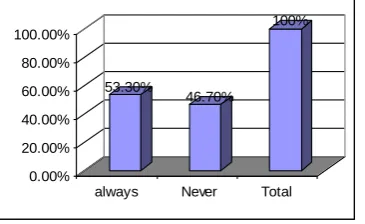
Table (1) Classroom interactions reflect collaborative working relationships between teachers and students.
Answers Frequencies Percentage (%)
always 8 53.3
Never 7 46.7
Total 15 100.0
Figure (1) Classroom interactions reflect collaborative working relationship between teachers and students.
The result in the above table and figures points the answers of sample studies of statement, show percentage in always and
53.30%
46.70%
100%
0.00% 20.00% 40.00% 60.00% 80.00% 100.00%
Never which are exemplified in (53.3%) and (46.7%), respectively the highest percentage equal (53.3%),so the highest percentage is going to positive direction of the statements and all answers of the sample study are agreeable. Therefore this hypothesis is achieved successfully. The percentage result is near to each other. There are teachers need extra training sessions in how to let their students participate effectively.
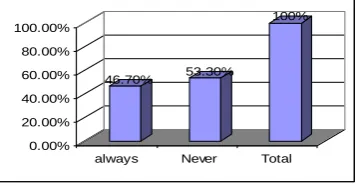
Table (2) The teacher exhibit behaviors that indicate care and concern about students.
Answers Frequencies Percentage (%)
Always 7 46.7
Never 8 53.3
Total 15 100.0
Figure (2) The teacher exhibit behaviors that indicate care and concern about students.
The result in the above table and figure points the answers of sample studies of statement, show percentage in Never and always which are exemplified in (46.7%) and (53.3%), respectively the highest percentage equal (53.3%),so the highest percentage is going to negative direction of the statements and all answers of the sample study are not agreeable. Therefore this hypothesis is not achieved successfully. A large number of teachers do not use positive
46.70% 53.30%
100%
0.00% 20.00% 40.00% 60.00% 80.00% 100.00%
behaviors or techniques that motivate and encourage their students to interact positively in the classroom.
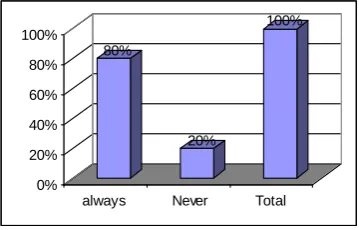
Table (3) Students have opportunities to ask their teacher questions about what they are learning
Answers Frequencies Percentage (%)
Always 12 80.0
Never 3 20.0
Total 15 100.0
Figure (3) Students have opportunities to ask their teacher questions about what they are learning
The result in the above table and figures points the answers of sample studies of statement, show percentage in always and Never which are exemplified in (80%) and (20%), respectively the highest percentage equal (80%),so the highest percentage is going to positive direction of the statements and all answers of the sample study are agreeable. Therefore this hypothesis is achieved successfully. Most secondary schools‟ teachers offer good opportunities to their student so as to ask questions or to add some points in the lesson. It considers a teacher‟s positive point.
80%
20%
100%
0% 20% 40% 60% 80% 100%
Table (4) the teacher employs Non-lecture learning activities (i.e. small groups discussion, student led activities).
Answers Frequencies Percentage (%)
Always 1 6.7
Never 14 93.3
Total 15 100.0
Figure (4)The teacher employs Non-lecture learning activities (i.e. small groups discussion, student led activities)
The result in the above table and figures point the answers of sample studies of statement, show percentage in Never and always which are exemplified in (93.3%) and 6.7(%), respectively the highest percentage equal (93.3%),so the highest percentage is going to negative direction of the statements and all answers of the sample study are not agreeable. Therefore this hypothesis is not achieved successfully. The results showed that most teachers never use the modern and effective techniques inside their classroom. They use the lecturing in presenting their lessons and it is useless and boring for secondary schools‟ students.
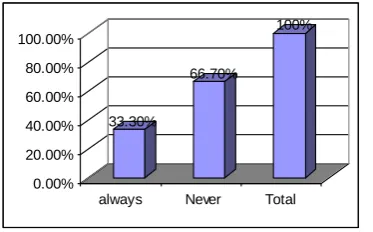
Table (5) Students are motivated and participate effectively
Answers Frequencies Percentage (%)
Always 5 33.3
Never 10 66.7
Total 15 100.0
6.70%
93.30% 100%
0.00% 20.00% 40.00% 60.00% 80.00% 100.00%
Figure (5) Students are motivated and participate effectively.
The result in the above table and figures points the answers of sample studies of statement, show percentage in Never and always which are exemplified in (66.7%) and (33.3%), respectively the highest percentage equal (66.7%),so the highest percentage is going to negative direction of the statement and all answers of the sample study are not agreeable. Therefore this hypothesis is not achieved successfully. The result also explained that teachers need to be trained in how to motivate their students so as to encourage them learn and participate effectively inside the classroom.
FINDINGS OF THE STUDY
The researcher has come out with the fallowing findings: 1- Teachers lack motivation in their teaching.
2- Lack of group work and pair work negatively affect students‟ acquisition and interaction.
3- Many teachers need special training workshops in how to motivate and encourage their students to participate effectively inside the classroom.
4- Teachers need to exchange their experiences in teaching.
33.30%
66.70%
100%
0.00% 20.00% 40.00% 60.00% 80.00% 100.00%
RECOMMENDATIONS
The researcher has come out with the fallowing recommendations:
1- Ministry of education should organize regular professional development workshops so as to provide secondary schools teachers with effective teaching techniques.
2- Secondary schools‟ headmasters should encourage teachers‟ peer observations inside their schools to exchange their experiences in teaching.
3- Secondary schools‟ teachers should be motivated regularly to lead effective teaching in their schools. 4- Secondary schools‟ teachers should use different
teaching techniques inside their classrooms so as to motivate their students to participate.
CONCLUSION
the results revealed that students are not motivated and participate effectively with their teacher inside the classroom. Students‟ motivation is one of the important points in the success of teacher- students‟ interactions inside the classroom. Teacher- students‟ interaction is one of the neglected issues in the teachers training programs. so, secondary schools‟ teachers need extra and regular training sessions in this area so as to develop it.
REFERENCES
1. Craft, A. (2000). Continuing Professional Development: A practical Guide for Teachers and Schools. London, UK: Routledge Falmer.
2. Edge, J. (Ed). (2002). Continuing Professional Development: Some of our Perspectives. Great Britain: Information Press.
3. Hustler, D. (2003). Teachers’ perceptions of continuing professional development. Institute of education, Manchester Metropolitan University.
4. Kohonen, V. (2002). From Isolation to Interdependence in ELT: Supporting Teacher Development through a School- University Partnership. Great Britain: information press.
5. Leung, K.P. (2004). Effects of professional development on teachers’ integration of ICT in teaching in Hong Kong. Ph.D dissertation. Faculty of Education, Queensland University of Technology.