Comparative Analysis of BER, SER, PAPR
&PSD in OFDM using Wavelet Based OFDM
System
Prof. U. V. Patil1, S. V. Dawange2
Associate Professor, Dept. of E&TC, Pravara Rural Engineering College, Loni, Ahemadnagar, India1
PG Student [VLSI& Embedded System], Dept. of E&TC, Pravara Rural Engineering College, Loni, Ahemadnagar,
India2
ABSTRACT: The analysis of BER, PSD, SER and PAPR performance of OFDM system using wavelets based OFDM
system. We implement the parameter by using 16 QAM, 64 QAM, 256 QAM by using wavelet based OFDM system. We do study of wavelet based OFDM to find out the performance parameter using different types of wavelet. In WOFDM parallel transmission takes place, so it increases the spectrum efficiency than the traditional OFDM. The analysis of BER & SER profile is obtained by using energy per bit to noise, PAPR can be obtained by using z function, then Power spectral density is obtained by using frequency function. The performance of parameter shows that there is not much difference for all types of wavelet.
KEYWORDS:Bit Error Rate, Peak to Average Power Ratio, Power Spectral Density, Symbol Error Rate, Orthogonal
Frequency Division Multiplexing, Wavelets.
I.INTRODUCTION
Orthogonal frequency division multiplexing system is a parallel transmission system, so it can be used in much broadband communication. Wavelet based OFDM system has high data rate. In normal OFDM used DFT & IDFT but in wavelet based OFDM used DWT & IDWT because it is a fast transform. WOFDM produce spectral efficiency which is better than traditional FDM system. In this paper we perform the parameter like as Power spectral density, Symbol error rate, Peak to average power ratio & Bit error rate for 16 QAM, 64 QAM, 256 QAM. So analysis of BER & SER profile is obtained by using energy per bit to noise, PAPR can be obtained by using z function, then Power spectral density is obtained by using frequency function. The performance of parameter shows that there is not much difference for all types of wavelet.
In wavelet data can be divide into different frequency component i.e. no of subcarrier can be used, so wavelet can be performed mathematical function. It is better than traditional OFDM SYSTEM. At the same CCDF function level considered as z also increasing as the order of wavelet can be increased. Number of wavelet can be chosen from wavelet families from this Haar wavelet is the simple one and it gives better performance than the other wavelet. Orthogonal frequency division multiplexing has multipath and multicarrier system and modulation technique, so multipath can be produced between transmitter and receiver. In multichannel and multicarrier technique available spectrum is divided into narrow bandwidth. Available bandwidth is divided into non overlapping frequency subchannel. Separate symbol stream can be produced when each sub channel is modulated. Interchange Interference can be reduced when avoid of the overlapping of subcarriers. Subcarriers are mathematically orthogonal to each other. Wavelet transform
There are two types:
1. Discrete wavelet transform 2. Continuouswavelet transform
function can be used. It has time and frequency localization function, frequency analysis can be obtained with low and high frequency version.
II.SYSTEM MODEL AND ASSUMPTIONS
1. Wavelet based OFDM:
Number of wavelets family can be used. It save the bandwidth, wavelet obtained the translation and contraction properties. In many communication system we used the wavelet based OFDM than the other typical OFDM.
2. System Model:
In transmitter & receiver section consists of following contains:
Random Data generator
Encoder/decoder
QAM mapping
DWT & IDWT
Channel model
Data can be generated and encoded .It can be mapped with 16, 64, 256 QAM.DWT&IDWT arethe fastest transform & it perform the linear operation. After that de mapping and demodulation can be performed, and thenthe reconstruction of signal or data can be obtained.
Fig.1Block Diagram of Wavelet Based OFDM
III. EFFICIENT COMMUNICATION
IV.SECURITY
We implement the parameter like as Bit error rate, Symbol error rate, Power spectral density, Peak to average power ratio by using different wavelet families for 16 QAM, 64 QAM, 256QAM. We use wavelet family Haar, Symlet, Coiflet, Daubechies, Discrete Mayer wavelet for the performance parameter. Haar wavelet given the better result than the other wavelet.High PAPR i.e. peak signal power is greater than average signal power. Peak-to-Average ratio describes the envelope fluctuation.
PAPR causes-
Intermodulation
Out of band radiation
Reduce efficiency
V. RESULT AND DISCUSSION
1. Analysis parameter
Table No.1.The analysis parameter for BER, SER, PSD & PAPR are as below:
Parameter value
Modulation type 16QAM,64QAM,256 QAM No.of subcarrier 128
DWT point 128
Channel model AWGN
Reduction of Bit error rate, Symbol error rate, Peak to average power ratio &Power spectral density can be performed in wavelet based OFDM analysis using 16, 64, 256 QAM.
Bit Error Rate:
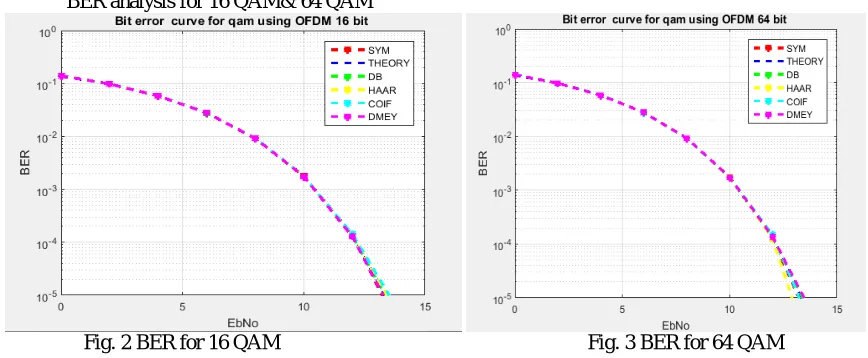
BER analysis for 16 QAM& 64 QAM
Fig. 2 BER for 16 QAM Fig. 3 BER for 64 QAM
BER for 16 QAM: The conventional OFDM has use the 13.3 dB power at 10-5.remaining wavelet obtained
the power is sym(13.3dB),DB(13.2dB),Haar(13.4dB),coif(13.4dB), dmey(13.5dB).
BER for 64 QAM: The conventional OFDM has use the 13.4 dB power at 10-5.remaining wavelet
obtainedsym(13.2dB),DB(13.2dB),Haar(13.4dB),coif(13.2dB), dmey(13.2dB).
Fig. 4 BER for 256 QAM
BER for 256 QAM: The conventional OFDM has use the 13.8 dB power at 10-5.remaining
waveletsym(14dB),DB(13.8dB),Haar(13.7dB),coif(14dB, dmey(14dB). We found that WOFDM has better performance than the conventional OFDM.
Power Spectral Density:
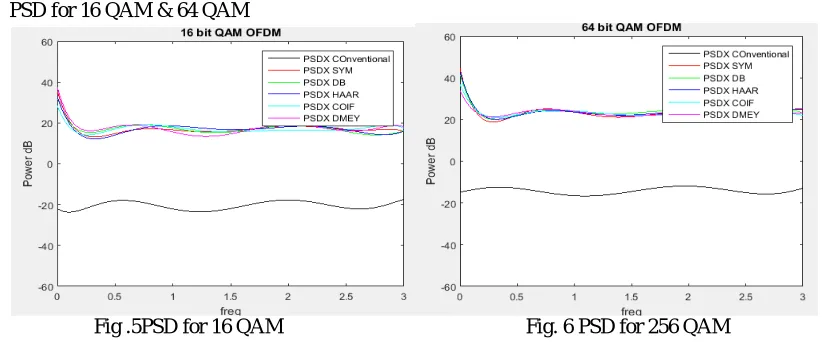
PSD for 16 QAM & 64 QAM
Fig .5PSD for 16 QAM Fig. 6 PSD for 256 QAM
At 0 frequency level, power is high after that spectrum remain constant.
PSD for 16 QAM: At 0 frequency level, power of conventional OFDM is -20 dB. Remaining wavelet
obtained the power is sym(33dB),DB(37dB),Haar(35dB),coif(37.5dB),dmay(38dB).
PSD for 64 QAM: At 0 frequency level, power of conventional OFDM is -15 dB. Remaining wavelet
obtained the power is sym(37dB),DB(40dB),Haar(38dB),coif(43dB),dmay(39dB).
Fig. 7 PSD for 256 QAM
PSD for 256 QAM: At 0 frequency level, power of conventional OFDM is -6 dB. Remaining wavelet
obtained the power is sym(41dB),DB(40dB),Haar(39dB),coif(44dB),dmay(42dB). We analyse that power spectral density performance is much better in 256 QAM.
Symbol Error Rate:
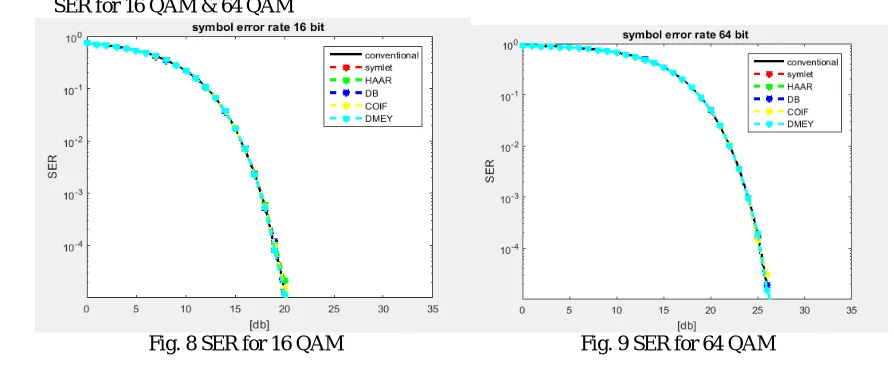
SER for 16 QAM & 64 QAM
Fig. 8 SER for 16 QAM Fig. 9 SER for 64 QAM
SER for 16 QAM :
SER is closer to the 0.75 that is nearer to the 1. The conventional OFDM has power 20.2 dB. Another wavelet obtained the power as DB(19.9dB), Haar(20dB), symlet(20.2dB), coif(20.2dB), dmay(20.1dB).
SER for 64 QAM:
SER is closer to the 0.9 that is nearer to the 1.The conventional OFDM has power 26.1 dB. Another wavelet obtained the power DB(26.1dB), Haar(26.3dB), symlet(26dB), coif(26dB), dmay(26.3dB).
Fig. 10 SER for 256 QAM
SER for 256 QAM:
SER is closer to the 1.The conventional OFDM has power 32.4dB. Another wavelet obtained the power as DB(32.5dB), Haar(32.6dB), symlet(32.6dB), coif(32.4dB), dmay(32dB).
Peak to Average Power Ratio (PAPR)
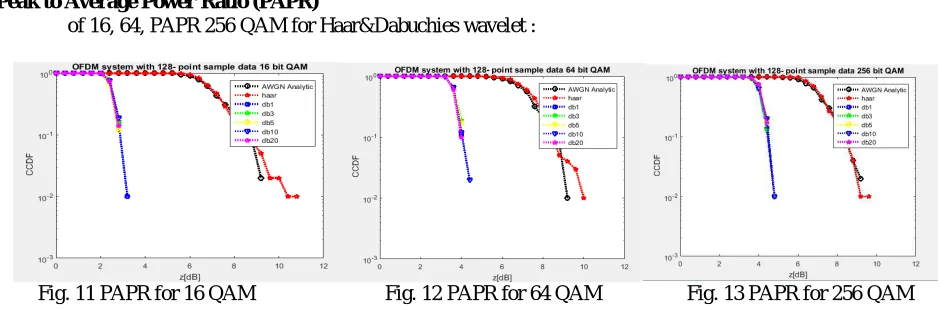
of 16, 64, PAPR 256 QAM for Haar&Dabuchies wavelet :
Fig. 11 PAPR for 16 QAM Fig. 12 PAPR for 64 QAM Fig. 13 PAPR for 256 QAM
At the CCDF of 10-1 HAAR has the highest power i.e. 8.4dB, 8.6dB, 9.6 dB respectively in 16, 64, 256 QAM.
PAPR for 16 QAM: For Haar&Daubechies wavelet
Theoretically obtained value is 8.4 dB. Remaining wavelets power as haar(8.4dB), dB1(2.8dB),dB3(2.8dB),dB5(2.8dB), dB10(3dB), dB20(2.8dB).
PAPR for 64 QAM: For Haar&Daubechies wavelet
Theoretically obtained value is 8.6 dB. Remaining wavelets power as haar(8.6dB), dB1(4dB),dB3(4.1dB),dB5(4.1dB), dB10(4.3dB), dB20(4dB).
PAPR for 256 QAM: For Haar&Daubechies wavelet
Theoretically obtained value is 9.2 dB. Remaining wavelets power as haar(9.6dB), dB1(4.45dB),dB3(4.4dB),dB5(4.45dB), dB10(4.45dB), dB20(4.45dB).
Fig. 14 PAPR for 16 QAM Fig. 15 PAPR for 64 QAM Fig. 16 PAPR for 256 QAM
PAPR for 16 QAM: For Symelet wavelet
Theoretically obtained value is 8.4 dB.Remaining wavelets power as sym2 (2.8dB), sym3 (2.8dB) sym5(3.2dB),sym10(3.2dB).
PAPR for 64 QAM: For Symlet wavelet
Theoretically obtained value is 8.6 dB. Remaining wavelets power as sym2 (4dB), sym3(4dB), sym5(4dB),sym10(4dB).
PAPR for 256 QAM: For Symlet wavelet
Theoretically obtained value is 9.2 dB. Remaining wavelets power assym2 (4.4dB),sym3(4.8dB), sym5(4.8dB),sym10(4.4dB).
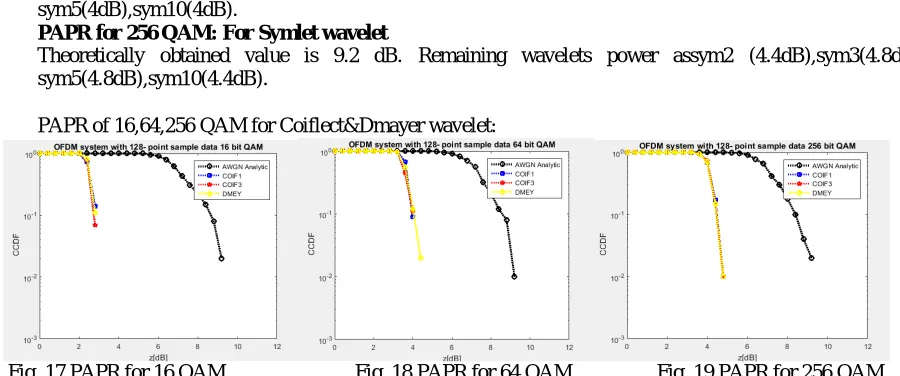
PAPR of 16,64,256 QAM for Coiflect&Dmayer wavelet:
Fig. 17 PAPR for 16 QAM Fig. 18 PAPR for 64 QAM Fig. 19 PAPR for 256 QAM
PAPR for 16 QAM: For Coiflect, Dmayer wavelet
Theoretically obtained value is 8.4dB. Remaining wavelets power as coif1(2.8dB), coif3 (2.8dB), dmay(2.8dB).
PAPR for 64 QAM: For Coiflect , Dmayer wavelet
Theoretically obtained value is 8.6dB. Remaining wavelets power as coif1(4dB),coif3(4dB), dmay(4.4dB).
PAPR for 256 QAM: For Coiflect, Dmayer wavelet
Theoretically obtained value is 9.2dB. Remaining wavelets power as coif1(4.8dB),coif3(4.8dB), dmay(4.8dB).
VI.CONCLUSION
OFDMsystem is much better than the conventional OFDM.Power level is increased than conventional OFDM, which is more in 64 & 256 QAM.
REFERENCES
[1] Member, IEEE,J.-L. Wang, K.-C. Yi, Member, IEEE, and B. Tian, PAPR Reduction of OFDM Signals With Minimized EVM via
Semidefinite Relaxation, IEEE transactions on vehicular technology, vol. 60, no. 9, pp 4662- 4667,November 2011.
[2] ShiannShiunJeng, Member, IEEE, and JiaMing Chen, Student Member, Efficient PAPR Reduction in OFDM Systems Based on a
Companding Technique With Trapezium Distribution, IEEE, VOL. 57, NO. 2, pp 291 – 298, JUNE 2011.
[3] Suverna Sengar1, ParthaPratim Bhattacharya, Performance Improvement In OFDM System By PAPR Reduction, An International Journal
(SIPIJ), Vol.3, No.2, pp 157 – 169, April 2012.
[4] V. G. Khetmalis Department of Electronics and Telecommunication, Wavelet Based Multicarrier Modulation Schemes,Interenational
Journal Of Engineering Research and Technology, Vol. 2 Issue 9, September 2013.
[5] Guobing Cheng, Huilei Li, Shaoqian Li, Lisha Gong, Binhong Dong, Peng Wei, Comparison between OQAM and N-continuous OFDM,
National Key Laboratory of Science and Technology on Communications, University of Electronic Science and Technology of China, Chengdu, China Received Communications and Network, 2013, 5, pp 390-393, August, 2013.