An Emphasized Apriori Algorithm for Huge Sequence
of Datasets
RaviKumar.V1, Dr.Purna chander Rao2
Assoc.Professor, Dept of IT, TKRCET, Research Scholar, JNTUH Professor, SVIET
Abstract: In this paper, an Emphasized Apriori algorithm is proposed based on the most popular Apriori algorithm to overcome its drawbacks which are nothing but time consumption and the memory space. Since the Apriori algorithm scans the entire database based on minimum support and minimum confidence, it consumes more time and also more space. In this approach, new candidate set was prepared by considering the minimum support such that the total number of items will be reduced intern reduces the time taken and also memory space. This approach also includes the concept of Frequent Pattern (FP) growth to delete the items which are not frequent. Finally, a FP tree is established based on the frequent itemsets such that the items which are not frequent were delete intern to reduce the space consumption.
Keywords: Sequential Pattern Mining, Apriori, Frequent Pattern, Itemsets, Time Consumption.
1. Introduction
With the quick development of the Internet and information, mining valuable and important learning or data is a basic issue as of late.
Contingent upon particular
applications [1], [2], the found learning can be named affiliation
manage mining [3],
characterization [4], bunching [5], and successive example mining
[6], [7] among others [8].
Consecutive example mining
(SPM) concerns the requested
arrangement information, for
example, DNA successions,
few socks in one exchange at shopping center, he or she will get a few shoes in a later exchange. In prior, Agrawal et al. proposed the AprioriAll calculation [6] to produce and-test contender for mining the successive examples from a static database. Pei et al.
planned the PrefixSpan
calculation to effectively mine the successive examples in view of the projection component [9]. A grouping database is recursively anticipated into a few littler
arrangements of anticipated
database to accelerate the
calculations for mining
consecutive examples. Zaki et al. proposed a SPADE calculation to
quick mine the successive
examples [10]. The SPADE
calculation uses the combinational properties in view of the effective grid seek methods with join operations. In view of SPADE
calculation, the consecutive
examples can be determined with three database filters. Numerous calculations have been proposed to mine the consecutive examples, however the greater part of them
are performed to handle the static database. At the point when the arrangements are changed whether
succession inclusion [11] or
erasure [12] in the first database, the found consecutive examples may get to be invalid or new successive examples may emerge. A natural approach to overhaul the successive examples is to re-handle the redesigned database in cluster mode, which is wasteful in certifiable applications. To handle
the dynamic database with
succession inclusion, Lin et al. proposed a FASTUP calculation [13] to incrementally keep up and overhaul the found successive
examples with arrangement
addition. The first database is still,
nonetheless, required to be
arrangement erasure [15] in a level-wise manner, which requires more calculations of numerous database rescans. Lin initially
planned a quick redesigned
consecutive example (FUSP)- tree and built up the calculations for productively taking care of an
incremental database with
grouping inclusion [16]. The FUSP tree is implicit progress
before the arrangements are
embedded into the first database. Two sections with four cases are then separated in light of the FASTUP idea to keep up and overhaul the FUSP tree for later
mining process. Lin et al.
additionally proposed the support
calculation for grouping
cancellation [17]. The first
database is, be that as it may, required to be rescanned in the event that it is important to keep up a succession which is little in the first database yet substantial in the embedded groupings with
arrangement inclusion or a
succession is little both in the first database and in the erased
successions with grouping
erasure. In this paper, an
Enhanced Apriority approach is proposed to diminish the time utilization and memory space in
consecutive example mining
framework. The proposed
approach depends on the most well known Apriority algorithm which is having an issue of exercise in futility and parcel of memory utilization. The improved Apriority algorithm beats these two issues by erasing the itemsets which are not visit. Whatever is left of paper is sorted out as takes after: area II depicts the points of interest of Apriority algorithm. Area III depicts the points of interest of the proposed Enhanced Apriority algorithm. The test results are represented in area IV lastly the conclusions are given in segment V.
2. Apriori Algorithm
Agrawal and Srikant [6] firstly proposed Apriority algorithm .
This calculation depends on
primary process are executed in Apriority algorithm : one is applicant era handle, in which the bolster tally of the comparing sensor things is computed by checking value-based database and second is substantial itemset era, which is produced by pruning those hopeful Itemsets which has a bolster number not as much as least limit. These procedures are
iteratively rehashed until
competitor Itemsets or huge
Itemsets gets to be unfilled as in illustration appeared in Fig 1. Unique database is filtered first time for the competitor set, comprises of one sensor thing and
there support has checked, then these 1-Itemset applicants are pruned by just evacuating those things that has a thing tally not as much as client determined edge (in above case threshold=30%). In second pass database is filtered again to create 2-Itemset hopefuls comprise of two things, on the other hand pruned to delivered
expansive 2-Itemset utilizing
apriori property. As per apriori property each sub 1-Itemset of 2 regular Itemsets must be visit. This procedure closes as in fourth sweep of database 4-Itemset hopeful will be pruned and huge itemset will be unfilled.
(a) (b) (c)
(d) (e)
(f) (g)
There are two constraints of this calculation: one is unpredictable hopeful itemset era handle which expends substantial memory and tremendous execution time and second issue is over the top database checks for competitor era. By and large there are two
approaches to beat these
constraints: one route is to investigate distinctive pruning and
separating systems to make
competitor Itemset littler. Second approach is either supplant unique database with subset of exchange in light of huge incessant Itemset or minimizes the quantity of sweeps over the database.
3. Emphasized Apriori
Algorithm
Despite being straightforward and
clear, the Apriori algorithm
experiences some shortcoming. Squandering of expensive time for checking all out datasets and the lower least support or bigger
itemsets is the principle
confinement couch priori
calculation. Since, it has
exponential multifaceted nature; it
devours parcel of memory
furthermore reaction time. For instance, if the quantity of exchanges is 100, then the aggregate number of itemsets will be 2 furthermore it does mining
twice. This issue can be
illuminated by decreasing the quantity of itemsets by continuous itemsets mining (FIM) assistant diminishes the time required for mining. Be that as it may, the
fundamental impediment with
FIM is the utilization of a great deal of space and gets to be wasteful for ongoing itemset applications.
In this paper, another example mining methodology is proposed to beat the issue of ordinary Apriori and FIM calculations. We
should characterize a few
We first output every one of the exchanges to produce F1 which contains the things, their bolster check and Transaction IDs where
the things are found. And
afterward we utilize F1 as a partner to create F2, F3 … ., Fk. When we need to produce C2, we make a self-join F1 * F1 to develop 2-itemset C (x, y), where x and y are the things of C2. Before filtering all the exchange records to check the bolster tally of every competitor, utilize F1 to get the exchange IDs of the base bolster tally amongst x and y, and in this way examine for C2 just in these particular exchanges. A similar thing applies for C3, build 3-itemset C(x, y, z), where x, y and z are the things of C3 and utilize F1 to get the exchange IDs of the base bolster tally between x, y and z and after that output for
C3 just in these particular
exchanges and rehash these means until no new continuous itemsets are distinguished. Presently to decrease the memory space when extensive exchanges are there a straightforward administer can be
taken after: Let n be the quantity of hubs in the FP-tree and k be the shade of the groups of the
exchanges in the database.
Presently, absolutely n > k. If so then k is at most n - 1. Assume we have 1000 exchanges then k will be at generally 999. There are
such a large number of
conceivable outcomes of hues and every one of the hues will be
picked by us. All things
considered, unmistakably that
prompts to a terrible decision. Presently, let n>= k as this can likewise be conceivable then k will be at most n yet at the same time the run applies as n can't be not as much as k since then at every level hubs will have a similar shading. It must be same if the tree is completely needy. Since it consumes exponential
memory room, the potential
outcomes of hues getting
definitely eg; if n = 1000 now then k will be around log2(1000) = 10. The base 2 connotes that the bunch is getting apportioned into 2 sections and selecting implies out of the two just 1 is getting chosen. This can be any number of segments relying upon client's decision. Client will have the decision of choosing the base. The
estimation of the base is
equivalent to the quantity of allotments of the group. Utilizing this approach less memory space is devoured at once and things can be mines in a lesser measure of time. Consequently, it fills the need.
Give us a chance to accept an extensive grocery store tracks deals information by stock-putting
away unit (SSU) for every thing, for example, "Sugar", "Dal", "Drain", "Wheat", "Oil", "Rice" is distinguished by a numerical SSU. The general store has a database
of exchanges where every
exchange is an arrangement of
SSUs that were purchased
together. Give the database of exchanges a chance to comprise of
taking after itemsets: The
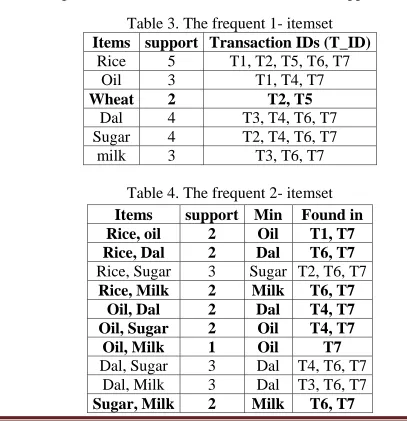
exchange set as appeared in Table 1. At first, filter all exchanges to get visit 1-itemset I1 which contains the things and their bolster tally and the exchanges ids that contain these things, and after that dispense with the competitors that are not visit or the thing having bolster not exactly the base support as appeared in table 2.
Table 1. The Transactions Transactions Item sets
T1 Rice, oil
T2 Rice, wheat, sugar
T3 Milk, dal
T4 Dal, sugar, oil
T5 Wheat, rice
T6 Rice, dal, sugar, milk
Table 2. The candidate 1- itemset Items support
Rice 5
Oil 3
Wheat 2
Dal 4
Sugar 4
milk 3
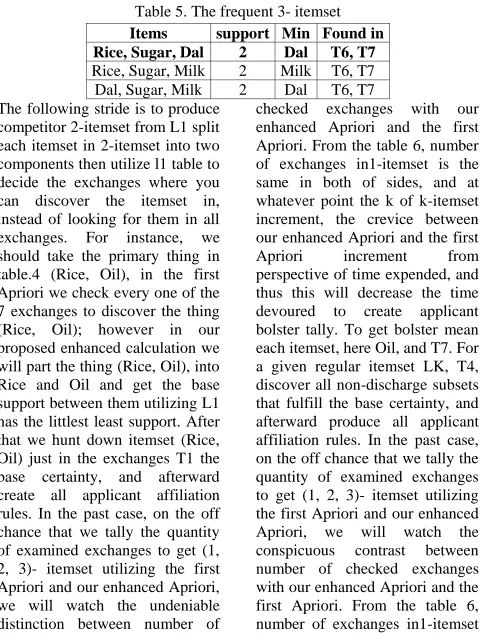
The regular 1-itemset is appeared in table 3. The sets which are in intense will be erased in regular 2-itemset as appeared in table 4. The sets which are in strong will be erased in successive 3-itemsets as appeared in table 5.
Table 3. The frequent 1- itemset
Items support Transaction IDs (T_ID)
Rice 5 T1, T2, T5, T6, T7
Oil 3 T1, T4, T7
Wheat 2 T2, T5
Dal 4 T3, T4, T6, T7
Sugar 4 T2, T4, T6, T7
milk 3 T3, T6, T7
Table 4. The frequent 2- itemset Items support Min Found in
Rice, oil 2 Oil T1, T7
Rice, Dal 2 Dal T6, T7
Rice, Sugar 3 Sugar T2, T6, T7
Rice, Milk 2 Milk T6, T7
Oil, Dal 2 Dal T4, T7
Oil, Sugar 2 Oil T4, T7
Oil, Milk 1 Oil T7
Dal, Sugar 3 Dal T4, T6, T7
Dal, Milk 3 Dal T3, T6, T7
Table 5. The frequent 3- itemset
Items support Min Found in Rice, Sugar, Dal 2 Dal T6, T7
Rice, Sugar, Milk 2 Milk T6, T7
Dal, Sugar, Milk 2 Dal T6, T7
The following stride is to produce competitor 2-itemset from L1 split each itemset in 2-itemset into two components then utilize l1 table to decide the exchanges where you can discover the itemset in, instead of looking for them in all exchanges. For instance, we should take the primary thing in table.4 (Rice, Oil), in the first Apriori we check every one of the 7 exchanges to discover the thing (Rice, Oil); however in our proposed enhanced calculation we will part the thing (Rice, Oil), into Rice and Oil and get the base support between them utilizing L1 has the littlest least support. After that we hunt down itemset (Rice, Oil) just in the exchanges T1 the base certainty, and afterward create all applicant affiliation rules. In the past case, on the off chance that we tally the quantity of examined exchanges to get (1, 2, 3)- itemset utilizing the first Apriori and our enhanced Apriori, we will watch the undeniable distinction between number of
checked exchanges with our enhanced Apriori and the first Apriori. From the table 6, number of exchanges in1-itemset is the same in both of sides, and at whatever point the k of k-itemset increment, the crevice between our enhanced Apriori and the first
Apriori increment from
perspective of time expended, and thus this will decrease the time devoured to create applicant bolster tally. To get bolster mean each itemset, here Oil, and T7. For a given regular itemset LK, T4, discover all non-discharge subsets that fulfill the base certainty, and afterward produce all applicant affiliation rules. In the past case, on the off chance that we tally the quantity of examined exchanges to get (1, 2, 3)- itemset utilizing the first Apriori and our enhanced Apriori, we will watch the
conspicuous contrast between
is the same in both of sides, and at whatever point the k of k-itemset increment, the
hole between our enhanced
Apriori and the first Apriori
increment from perspective of time devoured, and consequently this will lessen the time expended to produce competitor bolster check.
Figure.2. FP-tree of the above illustrated Example
The last yield of the FP-Tree is as appeared in Figure.2. Also, the base bolster tally is 3. Presently locate the incessant examples from the FP-Tree. It's minor. The things of the database and their recurrence of events are appeared in Table:2 for everything. Above all else, we have to organize all the itemsets as indicated by their recurrence of events and afterward we will see everything one by one from base to beat. The things can be recorded as: Then we see Milk. To begin with we have to locate the contingent example base for Milk:3. This is because of the recurrence of event of Milk. Presently go to Graph 1 and check
the FP-Tree which we can draw again for Milk and similarly for every single other thing.
4. Experimental Analysis
The performance evaluation of proposed approach is examined by applying on various datasets. For every itemset, the performance was measured by measuring the time taken for every transaction and the reduced amount of time at
every transaction, the execution time will vary with number of transactions. As the number of transaction increases, the time taken for scanning also increases. Initially, the time taken for execution is evaluated for all transaction and the one transaction is considered for evaluation with varying minimum support. The obtained results are summarized as follows:
Figure.3. Running time for all transactions
Figure.3. shows the comparative analysis of the proposed approach with earlier Apriori algorithm with respect to the time taken for execution. The running time varies from transaction to transaction. As the number of transactions increases, the time required for execution also increases. From the above figure, it can be observed that the running time for proposed approach is less compared to Apriori algorithm.
Figure.4. Running time variations w.r.t minimum support
T1 T2 T3 T4 T5
0 5 10 15 20 25
R
u
n
n
in
g
Ti
m
e
(s
)
Transactions Apriori[5]
EApriori
0.02 0.04 0.06 0.08 0.10
0 0.5 1 1.5 2 2.5 3 3.5 4
R
u
n
n
in
g
Ti
m
e
(s
)
Minimum Support
Apriori[5]
Figure.4 shows the time taken for execution with respect to minimum support. As the minimum support increase, the time taken for execution will be decreased. The above figure compares the Apriori with the proposed approach with respect to execution time for varying minimum support. From the above figure, it can be observed that for the proposed approach, the time taken for execution at each and every minimum support is less compared to Apriori.
Figure.5. Time consuming comparison for different groups of transactions. Figure.5 describes the details of the time taken for execution with varying number of transaction. The number of transactions is varied from 500 to 2500 and the respective time consumption results for both the Apriori and the proposed EApriori are shown in figure.5. Since the proposed approach considers the frequent itemset as one more parameter to perform mining, the time taken by EApriori must be less when compare to Apriori. In the above figure, the time taken is increasing with number of transaction, but the increment is less for EApriori compared to Apriori.
Figure.6. Number of nodes of tree for varying data size
Figure.6 describes the number of node obtained for varying data side such that the number of itemsets. Generally, the dataset size increases, the number of nodes also increases. From the above figure, the proposed approach almost approaches the earlier approach.
500 1000 1500 2000 2500
0 5 10 15 20 25 30 35 40 45 50
Number of transactions
Ti
m
e
(s
)
Apriori[5] EApriori
10 50 100 150 200 0
1000 2000 3000 4000 5000 6000 7000 8000 9000
N
u
m
b
e
r
o
f
N
o
d
e
s
Dataset Size Apriori[5]
Figure.7. Runtime (ms) variations with varying dataset size
The runtime generally increases with an increase of dataset size. The above figure illustrates the
variations of runtime in
milliseconds for a varying dataset size. Form the above figure, it can be observed that the proposed approach has less increment in the
runtime compared to earlier
approach.
5. Conclusion
In this paper, a new approach was proposed for sequential pattern mining based on the earlier Apriori algorithm. This approach successfully reduces the memory space and also reduces the time required for execution even for large datasets. The enhancement if the proposed approach can be observed when there is an increment in the k itemsets. The
time consumed to generate
candidate support count in our enhanced Apriori is less than the
time consumed in the original Apriori. The results also reveal the efficiency of proposed approach in the view of time consumption.
6. References
[1] R. Agrawal, T. Imielinski,
and A. Swami, ``Database
mining: A performance
perspective,'' IEEE Trans.
Knowl. Data Eng., vol. 5, no. 6,
pp. 914_925, Dec. 1993
[2] M.-S. Chen, J. Han, and P. S. Yu, ``Data mining: An overview from a database
perspective,'' IEEE Trans.
Knowl. Data Eng., vol. 8, no. 6,
pp. 866_883, Dec. 1996.
[3] R. Agrawal and R. Srikant,
``Fast algorithms for mining
association rules in large
databases,'' in Proc. Int. Conf.
Very Large Data Bases, 1994,
pp. 487_499.
[4] S. B. Kotsiantis,
``Supervised machine learning:
0 20 40 60 80 100 120 140 160 180 200 0
1000 2000 3000 4000 5000 6000 7000
Dataset Size
R
u
n
ti
m
e
(m
s
)
A review of classi_cation techniques,'' in Proc. Conf. Emerg. Artif. Intell. Appl. Comput. Eng., Real Word AI Syst. Appl. eHealth, HCI, Inf.
Retr. Pervasive Technol., 2007,
pp. 3_24.
[5] P. Berkhin, ``A survey of
clustering data mining
techniques,'' in Grouping
Multidimensional Data. Berlin,
Germany: Springer-Verlag,
2006,pp. 25_71.
[6] R. Agrawal and R. Srikant,
``Mining sequential patterns,''
in Proc. Int. Conf. Data Eng.,
1995, pp. 3_14.
[7] C. H. Mooney and J. F.
Roddick, ``Sequential pattern
mining_Approaches and
algorithms,'' ACMComput.
Surveys, vol. 45, no. 2, pp.
1_39, Feb. 2013.
[8] C.-W. Lin, T.-P. Hong, and
W.-H. Lu, ``An effective tree structure for mining high utility itemsets,'' Expert Syst. Appl., vol. 38, no. 6, pp. 7419_7424, Jun. 2011.
[9] J. Pei et al., ``Mining
sequential patterns by
pattern-growth: The PrefixSpan
approach,'' IEEE Trans. Knowl.
Data Eng., vol. 16, no. 11, pp.
1424_1440, Nov. 2004.
[10] M. J. Zaki, ``SPADE: An
efficient algorithm for mining
frequent sequences,'' Mach.
Learn., vol. 42, nos. 1_2, pp.
31_60, Jan. 2001.
[11] D. W. Cheung, J. Han, V. T.
Ng, and C. Y. Wong,
``Maintenance of discovered
association rules in large
databases: An incremental
updating technique,'' in Proc.
25th Int. Conf. Data Eng., Mar.
1996, pp. 106_114.
[12] D.W.-L. Cheung, S. D. Lee, and B. Kao, ``A general
incremental technique for
maintaining discovered
association rules,'' in Proc. Int. Conf. Database Syst. Adv.
Appl., Apr. 1997, pp. 185_194.
[13] M.-Y. Lin and S.-Y. Lee,
``Incremental update on
sequential patterns in large databases,'' in Proc. IEEE Int.
Conf. Tools Artif. Intell., Nov.
1998, pp. 24_31.
[14] T.-P. Hong, C.-Y. Wang,
and S.-S. Tseng, ``An
incremental mining algorithm
for maintaining sequential
patterns using pre-large
[15] C.-Y. Wang, T.-P. Hong,
and S.-S. Tseng, ``Maintenance of sequential patterns for record deletion,'' in Proc. IEEE Int.
Conf. Data Mining, Nov. 2001,
pp. 536_541.
[16] C.-W. Lin, T.-P. Hong, W.-H. Lu, and W.-Y. Lin, ``an
incremental FUSP-tree
maintenance algorithm,'' in
Proc. 8th Int. Conf. Intell. Syst.
Design Appl., Nov. 2008, pp.
445_449.
[17] C.-W. Lin, T.-P. Hong, and W.-H. Lu, ``An efficient
FUSP-tree update algorithm for
deleted data in customer
sequences,'' in Proc. Int. Conf.
Innovative Comput., Inf.
Control, Dec. 2009, pp.