Density Based Optimized Broadcasting for Multirate
Services in Wireless ADHOC Network
Ch.Nagraju
1,
M.V.Subramanyam
2 #Electronics and Communication Engineering,
1St.Johns College of Engineering & Technolog
2Santhiram College of Engineering
kurnool (Dt), Andhrapradesh
Abstract
—
Due to non-infrastructure requirement AdHoc network has gained higher popularity in recent past. AdHoc networks demands for higher intermediate node supports for long-range communication. For the improvement of long-range communication different routing schemes were suggested. Wireless AdHoc network is an emerging communication approach. In wireless AdHoc network the most commonly used routing method is anycast routing. Any cast is an addressing mode in which the same address is assigned to multiple hosts. In these hosts form any cast group and each host is referred to as an any cast group member. To transmit the packets from a client to the group address are routed to the any cast group member closest to the client. Where ‘closest’ is the specific routing protocol. Today’s any cast routing protocols are commonly modification of existing unicast routing protocols such as link-state routing protocol and distance routing algorithm. The main drawback of these routing is it cannot consider the number of available any cast group members for its routing decision. In order to solve these problems by using density-based routing has to be developed.
Keywords
—
Adhoc
Network, Throughput, High rate services.I.
INTRODUCTION
Wireless networks have generated tremendous interest among researchers these years because of their potential usage in a wide variety of applications. Sensor nodes are inexpensive portable devices with limited processing power and energy resources. Sensor nodes can be used to collect information from the environment, locally process this data and transmit the sensed data back to the user. Sensor nodes consist of five main components [11]: a computing unit, a communication unit, a sensing unit, a memory unit, and a power supply unit. The computing unit consists of a microprocessor. The microprocessor is responsible for managing the communication protocols, processing collected data from the on-board sensors, and performing the power management. Each sensor node has a single communication unit that is able to transmit and receive packets. This unit combines the functionality of both transmitter and receiver.
The communication frequencies of the sensor nodes are between 433 MHz (in some early generations of sensor nodes) and 2.4 GHz (the most commonly used frequency) [2]. The communication unit has four operational states: transmit, receive, idle and sleep. A sensing unit is usually a sensor board that consists of one or more sensors. Sensors must have extremely low power consumption. Some commonly used sensors are temperature sensor, humidity sensor, light sensor, barometer, 2-axis accelerometer, microphone, and GPS receiver. There are two types of memory units based on different needs for storage in a sensor node. The microprocessor itself contains some on-chip memory used to store system software.
There is also typically flash memory available where users can store their own applications and data. The power unit provides power to other four units described above. In the MicaZ mote, for example, it consists of two AA batteries, either rechargeable or non-rechargeable [2]. Although all sensing, computing and communication operations consume energy, data communication
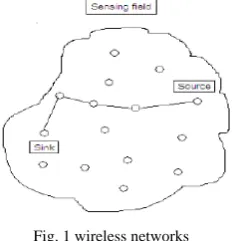
requires more energy than sensing and computing. Thus, reducing data communication between sensor nodes can improve the energy efficiency and extend the lifetime of sensor networks. As shown in Figure 1, typical wireless networks consist of multiple sensor nodes deployed in the sensing field, and one or several sinks nodes at which data is collected and which have external network connectivity. Sensor networks in many applications are deployed without pre-defined structure and left unattended to perform multiple monitoring or tracking tasks. A WN is able to self-configure its operation and manage its connectivity. A WN is also able to tolerate malfunctioning nodes and integrate new nodes in the network since node failure is common in WN applications [12]. Because of the limited power and transmission range in a large sensor network, the communication between sensor nodes must be multihop. Data from a source sensor node relayed by a number of intermediate nodes before it reaches the final destination. Collaboration between sensor nodes and in-network processing are necessary in sensor networks since a single node may not have all the data concerning some event of interest [8] [13]. In-network processing can also reduce the number of packets transmitted in the network by aggregating similar data together and thus reducing the power consumption. Wireless networks have great potential for many industrial applications. Typical WN applications can be classified into two categories: monitoring and tracking [16]. Monitoring applications may involve periodic data collection or may be event driven. In an event-driven application, when a certain event occurs in the sensing field, sensor nodes collect the sensor readings of that certain event and transmit them back to the sink. Those applications usually employ a very strict power management strategy due to the limited power supply of sensor nodes and long lifetime requirement of the application [9] [13][11]. For example, sensor nodes may operate most of the time in sleep mode and are only woken up by a nearby sentry node (a node that is awake all the time and monitors the sensing field) when a certain event is detected. Some common WN monitoring applications include environmental monitoring, battlefield monitoring, health monitoring, water monitoring, and greenhouse monitoring [1]. Tracking applications have different requirements than monitoring applications in that the source of an event can be mobile. Of interest is the current location of the target. Real-time communication is usually desired in tracking applications [11].
Fig. 1 wireless networks
client destined to the group address are routed to the any cast group member closest to the client, where “closest” is in terms of the metrics used by the specific routing protocol. The most prominent use of any cast today is in the Internet to find replicated DNS root servers [2] or to locate rendezvous points in multicast trees [3]. However, any cast has also many potential applications in wireless ad hoc networks. For example, any cast can be used in wireless mesh networks to route data packets to an Internet gateway or in sensor networks to send data to any data sink when multiple sinks are accessible. Today’s any cast routing protocols are most commonly modifications of existing unicast routing protocols. For example, link-state routing protocols such as OSPF [4] have been extended to support any cast routing by adding a virtual node that represents the any cast service [5]. With distance vector routing algorithms such as RIP [6], any cast routing is implemented by group members that advertise their anycast address with a distance of zero [5]. Also in the context of ad hoc networks, link reversal algorithm, such as TORA [7], were extended to support any cast routing by assigning a height of zero to all members of a given any cast group [5]. Since these proposed any cast protocols are designed as extensions of unicast routing techniques, they are easy to implement and to deploy. However, as a consequence, they all follow the routing strategy determined by the corresponding unicast routing technique: packet delivery to the closest group member using shortest-path forwarding.
In this paper, we propose a new method that adds a whole family of routing strategies to the class of any cast routing schemes: density-based routing. This method not only considers the member proximity in the routing decision, but also the quantity of accessible group members. Therefore, it is possible that a path over which multiple members are accessible is preferred over a path to a closer single member. Our goal is not to replace proximity-based routing, but to add a new dimension to the routing strategy design space. With this new axis in the design space, the routing strategy can be designed as an optimal tradeoff between proximity and density. Density-based any cast routing is of particular interest in wireless and mobile ad hoc networks where the network conditions are dynamic. Proposed any cast routing protocols for such networks [5], [8]–[11] are all implemented as modifications of existing unicast routing protocols and hence always route packets towards the closest group member. In wireless and mobile networks however, the closest member might become unreachable because it moves away or because of intermediate link failures along the path. Under such conditions, routing towards a dense group member population increases the probability that a packet eventually reaches any group member because packets can more easily be re-routed to neighboring group members when the targeted one becomes unreachable.
To evaluate the benefits of density versus proximity anycast routing, we implement a distributed protocol to establish potential fields and simulate the different routing strategies under various dynamic network conditions. In particular, we consider two different mobile scenarios and a static scenario with temporary link failures. Our results show that a combined proximity-density routing strategy increases considerably the robustness (in terms of packet delivery ratio) compared to the traditional pure proximity-based routing scheme while not increasing significantly the path length of the traveled packets.
II.
ANYCAST ROUTING SCHEME
In this section, we present our field-based model for anycast routing. First, we give an overview of the basic concepts. Then, we introduce our definition of potential fields in a networking context and describe how packets are routed along those fields. Finally, we discuss convergence limitations of the model due to undesired local maxima in the fields that might occur in particular network topologies.
A.
Overview
Our model is inspired from field theory in physics. Every group member creates a potential field which decreases with d-k, where is the distance to the group member, and determines how quickly the field decreases. The field of an entire anycast group is the linear superposition of all individual fields from the group members. An example field for an anycast group with four members (marked as black nodes) is depicted in Figure 2. The peaks in the field are at the locations of the group members. Note that only one field is drawn in the figure, but as each anycast group requires its own field, multiple fields will generally co-exist simultaneously. We achieve anycast routing by forwarding packets towards the steepest gradient of the field. This is in analogy to field diffusion in physics. By following the steepest gradient, packets eventually reach a field maximum, i.e., a group member. The steepest gradient at each node is determined by comparing the potential values of its neighbors. The steepest gradient is towards the neighbor with the highest potential value. The proposed routing model allows for different anycast strategies comprising proximity, density, and combined routing strategies. Which routing strategy is applied is determined by the value of the parameter K .
Fig 2: Example potential field. Black nodes represent group members.
B. Potential Fields
We define the potential field of an anycast group member with a strictly decreasing function. That is, we define the potential value at some node as
Where dj(n) is defined as the distance of to the group member j, and
the exponent is a parameter that determines how quickly the potential decreases with increasing distance to the group member. In this paper, we always use the number of hops to calculate the distance between a node and a group member. However, the distance function could also capture different metrics (such as for example the transmission delay between a node and a group member) as long as the potential function remains strictly decreasing. Any cast groups consists of multiple members. Every member contributes to the field of the group. Thus, the potential field of an anycast group N is defined as the superposition of the potential fields of all members in this group
With this definition, the potential field’s shape resembles a
landscape with poles at every group member since
(in one term of (2) the distance dj(j) is equal to zero
III.
ROUTING MECHANISMS
A. Gradient-Based RoutingWe use the potential field of the anycast group to route packets in the network. The routing mechanism is similar to field diffusion in physics. With field diffusion, an element (e.g., a test charge in an electrical field) is attracted by a force in the direction of the steepest gradient of the field. If the element is free to move, it will diffuse along the steepest gradient until it arrives at a field maximum. In the same manner, we route anycast packets along the steepest gradient of the potential field. The steepest gradient at each node is determined by evaluating the potential values of the neighbors. That is, the link from a node to the neighbor with the highest potential value corresponds to the steepest gradient. Therefore, the nodes always compare the potential value of their neighbors and forward anycast packets to the neighbor with the highest potential value. A necessary condition is that the potential at the neighbor with the highest potential value is larger than at the forwarding node. This guarantees that the steepest gradient is ascending.
B. Convergence Limitations
The proposed model manages to successfully deliver anycast packets from any node in the network with the condition that there are no local1 maxima in the potential field. In a local maximum, packets are stuck since there are no neighbors with a greater potential value to forward to. However, in contrast to the physical model which operates in a continuous space, we cannot avoid the occurrence of local maxima in our field model which operates on a discrete set of nodes. This fundamental difference implies that we can only guarantee the absence of
local maxima for , where is a constant we will
derive in the next section. For values of , local maxima may occur and routing along the steepest gradient may not converge. Although we cannot guarantee routing convergence for that range, we use our model in that range because: 1) the occurrence of local maxima in random networks is rare and 2) in practice, local maxima can easily be detected by comparing the own potential value with the value of the direct neighbors. Hence, it is possible to circumvent them at the protocol layer without considerable communication overhead.
C. Local Maxima in Random Topologies
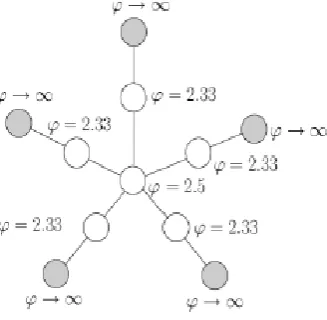
Local maxima may occur in particular topologies like for example the one shown in Figure 3. The node in the center of the star-shaped topology has a potential value of 2.5 which is higher than the potential value of any of its surrounding neighbors. To assess how frequent local maxima occur for, we perform simulations with random network topologies. Our simulations are based on graphs which are constructed as follows.
Fig .3 Example of a local maximum for K=1. The gray nodes are group members
We place a number of nodes randomly on a square. We assign a link between two nodes in the graph if the geometric distance
between those two nodes is smaller than the wireless range, a constant value equal for all nodes. The distances of the nodes to the group members, as required to compute the potential values, are obtained by computing the shortest path according to Dijkstra’s algorithm [12] in the graph. Finally, to detect whether there is a local maximum in the potential field, we iterate over all nodes and compare their potential values with the values of their direct neighbors in the graph. If a node’s potential is larger than all of its neighbors, and it is not itself a group member, the node constitutes a local maximum.
D. Effect of on Routing Strategy
The potential field and thus also the resulting routing strategy is influenced in our model by the exponent in (1). For large values of K, the field results in a steeper distribution than for small values. It is observed that the bound for K where packets are always routed towards the closest group member along the shortest path (proximity routing), and a bound for K where packets are only routed in a specific direction based on the group member density and the member proximity is irrelevant (pure density routing).
IV.
FIELD-BASED ANYCAST ROUTING
PROTOCOL
To evaluate the performance of density-based anycast routing in dynamic networks, we designed a distributed routing protocol to establish potential fields and forward packets along the steepest gradient. Note that the focus of this paper is not on the performance of the routing protocol itself, but on the comparison of the different anycast routing strategies. Therefore, we designed a relatively simple protocol for the only purpose of comparing the different strategies, and leave possible enhancements of the protocol to future work.
A. Potential Field Establishment
To establish a potential field, every node in the network must know its distance to the existing group members. For this purpose, the group members periodically flood the network with a message indicating the anycast group they belong to, and their identity (i.e., an identifier that uniquely identifies the group member). These flooded messages also include a time-to-live (TTL) value indicating how many hops the packet has traveled. The TTL value serves two purposes. First, it allows every receiver to determine its distance to the group member who initiated the flooding. Second, it allows to limit the flooding scope by only rebroadcasting messages which have a TTL value greater than 0 which reduces the communication overhead produced by such messages. By listening to those messages, each node calculates its potential value according to (2). The interval at which the member should advertise such messages is a tradeoff between accuracy and protocol overhead. In this paper, we do not focus on finding the best compromise with regard to this tradeoff, but we study the relative performance resulting from different anycast strategies using the same advertisement interval.
B. Gradient Determination
To determine the steepest gradient of a field, the nodes in an ad hoc network must know the potential values of their direct neighbors. For this, neighboring nodes also exchange their potential values on a periodic basis. Such messages are one-hop broadcast packets and include a list of all the known anycast groups and the corresponding potential value for each group. Again, the rate at which such messages are exchanged is a tradeoff between accuracy and protocol overhead.
C. Packet Forwarding
away), the packet is simply forwarded to the neighbor with the second highest potential value. In case this node is also unreachable, the packet is forwarded to the neighbor with the next highest potential value, and so on. A node continues with this procedure until there are no neighbors left with a higher potential value than its own. Note that nodes are not allowed to forward to a neighbor with a lower potential value to make sure that routing eventually converges and loops do not form. If a node has no neighbors left with a larger potential value than its own, it drops the packet.
V.
RESULTS
0 5 10 15 20 25 30 35 40 45 50
0.2 0.3 0.4 0.5 0.6 0.7 0.8 0.9 1
node speed m/s
pac
k
et
del
iv
er
y
r
at
io
k=0.01(pure density) k=.1
k=.8
k=300(pure proximity)
0 5 10 15 20 25 30 35 40 45 50
0.5 0.55 0.6 0.65 0.7 0.75 0.8 0.85 0.9 0.95 1
node speed m/s
pac
k
e
t del
iv
ery
rat
io
k=0.01(pure density) k=.1
k=.8
k=300(pure proximity)
0 5 10 15 20 25 30 35 40 45 50
1.5 2 2.5 3 3.5 4 4.5 5
node speed m/s
av
erage num
ber of
hops
k=0.01(pure density) k=.1
k=.8
k=300(pure proximity)
0 5 10 15 20 25 30 35 40 45 50
0.5 0.55 0.6 0.65 0.7 0.75 0.8 0.85 0.9 0.95 1
node speed m/s
pac
k
et
del
iv
ery
r
a
ti
o
k=0.01(pure density) k=.1
k=.8
k=300(pure proximity)
0 5 10 15 20 25 30 35 40 45 50
1.5 2 2.5 3 3.5 4 4.5 5
node speed m/s
av
er
age
num
be
r of
hops
k=0.01(pure density) k=.1
k=.8
k=300(pure proximity)
VI.
CONCLUSION
In this paper, we have examined the existing anycast routing strategies and introduced a new class of anycast routing schemes: density-based routing. We have presented a field based routing model that represents both, the existing anycast routing schemes as well as the density-based ones. We use the results from the model evaluation to categorize the routing strategies into three regimes: (I) proximity-based routing; (II) routing as the tradeoff between proximity and density; and (III) pure density-based routing.
Our results show that density-based anycast routing is of particular interest in wireless and mobile ad hoc networks. Due to the dynamic nature of these networks, traditional proximity-based routing schemes often fail to find alternative routes when a group member moves away or when intermediate links along the path to a group member break. Under these conditions, density-based anycast routing outperforms proximity-based routing in terms of successful packet delivery because the probability to be able to re-route packets is increased when forwarding towards a high population of group members.
REFERENCES
[1] IETF, C. Partidge, T. Mendez, and W. Milliken, “Host Anycasting Service,” RFC 1546, 1993.
[2] T. Hardie, “Distributing authoritative name servers via shared unicast addresses,” RFC 3258, 2002.
[3] D. Kim, D. Meyer, H. Kilmer, and D. Farinacci, “Anycast rendevous point (RP) mechanism using Protocol Independent Multicast (PIM) and Multicast Source Discovery Protocol (MSDP),” RFC 3446,2003.
[4] J. Moy, “OSPF Version 2,” IETF, RFC 2328, 1998.
[5] V. Park and J. Macker, “Anycast routing for mobile services,” in Conf.Information Sciences and Systems (CISS), Baltimore, MD, Mar. 1999. [6] G. Malkin, “RIP Version 2,” IETF, RFC 2453, 1998.
[7] V. Park and S. Corson, “Temporally-Ordered Routing Algorithm (TORA),” IETF Internet Draft, 2001.
[8] J. Wang, Y. Zheng, and W. Jia, “An AODV-based anycast protocol in mobile ad hoc network,” in IEEE Int. Symp. Personal, Indoor and Mobile Radio Communications, Beijing, China, Sep. 2003.
[9] C. Intanagonwiwat and D. D. Lucia, “The sink-based anycast routing protocol for ad hoc wireless sensor networks,” Computer Sci. Dept., Univ. Southern California (USC) , Los Angeles, CA, 99-698, 1999.
[10] J. Wang, Y. Zheng, and W. Jia, “A-DSR: A DSR-based anycast protocol for IPv6 flow in mobile ad hoc networks,” in IEEE Veh. Technol. Conf., Orlando, FL, Oct. 2003.
[11] U. C. Kozat and L. Tassiulas, “Network layer support for service discovery in mobile ad hoc networks,” in IEEE INFOCOM, San Francisco, CA, Apr. 2003.
[12] E. W. Dijkstra, “A note on two problems in connexion with graphs,” Num. Math., vol. 1, pp. 269–271, 1959.
[13] V. Lenders, M. May, and B. Plattner, “Density-based vs. proximity- based anycast routing for mobile networks,” in IEEE INFOCOM, Barcelona, Spain, Apr. 2006.
[14] D. Johnson and D. Maltz, “Dynamic source routing in ad hoc wireless networks,” in Mobile Computing, T. Imelinsky and H. Korth, Eds. Norwell, MA: Kluwer Academic, 1996, vol. 353, pp. 153–181.
[15] C. Bettstetter, G. Resta, and P. Santi, “The node distribution of the random waypoint mobility model for wireless ad hoc networks,” IEEE Trans. Mobile Comput., vol. 2, no. 3, pp. 257–269, Mar. 2003.
[16] W. Navid and T. Camp, “Stationary distributions for the random waypoint model,” IEEE Trans. Mobile Comput., vol. 3, no. 1, pp. 99–108, Jan. 2004.
[17] T. Camp, J. Boleng, and V. Davies, “A survey of mobility models for ad hoc network research,” Wireless Commun. Mobile Computing (WCMC), vol. 2, pp. 483–502, 2002.