Optimal Fuzzy Tuning Using Bacterial
Foraging Optimization Algorithm
N. Nachammai1, R. Kayalvizhi2
Associate Professor, Dept. of E & I, Annamalai University, Annamalainagar, Tamilnadu, India1
Professor, Dept. of E & I, Annamalai University, Annamalainagar, Tamilnadu, India2
ABSTRACT: Positive output elementary Luo converter performs the conversion from positive DC input voltage to positive DC output voltage. Since Luo converters are non-linear and time-variant systems, the design of high performance controllers for such converters is a challenging issue. The controller should ensure system stability in any operating condition and good static and dynamic performances in terms of rejection of supply disturbances and load changes. To ensure that the controllers work well in large signal conditions and to enhance their dynamic responses, soft computing techniques such as Fuzzy Logic controller (FLC) and Bacterial Foraging Optimization Algorithm based FLC (BFOA-FLC) are suggested. Trial and error method is used to find the parameters of fuzzy controller. It is a hard and time-consuming method based on expert knowledge. Hence in this research work, a method based on Bacterial Foraging Optimization Algorithm (BFOA), which simulates the foraging behavior of “E.coli” bacterium is used to tune fuzzy rules, membership functions and scaling gains of FLC. BFOA is employed to search for optimal fuzzy parameters for controlling the output voltage of Luo converter by minimizing the time domain objective function. The performance of the proposed technique has been evaluated with respect to load variations and line variations. Simulation results have shown the validity of the proposed technique in controlling the output voltage of Luo converter under different disturbances.
KEYWORDS: Bacterial Foraging Optimization Algorithm, Fuzzy Logic Controller, Luo Converter, Membership Functions.
I. INTRODUCTION
Fuzzy logic controller (FLC) is an alternative to conventional model-based control schemes. An FLC is basically a model-free control paradigm, where the control signal is calculated by fuzzy inference rather than from the system dynamics. This property makes an FLC suitable for controlling nonlinear, uncertain or ill-understood dynamic systems. It has also been proved that an FLC works well in situations where there is unknown variation in plant parameters.
computational time requirement. The BFOA as a computational intelligence based technique is very powerful in many control applications especially as non-linearity of systems or size of problems does not largely affect its performance and converge to the optimal solution in many problems where most analytical or gradient based methods fail to converge. BFOA work due to its unique dispersal and elimination technique and can find favourable regions when the population involved is small. These unique features of the algorithm overcome the premature convergence problem and enhance the search capability. Hence, it is a suitable optimization tool for power electronic controllers. This research presents the application of the concept of bio-inspired Bacterial Foraging Optimisation Algorithm (BFOA) to tune fuzzy logic controller parameters for voltage control of Luo converter. The fuzzy membership functions, fuzzy control rules and normalizing and denormalizing gains are optimized using Bacterial Foraging Optimisation Algorithm. The optimization algorithm is implemented by using MATLAB m-file program and linked with the system simulation program in MATLAB-SIMULINK, to check the system performance. The BFOA optimized the fuzzy parameters which give the minimum objective function (ISE).
II. POSITIVE OUTPUT ELEMENTARY LUO CONVERTER (POELC)
Luo converters belong to a series of new DC-DC converters that are developed from the basic converters using the voltage lift technique. Voltage lift technique is a popular method that is applied in electronic circuit design to improve the circuit characteristics. Luo converters overcome the effects of the parasitic elements that limit the voltage conversion ratio. Positive output Luo converter performs the conversion from positive DC input voltage to positive DC output voltage. They work in the first quadrant with large voltage amplification. The elementary Luo converters perform step-down or step-up DC-DC conversion.
The positive output elementary circuit is shown in Fig. 1. Switch S is a N-channel power MOSFET (NMOS) device. It is driven by a PWM switching signal with repeating frequency ‘ ’ and duty ratio ‘ ’. The switching period is
= 1/ so that the switch-on period is and the switch-off period is (1− ) . The load is resistive, where
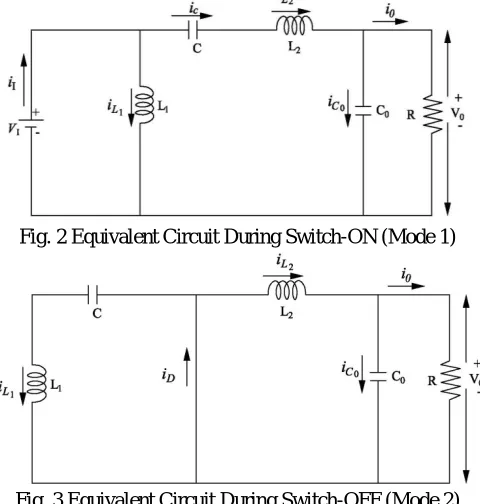
= / ; and are the average output voltage and current. The elementary circuit consists of a positive Luo pump S-L1-C-D and a low pass filter L2-C0. The pump inductor L1 transfers the stored energy to capacitor C during the switch-off period and then the energy stored on capacitor C is delivered to load R during the switch-on period. Therefore if the voltage Vc is higher, the output voltage Vo should be higher. When switch S is ON, the source current
= + (Fig. 2). Inductor L1 absorbs energy from the source and inductor L2 absorbs energy from the source and capacitor C. Both currents and increase when switch S is OFF (Fig. 3) source current = 0. Current flows through the freewheeling diode D to charge capacitor C. Inductor L1 transfers its stored energy to capacitor C. Current
flows through the (Co-R) circuit and freewheeling diode D to keep itself continuous. Both currents and decrease. When switch S is turned off, current flows through the freewheeling diode D. This current descends in the switch-off period (1− ) . If current does not become zero before switch S is turned on again, this working state is defined as the Continuous Conduction Mode (CCM). If current becomes zero before switch S is turned ON again, the working state is defined as Discontinuous Conduction Mode (DCM). The average output voltage of the converter in Continuous Conduction Mode is
=
(1− ) (1)
Fig. 2 Equivalent Circuit During Switch-ON (Mode 1)
Fig. 3 Equivalent Circuit During Switch-OFF (Mode 2)
III. FUZZY LOGIC CONTROLLER
Fuzzy logic is a form of many-valued logic which is derived from fuzzy set theory. In contrast with “crisp logic”, where binary sets have two-valued logic, fuzzy logic variables may have a truth value that ranges in degree between “0” and “1”. Fuzzy logic controller is a control tool for dealing with uncertainty and variability in the plant. The implementation of the proposed controller does not require any specific information about the converter model as well as circuit parameters and works independent of the operating point of the Luo converter.
Fig. 4 Block Diagram of Fuzzy Logic Controller for Luo Converter
error (e) and rate of change of error (ce) and a controller output (du). The number of necessary fuzzy sets and their ranges are designed based upon the experience gained on the process. A Mamdani based system architecture has been realized. Max-min composition technique for the inference engine and center of gravity method for defuzzification have been used. In the present work, seven triangular fuzzy sets are chosen as shown in Fig. 5 and are defined by the following library of fuzzy set values for the error e, change in error ce and for the change in duty cycle du. NB: Negative Big, NM: Negative Medium, NS: Negative Small, Z: Zero, PS: Positive Small, PM: Positive Medium, PB: Positive Big. The fuzzy rule base consists of 49 rules which are used to produce change in duty cycle (du) of the MOSFET of the Luo converter.
Fig. 5 Triangular Type Membership Functions for Error, Change in Error and Change in Duty Cycle
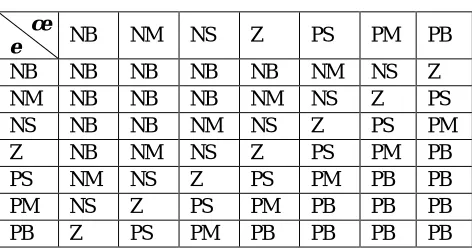
The derivation of the fuzzy control rules is heuristic in nature and is shown in Table 1. The inference mechanism seeks to determine which rules fire to find out which rules are relevant to the current situation. The inference mechanism combines the recommendations of all the rules to come up with a single conclusion.
Table 1 Rules for Mamdani-Type Fuzzy System
ce
e NB NM NS Z PS PM PB
NB NB NB NB NB NM NS Z
NM NB NB NB NM NS Z PS
NS NB NB NM NS Z PS PM
Z NB NM NS Z PS PM PB
PS NM NS Z PS PM PB PB
PM NS Z PS PM PB PB PB
PB Z PS PM PB PB PB PB
Since the inferred output is a linguistic value, a defuzzification operation is performed to obtain a crisp value. In this work, the centre of gravity or centroid method is used for de-fuzzification. As a result the control increment is obtained by the eqn. 2.
( )
= (2)
( )
IV. BACTERIAL FORAGING OPTIMIZATION ALGORITHM (BFOA)
Many of species depends in its survival on their fitness. The law of evolution supports those species who have better food searching ability and either eliminates or reshapes those with poor search ability. Application of group foraging strategy of a swarm of E.coli bacteria in multi-optimal function optimization is the notion of the new algorithm. So by understanding and modeling of foraging behavior in any of the evolutionary species, leads to its application in any nonlinear system optimization algorithm. The foraging strategy of Escherichia coli bacteria present in human can be described by four processes, namely chemotaxis, swarming, reproduction and elimination-dispersal.
Chemotaxis
The behavior of the bacteria toward the nutrient sources is interpreted as chemotaxis. The bacterium tries to find nutrient-rich areas and stay away from toxic environments. An E.coli bacterium moves in 2 different ways: tumble and swim. Tumble is a unit walk in a random direction and is always continued by another tumble or aswim. If a random direction results in a better position, it will be followed by swim, or else another tumble will be taken. In fact, swim is a unit walk in a previous random direction. In each tumble unit, the walk position of the bacterium is updated based on Eqn. 3.
( + 1, , ) = ( , , ) + ( ) ( ) (3)
where is the index of the bacterium, and ( , , ) is the position of the th bacterium in the th step of chemotaxis, the kth stage of reproduction, and the th stage of elimination-dispersal. C is the step size of the chemotaxis operation, which determines the height of each random step. The cost function of the th bacterium is determined based on its position and is represented by ( , , , ). is represented by the minimum fitness value. In the swim stage, if at ( + 1,
, ) the cost function becomes better than at ( , , ), another step will be taken in the same direction. This sequence will continue until steps are taken in swim. is the upper band for the number of steps in swim.
The above discussion is specified to the single bacterium. Each bacterium has repellant and attractant effects on the others. To consider these effects, Eqn. 4 is added to the cost function.
, ( , , ) = , ( , , ) = − exp − ( − )
+ ℎ − ( − ) (4)
= ( , , , ) + ( , ) (5)
Where = [ ,⋯, ] is the position of the ith bacterium in a p-dimensional space, is the th component of position for the ith bacterium, S is the number of bacteria (population size), is the depth of the attractant released by the cell, is a measure of the width of the attractant signal, ℎ is the height of the repellant effect, and is the measure of the width of the repellant.
Reproduction
= ( , , , ) (6)
Elimination and dispersal
To increase the ability of bacteria for global searching and to prevent them from becoming involved in local optimums, some of the bacteria are randomly eliminated and some of them are dispersed. is the number of elimination and dispersal steps that should be taken.
V. OPTIMIZATION OF FLC USING BFOA
In this research work, MFs of input/output variables, rule base and input/output scaling factors of FLCs are determined with BFO algorithm. The method of tuning fuzzy parameters is based upon minimizing the ISE.
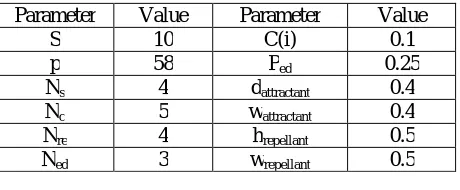
The BFOA has been programed using MATLAB M-file to calculate the optimal parameters of fuzzy controller then connected with system simulink. The controller tuning process is employed to find the best possible values for fuzzy parameters. In order to achieve the superior accuracy during the optimization search, it is necessary to assign appropriate fuzzy values which guides the BFO algorithm. The performance criterion with five parameters, such as ISE, IAE, % peak overshoot, settling time and rise time are considered in this work. Table 2 list out the circuit parameters of POELC. Table 3 lists the parameters of BFOA used in this work.
Table 2 Circuit Parameters for POELC
Parameters Values Inductors (L1& L2) 100 H Capacitors (C & C0) 5 F Load resistance (R) 10Ω
Input Voltage (VI) 10V
Output Voltage (VO) 20V Switching frequency (fs) 50KHz Range of duty ratio (d) 0.1-0.9
MOSFET IRF250N
Diode UF5042
Table 3 Parameters of Bacterial Foraging Optimization Algorithm
Parameter Value Parameter Value
S 10 C(i) 0.1
p 58 Ped 0.25
Ns 4 dattractant 0.4
Nc 5 wattractant 0.4
Nre 4 hrepellant 0.5
Ned 3 wrepellant 0.5
VI. SIMULATION RESULTS AND DISCUSSION
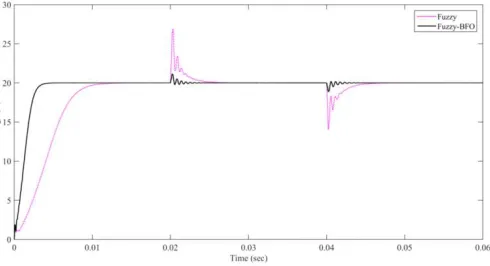
eliminate the steady state output voltage error. The steady state output voltage is always maintained at 20 V. Fig 6. Shows the step responses of Luo converter with Fuzzy and BFOA-fuzzy controllers
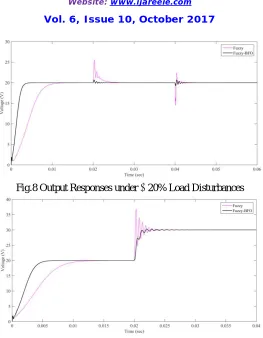
Fig. 7 shows the responses of Luo converter with controllers under line disturbances of 25%. When the input voltage increases from 10 V to 12.5 V, the settling time is 3.63 msec and % peak overshoot is 35.45 for fuzzy controller and the settling time is 1.12 msec and % peak overshoot is 5.5 for BFOA based FLC. When the input voltage is decreased from 12.5 V to 10 V, the output voltage is settled at 4 msec with peak overshot of 30.75% for FLC and the output voltage is settled at 0.88 msec with peak overshoot of 6.59% for BFOA-FLC. When the system is subjected to a sudden change in load (20% increase), it is being observed that the % peak overshoot is 3.3 and 28.5 and settling time is 0.88 msec and 3.27 msec for BFOA-FLC and FLC respectively which is shown in Fig. 8. Similarly when a change of load is 20% decrease, it is observed that the % peak overshoot is 3 and 27.45 and the settling time is 1.09 msec and 1.45 msec for BFOA-FLC and FLC respectively. The simulation is carried out by varying the system reference voltage where the result for the output voltage is shown in Fig. 9.
Fig. 6 Step Responses of Luo Converter with Fuzzy and BFOA-fuzzy Controllers
Fig.8 Output Responses under 20% Load Disturbances
Fig. 9 Servo Responses of Luo Converter with Controllers.
VII. CONCLUSION
Bacterial Foraging Algorithm was successfully utilized to obtain the optimal values of fuzzy parameters. The bacterial foraging algorithm uses bacterial operations to tune the values of fuzzy parameters where the bacterial operations include chemotaxis, swarming, reproduction, elimination and dispersal. BFOA improved the system response of the Luo converter reducing rise time, settling time and peak overshoot, thereby successfully fulfilling the objective of obtaining desirable time domain system responses. From the simulation results it is seen that, even when subjected to line and load disturbances, output voltage reached steady state within a time duration of 1.12 milliseconds exhibiting stability and an ability to withstand the disturbances.
REFERENCES
[1] Luo, F.L. (1997), Luo Converters: New DC-DC step-up Converters, Proceedings of IEEE international Symposium on Integrated Circuit-97, Singapore, Vol.2, Jun., pp. 227-230.
[2] Luo. F. L. and Hong Ye. , Advanced DC/DC Converters, First edition, CRC Press, LLC, London, 2014.
[3] Nashwan Saleh Sultan, (2014), Design and Implementation of PID Controller Based BFOA for Buck Converter Fed DC Motor Speed Control, Vol.3 (11), pp 212-217.
[4] Arunkumar.G and Gnanambal.I, (2016), Utilization of Bacterial Foraging Algorithm for Optimization of Boost Inverter Parameters, Circuits and Systems, Vol. 7, pp 1430-1440.
[5] Yu-Sheng Lin, Yih-GuangLeu and Wei-Cheng Lu, (2012), Fuzzy Bacterial Foraging System and its Applications in Control of Servo Motors, International Conference on Fuzzy Theory and Its Applications National Chung Hsing University, pp 203-207.
[6] Oshabaa A. S. and Alib E. S. (2014), Bacteria Foraging: A New Technique for Speed Control of DC Series Motor Supplied by Photovoltaic System, Wseas Transactions on Power Systems, Vol.9, pp 185-195.