Partial eigenstructure assignment for undamped vibration systems using
acceleration and displacement feedback
Jiafan Zhanga, Huajiang Ouyangb,*, Jun Yanga
aSchool of Mechanical Engineering, Wuhan Polytechnic University, Wuhan 430023, People’s
Republic of China
bSchool of Engineering, University of Liverpool, UK
Abstract
A new method for partial eigenstructure assignment using acceleration and displacement
feedback for undamped vibration systems is presented in this paper. Firstly, a necessary and
sufficient condition is proposed for the incremental mass and stiffness matrices that modify some
eigenpairs while keeping other eigenpairs unchanged. Secondly, based on this condition, an
algorithm for determining the required control gains matrices of acceleration and displacement
feedback, which assign the desired eigenstructure, is developed. This algorithm is easy to
implement, and works directly on the second-order system model. More importantly, the algorithm
allows the control matrix to be specified beforehand and also leads naturally to a small norm
solution of the feedback gain matrices. Finally, some numerical examples are given to demonstrate
the effectiveness and accuracy of the proposed algorithm.
1. Introduction
Vibration in engineering is usually undesirable and must be controlled to prevent damage to or
premature fatigue failure of structures or machines. There are many ways of controlling vibration.
Shifting natural frequencies away from excitation frequencies or adding damping is a common
control strategy. Both can be realised by means of pole or eigenvalue assignment. It is also very
useful to be able to force a structure or machine to possess modes (eigenvectors) in certain forms.
Assignment of both eigenvalues and eigenvectors is called eigenstructure assignment.
Eigenvalue assignment and eigenstructure assignment working directly on second-order dynamic
system models has attracted much attention over the past ten years, partly because of the demands
advantage of those peculiar properties afforded by the second-order system models. For these two
kinds of eigendata assignment problems, the undamped vibration models lead to an inverse
generalised eigenvalue problem and the damped vibration models lead to an inverse quadratic
eigenvalue problem.
Juang and Maghami [1] adapted the established first-order approach to second-order systems,
and presented a robust full pole assignment algorithm. Datta and his colleagues pioneered research
into inverse eigenvalue problems. Chu and Datta [2] proposed a modification to the foregoing
algorithm that produced well-conditioned closed-loop eigenvectors, and they also gave a
numerically robust algorithm by minimising the condition numbers of the eigenvectors.
Furthermore, Datta et al. [3] established three bi-orthogonality relations for eigenvectors of
symmetric definite quadratic pencils. One of these relations was used to derive an explicit solution
to the partial pole assignment of symmetric definite second-order systems by state feedback with a
single-input, where some desired eigenvalues were relocated to prescribed positions, while all the
other unassigned eigenvalues of the open-loop system remained unchanged in the closed-loop
system, i.e., possessing “no spill-over” property. Ram and Elhay [4] generalised partial assignment
of poles to multi-input control, and they demonstrated significant reductions in the magnitude of the
control forces by using multi-input control. In addition, the method does not require knowledge of
the unassigned eigenvalues and their corresponding eigenvectors of the open-loop system, and was
generalised to multi-input and asymmetric quadratic pencils by Zhang [5] and Chu [6]. Xu and Qian
[7, 8] put forward some robust partial pole assignment algorithms, where eigenvectors were chosen
in certain subspaces such that some measure of the distance between the eigenvectors and some
orthogonal bases of a certain subspace was minimised. Recently, Brahma and Datta [9], and Bai et
al. [10] solved robust partial quadratic eigenvalue assignment problems for vibrating structures
based on minimisation of a relevant norm.
The eigenstructure assignment problem of vibration systems is to assign both the eigenvalues
and their corresponding eigenvectors. Datta et al. [11] developed a method for partial
eigenstructure assignment, where only a small part of the eigenstructure was assigned and the rest
remained unchanged. Nichols and Kautsky [12] derived new sensitivity measures, or condition
numbers, for the eigenvalues of the quadratic matrix polynomial and defined a measure of the
robustness of the corresponding system. They showed that the robustness of the quadratic inverse
problem subject to structured perturbations. For eigenstructure assignment in second order systems,
a parametric expression of the feedback gain matrices was explicitly established in terms of the
eigenstructure and system matrices by Schulz and Inman [13], whereby the closed-loop system was
optimised by minimising the norms related to the feedback gains. Duan [14, 15] developed another
parametric method. Additionally, other eigenstructure assignment methods were developed by
Triller and Kammer [16], and Chu et al. [17]. It should be pointed out that for the eigenstructure
assignment of vibration systems not just any eigenvector can be assigned to a given system, that is,
the assigned or desired eigenvectors cannot be chosen arbitrarily, as discussed in [18, 12, 7]; and it
is believed that the "achievable" eigenvectors and then the required feedback gain matrices
generally should be determined from the original system matrices, the given control matrix, and the
desired assigned eigenvectors, as shown in this paper.
Eigenstructure assignment can also be made by means of structural modifications. Kypriano et
al. [19] assigned frequencies and zeros to lumped mass-spring systems with a mass and springs
using the Groebner bases. They did the same for a continuous structure of an L-shaped beam and
validated the theoretical results by experiment [20]. Ouyang et al. [21, 22] developed an
optimisation approach to assign the eigenstructure to a lumped mass-spring system and
implemented the approach on an experimental rig. Interestingly, the continuous optimisation
approach and integer optimisation approach were shown to yield fairly different modifications.
In addition to the eigendata assignment methods mentioned above, which can be called the
model-based approach, a new approach to eigenvalue assignment in structural vibration systems
was introduced by Ram and Mottershead [23], and extended by them and their colleagues [24-27]
based on measured receptances and without the need to know or evaluate the system matrices M, C and K. Ouyang [25] presented a receptance-based inverse method for assigning complex poles to
second-order asymmetric systems through state-feedback control using a combination of active
stiffness, active damping and active mass. Tehrani et al. [26] studied robust pole placement to
symmetric systems. Tehrani and Ouyang [27] developed partial pole assignment to asymmetric
systems.
As the focus of this paper is on eigenstructure assignment using the second-order framework,
works using the first-order formulation are largely omitted from the paper. It should also be
mentioned that some works on frequency placement, for example in [28], are also very useful but
From the open literature, it may be concluded that most researchers used velocity and
displacement feedback to assign eigendata of vibration systems. This paper instead uses
acceleration and displacement feedback for partial eigenstructure assignment of undamped vibration
systems. This is even more interesting because of the frequent use of accelerometers in practice.
Section 2 presents a necessary and sufficient condition that the modification of the mass and
stiffness matrices should satisfy so that spill-over does not occur when undamped vibration systems
are modified for a desirable eigenstructure. Based on this condition, a partial eigenstructure
assignment algorithm is proposed to determine the acceleration and displacement feedback matrices
in Section 3. Several numerical examples are used to demonstrate advantages of the algorithm in
Section 4. Finally, some conclusions are drawn in Section 5.
2. Partial Eigenstructure Modification
2.1. The problem description
Consider an n-degree-of-freedom undamped vibration system that is modelled by the following
set of second-order ordinary differential equations:
(1)
where is displacement vector, are mass and stiffness matrices,
respectively. In general, is symmetric and positive definite, and is symmetric and positive
semi-definite, i.e. . For the sake of convenience, the model is
simply denoted by .
It is well known that if is a fundamental solution of Eq. (1), then the natural
frequency and the mode shape vector must satisfy the following generalised eigenvalue
equation:
where is the square of the ith natural frequency , called the ith eigenvalue, and is the
corresponding ith eigenvector. Equation (2) can be written in a compact representation as follows:
(3)
where and make up the complete eigenstructure.
Suppose that the system described by Eq. (1) is modified by the incremental matrices
and . Then the motion of the modified system is governed by
(4)
Let , . The modified system is denoted simply by which
satisfy the following equation:
(5)
where and are the complete eigenstructure of
. Mathematically, the partial eigenstructure modification (PESM) problem may be
formulated as follows.
PESM Problem: Given a system model , a set of its associated eigenpairs
with , and another set of modified (or desired) eigenpairs
, find the incremental matrices and such that:
(1) The subset of is replaced by as m
eigenpairs of the modified model , where , .
those of the original model .This is the “no spill-over” property .
It is necessary to partition the complete eigenstructure into two parts: the assigned (part 1) and
the unassigned (part 2). Throughout this paper, the following notation is used. Let
, , , and
, .
In addition, for any real matrix A, AT denotes the transpose of A, A+ the Moore–Penrose inverse
of A, the rank of A, the null space of A, and In represents the identity matrix of size
n. The symbol stands for the Frobenius norm.
The following assumptions, which are quite reasonable in practice, are made:
(A1) ;
(A2) (an empty set);
(A3) ;
(A4) All the above-mentioned eigenvalues are distinct.
2.2. PESM: A necessary and sufficient condition for and
A necessary and sufficient condition for and to jointly satisfy in the PESM to prevent
spill-over is presented in the following Theorem 2.1. Before that, two lemmas have to be introduced
below.
Lemma 2.1 ( Sylvester’s law of nullity [29]). For any two matrices, and , if
, then .
With the above two lemmas, Theorem 2.1 can be stated below.
Theorem 2.1 (Eigenstructure preserving modification). Under assumptions (A1), (A2) and (A3),
the PESM can avoid spill-over, i.e. scenario (2) of the PESM is satisfied, if and only if and
jointly satisfy the following matrix equation (6a) or (6b).
(6a)
(6b)
Proof. Necessity:
Using the normalisation of modes in (A1), it is easy to show that and .
Partition of the left-hand side of the previous matrix equation, that is, , leads to
(7)
As , one can get , and
. So it follows that
(8)
From Eqs. (7) and (8), one can derive
(7a)
(8a)
It follows from Eq. (7a) - (8a) that
(9)
Moreover, partial eigenstructure assignment of means
. Subtracting the eigenstructure equation of
(10)
When Eq. (10) is used in (9), Eq. (6a) results (end of proof of the necessity).
In addition, multiplying matrix equation (6a) on the right by , matrix equation (6b) is
obviously obtained.
Sufficiency: Suppose matrix equation (6a) holds. It follows from Eq. (9) that
. Let and . Because
all modes of are orthogonal to one another, that is, X2 contains n-m orthogonal modes,
obviously . Lemma 2.1 dictates that .
Therefore one can conclude that . It can immediately be inferred from
lemma 2.2 that the matrix formulation (10) is valid. Then it is easy to verify that
This completes the proof. □
In the next section, an algorithm for solving the partial eigenstructure assignment of undamped
vibration systems is developed using acceleration and displacement feedback.
3. Partial eigenstructure assignment of undamped vibration systems
Partial eigenstructure assignment of an undamped vibration system by applying a control force is
presented in this section. Eq. (1) now becomes
(11)
where (p n) is known as the control matrix, and without loss of generality, is
assumed to have a full column rank, that is, . Suppose that system (11) is controllable. The
taken:
(12)
where and are acceleration and displacement feedback gain matrices, respectively.
Thus Eq. (11) may be written in the form of
(13)
with the corresponding eigenstructure equation of the closed-loop system (13) as follows:
(14)
where and are eigenvalues and the corresponding
eigenvector matrix of the closed-loop system (13), respectively.
Let and . The partial eigenstructure assignment (PESA) problem
is to find matrices F and G such that the partial eigenstructure and
of the open-loop system is replaced by the partial eigenstructure
and of the closed-loop system , while the
remaining eigenpairs of are also eigenpairs of . Let and
. Then it is easy to see that solving the PESA problem of undamped vibration systems
includes solving the PESM problem in section 2. In what follows the procedure to determine F and
G solving the PESA problem is presented.
Substituting F and G into Eq. (6b) with and gives
(15a)
Because B is assumed to be of full column rank, Eq. (15a) implies that
Let and . Substituting them into Eq. (15b) gives
(16)
Thus it can be deduced that and are a pair of solutions to the PESA problem
without spill-over if and only if F1 and G1 satisfy Eq. (16).
Now the partial eigenstructure equation of that F and G must also satisfy is
investigated. By definition,
(17)
Substituting and into Eq. (17) and rearranging it gives
(18)
Eqs. (16) and (18) are two key matrix equations used to solve the PESA problem.
Next the general solutions of Eq. (16) for F1 and G1 are explored. Eq. (16) is rewritten as
(19)
To this end, ranks of several matrices must be known. It can be proved that
, when (20)
With , one gets
.
Note that , then is invertible, and therefore
,
. Together with lemma 3.1 below, it is easy to see that Eq. (20) holds.
Lemma 3.1. If , then .
Proof. ,
where and are invertible matrices. Note that the rank does not change if rows of a matrix are
interchanged. Moreover, it is well known that [29]
if S is square and nonsingular. Thus
, which completes the proof. □
Now it is time to attempt to solve Eq. (19). Using QR decomposition, one gets
(21)
Where is an orthogonal matrix with and , and
is upper triangular and nonsingular. Let
(22)
where . It follows from Eq. (19) that
(23)
(24)
where is to be determined below.
At this point, the general solutions of Eq.(19) or Eq.(16) are obtained. It should be noted that
when , and the rank determination of the matrix in (20) is not straightforward, then the more
expensive singular value decompositions (SVD) could be used in (21) instead of the QR
decomposition, and the general solutions (24) stay unchanged.
Secondly, the solutions of Eq. (18) for F1 and G1 are sought below. Eq. (18) is rewritten as
(25)
Substituting the QR decomposition of B, i.e. , where is an
orthogonal matrix with and , and is upper triangular and
nonsingular, into Eq. (25) gives
,
that is
, (26)
. (27)
As is known, for the given assigned eigenvalues of , not any given corresponding
eigenvectors can be assigned to such that there exist F1 and G1 satisfying Eq. (25) of
corresponding to would be “achievable” for the PESA problem.
Theorem 3.1. Given eigenvalues , there exist F1 and G1 satisfying Eq.
(25) of the PESA problem, if and only if the given corresponding eigenvectors
satisfy Eq. (27), or in other words, must belongs to the right null space of matrix
, i.e. .
It should be noted that the similar requirements on were given in [30, 12] for the
eigenstructure assignment of linear descriptor systems and time-invariant second-order control
systems, respectively.
In order to ensure the accuracy of partial eigenstructure assignment, it is necessary to ‘condition’
the given according to theorem 3.1. In what follows the conditioning algorithm 3.1 is presented.
Conditioning algorithm 3.1:
(i) Solve the orthogonal basis vectors of , which make up a full column
rank matrix .
(ii) Solve the linear system of equations , which is usually over-determined. So
gives a unique least square approximation of for
. Then is taken to replace Y1 in the partial
eigenstructure assignment of Eq. (25) with the assigned eigenvalues
, i.e., as if 1 and are the assigned partial eigenstructure .
matrix equation are discussed, as they are used subsequently:
(28)
where , , and are known matrices. Eq. (28) has a special solution as follows [31]:
(29)
When Eq. (28) is consistent, the solution is a unique minimal norm solution of Eq. (28); when Eq.
(28) is inconsistent, the solution is a unique minimal norm least square solution.
Now the solution of Eq. (26) can be sought. Substituting the general solutions of Eq. (19), i.e.
Eq. (24), into (26) gives
. (30)
A solution of Eq. (30) for matrix is obtained using Eq. (29) as follows:
(31)
Then substituting the obtained back into Eq. (24), feedback matrices F and G are eventually
determined, which solve the PESA problem as:
(32)
Note that matrix is usually of full column rank.
Based on the above discussion, the following algorithm is developed for solving the PESA
problem.
Algorithm 3.2:
Inputs: The analytical mass and stiffness matrices and , and the eigenpairs and to
be assigned to , the assigned eigenpairs and of .
Output: Feedback matrices F and G.
(2) Solve the QR decomposition of the control matrix .
(3) Use algorithm 3.1 to condition and obtain the corresponding that is substituted into Eq.
(31).
(4) Solve from Eq. (31), and then substitute the obtained into (32).
Finally, some important features of algorithm 3.2 are summarised below.
(a) Algorithm 3.2 gives the acceleration and displacement feedback matrices to the PESA problem
of undamped vibration systems, which is rarely seen in the published literature. Accelerometers
have some good properties, such as being easy to install, wide frequency range and high
sensitivity, and are thus widely used in practice.
(b) Algorithm 3.2 is easy to implement, and its steps are simple and clear. It works directly on the
second-order system model, and can be implemented with the knowledge of only those few
eigenvalues and the corresponding eigenvectors of to be assigned and .
More importantly, this algorithm can accurately solve the PESA problem, and can also be used
to solve the partial eigenvalue assignment with a sparse control matrix B.
(c) Because the transformations (or decompositions) in steps (1) and (2) of algorithm 3.2 are all of
orthogonal type, and step (4) gives the minimal norm solution of , the presented algorithm
leads naturally to a small norm solutions for F and G. The results shown in the numerical
examples in the next section are comparable in the magnitude of the norms of the control gain
matrices with those obtained by an expensive optimisation procedure.
(d) Control matrix B in [11] cannot be prescribed beforehand but must be determined during the
process of solving the velocity and displacement feedback gain matrices, and B thus obtained is
usually a dense matrix. This kind of B would be difficult to realise in practice. In contrast, B in
this paper can be prescribed in a simple form (see for example, B used in Example 4.1 in
Section 4). Additionally, its solution in [11] is not unique, and the norms of the gain matrices
incorporating B are often much bigger. However, the presented algorithm does not have these
4. Numerical examples
To demonstrate the performance of the present algorithm, three numerical examples are analysed in
this section, using MATLAB 7.11.
Example 4.1. In this example, n=6, m=p=3, and
,
, .
The open-loop eigenvalues are
with , .
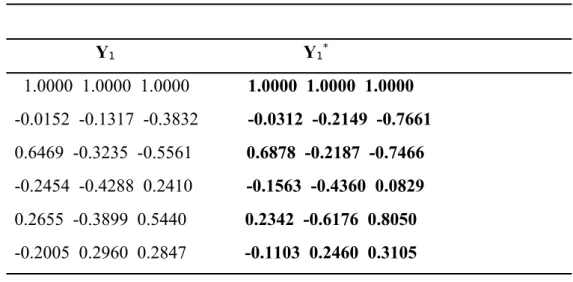
Eigenvector matrices X, Y1 and Y1* are listed in Table 1.
Table1. Eigenvector matrices X, Y1 and Y1*
X
1.0000 1.0000 1.0000 0.7039 0.4525 0.3001
-0.1529 -0.5317 -0.8832 -1.0000 -1.0000 -1.0000
0.5469 -0.4235 -0.6561 -0.0819 0.2105 0.0565
-0.1454 -0.3288 0.1410 0.7738 0.4879 -0.3469
-0.1005 0.1960 0.1847 -0.7552 0.7418 -0.1234
Y1 Y1*
1.0000 1.0000 1.0000 1.0000 1.0000 1.0000
-0.0152 -0.1317 -0.3832 -0.0312 -0.2149 -0.7661
0.6469 -0.3235 -0.5561 0.6878 -0.2187 -0.7466
-0.2454 -0.4288 0.2410 -0.1563 -0.4360 0.0829
0.2655 -0.3899 0.5440 0.2342 -0.6176 0.8050
-0.2005 0.2960 0.2847 -0.1103 0.2460 0.3105
The assignment results are provided as follows.
Table 2. The closed-loop eigenvalues and eigenvectors
0.05 1.0000 1.0000 1.0000 0.7039 0.4525 0.3001
1.8 -0.0312 -0.2149 -0.7661 -1.0000 -1.0000 -1.0000
12 0.6878 -0.2187 -0.7466 -0.0819 0.2105 0.0565
58.1668 -0.1563 -0.4360 0.0829 0.7738 0.4879 -0.3469
206.023 0.2342 -0.6176 0.8050 -0.1773 -0.1195 0.0361
818.8383 -0.1103 0.2460 0.3105 -0.7552 0.7418 -0.1234
Table 3. Feedback matrices G and F and their norms
-0.1506 -0.0752 -0.1767 0.0504 0.0043 0.0108
-0.0218 -0.0138 -0.1173 -0.0156 -0.1147 0.0178 1.9973
-1.2870 -0.6198 -0.7930 0.6082 0.9264 -0.0348
0.0144 -0.0043 -0.1448 -0.0126 -0.0333 0.0294
-0.0347 -0.0166 0.0195 0.0402 0.1566 -0.0080 2.2831
0.3923 0.0754 -1.5978 -0.4168 -1.4662 0.3539
The F- norms of the closed-loop eigenstructure equations are
,
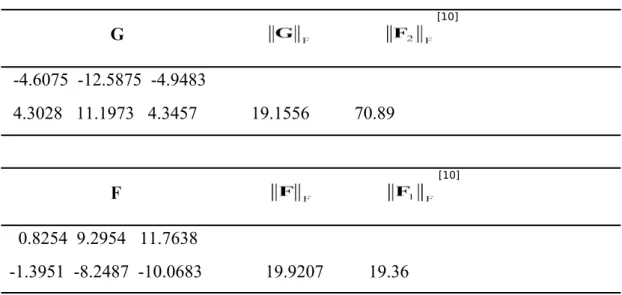
Example 4.2 (P 5.2 in [10]). In [10], the minimal norm solutions of gain matrices and
for the velocity and displacement feedback were determined. In this example, n=3, m=p=2, and
.
The open-loop eigenvalues are .
and are chosen, which are the same as those in
[10]. The eigenvector matrices X, Y1 and Y1*, and some other results are not listed for the sake of
saving space. The present algorithm also accurately implements the partial eigenstructure
assignment here, as can be seen in Table 4 for feedback matrices G and F, and their norms. The
minimal norms of feedback matrices and in [10] are also given for comparison.
Table 4. Feedback matrices G, and F and its norm
[10]
-4.6075 -12.5875 -4.9483
4.3028 11.1973 4.3457 19.1556 70.89
[10]
0.8254 9.2954 11.7638
, .
Example 4.3 (P 5.5 in [10]). In this example, n=20, m=2, p=3, and
.
For the sake of comparison with P 5.5 in [10], is chosen to replace
, which is the same as P 5.5 in [10] as far as assigned undamped
natural frequencies are concerned. In the same way, the present algorithm accurately finds the
partial eigenstructure assignment needed, while keeping the other frequencies of the open-loop
system unchanged with and
. Additionally, the present algorithm allows selective
assignment of some eigenvalues without changing the remainder of the frequency spectrum in this
example. The F-norms of feedback matrices G and F are and ,
respectively. In [10], speed feedback is used so as to increase the system damping and to improve
system response. It turned out that the F-norms of feedback matrices and are very high:
and .
From all these three examples, it can be seen that the resulting assigned frequencies and modes
are quite accurate.
A partial eigenstructure modification formulation for the incremental mass and stiffness matrices to
be satisfied is proposed. The formulation is successfully used to develop a partial eigenstructure
assignment algorithm for undamped vibration systems. This algorithm can accurately assign
prescribed eigenpairs while keeping other unassigned eigenpairs unchanged using acceleration and
displacement feedback. The algorithm mainly involves numerically stable matrix computations,
such as QR decomposition, and only need those few eigenpairs to be assigned and the analytical
mass and stiffness matrices of the open-loop vibration system. The norms of feedback gain matrices
obtained are found to be small.
References
[1] J. Juang, P.G. Maghami, Robust eigensystem assignment for state estimators using
second-order models, Journal of Guidance, Control and Dynamics 15 (1992) 920–927.
[2] E.K. Chu, B.N. Datta, Numerically robust pole assignment for second order systems,
International Journal of Control 64 (1996) 1113–1127.
[3] B.N. Datta, S. Elhay, Y.M. Ram, Orthogonality and partial pole assignment for the symmetric
definite quadratic pencil, Linear Algebra Applications 257 (1997) 29–48.
[4] Y.M. Ram, S. Elhay, Pole assignment in vibratory systems by multi-input control, Journal of
Sound and Vibration 230 (2000) 309–321.
[5] J.F. Zhang, Partial pole assignment for general vibration systems by multi-input state
feedback (in Chinese), Journal of Vibration and Shock 20 (2001) 45-47.
[6] E.K. Chu, Pole assignment for second-order systems, Mechanical Systems and Signal
Processing 16 (2002) 39–59.
[7] S.F. Xu, J. Qian, Orthogonal basis selection method for robust partial eigenvalue assignment
problem in second-order control systems, Journal of Sound and Vibration 317 (2008) 1-19.
[8] J. Qian, S.F. Xu, Robust partial eigenvalue assignment problem for the second-order system,
Journal of Sound and Vibration 282 (2005) 937–948.
[9] S. Brahma, B.N. Datta, An optimization approach for minimum norm and robust partial
quadratic eigenvalue assignment problems for vibrating structures, Journal of Sound and
Vibration 324 (2009) 471–489.
assignment in vibrating systems: a new optimization approach, Mechanical Systems and
Signal Processing 24 (2010) 766–783.
[11] B.N. Datta, S. Elhay, Y.M. Ram, D.R. Sarkissian, Partial eigenstructure assignment for the
quadratic pencil, Journal of Sound and Vibration 230 (2000) 101–110.
[12] N.K. Nichols, J. Kautsky, Robust eigenstructure assignment in quadratic matrix polynomials:
nonsingular case, SIAM Journal of Matrix Analysis and Applications 23 (2001) 77–102.
[13] M.J. Schulz, D.J. Inman, Eigenstructure assignment and controller optimization for
mechanical systems, IEEE Transaction on Control Systems Technology 2 (1994) 88–100.
[14] G.R. Duan, Parametric eigenstructure assignment in second-order descriptor linear systems,
IEEE Transactions on Automatic Control 49 (2004) 1789–1795.
[15] G.R. Duan, G.P. Liu, Complete parametric approach for eigenstructure assignment in a class
of second-order linear systems, Automatica 38 (2002) 725–729.
[16] M.J. Triller, D.C. Kammer, Improved eigenstructure assignment controller design using a
substructure-based coordinate system, Journal of Guidance, Control, and Dynamics 20
(1997) 941–948.
[17] M.T. Chu, Y.C. Kuo, W.W. Lin, On inverse quadratic eigenvalue problems with partially
prescribed eigenstructure, SIAM Journal on Matrix Analysis and Applications 25 (2003) 995–
1020.
[18] D.J. Inman, A. Kress, Eigenstructure assignment using inverse eigenvalue methods, Journal
of Guidance, Control, and Dynamics 18 (1995) 625–627.
[19] A. Kyprianou, J.E. Mottershead, H. Ouyang, Assignment of natural frequencies by an added
mass and one or more springs, Mechanical Systems and Signal Processing 18 (2004) 263–
289.
[20] A. Kyprianou, J.E. Mottershead, H. Ouyang, Structural modification. Part 2: assignment of
natural frequencies and antiresonances by an added beam, Journal of Sound and Vibration
284 (2005) 267–281.
[21] H. Ouyang, D. Richiedei, A. Trevisani, G. Zanardo, Eigenstructure assignment in undamped
vibrating systems: a convex-constrained modification method based on receptances,
Mechanical Systems and Signal Processing 27 (2012) 397–409.
[22] H. Ouyang, D. Richiedei, A. Trevisani, G. Zanardo, Discrete mass and stiffness modifications
validation, International Journal of Mechanical Sciences 64 (2012) 211–220.
[23] Y.M. Ram, J. E. Mottershead, Receptance method in active vibration control, AIAA Journal
45 (2007) 562–567.
[24] J.E. Mottershead, M.G. Tehrani, S. James, Y.M. Ram, Active vibration suppression by
pole-zero placement using measured receptances, Journal of Sound and Vibration 311 (2008)
1391–1408.
[25] H. Ouyang, Pole assignment of friction-induced vibration for stabilisation through
state-feedback control, Journal of Sound and Vibration 329 (2010) 1985–1991.
[26] M.G. Tehrani, J.E. Mottershead, A.T. Shenton, Y.M. Ram, Robust pole placement in
structures by the method of receptances, Mechanical Systems and Signal Processing 25
(2011) 112–122.
[27] M.G. Tehrani, H. Ouyang, Receptance-based partial pole assignment for asymmetric systems
using state-feedback, Shock and Vibration 19 (2012) 1135-1142.
[28] K. Farahani, H. Bahai, An inverse strategy for relocation of eigenfrequencies in structural
design. Part II: Second order approximate solutions, Journal of Sound and Vibration 274
(2004) 507- 528
[29] K.M. Abadir, J.R. Magnus, Econometric Exercises, Volume 1: Matrix Algebra, Cambridge
University Press, New York, 2005.
[30] L.R. Fletcher, J. Kautsky, N.K. Nichols, Eigenstructure assignment in descriptor systems,
IEEE Transactions on Automatic Control AC-31 (1986) 1138-1141.
[31] G.H. Golub, C.F. Van Loan, Matrix Computations (Third Edition), Johns Hopkins University