Volume 2008, Article ID 261317,13pages doi:10.1155/2008/261317
Research Article
A Full-Body Layered Deformable Model for Automatic
Model-Based Gait Recognition
Haiping Lu,1Konstantinos N. Plataniotis,1and Anastasios N. Venetsanopoulos2
1The Edward S. Rogers Sr. Department of Electrical and Computer Engineering, University of Toronto, Canada M5S 3G4 2Department of Electrical and Computer Engineering, Ryerson University, Toronto, Ontario, Canada M5B 2K3
Correspondence should be addressed to Haiping Lu,[email protected]
Received 17 May 2007; Accepted 15 September 2007
Recommended by Arun Ross
This paper proposes a full-body layered deformable model (LDM) inspired by manually labeled silhouettes for automatic model-based gait recognition from part-level gait dynamics in monocular video sequences. The LDM is defined for the fronto-parallel gait with 22 parameters describing the human body part shapes (widths and lengths) and dynamics (positions and orientations). There are four layers in the LDM and the limbs are deformable. Algorithms for LDM-based human body pose recovery are then developed to estimate the LDM parameters from both manually labeled and automatically extracted silhouettes, where the au-tomatic silhouette extraction is through a coarse-to-fine localization and extraction procedure. The estimated LDM parameters are used for model-based gait recognition by employing the dynamic time warping for matching and adopting the combination scheme in AdaBoost.M2. While the existing model-based gait recognition approaches focus primarily on the lower limbs, the es-timated LDM parameters enable us to study full-body model-based gait recognition by utilizing the dynamics of the upper limbs, the shoulders and the head as well. In the experiments, the LDM-based gait recognition is tested on gait sequences with differences in shoe-type, surface, carrying condition and time. The results demonstrate that the recognition performance benefits from not only the lower limb dynamics, but also the dynamics of the upper limbs, the shoulders and the head. In addition, the LDM can serve as an analysis tool for studying factors affecting the gait under various conditions.
Copyright © 2008 Haiping Lu et al. This is an open access article distributed under the Creative Commons Attribution License, which permits unrestricted use, distribution, and reproduction in any medium, provided the original work is properly cited.
1. INTRODUCTION
Automatic person identification is an important task in vi-sual surveillance, and monitoring applications in security-sensitive environments such as airports, banks, malls, park-ing lots, and large civic structures, and biometrics such as iris, face, and fingerprint have been researched extensively for this purpose. Gait, the style of walking of an individual, is an emerging behavioral biometric that offers the potential for vision-based recognition at a distance where the resolution is not high enough for the other biometrics to work [1–4]. In 1975 [5], Johansson used point light displays to demon-strate the ability of humans to rapidly distinguish human lo-comotion from other motion patterns. Similar experiments later showed the capability of identifying friends or the gen-der of a person [6,7], and Stevenage et al. show that humans can identify individuals based on their gait signature in the presence of lighting variations and under brief exposures [8]. Recently, there has been increased research activities in gait recognition from video sequences. Vision-based gait capture
is unobtrusive, requiring no cooperation or attention of the observed subject and gait is difficult to hide. These advan-tages of gait as a biometric make it particularly attractive in human identification at a distance. In a typical vision-based gait recognition application, a monocular video sequence is used as the input.
than treating human body as one whole holistic pattern. For example, contrary to common beliefs that cleaner silhou-ettes are desired for successful recognition, a recent study [15] shows that automatically extracted (noisy) silhouette sequences achieve better recognition results than very-clean (more accurate) manually segmented silhouettes [16], and the explanation in [16] is that there are correlated errors (noise) contributing to the recognition in the noisy silhou-ette sequences. On the other hand, the model-based ap-proach [17–21] extracts gait dynamics (various human body poses) for recognition and appears to be more sound, but it is not well studied and less successful due to the difficulties in accurate gait dynamics extraction [1,3]. For these existing model-based gait recognition algorithms, only the dynamics of the lower body (the legs) are used for recognition, except in [20], where the headx-displacement is also used. However, in the visual perception of a human gait, the dynamics of the upper-body, including the arms, the shoulders, and even the head, contributes significantly to the identification of a fa-miliar person as well. Therefore, it is worthwhile to investi-gate whether it is feasible to extract the upper-body dynamics from monocular video sequences and whether the gait recog-nition performance can benefit from it.
Motivated by the discussions above, the earlier version of this paper proposed a new full-body articulated human body model for realistic modeling of human movement, named as the layered deformable model (LDM) [22]. It is inspired by the manually labeled body-part-level silhouettes [15] from the “gait challenge” data sets, which were created for studying gait recognition from sequences free from noise and back-ground interference, and it is designed to closely match them in order to study gait recognition from detailed part-level gait dynamics. In this paper, more detailed descriptions and in-depth discussions on the LDM and the pose recovery algo-rithms proposed in [22] are provided; and furthermore, the LDM is applied to the automatic model-based gait tion problem. An overview of the LDM-based gait recogni-tion is shown inFigure 1. A coarse-to-fine silhouette extrac-tion algorithm is employed to obtain silhouettes automat-ically from a monocular video sequence and human body pose recovery algorithms are then developed to estimate the LDM parameters from the silhouettes. The pose recovery al-gorithms developed here do not rely on any tracking algo-rithm. Hence, it is fully automatic and does not suffer track-ing failures as in [17], where manual parameter estimation is needed when the tracking algorithm fails due to the prob-lems of body part self-occlusion, shadows, occlusion by other objects, and illumination variation in the challenging out-door environment. Next, the dynamic time warping (DTW) algorithm is utilized for matching body part dynamics and the combination scheme in AdaBoost.M2 is adopted to inte-grate the various part-level gait dynamics. The gait recogni-tion experiments are carried out on a subset of the gait chal-lenge data sets [9,15] and several interesting observations are made.
The rest of this paper is organized as follows:Section 2 describes the LDM. InSection 3, human body pose recov-ery algorithms are presented in more details for manual sil-houettes and automatically extracted silsil-houettes, followed
by a brief discussion on the computational complexity. The LDM-based gait recognition module is then proposed in Section 4. Finally, the experimental results are reported in Section 5and conclusions are drawn inSection 6.
2. THE LAYERED DEFORMABLE MODEL
As discussed in [22], in model-based gait recognition, the desirable human body model should be of moderate com-plexity for fast processing while at the same time it should provide enough features for discriminant learning. In other words, a tradeoffbetween the body model complexity (con-cerning the efficiency) and the model descriptiveness (con-cerning the accuracy) is sought. It is not to be as detailed as a fully deformable model used for realistic modeling (e.g., of animated characters in movies) in computer graphics and animations, while it must model limbs individually to en-able model-based recognition. The existing model-based gait recognition algorithms [17–21] regard the lower-body (the legs) dynamics as the discriminative features and almost completely ignore the upper-body dynamics. Such ignorance is partly due to the difficulty in accurate extraction of the upper-body dynamics and their assumption that the leg dy-namics are most important for recognition. However, in our opinion, the upper-body dynamics (the arms, shoulders, and head) provide us with valuable information for identification of a person as well. Therefore, gait recognition algorithms based on a full-body model are expected to achieve better re-sults than those relying on only the lower-body dynamics.
Although there are works making use of the full-body in-formation, such as the seven-ellipse representation in [23] and the combination of the left/right projection vectors and the width vectors in [24], these representations are rather heuristic. Since the biomechanics of human gait is a well-studied subject, it is helpful to develop a human body model by incorporating knowledge from this area. At the same time, as a vision-based approach, the information available for model estimation is limited to what can be extracted from a camera at a distance different from the marker-based studies in biomechanics of human gait [14].
Raw image frames
Silhouette extraction
Silhouette extracted
LDM recovery
Gait dynamics
Recognition module
Subject ID
Figure1: Overview of the proposed automatic LDM-based gait recognition.
θRLL
θLTH θH
Figure2: The layered deformable model.
be the ideal “clean” silhouettes that can be obtained from the raw video sequences.
Following [22], the LDM consists of ten segments model-ing the ten body parts: the head (a circle), the torso (a semiel-lipse on top of a rectangle), the left/right upper arms (rect-angles), the left/right lower arms (quadr(rect-angles), the left/right upper/lower legs (quadrangles). The feet and the hands are not modeled explicitly since they are relatively small in size and difficult to detect consistently due to occlusion with the “background” (e.g., covered by grass).Figure 2is an illustra-tion of the LDM, which matches closely to the manual sil-houettes in [15]. The model is defined based on a skeleton model, which is shown as thick lines and black dots in the figure.
The LDM is specified in [22] using the following 22 pa-rameters that define the lengths, widths, positions, and ori-entations of body parts, with the number of parameters for each category in brackets:
(i) lengths (6): the lengths of various body partsLH (the radius of the head), LT (the torso), LUA (the upper
arm), LLA (the lower arm, including the hand),LTH
(the thigh), andLLL(the lower leg, including the feet);
(ii) widths (3): the widths (thickness) of body partsWT (the torso, which is equal to the width of the top of the thigh),WK(the knee), andWA(the arm, assuming the same width for the upper and lower parts);
(iii) positions (4): the global position (xG,yG), which is also the position of the hip joint, and the shoulder displace-ment (dxSh,d ySh);
(iv) body part orientations (9):θLTH(the left thigh),θRTH
(the right thigh), θLLL (the left lower leg), θRLL (the
right lower leg),θLUA(the left upper arm),θRUA(the
right upper arm),θLLA(the left lower arm),θRLA(the
right lower arm), andθH(the head, the neck joint gle). The body part orientation is measured in the an-gle between the major axis of the body part and the horizontal axis, following the biomechanics conven-tions in [13]. InFigure 2,θRLL,θLTH, andθHare labeled for illustration.
In addition to the 22 parameters for the LDM, the height of the human full-body is denoted asHF.
Furthermore, in order to model the human body self-occlusion (e.g., between legs, arms, and torso), the follow-ing four layers are introduced in [22], inspired by the layered representation in [25]:
(i) layer one: the right arm; (ii) layer two: the right leg;
(iii) layer three: the head, the torso, and the left leg; (iv) layer four: the left arm
where the first layer is furthest from the camera (frequently occluded) and the fourth layer is the closest to the cam-era (seldom occluded).Figure 3shows each layer as well as the resulted overlaid image. As seen from the figure, self-occlusion is explained well with this model. LetLjdenote the image of layerj, wherej=1, 2, 3, 4. The gait stance imageIg obtained by overlying all layers in order can be written as
Ig =L4+B
L4∗L3+BL3∗L2+BL2∗L1, (1)
where “∗” denotes the elementwise multiplication andB(Lj) is the mask obtained by setting all the foreground pixels (the body segments) inLj to zero and all the background pix-els to one. The difference of this layered representation from that in [25] is that here the foreground boundary is deter-mined uniquely by the layer imageLjand there is no need to introduce an extra mask.
Layer four
Layer three
Layer two
Layer one
Four layers overlaid
Figure3: The four-layer representation of the LDM.
(a) (b) (c) (d)
Figure4: Illustration of the right leg deformation.
deformation. This is different from the traditional 2D (rect-angular) models and visual comparison with the manual sil-houettes [15] shows that the LDM matches well with hu-man’s subjective perception of human body (in 2D).
On the whole, the LDM is able to model human gait re-alistically with moderate complexity. It has a compact rep-resentation comparable to the simple rectangle (cylinder) model [17] and its layered structure models self-occlusion between body parts. At the same time, it models simple limb deformation while it is not as complicated as the fully de-formable model [26]. In addition, the shoulder displacement parameters model shoulder swing observed in the manual silhouette sequences, which is shown to be useful for auto-matic gait recognition in the experiments (Section 5.2), and they also relate to viewing angles.
3. LDM-BASED HUMAN BODY POSE RECOVERY
With the LDM, the pose (LDM parameter) estimation prob-lem is solved in two phases. The estimation of the LDM parameters from the manually labeled silhouettes is tackled first, serving as the ground truth in pose recovery perfor-mance evaluation and facilitating the studies of the ideal-case model-based gait recognition. In addition, statistics from the LDM parameters obtained from the manual silhouettes are used in the following task of direct LDM parameter estima-tion for the silhouettes extracted automatically from raw gait sequences.
3.1. Pose estimation from manually
labeled silhouettes
For each gait cycle of the manual part-level labeled silhou-ettes, the LDM parameters for a silhouette are estimated by
processing each individual segment one by one. As suggested in [22], some parameters, such as the limb orientations, are more closely related to the way one walks and hence they are more important to gait recognition than the others, such as the width parameters. Therefore, the limb orientation pa-rameters are estimated first using robust algorithms for high accuracy.
3.1.1. Estimation of limb orientations
For reliable estimation of the limb orientations (θLTH,θRTH,
θLLL,θRLL,θLUA,θRUA,θLLA, andθRLA), it is proposed in [22]
to estimate them from reliable edge orientations, that is, they are estimated from either the front or the back edges only, decided by the current stance (pose/phase). For instance, the front (back) edges are more reliable when the limbs are in front (at back) of the torso. The number of reliable edge pix-els is denoted byR. This method of estimation through reli-able body part information extends the leading edge method in [18] so that noise due to loose cloths are greatly reduced. The mean-shift algorithm [27], a powerful kernel-based al-gorithm for nonparametric mode-seeking, is applied in the joint spatial-orientation domain, and the different scales in the two domains are taken care of by using different kernel sizes for different domains. This algorithm is applied to the reliable edges of each limb individually with a preprocessing by a standard Gaussian lowpass filter to reduce noise. Let an edge pixel feature vectorpi=[psi;poi], wherepsiis the spatial coordinate vector of 2×1 andpoiis the local orientation value, estimated through the gradient. Denote by{pi}i=1:RtheR re-liable edge pixel feature vectors. Their modes{qi,c}i=1:R (de-fined similarly) are sought by iteratively computing
qi,j+1=
R
i=1pi·kqsi,j−psi
/hs
2 ·kqo
i,j−poi
/ho
2
R
i=1k(qis,j−psi
/hs2
·kqio,j−pio
/ho2
(2)
until convergence, wherek(·) is a kernel,hsandho are the kernel bandwidths for the spatial and orientation domains, respectively, with the initialization qi,1 = pi. The modes (points of convergence) are sorted in descending order based on the number of points converged to it. The dominant modes (modes at the top of the sorted list) represent body part orientations and the insignificant modes (modes at the bottom of the sorted list) are ignored.
This estimation process is illustrated inFigure 5.Figure 5(a)shows the edges of one arm and our algorithm is ap-plied to its front edge since it is in front of the torso. The orientations (in degrees) of the front edge points are shown inFigure 5(b)and the converged orientation values for each point are shown inFigure 5(c). After the mode sorting, two dominant (top) modes (for upper arm and lower arm) are retained and they are shown inFigure 5(d)where the con-verged point positions are highlighted by setting their orien-tation values to a larger number (140 degree).
3.1.2. Estimation of other parameters
(a)
20 40
60
X 120100
8060 40 20 Y 0
20 40 60 80 100 120 140
O
rien
tatio
n
(d
eg
)
(b)
20 40
60
X 120100
8060 40 20 Y 0
20 40 60 80 100 120 140
O
rien
tatio
n
(d
eg
)
(c)
20 40
60
X 120100
8060 40 20 Y 0
20 40 60 80 100 120 140
O
rien
tatio
n
(d
eg
)
(d)
Figure5: Illustration of limb orientation estimation through mean-shift. (a) The edges of one arm. (b) The orientation versus the spatial coordinate for the front edge in (a). (c) The orientation versus the spatial coordinates after mean-shift. (d) The position of the dominant modes are highlighted by setting their orientation values to 140 degree.
easily and the lengths (LUA,LLA,LTH, andLLL) and widths
(WKandWA) of upper and lower limbs are estimated from them using simple geometry, as discussed in [22]. The torso width (WT), torso length (LT), and global position (xG,yG) are estimated from the bounding box of the torso segment. For the head, the “head top” (the top point of the labeled head) and the “front face” (the left most point of the labeled head) points are estimated through Gaussian filtering and av-eraging. These two points determine the head size (LH) and the head center, partly eliminating the effects of hair styles. The neck joint angle (θH) can then be estimated from the head center and the neck joint position (estimated from the torso). The shoulder displacement (dxSh,d ySh) is determined
from the difference between the neck and the shoulder joint positions.
3.1.3. Postprocessing of the estimations
Due to the imperfection of manual labeling and the pose re-covery algorithm in Sections3.1.1and3.1.2, the estimated
LDM parameters may not vary smoothly and they need to be smoothed within a gait sequence, since according to biome-chanics studies [13], during walking, body segments gener-ally enjoy smooth transition and abrupt (or even unrealis-tic) change of body segment orientations/positions is not ex-pected. The two-step postprocessing procedure proposed in [22] is modified here. The first step still applies a number of constraints such as the interframe parameter variation limits and the body part orientation limits. The head size (LH) is fixed to be the median over a cycle and the interdependence between orientations of the same limbs are enforced to real-istic values by respecting the following conditions:
θLTH≤θLLL, θRTH≤θRLL,
θLUA≥θLLA, θRUA≥θRLA.
(3)
circular shifting before the filtering and truncated accord-ingly after the filtering to avoid poor filtering at the two ends (the boundaries).
3.2. Pose estimation from automatically
extracted silhouettes
In practice, the pose recovery process needs to be automatic and it is infeasible to obtain silhouettes manually. Therefore, an automatic silhouette extraction algorithm is required to produce silhouettes for pose recovery.
3.2.1. Coarse-to-fine automatic silhouette extraction
In [28], we have developed a localized coarse-to-fine algo-rithm for efficient and accurate pedestrian localization and silhouette extraction for the gait challenge data sets. The coarse detection phase is simple and fast. It locates the tar-get quickly based on temporal differences and some knowl-edge on the human target such as the shape and the motion of the subject. Based on this coarse detection, the fine de-tection phase applies a robust background subtraction algo-rithm based on Markov thresholds [29] to the coarse target regions and the detection obtained is further processed to produce the final results. In the robust background subtrac-tion algorithm [29], the silhouettes of moving objects are ex-tracted from a stationary background using Markov random fields (MRF) of binary segmentation variates so that the spa-tial and temporal dependencies imposed by moving objects on their images are exploited.
3.2.2. Shape parameter estimation
As pointed out in [22], since the shape (length and width) parameters are largely affected by cloths and the silhouette extraction algorithm used, they are not considered as gait dy-namics for practical automatic model-based gait recognition, which is to be shown in the experiments (Section 5). There-fore, coarse estimations can be used for these LDM param-eters. The statistics of the ratios of these parameters to the silhouette heightHFare studied for the gallery set of man-ual silhouettes and the standard deviations in these values are found to be quite low, as shown inFigure 6, where the standard deviations are indicated by the error bars. There-fore, fixed ratios to the height of the silhouette are used in the shape parameter estimations for the automatically extracted silhouettes as in [22], based on the gallery set of manual sil-houettes.
3.2.3. Automatic silhouette information extraction
With the help from the ideal proportions of the human eight-head-high figure in drawing [30], the following information is extracted for the LDM parameter (pose) estimation from the automatically extracted silhouettes; (more detailed infor-mation regarding body segment proportions from anthro-pometry is available in [14], where body segments are ex-pressed as a fraction of body height, however, the eight-head
figure is simpler and more practical for the application of vision-based gait analysis/recognition at a distance):
(i) the silhouette heightHF, the first rowymin, and the last
rowymaxof the silhouette;
(ii) the center columncH of the firstHF/8 rows (for the head position);
(iii) the center column of the waistcW is obtained as the average column position of the rows of the torso por-tion (rowsHF/8 toHF/2) with widths within a limited deviation (±0.3) from the expected width (0.169·HF) of the torso portion (to avoid distraction by arms); in case that the torso portion is heavily missing, more rows from the below (leg portion) are added until a certain number (5) of rows within the limits are found, these conditions are relaxed further in case of failure; (iv) the limb spatial-orientation domain modes and the
number of points converged to each mode of the front and back edges are obtained through the mean-shift procedure described inSection 3.1.1 for the left and right lower legs (lastHF/8 rows) and the left and right lower arms (rows 3·HF/8 to 5·HF/8). For the upper arms (rowsHF/8 to 3·HF/8), due to the significant collusion with the torso in silhouettes, similar infor-mation is extracted only for the front edge of the left upper arm and the back edge of the right upper arm.
3.2.4. Position and orientation parameter estimation
The silhouette information extracted in the previous section is used for the estimation of the position and orientation pa-rameters. The global position is determined as
xG=cW, yG=ymin+LT+ 2·LH. (4)
The head orientation θH is then calculated through esti-mating the neck joint (xG,yG−LT) and the head centroid (cH,ymin+LH).
Next, the limb orientations are estimated. The left or right limb orientations in this section refer to the orienta-tions estimated for the left or right limb in the silhouettes, respectively. The next section will discuss the correct labeling of the actual left and right limbs for a subject.
For the lower leg orientations (θLLLandθRLL), if the
dif-ference of the front and back edge estimations exceeds a threshold TLL (15) and they have similar number of
con-verged points, the estimations that will result in smaller changes are chosen, compared to the estimations in the last frame. Otherwise, the front and back edge estimations are merged using weighted average if their difference is less than the thresholdTLL. If none of these two cases is true, the
es-timation that has a larger number of points converged to it is taken. A bias ofNLL(5) points is applied to the estimation
for the reliable edge, that is,NLLis added to the number of
converged points of the front edge for the left lower leg and to that of the back edge for the right lower leg. The lower arm orientations (θLLAandθRLA) are estimated similarly.
Input: The gallery gait dynamicsXg∈RTg×P,g=1,. . .,G Algorithm:
Initialize D1(g,c)=1/(G(G−1)),D1(g,g)=0, Do forp=1:P:
(1) Get hypothesis{hp(xpg,c)∈[0, 1]}by scaling{DTW(xpg,xpc),c=1,. . .,C}.
(2) Calculatep, the pseudo-loss ofhp, from (6) and setβp=p/(1−p).
(3) UpdateDp:Dp+1(g,c)=Dp(g,c)·β
(1/2)(1+hp(xpg,g)−hp(xpg,c))
p , and normalize it:Dp+1(g,c)=(Dp+1(g,c)/(
g
cDp+1(g,c))). Output: The final hypothesis:hfin(X)=arg maxc
P
p=1(log (1/βp))hp(xp,c).
Algorithm1: Combination of the LDM parameters for gait recognition.
LH LT LUA LLA LTH LLL WT WK WA
0 0.1 0.2 0.3 0.4
The
m
ean
w
ith
standar
d
de
vi
ation
indicat
ed
The statistics of ratios withHF
Figure 6: The means and standard deviations of the ratios of the length and width parameters over the full-body height for the gallery set of manual silhouettes.
orientations are estimated and the points on the lower legs (the positions) are also available, the knee positions are de-termined through simple geometry. The thigh orientations (θLTH andθRTH) are then calculated from the hip joint
po-sition (xG,yG) and the knee joint positions. The upper arm orientations (θLUAandθRUA) are set to the estimations from
Section 3.2.3.
The shoulder displacement (dxSh,d ySh) is estimated from
the left arm since the right arm is mostly severely occluded when walking from the right to the left. The points (posi-tions) on the upper and lower left arms together with their estimated orientations determine the elbow position. The shoulder position can then be calculated based onLUA,θLUA
and the elbow position and it is compared with the neck joint position to givedxShandd ySh.
The constraints described in the first step of postprocess-ing inSection 3.1.3are enforced in the estimation above. A number of rules are applied to improve the results and they are not described here to save space, for example, when one leg is almost straight (the thigh and the lower leg have the same orientation) and its orientation differs 90 degree by a large amount (15 degree), the other leg should be close to straight too.
(a) (b) (c)
(d) (e) (f)
(g)
Figure7: An example of human body pose recovery: (a) the raw image frame, (b) the manual silhouette, (c) the recovered LDM overlaid on the manual silhouette, (d) the reconstructed silhouette for the manual silhouette, (e) the automatically extracted silhou-ette (silhousilhou-ette), (e) the recovered LDM overlaid on the auto-silhouette, (f) the reconstructed silhouette for the auto-silhouette.
3.2.5. Limb switching detection for correct labeling of left and right
problem needs to be addressed for accurate pose recovery. Without loss of generality, it is assumed that in the first frame, the left and right legs are “switched,” that is, the left leg is on the right and the right leg is on the left and we at-tempt to label the limbs in subsequent frames correctly. The opposite case (the left leg is on the left and the right leg is on the right) can be tested similarly and the one results in better performance can be selected in practice.
To determine when the thighs and lower legs switch, the variations of respective lower-limb orientations are exam-ined. From our knowledge, in normal gait, the arms have the opposite “switching” mode. The arms switch in opposite di-rection of the thighs. In addition, we set the minimum time interval between two successive switches to be 0.37 second, which is equivalent to a minimum number of frames of 11 for a 30 frames per second (fps) video.
A number of conditions are examined first to determine when the lower legs switch.
(i) If switched, the sum of the changes in the left and right lower leg orientations (compared with those in the previous frame) is lowered by a certain amountΔLL
(30).
(ii) When the lower leg with thigh at the back (right) is al-most vertical (90±5 degree) in the previous frame, its orientation (in degree) is decreasing instead of increas-ing. This condition is set by observing the movement of the lower legs in crossing.
(iii) When the thighs are just switched, the sum of the changes in the left and right lower leg orientations (compared with those in the previous frame) is less than a certain amount ΔLL if the lower legs are
switched.
(iv) None of the above three conditions are satisfied af-ter the thighs have been switched for 0.13 second (4 frames for a 30 fps video).
Similarly, thigh switching is determined by examining the following conditions.
(i) Either thigh orientation is within 90±15 degree or the lower legs are just switched.
(ii) If the thighs are switched, the sum of the changes of the left and right thigh orientations is less than a certain amountΔTS(28).
(iii) The differences of the left and right thigh orientations are less than a certain amountΔD(25) in the previous frame and in this frame.
(iv) The thigh orientation difference is increasing (decreas-ing) in the previous frames but it is decreasing (in-creasing) in this frame.
(v) A thigh orientation is within 90±5 degree in the previ-ous frame, and it is increasing (decreasing) in previprevi-ous frames but it is decreasing (increasing) in this frame. (vi) If the lower legs are switched, the sum of the changes
of the left and right lower leg orientations is less than a certain amountΔLS(38).
(vii) The column number of the right knee minus that of the left knee is less than−3.
Finally, the estimations are smoothed through the two-step postprocessing described inSection 3.1.3.
3.3. Comments on the computational complexity
It can be seen from the above that with silhouettes as the input, the LDM pose recovery takes a rule-based approach to incorporate human knowledge into the algorithm, rather than the popular tracking-based approach [17]. Most of the calculations are simple geometric, with the only exceptions to be the mean-shift procedure, which is a very efficient al-gorithm, and the lowpass filtering procedures. Therefore, the proposed algorithm is very efficient compared to the track-ing algorithm in [17] based on particle-filtering, which is a sample-based probabilistic tracking algorithm with heavy computational cost. For example, in experiments, the pose estimation from 10005 automatically extracted silhouettes (with average size of 204.12×113.69) took only 94.798 sec-onds on a 3.2 GHz Pentium 4-based PC (implemented in C++), which is equivalent to a processing speed of more than 105 frames per second, which is much faster than the com-monly used 30/25 fps video capturing speed. An additional benefit is that incorrect estimations of the parameters, due to the challenges in outdoor setting, do not lead to tracking failures.
4. LDM-BASED GAIT RECOGNITION THROUGH DYNAMIC TIME WARPING
From a gait cycle, the LDM parameters are estimated using the pose recovery algorithms in previous section for recogni-tion. LetX ∈RT×Pdenote the LDM parameters describing the gait dynamics in a gait cycle, whereTis the number of frames (silhouettes) in the gait cycle andPis the number of LDM parameters. The LDM parameters are arranged in the order as shown inTable 1. Thus,X(t,p) denotes the value of the pth LDM parameter in thetth frame and the sequence for the pth LDM parameter is denoted as xp ∈ RT×1. For the automatic LDM-based gait recognition, the maximumP
is 12 since the LDM parameters for p > 12 (the shape pa-rameters) are proportional to the full-body height (p =9). For gait recognition from the manual silhouettes, the maxi-mumPis 21. Since, in this work, there is only one cycle for each subject, the number of classesC equals to the number of samplesGfor the gallery setC=G.
For the LDM-based gait recognition, the first problem to be solved is the calculation of the distance between two sequences of the same LDM parameter,for example,xp1 ∈ RT1×1andx
p2∈RT2×1. Since there is only one cycle for each subject, a simple direct template matching strategy, the dy-namic time warping (DTW), is adopted here. The DTW is an algorithm for measuring the similarity between two se-quences that may vary in time or speed based on dynamic programming [31] and it has been applied to gait recognition in [32–34]. To calculate the distance between two sequences, for example, a gallery sequence and a probe sequence, of pos-sibly different lengths (e.g., T1=T2) through DTW, all
Table1: The arrangement of the LDM parameters.
p 1 2 3 4 5 6 7 8 9 10 11 12
LDM θLTH θLLL θRTH θRLL θLUA θLLA θRUA θRLA HF θH dxSh d ySh
p 13 14 15 16 17 18 19 20 21 — — —
LDM LT LH LUA LLA LTH LLL WT WK WA — — —
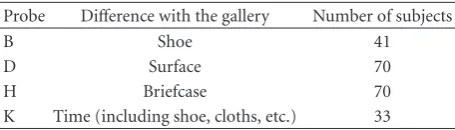
Table2: The four key probe sets.
Probe Difference with the gallery Number of subjects
B Shoe 41
D Surface 70
H Briefcase 70
K Time (including shoe, cloths, etc.) 33
with the minimum accumulated distance, denoted as DTW (xp1,xp2), is determined. A warping path maps the time axis of a sequence to the time axis of the other sequence. The start and end points of a warping path are fixed and the mono-tonicity of the time-warping path is enforced. In addition, the warping path will not skip any point. Euclidean distance is used here for measuring the distance between two points. The details of the DTW algorithm can be found in [31].
A distance is calculated for each parameter and a combi-nation scheme is needed to integrate the gait dynamics (pa-rameters) of each body part for gait recognition. The com-bination scheme used in AdaBoost.M2 [35] is adopted here to weight the different LDM parameters properly, as shown in Algorithm 1. AdaBoost is an ensemble-based method to combine a set of (weak) base learners, where a base learner produces a hypothesis for the input sample. As seen in Al-gorithm 1, the DTW distance calculator, with proper scal-ing, is employed as the base learner in this work. LetXg ∈
RTg×P,g=1,. . .,G, be the LDM gallery gait dynamics, where
Gis the number of gallery subject. In the training phase, each parameter sequencexpg is matched against all the sequences for the same parameterxpc,c=1,. . .,C, using DTW and the matching scores are scaled to the range of [0, 1], which are the outputs of the hypothesis hp. Similar to AdaBoost.M2, the pseudolosspis defined with respect to the so-called misla-bel distributionDp(g,c) [35], wherepis the LDM parameter index here. A mislabel is a pair (g,c) wheregis the index of a training sample andcis an incorrect label associated with the sampleg. LetBbe the set of all mislabels:
B=(g,c) :g=1,. . .,G,c=g. (5)
The pseudolossp of the pth hypothesishp with respect to
Dp(g,c) is given by [35]
p= 1 2
(g,c)∈B
Dp(g,c)
1−hp
xpg,g
+hp
xpg,c
. (6)
Following the procedures in Algorithm 1, log (1/βp), the weight of each LDM parameterp, is determined.
5. EXPERIMENTAL RESULTS
The experiments on LDM-based gait recognition were car-ried out on the manual silhouettes created in [16] and the corresponding subset in the original “gait challenge” data sets, which contains human gait sequences captured under various outdoor conditions. The five key experiments of this subset are gallery, probes B, D, H, and K. The differences of the probe sets compared to the gallery set are listed inTable 2, together with the number of subjects in each set. The number of subjects in the gallery set is 71. Each sequence for a subject consists of one gait cycle of about 30∼40 frames, and there are 10005 frames in the 285 sequences. For the mean-shift algorithm in the pose recovery procedure, we set the kernel bandwidthshs=15 andho=10 and use the kernel with the Epanechnikov profile [27]. For the running average filter, a window sizen=7 is used.
0 5 10 15 20 25 P(number of LDM parameters)
0 0.1 0.2 0.3 0.4 0.5 0.6 0.7
Ra
nk
1
(c
o
m
b
in
ed
)
Rank 1 performance (combined)
Probe B Probe D Probe H
Probe K Average (a) Rank 1 versus the number of LDM parameter
0 5 10 15 20 25
P(number of LDM parameters) 0
0.2 0.4 0.6 0.8 1
Ra
nk
5
(c
o
m
b
in
ed
)
Rank 5 performance (combined)
Probe B Probe D Probe H
Probe K Average (b) Rank 5 versus the number of LDM parameter
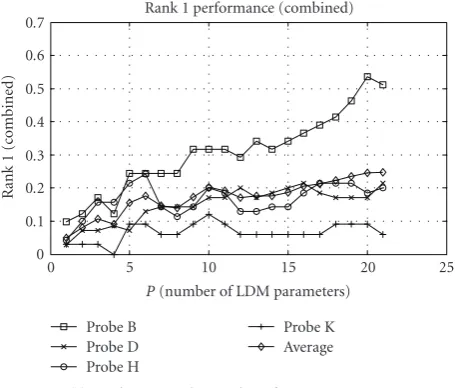
Figure8: The gait recognition performance for the manual silhou-ettes.
holistic patterns, we refer to them as the holistic approach. For the LDM-Man and LDM-Aut algorithms, the indicated recognition rates are obtained withP=21 (all LDM param-eters) and P = 11, respectively. The shoulder vertical dis-placementd ySh(p=12) is excluded for the best performing
LDM-Aut algorithm (resulting inP = 11) because the es-timatedd yShin this case is not helpful in identification, as
to be shown inFigure 9(Section 5.2). The recognition rates reported in brackets for the LDM-Man are obtained with the same set of LDM parameters as in the LDM-Aut, that is,P=11.
5.1. Gait recognition with the manual silhouettes
The detailed gait recognition results using the manual silhou-ettes are reported inFigure 8, where the averaged recognition
rates are shown in thicker lines. There are several interest-ing observations from the results. First, the inclusion of the arm dynamics (p =5, 6, 7, 8), the dynamic of the full-body height (p = 9), and the head dynamic (p = 10) improves the average recognition rates, indicating that the leg dynam-ics (p = 1, 2, 3, 4) are not the only information useful for model-based gait recognition. A similar observation is made recently in [36] for the holistic approach, where the arm sil-houettes are found to have similar discriminative power as the thigh silhouettes.
Secondly, it is observed that the length and width param-eters concerning the shape provide little useful discrimina-tive information when clothing is changed, that is, probe K. Furthermore, for the rank 5 recognition rate (Figure 8(b)), including the shape parameters (p >12) results in little im-provement on the performance, indicating that shapes are not reliable features for practical model-based gait recogni-tion, even if the body-part level silhouettes can be obtained ideally, which agrees with intuition since shapes are largely affected by clothing. On the other hand, fromFigure 8(a), the rank 1 recognition rate for probe B, which is captured under the conditions with the same clothing and only dif-ference in shoes, benefits the most from the inclusion of the shape parameters.
Another interesting observation is that for probe H, where the subject carries a briefcase with the right arm, the inclusion of the right arm dynamics (p =7 and p=8) re-sults in performance degradation for both rank 1 and rank 5, which can be explained by the fact that the right arms are not moving in the “usual way.” This information could be utilized to improve the gait recognition results through, for example, excluding the right arm dynamics if it is known or detected that the subject is carrying some objects (while there is no carrying in the gallery). Moreover, these clues drawn from the LDM gait dynamics could be useful in applications other than gait recognition, such as gait analysis for the de-tection of carrying objects or other abnormalities.
5.2. Gait recognition with automatically
extracted silhouettes
In [15], studies on the holistic recognition show that “the low performance under the impact of surface and time variation can not be explained by the silhouette quality,” based on the fact that the noisy silhouettes (extracted semi-automatically) outperforms the manual (clean) silhouettes due to correlated errors/noise acting as discriminative information. Different from [15], the LDM-based gait recognition achieves better results on the manual (clean) silhouettes than on the auto-matically extracted (noisy) silhouettes, especially in the rank 5 performance, as shown in Table 3, suggesting that more accurate silhouette extraction and body pose recovery algo-rithms could improve the performance of automatic model-based gait recognition, which agrees with our common be-lief.
Table3: Comparison of the LDM-based and holistic gait recognition algorithms.
Rank 1 recognition rate (%) Rank 5 recognition rate (%)
Probe BL-Man CBGR-Man LDM-Man LDM-Aut BL-Man CBGR-Man LDM-Man LDM-Aut
B 46 49 51(32) 29 66 78 73(76) 49
D 23 26 21(17) 9 39 53 43(39) 26
H 9 16 20(19) 20 36 46 44(39) 40
K 12 15 6(9) 12 39 39 39(42) 27
Average 23 27 25 (19) 18 45 54 50 (49) 35
0 2 4 6 8 10 12
P(number of LDM parameters) 0
0.05 0.1 0.15 0.2 0.25 0.3 0.35
Ra
nk
1
(c
o
m
b
in
ed
)
Rank 1 performance (combined)
Probe B Probe D Probe H
Probe K Average (a) Rank 1 versus the number of LDM parameter.
0 2 4 6 8 10 12
P(number of LDM parameters) 0
0.1 0.2 0.3 0.4 0.5
Ra
nk
5
(c
o
m
b
in
ed
)
Rank 5 performance (combined)
Probe B Probe D Probe H
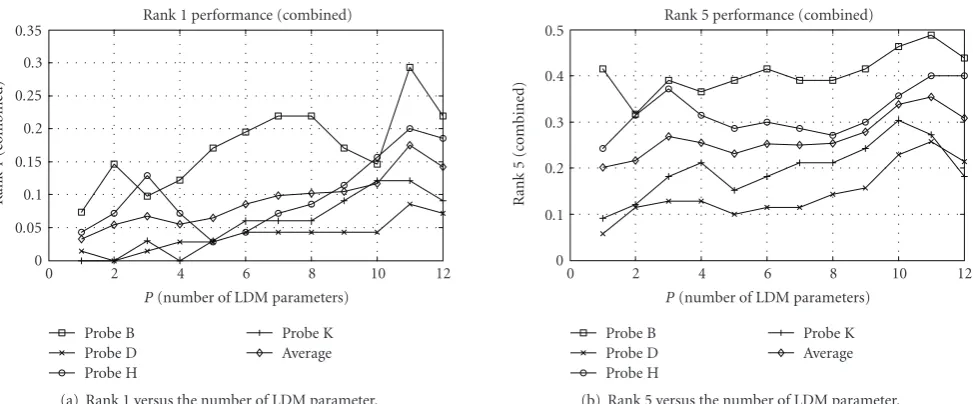
Probe K Average (b) Rank 5 versus the number of LDM parameter. Figure9: The gait recognition performance for the automatically extracted silhouettes.
to the fact that our model-based gait recognition relies purely on the gait dynamics and it seems that a different surface sig-nificantly affects the accurate estimation of the LDM param-eters. This suggests that by knowing the fact that the surface is different, the silhouette extraction and body pose recovery algorithms should be modified to adapt to (to work better on) the different surface. Another interesting observation is that for probe H (with briefcase), the LDM-based approaches (both LDM-Man and LDM-Aut) outperform the holistic ap-proach in rank 1, especially the BL-Man, implying that the proposed LDM-based gait recognition approach suits situa-tions with “abnormality“ better than the holistic approach.
Figure 9depicts the detailed gait recognition results for the automatically extracted silhouettes and the averaged recognition rates are shown in thicker lines too. Similar to the results on the manual silhouettes, the inclusion of the dy-namics of the arms, the full-body height, the head, and even the shoulder’s horizontal dynamic (p=11) improves the av-erage recognition rates, indicating again that there are other gait dynamics other than the leg dynamics that are useful for model-based gait recognition. In addition, it is worthy to note fromTable 3(the results in brackets for LDM-Man and the results for LDM-Aut) that for probe K, which is captured with six months time difference from the gallery set, the
in-clusion of the shape information degrades both the rank 1 and rank 5 recognition rates from 9 to 6 and from 42 to 39, respectively. While the recognition results for probes B, D, and H, captured with the same clothing, improves with the shape parameters, which confirms again that shape informa-tion works only for the same (or similar) clothing.
6. CONCLUSIONS
contributions from each parameter are weighted as in Ad-aBoost.M2. The experimental results on a subset of the gait challenge data sets show that the LDM-based gait recogni-tion achieves comparable results (and better results in some cases) as the holistic approach. It is demonstrated that the upper-body dynamics, including the arms, the head, and the shoulders, are important for the identification of individuals as well. Furthermore, the LDM serves as a powerful tool for the analysis of different factors contributing to the gait recog-nition performance under different conditions and it can be extended for other gait-related applications. In conclusion, the LDM-based approach proposed in this paper advances the technology of automatic model-based gait recognition.
ACKNOWLEDGMENTS
The authors would like to thank the anonymous review-ers for their insightful comments. The authors would also like to thank Professor Sudeep Sarkar from the University of South Florida for kindly providing them with the manual silhouettes as well as the gait challenge data sets. This work is partially supported by the Ontario Centres of Excellence through the Communications and Information Technology Ontario Partnership Program and the Bell University Labs at the University of Toronto. An earlier version of this paper was presented at the Seventh IEEE International Conference on Automatic Face and Gesture Recognition, Southampton, UK, 10–12 April 2006.
REFERENCES
[1] M. S. Nixon and J. N. Carter, “Automatic recognition by gait,” Proceedings of the IEEE, vol. 94, no. 11, pp. 2013–2024, 2006. [2] A. Kale, A. Sundaresan, A. N. Rajagopalan, et al.,
“Identifica-tion of humans using gait,”IEEE Transactions on Image Pro-cessing, vol. 13, no. 9, pp. 1163–1173, 2004.
[3] N. V. Boulgouris, D. Hatzinakos, and K. N. Plataniotis, “Gait recognition: a challenging signal processing technology for biometrics identification,”IEEE Signal Processing Magazine, vol. 22, no. 6, pp. 78–90, 2005.
[4] L. Wang, T. Tan, H. Ning, and W. Hu, “Silhouette analysis-based gait recognition for human identification,”IEEE Trans-actions on Pattern Analysis and Machine Intelligence, vol. 25, no. 12, pp. 1505–1518, 2003.
[5] G. Johansson, “Visual motion perception,”Scientific American, vol. 232, no. 6, pp. 76–88, 1975.
[6] J. Cutting and L. Kozlowski, “Recognizing friends by their walk: gait perception without familiarity cues,”Bulletin of the Psychonomic Society, vol. 9, no. 5, pp. 353–356, 1977. [7] C. D. Barclay, J. E. Cutting, and L. T. Kozlowski, “Temporal and
spatial factors in gait perception that influence gender recogni-tion,”Perception and Psychophysics, vol. 23, no. 2, pp. 145–152, 1978.
[8] S. V. Stevenage, M. S. Nixon, and K. Vince, “Visual analysis of gait as a cue to identity,”Applied Cognitive Psychology, vol. 13, no. 6, pp. 513–526, 2000.
[9] S. Sarkar, P. J. Phillips, Z. Liu, I. Robledo, P. Grother, and K. W. Bowyer, “The human ID gait challenge problem: data sets, per-formance, and analysis,”IEEE Transactions on Pattern Analysis and Machine Intelligence, vol. 27, no. 2, pp. 162–177, 2005. [10] N. V. Boulgouris, K. N. Plataniotis, and D. Hatzinakos, “Gait
recognition using linear time normalization,”Pattern Recogni-tion, vol. 39, no. 5, pp. 969–979, 2006.
[11] J. Han and B. Bhanu, “Individual recognition using gait energy image,”IEEE Transactions on Pattern Analysis and Machine In-telligence, vol. 28, no. 2, pp. 316–322, 2006.
[12] H. Lu, K. N. Plataniotis, and A. N. Venetsanopoulos, “MPCA: Multilinear principal component analysis of tensor objects,” IEEE Transactions on Neural Networks, vol. 19, no. 1, 2008. [13] D. A. Winter,The Biomechanics and Motor Control of Human
Gait: Normal, Elderly and Pathological, University of Waterloo Press, Waterloo, Ontario, Canada, 2nd edition, 1991. [14] D. A. Winter,The Biomechanics and Motor Control of Human
Movement, John Wiley & Sons, New York, NY, USA, 2005. [15] Z. Liu and S. Sarkar, “Effect of silhouette quality on hard
prob-lems in gait recognition,”IEEE Transactions on Systems, Man, and Cybernetics, Part B: Cybernetics, vol. 35, no. 2, pp. 170–183, 2005.
[16] Z. Liu, L. Malave, A. Osuntogun, P. Sudhakar, and S. Sarkar, “Toward understanding the limits of gait recognition,” in Pro-ceedings of SPIE Processings Defense Security Symposium: Bio-metric Technology for Human Identification, pp. 195–205, April 2004.
[17] L. Wang, H. Ning, T. Tan, and W. Hu, “Fusion of static and dynamic body biometrics for gait recognition,”IEEE Trans-actions on Circuits and Systems for Video Technology, vol. 14, no. 2, pp. 149–158, 2004.
[18] C. Y. Yam, M. S. Nixon, and J. N. Carter, “Automated per-son recognition by walking and running via model-based ap-proaches,”Pattern Recognition, vol. 37, no. 5, pp. 1057–1072, 2004.
[19] D. Cunado, M. S. Nixon, and J. N. Carter, “Automatic extrac-tion and descripextrac-tion of human gait models for recogniextrac-tion purposes,”Computer Vision and Image Understanding, vol. 90, no. 1, pp. 1–41, 2003.
[20] D. K. Wagg and M. S. Nixon, “On automated model-based ex-traction and analysis of gait,” inProceedings of the 6th IEEE International Conference on Automatic Face and Gesture Recog-nition, pp. 11–16, Seoul, Korea, May 2004.
[21] R. Zhang, C. Vogler, and D. Metaxas, “Human gait recogni-tion,” inProceedings of the Conference on Computer Vision and Pattern Recognition Workshop, pp. 18–18, Washington, DC, USA, June 2004.
[22] H. Lu, K. N. Plataniotis, and A. N. Venetsanopoulos, “A lay-ered deformable model for gait analysis,” inProceedings of the 7th International Conference on Automatic Face and Gesture Recognition, pp. 249–256, Southampton, UK, April 2006. [23] L. Lee and W. E. L. Grimson, “Gait analysis for recognition and
classification,” inProceedings of the IEEE International Confer-ence on Automatic Face and Gesture Recognition, pp. 148–155, Washington, DC, USA, May 2002.
[24] N. Cuntoor, A. Kale, and R. Chellappa, “Combining multiple evidences for gait recognition,” inProceedings of the IEEE Inter-national Conference on Multimedia & Expo (ICME ’06), vol. 3, pp. 113–116, Toronto, Ontario, Canada, July 2006.
[25] N. Jojic and B. J. Frey, “Learning flexible sprites in video lay-ers,” inProceedings of the IEEE Computer Society Conference on Computer Vision and Pattern Recognition, vol. 1, pp. I199–I206, Kauai, Hawaii, USA, 2001.
[26] J. Zhang, R. Collins, and Y. Liu, “Representation and matching of articulated shapes,” inProceedings of the IEEE Computer So-ciety Conference on Computer Vision and Pattern Recognition, vol. 2, pp. II342–II349, Washington, DC, USA, July 2004. [27] D. Comaniciu and P. Meer, “Mean shift: a robust approach
Analysis and Machine Intelligence, vol. 24, no. 5, pp. 603–619, May 2002.
[28] H. Lu, K. N. Plataniotis, and A. N. Venetsanopoulos, “Coarse-to-fine pedestrian localization and silhouette extraction for the gait challenge data sets,” in Proceedings of the IEEE In-ternational Conference on Multimedia and Expo (ICME ’06), vol. 2006, pp. 1009–1012, Toronto, Ontario, Canada, 2006. [29] J. Migdal and W. E. L. Grimson, “Background subtraction
us-ing Markov thresholds,” inProceedings of the IEEE Workshop on Motion and Video Computing (MOTION ’05), pp. 58–65, 2005.
[30] A. Zaidenberg,Drawing the Figure from Top to Toe, World, 1966.
[31] T. K. Moon and W. C. Stirling,Mathematical Methods and Al-gorithms for Signal Processing, Prentice Hall, Englewood Cliffs, NJ, USA, 2000.
[32] N. V. Boulgouris, K. N. Plataniotis, and D. Hatzinakos, “Gait recognition using dynamic time warping,” inProceedings of the IEEE 6th Workshop on Multimedia Signal Processing (WMSP ’04), pp. 263–266, Siena, Italy, 2004.
[33] A. Kale, N. Cuntoor, B. Yegnanarayana, A. N. Rajagopalan, and R. Chellappa, “Gait analysis for human identification,” in Proceedings of the International Conference on Audio and Video Based Person Authentication, Guildford, UK, 2003.
[34] R. Tanawongsuwan and A. Bobick, “Gait recognition from time-normalized joint-angle trajectories in the walking plane,” in Proceedings of the IEEE Computer Society Conference on Computer Vision and Pattern Recognition, vol. 2, pp. II726– II731, Kauai, Hawaii, USA, 2001.
[35] Y. Freund and R. E. Schapire, “Experiments with a new boost-ing algorithm,” inProceedings of the 13th International Confer-ence on Machine Learning, pp. 148–156, Desenzano sul Garda, Italy, June 1996.