1 INTRODUCTION 1.1 Aims
At the University of the West of England we are working on managing knowledge within engineering organisations with the aim of using this knowledge to reduce the costs of manufacture of products. In many engineering organisations employees and de-partments create spreadsheet models of manufactur-ing information. Because this information is not held in a central repository, it is not shared and is easily lost when those employees responsible for its’ up-keep leave. So it is important to create a knowledge base that can be maintained and updated easily, and is managed effectively. A knowledge-based system is the information source for our decision support systems. We are working on constructing the knowl-edge-based system, based on an Ontology of engi-neering terms. Ontologies are explained later and in (Denny, 2002). At present there is a conflict be-tween the needs of employees to create decision sup-port systems for analysis of effectiveness in fast changing economic conditions, and those of the IT managers who need to provide a stable centralised system. A centralised knowledge base, which links to decision support software that employees distrib-uted around an organisation can use, solves both problems.
The intention of the Design Analysis Tool for Unit-cost Modelling (DATUM) project is to make it possible for Rolls-Royce employees, and employees of Rolls-Royce suppliers to view a knowledge repre-sentation of an engine, and of the engine compo-nents. Menus of engine components, materials, man-ufacturing processes etc will be created
automati-cally from a central database(s). For each engine component a model is to be created which will give the cost of that component and may give other infor-mation such as materials, and process plan. The vi-sualisation is via a web interface.
This should make it possible for designers to see the effect of their design changes on manufacture, and for the whole specification, design, manufac-ture, maintenance cycle to be managed more effi-ciently.
The software consists of modules that are directly related to items in a separate data source. It is im-portant to separate the data from the software, so that this data can be easily used by any other soft-ware, which exists now, or will exist in the future. This architecture also ensures that if the data changes the models will update automatically, and models can be added just by adding to the database. For simple parametric models this works well with no requirements for software apart from browser languages. If this same methodology is to be used for more complex models a server program will be required.
Instead of relying heavily on artificial intelli-gence techniques such as rule-based reasoning, our intention is to use standard software, and construct the system rigorously for ease of maintenance and update. We believe software can be made to act in-telligently by the use of a large number of simple modules co-operating together, each being responsi-ble for their own data and calculations.
The aim of this project is therefore to provide network software that gives users easy access to en-gineering information. This can relieve bottlenecks in the flow of knowledge between individuals.
Design and Prototyping of Knowledge Management Software for
Aerospace Manufacturing
P. Hale, J.Scanlan, C. Bru
University of the West of England, Bristol, UK
ABSTRACT: At the University of the West of England we are involved in a project with RollsRoyce Aero -Engines. This is the Design Analysis Tool for Unit-cost Modelling (DATUM) project. The aim of this project is to produce a knowledge based system which is capable of costing an aircraft engine and its’ subcomponents, and generating a process plan for the manufacture of the engine. From this we hope to learn how to de -velop a generic knowledge-based system that could be used for the manufacture of any product. We also hope to learn about the best methods for using software to share knowledge within and between organisations. We are researching how to structure this knowledge in such a way as to make it easy to retrieve both by humans and automated software. We are also examining how to visualise the results output from the software in a way which carries the meaning to the user. Our preferred method of delivery for this project is the use of open-standard Web technologies such as XML (eXtensible Markup Language). This will be used to provide a high level view of information held in distributed data sources.
1.2 Past Research
We have undertaken work relating to aerospace manufacturing for Airbus, and Rolls-Royce. The University of the West of England Implied Cost Evaluation System (ICES) group have produced manufacturing decision support systems. The aims of the ICES team were outlined in (Scanlan et al. 2000). A prototype expert system shell (Marsh et al. 2000) has been created. This system (COINER) has much of the functionality required of a knowledge-based system, but is usable on a single PC only. (Bru et al. 2002) have worked on visualisation of cost information. (Hale et al. 2002) have undertaken research in evaluating Web technologies for provid-ing a knowledge-based decision support system. 1.3 Current Research
It is proposed that we expand the aims of the re-search, which created the COINER system. This to-gether with the visualisation research will be the ba-sis for the Web based system currently under con-struction. We are looking for ways of representing the information in an open standard data source such as XML (eXtensible Mark-Up Language), and pro-cessing this information to provide a Generative Costing system. We define Generative Costing as costing based on the automated generation of a process plan.
2 BACKGROUND
The aim of the DATUM project is to provide soft-ware to allow a user to obtain the cost of a compo-nent or assembly of compocompo-nents at any stage in the design. As the design progresses towards produc-tion, more will be known about the product, and eventually it will be possible to create a process plan for its’ manufacture. In the early stages of design it will only be possible to use parametric equations to estimate the cost. These models are based on past data and involve the use of data mining software. In the later stage of design much more is known about the final form the product will take and we can cre-ate software for this which crecre-ates a process plan and a more accurate cost. We call this Generative costing. This corresponds to the bottom two layers in the diagram below. The lowest layer involves de-tailed simulation of the manufacturing process flow, while the second lowest layer can be used when the detail of the process is not yet clear. So as we have more detail the software needs to intelligently use more generative costing techniques and less para-metric in order to produce higher accuracy. Figure 1 shows this.
Figure 1. Parametric to Generative Costing
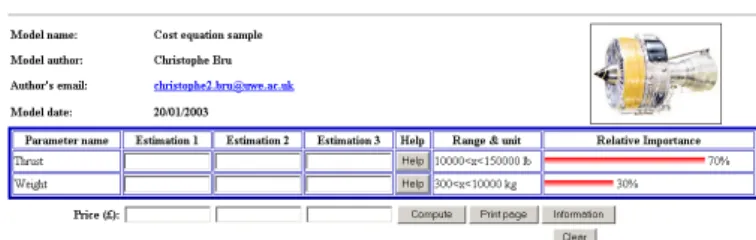
An example of the interface for parametric cost estimation via the Web is shown in Figure 2.
Figure 2. Parametric Cost Estimation Software
Examples of parametric cost estimation software can be found at
Engine example http://www.cems.uwe.ac.uk/ ~cbru/pce.htm?id=engine
Bolt example http://www.cems.uwe.ac.uk/~cbru/ pce.htm?id=bolt
In order to create a software costing system that can judge what information to use at the current de-sign stage it is essential that the information is well structured. A comprehensive library of information is required in order to allow us to create rules and al-gorithms for accessing the information required in order to create the cost estimate. Because of this problem, and the need to easily share information over a range of computers and users we have exam-ined the creation and use of ontologies.
2.1 Ontologies
This 'thesaurus' structure is the Ontology and may contain one or more taxonomies.
Engineers may have different names for the same thing, e.g. wing skin stiffeners may be referred to as stringers, but rib stiffeners are never called stringers. There is a relationship of stringer to stiffener, which needs to be defined, and this definition depends on the context. An engineering classification scheme or Ontology is necessary in order to make communica-tion between engineers precise. Such an Ontology can also be used to help non-engineers to understand the terminology.
These complex relationships between words make the construction of the Ontology more in-volved than for that of a taxonomy such as a Product Data Structure. Instead of designing the structure as an information source for a software system to oper-ate for a specific purpose(s), it becomes necessary to identify relationships between items that hold true in the long term. These relationships must be true for a variety of applications. The relationships may be many and varied, and each term must be linked with many other terms that have a similar meaning.
The Ontology can also enable communication be-tween the computer systems, users, and administra-tors. Ontology development tools allow the ontology administrator(s) and representatives of the users to meet discuss and develop the ontology together, us-ing a visual interface. (Hunter, 2002) explains how taxonomies can be the basis of the definitions for the Ontology, and that commercial software is becom-ing available. Rolls-Royce are usbecom-ing Protégé from Stanford University (Stanford, 2003) to create an ontology for parametric modelling of engine cost. This can be the basis for a more detailed Ontology to be used for generative modelling as well.
The use of Ontologies is being driven by e-com-merce and e-procurement where trading is online (ebXML, 2002) such as Exostar. Exostar is the e-commerce system formed in March 2000 by BAE SYSTEMS, Boeing, Lockheed Martin and Raytheon. Rolls-Royce joined in June 2001. This system now links over 20,000 second and third tier suppliers. (Exostar, 2003).
For our ontology the underlying data will employ an object oriented database to hold libraries of ob-jects. This will offer the ability to integrate with other web-based services such as Exostar, which of-fers the potential to access relevant supply-chain costing data. We will also attempt to make it possi-ble for our ontology to integrate with product and process ontologies being developed as part of STEP (Standard for the Exchange of Product Model Data) and PSL (Process Specification Language) projects. 2.2 Knowledge-based systems in Practice
In order to construct a knowledge-based system, it is necessary to investigate ways to structure the
infor-mation in a coherent, manageable, and computer in-dependent way. Any system created without this in mind may have temporary success but is doomed to failure in the longer run. This failure is likely be-cause the keeping of information in proprietary for-mats and within particular computer systems frag-ments the access of users in such a way that the ma-jority does not have access. The lack of accessibility to the information causes attitudes ranging from in-difference to outright opposition to the introduction of such a system over a whole organisation.
This leaves protagonists of such a system won-dering how it can fail to take off, when it seemed to them to be useful. The result is to scale back aims, and provide the system for only a particular group or type of user. This is counter to the requirements for a knowledge-based system as it merely helps these users perform a limited variety of organisational functions. Knowledge based systems need to allow a variety of people in different disciplines to share knowledge across functional, departmental, and dis-ciplinary boundaries. The Web makes it easier for users to share information, once the information is on the organisation's Intranet, everyone can access it unless it is deliberately restricted. This access is nec-essary before even considering the further problem that certain knowledge should be shared with others outside the organisation such as suppliers, and cus-tomers.
The varied user base of knowledge systems re-sults in a further problem, which is that of fragmen-tation of the language itself. As the users are in dif-ferent trades and professions they will not necessar-ily understand the same words, or assign to them the same meaning. The use of separate software systems in different departments has made this problem worse as the terminology used in software will tend to become part of the business language for that group of users. Again this makes it necessary to structure the information in a knowledge-based sys-tem carefully.
(Sutton, 2001) illustrates how codifying knowl-edge into a knowlknowl-edge-based system for decision support is likely to be very difficult. Most people 'just do' a task and therefore never write down in-structions for others. This highlights the difficulty of getting information into a knowledge base when it may be either only in individuals' minds, or com-pletely unstructured.
3 RESEARCH APPROACH 3.1 Knowledge Representation
struc-ture can be shown as tree diagrams and those in-volved can meet in order to amend the structure and agree the most suitable names for items. The SPEDE (Structured Elicitation and Demonstration Environment) project involves Rolls-Royce, Rover/BMW, University of Nottingham and Para-metric Technology Corp, and KTI. SPEDE investi-gates ways of representing products and business for further analysis and simulation.
The aim of the research is to find ways of repre-senting the information in the Ontology in an open, well-structured and accessible format. This must al-low for this information to be easily interpreted by users, and processed by computers in order to gener-ate cost and process planning information for a given component. We have made use of web stan-dards to represent and display the information in a web browser.
3.1.1 The Semantic Web
The research is not just into representing engineer-ing knowledge on the web. It is also a small part of a much wider world wide effort to make the web into a repository of knowledge, which can be catalogued and searched intelligently. This search task could then be undertaken by humans, or by software agents.
(Berners-Lee, 2002) has envisaged the Semantic Web as a sort of global database with the informa-tion held in a structured form where content is sepa-rated from markup. To achieve this the structure is created using XML Meta-data tags, and a stylesheet contains separate tags for formatting. This is why in our project we use XML Meta-data tags for organis-ing content and the semantics (meanorganis-ing) of that con-tent, and separate stylesheets for formatting the in-formation.
3.1.2 Knowledge Representation Languages
3.1.2.1 XML (Extensible Markup Language)
The basis for much of this work is XML (eXten-sible Mark-Up Language). The Web Based Cost Es-timation Software in Figure 2 above uses XML as its’ information source. We are creating an Ontology for engine manufacture using relational database ta-bles and software to translate and structure these into XML or RDF (described below). (Huang et al. 2001) examines the issues that are important in de-veloping Web applications for product design and manufacture.
The reason for using this language is that it pro-vides a structured way to represent information that is independent of the way this information is dis-played. It is also open standard not proprietary. This is why XML is increasingly being used for commu-nication of data between computer systems, this is
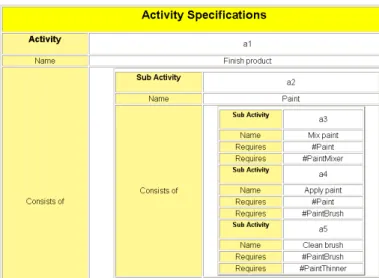
the basis for Web Services (W3C, 2002). W3C (World Wide Web Consortium) ‘develops interoper-able technologies (specifications, guidelines, soft-ware, and tools’. Web Services are a means of al-lowing application to application communication, and acceptance of XML as a W3C standard helps to ensure that many applications are enabled to com-municate using XML. The Process Specification Language (PSL) uses RDF (Resource Description Framework) to add a layer of engineering semantics to the XML for communication between process modelling tools, and for use in defining ontologies (PSL, 2000). Figure 3 shows a section from an ex-ample PSL process sequence rendered using an XSL (eXtensible Stylesheet Language) stylesheet.
Figure 3. Section from PSL Process Taxonomy and sequence rendered with stylesheet
These semantics languages can be part of a larger effort to provide a Data Grid of information and ap-plications, which can be requested as required (Walker, 2003).
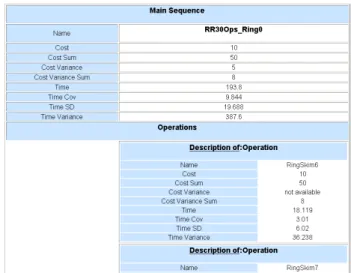
So we have looked for examples of XML being used to solve problems of manufacturing process in-formation representation. XML can be used as a way to manage workflow within and between organiza-tions (Ferreira & Ferreira, 2001). XML provides the basis for creation of taxonomies and Ontologies (Bryan, 2002).
Figure 4. Representation of Engine Ring Manufacturing Se-quence
(Ribiere & Charlton, 2002) have evaluated lan-guages, tools, and techniques for creating ontolo-gies.
3.1.2.2 SVG (Scalable Vector Graphics)
We have written software in order to perform queries and calculations on the information, and dis-play it in ways that should enhance the users under-standing of the results. The emerging standard of SVG (Scalable Vector Graphics) assists in this. SVG is a specific variety of XML for representing dia-grams and allows us to display a graph, or an engi-neering component and let its' size and shape be al-tered according to the values in its' information source. This makes it ideal for visualising knowl-edge. XML information can be automatically trans-lated into SVG format for display using stylesheets. SVG’s future, and tools for SVG development are outlined in (Quint, 2002).
3.2 Knowledge Visualisation
The importance of visualising the output from queries and calculations in such a way as to convey the meaning of the results cannot be overestimated. In the Implied Cost Evaluation System (ICES)
project results were displayed in a sequence dia-gram. Cost was represented by the size of a node in the sequence. Uncertainty was represented by varia-tions in the shape from square to indicate low uncer-tainty, through to a circle meaning high uncertainty. Figure 5 shows the output from the cost map soft-ware.
Figure 5. Cost Map from ICES system
Our intention is to reproduce this kind of functional-ity in our Web system. We are experimenting with SVG as it is a W3C recommendation and is also an XML syntax.
Figure 6. shows an example wing spar, as the user changes the values on the left, the diagram changes shape, and the result values such as volume change accordingly.
XML can be used both to represent information and to display the information, the example below outputs an XML structure in a menu. This can be created either by writing an XML file directly using a text editor, or by creating or re-using relational database tables and using Active Server Pages (ASP) or Java Server Pages (JSP) code to output the XML. The XML is rendered into html for display using a stylesheet by (De Andreis, 2001). Figure 7 shows this.
Figure 7. Hierarchical Menu
We use software which allows information to be extracted from a database or XML and displayed in a spreadsheet on the web (Softartisans, 2003). This is useful because many engineers are already used to spreadsheets, and costing models are often proto-typed using spreadsheets.
3.3 Simulation
Although the use of process models can allow accu-rate manufacturing times to be geneaccu-rated this does not allow accurate charging rates to be established. DATUM will take into account the need for dy-namic models of factories, cells and processes. We intend to develop simulation software, which could verify the process plan. This will alter these details to reflect resource and time constraints.
The development of visual user interfaces and pictorial metaphors are useful for representing a static snapshot at a particular time, usually the end of production. This technique can be used more dy-namically in simulations. Simulations represent the real world problem and provide constant feedback to the user. Pictorial metaphors are static, while a per-son's mental model is made up of mental images connected together by a set of actions. People re-member by running a mental model like a simula-tion. So a dynamic simulation is more memorable and conveys more information than a static picture. In order to be useful for our project simulation soft-ware must be able to take inputs from and provide outputs to our other applications.
(Kuljis) gives a summary of the aims of the AARIA project for manufacturing simulation over the Internet. Kuljis argues the need for web-based simulations to be focussed on solving real-world problems in order to be successful. (Miller et al. 2001) also explains the technology behind web-based simulations, and argues the need for demon-stration of web-based simulations for major projects. (Chen, 2001) has shown how web-based simulation models can be developed and configured.
DATUM will make use of both discrete-event and sample-based models to analyse dynamic and stochastic cost elements. A framework for a library of processes, cells and virtual factories will be gen-erated within the DATUM project. Product data, se-quences and timings will be exchanged with the vir-tual factories to yield realistic activity based costs.
A significant problem that is not addressed by current costing tools concerns the dynamics of the underlying cost calculation. Essentially current cost-ing tools attempt to predict the resources consumed in designing, producing and operating a product. However they almost always use a static model with simple overhead accounting rates. It is well known, however, that this produces a highly distorted view of actual costs (Sherrard, 1997). A more reliable and accurate cost can be achieved by using differential charging rates based on the principles of Activity Based Costing (ABC) which gives a more authentic analysis of the actual resources consumed in produc-ing a product.
4 FINDINGS
necessary to use the Ontology as a repository that not only stores information, but also gathers it from various computer systems such as databases and spreadsheets. There is a conflict between the aim to develop an ideal representation of knowledge using an ontology editor, and the practical need to edit the data in the database or application it is currently held. Therefore we have created software to take in-formation from data sources and output it the ontol-ogy.
This means it is necessary to provide a software link between these sources of information, and the Ontology. The Ontology is therefore a centralised repository of information within a distributed sys-tem. (McGuinness, 2002) provide useful guides on how ontologies can assist in linking distributed data. This use of the Web as a link to a multitude of appli-cations and data sources is termed the Active Web and is described in (Morris et al. 2001).
4.1 Software Architecture
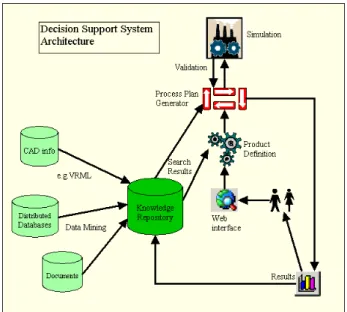
Figure 8 shows the architecture of the DATUM sys-tem.
Figure 8. Software architecture for DATUM system
Although much of the software required has been prototyped, it has not yet been fully assembled into such an architecture. This will involve adaptation and integration of components. XML plays an im-portant role in both the Web Services sense of being a communicating language for different systems, and also in the Semantic Web sense of providing an ontology definition language. The Knowledge repository would contain XML data obtained from other applications and from user forms. An extra layer of semantics would be created above the XML syntax layer using RDF and/or DAML/OIL.
We need to investigate further techniques for vi-sualising the information for a wide range of users, and in complex ways. While SVG could prove use-ful, as an open standard for this, we are still evaluat-ing tools and techniques for production and display of the SVG. Further investigation is also needed into web simulation, both to verify a process plan and to provide results to the users in the most infor-mative way.
5 CONCLUSION
This work has been an essential first step in evaluat-ing and prototypevaluat-ing a knowledge based system. The knowledge we have gained will allow us to create such a system for Parametric and Generative cost es-timation, and decision support. However the quan-tity of information needed for this system imposes extra requirements for automated software links to other systems, and a user interface which allows easy navigation, viewing and editing of information. The difficulty here will be in reading information from these other systems and codifying it into a sen-sible structure for the Ontology. This means it is es-sential that we use open data standards. This also implies the need for a semi-automated rule based codifying tool. This could assist administrative users in taking information from various sources and link-ing it to the Ontology.
REFERENCES
Baclawski, K. & Mieczyslaw, K. & Kogut, P. & Hart, L. & Smith, J. & Holmes, W. & Letkowski, J. & Aronson, M. 2001. Extending UML to Support Ontology Engineering for the Semantic Web http://ubot.lockheedmartin.com/ ubot/papers/publication/UMLOntology.pdf
Berners-Lee, Tim. 2002. The World Wide Web – Past Present and Future http://www.w3.org/2002/04/Japan/Lec-ture.html, Japan prize Commemorative Lecture
Bru, C. & Scanlan, J. & Hale, P. & Dunkley, M. 2002. Visu-alisation of Cost Information, 9th ISPE International Con-ference on Concurrent Engineering: Research and Appli-cations, Cranfield University: 829-838
Chen, Yücesan. 2001. Distributed Web-Based Simulation Ex-periments For Optimization, Journal of Simulation Prac-tice and Theory, Vol. 9, pp. 73-90, September 2001
De Andreis, Emmanuele. 2001. 2MXtree XML-based tree
http://manudea.duemetri.net/xtree/
Denny, M. 2002. Ontology Building: A Survey of Editing Tools, http://www.xml.com/lpt/a/2002/11/06/ontolo-gies.html, XML.com
EbXML. 2002. ebXML Enabling a Global Electronic Market.
http://www.ebxml.org, OASIS & UN/CEFAC
Exostar. 2003. http://www.exostar.com/publisher.asp
Ferreira, D. & Ferreira, J. 2001. Designing Workflow-Enabled Business-to-Business Infrastructures. 7th International
Conference on Concurrent Enterprising: 81-89
Hale, P. & Scanlan, J. & Bru, C. &Dunkley, M. 2002. Prelim-inary Findings from the DECIDE project, 9th ISPE Inter-national Conference on Concurrent Engineering: Re-search and Applications, Cranfield University: 839-848
Harmelen F. V. & Horrocks I. 2002. Questions and answers on OIL: the Ontology Inference Layer for the semantic web, http://www.onntoknowledge.org/oil/oil-faq.html
Manchester University & Amsterdam University
Huang, G. Q. & Mak, K. L. 2001. Issues in the development and implementation of web applications for product design and manufacture. Computer Integrated Manufacturing
14(1): 125-135
Hunter, A. 2002. Engineering Ontologies, http://www.cs.u-cl.ac.uk/staff/a.hunter/tradepress/eng.html
Kogut, P. & Cranefield, S. & Hart, L. & Dutra, M. & Ba-clawski, K. & Kokar, M. & Smith, J. 2002. UML for On-tology Development. http://whitepapers.techrepublic.-com.com/whitepaper.aspx?docid=92641
Kuljis, J. 2001. An appraisal of web-based simulation: whither we wander?. Simulation Practice and Theory 9: 37-54
Marsh, R. & Hill, T. & Scanlan, J. & Dunkley, M. & Cleevely, P. 2002. Modelling manufacturing cost
uncer-tainty with input distributions and exemplars. 9th ISPE In-ternational Conference on Concurrent Engineering: Re-search and Applications, Cranfield University: 881-890
McGuinness, D. L. 2002. Conceptual Modeling for Distrib-uted Ontology Environments. http://www.ontology.org/ main/papers/iccs-dlm.html
Miller, J. & Fishwick, P. A. & Taylor, S. J. E. & Benjamin, P. & Szymanski, B. 2001. Research and commercial op-portunities in Web-Based Simulation. Simulation Practice and Theory 9: 55-72
Morris, S. & Neilson, I. & Charlton, C. & Little, J. 2001. In-teractivity and collaboration on the WWW - is the 'WWW shell' sufficient?. Interacting with Computers 13: 717-730
Oasis. 2000. Process Specification Language (PSL) and XML http://xml.coverpages.org/psl-xml.html
Quint, A. 2002. SVG’s Past and Promising Future, 2002,
http://www.xml.com/lpt/a/2002/12/04/svg.html, XML.Com
Ribiére, M. & Charlton, P. 2002. Ontology Overview Mo-torola Labs, http://www.fipa.org/docs/input/f-in-00045/f-in-00045.pdf
Rolls-Royce,
Rover/BMW, University of Nottingham and Parametric Technology Corp, and KTI,. 2002. http://www.manufac-turingtalk.com/news/kno/kno102.html
Scanlan, J. & Hill, T & Marsh, R. & Bru, C. 2000. Cost Mod-elling for Aircraft Design Optimisation, Engineering De-sign 2000 conference, Brunel University.
Sherrard W. 1997. Activity-Based Costing in a Manufacturing Resource Planning Environment, Fall 1997 meeting of the Institute for Operations Research and the Management Sciences (INFORMS), October 26-29, 1997, Dallas, Texas
Softartisans. 2003. ExcelWriter. http://www.softartisans.com/ excelwriter.html
Stanford University. 2003, Welcome to the Protégé Project,
http://protege.stanford.edu/
Walker D. W. 2003. Emerging Distributed Computing Tech-nologies, http://www.cs.cf.ac.uk/User/David.W.Walker,
Cardiff University
World Wide Web Consortium. 2003. Web Services Activity