95 |
P a g e
www.ijarse.com
IMPLEMENTATION OF RF TRANSCEIVER AND
BASEBAND PROCESSOR IN DUAL SIM MOBILE
SYSTEM
Prof. Virendrakumar V. Raut
Jagdambha College of Engineering &Technology Yavatmal. (India)
ABTRACT
Mobile phones or cell phones as it’s frequently called nowadays, havesignificantly revolutionized the way people communicate with one another. It has empowered a lot of people and has even made a lot of things possible because of its many features and capabilities. Dual SIM handsets have been around for a few years now. As of now few mobile manufacturers are manufacturing dual/3 SIM card mobiles. But their some disadvantage of dual SIM mobile system. At instant we can’t access both SIM. In this research paper we will proposed solution to overcome these disadvantages such that, we can access both SIM without interacting with each other. If we are calling someone in dual SIM mobile system, key factor is that automatically one SIM switch off. So frequency of switch of SIM is unoccupied. We can be usedswitch off SIM, by proposing some modification in system.The modification of system in such way that, we can access both sim at time instant.
Keywords: Baseband Processors, BPSK Transceiver, Switching Network.
I INTRODUCTION
1985 - First mobile telephone service instarted on non-commercial basis in Delhi. While all the major cities and
towns in the country were linked with telephones during The British period, the total number of telephones in
1948 was only around 80,000. Even after independence, growth was extremely slow. The telephone was a status
symbol rather than being an instrument of utility. The number of telephones grew leisurely to 980,000 in 1971,
2.15 million in 1981 and 5.07 million in 1991, the year economic reforms were initiated in the country [1]. First
mobile telephone service started on non-commercial basis in Delhi. The initial Handset costs around Rs.40, 000
& Call Tariff at 17 Rs/min. Both Incoming andOutgoing were charged at that time. The incoming charges were
charged up to year 2005. In this paper, we are consider and taken as example of Maharashtra state in India ,
there are more than 20 mobile service providers; almost every mobile subscriber in Maharashtra has got at least
5 to 10 SIM cards from different providers. Only dual SIM card mobiles are only the way to keep 2 SIM cards
for use of 2 different service providers‟ services.
Dual SIM mobile phones are designed in nearly the same way as any other phone with the addition of a second
96 |
P a g e
www.ijarse.com
In this research paper we can used both RF transceivers for utilised both frequency. We add switching network
to allocate both same frequency at time and use it same time.Switching network act as fuzzy logic controller.
We can discuss about that on below.
II BASEBAND PROCESSOR
Baseband processor employs GSM protocol stack for enabling Smartphone to access different types of wireless
network technologies such as WCDMA, EDGE, CDMA, Zigbee, Bluetooth 4.0, Wi-Fi, or LTE. BP manages
radio communications and control functions such as signal modulation, radio frequency shifting and encoding.
Baseband processors were used earlier in ordinary mobile phone technology for accessing cellular network;
however, its architecture has evolved in several stages from analog to digital to 3G, and the latest development
to LTE. Smartphone has a GSM modem which interfaces with the GSM network.
2.1 BPSK Transceiver
BPSK (also sometimes called PRK, Phase Reversal
Keying or 2PSK) is the simplest form of phase shift keying (PSK). It uses two phases which are separated by
180° and so can also be termed 2-PSK. It does not particularly matter exactly where the constellation points are
positioned, and in this figure they are shown on the real axis, at 0° and180°. This modulation is the most robust
of all the PSKs since it takes the highest level of noise or distortion to make the demodulator incorrect decision.
It is, however, only able to modulate at1bit/symbol (as seen in the figure) and so is unsuitable for high data-rate
applications when bandwidth is limited.
III RELATED WORK
We described related work about the today’s mobile system. Firstly we want know about, how mobile system
works. After that we proposed my recent work on dual SIM Mobile system, such way the system we implement
will helpful to users. The following figure.3 shows that
97 |
P a g e
www.ijarse.com
3.1 Power Amplifier
One of the most important components in the mobile phone is the power amplifier (PA). The PA provides gain
to the generated RF signal. Depending on the standard, this could output up to 30 dBm or 1 watt of power from
a phone. It affects battery life more than other components in the phone, so particular attention is made to make
this as efficient as possible.
3.2 RF Transceiver
The RF transceiver is the primary front end for the baseband processor. It down converts the signal from the RF
frequency of choice to either an intermediate frequency typically below 100 MHz and often with further signal
processing to baseband (0 Hz) to obtain the original transmitted complex data. It also up converts the baseband
data from the processor typically through an I/Q modulator directly to an RF frequency.
3.3 Baseband Processor
Although not the focus of this white paper, it is important to understand this component’s function. The
baseband processor collects the captured data from the RF transceiver and extracts the raw data through
demodulation and other signal processing. This content can include anything from audio information to video or
browser bit information for Web surfing. It also does the reverse by signal processing and modulating the data.
Besides managing just the physical layer portion of the data it also deals with signalling requirements for the
phone to communicate with the base station.
3.4 RF Front-End Devices Vs Other Mobile Device Components
One difference between the RF front-end devices, such as the PA, and the other mobile device components is
the way they are made. Because silicon (Si) does not have great properties for microwave-based signals, it is not
commonly used for RF devices. Instead PAs and other RF front-end devices are made with Gallium Arsenide
(GaAs), which is the most common semiconductor compound. However, newer devices are also using Indium
Phosphide (InP), Silicon Germanium (SiGe), and Gallium Nitride (GaN). These compounds have advantages of
faster transistor junctions and tolerances for higher frequency signals. The disadvantages are that they are more
expensive to fabricate and have smaller wafer sizes. For these reasons, there is a lot of research and
development to move microwave devices to silicon.
3.5 Importance of Test for RF Front-End Devices
Developing a phone with all of its components can lead to many issues or errors without proper testing. These
errors can compound with each other to degrade the phone’s overall performance. Therefore, it’s important to
test each component to ensure quality and test the entire phone itself to ensure proper integration. Traditionally,
98 |
P a g e
www.ijarse.com
wafer development and processes, it is becoming more important to also catch any issues with the silicon prior
to packaging.
3.6 Common Tests for RF Front-End Devices
Many of these common tests have been proven to be the most effective to catch issues with the semiconductor
device. For characterization test, they also can provide insight into the function of the chip. The following
sections discuss which tests are appropriate for characterization, production, or both. Some
Tests are used for both packaged chips as well as wafer-level testing.
3.7 RF Power Measurements
TX power or transmit power is probably the most common measurement performed for a device. Output power
from the device must be within compliance of its design. You can perform this measurement using a variety of
measurement equipment including a power meter, vector signal analyser (VSA), and vector network analysers
(VNA).Power versus time (PVT) measures the burst power and the average power of a signal. It is commonly
used for busted RF signals such as GSM or WLAN. Often, a mask is placed around the signal to make sure it is
in compliance for the test.
3.8 Wireless Interfaces
The wireless modules found within an application processor enable the Smartphone to communicate with the
cellular network and data network (internet). The digital components of the wireless communication scheme are
integrated into the chip as part of the application processor, whereas the analog parts are placed off-chip. A
Smartphone employs the following wireless modules.
Bluetooth Module allows for communication with peripherals such as headset, or other nearby mobile devices.
Wi-Fi module enables Smartphone to communicate with local 802.11 networks.
GSM modules enable Smartphone to communicate with the cellular network for both vice communication and
access to internet.
99 |
P a g e
www.ijarse.com
Implementation of baseband processor and two RF transceiver here above diagram shown how to variable
frequency by antenna but only one SIM is block at time of call processing here we can use two baseband
processor which is reliable for communication between users. Its beneficial interface the users during calling if
Dual SIM mobile as consider one users start calling process with another user that time the one SIM active and
another SIM are deactivated or there have some facility to call forwarding on active sin m but here we have
propose the concept of dual SIM we can use two RF transceiver and two baseband processor. Main motivation
in this paper we can access both SIM without interference between users and link without obstacle. Here shown
in figure. Interface the mobile component with RF transceiver and baseband processor
IV RESERCH WORK
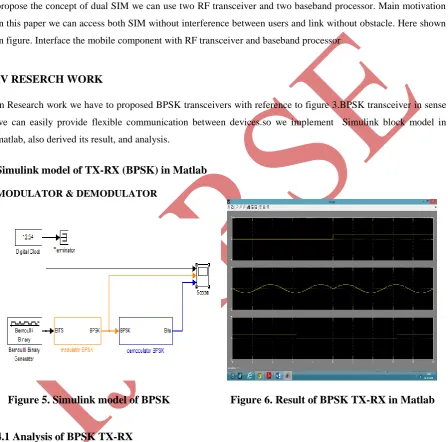
In Research work we have to proposed BPSK transceivers with reference to figure 3.BPSK transceiver in sense
we can easily provide flexible communication between devices.so we implement Simulink block model in
matlab, also derived its result, and analysis.
Simulink model of TX-RX (BPSK) in Matlab
MODULATOR & DEMODULATOR
Figure 5. Simulink model of BPSK Figure 6. Result of BPSK TX-RX in Matlab
4.1 Analysis of BPSK TX-RX
BPSK (also sometimes called PRK, Phase Reversal Keying, or 2PSK) is the simplest form of phase shift keying
(PSK). It uses two phases which are separated by 180° and so can also be termed 2-PSK. It does not particularly
100 |
P a g e
www.ijarse.com
Where, bk is a bipolar bit sequence of the form
A fundamental pulse shape p.t / is the rectangle shape
BPSK constitutes a form a digital phase modulation in the carrier phase is switched betweenand radians
depending upon the sign of bk.
Since a phase of radians simply changes the sign of the carrier signal, we observe that for the case of BPSK.
This is of the same form as of double sideband suppressed carrier (DSB-SC) modulation.
Fig7. BPSK Using a Rectangle Pulse
The power spectral density of BPSK can be shown to be of the form
101 |
P a g e
www.ijarse.com
For a rectangular pulse shape the main lobe bandwidth, also known as the RF bandwidth is BRF D 2=T D 2Rb,
where Rb D 1=T is the bit rate. Another useful bandwidth measure is the fractional containment bandwidth, Bf,
defined as
4.2 Implementation BPSK Transceiver And Switching Network In Dual Sim Mobile System.
In fig 8.show how exctacly work after we implmentation of BPSK TX-RX, Switching Network show below
Fig8.Advance Communication between Components
In this paper we saw fig.3 with reference to that figure, we compare both figurehow to component is
communicate with each other, but here in fig8 we add two baseband processors and two RF transceivers. We
can use BPSK TX-RX and give its Simulink model in Matlab & also give its Mathematical analysis. Reason
behind that concept we have to access both Sims at a time that’s why we use two baseband and two RF TX-RX.
The work variable frequencies are adaption process done by the flexible antenna with the multiple channel
access. So that’s why we use switching network for access the frequencies. Work of switching network to keep
both SIM active any instant so that display users id on display screen of our mobile and Another advantage of
that above unit we can Access the GPRS services both Sims at same instant. If user1 calling on sim1 of user2
102 |
P a g e
www.ijarse.com
During call process between user1 and user2 that same instant user3 reach to user2 and display on screen of
mobile user2 as show in fig 9.
Fig9. Communication between Users
4.3 Switching Network
In this research paper we can implement switching network, in such way that it can access two different
frequencies at same time in dual SIM mobile system. Switching network name itself work as frequency
controller .So that we can use here switching network as fuzzy logic controller.
Thusfuzzy logic controller use to acess the frequencies.its useful to give solution to access variable frequencies
and controlling the interfernce between users. Genrlies block digram of fuzzy logic controller as shown below
in fig11 and we propose rule base algorithm below.
Figure10. Switching Network Figure11. Block Diagram Of Fuzzy Logic Controller
Table1. Rule Base Algorithm For General Switching Network
SIM
1
SIM
2
Output
TX-RX 1
TX-RX 2
Low
Low
Any of them at a time
High
Low
active
none
103 |
P a g e
www.ijarse.com
Table 1 shows the rule base of a fuzzy logic controller for switching network of a dual SIM Smartphone. As we
can see from table 1, the activation of TX-RX strictly depends on availability or the strength of SIM network.
And it also seems that, algorithm is bounded by limitation that, only one SIM at a time can be available. Means
either of SIMs will be disabled or deactivated while using other SIM. In first condition, when both SIMs are
available any of the TX-RX will be activated depending upon usage of them. This is major drawback of recent
dual SIM systems. To overcome from this drawback we will introduce a new Simulink model which is in
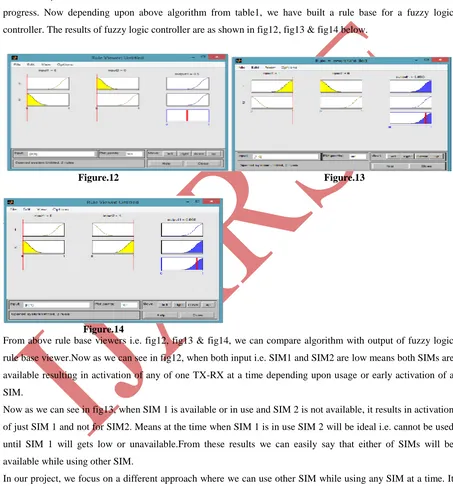
progress. Now depending upon above algorithm from table1, we have built a rule base for a fuzzy logic
controller. The results of fuzzy logic controller are as shown in fig12, fig13 & fig14 below.
Figure.12 Figure.13
Figure.14
From above rule base viewers i.e. fig12, fig13 & fig14, we can compare algorithm with output of fuzzy logic
rule base viewer.Now as we can see in fig12, when both input i.e. SIM1 and SIM2 are low means both SIMs are
available resulting in activation of any of one TX-RX at a time depending upon usage or early activation of a
SIM.
Now as we can see in fig13, when SIM 1 is available or in use and SIM 2 is not available, it results in activation
of just SIM 1 and not for SIM2. Means at the time when SIM 1 is in use SIM 2 will be ideal i.e. cannot be used
until SIM 1 will gets low or unavailable.From these results we can easily say that either of SIMs will be
available while using other SIM.
In our project, we focus on a different approach where we can use other SIM while using any SIM at a time. It
104 |
P a g e
www.ijarse.com
Table2. Rule Base Algorithm for Our Project
SIM
1
SIM
2
Output
TX-RX
1
TX-RX
2
Low
Low
Both of them
active
High
Low
Both of them
active
Low
High
Both of them
active
High
High
Both of them
active
As we can see in table2, in any condition both of the TX-RX are active while using any or both of the SIMs.
This is our approach to design a Simulink model for a dual SIM system in which both the TX-RX should be
active at any time. This project is in progress. The main intension of this approach is to utilize the availability of
SIM while using other, so none of the TX-RX will be ideal for any time.
V CONCLUSION
Smartphone is a portable device that encapsulates computing capabilities and cellular network access
functionalities in a single integrated multicore processor. In modern Smartphone, dual core processor is
composed of two processors; each one with a separate RAM and flash memory access. This approach provides
call and internet access, without interference between SIMs at same instant of time. We can use here two BPSK
transceivers, two baseband processors, switching network, setup of these devices by considering arrangement of
hardware parallel in mobile, so as to use reliably and easily.
VI FUTURE SCOPE
There are so many requirement day to day lives. So we have to research on this topic that is mobile
communication. If we use same SIM but users are different and operate or control same SIM of our mobile, it
can also be a useful technique for advance mobile communication.
REFERENCES
[1] What Is a Smart Phone? (2012),eHow.com http://www.ehow.com/facts_5172033_smart-
phone_html#ixzz1jUgCSzpg Accessed on 15th January 2012.
[2] Prosper Mobile Insights, Smartphone/tablet user survey (2011) (Accessed on 20th July, 2011) [Online
available] URL http://prospermobileinsights.com/Default.aspx?pg=19
[3] Albanesius.C. (2011), Smartphone shipments surpass PC shipments for first time. What’s next? (Accessed
105 |
P a g e
www.ijarse.com
[4] Welt. H.(2010), Anatomy of contemporary GSM cell phone hardware, April 2010,
http://laforge.gnumonks.org/papers/gsm_phone-anatomy-latest.pdf Accessed on 15th January 2012.
[5] Shiraz. M.,Gani. A., Khokhar. H. R., Buyya. R.(2012), A Review on Distributed Application Processing
Frameworks in Smart Mobile Devices for Mobile Cloud Computing, Accepted for Publication in IEEE
COMMUNICATIONS SURVEYS & TUTORIALS, DOI.10.1109/ SURV.2012.111412.00045, November
2012.
[6] Learning-with-block-diagram-on-how.html (2012), http://cellphonerepairtutorials.blogspot.com/ Accessed
on 14th January 2012
[7] Baseband processor (2012), http://en.wikipedia.org/wiki/Baseband_processor Accessed on 14th January
2012.
[8] Advanced Electronic Communications Systems (Fifth Edition); Tomasi, Wayne;Prentice-Hall, Inc.: Upper
Saddle River, New Jersey 2001; pp. 47.
[9] W. Dai, Y. Wang, J. Wang, Joint power estimation and modulation classification using second and higher
statistics, WCNC 2002 - IEEE Wireless Communications and Networking Conference, No. 1, 2002, pp.
767-770.
[10] L. Hong, K. C. Ho, Identification of digital Modulation types using the wavelet transform, MILCOM 1999
– IEEE Military Communications Conference, No. 1, 1999, pp. 427 – 431.
[11] L. Hong, K. C. Ho, BPSK and QPSK modulationClassification with unknown signal levels, MILCOM2000