spaces
Richard Winter1, Ana Salagean1, and Raphael C.-W. Phan2 1
Department of Computer Science, Loughborough University, Loughborough, UK {R.Winter, A.M.Salagean}@lboro.ac.uk
2
Faculty of Engineering, Multimedia University, Malaysia
Abstract. We generalise the cube attack of Dinur and Shamir (and the similar AIDA attack of Vielhaber) to a more general higher order differ-entiation attack, by summing over an arbitrary subspace of the space of initialisation vectors. The Moebius transform can be used for efficiently examining all the subspaces of a big space, similar to the method used by Fouque and Vannet for the usual cube attack.
Secondly we propose replacing the Generalised Linearity Test proposed by Dinur and Shamir with a test based on higher order differentiation/ Moebius transform. We show that the proposed test provides all the information provided by the Generalised Linearity Test, at the same computational cost. In addition, for functions that do not pass the lin-earity test it also provides, at no extra cost, an estimate of the degree of the function. This is useful for guiding the heuristics for the cube/AIDA attacks.
Finally we implement our ideas and test them on the stream cipher Trivium.
Keywords: Cube/AIDA attack, Trivium, Linearity testing, Moebius transform, higher order differentiation
1
Introduction
The cube attack introduced by Dinur and Shamir [3] and the similar AIDA attack introduced by Vielhaber [11] have received much attention over the last few years. They can be viewed as higher order differential attacks (see [5] and [9]). The idea of higher order differentials was introduced in cryptography by Lai [10] and was used in many different attacks, most of them being statistical attacks, whereas the cube/AIDA attacks are primarily algebraic.
Several techniques were proposed in order to make the cube attack more efficient. Of particular interest to the present work are the Moebius transform used by Fouque and Vannet [7] and the Generalised Linearity Test introduced by Dinur and Shamir [4].
we sum over an arbitrary subspace of the space of public (tweakable) variables. The usual cube attack becomes then the particular case where the subspace is generated by vectors from the canonical basis. The Moebius transform can again be used to make computations more efficient, by reusing values to compute the summations over many subspaces at once.
Secondly we propose an alternative to the Generalised Linearity Test pro-posed by Dinur and Shamir [4]. Given a set oft linearly independent keys, our linearity test computes the higher order derivatives of order 2,3, . . . , twith re-spect to any subset of keys and then checks whether all the results are zero. If a function fails this linearity test, the lowest order of a non-zero derivative gives a lower bound for the degree of the function, so we obtain extra information at no extra cost. We show that the set of functions that pass the General Linearity Test in [4] is exactly the same as the set of functions that pass our proposed test. The extra information about the degree is useful for guiding the heuristics in the cube attack, as it gives us information as to whether we are close or not to obtaining a linear function. Also, in some implementations of the cube attack, quadratic equations are used if insufficient linear equations are found.
We implemented our ideas and tested the implementation on the stream cipher Trivium [1], which is a popular candidate for testing cube attacks. We looked at between 640 and 703 initialisation rounds. We tested several spaces of initialisation vectors of dimension 28 (including the space corresponding to a usual cube attack), and all their subspaces, using the Moebius transform. We estimated the degrees of the results using our proposed linearity test.
We found one particular vector space which, compared to the usual cube attack, produces significantly more linear equations, but at a slightly higher di-mension of subspaces. However for most vector spaces the results are significantly worse than the usual cube attack, which leads us to believe that the success of the usual cube attack on Trivium is not only due to the relatively low degree of the polynomial, but also to the fact that the monomials of that polynomial are not uniformly distributed, as would be expected if it was a random polynomial. In other words, the polynomials in Trivium are “aligned” with the canonical ba-sis rather than being in a generic position. We suggest therefore that preceding Trivium by a (secret) linear change of coordinates on the initialisation vectors would improve its resistance to cube attacks. We did some preliminary exper-imental testing of this idea, but a full exploration would be a topic of future work.
2
Preliminaries
2.1 Cube Attack
The Cube attack was originally proposed by Dinur and Shamir in [3] and is closely related to the AIDA attack introduced by Vielhaber in [11].
Letf :Fn
{i1. . . ik} ⊆ {1,2, . . . , n}, the “cube”CI is defined by choosing the 2k possible 0/1 combinations for the variables with indices inI, with the other variables left undetermined. Summing over all vectors inCI we obtain a function
fI =
X
v∈CI
f(v).
which depends only on the variables which are not inI. Factoring out the termtI =xi1· · ·xik, we can writef as
f(x1, . . . , xn) =tIfS(I)+r(x1, . . . , xn).
wherefS(I)is a polynomial that shares no common variables withtI, whereasr is a polynomial in which each term misses at least one variable intI. The main results on which the cube attack is based are:
Theorem 1. ([3, Theorem 1]) For any polynomial f and subset of variables I,
fI ≡fS(I) (mod 2).
Corollary 1. If deg(f) =dandI containsd−1 elements, then fI has degree
at most one.
When mounting an actual attack, we have two types of variables, the secret variables x1, . . . , xn and the public, or “tweakable” variables v1, . . . , vm, which the attacker can control. The cipher consists of a “black box” function g:Fn2×
Fm2 →F2. The attacker chooses a setIof indices of the public variables, sets the other public variables to constant values (usually zero) and computesgI, which will now only depend on the secret variables. In the preprocessing phase, the attacker studies the cipher, so they can evaluategI for any chosen values of the secret variables. It is hoped that, for suitable choices ofI(particularly the ones of cardinality approaching deg(g)−1, assuming deg(g)≤m), gI is linear (but not constant) in the secret variables. Linearity tests are discussed in the next section.
If the preprocessing phase found a large number of sets I for which gI is linear and non-constant (ideally n linearly independent gI), one can then use this information in the online phase. Now the secret variables are unknown, but the attacker can still control the public variables. The attacker computesgI for the values ofIidentified in the preprocessing phase, and then they can determine the secret variables by solving a system of linear equations.
2.2 Generalised Linearity Test
Consider a function f : Fn
2 → F2. We want to decide whether f is an affine function, i.e. it is a polynomial of degree one or less. We assumen is large and evaluations of f are costly, so we cannot evaluate f for all its inputs. We are looking therefore for a probabilistic test.
If f fails this test, then it is not an affine function. If it passes the test for “sufficiently many” pairsa,b, then we conclude thatf is probably affine.
Since the test above needs 3 evaluations off for each test (assuming we store and reusef(0)), in [4, Section 4], Dinur and Shamir proposed the following Gen-eralised Linearity Test, which has the advantage that it reuses many evaluations off so it is overall much more computationally efficient.
Consider a set{b1, . . . ,bt} ⊆Fn2 of linearly independent elements. The Gen-eralised Linearity Test consists of the following set of 2t−t−1 equations:
(
f( t
X
i=0 cibi) +
t
X
i=0
cif(bi) + ((w(c)−1)) mod 2)f(0) = 0|c∈Fn2,w(c)≥2
)
(1) where w( ) denotes the Hamming weight. Again, if there are equations which are not satisfied byf, thenf is not affine, otherwise we conclude thatf is probably affine (assumingt is “large enough”). Note that here we need 2t evaluations of f for 2t−t−1 tests, so an amortised cost of just over one evaluation per test, compared to 3 evaluations for the previous test.
Remark 1. In the original description of this test in [4] there is a mistake, in that the term (w(c)−1) mod 2 is missing. This would make the test incorrect whenever the weight is odd, so affine functions with non-zero constant term would wrongly fail the test.
2.3 Moebius Transform
Letf :Fn2 →F2. The Moebius transform offis a functionfM :Fn2 →F2defined as fM(y) = P
xyf(x) where x = (x1, . . . , xn) and the partial order relation
is defined as (x1, . . . , xn) (y1, . . . , yn) iff xi ≤yi for alli = 1, . . . , n. It is well known that the Moebius transform has the property that for any a∈Fn2, fM(a) equals the coefficient of the termxa1
1 . . . xann in f. Further details about the Moebius transform can be found, for example, in [8]. An efficient algorithm which, given the truth table of f computes the truth table of fM in-place in n2n−1 operations is also given in [8].
In connection with the cube attack, note that when choosing a set of variable indices I={i1, . . . , ik}, if we define a as having ones in the positions in I and zeroes elsewhere, we have fI(0) = fM(a). Hence the algorithm for computing the Moebius transform can also be used for efficiently computingfJ for all the subsetsJ of a large setI.
2.4 Higher order differentiation
The notion of higher order derivative (or higher order differentiation) was intro-duced in the cryptographic context by Lai [10].
Definition 1. Let f : Fn
2 → F2 be a function in n variables x1, . . . , xn. Let a = (a1, . . . , an) ∈ Fn2 \ {0}. The differentiation operator (or finite difference
operator) along a vector a associates to each functionf the function ∆af (the
derivative off) defined as
∆af(x1, . . . , xn) =f(x1+a1, . . . , xn+an) +f(x1, . . . , xn).
Denoting x= (x1, . . . , xn) we can also write∆af(x) =f(x+a) +f(x).
Higher order differentiation (higher order derivative) refers to repeated applica-tion of this operator and will be denoted as:
∆(ak)
1,...,akf =∆a1∆a2. . . ∆akf
wherea1, . . . ,ak∈Fn2\ {0} are linearly independent. An explicit expression for computing higher order derivatives follows directly from the definition:
∆(ak1),...,akf = X (c1,...,ck)∈{0,1}k
f(x+c1a1+. . .+ckak) (2)
Differentiation decreases the degree of polynomials:
Theorem 2. [10] Letf :Fn2 →F2anda∈Fn2\{0}. Thendeg(∆af)≤deg(f)−
1.
The main construction of the cube attack can be reformulated in terms of higher order differentiation, see [5] and [9]. Namely for a set of indicesI={i1, . . . , ik}
fI =∆(eki1),...,eikf
whereeiare the vectors of the canonical basis, i.e. they have a one in positioni
and zeroes elsewhere.
3
General differentiation attack
As in Subsection 2.1 we assume the cipher consists of a “black box” function g(x,v) withg :Fn
2×Fm2 →F2 andxdenoting secret variables and vdenoting public variables. We generalise the cube/AIDA attacks by choosing an arbitrary subspace V ⊆Fm
2 of the space of public variables and defining a functiongV as gV(x) =
X
v∈V
g(x,v).
Denote by k the dimension ofV and let{v1, . . . ,vk} be a basis for V. Using equation (2) we can give an equivalent formula forgV using higher order differ-entiation, namely gV(x) = (∆
(k)
becomes a particular case of this attack, forV =hei1, . . . ,eiki, whereeiare the
vectors of the canonical basis, andI ={i1, . . . , ik} are the positions chosen for the usual cube attack.
Using Theorem 2 we have that deg(gV)≤deg(g)−dim(V). Hence, as in the cube attack (see Corollary 1), if the dimension of V is k = deg(g)−1 we are guaranteed thatgV is linear or constant.
We can therefore search for spaces V such that the resulting gV is a linear function in the secret variables. Linearity tests can detect whether the result is linear, like in the usual cube attack. This search space is a superset of the search space of the usual cube attack.
Moebius transform can be used here again for improved efficiency. Namely we start with a large vector spaceV =hv1, . . . ,vkiFor any fixed valuexof the secret variables we compute the truth table of the functionh(y1, . . . , yk) =g(x, y1v1+ . . . +ykvk). We then apply the Moebius transform to h. For any subspace V0 =hvi1, . . . ,vijiof V leta be the vector with ones in exactly the positions
i1, . . . , ij and zeroes elsewhere. We have hM(a) =P(c1,...,cj)∈{0,1}jg(x, c1vi1+ . . .+cjvij) =
P
v0∈V0g(x,v0) =gV0(x,0). Hence, again, the Moebius transform
hM computes simultaneously all theg
V0(x,0) for all subspacesV0 ofV. Remark 2. In [3] Dinur and Shamir also consider the possibility of setting some of the non-cube public variables to 1 rather than zero. That is not the same as our approach, as the set to sum over in that case is no longer a vector space. We can include that generalisation in our approach as follows. Letcbe a fixed vector of public variables andV a vector space. Instead of computingfV as before, we can compute instead the sum
X
v∈V
g(x,c+v)
which, using equation (2), can be proved to equal (∆(vk1),...,vkg)(x,c). The attack
can work equally well in this scenario.
4
Proposed linearity test
We propose an alternative to the Generalised Linearity Test presented in Sub-section 2.2. Again, let f : Fn
2 → F2 and let {b1, . . . ,bt} ⊆ Fn2 be a set of t linearly independent elements. (The question of how to choose a suitable value for t is, as we shall see, exactly the same as in [3], and a further discussion of this choice is beyond the scope of this paper.) For eachdwith 1≤d≤tconsider the following set of equations:
Ld=
X
uc
f( t
X
i=0
uibi) = 0|c∈Ft2,w(c) =d
(3)
order derivatives: Ld=
n
∆(bd)
i1,...,bidf(0) = 0|{i1, . . . , id} ⊆ {1, . . . , t}
o
.
Note that the equations inL2correspond to the usual (BLR) linearity tests. The equations in L3 have been proposed for testing whether the function is quadratic in [4, Section 4]. The following result is quite straightforward but we prove it for completeness.
Proposition 1. If f has degree d, then it satisfies all the equations in the sets
Ld+1, . . . , Lt.
Proof. By Theorem 2, deg(∆(bj)
i1,...,bijf)≤deg(f)−j=d−j. Hence for allj > d
we have ∆(bj)
i1,...,bijf ≡0, so the equationsLj are satisfied for allj > d.
One can give an alternative proof of this result using the Moebius transform. Based on the result above we propose an alternative to the Generalised Linearity Test. Namely we test whether a function f has degree one or less by testing whether it satisfies the equations in the sets L2, . . . , Lt. An advantage of this test is that if a function fails the test (i.e. has degree more than one), we can get, at no additional cost, an indication of its degree. Namely, ifdis the highest number for which some equations in Ld are not satisfied, then we know that deg(f)≥d. We will estimate the degree off as beingd.
The proposed test contains the same number of equations (namely 2t−t−1) and needs the same number of evaluations off (namely 2t) as the Generalised Linearity Test. If the functionf is affine (has degree at most one), then it passes both types of test, so there are no false negatives. If f has degree 2 or more it might still pass one of the types of tests (i.e. we can have false positives). We can ask ourselves whether some functions can pass our proposed test but fail the Generalised Linearity Test or vice-versa. We show that this is not possible, in other words the tests are equivalent. More precisely:
Proposition 2. A function f satisfies the Generalised Linearity Test (1) iff it satisfies the sets of equations L2, L3, . . . Lt.
Proof. We renamey{i1,...,ij}=f(bi1+. . .+bij). Both the Generalised Linearity
Test and the set of equationsL2, L3, . . . Ltcan be rewritten as homogeneous sys-tems of 2t−t−1 linear equations in the 2t unknownsy
J for allJ ⊆ {1, . . . , t}. Both sets of equations are in triangular form, so both solution spaces have di-mensiont+1. To prove that the two solution spaces are equal, it suffices therefore to prove one inclusion. We show that a solution of the first set of equations is also a solution for the second. The first system gives immediately the solution
y{i1,...,ij}=
j
X
`=1
y{i`}+ ((j−1) mod 2)y∅. (4)
The equation becomes P
J⊆IyJ = 0. Substituting the solution (4) of the first system of equations in this equation we obtain an equation that only contains the variables y{i1}, . . . , y{id} and y∅. We count how many times each of these
variables appears: y{i1} will appear a number of times equal to the number of subsets J of I that contain y{i1}; this is half of the subsets, i.e. 2d−1 times. The variable y∅ appears once for each subset J ⊆ I of even cardinality, i.e.
Pbs/2c
`=0 s 2`
= 2d−1 times. Hence the left hand side of the equation becomes 2d−1(y
{i1}+. . .+y{i1}+y∅). Sinced≥2 and we are inF2, we have 2d−1= 0 so the equation is satisfied.
Finally note that the Moebius transform can again be used for efficiency. Namely puttingh(y1, . . . , yt) =f(y1b1+. . .+ytbt) and computing the Moebius
trans-formhM ofh, the set of equationsL
dare precisely the equationshM(y1, . . . , yt) = 0 for all (y1, . . . , yt) of weightd. Moreover we obtain automatically the sets of equationsL1andL0. Iff satisfiesL1thenf is a constant, which is another test needed in the cube attack.
5
Implementation
We implemented our ideas and tested them on the stream cipher Trivium [1]. The public variables are in this case the initialisation vector and the secret variables are the key.
To test the cube attack over different vector spaces, as described in Sec. 3 we generated a large vector spaceV of initialisation vectors of dimension 28 giving us 28k
We define q as the probability that a column in matrix A will follow the probability por be set to all zeroes. The probability pdefines the probability that an entry will be set to 1 in matrix A. This means that whenpis set to 0, qbecomes irrelevant and whenqis set to 0,pbecomes irrelevant. Setting either porqto 0 is the equivalent of running the standard cube attack.
We run the attack whereq= 1 andp= 0,0.03,0.5,0.97,1, meaning that all columns in the basis which don’t correspond to any of thei1, . . . , i28indices are chosen according to the probabilityp (forp= 1, all the remaining 52 columns are set to all ones in the basis). A further test is run where q = 0.0625 and p= 0.5 which generates a fairly sparse matrixA as the probability of a column of variables being chosen using probabilitypis low therefore most variables are set to 0. We kept the choice ofi1, . . . , i28the same in all cases.
6
Discussion
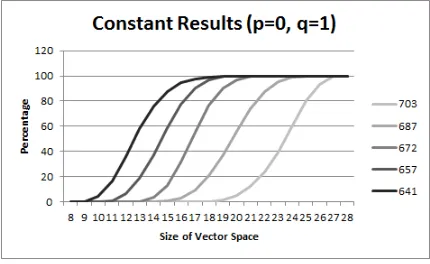
Figs. 1 and 2 show how many subspaces of each dimension (as a percentage of all subspaces of that dimension) were found to return constant results whereq= 1 andp= 0 orp= 1
Multiple lines show the results over different numbers of rounds, from 641 to 703. Predictably there are fewer constant results found at smaller dimensions as the number of rounds increases, indicating that the degree of the underlying polynomial is increasing.
Fig. 1.Percentage of Constant Vector Spaces wherep= 0, q= 1 for selected rounds
When comparing the two figures, it is clear that constant results are found at smaller dimensions when p= 0 compared top= 1. There were no constant results found for 703 rounds whenp= 1 whereas constant results were found in cubes as small as 19 whenp= 0. This shows that changing the vector space can have a negative effect on an attacker’s ability to find linear results.
Fig. 2.Percentage of Constant Vector Spaces wherep= 1, q= 1 for selected rounds
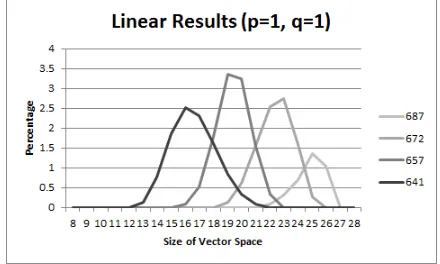
Fig. 3.Percentage of Linear Vector Spaces wherep= 0, q= 1 for selected rounds
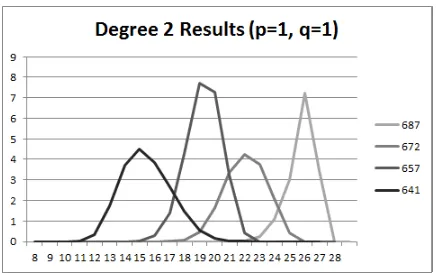
Fig. 5.Percentage of Degree 2 Vector Spaces wherep= 0, q= 1 for selected rounds
constant) results. For each of the rounds presented, the peak dimension where linear results are most frequent is slightly larger (by 3 to 5 units) when p= 1 (Fig. 4) compared to wherep= 0 (Fig. 3).
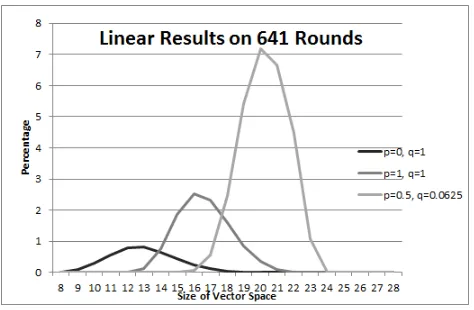
There are however some benefits to changing the vector space, as shown in Fig. 7. When analysed on the same scale, we can see that a higher percentage of subspaces produce linear results when we increase the search space by changing the vector space of the cube attack. Across all rounds, the test where p = 1 consistently showed a 3 to 4 times higher percentage of linear results being found as compared to wherep= 0.
Furthermore, the percentage of subspaces found at dimension 14 wherep= 1 in Fig. 7 is equivalent to the percentage of cubes found at cube size 12 and 13 wherep= 0. While again reinforcing the result that the required dimension does increase, this shows that it is not always of significant detriment to the attacker. The trend of increasing the required vector space dimension continues when we test using a small value forq. Fig. 7 shows a large increase in the percentage of linear cubes found whenp= 0.5, q= 0.0625 compared top= 1, q= 1 although these linear results are found at a significantly higher dimension.
Fig. 7.Percentage of Linear Vector Spaces where q = 1 whenp= 0 and p= 1, and
q= 0.0625 whenp= 0.5
to the high value ofq. This is in contrast to the result presented in Fig. 7 which showed a significant number of linear results whenp= 0.5 andq is small.
Table 1.Percentage of Vector Spaces of degree 0 to 6 when 0< p <1 andq= 1
Degree 0 1 2 3 4 5 6
Percentage 0 0 0<0.001% 0.78% 49.21% 50%
The fact that for Trivium the cube attack over arbitrary vector spaces V performs in general worse than the usual cube attack when q is large is, on one hand, disappointing from an attacker’s point of view. However on the other hand it offers insights into the properties of Trivium. Namely it shows that cube attacks work for Trivium not only because the degree increases relatively slowly through the rounds, but also because for the degree that is achieved, the distribution of the monomials is not uniform, as would be expected for a random function. This phenomenon has been observed in other contexts, for example the density of terms of each degree is estimated by Fouque and Vannet [6]. Another manifestation of this phenomenon is that out of all the linear equations that were found by different cube attacks on Trivium reported in the literature, the vast majority contain only one or two secret key variables, instead of around 40 variables as would be expected.
An alternative way to look at this would be to create a new, enhanced “black box” for Trivium, which contains a multiplication of the vector of public IV variables by an arbitrary fixed invertible matrix. The result of the multiplication is fed into the usual Trivium black box function. It is expected that the usual cube attack on this enhanced black box would have a much reduced chance of success, as it would be, in effect, equivalent to running our generalised cube attack on the usual Trivium black box. Obviously, the matrix needs to be secret, as otherwise the attacker could undo its effect. Preliminary tests on small cubes seem to confirm this idea, but a full investigation will be the subject of future work.
Acknowledgements The authors would like to thank the referees for useful comments. One of the referees brought to our attention the recent paper [2] that we had not been aware of, and in which higher order derivatives with respect to an arbitrary vector space (as explored in Sec. 3) were used for statistical attacks on the NORX cipher.
References
1. Christophe De Canni`ere. Trivium: A stream cipher construction inspired by block cipher design principles. InInformation Security, 9th International Conference, ISC 2006, Samos Island, Greece, August 30 - September 2, 2006, Proceedings, pages 171– 186, 2006.
3. Itai Dinur and Adi Shamir. Cube attacks on tweakable black box polynomials. In EUROCRYPT, pages 278–299, 2009.
4. Itai Dinur and Adi Shamir. Applying cube attacks to stream ciphers in realistic scenarios. Cryptography and Communications, 4(3-4):217–232, 2012.
5. Ming Duan and Xuejia Lai. Higher order differential cryptanalysis framework and its applications. InInternational Conference on Information Science and Technology (ICIST), pages 291–297, 2011.
6. Pierre-Alain Fouque and Thomas Vannet. Improving key recovery to 784 and 799 rounds of trivium using optimized cube attacks. InFast Software Encryption - 20th International Workshop, FSE 2013, Singapore, March 11-13, 2013. Revised Selected Papers, pages 502–517, 2013.
7. Pierre-Alain Fouque and Thomas Vannet. Improving key recovery to 784 and 799 rounds of trivium using optimized cube attacks. IACR Cryptology ePrint Archive, 2015:312, 2015.
8. Antoine Joux.Algorithmic Cryptanalysis. Chapman & Hall/CRC, 1st edition, 2009. 9. S. Knellwolf and W. Meier. High order differential attacks on stream ciphers.
Cryp-tography and Communications, 4(3-4):203–215, 2012.
10. Xuejia Lai. Higher order derivatives and differential cryptanalysis. In Richard E. Blahut, Daniel J. Costello, Jr., Ueli Maurer, and Thomas Mittelholzer, editors, Com-munications and Cryptography, volume 276 ofThe Springer International Series in Engineering and Computer Science, pages 227–233. Springer Verlag, 1994.