tance of the null hypothesis. One can always argue that the test
of awareness was insensitive, did not match the conditions
present at encoding, or was unreliable. Caution is appropriate in
calling subjects unaware, but one must ask how an experimenter
can be any more certain that subjects do not have explicit
knowledge when subjects repeatedly deny noticing a sequence,
make errors when forced to guess about its characteristics, and
fail to recognize it (Willingham et al. 1993).
Even if unconscious learning has not been satisfactorily
dem-onstrated, consciousness may still be an important attribute in
CSs of memory. S&S take the position that consciousness can
only take on two values (conscious or unconscious) as an
attri-bute in a CS. A complete lack of awareness may be one end of a
spectrum of states of awareness of the contingency at learning; if
unconscious learning cannot take place, that does not mean that
the rest of the spectrum is irrelevant.
In sum, the implicit/explicit CS appears preferable to the
fragment-based/rule-based CS because: (1) the latter is
discor-dant with the amnesic data, whereas the former fits those data
and shows that two different theoretical principles - information
processing and neurobiology - lead to the same CS; and (2) the
chief argument against the implicit/explicit CS (that learning is
never unconscious) is difficult to falsify, because one who
be-lieves the testing of awareness was not adequate can raise
objections that cannot be discounted. Furthermore, if
uncon-scious learning did not exist, it would not sound a death knell for
the implicit/explicit CS. For this CS to have validity, there need
only be variability in the attribute of consciousness, and
predic-tive power in that variability.
ACKNOWLEDGMENT-The author thanks Maggie Keane for very helpful comments on an
earlier draft of this commentary.
Authors' Response
How should implicit learning be
characterized?
David R. Shanks
3
and Mark F. St. John
b
"Department of Psychology, University College London, London WC1E
6BT, England; "Department of Cognitive Science, University of California at
San Diego, La Mia, CA 92093
Electronic mall: [email protected];
b
[email protected];
The commentators on our target article have raised a very
broad range of issues, and in our response we will attempt
to answer as many of the key points as possible. We thank
the commentators for the careful consideration they have
given to our arguments. We should say at the outset,
however, that although our arguments have been
chal-lenged at a number of places, we have not been led to
abandon our view of the implicit learning literature. We
continue to believe that although the instance/rule
dis-tinction provides a meaningful characterization of human
learning, it remains highly questionable whether
uncon-scious learning has been adequately demonstrated.
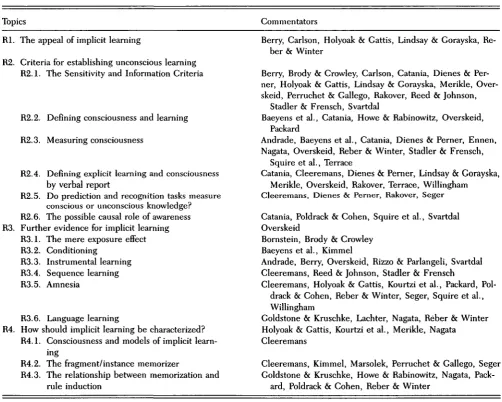
The organization of our response is shown in Table Rl.
Our plan is first to say something about the appeal of
implicit learning, and then to consider the question of
unconscious learning: whether our Information and
Sen-sitivity Criteria are appropriate, how consciousness and
learning should be defined, what the role of
conscious-ness in learning might be, and whether the further
evidence for unconscious learning that commentators
discuss warrants a revision of our conclusions. Following
these sections, we will consider other dimensions for
characterizing distinct learning systems. Is the
frag-ment/instance memorization versus rule-induction
dis-tinction a useful and valid one? And finally, can we refine
and further specify what is learned and later used by the
fragment/instance system?
R1. The appeal of implicit learning
Carlson points out that the idea of implicit learning has an
appeal that defies dismissal. Part of this appeal might
simply be the cachet of a mysterious process. But more
seriously, there clearly is something to implicit learning.
Most, if not all, of the commentators agree that there is a
real phenomenon, one characterized by Holyoak &
Cattis as "(a) knowledge about covariations in the
environ-ment, (b) learned by exposure to stimuli exhibiting the
covariations . . . (e) [knowledge that] is not fully
verbaliz-able and ( / ) [knowledge that] is not manipulverbaliz-able in the
sense that it cannot be re-represented explicitly to serve
as input to other procedures." We agree; the task at hand
is to further analyze this phenomenon. One question is
whether the implicit learning process and the resulting
information are unconscious. The other question
con-cerns what this knowledge is like and what sort of learning
process acquires it.
Several commentators (Berry, Lindsay & Corayska,
Reber & Winter) have challenged an important aspect of
the overall logic of the target article. We have assumed
that the sensible approach is to be skeptical about
uncon-scious learning until it is demonstrated, but these
com-mentators argue that exactly the opposite assumption
should be adopted, namely, that unconscious processes
have some sort of priority over conscious ones. For
exam-ple, Berry says that we "adopt the position that unless
researchers can prove conclusively that learning is
uncon-scious then we should assume that it is conuncon-scious," but we
"never justify why conscious processing should be the
default assumption." Our argument is simply that explicit
learning is the agreed starting point, since no one doubts
that learning is at least some of the time accompanied by
awareness of what is being learned. What remains to be
shown is whether unconscious learning is also feasible.
The position advocated by Berry, Lindsay & Gorayska,
and Reber & Winter is tantamount to holding that
uncon-scious learning does not need to be demonstrated in the
laboratory. But no amount of a priori argumentation is
going to demonstrate its existence: what is needed is clear
experimental evidence. If we do not know in a certain task
whether knowledge is conscious or unconscious, it is
surely foolhardy to assume the latter.
R2. Criteria for establishing unconscious
learning