Electronic Thesis and Dissertation Repository
8-24-2012 12:00 AM
Exploring the Current Nature of a School Principal's Work
Exploring the Current Nature of a School Principal's Work
Donna Swapp
The Univesity of Western Ontario Supervisor
Dr. Katina Pollock
The University of Western Ontario Graduate Program in Education
A thesis submitted in partial fulfillment of the requirements for the degree in Master of Education
© Donna Swapp 2012
Follow this and additional works at: https://ir.lib.uwo.ca/etd Part of the Education Commons
Recommended Citation Recommended Citation
Swapp, Donna, "Exploring the Current Nature of a School Principal's Work" (2012). Electronic Thesis and Dissertation Repository. 845.
https://ir.lib.uwo.ca/etd/845
This Dissertation/Thesis is brought to you for free and open access by Scholarship@Western. It has been accepted for inclusion in Electronic Thesis and Dissertation Repository by an authorized administrator of
(Thesis format: Monograph)
by
Donna Hazel Swapp
Graduate Program in Faculty of Education
A thesis submitted in partial fulfillment of the requirements for the degree of
Master of Education
The School of Graduate and Postdoctoral Studies The University of Western Ontario
London, Ontario, Canada
ii
School of Graduate and Postdoctoral Studies
CERTIFICATE OF EXAMINATION
Supervisor
______________________________ Dr. Katina Pollock
Supervisory Committee
______________________________ Dr. Derek Allison
Examiners
______________________________ Dr. Jason Brown
______________________________ Dr. Margaret McNay
______________________________ Mr. Larry Langan
The thesis by
Donna Hazel Swapp
entitled:
Exploring the Current Nature of a School Principal’s Work
is accepted in partial fulfillment of the requirements for the degree of
Master of Education
______________________ _______________________________ Date Chair of the Thesis Examination Board
iii
Abstract
This study employed a qualitative framework to explore the current nature of a selected
school principal’s work. Specifically, through observations, audio journals and interviews, I
sought to better understand what a selected Ontario elementary school principal did when
engaging in her work. The research questions were designed to explore how the principal
spent her time and why, and examine the challenges she faced in accomplishing her work.
The findings of the inquiry revealed that the school principal was concerned with fulfilling
the formal mandates of her job while emphasizing communication, building relationships and
the instructional program in developing healthy learning environments for students. She
employed a range of media in the day to day operationalization of her work and faced several
challenges including increasing student diversity, labour relations, and lack of parental
involvement.
Keywords:
Formal work expectations, after-hours work, changing nature of work, observational studies
iv
Dedication
This thesis is dedicated to my late grandmother, Mrs. Althea Felix. Her love and support carried me throughout my secondary and undergraduate education and her spirit has been a constant companion through this achievement.
v
vi
CERTIFICATE OF EXAMINATION ... ii
Abstract ... iii
Dedication ... iv
Acknowledgments ... iv
Table of Contents ... vi
List of Tables ... x
List of Figures ... xi
List of Appendices ... xii
Chapter 1: Introduction ... 1
Background ... 4
Research Problem ... ..9
Purpose of the Study………...12
Research Question………....13
Significance of the Study………..13
Key terms of the Study……….16
Thesis Outline………...17
Chapter 2: Literature Review ... 20
The Evolution of School Administration ... 20
The Theory/New Movement ... ..22
Empirical Studies on School Principals' Work……….28
The Changing Nature of School Principals' Work………37
Neoliberalism……….38
Accountability and Standardization………...40
vii
Formal Work Expectations for Ontario school principals……….47
Chapter Summary………..50
Approach to Inquiry………...52
Conceptualization of Work………53
Changing Nature of work………..54
Formal Work Expectations………56
Summary………59
Chapter 3: Methodology ... .61
Qualitative Methodology ... 66
Methods of Data Collection ... 70
Observations………..70
The Observation Protocol………..73
Interviews………..73
The Interview Schedule……….75
Audio Journals………...77
Participant Selection and Recruitment………..79
Participant Introduction……….81
Data Collection Process……….82
Data Presentation and Analysis……….85
Observational Data Analysis………..86
Interview Data Analysis……….87
Chapter Summary………....…...89
Chapter 4: Presentation and Analysis………...….90
How Principal Spent Her Time………...…...…90
viii
Work Media in Relation to Location………...98
Principal's Time Spent Alone and With Others………...….100
The Initiated Activity Record………...102
Discussion………...102
Why Principal Spent Time Doing What She Did………....106
Principal's Understanding of Her Work………..…..106
Formal Dimensions……….…..108
Personal Dimensions……….…112
Understanding Translated into Behaviour……….…113
Principal's Approach to Her Work……….…114
Principal's Work Media……….….116
Discussion………..….123
Challenges Principal Faced………..……..127
Student Discipline………..…….127
Increasing Student Diversity………..…….129
Lack of Parental Involvement………..……130
Labour Relations………..……131
Formal Mandates………...…132
Discussion………...133
Chapter Summary………136
Chapter 5: Conclusion ... ...137
Conclusions of the Study ... 138
Implications of the Study………142
Limitations of the Study………..145
ix
References...150
Appendices...170
x
Table 1. Summary of Formal Work Expectations for Ontario School Principals adapted from the Education Act, pertinent Regulations and the Ontario Leadership Framework…………58
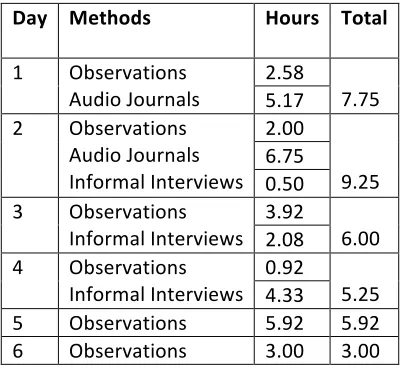
Table 2. Total Hours of Data Collection………..84
xi
List of Figures
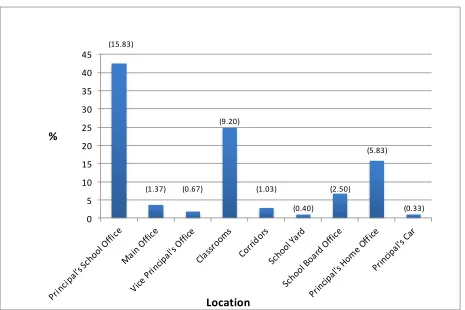
Figure 1. The Principal’s Time Spent at Different Locations………..97
xii
List of Appendices
Appendix A: Ethics Approval, Faculty of Education Sub-Research Ethics Board………170
Appendix B: Letter of Information and Informed Consent………171
Appendix C: Observational Protocol………..174
Appendix D: Pre-Observation Interview Schedule………...175
Appendix E: Post-observation Interview Schedule……….…178
Chapter 1: Introduction
This thesis explores what a selected Ontario elementary school principal did when
engaging in her work. Specifically, it sought to examine how she spent her time and why,
and the challenges of her work. This research built on the limitations of previous
empirical studies into school principals’ work by examining the motives behind a school
administrator’s observable behaviours and activities and is premised on the need for more
current understandings of the nature of school principals’ work. The research was framed
around a conceptualization of work which encompassed activities performed by the
principal both within and beyond normal hours of school; the changing nature of a school
administrator’s work in light of, on one hand, the pervasive theme of neoliberalism and
its attendant tenets of work intensification, centralization, accountability, and
standardization in education and, on the other, the formal, legislated work expectations
for Ontario school principals. To address the research problem in this research, I
employed a qualitative methodological framework of observations, audio journals and
interviews.
Interest in the field of educational administration, and the work of school
administrators in particular, was fuelled by personal experiences as an educator and my
current status as an international student in Ontario, Canada. Over the last ten years as a
secondary teacher in Grenada, a small developing country in the Caribbean, I witnessed
first-hand the negative effects on teacher morale, student achievement, and community
same time, I developed significant appreciation for the work of school administrators as I
have come to realize that such work is complex, intense and often thankless, and that
there exists many flawed assumptions regarding incumbents’ roles, responsibilities and
functions.
Furthermore, as a new, international graduate student in Canada, I was
particularly struck by considerable lateral and vertical differences in the perception,
articulation and execution of school administration in Ontario. I remain fascinated --
entranced even -- by significant philosophical, pedagogical and legal variations in the
ways in which school administration was understood and undertaken. Issues regarding
corporal punishment, students’ rights, parental choice, teachers’ collective agreements,
accountability and standardized assessments were all prevalent in classroom discussions
with the Ontarian educators I encountered in my graduate classes.
This is not to say that my region has escaped unscathed from the impact of
globalization, or that education unfolds in linear or unproblematic ways. Indeed, our
status as developing countries and our concomitant association with international lending
organizations such as the World Bank and the International Monetary Fund have brought
on substantial changes in the study and practice of school administration, especially in
relation to the structural adjustments programs and other austerity mandates characteristic
of these organizations’ loan agreements. Increasingly, the kinds of issues and positions
which represent the taken-for-granted reality in Ontario and other parts of the more
are being redefined by central authorities and other public stakeholders, the Ministry of
Education is emphasizing instructional leadership as the way to secure student learning
and a neoliberal storm seethes at the education periphery -- its gusts often infusing local
debates regarding school policy, assessment and accountability. At the same time, school
administration in my native land remains a substantially unencumbered, low-stakes
enterprise, at least in comparison to its frenzied, hectic and high-stakes nature as
experienced in Ontario and other parts of the world.
My own experiences galvanized me to pursue research in this specific area of
school administration. I was curious to witness, first-hand, how the work of a school
principal unfolds in Ontario. Given the current complex, intense and challenging climate
of school administration and leadership, how does the school principal go about fulfilling
the day to day obligations of her work? What is the contextual nature of, and motivation
for, her work? And, what challenges does she face when engaging in her work? Gronn
(2003) asserts that “these kinds of questions necessitate an analysis of action” (p. 71). My
reading of the empirical literature on educational administration and leadership convinced
me of the value of Gronn’s view and further sparked my desire to employ direct
observations as a base for my research. This inquiry led me to the school of one vibrant
elementary school principal in Southwestern Ontario where I spent six intense and
thoroughly fulfilling days shadowing and interviewing her.
Although a potentially important basis for future research, this study did not seek
this investigation I sought to satisfy my curiosity in terms of understanding the dynamics
of what a selected Ontario school principal actually did during her work day, while at the
same time attempting to make a heuristic, meaningful and informed contribution to the
study and practice of school administration in Ontario and in general.
Background
Today, school administration occurs within an increasingly complex arena of
ambiguities and contestations (Ball, 1998, 2008; Lashway, 2006; Richmon & Allison,
2003: Owens & Valesky, 2011), global influences, shifting education mandates, and
standardized curricula (Ball, 1998; Bates, 2011; Bottery, 2004; Carnoy & Rhoten, 2002;
Rezai-Rashti, 2003; Rizvi & Lingard, 2010). Lashway (2006) expresses the situation this
way:
For anyone journeying in the landscape of school leadership in recent years, the view seems to change every time you look up: new standards, new policy mandates, new demands for accountability. Whereas school leadership once changed at a measured pace, it now seems to ricochet from one new goal to another, each of which raises profound (and so far unanswered) questions. (p. 167)
Dewa, Dermer, Chau, Lowrey, Mawson & Bell (2009) concur, noting that “[t]he rise in
globalization, new technologies and changes in workforce demographics have created
new work environments” (p. 1). The contention of many theorists seems unanimous that
this situation largely reflects a neoliberal education agenda, the genesis of a
consumer-type business approach to education characteristic of a zealous thrust for system and
scores (Ball, 2008; Carnoy & Rhoten, 2002; Rezai-Rashti, 2003; Ryan, 2012). It is
argued that this thrust has come on the heels of a new spate of global debates about the
state, value and purpose of state-funded education in developing the economic potentials
of nation states (Ball, 2008; Bottery, 2004; Carnoy & Rhoten, 2002; Davies & Guppy,
1997; Lessard & Brassard, 2009).
Over the last two decades in Ontario, school principals have had to grapple with
sweeping reform measures that have re-engineered and re-configured the educational
terrain of school administration and leadership (Anderson & Jaafar, 2006; Gidney, 1999;
Larsen, 2005; Paquette, 1999; Paquette & Alllison, 1988; Rezai-Rashti, 2003; Wallace,
2001, 2010). The ramifications of this milieu are all-encompassing; shaping educational
discourses and giving rise to political debates about the value and purpose of education,
which then considerably dictate the kinds of formal, legislated standards and expectations
that are articulated for school administration (Ball, 2008; Bottery, 2004; Lessard &
Brassard, 2009; Pal, 2010; Smith & Piele, 2006).
For the most part, Ontario has had a history of centralized control of education
(Allison, 1989; Anderson & Jaafar, 2006; Gidney, 1999; Paquette, 1999; Wallace, 2000),
and this establishes the thrust and involvement of the Ontario Ministry of Education in
the administration of schools. The Ontario education system is highly centralized,
bureaucratic and hierarchical in structure (see Gidney, 1999; Paquette, 1999; Wallace,
2000), and standards and policies regarding school administration are explicitly laid out
2009). The legislated authority governing schools is set out in the Education Act and the
Ontario Regulations; school boards are required to oversee the operations of their schools
and are concomitantly accorded the legally-enshrined jurisdiction to oversee school
administration. In keeping with this legal mandate and the duties subsumed in the
Education Act and the Ontario Regulations, school boards articulate policies and other
expectations to guide the work of principals in their jurisdictions. School principals are
school managers hired by the boards to ensure adherence to the stipulated mandates. This
legal structure establishes the parameters of management decision-making that must be
bureaucratically acceded to to ensure legitimate decision-making.
In addition to the formal, legislated expectations for school principals outlined in
the Education Act and the Ontario Regulations, school principals’ work is also guided by
the Ontario Leadership Framework (OLF). The OLF is a leadership document which
developed as a broader initiative called the Ontario Leadership Strategy (OLS) launched
in 2008 (Ontario Leadership Strategy, 2009; Quick Facts, 2012). The Education Actand
the Ontario Regulations detail the list of administrative duties which principals must
perform while the OLF describes a list of leadership skills and competencies which they
are to develop and articulate in the management of their schools. Principals are then
formally evaluated by the superintendents of their employing school boards as per
Regulation 234/10 (Ontario Ministry of Education, 2012; Principals and Vice Principals
The Ontario curriculum is very prescriptive, outlining clear, sequential learning
outcomes accompanied by clear assessment guidelines, and definitive, sequential subject
content and standards by grade and subject level (Allison & Paquette, 1991; Anderson &
Jaafar, 2006; Paquette, 1999). As per the formal work duties, Ontario school principals
are expected to assume instructional leadership of their schools.This centralized nature
of the Ontario education system sets an inescapable legal precedent which largely
establishes the parameters of school management and decision-making. Many theorists
are resolute that this legal reality severely curtails any meaningful attempts on school
principals’ part to exercise innovative management and/or leadership as education
standards and policies are set centrally (Bezzina, 1998; Bush, 2005; Hadjithoma-Garstka,
2011; Sergiovanni, 2009).
Legislation enacted in 1995 and 1997 added affirmation and texture to the
bureaucratic situation described above. First, An Act to Establish the Education Quality
and Accountability Office (Bill 30)changed the practice of school administration in
Ontario, especially regarding educational standards, testing and accountability (Allison &
Paquette, 1991; Paquette, 1999; Wallace, 2000). This bill was legislated to produce and
administer tests of student achievement in Ontario and was accompanied by specific
standards regarding the preparation, execution and dissemination of these results (EQAO,
2011). In particular, principals were expected to complete annual school improvement
plans aligned with EQAO standards and test scores (EQAO, 2011; Ministry of Education,
2011). Several concerns have been levied against the tests, including the difficulty of test
schools and minorities, especially ESL students (Anyon, 2005; Jordan, 2010;
Rezai-Rashti, 2003); and increased levels of stress for principals and teachers (Larsen, 2005;
Meyer,Macmillan & Northfield, 2009; Wallace, 2001).
Through Bill 160: Education Quality Improvement Act (1997), the Ontario
government further asserted and solidified its authority over school administration with a
number of provisions regarding finance, teachers’ unions and school management
(Anderson & Jaafar, 2006; Gidney, 1999; Paquette, 1999). Of appreciable significance to
school administration, though, was the removal of principals from the teachers’ unions
and their re-designation as board employed administrators (Anderson & Jaafar, 2006;
Paquette, 1999). Government intervention in administrative unionism has been described
by theorists as a neo-liberal move designed to eradicate or nullify structured forms of
social solidarity (Bourdieu, 1998; Foucault, 1994, 1997; McNay, 2009). Other theorists
have documented the ramifications of principals’ removal from teachers’ unions on
school administration, including altered relationships between principals and teachers
(Larsen, 2005; MacMillan, Meyer & Northfield, 2004; Smith, 2000; Wallace, 2000,
2010); more stringent accountability for principals (Ryan, 2012; Wallace, 2000); and
even tighter centralized control of education (Paquette, 1999; Rezai-Rashti, 2003;
Wallace, 2000).
Evidence from the literature points to increased levels of stress, burnout and
succession rates among Ontario school administrators (Dewa et al., 2009; Fink &
intensification through higher volumes of administrative paperwork, increased workload
and time constraints; increasing and often conflicting policies, regulations and other
mandates; standardization and accountability challenges; decreasing principal autonomy;
and, increased militancy of teachers’ unions (Fink & Brayman, 2004; Jakubowski &
Leidner, 2007; Ryan & Gallo, 2011). Fink (2010) concurs that these administrative
challenges have significantly tapered individuals’ eagerness while simultaneously
contributing to the dwindling numbers of candidates wanting to assume the position of
school principal. A 2001 Ontario Principal Council (OPC) estimated that by the end of
2011, principals’ succession rates in Ontario will exceed eighty percent (Ontario
Principals’ Council, 2001).
Research Problem
A dominant theme in the current literature on school administration and leadership is
the changing nature of school administrators’ work. Within this overall context of
change, school principals’ work has been re-engineered and re-structured, presenting new
challenges for school leaders. Shifting educational agendas and emphases also
significantly dictate the terrains of school management, and it has come to mean that
leaders must find innovative and transformative ways to navigate school administration
and leadership.
Public school administration remains a highly centralized and bureaucratic
enterprise in most Western societies, including Ontario, and this serves to constrain
1998; Bush, 2005; Hadjithoma-Garstka, 2011; Sergiovanni, 2009; Wallace, 2000).
Contestations and ambiguities continue to abound in the field of educational
administration to the extent that there exists no shared common understanding about what
is school leadership (Allison, 1989; Owens & Valesky, 2011; Ubben, Hughes & Norris,
2011) far less how it can be harnessed in school organizations.This presents serious
challenges for researchers, academicians, practitioners and other stakeholders to
articulate education reform and assess overall school improvement.
While the current literature offers innumerable prescriptive indicators and models
of ‘good’ principalship and skills and competencies of ‘successful’ school administrators
(e.g. Leithwood, Jantzi & Steinbach, 1999; Leithwood, Harris & Hopkins, 2008;
Sergiovanni, 2009), the models make several debilitating presumptions regarding the
nature of work in school organizations. Many of these models have been adopted from
business (Gronn, 1982, 2003; Richmon & Allison, 2003; Wallace, 2000) and are
de-contextualized for school organizations (Hickling-Hudson, 2006; Larsen, 2005; Manzon
& Bray, 2007). Other frameworks lack empirical substantiation for stated claims and
assumptions regarding role expectations and the nature of work for school leaders
(Gaziel, 1995; Horng, Klasik & Loeb, 2010; Morris et al., 1981;Tareilo, 2010; Ubben,
Hughes & Norris, 2011).
Instead, the current literature on educational administration offers a
preponderance of theoretical and scholarly assumptions regarding the nature of the
school leaders (see Leithwood & Riehl, 2005;Sergiovanni, 2009). While not denouncing
the usefulness of these models, many theorists (including Ball, 1998; Hickling-Hudson,
2006; Larsen, 2005; Masemann, 2003) have stressed the centrality of context, culture and
values in determining and understanding administrative performance. Gronn (2003)
concurs that the logic which informs the kinds of normative standards under which
school principals are increasingly required to operate rebuffs the relevance or
significance of such context.Moreover, despite evidence of an intensified pace of
administrative work, and an insurgence of new and re-emerging, distributive-focused
models of leadership, Gronn asserts that governments continue to espouse leadership
accountability measures which bear little relation to these distributed models and which
exacerbate intensification. Many theorists have argued that these kinds of unrealistic
frameworks deter educators from wanting to aspire to the position of administrator
(Allison & Richmon, 2003; Dewa et al., 2009; Smith & Piele, 2006).
The issue of concern in this research was the lack of current, site-based
understandings of the nature of school principals’ work. Instead of depending on
dominant, US-based research to support the Ontario principalship, Canadian educators
should demand more empirical investigations which seek to better understand school
principals’ approach to their work and examine the motives behind their decisions and
actions. Amidst increasing claims of contestations regarding definitions and notions of
work, work intensification and increased accountability and standardization in education,
it seemed especially critical to investigate work-place reality from the perspectives of an
Purpose of the Study
Given the complex and multi-faceted challenges facing school organizations
today, it is difficult, if not impossible, to recognize and articulate specific expectations
regarding school administration that would fit every situation (Richmon & Allison, 2003;
Owens & Valesky, 2011). Also, education policy makers (and standards makers) often
inaccurately assume that school principals’ interpretation and implementation of
mandated education policies (and standards) are in keeping with the original intentions
and purposes of these policies (Ball, 1998, 2008; Larsen, 2005; Lashway, 2006). It
therefore stands to reason that more meaningful and informed attempts be made to put
school administration into a more realistic perspective, problematizing the often highly
linear and de-contextualized frameworks currently informing the school principalship
(Hickling-Hudson, 2006; Larsen, 2005; Manzon & Bray 2007). To state in precise terms
what a school administrator should be doing in her school is one thing; what she does in
actuality on a typical work day may be quite another, and is therefore deserving of
explicit, thorough investigation.
This study therefore purported to better understand the current nature of a selected
Ontario elementary school principal’s work. Given the dearth of current, empirical
research into school administrators’ work within an Ontarian context (Smith, 2010;
Wallace, 2000; Williams, 2003), it sought to uncover the kinds of activities in which a
selected Ontario school principal engaged, the visible and abstract mechanisms she
work. It is hoped that such an approach can serve as a heuristic tool to inspire future
researchers in the said areas and provide aspiring administrators with a more meaningful
snapshot of the work of the position.
Research Question
The overarching research question posed in this investigation was:
What does a selected Ontario elementary school principal do when engaging in her
work?
Three sub-questions expand on the overarching question, thereby adding more depth to
the research and the findings:
• How does a selected Ontario elementary school principal spend her time when
engaging in her work?
• Why does a selected Ontario elementary school principal spend her time how she
does?
• What challenges does a selected Ontario elementary school principal face in her
work?
Significance of the Study
School administration is too important to continue to be left in its current state of
contestation and uncertainty. The empirical research reported in this thesis provides
insight into the varied nuances of school administration and uncovers contextual issues
a detailed, site-based exploration of the nature and processes of school administration
within a specific site, and an examination of the kinds of complex, situational issues
which influence a school administrator’s work. Such insights can help establish a more
contextual and accurate understanding of a school administrator’s work and in this way
better help to inform the articulation of more supportive and practical policies for current
and future school leaders. The comparative analysis of findings from this investigation
with similar inquiries undertaken in past decades offers a potentially more solid
foundation for further analysis into the changing nature of school administrators’ work.
Additionally, the examination of how the principal in this study used her time
provides a valuable reference in considerations of principals’ work behaviours and the
demands of specific tasks, and further expands the present limited understanding of the
nature of school administrators’ work generally, and specifically within the Ontario,
Canada context. Understanding the workplace realities of school administration generated
from this site-specific empirical investigation may provide critical insight into the
reasonableness of standards-based expectations of school administration and leadership,
given the general demands on school principals as they try to cope with the current
intensified pace of work.
Furthermore, this study offers potential benefits for practicing school
administrators themselves. A more accurate understanding of the nature and work content
of the principalship can replace current misleading and surreal frameworks regarding the
informed understandings about the day to day operationalization of work at the
micro-level may stimulate self-improvement on the part of practitioners and help diagnose
substandard performance. Further, issues of stress, burn-out and succession plaguing the
principalship can also, it is hoped, be reduced, so that more educators will aspire to the
position of school administrator.
Finally, the deliberate study of a single school principal in this investigation offers
potentially more in-depth, site-based knowledge of the dynamics of administrative work
within the broader, complex processes of school administration within a formal
organization. Previous empirical studies investigating school administrators’ work
studied multiple participants across many different school sites (for example, Gaziel,
1995; Horng, et al., 2010; Martin & Willower, 1981; Willower & Kmetz, 1982). These
studies provided rich but broader knowledge about factors surrounding school
administration. Studies which seek to explore specific cases in school administration, by
analyzing the varied nuances of school leadership at a particular site, are rare (Gronn,
2003; Tareilo, 2010). This research therefore sought to address this specific type of
research paucity in the field of educational administration by investigating a school
principal’s work within her actual school site. In so doing, in-depth, site-specific data of
the nature and challenges of the principal’s work were uncovered. This type of research
can serve as an impetus for similar site-based future research as findings from these kinds
of investigations can more meaningfully and broadly inform policy initiatives regarding
Key Terms of the Study
School principal/School administrator – For the purpose of this study, these terms
are used interchangeably to refer to the chief administrator or principal of an elementary
school who has been given the formal, legitimate authority to function in this position
(Kimbrough, 1997, The Education Act).
Manager/Leader – These terms are also used interchangeably in this study to refer
to the chief administrator/principal of an elementary school. This is done despite clear,
appreciable and sometimes ambiguous differences in the literature: management is based
upon a legal contractual basis whereas leadership is grounded upon cognitive output and
school members’ mental attributions (Gronn, 2003).
Administration/Leadership/Management – For the purpose of this study, these
terms are used interchangeably to describe the process through which a principal of a
school goes about fulfilling her formal responsibilities and bringing her organization
towards goal realization. It involves the administrator’s work activities which are
encompassed by the duties and responsibilities of organization managers as determined
by the terms and conditions of their employment contracts. Elsewhere these terms are
considered mutually important but sufficiently exclusive of each other (for example, see
Leithwood, Harris & Hopkins, 2008; Ryan, 2012; Owens & Valesky, 2011; Ubben,
Hughes & Norris, 2011).
Work - In this research, work refers to all activities relating to the principal’s role
fall both within and outside normal school hours and categories of paid and non-paid
work associated with the formal expectations of the job (England & Harpaz, 1990;
Livingstone, 2001; Tancred, 1995).
Thesis Outline
This present chapter situated this study’s background, purpose and rationale. It also
introduced the qualitative methodological approach and methods employed in this
research, and alluded to the conceptual lens framing this research. This introductory
chapter emphasized the inductive nature of this investigation and the overall aim of
arriving at more site-based, meaningful understanding of the work of a selected school
principal, and the influences and challenges of such work.
Following up on the introduction presented in the first chapter, Chapter Two,
Literature Review, presents a review of the literature in relation to the research problem
from several respects. The review begins with a historical overview of the field of school
administration. The sustained, traditional practice in school administration of borrowing
from the theoretical and conceptual scholarships of other fields is located within this
historical context. Several observational studies conducted into the work of school
principals are then explored, and again mention is made of continued pillaging into the
forays of other fields. The purpose of this discussion is to situate the foundations of the
field while establishing the major theoretical, conceptual and empirical assumptions
which have both guided and constrained approaches to the study and practice of school
changing nature of school administrators’ work, and situates pervasive themes of
neoliberalism, work intensification, accountability, and standardization in education.
Ways in which these themes have purportedly re-configured and re-engineered the
educational terrain of school administration and leadership are discussed and the review
ends by outlining the formal, legislated work expectations articulated for Ontario school
principals as outlined in the relevant documents.
The content of the literature review also serves as the context for the conceptual
framework guiding this study, which is discussed in the last section of Chapter Two. This
framework situates my position on the research problem and describes the direction of
the study. Highlighted are my understanding and approach regarding three overarching
themes: the conceptualizations of work framing the research; the changing nature of work
as a result of significant neoliberal influences including work intensification,
centralization and accountability and standardization; and, the formal work expectations
for Ontario school principals. I adopt a conceptualization of work that includes activities
the school principal performs both within and outside normal school hours and explore
how the dimensions of such work play out in the principal’s context. In particular, I
examine the principal’s work in relation to the influences on her practices, in terms of
how work intensification, centralization, and accountability and standardization
have/have not impacted such work, the principal’s personal assumptions and values, and
In Chapter Three, Methodology, the focus is on the research methodology guiding
this inquiry. The definition, nature and purpose of the qualitative research design guiding
this study are discussed, and specific methods of data collection are described. This
component of the study also addresses the rationale for studying the work behaviours of a
single school principal. The discussion also addresses details relating to participant
selection, and the processes of data collection and analysis.
Chapter Four, Findings and Discussion, presents and discusses the findings of the
research which are discussed in relation to the three research sub-questions posed at the
onset of this investigation and the overall literature review from which this study evolved.
The structure of the presentation for the first research sub-question is adapted from
Willis’ (1980) framework and unfolds in relation to the duration, location and initiators of
the activities relating to the principal’s work. Research sub-questions two and three
unfold according to prevalent themes, and address the motives behind the principal’s
actions and the challenges she faced in her job, respectively.
Chapter Five, Conclusion, is a summative description of the study. It highlights
major findings of this research and discusses several implications of the study for
educational theory, policy and practice. The chapter also highlights several limitations of
Chapter 2: Literature Review
This chapter presents a literature review of the theoretical, conceptual and
empirical foundations of school administration, broadly, and the work of school
principals in particular. The review begins with a discussion of the evolution of school
administration, situating key theoretical founding principles including the New
Movement. Next, several empirical studies conducted into school principals’ work are
discussed in relation to their contributions and limitations. After these historical treatises,
the discussion moves to explore more current shifts in the field of school administration
and leadership through an examination of the changing nature and notions of school
administrators’ work, situating pervasive themes of neoliberalism, work intensification,
accountability and standardization discourse in education. The review then ends with a
discussion of the formal work expectations for Ontario school principals as outlined in
the Education Act, the Ontario Regulations and the Ontario Leadership Framework.
Together, these components attempt a well-rounded discussion of the historical context
from which the field of school administration has evolved and of the kinds of issues
which continue to impact the work of school administrators in Ontario.
The Evolution of School Administration
The scientific study and practice of school administration dates back to over a
century ago in the United States and major developments in this field, to a great extent,
have occurred within the context and culture of this country (Allison, 1989; Owens &
sciences were premised on the dominant positivistic assumption of the natural sciences
that human phenomena could be readily understood through the application of causal,
predictable and structured modes of inquiry. Some of the earliest scholarship focused on
the systematic study of the administrative functions of executives and managers
(Drucker, 1973;Fayol, 1949;Gulick & Urwick, 1937; Morris, Crowson, Hurwiz &
Porter-Gehrie, 1981; Simon, 1950, 1960). French industrialist Henri Fayol was among
the earliest theorists to focus on the work of managers, and in 1916 he described five
administrative functions of top managers: planning; organizing; coordinating; controlling;
and, commanding. In scholarship specific to public administration, Gulick & Urwick
(1937) developed the popular acronym, ‘PODSCORB’, which represented seven main
tasks performed by chief executives in accomplishing their work. These tasks of
planning, organizing, developing, staffing, coordinating, reporting and budgeting later
found their way, in somewhat modified forms, into the repertoire of school administration
(Gronn, 1982; Morris et al., 1981; Owens & Valesky, 2011).
One of the earliest consolidated efforts towards a theory of administrative
processes in school management was advanced by Erwin Miklos in 1968 and later
modified in 1975 (Allison, 1980). Miklos drew from the scholarship of earlier theorists
who had defined and analyzed administrative processes to develop a matrix of school
administration which incorporated both its processes and areas. In later years, terms such
as controlling, commanding and directing were substituted for others such as stimulating,
influencing, leading and evaluating results (Owens & Valesky, 2011). Altogether, Miklos
For Miklos, school managers planned, made decisions, organized, co-ordinated,
communicated, influenced, and, evaluated. These processes were carried out in relation to
the school program, pupil personnel, staff personnel, community relations, management,
and, the physical facilities. Significant aspects of the current formal work expectations for
Ontario school principals articulated in the Education Act and the Ontario Regulations
bear striking resemblance to Miklos’ matrix.
Criticisms of these kinds of frameworks had been mounting since the mid-1950s.
These frameworks were largely siphoned off already established principles and theories
of other fields, including business, psychology and the natural sciences and
tailor-stamped to/for educational purposes (Allison, 1989; Owens & Valesky, 2006).
Educational theorists argued that these frameworks were impractical for the academic
and practical purposes of school administration and that the field should be served with
its own theoretical science to guide the study and practice of school administration, and
the work of school administrators, in particular. This revolutionary period was known as
the Theory or New Movement, and was embraced as being able to better serve the
academic, but especially practical, needs of educational administration (Allison, 1989).
The Theory/New Movement
In a symposium paper presented at the American Educational Research
Association in San Francisco, Allison (1989) outlined four key stages in the continuing
evolution of educational administration and postulated a fifth. The four stages were:
and, conceptual complexity (1975-present). This trajectory offers an informed, historical
account of significant ontological and epistemological foundations in the field of
academic educational administration, and expounds on dominant theoretical and
conceptual underpinnings in school administration. In particular, Allison credits the
theoretical science stage with advancing the most important “dramatic change in the
focus of academic work being done in the field as a consequence of the advent of the
Theory or New Movement” (p. 10). Allison affirms that
in the transformed social and scientific climate of the post war years, the academic knowledge inherited from the previous age was deemed inadequate. Textbooks were considered to be far too prescriptive, too preoccupied with concrete minutiae and out-of-phase with the social and educational realities and values of the times. (p. 10)
The Theory Movement thus represented an epoch of transformation in the focus of
academic school administration, from around 1950 to 1975, and emerged to address the
inadequacies of previous academic knowledge informing school administration, broadly,
and school administrators’ work, in particular. Its main aim was to generate a theoretical
framework with which to “give meaning and order to observations already made and
…specify areas where observations still need to be made” (Getzels, 1958 p. 235), in the
areas of school administration.
The major underlying assumptions which influenced the ‘new’ approaches to the
study of school administration were grounded in Simon’s (1946) pioneering work on
dominant administrative principles of the time were overly simplistic and in need of
immediate re-haul in order to secure and ensure organizational efficiency. He wrote that
administrative description suffers currently from superficiality,
oversimplification, lack of realism. It has confined itself too closely to the mechanism of authority and has failed to bring within its orbit the other, equally important, modes of influence on organizational behaviour. It has refused to undertake the tiresome task of studying the actual allocation of decision-making functions. (p. 63)
Disciples of the New Movement therefore aimed to develop “an objective, scientific
analysis of [school] administration as a technical process in organizations” (Allison,
1989, p. 12) with attention to its psycho-social dimensions (Getzels, 1958). Education
scholarship focused on more interactive approaches to school administration, and Owens
and Valesky credit the emergence of a ‘systems theory’ of complex human organizations
as part of the New Movement. Schools were increasingly studied as organizations, and
researchers began attending to the complexities of relationships between administrators
and others both internal and external to the school environment (see Getzels & Guba,
1957; McGregor, 1978), the structure of the organization (nomothetic) on a whole, and
the human side of the organization (idiographic) (McGregor, 1978;Owens & Valesky,
2011, Ubben, Hughes & Norris, 2011). The rationale behind these inquiries was that
understanding these dimensions, and the interplay among them, would generate more
accurate definitions of school administrators’ work, and hence produce a more practical
However, the broad aim of the Movement was not to general practical knowledge
to train school administrators but to generate a theoretical framework with which to “give
meaning and order to observations already made and …specify areas where observations
still need to be made” (Getzels, 1958, p. 235) in the areas of school administration. Hence
the eager (and relentless) hope of a concrete framework to inform the work of school
administrators remained unfulfilled. Educational theorists assert that the foundations
upon which the Theory Movement was buttressed were integrally flawed and therefore
doomed to fail; still others argue that the failure to develop a theory of school
administration was inherently inevitable (Allison, 1989; Greenfield, 1980; Hodgkinson,
1978; Owens & Valesky, 2011). The field of educational administration had sustained the
positivistic research paradigms upon which it was originally founded for quite a long
time, even in the face of mounting evidence of their impractical and futile application to
school administration. When they finally became convinced of the inadequacies and
impracticalities of the models inherited from the natural sciences, educational researchers
then turned to other fields and continued the embedded practice of pillaging and transfer.
Throughout, little, meaningful attention was given to the unique complexities of school
organizations and the inherently value-laden, context-specific nature of school
administrators’ work.
Arguably the bluntest and most vocal critique of the Theory Movement was that
by Thom Greenfield (1980). According to this educational theorist, aspiring school
administrators and educators alike should not be seduced into the belief that organizations
change. Instead, argued Greenfield, “the dynamic of organization is made from nothing
more substantial than people doing and thinking” (p. 92). Hence, for this theorist,
organizations were intangible entities, “expressions of will, intention, and value (p. 104),
and represented “arbitrary definitions of reality woven in symbols and expressed in
language” (p. 109). School organizations were therefore accomplished by people who
were responsible for what transpired within them, and for what they accomplished, or
failed to accomplish.
Greenfield (1980) therefore contended that there existed no concretetechnology
for helping organizations fulfill their purposes and therefore no way to train
administrators to perform their roles; for “if there is no science that explains human
action within organizations…. how then can administrators be trained and made to serve
their organizations beneficially?” (p. 111). In short, Greenfield was addressing the limits
of educational training programs to “tightly and precisely mould the consciousness and
future behaviour of its products” (Gronn, 2003, p. 2). Hence, it can reasonably be said
that prior to Greenfield, inquiries into school administrators’ work largely did not attend
to the centrality of context in determining how such work unfolded. It was assumed that
principles developed elsewhere could be applied to the work of school administrators
with similar results. Another erroneous assumption was that standardized practices would
produce similar/desired outcomes in universal situations (Gronn, 2003; Levacic &
Glatter, 2001; Wenger, 1999). Wenger (1999) argues that “one can design roles, but one
cannot design the identities that will be constructed through those roles” (p. 229).
headteachers over the past 20 years… there is no evidence that it had any influence on the
construction of standards” (p. 13). Despite Allison’s (1989) postulation that the implicit,
rather than direct, relevance of academic knowledge was finally recognized in the
educational literature subsequent to the Theory Movement, Gronn surmises that the
vexing problem in school administration of developing and articulating work standards
for school administrators which erroneously assume analogous relationships between
identities and roles persist.
Perhaps in response to Greenfield’s cynical caveat, Owens & Valesky (2011)
write that “because so much of educational organization defies explanation by existing
rational concepts, the suggestion is that we give serious thought to newer, more
unconventional ideas that may lead to more accurate understanding” (p. 119) of the
processes of school administration, and the work of school leaders. These authors
privilege scholarship which emphasizes flexibility, and content that despite the innately
hierarchical and bureaucratic structures of public school organizations, there are
significant levels of structural looseness about them, that though there are levels of
interrelation, each unit/subsystem “preserves its own identity and individuality” (p. 119).
Hence, the implication is that school organizations be understood as being loosely
structured in significant ways and highly bureaucratic and hierarchical in other ways, and
it is important to understand them and the people in them.
The continued quest to develop more practical perspectives of school
school administration (Morris, et al., 1981). The basis for its genesis seemed simple:
instead of reliance on [impractical] theoretical and logical assumptions informing the
principalship (Carlson, 1951; Sayles, 1964), why not study school administrators to see
what they actual do during their work day? In this too, school administration borrowed
heavily on models in the neighbouring social sciences including business and
anthropology.
Empirical Studies of School Administrators’ Work
Ethnomethodology/ethnographic-focused research represented yet another distinct
shift in the study of school administrators’ work. Drawing upon behavioural
anthropology, the assertion was that by studying the behaviour of school administrators at
work, evidence could be gleaned into the nature and constituents of the job and hence the
production of more informed, meaningful accounts to support school administrators’
work (Gronn, 1982, 2003; Owens & Valesky, 2011). Again, note the continued reliance
on other fields to apply to scholarship in the field of education. These empirical studies
investigating managers’ time use shed important light on how school administrators spent
their time. In the paragraphs which follow, the major approaches and contributions of
several of these studies are briefly outlined, then attention is placed on the gaps in the
field of school administration which have persisted despite these direct, investigative
forays into the work of school principals.
Wolcott’s (1973)ethnographic study of one school principal represented one of
the nature of a principalship. The intention of the research was “to speak to principals and
to paint a realistic picture of what the principalship was like, based on an intense study of
one person” (Wolcott, 2003, p. vii). This researcheremployed participant observation in
shadowing one US school principal for two years. His field methods included collecting
routine distributions of notices, copies of school records, reports and correspondences;
noting, at 60-minute intervals for durations of two hours, the activity and social
interaction patterns of the principal; soliciting pupil impressions; recording with a tape
recorder; and designing and administering a staff questionnaire at the end of the school
year. At the end of the data collection period, Wolcott concluded that “the greatest part of
a principal’s time is spent in an almost endless series of encounters, from the moment he
arrives at school until the moment he leaves” (p. 88). In an average day, he had found that
the principal participated in 13-35 prearranged meetings (26 percent of time in an average
day), 24-29 deliberate but unplanned encounters (a 25 percent average), and 10-28 casual
or chance encounters (an average of 15 percent).
Unlike Wolcott (1973), Mintzberg (1973) employed structured, non-participant
observations in his study of five chief executives in the United States (US). Mintzberg
observed these five executives for five consecutive days in relation to their time use.
Mintzberg described his research as being unapologetically inductive in that its purpose
was to understand and describe what was unknown about managers’ work in order to
develop from a specific study of managers a general theory of managerial roles;
comprehensive so as to capture the whole job of managing; and, intensive since it
analyzed his data according to coded categories he developed during and after his
observations, such as ‘scheduled’ and ‘unscheduled’ encounters, ‘tours’, ‘desk work’ and
‘duration’. Mintzberg concluded that three characteristics described the work of
managers: brevity (shortness of time); variety (different assortment or range); and,
fragmentation (interruptions).
Though Mintzberg (1973) was not concerned with school principals, his research
held significant implications for education and was later replicated or adapted in
educational studies of the school principalship (e.g. by Martin & Willower, 1981;
O’Dempsey, 1976; Willis, 1980). Martin & Willower applied structured observations to
study five US school principals, spending five consecutive days with each principal and
recording all events in which the principals were involved. The researchers recorded field
notes in shorthand fashion, and notes included categories for duration, participants,
purpose and activity initiators. These researchers employed Mintzberg’s analytical
structure and work categories to inform the presentation of their results, but expanded on
his categories of chronology, correspondence and contact record “to allow for more
detailed analysis as well as to accommodate the special features of school building
administration” (Martin & Willower, 1981, p. 70). Martin and Willower found that the
majority of the principals’ time was spent in encounters - planned or unscheduled - and
desk work. O’Dempsey (1976) observed three Australian principals for a week each and
found, like Mintzberg (1973), that the terms brevity, variety and fragmentation aptly
commonality in both the work content and characteristics of Mintzberg’s five executive
managers and his own three school principals.
Willis (1980) employed a direct observational methodology in gathering data in
terms of the time use of three US school principals whom he shadowed for 15 days each.
For Willis, the observational data were recorded chronologically as activities occurred on
what he described as an activity form. The form consisted of a list of predetermined
categories such as ‘scheduled’, ‘unscheduled’, ‘purpose’ and ‘location’. Some of the
noted variables for each observed activity included duration, location, people involved,
initiator of the activity and whether or not it was scheduled. Willis found that categories
such as ‘scheduled’ or ‘unscheduled’ could easily be ticked but that the recording was
especially hectic during busy periods for those categories which required more
description. Willis found that in an average day, the principals spent the most time
engaged in conversation (39.1 percent), desk work (22.5 percent) and meetings (19.6
percent).
Mintzberg’s approach, and its application in the work of subsequent researchers,
presented a rich example of how structured observations could be employed to gather
knowledge about the work of school administrators. These kinds of investigations also
provided evidence of the work intensify of managers’ jobs. However, Mintzberg himself
had admitted the challenges of this approach:
much structure could have led to the problem inherent in diaries – an inability to develop an understanding of the things we knew nothing about. (p. 231)
This admission serves to forewarn aspiring researchers of the importance of solidifying
research frameworks and seeking to sensibly strike the delicate balance between rigidity
and flexibility depending on the nature of the research problem and kinds of data being
sought.
Morris et al.’s (1981) research is distinguished from that of other researchers of
the same time and genre in several respects: these researchers focused on studying a
specific aspect of the work of US school administrators, that of their discretionary
decision-making process; made important distinctions between the work life of
elementary as opposed to secondary school principals; and, followed the principal into
the late afternoon and evening“if he or she were engaged in professional responsibilities
related to the principalship” (p. 6). Morris et al. studied 16 principals for a total of 12
non-sequential days and found that while the elementary principals employed different
modes of communication, in 74 percent of instances “verbal communication, either face
to face or on the phone, represents the primary medium of contact” (p. 36). Secondly, the
researchers found that principals initiated contact 70 percent of the time and that teachers,
when they initiated contact, tended to do so when the principal was “on the run – in the
corridors or between regularly scheduled meetings” (p. 36). The principals also made
little use of the school’s intercom system (0.5%), limiting such use to morning
and observing teachers in classrooms (14%). Principals spent 48 percent of time in their
offices, 11 percent of time in corridors, nine percent in classrooms and 13 percent at
locations external to the school.
All of the afore-mentioned studies showed school administrators performing an
impressive number of activities and actions in the day-to-day management of their
organizations. The activities were of particular durations, and carried out through a
variety of media across different locations external and internal to the school
organizations. Work activities included desk work, telephone calls, meetings, tours, and
conferences. Durations were characterized by brevity, fragmentation and variety and
were mostly of short durations. The principals’ media included telephone calls, meetings,
and communication, and locations were predominantly in the office/at their desks, on the
phone, in corridors and hallways, classrooms, cafeterias and playgrounds. Central in all
of these findings was evidence that school administrators spent most of their time
interacting with others; through direct conversations, scheduled meetings and unplanned
encounters. These studies also revealed evidence of the hectic, constant pace of work for
school administrators.
These empirical studies described above therefore provided rich data on how
managers spent their time. Those undertaken in education were especially useful in
identifying the kinds of activities and actions which school principals performed, and
provided details on where and with whom they interacted frequently. Hence, they offered
fragmentation of time and tasks; prevalence of verbal media in accomplishing work;
frequent interruptions; and, administrators as arbitrators of internal and external
conflict/relations. However, a serious limitation was that these studies did little to
investigate or provide answers for why school principals engaged in these kinds of
activities (Gronn, 1982). As Gronn aptly posits, these studies therefore still failed to
adequately answer what it is that school principals actually ‘do’. This was an important
criticism against these studies owing to the eagerness, desperation even, in the field to
learn more about what school administrators do to better equip them to serve in their
roles. It stood to reason that there needed to be a follow up to these kinds of observational
studies, the addition of a research component which sought to investigate the motives
behind a principal’s action, as “principles and rules arise in the course of conduct and are
intelligible only in relation to the conduct out of which they arise” (Winch, 1958, p. 63).
This new aspect of research could be better informed through qualitative inquiry in order
to arrive at empirical-based understandings of the motivations for a school principal’s
work-related actions.
Gaziel (1995) was one of the earliest researchers to attempt to interpret school
principals’ actions by assigning categories of purpose in his observations. Gaziel writes
that though “the literature is clear about what principals should do, studies of actual time
utilization by principals typically indicate that principals do not act in such a fashion” (p.
180). This researcher therefore advocated that “the gap between what is expected from
school principals and what they actually do needs explanation” (p. 180). Employing
three-week period, and also used questionnaires asking principals about their preferred
allocation of work time. Gaziel’s categories included instructional management, planning
and acting for school improvement, office management and coping with disorders. He
concluded that “principals spend nearly all their time on organizational maintenance and
pupil control activities” (p. 180). He had found significant commonalities between these
two groups of principals and the principals in other research especially regarding the
intensity of work, fragmentation of tasks, high levels of verbal communication and high
portions of time spent in scheduled encounters.
Similarly, Horng, Klasik & Loeb (2010) employed an analytical approach in
conducting a study into principals’ time use and school effectiveness. These three
researchers and their team observed 65 school principals for one day each over a one
week period using an observational schedule of predetermined, structured categories and
sub-categories. Major categories were administration, organization management,
day-to-day instruction, instructional program, internal relations and external relations. Like
Gaziel’s (1995) approach, Horng, Klasik and Loeb’s involved coding principals’
activities directly into pre-determined work categories during observations. These
researchers found that principals spent the most time on administrative tasks geared at
keeping “the school running smoothly, such as managing student discipline and fulfilling
compliance requirements” (p. 502), findings which were consistent with other time use
The two latter studies described above generated similar, pervasive themes
regarding school administrators’ work. Findings suggested that principals spent a
significant amount of their time activities geared at organizational efficiency, which
includes large amounts of office work, and attending to student discipline. Gronn (2003)
too, had asserted that school administrators’ work behaviours were geared towards
fulfilling compliance to formal, managerial/administrative expectations, and control in
terms of student discipline and school operations. The consensus therefore seemed to be
that school administrators spent most of their time in talk at meetings and spontaneous
encounters and engaged in office work, and that these tasks were mostly geared at
fulfilling compliance and control responsibilities.
Despite the variation of work categories in the studies conducted by Gaziel (1995)
and Horng, Klasik and Loeb (2010), important shortcomings persisted. The researchers
had entered the research setting with their own pre-determined assumptions and criteria
regarding school principals’ work, and relied solely on quantitative data collection and
analysis to make their claims. In short, their scholarship represented an interpretation of
the work reality of school administrators, not from the administrators’ themselves, but
from their (the researchers’) own perspectives. Given the importance of investigating
work-place reality from the perspective of the participant engaged in that reality (Gall,
Gall & Borg, 2010; Winch, 1958), this was a considerable weakness of/in these studies.
Hence, with the exception of the seminal contributions by Wolcott (1973) described