Available Online atwww.ijcsmc.com
International Journal of Computer Science and Mobile Computing
A Monthly Journal of Computer Science and Information Technology
ISSN 2320–088X
IMPACT FACTOR: 6.199IJCSMC, Vol. 8, Issue. 4, April 2019, pg.209 – 216
Image Processing: A Methodology
to Detect Plant Diseases
1
Swati Parashar;
2Ms.Kirti Bhatia;
3Ms.Shalini Bhadola
1
M-Tech Student (Computer Science & Engg.)
Sat Kabir Institute of technology and Management Bahadurgarh (HR) Affiliated by Maharshi Dayanand University (Rohtak), India
2
AP(Computer Science & Engg.)
Sat Kabir Institute of technology and Management Bahadurgarh (HR) Affiliated by Maharshi Dayanand University (Rohtak), India
3
AP(Computer Science & Engg.)
Sat Kabir Institute of technology and Management Bahadurgarh (HR) Affiliated by Maharshi Dayanand University (Rohtak), India
[email protected], [email protected], [email protected]
Abstract- Agricultural productivity is something on which Economy highly depends. This is the one reason that sickness recognition in plants assumes a vital job in horticulture field, as having illness in plants are very normal. On the off chance that appropriate consideration isn't taken around there, at that point it causes genuine impacts on plants and because of which separate item quality, amount or profitability is influenced. For example a sickness named little leaf ailment is a dangerous ailment found in pine trees in United States. Recognition of plant infection through some programmed strategy is helpful as it lessens a substantial work of observing in huge homesteads of yields, and at all around beginning period itself it recognizes the side effects of maladies for example when they show up on plant leaves. This paper introduces a calculation for picture division strategy which is utilized for programmed identification and order of plant leaf ailments .It likewise covers review on various illnesses grouping methods that can be utilized for plant leaf sickness discovery. Image segmentation, which is an important aspect for disease detection in plant leaf disease, is done by using K- means algorithm.
Keywords- Image segmentation technique
I. INTRODUCTION
Southern US. In such situations early recognition could have been productive. The current strategy for plant infection discovery is basically bare eye perception by specialists through which distinguishing proof and location of plant ailments is finished. For doing as such, a huge group of specialists just as ceaseless observing of plant is required, which costs high when we do with vast homesteads. In the meantime, in certain nations, ranchers don't have appropriate offices or even thought that they can contact to specialists. Because of which counselling specialists even cost high just as tedious as well. In such conditions, the recommended strategy turns out to be advantageous in observing expensive fields of harvests. Programmed recognition of the maladies by simply observing the side effects on the plant leaves makes it simpler just as less expensive. This likewise bolsters machine vision to give picture based programmed process control, investigation, and robot direction. Plant malady ID by visual way is progressively relentless assignment and in the meantime, less precise and should be possible just in restricted territories. Though if programmed location method is utilized it will take less endeavours, less time and become increasingly exact. In plants, some broad sicknesses seen are darker and yellow spots, early and late sear, and others are contagious, viral and bacterial illnesses. Picture preparing is utilized for estimating influenced zone of ailment and to decide the distinction in the shade of the influenced zone.
Picture division is the way toward isolating or gathering a picture into various parts.
There are as of now a wide range of methods for performing picture division, running from the straight forward thresholding strategy to cutting edge shading picture division techniques. These parts typically compare to something that people can without much of a stretch discrete and see as individual articles. PCs have no methods for insightfully perceiving items, thus a wide range of techniques have been created so as to portion pictures. The division procedure depends on different highlights found in the picture. This may be shading data, limits or portion of a picture we utilize Genetic calculation for shading picture division.
The MATLAB image processing starts with acquiring the images from the digital high resolution camera or from the samples that is stored in the database. Affected and unaffected images of leaves are captured and stored for experiment. Then the images are applied for pre-processing in order to enhance the contrast of an image. Captured leaves images are segmented using k-means clustering method to form clusters. Features are extracted before applying K-means and SVM algorithm for training and classification. Finally diseases are recognized by this system and classified. The present work has been carried out for the detection of diseases: Alternaria Alternata, Anthracnose, Bacterial Blight, Cercospora Leaf Spot using image processing techniques.
II. RELATED WORK
infected with powdery mildew, yellow rust, and aphids were 86.5%, 85.2%, 91.6%, and 93.5%, respectively. We also applied these NSIs for non imaging canopy data of winter wheat, and the classification results of different diseases were promising. For the leaf scale, the powdery mildew-index (PMI) correlated well with the disease mildew-index (DI), supporting the use of the PMI to invert the severity of powdery mildew. For the canopy scale, the detection of the severity of yellow rust using the yellow rust-index (YRI) showed a high coefficient of determination (${mbi{R}}^{bf 2 =} {bf 0.86}$ ) between the estimated DI and its observations, suggesting that the NSIs may improve disease detection in precision agriculture application..
K. Thangadurai, K. Padmavathi, [02],Enhanced images have high quality and clarity than original captured images. Computer vision image enhancement (Color conversion and Histogram equalization) is used in different real time applications such as remote sensing, medical image analysis and plant leaves disease detection. Original captured images are RGB images. RGB images are combination of primary colors (Red, Green and Blue). It is difficult to implement the applications because of the range of this color is 0 to 255. Grayscale images have only the range between 0 and 1. So it is easy to implement many applications. Histogram equalization is used to increase the images clarity. Grayscale conversion and histogram equalization is used in plant leaves disease detection
Monica Jhuria, Ashwani Kumar, RushikeshBorse,[03], due to the increasing demand in the agricultural industry, the need to effectively grow a plant and increase its yield is very important. In order to do so, it is important to monitor the plant during its growth period, as well as, at the time of harvest. In this paper image processing was used as a tool to monitor the diseases on fruits during farming, right from plantation to harvesting. For this purpose artificial neural network concept is used. Three diseases of grapes and two of apple have been selected. The system uses two image databases, one for training of already stored disease images and the other for implementation of query images. Back propagation concept is used for weight adjustment of training database. The images are classified and mapped to their respective disease categories on basis of three feature vectors, namely, color, texture and morphology. From these feature vectors morphology gives 90% correct result and it is more than other two feature vectors. This paper demonstrates effective algorithms for spread of disease and mango counting. Practical implementation of neural networks has been done using MATLAB.
Zulkifli Bin Husin, Abdul Hallis Bin Abdul Aziz, Ali Yeon Bin MdShakaff, RohaniBinti, S Mohamed Farook[04],Producing chilli is a daunting task as the plant is exposed to the attacks from various micro-organisms and bacterial diseases and pests. The symptoms of the attacks are usually distinguished through the leaves, stems or fruit inspection. This paper discusses the effective way used in performing early detection of chili disease through leaf features inspection. Leaf image is captured and processed to determine the health status of each plant. Currently the chemicals are applied to the plants periodically without considering the requirement of each plant. This technique will ensure that the chemicals only applied when the plants are detected to be effected with the diseases. The image processing techniques are used to perform hundreds of chili disease images. The plant chili disease detection through leaf image and data processing techniques is very useful and inexpensive system especially for assisting farmers in monitoring the big plantation area.
segmentation use gray scale value. In addition, the system deals with desert-specific challenges, such as, dust, infertile sandy soil, constant wind, very low humidity, and the extreme variations in diurnal and seasonal temperatures.
III. METHODLOLGY USED
In disease acknowledgment from an image, the strategic is to extract the characteristic feature of the unhealthy region. According to the disease the choices may vary. The features extracted from the image are colour, texture etc.
3.1.1. Proposed methodology-
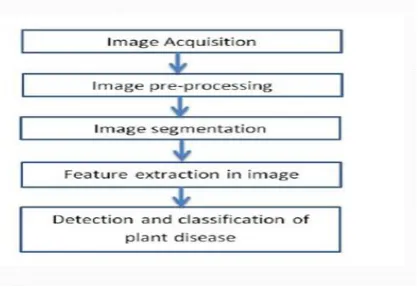
The block diagram shown in Figure 1 depicts the basic technique of the recommended vision-based detection algorithm in this research. Firstly, the images of various plants leaves are going to obtain using a digital camera. The next stage of the proposed algorithm is to apply the image-processing techniques on the acquired images to extract useful features for onwards analysis.
Fig. 1 Framework of the proposed system
Algorithm:
Basic steps describing the proposed algorithm:
1.RGB image acquisition
2. Enhancing the contrast of an image
3. Apply K-means clustering method and select the region of interest (ROI).
4. Features are extracted.
5. Configuring SVM Classifier for classification. 6. Accuracy and percentage of affected portion is calculated.
3.1.2 Image Acquisition
Image acquisition is the first method of digital image processing and it is described as capturing the image through digital camera or from the samples that are stored in database for further MATLAB operations.
3.1.3 Image Pre-Processing
The main purpose of image pre-processing is to improve the quality of an image containing unwanted distortions or to enhance some image features for further processing. This method includes various techniques such as changing image size, filtering of noise, image conversion, enhancing image.
3.1.4 Image segmentation
Segmentation means partitioning of image into various groups or clusters of same features or having some similarity. K-means clustering method partitions the images into clusters in such a way that atleast one part of cluster contains an image with major area of affected part. Algorithm for the K-Means image segmentation:-
Step 1: Read input image.
Step 2: Transform image from RGB to L*a*b* color space.
Step 3: Classify colors using K-Means clustering in 'a*b*' space.
Step 4: Label each pixel in the image from the results of K-means.
Step 5: Generate images that segment the image by color.
Step 6: Select the segment containing disease.
3.1.5 Feature Extraction
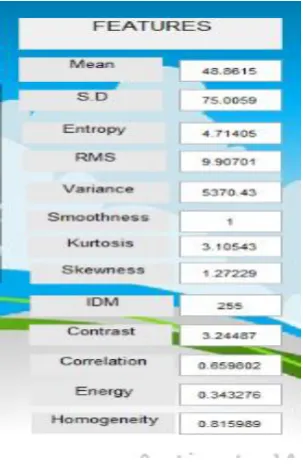
Feature extraction plays an important role for identification of an object. In many application of image processing, feature extraction is used. Colour, texture, morphology, edges etc. are the features which can be used in plant disease detection.
Fig 2: Features
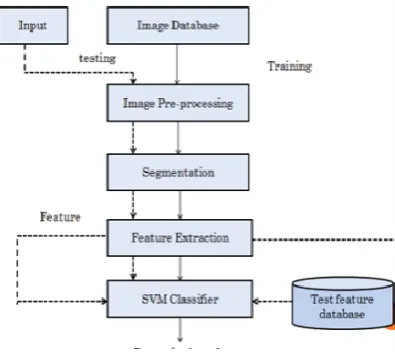
3.1.6 Training & Classification:
problems for handling the separation of the different classes. SVM is a binary classifier that means the class labels can only take two values ±1.
Fig.3 Principle of SVM
3.1.7 Diseases and their remedies:
Along with the type of disease the plant is having, we can also provide some remedies to cure or to prevent that disease from spreading. Example:
1.Alternaria Alternata
Alternaria alternata is a fungus which has been recorded causing leaf spot and other diseases on over 380 host species of plant. It is an opportunistic pathogen on numerous hosts causing leaf spots, rots and blights on many plant parts
Remedy: Liquid copper fungicides, powdered sulfur fungicides, Bacillus subtilis. Also prevention of pest-spread fungal matter, removing dead plant matter, using drip irrigation, planting disease-free seeds and resistant cultivars, sterilization of tools, crop rotation.
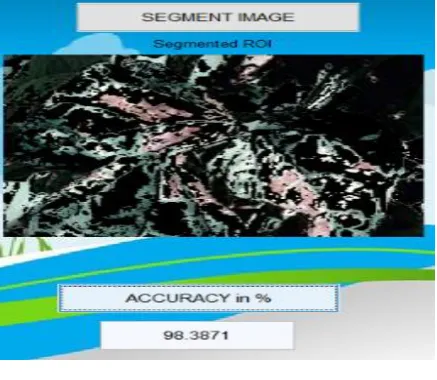
IV. Result
Fig. 5: segmentation of image
Fig. 6: Disease with remedy V. CONCLUSION
The accurately detection and classification of the plant disease is very important for the successful cultivation of crop and this can be achieved using image processing. A system for diagnosis the detection of plant disease has been developed using the Matlab application. This paper discussed how the dataset can be segmented for finding and analysing the diseased part of the plant.
This paper also discussed that along with finding out the type of diseases, we can also provide some remedies which can be helpful in preventing the crops from getting affected from those diseases. From these methods, we can accurately identify and classify various plant diseases using image processing techniques.
REFERENCES
[01] Wenjiang Huang, Qingsong Guan, Juhua Luo, Jingcheng Zhang, Jinling Zhao, Dong Liang, Linsheng Huang, Dongyan Zhang, "New Optimized Spectral Indices for Identifying and Monitoring Winter Wheat Diseases", IEEE journal of selected topics in applied earth observation and remote sensing, vol. 7, no. 6, June 2014.
[02] K. Thangadurai, K. Padmavathi, "Computer Visionimage Enhancement For Plant Leaves Disease Detection", World Congress on Computing and Communication Technologies, 2014.
[04] Zulkifli Bin Husin, Abdul Hallis Bin Abdul Aziz, Ali Yeon Bin MdShakaff, RohaniBinti, S Mohamed Farook, "Feasibility Study on Plant Chili Disease Detection Using Image Processing Techniques", Third International Conference on Intelligent Systems Modelling and Simulation, 2012., [05] Mrunalini R. Badnakhe, Prashant R. Deshmukh, "Infected Leaf Analysis and Comparison by Otsu Threshold and k-Means Clustering", International Journal of Advanced Research in Computer Science and Software Engineering, vol. 2, no. 3, March 2012
[06]H. A1-Hiary, S. Bani-Ahmad, M. Reyalat, M. Braik, Z. Alrahamneh, "Fast and Accurate Detection and Classification of Plant Diseases", International Journal of Computer Applications, vol. 17, no. 1, March 2011.