KEY GENERATION & DISTRIBUTION FOR GROUP
COMMUNICATION IN ADHOC NETWORK
Preeti
1, Ruchi Sanduja
2, Kapil Shrivastava
31
M.Tech Student,
2Assistant Professor, Department of Computer Science & Engineering,
SCET, Palwal (India)
3
Assistant Professor, Department of Computer Science & Engineering, HCST, Mathura (India)
ABSTRACT
We consider several distributed collaborative key agreement protocols for dynamic peer groups. This problem
has several important characteristics which make it different from traditional secure group communication. They
are distributed nature in which there is no centralized key server, collaborative nature in which the group key is
contributory; i.e., each group member will collaboratively contribute its part to the global group key, and
dynamic nature in which existing members can leave the group while new members may join. Instead of
performing individual rekey operations, i.e., re-computing the group key after every join or leave request, we
consider an interval-based approach of rekeying. In particular, we consider two distributed algorithms for
updating the group key: (1) the Rebuild algorithm, (2) the Queue-batch algorithm. Performance of these
distributed algorithms under different settings, such as different join and leave probabilities, is analyzed. We
show that these three distributed algorithms significantly outperform the individual rekey algorithm, and that the
Queue-batch algorithm performs the best among the three distributed algorithms. Moreover, the Queue-batch
algorithm has the intrinsic property of balancing the computation communication workload such that the
dynamic peer group can quickly begin secure group communication. This provides a fundamental understanding
about establishing a collaborative group key for a distributed dynamic peer group.
Keywords: Authentication, Dynamic Peer Groups, Group Key Agreement, Rekeying, Secure Group,
Communication, Security.
I. INTRODUCTION
With the emergence of many group-oriented distributed applications such as multi-player games and tele/
videoconferencing, there is a need for security services to provide group-oriented communication privacy and
data integrity. To provide this form of group communication privacy, it is important that members of the group
can establish a common secret key for encrypting group communication data. For example, consider a group of
people in a peer-to-peer ad hoc network having a closed and confidential business meeting. Since they have not
previously agreed upon a common secret key, communication between group members is susceptible to
eavesdropping. To solve the problem, we need a secure distributed group key agreement protocol such that the
group of people can establish the common group key for secure and private communication. Note that this type
of key agreement protocols is both distributed and contributory in nature: each member of the group contributes
its part to the overall group key. It is important to point out that the type of distributed group key agreement
Centralized protocols rely on a centralized key server to efficiently distribute the group key. An excellent body
of work on centralized key distribution protocols exists in various researches. In those approaches, group
members are arranged in a logical key hierarchy known as a key tree. Using the tree topology, it is easy to
distribute the group key to members whenever there is any change in the group membership (e.g., a new
member joins or an existing member leaves). For distributed key agreement protocols, however, no centralized
key server is available. This arrangement is justified in many situations – e.g., in a peer-to-peer or ad hoc
network where centralized resources are not readily available. Moreover, an advantage of distributed protocols
over the centralized protocols is the increase in system reliability, since the group key is generated in a shared
and contributory fashion and there is no single point of failure. [1][2][3].
In this paper, we consider a dynamic communication group in which members are located in a distributed
fashion. We extend the Diffie-Hellman key exchange protocol to more than two members in the communication
group. The membership of the communication group is dynamic so that members can leave and new members
can join the group at any time [4][5]. The contributions of our work are:
The key agreement protocol is distributed in nature and does not require a centralized key server. The key agreement protocol is contributory; each member contributes its part to the overall group key. We illustrate that instead of performing individual rekeying operations, one can use an interval-based
approach to significantly reduce the computation and communication costs of maintaining the group key.
We propose three distributed interval-based rekey protocols, and carry out quantitative and simulation-based
analysis to illustrate their performance merits [6].
II. PROBLEM DEFINITION
The mainstay of the paper is to collaboratively generate a common key for group communication and to
dynamically perform re-keying operation using various algorithms and to share resources using the generated
group key in client server architecture. In this project we need to create a system which can provide the
members of a group with secure common group key [7]. We implemented Queue Batch algorithm to reduce the
rekey complexity. This algorithm uses an interval-based rekey approach so that we can group multiple
join/leave requests and process them at the same time. This reduction enables a more efficient way to manage
secure group communication. It will help to increase the utilization of resources in existing system. This
algorithm is implemented by using RSA algorithm to generate public and private key in order to create the
"secret group key" and then this generated secret group key is distributed among all the group members. Also
instead of performing individual rekey operations, i.e., re-computing the group key after every join or leave
request, we consider an interval-based approach of rekeying. The key agreement protocol is contributory that is
each member contributes its part to the overall group key [8]. Also instead of performing individual rekeying
operations, one can use an interval-based approach to significantly reduce the computation and communication
costs of maintaining the group key. This system will help to generate a group key with the involvement of all the
group members and also its distribution among the group members [9][10].
One major advantage is that this system would not be vulnerable to Man-in-the-Middle attack as attacker would
not be able to find the secret key between the group members. This algorithm involves collaborative key
agreement in which all nodes become a part of the secure group key. Moreover, rekeying is done after a batch of
frequent. Computational and communication cost is less. Resources used for rekeying is minimized because it is
being done for batch of join/leave operations [11].
Next we implemented Rebuild algorithm which is same as Queue Batch algorithm but here rekeying is done at
every join/leave requests. The motivation for this algorithm is to minimize the final tree height so that rekeying
operations for each group member can be reduced [12].
The main motivation behind comparing these algorithms is that many group-oriented communications require
security services. For example: a closed and confidential business meeting in a network. We therefore need a
secure group key agreement scheme so that the group can encrypt their communication data with a common
secret group key. The scope of this project is in corporate world, people need to communicate with secure
medium which will be provided by our system [13][15]. Confidentiality and data integrity is maintained hence
can be used by Defense Agencies Intelligence Bureaucrats. These algorithms provide intrinsic property that help
dynamic group to quickly begin secure group communication and thus will help saving time.
III. MATHEMATICAL MODEL
3.1 Rebuild Algorithm
The motivation for the Rebuild algorithm is to minimize the final tree height so that the rekeying operations for
each group member can be reduced. At the beginning of every rekey interval, we reconstruct the whole key tree
with all existing members who remain in the group, together with the newly joining members. The resulting tree
would be a complete tree [14]. The pseudo-code of the Rebuild algorithm to be performed by every member is
shown below:
Algorithm
1. Obtain all members from T and store them in Ml
2. Remove the L leaving members in Ml from Ml
3. Add the J new members in MJ to Ml
4. Create a new binary tree Tl based on members in Ml and set T = Tl
5. Rekey the key nodes and broadcast the new blinded keys in T.
3.2 Queue Batch Algorithm
Queue batch algorithm, an interval based algorithm is used for re-keying at equal intervals. Queue-batch
algorithm performs the best among the interval-based algorithms. The algorithm reduces the latency and the
workload created due to re-keying operation that is performed at the beginning of the re-keying intervals.
In Queue batch algorithm, as and when members join, they are stored as in a temporary tree and at the beginning
of a re-keying interval this tree is attached to the tree with existing members. It is attached to the highest departed
position, so that the height of the tree does not increase much [16][17].
The Queue batch algorithm is illustrated in Figure-1, where members M8, M9, M10 wish to join the
communication group, while M2 and M7 wish to leave. Then in the Queue-sub-tree phase, the three new
members M8, M9, M10 will form a tree. In the Queue merge phase, the tree is added at the highest departed
position, which is at node 6. Now group key is computed for the new group structure and the computed group
key is broadcasted to all the members.
Phase 1: Queue-sub tree formation (T0)
1. if (a new member joins) f
2. if (T0 == NULL) /* no new members in T’ */
3. create a new tree T0 with the only one new member;
4. else f /* there are new members in T’ */
5. find the insertion node;
6. add the new member to T0;
7. Select the rightmost member under the sub-tree rooted at the sibling of the joining node to be the sponsor;
8. if (sponsor) /* sponsor’s responsibility */
9. Re-key the key nodes and broadcast the new blinded keys to the communication group;
The node ID of root node is set 0. Each non-leaf node v consists of 2 child-nodes, with ID 2v+1 2v+2.Based on
this protocol, the secret key of v can be generated by the secret key of one child node blinded node of another
child-node [18].
Phase 2: Queue-merge (T, T0,Ml ;L)
1. if (L == 0) f /* there are no leave */
2. add T0 to either (a) the shallowest node (which need not be the leaf node) of T such that the merger would not
increase the resulting tree height, or
(b) the root node of T if the merge to any locations would increase the resulting tree height;
3. else /* there are leaves */
4. add T0 to the highest leave position of the key tree T;
5. elect members to be sponsors if they are (a) the rightmost member of the sub-tree rooted at the sibling nodes of
the departed leaf nodes in T, or (b) the rightmost member of T0;
6. if (sponsor) /* sponsor’s responsibility */
7. re-key the key nodes and broadcast the new blinded keys to the communication group;
The Queue-batch algorithm has the intrinsic property of balancing the computation/communication workload
such that the dynamic peer group can quickly begin secure group communication.
IV. PERFORMANCE EVALUATION
In this section, we present the mathematical analysis of the two proposed algorithms. We consider two
performance measures, namely:
1. Number of renewed nodes: a node is said to be renewed if it is a non-leaf node and its associated keys
are renewed. This metric provides a measure of the communication cost since new blinded keys of the
renewed nodes have to be broadcast to the whole group [19].
2. Number of exponentiation operations: this metric provides a measure of the computation load for all
members in the communication group. For simplicity, we assume the following in the analysis:
Each member has a homogeneous leave probability.
The number of blinded key computations simply equals that of renewed nodes, provided that the blinded
key of each renewed node is broadcast only once [20][21][22].
IV. RESULTS
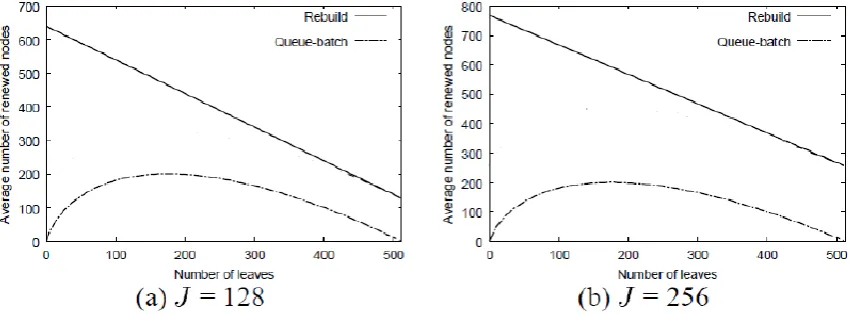
The above experiments show that Queue-batch offers the best performance in terms of computation and
communication costs among the two interval-based algorithms. The superior performance of Queue-batch is
more obvious when the occurrences of join and leave events are highly frequent. Queue-Batch algorithm require
more time as compared to Rebuild algorithm in the generation of group key. This is due to the fact that in queue
batch algorithm, group is generated after a predefined batch of time irrespective of joining and leaving operation
of group members whereas in Rebuild algorithm, group is generated after every join and leave operation of group
members.
Load on system resources is more while implementing Rebuild algorithm as compared to Queue-Batch
algorithm. This is due to the fact that in Rebuild algorithm, group key is generated after every join and leave
operation of group members so more work has to be done.
Figure 4.1: Average Number of Renewed Nodes At Different Numbers of Joins (J) When The
Original Tree is Completely Balanced
V. CONCLUSION
We have implemented two algorithms i.e. ’Queue-batch algorithm’ and ’Rebuild algorithm’ for generating
common group key using collaborative key agreement protocols for dynamic groups in client server architecture.
We found that interval-based rekey approach is the better than rebuild algorithm which reduces rekeying
complexity so that multiple join/leave requests can be grouped and processed at the same time. In particular, we
show that the Queue-batch algorithm is better than rebuild algorithm and can significantly reduce both
computational and communication costs. This reduction enables a more efficient way to manage secure group
communication. We conclude that our group key server using any of the two rekeying strategies is scalable to
very large groups with frequent joins and leaves. In particular, the average server processing time per join/leave
REFERENCES
[1] BURMESTER, M., AND DESMEDT, Y. A secure and scalable group key exchange system. IEEE Trans
(2010).
[2] CANNY, J. Collaborative filtering with privacy. In Security and Privacy, 2006. Proceedings. 2002 IEEE
Symposium on (2002), IEEE, pp. 45–57.
[3] HOU, R. Y.-K. Improving reliability and performance of redundant disk arrays by improving rebuild time
and response time. PhD thesis, 1994.
[4] KIM, Y., PERRIG, A., AND TSUDIK, G. Tree-based group key agreement. ACM Transactions on
Information and System Security (TISSEC) 7, 1 (2004), 60–96.
[5] LEE, P. P., LUI, J. C., AND YAU, D. K. Distributed collaborative key agreement and authentication
protocols for dynamic peer groups. Networking, IEEE/ACM Transactions on 14, 2 (2006), 263–276.
[6] LUCANTONI, D. M. New results on the single server queue with a batch markovian arrival process.
Communications in Statistics. Stochastic Models 7, 1 (1991), 1–46.
[7] RAJARAM, M., AND THILAGAVATHY, D. An interval based contributory key agreement. In Wireless
Communication and Sensor Computing, 2010. ICWCSC 2010. International Conference on (2010), IEEE,
pp. 16.
[8] RATHGEB, C., AND UHL, A. An iris-based interval-mapping scheme for biometric key generation. In
Image and Signal Processing and Analysis, 2009. ISPA 2009. Proceedings of 6th International Symposium
on (2009), IEEE, pp. 511–516.
[9] WONG, C. K., GOUDA, M., AND LAM, S. S. Secure group communications using key graphs.
Networking, IEEE/ACM Transactions on 8, 1 (2000), 16–30.
[10] YANG, Y. R., LI, X. S., ZHANG, X. B., AND LAM, S. S. Reliable group rekeying: a performance
analysis. In ACM SIGCOMM Computer Communication Review (2001), vol. 31, ACM, pp. 27–38.
44189-198. 2003.
[11] Robust Location Privacy Scheme for VANET,” IEEE J. Sel. Areas Commun., vol. 25, no. 8, pp.
1569-1589, Oct. 2007.
[12] M. Burmester and Y. Desmedt, “A Secure and Efficient Conference Key Distribution System,” in
Advances in Cryptology– EUROCRYPT’94, LNCS, vol. 950, pp. 275-286, 1995.
[13] M. Waldvogel, G. Caronni, D. Sun, N. Weiler and B. Plattner, “The VersaKey Framework: Versatile Group
Key Management,” IEEE J. Sel. Areas Commun., vol. 17, no. 9, pp. 1614-1631, Sept. 1999.
[14] M. Steiner, G. Tsudik and M. Waidner, “Key Agreement in Dynamic Peer Groups,” IEEE Trans. Parallel
Distrib. Syst., vol. 11, no. 8, pp. 769-780, Aug. 2009.
[15] A. Sherman and D. McGrew, “Key Establishment in Large Dynamic Groups Using One-way Function
Trees,” IEEE Trans. Software Eng., vol. 29, no. 5, pp. 444-458, May 2003.
[16] Y. Amir, Y. Kim, C. Nita-Rotaru, J. L. Schultz, J. Stanton, and G. Tsudik, “Secure Group Communication
Using Robust Contributory Key 0Agreement,” IEEE Trans. Parallel Distrib. Syst., vol. 15, no. 5, pp. 468-
480, May 2004.
[17] Y. Kim, A. Perrig and G. Tsudik, “Tree-Based Group Key Agreement,” ACM Trans. Inf. Syst. Security,
[18] Y. Sun, W. Trappe and K.J.R. Liu, “A Scalable Multicast Key Management Scheme for Heterogeneous
Wireless Networks,” IEEE/ACM Trans. Netw., vol. 12, no. 4, pp. 653-666, Aug. 2004.
[19] W. Trappe, Y. Wang and K.J.R. Liu, “Resource-Aware Conference Key Establishment for Heterogeneous
Networks”, IEEE/ACM Trans. Netw., vol 13, no 1, pp.134-146, Feb. 2008.
[20] P. P. C. Lee, J. C. S. Lui and D. K. Y. Yau, “Distributed Collaborative Key Agreement and Authentication
Protocols for Dynamic Peer Groups,” IEEE/ACM Trans. Netw., vol. 14, no. 2, pp. 263-276, April 2006.
[21] Y. Mao, Y. Sun, M. Wu and K. J. R. Liu, “JET: Dynamic Join-Exit Tree Amortization and Scheduling for
Contributory Key Management,” IEEE/ACM Trans. Netw., vol 14, no 5, pp.1128-1140, Oct. 2006.
[22] W. Yu, Y. Sun and K. J. R. Liu, “Optimizing the Rekeying Cost for Contributory Group Key Agreement