*
APPENDIX KCLOSE QUARTERS
COMBAT
TECHNIQUES
A large portion of combat in built-up areas takes place at very close
quarters, often between small groups of combatants within the confines of a single room. Because of this, individual combat actions can flare up quickly and be over in a matter of seconds. Success or failure is open determined by life or death decisions made and actions taken almost instinctively by individual soldiers and small teams as they encounter differing complex situations in each new room. One of the complexities often encountered particularly during OOTW, is the intermixing of combatants with noncombatants in the same building, often in the same rooms. Employing close quarters combat techniques
is open the most effective means of achieving victory w bile minimizing
friendly losses, avoiding unnecessary noncombatant casualties, and conserving ammunition and demolitions for subsequent operations.
K-l. BATTLEDRILLS AND CLOSE QUARTERS COMBAT
Close quarters combat techniques do not replace battle drills. They are techniques to be used when the tactical situation calls for room-by-room clearing of a relatively intact building in which enemy combatants and noncombatants may be intermixed. These techniques involve increased risk in order to clear a building methodically, rather than using overwhelming firepower to neutralize all its inhabitants. Certain close quarters combat techniques, such as methods of movement, firing stances, weapon positioning, and reflexive shooting, are useful for all combat in confined areas. Other techniques, such as entering a room without first neutralizing known enemy occupants, are appropriate in only some tactical situations. Generally, if a room or building is occupied by an alerted enemy force that is determined to resist, and if most or all noncombatants are clear, overwhelming firepower should be employed to avoid friendly casualties. In such a situation, supporting fires, demolitions, and fragmentation grenades should be used to neutralize a space before friendly troops enter. In some combat situations, however, the use of heavy supporting fires and demolitions would cause unacceptable collateral damage. In other situations, often during OOTW, enemy combatants are so intermixed with noncombatants that US forces cannot in good conscience use all their available supporting fires, and room-by-room clearing may be necessary. At such times, close quarters combat techniquesare most appropriate.
K-2. PRINCIPLES OF CLOSE QUARTERS COMBAT
Clf FM 90-10-1
train, practice, and rehearse close quarters combat techniques until each fire team and squad operates smoothly as a team. Each member of the unit must understand the principles of close quarters combat and the part his actions play in their successful execution. The principles of close quarters combat are surprise, speed,
and
controlled violent action.a. Surprise is the key to a successful assault at close quarters. The fire team or squad clearing the room must achieve surprise, if only for seconds, by deceiving, distracting, or startling the enemy. Sometimes stun or flash grenades may be used to achieve surprise. These are more effective against a nonalert, poorly trained enemy than against alert, well-trained soldiers.
b.Speedprovides a measure of security to the clearing unit. Speed lets soldiers use the first few vital seconds provided by surprise to their maximum advantage. In close quarters combat, speed does not mean incautious haste. It can best be described as "carefull hurry."
c. Controlled violent action eliminates or neutralizes the enemy while giving him the least chance of inflicting friendly casualties. Controlled violent action is not limited to the application of firepower only. It also involves a soldier mind-set of complete domination.
Each of the principles of close quarters combat has a synergistic relationship to the others. Controlled violence coupled with speed increases surprise.
Hence, successful surprise allows increased speed.
K-3. FUNDAMENTALS OF CLOSE QUARTERS COMBAT
The ten fundamentals of close quarters combat address actions soldiers take while moving along confined corridors to the room to be cleared, while preparing to enter the room, during room entry and target engagement, and after contact. Team members
must-a. Move tactically and silently while securing the corridors to the room to be cleared. Carry only the minimum amount of equipment. Rucksacks and loose items carried by soldiers tire them and slow their pace, and cause noise.
b. Arrive undetected at the entry to the room in the correct order of entrance, prepared to enter on a single command.
c. Enter quickly and dominate the room. Move immediately to positions that allow complete control of the room and provide unobstructed fields of fire.
d. Eliminate all enemy within the room by the use of fast, accurate, and
discriminating fires.
e. Gain and maintain immediate control of the situation and all personnel
in the room.
f. Confirm whether enemy casualties are wounded or dead. Disarm and segregate the wounded. Search all enemy casualties.
g. Immediately perform a cursory search of the room. Determine if a detailed search is required.
Clf FM 90-10-1
i. Mark the room as cleared, using a simple, clearly identifiable marking in accordance with the unit SOP.
j. Maintain security at all times and be prepared to react to more enemy contact at any moment. Do not neglect rear security.
K-4. INITIAL ACTIONS TO CLEARA BUILDING
The initial actions to clear a building are no different during close quarters combat than during any other MOUI.
a. The unit isolates the building using direct or indirect fires before the lead element moves to the breach point. The
unit-(1) Coversmounted avenues of approach with anti armor weapons. (2)Covers dismounted avenues of approach with automatic weapons. b. The unit suppresses enemy fires and neutralizes suspected and likely enemy positions as the breach ana clearing teams move into position. The unit obscures the movement of the breach ana clearing teams to the building by using smoke.
c. Breach and clearing teams secure a foothold in the building. Teams move along covered and concealed routes and enter at the highest possible level of the building. The unit shifts fires to other floors or buildings as the clearing teams enter. If possible, clearing teams clear hallways and rooms from the top of the building down.
K-5. COMPOSITION OF THE CLEARING TEAM
Close quarters combat clearing techniques are designed to be executed by the standard four-man fire team. Because of the confined spaces typical of building- and room-clearing operations, units larger than squads quickly become unwieldy. When shortages of personnel demand it, room-clearing operations can be conducted by two- and three-man teams, but four-man teams are optimum. Using fewer personnel greatly increases the combat strain and the risks to the participants.
K-6. BREACHING
An integral part of close quarters combat is the ability to gain access quickly to the room to be cleared. Breaching techniques vary widely based on the type of construction encountered and the types of munitions available to the breaching force. Techniques range from simple mechanical breaching to complex, specialized demolitions.
~~~:~1
3
2
.
.,.
1~AIMPOINT
I
to
3~
2
.
1.
~I
I I I I I I I
DOOR KNOB BREACH HINGE BREACH
Clf FM 90-10-1
stock of the shotgun in the pocket of his shoulder, the gunner places the muzzle tightly agamst the door, aiming down at a 45-degreeangle.
(1) For the doorknob breach, the aim point is a spot halfway between the doorknob and the frame, not at the doorknob itself. The gunner fires two quick shots in the same location, ensuring that the second shot is aimed as carefully as the first. Weak locks may fly apart with the first shot, but the gunner should always fire twice. Some locks that appear to be blown apart nave parts still connected that will delay entry. If the 10ck is not defeated by the second shot, the gunner repeats the procedure.
(2) The hinge breach technique is performed much the same as the doorknob breadl, except the gunner aims at the hinges. He fires three shots per hinge-the first at the middle, then at the top and bottom (Figure K-1). He fires all shots from less than an inch away from the hinge. Becausethe hinges are often hidden from view, the hinge breach is more difficult.
Figure K-l. Aim points for shotgun breach of a standard door.
Cl, FM 90-10-1
b. Demolitions are often needed to defeat more elaborate barriers or to produce a desired effect to aid the initial entry. See Appendix L for a discussion of expedient demolitions for breaching common urban barriers.
c. Mechanical breaching is not addressed here, but it is an assumed capability within all units. Whether or not to take the time to defeat weak barriers, such as doors or windows, by means of crowbars, saws, sledgehammers, or axes is a decision that must be made based on the conditions of METT-T.Mechanical breaching should always be planned as a backup to a ballistic or explosivebreach.
K-7. BREACH POINT
Clearing team members must approach the breach point quickly, quietly, and in standard order. This approach preserves the element of surprise and allows for quick entry and domination of the room.
a. The order of movement to the breach point is determined by the method of breach and the intended actions at the breach point. The members of the fire team are assigned numbers 1 through 4, with the team leader always designated number 3. If one member of the clearing team is armed with the SAW rather than an M16 rifle or carbine, he should be designated number 4.
(1) The order of movement for a shotgun breach has the shotgunner up front, followed by the number 1 man, number 2 man, and then the number 3 man (team leader). After the door is breached, the shotgunner falls to the rear of the lineup and acts as the number 4 man.
(2) The order of movement for a demolition breach is number 3 (team leader), number 2, number I, and then number 4. The team leader provides security at the doorway. The number 2 man carries the demolition charge and places it. Number 1 carries a fabricated blast shield. Number 4 provides rear security. After the demolition charge is placed, number 2 falls in behind number 1 (with the blast shield), and number 3 (team leader) falls in behind number 2, re-forming the standard I, 2, 3, 4 configuration.
(3) If neither a shotgun nor a demolitions breach is required, the order of movement is the standard 1,2,3,4 configuration.
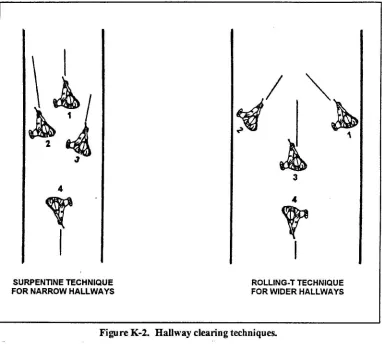
b. The clearing team must always be alert. Team members provide security at the breach point and to the rear, laterally down corridors, and upward if near stairs or landings. The two basic techniques for moving down hallways are shown in Figure K-2. Hallway intersections are dangerous areas and should be approached cautiously as shown in Figures K-3 and-K-4.
Clf FM 90-10-1
(2) The rolling-T techniqueis used in wide hallways. The number 1 and
number 2 men move abreast, covering the opposite side of the hallway from the one they are walking on. The number 3 man covers the far end-of the hallway from a position behind the number 1 and number 2 men, firing between them. Once again, the number 4 man provides rear security.
2
~,
~/
"'~
~
A
1
3 4
~
I
..
t
ISURPENTINE TECHNIQUE FOR NARROW HALLWAYS
ROLLING-T TECHNIQUE FOR WIDER HALLWAYS
Clf FM 90-10-1
~ ~
~~
2 4~~.. ..~~
~
':fl
INTERSECTION CLEARING POSITIONS
Figure K-3. T-shaped hallway intersection
Clf FM 90-10-1
Ii
.
J~I
A
~-3
HALlWAY cLEARiNG POSmONS
II
4
~
I
I
3 HALlWAY SECTORS
J(imll"~ J{-4. R'!JIlu..'fJI'~ int,..~p.,...t-inn ,...lnfJI...i'nn nn~itinn'" IJInll ...
8,&"."'" "'.A.."''f ".,'f a "".0.'7"'''''.U.. """'AI ..16 I'v",.".",..", A.8IU
sectors of fire.
K-8. INDIVIDUAL MOVEMENT AND WEAPONS CONTROL
Clf FM 90-10-1
a. When moving, team members hold their weapons with the muzzle pointed in the direction of travel. They keep the butt of the rifle in the pocket of their shoulder, with the muzzle slightly down to allow for unobstructed vision. Soldiers keep both eyes open and swing the muzzle with their head so that the rifle is always aimed where the soldier is looking.
b. Team members avoid "flagging," or leading, with the weapon when working around windows, doors, comers, or areas where obstacles must be negotiated. Flagging the weapon gives advance warning to anyone looking in the soldier's direction, making it easier for an enemy to grab the weapon. Soldiers must keep their weapons under control at all times.
c. Team memoers shoulcf keep weapons safe (selector switch on SAFE and index finger outside of trigger guard) until a hostile target is identified and engaged. After a team member clears his sector of all targets, he returns his weapon to the SAFE position.
a. If a soldier has a malfunction with his weapon during close quarters combat, he should immediately drop to one knee and conduct immediate action to reduce the malfunction. Once the weapon is operational, there is no need to return to the standing position to engage targets unless the soldier must move to another firing position. Valuable time is saved by resuming target engagement from the kneeling position. When other members of the team see a soldier drop to one knee, they know immediately that he has a malfunction and that they should engage targets in his sector.
K-9. ACTIONS OUTSIDE THE POINT OF ENTRY
Actions outside the point of entry must be quick and well rehearsed. The doorway or breach point is a dangerous position. The clearing team is focused on entry and could be surprised by an enemy appearing unexpectedly in the corridor.
a. Clearing team members' positions relative to the door are important as are their weapons' carry positions. Team members stand as close to the entry point as possible, staying in a crouched position. They hold their weapons either in the high-carry or the low-carry position. They ensure the muzzle is not pointed at another team member.
b. All team members must signal one another that they are prepared before the team enters the room. The last man taps or squeezes the arm of the man in front of him, and each one passes this signal along. Team members avoid the use o~ a verbal signal, which may alert the enemy and destroy the element of surpnse.
Clf FM 90-10-1
LJ
'-.J '
I I I
r
JI
- -- -"-!
CENTER DOOR, NUMBER 1 MAN
I
I I
_.J
_-JCORNER DOOR, NUMBER 1 MAN
I
lj----
,--Figure K-5. Path of#1 man center door and corner door.
K-I0. ACTIONS UPON ENTRY
The entire team should enter the room as quickly and as smoothly as possible and clear the doorway immediately.
a. The door is the focal point of anyone in the room. It is known as the "fatal funnel," because it focuses attention at the precise point where the individual team members are the most vulnerable. Moving into the room quickly reduces the chance that anyone will be hit by enemy fire directed at the doorway. The sequence of movements described below is shown in Figures K-5 through K-14.
b. On the signal to go, the clearing team moves tnrough
the
doorquicklyand takesup
positions inside the room that allowit to completelydominate the room and eliminate the threat. Team members stop movementonly after they have cleared the door and reached their designated point of domination.
(1) The first man to enter moves in as straight a line as possible toward the comer for which he is responsible. He may then turn and move deep into the far corner of the room. The depth of his movement is determined by the size of the robin, any obstacles in the room such as furniture, and by the number and location of
I
enemy and noncombatants in the room (Figure K-5).
Cl, FM 90-10-1
in the opposite direction, following the wall, but not directly against it (Figure K-6)
"
I I/ /
CENTER DOOR, NUMBER 2 MAN
CORNER DOOR, NUMBER 2 MAN
Clf FM 90-10-1
(3) The number 3 man (team leader) buttonhooks inside the room at least 1 meter from the door, but between the number 1 man and the door (Figure K-7).
r-I
J
CENTER DOOR, NUMBER 3 MAN
CORNER DOOR, NUMBER 3 MAN
Figure K-7. Path of #3 man, center door and comer door.
Clf FM 90-10-1
I
II
~
.I
~'.~
.
I ,---~
---~
CENTER DOOR, NUMBER 4 MAN
I
I
I~
I
I
I
"
IV'
I
:I
I
CORNER DOOR, NUMBER 4 MAN
~~ I.)"" 0 n L _1'.£1.4 --- ~--- --,I
AI'Io._-.rlgun: n.-o. c;uu UI t1"t W<lU, U::ULI::I UUUI~ <lUU \:UIII~I UUUI.
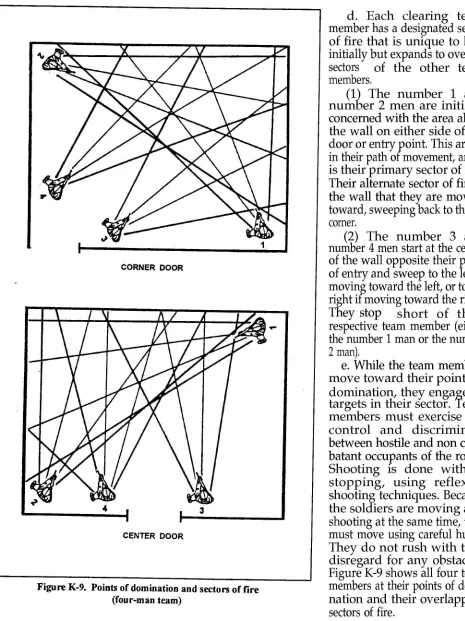
c. Tomake closequarters combat techniques work, each member of the team must know his sector of fire and how his sector overlaps and links with the sectors of the other team members. Team members do not move to the point of domination and then engage their targets. They engage targets as they move to their designated point. However, engagements must not slow movement to their points of domination. Team members may shoot from as short a range as 1 to 2 inches. They engage the most immediate enemy threats first. Examples of immediate threats are enemy personnel
who-.
Are armed and prepared to return fire immediately.Cl, FM 90-10-1
1
CORNER DOOR
4 3
CENTER DOOR
Figure K-9. Points of domination and sectors of fire (four-man team)
d. Each clearing team member has a designated sector of fire that is unique to him initially but expands to overlap sectors of the other team members.
(1) The number 1 and number 2 men are initially concerned with the area along the wall on either side of the door or entry point. This area is in their path of movement, and it is their primary sector of fire. Their alternate sector of fire is the wall that they are moving toward, sweeping back to the far corner.
(2) The number 3 and number 4 men start at the center of the wall opposite their point of entry and sweep to the left if moving toward the left, or to the right if moving toward the right. They stop short of their respective team member (either the number 1 man or the number 2 man).
Clf FM 90-10-1
f. When full four-man teams are not available for room clearing, three-man and two-man teams can be used. Figures K-IO and K-ll show the paths, points of domination, and sectors of fire for a three-man
clearing team. Figures K-12
and K-13 show the same thing for a two-man team.
I
I
I
I
~L~
I
I
I
3 2 1
Hir
-~
I~
~~I
I
Cl, FM 90-10-1
.
. I
~~~
1 2 3Cl, FM 90-10-1
I
I
,
I
I
I
I
LA.
z 1
/7
/~..
I
~I
I~
I
I
I
I
Clf FM 90-10-1
I I
I
I
I
I
I
~~
2 1~
~
1/
/
-.
rII
L
J-
~-
J
I Lh7
rJ?/
I
I
~...,
I
I
II
,
I II
I
I
I
Clf FM 90-10-1
K-ll. REFLEXIVE SHOOTING
During close quarters combat, there is little or no margin for error. Too slow a shot at an enemy, too fast a shot at a noncombatant or inaccurate shots can all be disastrous for the clearing team. Proper weapon carry technique, stance, aiming, shot placement, and trigger manipulation constitute the act of reflexive shooting. This method of shooting is the only way for the clearing team members to consistently succeed without excessive casualties.
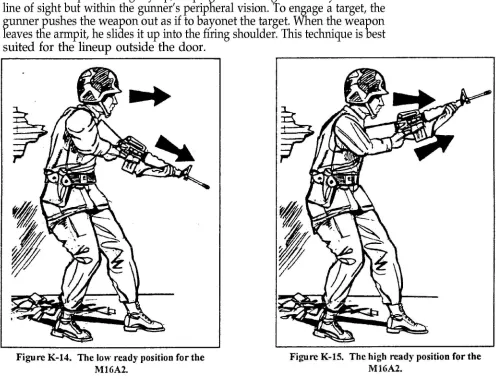
a. Weapon Ready Positions. The two weapon ready positions are low ready' and high ready.
(1) Low ready position. The butt of the weapon is placed firmly in the pocket of the shoulder with the barrel pointed down at a 45-degree angle. This is the safest carry position. It should be used by the clearing team while inside the room, except when actually entering and clearing.
(2) High ready position. The butt of the weapon is held under the armpit,
with the barrel pointed slightly up, keeping the front sight assembly under the line of sight but within the gunner's peripheral vision. To engage a target, the gunner pushes the weapon out as if to bayonet the target. When the weapon leaves the armpit, he slides it up into the firing shoulder. This technique is best suited for the lineup outside the door.
~.
I~
~
"'
I
;-Figure K-14. The low ready Iwsition for the M16A2.
Figure K-15. The high ready position for the M16A2.
Clf FM 90-10-1
staggered to the rear of the non-firing side foot. Knees are slightly bent and the upper body is leaned slightly forward. Shoulders are square and pulled back, not rolled over or slouched. The head is up and both eyes are open. When engaging targets, the gunner holds the weapon with the butt in the pocket of his snoulder.
c. Aim. The four aiming techniques all have their place during combat in built-up areas, but the aimed quick-Kill technique is the one most often used in close quarters combat.
(1) Slow aimed fire. This technique is the most accurate. It consists of taking up a steady, properly aligned sight picture and squeezing off rounds. It is normally used for engagements beyond 25 meters or when the need for accuracy overrides speed.
(2) Rapid aimedJire. This technique features an imperfect sight picture in which windage is critical but elevation is of lesser importance. When the front sight post is in line with the target, the gunner squeezes the trigger. This technique is used against targets out to 15 meters and is fairly accurate and very fast.
(3)Aimed quick kill. This technique consists of using a good spot weld
and placing the front sight post flush on top of the rear peep sight. It is used for very quick shots out to 12 meters. Windage is important, but elevation is not critical with relation to the target. This technique is the fastest and most accurate. With practice, soldiers can become deadly shots at close range.
(4) Instinctive fire. This technique is the least desirable. The gunner focuses on the target and points the weapon in the target's general direction, using muscle memory to compensate for lack of aim. This technique should be used only in emergencies.
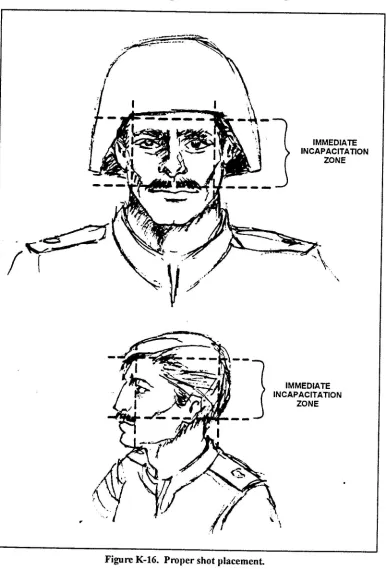
d. Shot Placement In close quarters combat, enemy soldiers must be incapacitated immediately. Shots tnat merely wound or that are mortal but do not incapacitate the target instantaneously are only slightly better than clean misses. Members of clearing teams should concentrate on achieving solid, well-placed head shots. This shot placement is difficult for some soldiers to learn, having been taught previously to aim at center of mass.
(1) The only shot placement that guarantees immediate and total incapacitation is one roughly centered in the face, below the middle of the forehead, and above the upper lip. Shots to the side of the head above the horizontal line passing through the ear opening to just below the crown of the skull and from the cheekbones rearward to the occipital lobe are also effective. With practice, accurate shot placement can be achieved. (See Figure K-16 for proper shot placement.)
(2) Shots to the spinal column below the jaw and above the sternum can neutralize a target immediately. However, the spinal column is a narrow target and misses by only a few centimeters may cause no immediate reaction or a delayed reaction in the target. Even though severely wounded, the enemy
soldier may be able to return effective fire.
body may also be shielded by military equipment or protective vests that can often deflect or absorb rounds and prevent immediate incapacitation.
IMMEDIATE INCAPACITATION
ZONE
.~~~
(f
,~-...v/
"','--J
...-IMMEDIATE INCAPACITATION
ZONE
\'
,
Figure K-16. Proper shot placement.
Clf FM 90-10-1
(4) Shots to the abdomen or lower extremities are rarely effective in rendering an opponent immediately incapable of returning fire, even if they are ultimately fatal.
e. Trigger Manipulation. Rapid, aimed, semiautomatic fire is the most effective method of engaging targets during close quarters combat. As each round is fired from the aimea qUIck-kill position, tne weapon's recoil makes the front sight post move in a small natural arc. The gunner should not fight this recoil. He should let the weapon make the arc and immediately bring the front sight post back onto the target and take another shot. This two-shot combination is known as adouble tap. Soldiers must practice the double tap until it becomes instinctive. Clearing team members continue to fire double taps until the target goes down. If there are multiple targets, team members double tap each one and then return to reengage any enemy left standing or who are still trying to resist.
(1) Controlled three-round bursts fired from the M16A2 rifle are better than fully automatic fire, but they are only slightly faster and not as accurate or effective as rapid, aimed semiautomatic fire.
(2) Fully automatic fire with the M16A2 rifle or carbine is rarely effective and may lead to unnecessary noncombatant casualties. Not only is fully automatic fire inaccurate and difficult to control, but it also rapidly empties ammunition magazines. A clearing team member who has expended his ammunition while inside a room with an armed, uninjured enemy soldier will become a casualty unless his fellow team members can quickly intervene.
K-12. TARGET DISCRIMINATION
Target discrimination is the act of quickly distinguishing between combatant and noncombatant personnel and engaging only the combatants. US forces engage in close quarters combat in order to apply discriminating combat power and limit unnecessary casualties among noncombatants. Therefore, target discrimination is vital in close quarters combat. If there is no need for selective engagements, that is, only combatants attempting to resist are present, a much less discriminating use of firepower is possible. However, even if an area is known to be free of noncombatants, other soldiers moving through the area may be mistaken as enemy and engaged unless clearing team members are disciplined and well-trained in fire control and target discrimination. Even with well-trained, disciplined soldiers, close quarters combat can result in unintentional casualties among noncombatants. Commanders must recognize this and take steps to relieve the stress it causes soldiers.
K-13. SAFETY AND FORCE PROTECTION
Clf FM 90-10-1
a. Leaders at all levels must enforce safe handling of weapons and demolitions. The concern that individual soldiers not be injured in accidents is essential to mission accomplishment. Unintentional and unsafe weapons fire or detonation of explosives or munitions can jeopardize the mission of the clearing team and subsequently the entire unit.
b. Soldiers engaged in dose quarters combat should wear all of their protective equipment.
(1) Soft body armor, such as the standard Army-issue Kevlar vest, is effective in preventing death or serious injury from high-velocity fragments that strike the torso area. Although the Kevlar protective vest is effective, flexible, and relatively comfortable, it is not designed to stop bullets. As a rule, soft body armor will stop some low-power handgun rounds but not rifle or carbine ammunition.
(2) Some versions of hard body armor will stop almost any round fired at it. They tend to be heavy and stiff but have been proven effective during close quarters combat. If a commander knows his unit will be conducting lengthy close quarters combat, he should request a special issue of threat level III protective equipment. This equipment is excellent, but soldiers must train and rehearse wearing it before they enter combat. All close quarters combat is tiring, and soldiers wearing threat level III vests will tire or overheat more quickly.
(3) The standard Army Kevlar helmet and ballistic protective eyeglasses have also been proven to significantly reduce casualties during close quarters combat. Histoically, eye injuries caused by small metal fragments or pieces of stone or concrete have been a large percentage of casualties during combat in built-up areas.
(4) Hard plastic knee and elbow protectors are available upon special request. They are useful, especially during prolonged search and clear operations. They prevent injury from rubble and broken glass when kneeling or prone.
c. Detailed knowledge of weapons and munitions effects is important to the safety of members of the clearing team, as well as to mission accomplishment. Most interior walls of buildings do not stop rifle fire. Fragments from grenades often penetrate interior walls. Standard home furnishings or office furniture offer little protection from high-velocity rounds. Excessive amounts of demolitions used to breach a wall may knock it down instead, perhaps even bring the roof of the building down also.
K-14. CLOSE QUARTERS COMBAT DURING DARKNESS
Clf FM 90-10-1
and the equipment available to him before he decides whether to use visible, invisible, or no artificial light during close quarters combat.
a. Equipment. Some specialized night vision equipment is available to the soldier now; other equipment will be available in the future.
(1)ANIPAQ-4 aiming light. This device projects a pulsing dot of IR light
along the weapon's line of sight. The dot is invisible to the naked eye, but it can be seen by personnel wearing night vision goggles. Gunners with weapons equipped with the AN jP AQ-4 aiming light simply place the projected spot on the target and fire.
(2) ANIPVS-5 and ANIPVS-7 night vision goggles.These goggles are lightweight, battery-powered passive devices worn on the head. Eacn has an IR-emitting light source for close-up illumination.
(3) Tactical lights. These devices are small, lightweight, battery-powered white lights that can be attached to weapons. The light is activated by either a pressure switch or an onloff switch. An IR filter can be attached to most tactical lights to provide covert illumination. The most common example of a tactical light is sold under the name Maglite. This light can be attached to weapons using hose clamps or heavy tape. They must be checked periodically, because they can loosen and shift.
(4) Red dot sights. These devices are lightweight, battery-powered optical sights attached to the top of the weapon. A red dot in the sight aligns the weapon and the target. These sights are for use in low light levels, not total darkness. They do not assist in identifying targets.
(5) Active laser devices.These devices are lightweight, battery-powered, visible light-emitting sights. The device projects a red dot onto the target that corresponds to the point of bullet impact. These devices are not effective in sunlignt.
(6) Various thermal weapons sights.In the near future, thermal weapons sights will be available to detect targets in total darkness.
b. Use of White Light. Although not covert, white light has several advantages:
. The equipment is readily available and reliable.
.
No additional training is required..
It offers the fastest means of identifying targets and searching a room..
It allows colorvision.*
APPENDIX LEMPLOYMENT OF ARMED HELICOPTERS IN
BUILT-UP AREAS
Wherever
infantry forces are sent in the world, whether for combat operations or operations other than war, they will operate part of the time in built-up areas. Operating alongside and supporting them will be armed helicopters flown by technically skilled and tactically proficient US aviators. The commander or small-unit leader on the ground are responsible for ensuring the actions of these powerfulaircraft are smoothly integrated into the combined arms team. Joint operations will mean that the aircraft supporting ground forces may be Army or USMC. During combined and coalition operations, especially
during OOTW, it is more and more likely that armed helicopters from other nations may support US forces. In those cases, detailed information on their capabilities and employment techniques must be obtained through liaison channels.
L-l. MISSIONS OF ARMED HELICOPTERS SUPPORTING MOUT Infantry units may be supported by a variety of armed helicopters ranging from filly modernized AH-64s or somewhat less capable AH-ls, to lightly armed but agile OH-58Ds and AH-6s. Regardless of the specific type of armed helicopter available, the same missions and tasks can be accomplished due to the inherent flexibility of Army aviation units.
a. The most common missions assigned to armed helicopters during
MOUT are the following:
(1) Escort of troop-carrying aircraft during air assaults.
(2) Overwatch and supporting attacKs integrated with the ground commander's maneuver.
(3) Interdiction and destruction of enemy armored vehicles moving against friendly forces.
(4) Precision engagement of hardened point targets.
b. In addition to tlie missions listed above, armed helicopters may be called on to perform some additional, nontraditional roles during MOUT. This is particularly true during OOTW in urban areas. Additional missions may include the following:
(1) Assisting, for limited periods, in the control and coordination of fires with the maneuver of ground torces.
(2)Providing limited relay of radio messages from isolated ground units.
(3)Marking or identifying specific buildings and areas by smoke, fires, or targeting lasers.
(4) Videotaping routes or objectives for later analysis by ground commanders.
Clf FM 90-10-1
(6) Providing limited area illumination by infrared or white light using
either on-board sources or illumination rockets.
(7) Providing countersniper and counter-mortar/rocket armed recon-naissancepatrols around friendly unit locations.
L-2. PLANNING CONSIDERATIONS FOR ARMED HELICOPTER EMPLOYMENT
Although armed helicopters provide a flexibility and responsiveness almost unequaled by any other means of fire support, detailed planning is required to effectively integrate them with ground operations to accomplish the overall mission. The following must be considered when planning employment of armed helicopters.
a. Increased Exposure to Direct Fire. The ground-fire threat to armed helicopters increases during MOUT. Urban areas force the concentration of units and provide excellent cover and concealment for enemy gunners. In order to limit exposure to heavy antiaircraft weapons, helicopters may have to stay low and move quickly. This increases their vulnerability to light
small-arms fire.
b. Obstacles to Flight. Obstacles within urban areas are more numerous and dangerous than in any other environment. These obstacles include such things
as-(1) Power lines and power cable pylons.
(2) Hard-to-see telephone lines, trolley cables, and traffic light cables. (3) Light poles, rooftop antennas, and telecommunication towers.
(4) Towering buildings that may prevent rapid vertical maneuvering of heavily loaded aircraft.
c. Navigational Difficulties. Even though pilots can often see better than observers on the ground, because most maps do not show the vertical development of urban terrain, pilots can easily become temporarily misoriented. Navigational aids, such as eps, have lessened but not eliminated this problem. Rapid displacement from position to position can sometimes create confusion between aerial and ground oDserversas to cardinal directions or locations. Mission planning should include the use of upgraded photoimagery whenever possible. Newly developed areas or buildings may not show on recent maps. Some advanced computer simulation aids are now available to generate three-dimensional aerial views, which can be very useful especially during OOTW. Differing datums between the ground unit's maps and the aerial unit's GPS can cause significant
confusion unless compensated for.
d. Weapons Limitations. Many characteristics of operations in urban areas limit weapons employment.
(1) Weapons use may be limited by the short arming/slant ranges within the urban area. Precision weapons, such as TOW and He1lfire missiles, require about 500 meters minimum range to reliably arm and stabilize on the intended target. Often, fire from longer ranges actually improves accuracy.
(3) Laser designation by both ground and aerial systems may be degraded by the large expanses of polished, flat reflective surfaces common in many urban areas.
(4) With the obvious exception of precision strikes by TOW or Hellfire, aerial fires can rarely destroy a target or kill large numbers of enemy forces within buildings. These fires provide excellent suppression, however, and can drive enemy forces away from firing positions or fix the enemy in place until ground maneuver forces can destroy him. Enemy positions that have been struck by fire can normally be reoccupied quickly by the enemy.
(5) Target identification and marking may be difficult because of heavy smoke and dust rising from urban fires and explosions. Some smoke from fires in industrial areas may be highly toxic or irritating. Pilots may have to don chemical protective equipment that hinders target detection and engagement. Friendly unit locations and personnel can be marked with colored panels, glint tape, strobe lights, and colored smoke. Targets can be marked with infrared laser pointers, such as the GCP-l Ground Commander Pointer /Illuminator, coloredM203 smoke rounds,M203 or mortar flares burning on the ground, or tracer fires. In some situations, improvised spotlights can also be used.
(6) If the combat situation allows, pilots should make a nonfiring (dry) run first before returning for a firing pass. Although fire from stationary positions is more accurate, running fire is normally safer for the aircraft due to enemy ground fire. If possible, ground commanders should avoid directing pilots along a gun-target line that passes over friendly troops. Gun-target runs that are perpendicular to the friendly unit's front are norma1ly best.
e. Aircraft Power Limitations. The need to deliver hovering fires from temporary battle positions may require the aircraft to carry less than a full load of munitions or fuel. This is especially true with older model aircraft in hot, wet climates. Reduced loads mean more frequent trips to forward area refuel and rearm points and less time on station.
f. Command and Support Relationships. From the ground unit perspective, armed helicopters are most effective when they operate under the OPCON of the ground unit commander closest to the enemy. Normally, the infantry battalion is the lowest level granted formal OPCON of armed helicopters. However, in an urban area the battalion commander is rarely able to identify the precise location of enemy forces or to coordinate aerial fires with friendly squad and platoon maneuver. He often must pass the responsibility for close coordinate on of armed helicopter fires to the small-unit commander or leader on the scene. This commander can direct the efforts of only a few aircraft at a time, normally a scout weapons team consisting of an unarmed observation aircraft and an attack helicopter or two armed aircraft. It may be more effective for the aviation unit to retain control of its individual aircraft and operate by continuously rotating armed helicopter elements into the battle area where they then coordinate their attacks with the ground commander's maneuver. Generally, the smaller and more decentralized the combat actions, the better it is to have armed aircraft coordinate directly with the small-unit leader on the ground. The larger, more centralized the combat action, the better it is to retain control of armed aircraft by the aviation
Clf FM 90-10-1
headquarters. Whichever command and support relationship is chosen, both the ground and the aviation headquarters must understand what is expected of the other. Close liaison and unambiguous verbal communication are important.
L-3. ARMED HELICOPTER OPERATIONS IN LIMITED VISIBILITY Although US helicopters possess the most sophisticated night vision equipment in the world, armed helicopter operations in limited visibility are diFficultand require extra care.
a. The extensive use of GPS and handheld laser pointers or designators eases the problems associated with night navigation, orientation, and target
iden tifica tion.
b. Operations that involve twilight, either dawn or dusk, present special problems for aircrews using image-intensification NVDs. The rapid change in the amount of illumination makes it difficult for pilots to observe the ground and see other aircraft. In the confined airspace low over an urban area, with friendly and enemy forces close by and dangerous obstacles, such as antennas, hard to see, armed helicopter support is difficult and dangerous. Infantry units should seek the advice of experienced aviators when planning night operations, especially those that may extend through a period of twilight.
c. Artificially lit urban areas create a hazard for pilots using image-intensificatIon NVDs. One method of bleaching out brigllt city lights is to use the infrared light found on most US aircraft. This makes it easier to see and avoid obstacles, especially rooftop antennas, which stand out well in infrared light.
*
APPENDIX MFIELD-EXPEDIENT
BREACHING
OF COMMON URBAN BARRIERS
An integral part of combat in built-up areas is the need to gain access to compounds, buildings, and rooms. Mechanical breaching of doors or windows using weapons fire, sledgehammers, bolt cutters, saws, or crowbars is almost always an option for infantrymen attempting to gain rapid access, but it is sometimes too slow or exposes them to too
much risk of enemy fire. Explosive breaching is often the fastest and most combat-effective method. With a little time to prepare, units can use slightly modified standard Army demolitions to breach all common urban barriers.
M-l. FORCE PROTECTION
As in all operations involving demolitions, soldiers must take care when fabricating, carrying, and using field-expedient explosive devices. Leaders must ensure that all the standard procedures and precautions outlined in doctrinal and training material for Army demolitions activities are followed. This is dictated by more than just the commander's concern for the safety and welfare of his individual soldiers. Accidental or premature detonation of demolitions during combat not only can injure or kill friendly soldiers but also can jeopardize the unit's mission. During combat, soldiers often need to position themselves close to breach points in order to enter quickly and overcome enemy resistance before the effects of the explosion subside. However, a soldier who is too close to an explosion and injured by flying debris is considered a casualty the same as one who is shot by the enemy. The unit must accomplish its mission without sustaining friendly casualties from its own demolitions. All demolitions have the potential to cause injury to nearby personnel, mainly from flying debris but also from blast and noise overpressure.
M-2. BREACHING REINFORCED AND NONREINFORCED EXTERIOR WALLS
Clf FM 90-10-1
these improvised satchels, depending on the types of walls found in the battle area.
a. General-purpose satchel charges can be assembled using empty machine gun ammunition bandoleers filled with various amounts of C4 explosive.
(1) Connect a short length of detonation cord firmly to the explosive and leave it dangling. Tape the explosive securely into the bandoleer.
(2) Hang the charge on a wall by the bandoleer strap or prop it against the wall using a stick or other object. Satchel charges detonated wli:ile held firmly against the target wall at about shoulder height produce the best effects.
(3) Prime the charge, attaching either an electric or nonelectric firing system to the short length of detonation cord left dangling.
When used against nonreinforced concrete walls, a satchel charge containing 2 pounds of C4 normally produces a mousehole; 5 pounds create a hole large enough for a man to move through; 7 pounds create a large hole through which two men can move simultaneously; and lO pounds can blow a hole large enough to drive a vehicle through. The lO-pound charge may also destroy the entire building if it is not of sturdy construction.
b. A useful breaching charge improvised by light engineer sappers during combat operations in Somalia consisted of a 3-foot length of engineer picket (V-shaped engineer stake) packed with 4 to 8 pounds of C4. The explosive was primed with detonation cord and taped securely to the picket. When needed, the picket was placed upright with its flat side against the wall, held to the wall by another stake, and then detonated. This charge could be rapidly fabricated, was sturdy, and could be easily and quickly emplaced. According to reports from the field, this device would blow a hole about 4 feet wide and 8 feet high in a nonreinforced concrete wall (common in the third world). The charge would throw fragments from the picket straight back for long distances (from 50 to 100 meters) but was fairly safe to either side. In combat, infantrymen could stand about 20 meters from the picket, crouched tightly against the wall with their backs turned to the explosive, without undue risk. This allowed them to follow up on the explosion with a rapid assault into the compound or building before the occupants could recover.
M-3. BREACHING INTERIOR WALLS AND PARTITIONS
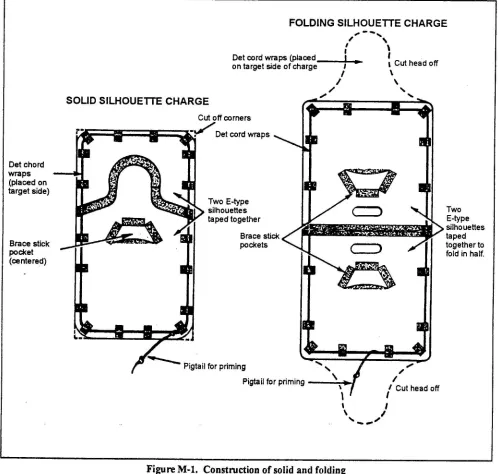
Interior walls generally require much less explosive to create a satisfactory breach than do exterior, load-bearing walls. An easily fabricated silhouette charge can further reduce the amount of explosiveneeded to breach plywood, sheet rock, or light plaster walls. It can also be used to breach wooden or metal doors. This charge produces a hole large enough for a man to run through. It can be emplaced quickly and throws only a small amount of dangerous material back into the first room.
Clf FM 90-10-1
FOLDING SILHOUETTE CHARGE
Det cord wraps (placed on target side of charge
,-....
,
"",I
\
,
,I
,.. , Cutheadoff
I \ I \
"
"
;" ....
SOLID SILHOUETTE CHARGE
Det chord wraps (placed on target side)
Cut off corners
-:/
Det cord wrapsBrace stick pocket
(ce nte red)
Two E-type silhouettes taped together
Brace stick pockets
;"
"
I
\ I Cut head off
\
,
II
\ I
"--~
Figure M-l. Construction of solid and folding
silhouette charges.
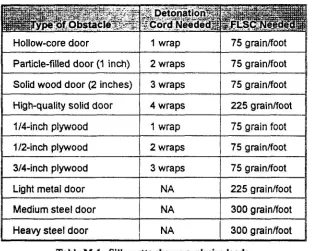
b. Place detonation cord or flexible linear-shaped charge (FLSC) around
the edges of the silhouettes, leaving a 6-inch tail for priming. Secure the cord
to the silhouette using sturdy tape. (See Table M-l for the appro
r
riate numberof wraps of detonation cord or FLSC to breach various barriers. Tape several small dowels or other materials at various places around the silhouette if using FLSC. This provides the necessary stand-off distance to ensure the maximum shaped charge effect. (See Table M-2 for the required stand-off distance for vanous sizes of FLSC.)
Hollow-core door 1 wrap 75 grain/foot
Particle-filled door (1 inch) 2 wraps 75 grain/foot
Solid wood door (2 inches)
I 3 wraps 75 grain/foot
High-quality solid door 4 wraps 225 grain/foot
ot fA :...-.1... _I...__~ ... ...-- ..,r:. -...-:... ,,--~ 1/"'-111"'11 ~.IIYWVVU I WI djJ I;J ~Idill IUVl
1/2-inch plywood 2 wraps 75 grain/foot
3/4-inch plywood 3 wraps 75 grain/foot
Light metal door NA 225 grain/foot
Medium steel door NA 300 grain/foot
Heavy steel door NA 300 grain/foot
Table M-l. Silhouette charge explosive loads. Cl, FM 90-10-1
75 grain
225 grain
0- 1/16 inch
1/8 inch
300 grain 1/8 inch
-
3/16 inchTable M-2. Standoff required for flexible linear-shaped charges
c. Using heavy-duty tape, place three or four strips of double-sided contact tape on the front of the silhouette from top to bottom. Construct a sturdy pocket for a brace stick in the appropriate position on the back of the silhouette.
d. Pull the covering off the double-sided tape and place the charge against the wall at knee height, bracing it if necessary. Prime, take cover, and
detonate.
M-4. DOOR-BREACHING CHARGES
Clf FM 90-10-1
a. The general-purpose charge is the most useful preassembled charge for breaching a door or other barrier. As its name implies, it is useful not only for
door breaching, but it can also cut mild steel chain and destroy captured enemy equipment.
(1) Start building the general-purpose charge with a length of detonation cord about 2feet long. Using another length of detonation cord, tie two uli knots (Figure M-2) around the 2-foot long cord. The uli knots must have a minimum of six wraps and be loose enough for them to slide along the main line. Trim excess cord from the uli knots and secure them with tape, if necessary .
(2) Cut a block of C4 explosive to a 2-inch square. Tape one uli knot to each side of the C4 block, leaving the length of detonation cord free to slide through the knots (Figure M-3).
-
~
UIIknots should be dressed and both knots should slide easily up and down the length of the cord.
Figure M-2. Sliding uli knots.
SLIDING ULI KNOTS
Clf FM 90-10-1
SQUARE KNOT
NONELECTRIC DUAL DETONATING ASSEMBLY
Figure M-4. Charge placement against doorknob.
DETAPRIME BOOSTER
----I ----I I I I I I I I I I I I I I I I I I I I I I I I I I I I I I IFigure M-5. Rubber band charge with Detaprime booster.
(3) To breach a standard door, place the top loop of the charge over the doorknob. Slide the uli knots taped to the C4 so that the charge is tight against the knob. Prime the loose ends of the detonation cord with either an electric or nonelectric firing system and detonate
(Figure M-4). To cut mild steel chain, place the loop completely around the chain link to form a girdl hitch. Tighten the loop against the link by sliding the uli knots.
b. The rubberband charge is another easily fabricated, lightweignt device that can be used to remove the locking mechanism or doorknob from wooden or light metal doors, or to break a standard-size padlock at the shackle.
(1) Cut a 1Q-inch piece of detonation cord and tie an overhand knot in one end. Using another piece of detonation cord, tie a uli knot with at least eight wraps around the first length of cord. As an alternative to the uli knot, pass the detonation cord through the center of a 20-gram Detaprime booster. Slide the uli knot or the Detaprime booster tightly up against the overhand knot. Secure it in place with either tape or string. Loo
?
a strong rubber band aroundthe base 0 the uli Knot tied around the detonation cord, or around the base of the booster. Tie an overhand knot in the other end of the cord to form a pigtail for priming the charge (FigureM-5).
(2) Attach the charge to the doorknob (or locking mechanism) by pulling the loose end of the rubber band arouna the knob. The charge should be placed between the knob and the door frame. This places the explosive over the bolt that secures the door to the frame.
c. One of the simplest field-expedient charges for breaching wooden doors is the flexible linear charge. It can be made in
particle-filled, and solid wood doors. When detonated, the flexible linear charge cuts through the door near the hinges (Figure M-6).
(1) Layout a length of double-sided contact tape with the top-side adhesive exposed. Place the necessary number of strands of detonation cord down the center of the double-sided tape, pressing them firmly in place. For hollow-core doors, use a single strand. For particle-filled doors, use two strands, and for solid wood doors use three. If the type doors encountered is unknown, use three strands. One of the strands must be cut about a foot longer than the others and should extend past the end of the double-sided tape. This forms a pigtail where the firing system is attached once the charge is in place.
(2) Cover the strands of detonation cord and all the exposed portions of the double-sided tape with either sturdy single-sided tape or another length of double-sided tape. Roll the charge, starting at the pigtail, with the double-sided tape surface that is to be placed against the door on the inside.
(3) At the breach site, place the charge straight up and down tightly against the door. If the charge is too long, angle it to best fit the door. If it is too short, place it so that it covers at least half of the door's height. Prime and fire the charge from the bottom.
FLEXIBLE frn LINEAR
--
Hl1CHARGE ~
...
Clf FM 90-10-1
LINEAR CHARGE
DOUBLE CONTACT
TAPE :~~
SUFFICIENT WRAPS OF DETONATING
CORD ~
PIGTAIL FOR PRIMING
,,--Figu re M-6. Placement of the flexible linear charge.
rl
0
Clf FM 90-10-1
d. A doorknob charge is easy to make and is highly effective against wooden or light metal aoors. Charges for use against wooden doors can be made with detonation cord. If the charge is to breach a light metal door, either detonation cord (3 lengths) or 225 grain/foot FLSC should be used.
(1) Cut the appropriate amount of detonation cord for the charge. Use a 3D-inch length for a nollow-core door. For a particle-filled door, use one 3D-inchlength and one IS-inch length. For a solid-core wooden door or a light metal door, use one 3D-inchlength and two IS-inch lengths.
(2) Cut the charge holder from a piece of stiff cardboard. (3) Tape the detonation cord in the sha
r
e of a large "C" along the edge ofthe charge holder. Leave a 12-inch pigtai for priming (Figure M-7). Place double-sided tape on the back of the charge holder.
(4) If using FLSC, cut a length 21 inches long. Cut a 2D-gram Detaprime booster in half. Tape the FLSC to the charge holder, leaving a 3-inch tail for priming. Bend the tail upward. Slide a 12-inch length of detonation cord through the Detaprime booster and tie an overhand knot on each end. Tape the booster and detonation cord combination to the tail end of the FLSC.
(5) Hang the charge on the door knob or locking mechanism. Secure it in place with the double-sided tape. The detonation cord must be held firmly against the door's surface.
3-STRANDS DET CORD
HOLE FOR DOORKNOB
-OR--
FLSCDET CORD TAIL
1/2 OF 20 GRAM BOOSTER FLSC BENT UP
*
APPENDIX NINFANTRY AND ARMOR SMALL-UNIT ACTIONS
DURING MOUT
The first and most fundamental lesson learned from recent us and allied operations in built-up areas is the value of the fully integrated combined arms team. There is no denying the value of light infantry
forces during MOUT However, combat or OOTW in urban areas
never should be considered a pure infantry task. Urban combat by units composed entirely of infantrymen is a historical anomaly. Across the spectrum of combat action in urban areas, powerful combined arms teams produce the best results. The actual composition of these teams must be determined based on a careful analysis by commanders at all levels. Light infantry units operating alone suffer from critical shortcomings that can be compensated for only by appropriate task organization with mechanized infantry, armor, and engineers. These teams must be supported by closely integrated aviation, fire support, communication, and logistical elements.
N-l. STRENGTHS, WEAKNESSES, AND EMPLOYMENT
CONSIDEA TIONS FOR SMALL COMBINED ARMS TEAMS
Because of the decentralized, fragmented nature of both OOTW and conventional battles in urban areas, dismounted infantrymen will always represent the bulk of any successful force. At the small-unit tactical level, light infantry forces have disadvantages that can be compensated for by mechanized infantry or armor units. Conversely, tanks and mechanized forces face problems in the confines of urban areas that place them at a severe disadvantage when operating alone. Only together can these forces accomplish their mission with minimal casualties while avoiding unnecessary collateral damage.
a. Light infantry forces lack heavy supporting firepower, protection, and long-range mobility. Armored forces, on the other hand, can deliver devastating fires, are fully protected against antipersonnel mines, fragments, and small arms, and have excellent mobility along unblocked routes.
b. Crewmen in armored vehicles have poor all-round vision through their vision blocks; they are easily blinded by smoke or dust. Tanks cannot elevate or depress their weapons enough to engage targets very close to the vehicle or those high up in tall buildings. Dismounted infantrymen have excellent all-round vision and can engage targets with small arms fire under almost all conditions.
Clf FM 90-10-1
d. If isolated or unsupported by dismounted infantry, armored vehicles (with the possible exception of the heavily protected main battle tank) are vulnerable to enemy hunter/killer teams firing light and medium antiarmor weapons. Armored vehicle gunners cannot easily identify enemy targets unless the commander exposes himself to fire by opening his hatch, or dismounted infantrymen direct the gunner onto the target.
e. Armored vehicles are noisy. Therefore, there is little chance of them arriving in an area undetected. Dismounted infantrymen can move stealthily into position without alerting the enemy. Armored vehicles can be blocked by improvised barricades, narrow streets and alleyways, or large amounts of rubDle. Dismounted infantrymen can move over or around most urban terrain, regardless of the amount of damage to buildings.
f. Although they have limited fields of view at the typically short ranges normally encountered during MOUT, the thermal sights on armored vehicles can detect enemy activity through darkness and smoke, conditions that limit even the best-equipped dismounted infantry.
g. In some OOTW situations, armored vehicles project a psychological presence, an aura of invulnerability, that aids the friendly forces in deterring violence. Mounted patrols by armored vehicles can monitor large areas of a city while making their presence known to the entire populace, both friendly and unfriendly.
h. During cordon and search operations, armored vehicles can move mounted infantrymen rapidly to points where, together, they can dominate and isolate the cordoned area. With their long-range sights and weapons, armored vehicles can dominate large expanses of open area and thus free dismounted infantry to cordon closer terrain and visual dead space.
i. The mobile protected firepower of armored vehicles can be used to add security to resupply convoys and to extract wounded personnel under fire. The armored vehicle's smoke-generation capability can aid this and other
small-unit actions.
N-2. INFANTRY-TANK/BFV COMBINED ARMS TEAM
Clf FM 90-10-1
tactical pause for reorganization and a change of tactical tempo, which could disrupt the ongoing combat operation at a critical time.
a. Traditionally, armored vehicles participating as part of a small-unit combined arms team have been tanKs working with small groups of dismounted infantrymen. However, the advent of the BFV (especially the heavily protected variants) has meant that successful infantry /tanl<-type teams can be created around a few BFVs and some dismounted infantry. The BFV lacks the tank's main gun, but it has a powerful weapons combination in the TOW/25-mm/ coax system. Unless specifically noted, the following discussion of infantry/tank teams also includes infantry/BFV and infantry/Sheridan teams. When the Armored Gun System (AGS) is fielded, it will replace the Sheridan armored vehicle in this role. Designed from the beginning to work closely with light infantry, the AGS will be an effective and powerful addition to the small-unit combined arms team.
b. The most common task organization of dispersed armor is to attach a tank platoon to an infantry company, with the platoon further subattached on the basis of a two-tank section to each of the lead rifle platoons. Individual tanks can be employed, but two-vehicle sections are preferred. A rifle squad is normally designated to work with each of the platoon's attached tanks.
c. Infantry/tank teams work together to bring the maximum combat power to bear on the enemy. The dismounted infantry provides the eyes and ears of the team. The infantry locates and identifies targets for the tank to engage. It maneuvers along covered and concealed routes to assault enemy elements fixed and suppressed by tank fire. It provides protection for the tank against attack by enemy dismounted infantry. Meanwhile, the tank provides heavy, continuous supporting fires against enemy strongpoints.
d. The dismounted infantry normally leads movement through built-up areas. The tanks follow and provide close overwatch. If the infantry discovers an enemy position or encounters resistance, the tank immediately responds with supporting fire to fix the enemy in place or suppress him and allow the infantry to develop the situation. After sufficient time to develop the situation or conduct short-range reconnaissance, the infantry squad leader directs the tank to move, if necessary, and identifies specific targets for the tank to engage.
e. Coordination between the tank commander and the squad leader must be close and continuous. The tank commander or driver may need to dismount and move, accompanied by the squad leader, to a position where the route or target can be better seen. Signals for initiating, shifting, or lifting fires must be understood by all. One of the greatest barriers to coordination and command and control in urban combat is the intense noise. Verbal commands should be backed up by simple, nonverbal signals.
Clf FM 90-10-1
ADA AGS ANGLICO AP APC APDS-T APFSDS AT ATGMs ATTN AXP BDAR BDU BFV BMNT BMPs BTRs CA CAS CEV CFV C1 CN COLT CP CS CSS DA DEA DPRE DS ECM
*
GLOSSARY
air defense artillery Armored Gun System
air naval gunfire liaison company armor-piercing, antipersonnel armored personnel earner
armor-piercing discarding sabot-tracer
armor-piercing, fin-stabilized, discarding sabot antitank
antitank guided missiles attention
ambulance exchange point
battle damage assessment and repair battery display unit; battle dress uniform Bradley fighting vehicle
beginning morning nautical twilight Threat fighting vehicles
Threat fighting vehicles
civil affairs close air support
combat engineer vehicle
combat fighting vehicle
configuration item; command information; counterintelligence chloroacetothenone
combat observation and lasing team command post
combat support, chemical smoke, Ochlorobenzylidene malononitrile combat service support
Department of the Army Drug Enforcement Agency
displaced persons, refugee, and evacuee direct support
Cl, FM 90-10-1 EOD EPW FA FAC FAE FASCAM FAST FBI FCL FEBA FIST FLIR FLSC FM FO FPF FPL FRAGO FSB FSE FSO G3 G5 GS GPS GSR GRREG HC HE HEAT HEAT-MY HEI -T HMMWV lAW
explosive ordnance disposal enemy prisoner of war field artillery
forward air controller fuel air explosives
family of scatterable mines
Freight Automated System for Traffic Management forward area support team
Federal Bureau of Investigation final coordination line
forward edge of battle area fire support team
forward-looking infrared flexible linear shaped charge field manual; frequency modulation forward observer
final protective fire final protective line fragmentary order final staging base fire support element fire support officer
Assistant Chief of Staff,G3(Operations and Plans) Assistant Chief of Staff, G5 (Civil Affairs)
general support
global positioning system ground surveillance radar graves registration
hydrogen chloride high explosive
high-explosive antitank
high-explosive antitank, multipurpose high-explosive incendiary-tracer
Clf FM 90-10-1
ICM ID IPB ITOW ITV
J5
LAW LCMS LD LIC LOGPAC LOS LTC
improved capabilities missile identification
intelligence preparation of the battlefield improved TOW
improved TOW vehicle
Plans and Policy Directorate
light antitank weapon
laser countermeasure system line of departure
low-intensity conflict
logistics package line of sight lieutenant colonel
MBA main battle area
MCOO modified, combined obstacleoverlay
MDP meteorologicaldatum plane, main defensiveposition MEDEVAC medical evacuation
METT-T mission, enemy, terrain, troops, and time available MOPP mission-orientedprotective posture
MODT military operationson urbanized terrain MP military police
MRB motorized rifle battalion MRR motorized rifle regiment
MSR main supply route
NATO NBC NCA NCO NEO NOE NVD NVG
OOTW OP
North Atlantic Treaty Organization nuclear, biological, chemical national command authority
noncommissioned officer
noncombatant evacuation operations nap-of-the-earth
night vision device night vision goggles
C1. FM 90-10-1 OPCON OPLAN OPORD OPSEC PA PAC PDDA PE PEWS POL PSYOP PW
RCLR
REMs ROE RP RPG S1 S2 S3 S4 S5 SALT SAW SEAD SEAL SF SIDPERS SMAW SOF SOP STB SWAT operational control operation plan operation order operational security public affairsPersonnel and Administration Center; plastic ammunition container power-driven decontaminating apparatus
probable error
platoon early warning system
petroleum, oils, and lubricants psychological operations prisoner of war
recoilless rifle
remote sensors rules of engagement
reference point, red phosphorus
Threat antiarmor weapon
Adjutant (US Army)
intelligence officer
Operations and Training Officer (US Army)
Supply Officer (US Army) Civil Affairs Officer (US Army) supporting arms liaison team
squad automatic weapon
suppression of enemy air defenses sea-air-Iand team
special forces
Standard Installation/Division Personnel System
shoulder-launched, multipurpose, assault weapon special operations force
standing operating procedure supertopical bleach
Special Weapons and Tactics (civilian police)
Clf FM 90-10-1
TF II TM TNT TOC TOW TP-T TRADOC TTP
UAV UCMJ US USAF USMC USN VT
WP
task force
technical inspection; technical intelligence technical manual, team (graphics only) trinitrotoluene
tactical operations center
tube-launched, optically tracked, wire-guided missile target practice-tracer
Training and Doctrine Command tactics, technics, and procedures
unmanned aerial vehicle
Uniform Code of Military Justice United States
United States Air Force United States Marine Corps United States Navy
variable time