of SAC 2004,
Lecture Notes in Computer Science, Springer-Verlag, 2004.
Extending the Resynchronization Attack
(extended version)
⋆Frederik Armknecht1⋆⋆ and Joseph Lano2⋆ ⋆ ⋆and Bart Preneel2
1 Universit¨at Mannheim
Theoretische Informatik 68131 Mannheim, Germany
2 Katholieke Universiteit Leuven
Dept. Elect. Eng.-ESAT/SCD-COSIC, Kasteelpark Arenberg 10, 3001 Heverlee, Belgium
{joseph.lano,bart.preneel}@esat.kuleuven.ac.be
Abstract. Synchronous stream ciphers need perfect synchronization be-tween sender and receiver. In practice, this is ensured by a resync mech-anism. Daemen et al. [9] first described attacks on ciphers using such a resync mechanism. In this paper, we extend their attacks in several ways by combining the standard attack with cryptanalytic techniques such as algebraic attacks and linear cryptanalysis. Our results show that using linear resync mechanisms should be avoided, and provide lower bounds for the nonlinearity required from a secure resync mechanism.
1
Introduction
Synchronous stream ciphers generate a key stream independently from the plain-text. They typically consist of a finite state machine from which at each iteration a key stream bit is generated by an output function. Synchronous stream ciphers have the advantage that there is no error propagation. On the other hand, per-fect synchronization between sender and receiver is required. In order to prevent synchronization loss or to restore synchronization after synchronization loss is detected, a resynchronization mechanism is used. Such a mechanism generates a new initial state for the finite state machine from the secret key and a unique ⋆This work was supported by the Concerted Research Action (GOA) Mefisto-2000/04
of the Flemish Government.
⋆⋆ This work has been supported by grant 620307 of the DFG (German Research Foun-dation)
initialization vectorIV and thus prevents the reuse of key stream. For the sake of efficiency the resynchronization mechanism should be as fast as possible.
Daemen, Govaerts and Vandewalle [9] observed that this resynchronization mechanism can lead to a new type of attacks on synchronous stream ciphers. They also showed an efficient attack on nonlinearly filtered systems using a linear resynchronization mechanism and using an output Boolean function with few inputs. Golic and Morgari [12] extended this attack to the case where the output function is unknown. Borissov et al. [6] showed that a ciphertext-only attack is also possible in some cases.
In this paper, we extend the resynchronization attack to overcome some limi-tations of the original attack of Daemenet al. We achieve this by further refining the original resynchronization attack and by combining the attack with other attack methodologies, notably with algebraic attacks.
The paper is organized as follows. In Sect. 2, we present some preliminary notions: Boolean functions, the general framework of a stream cipher, algebraic attacks and resynchronization attacks. In Sect. 3 we present the Daemen et al.
attack and its limitations. In Sect. 4 we show how to perform the Daemenet al.
attack in real-time by precomputation. In Sect. 5 we describe several methods to mount a resync attack when the number of resyncs is small. Section. 6 describes methods to mount attacks when the output function has many inputs. In Sect. 7, we describe attacks on stream ciphers with memory and in Sect. 8 we discuss attacks on stream ciphers with nonlinear resynchronization mechanism. In Sect. 9, we apply some of the attacks described on some stream ciphers: E0 from the Bluetooth standard, Toyocrypt and the summation generator. We conclude in Sect. 10.
2
Preliminaries
2.1 Boolean Functions and Related Inputs
In this section we repeat some definitions and known facts about Boolean func-tions. Additionally, we provide some theorems about Boolean functions and re-lated inputs. All calculations are done over the finite field GF(2).
Definition 1 For α = (α1, . . . , αn) and x = (x1, . . . , xn) ∈ {0,1}n, we define
mα(x) :=Qixαii and the degree degmα:=|α|:= #{i|αi= 1}.
Theorem 2 (Algebraic Normal Form) Let f : {0,1}n → {0,1} be a Boolean function. Then, f(x) can be written as f(x) =Lα∈{0,1}ncα·mα(x) for unique coefficients cα ∈ {0,1}. Hence, the value max{degmα|cα 6= 0} is unique and is called the degree degf off.
Definition 3 For α = (α1, . . . , αn), α′ = (α′1, . . . , α′n) ∈ {0,1}n we say that
α′ ≤αif ∀i: α′
i≤αi (treated as integers). Consequently, we say that α′ < α if
α′ ≤αbutα′ 6=α. Forα′≤αwe defineα−α′:= (α1−α′
Obviously, α′ ≤ α (resp. α′ < α) implies degm
α′ ≤ degmα (resp. degmα′ <
degmα).
Lemma 4 Let α, δ(1), δ(2) ∈ {0,1}n be arbitrary. For i = 1,2 it holds that
mα(x⊕δ(i)) =Lα′≤αmα′(x)mα−α′(δ(i))andmα(x⊕δ(1))⊕mα(x⊕δ(2))has a degree≤degmα−1.
Proof. The first equation is obvious. The second one is because of: mα(x+δ(1)) +mα(x+δ(2))
=Pα′≤α mα′(x)mα−α′(δ(1)) +mα′(x)mα−α′(δ(2))
=mα(x) +mα(x)
| {z }
=0
+Pα′<α mα′(x)mα−α′(δ(1)) +mα′(x)mα−α′(δ(2))
. ⊓⊔
Theorem 5 Let f be a Boolean function with degf =d. Then, f(x⊕δ(1))⊕ f(x⊕δ(2))has a degree≤d−1.
Proof. By theorem 2 we can writef(x) asPα,|α|≤dcαmα(x). Then, by lemma 4
it isf(x⊕δ(1))⊕f(x⊕δ(2)) =L
α,|α|≤dcα
mα(x⊕δ(1))⊕mα(x⊕δ(2))
| {z }
deg≤d−1
. ⊓⊔
The following corollary is obvious:
Corollary 6 For any even numberm and any vectorsδ(1), . . . , δ(m), the degree
of the functionLmi=1f(x⊕δ(i)) is≤degf −1.
Theorem 7 is a special case of theorem 5 and will be of use in this paper: Theorem 7 Letf be a Boolean function withdegf =d. Let ei∈ {0,1}n be the unit vector with its only1in positioni. Then the functionf1(x′) =f(x)⊕f(x⊕ei)
has degree≤d−1, where x′= (x1, . . . , x
i−1, xi+1, . . . , xn)∈ {0,1}n−1.
Proof. We first split the functionf(x) into two parts, the first part consisting of the monomials containing xi, and the second part consisting of the monomials
not containingxi as a factor:
f(x) =xi·f1(x′)⊕f2(x′), (1)
where it is straightforward to see that degf1≤d−1 and degf2≤d. We do the same for the functionf(x⊕ei):
f(x⊕ei) = (xi⊕1)·f1(x′)⊕f2(x′). (2)
Taking the XOR of the equations (1) and (2) and eliminating terms occurring
2.2 General Framework for Synchronous Stream Ciphers
We consider a synchronous stream cipher withn-bit stateSupdated by a linear function represented by a matrixL(e.g., one or more LFSRs) overZ2, and with a nonlinear output functionf that takesϕinput bits coming fromS to produce one output bitzt. Some designs (e.g., the combiners with memory) also include
a m-bit memoryM that has a nonlinear update function h. This results in the following general framework for a synchronous stream cipher:
zt=f(St, Mt)
ct=pt⊕zt
St+1=L·St
Mt+1=h(St, Mt),
(3)
wherept,ztandctare respectively the plaintext, the key stream and the
cipher-text at timet= 0,1,2. . .
The initial state (S0, M0) is determined by the resynchronization mechanism, which combines ak-bit secret keyK and aι-bit known initialization vectorIVi
with an initialization functionfinit:
(S0, M0) =finit(K,IVi). (4)
2.3 Algebraic Attacks
In this section we repeat some facts about algebraic attacks against LFSR-based key stream generators. We describe the general attack on combiners with memory introduced in [2] as this includes the special case of memoryless combiners [7].
An algebraic attack works as follows: first find a Boolean function F 6≡ 0 (called an ad-hoc equation) such that for alltit holds
0 =F(Lt·K, . . . , Lt+r−1·K, z
t, . . . , zt+r−1). (5)
Such a functionF can be found with the algorithm of [2] ifϕ·ris not too large. Secondly, recover the secret keyKby solving this system of equations. For this purpose, several methods (Linearization, XL, XSL, Groebner bases, . . . ) exist. Amongst them only the linearization method allows a general estimation of the work effort. We give now a description of the linearization method. Due to the linearity ofL, all equations (5) have degree≤d:= degF. Therefore, the number
Mof different monomials occurring is limited by:
M ≤
k 0
+. . .+
k d
=:β(k, d)∈O(kd). (6)
By replacing each monomial by a new variable, the attacker gets a linear system of equations inMunknowns. It can be solved by Gaussian elimination or more refined methods like the one by Strassen [26]. Asβ(k, d)∈O(kd), the lower the
2.4 Resynchronization Attacks
For a synchronous stream cipher, perfect synchronization between sender and receiver is required. The aim of the resynchronization mechanism is to achieve this in a secure fashion.
A first solution is fixed resync. In this scenario, the message is divided into frames, and each framei is encrypted with a unique IVi, a frame counter up-dated in a deterministic way. An attack under this scenario is called aknown IV
resynchronization attack. The frequency at which resynchronization should occur depends on the risk of synchronization loss. Examples of stream ciphers that use fixed resync are theE0 algorithm used in the Bluetooth [5] wireless communica-tion standard, and A5 [1] used in GSM cellular voice and data communicacommunica-tion.
A second scenario is that the receiver sends a resynchronization request to the sender as soon as synchronization loss is detected. This is calledrequested resync. In this scenario, the receiver may be allowed to choose the nonceIVi used in the frame. This may enable achosen IV resynchronization attack, as describede.g.
by Joux and Muller [15]. Security under the chosenIV attack scenario implies security under the knownIV attack scenario. Hence, a good resynchronization mechanism should be resistant against a chosenIV attack.
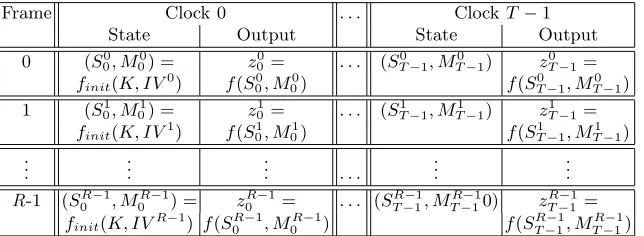
Table 1 shows the general setting for a resync attack as used throughout this paper. For R frames, the attacker knows the first T key stream bits.3 He also knows the initial valueIVi of each frame.
Frame Clock 0 . . . ClockT−1
State Output State Output
0 (S0
0, M00) = z00= . . . (ST0−1, M
0
T−1) z
0
T−1= finit(K, IV0) f(S00, M00) f(ST0−1, M
0
T−1)
1 (S01, M01) = z01= . . . (ST1−1, M
1
T−1) z
1
T−1= finit(K, IV1) f(S01, M01) f(ST1−1, M
1
T−1)
..
. ... ... . . . ... ...
R-1 (SR−1
0 , M0R−1) = z0R−1= . . . (STR−−11, M
R−1
T−10) z
R−1
T−1 = finit(K, IVR−1) f(S0R−1, M0R−1) f(STR−−11, M
R−1
T−1)
Table 1.The situation of a frequently reinitialized key stream generator
We now describe a first resynchronization attack by Daemen et al. [9] on a simplified version of this framework and point out its limitations.
3 For most attacks described in this paper, the observed key stream bits need not be
3
The Daemen
et al.
Resynchronization Attack
3.1 Description
The resynchronization attack of Daemen et al. is a known plaintext attack for the special case of a simple memoryless combiner with a linear resynchronization mechanism.
The framework of the attack can be described as follows:
Si
0=A·K⊕B·IVi zi
t=f(Π·Sti)
Si
t+1=L·Sti.
(7)
In these equations,A, B, Land Π are known binary matrices,A∈Zn2×k, B ∈
Zn2×ι,L∈Z
n×n
2 and Π ∈Z
ϕ×n
2 . The matricesAand B represent the fact that the resync mechanism is linear, the projection matrixΠ shows that the output functionf uses only a subset of ϕbits of Si
t. The initialization vector of theith
frame isIVi, andzi
tis the key stream bit at time tof theith frame.
We introduce the key-dependent unknown values kt and the known values ivitas follows:
kt=Π·Lt·A·K ivi
t=Π·Lt·B·IVi .
(8) Using the setting from Table 1, the attacker can then rewrite this system into a system of equations built as follows:
zti=f(kt⊕ivi
t) for 0≤i≤R−1, 0≤t≤T−1. (9)
Now we try to find a solution of this system of equations for each t. Assume without loss of generality thatt = 0. If ϕis not too large, we can perform an exhaustive search overk0, and check whether the guess satisfies theRequations fort= 0. IfR≥ϕ, it is expected that a unique solution fork0 exists. Hence the correct value ofk0has been found, and thusϕlinear equations in the bits of the secret key. This is repeated fort= 1,2, ..., p−1, such thatp=⌈k/ϕ⌉, until the entire secret key is deduced.
The complete attack requires on average⌈k/ϕ⌉ ·2ϕ evaluations of the
func-tionf, at least ϕ resyncs and about k bits of key stream in total (ϕframes of length⌈k/ϕ⌉). Note that the computational complexity of the attack increases exponentially with the numberϕof inputs of the Boolean function f.
3.2 Limitations
The Daemenet al.attack can be seen as a divide-and-conquer attack. Standard cryptanalytic attacks such as correlation and algebraic attacks work chronologi-cally on a key stream, which corresponds to a row in Table 1. On the contrary, the Daemenet al.attack tries to solve the system column by column. One of the motivations of the paper is to combine both approaches. Of special interest is the combination of the resynchronization attack with algebraic attacks.
1. The attack does not work in real time.
2. The number of resyncsRhas to be at least the numberϕof input bits of the output function f.
3. The complexity is prohibitively large for large values ofϕ.
4. The divide-and-conquer approach does not work if the key stream generator uses additional memory.
5. The initialization functionfinit has to be linear.
In this paper, we will address each of these limitations and show how to overcome them.
4
Real-time Attack
The attack of Daemenet al.shows that ciphers that use a linear resynchronization mechanism and that have a Boolean functionf with few inputs are insecure. This enables a passive attack on such designs. A real-time attack in which the attacker can discover the plaintext immediately (and even modify it in a controlled way) is not possible, because the time required to perform thepexhaustive searches will be too high. Here we show how to easily replace this iterated exhaustive search by a precomputation step. This enables real-time active attacks on such ciphers. We start from the realistic assumption that the IVis are chosen in a de-terministic way, for instance by a counter or a fixed update mechanism. In the precomputation step, we first calculate the values ivi
t for 0 ≤ i ≤ ϕ−1 and
0 ≤ t ≤ T −1. Then we calculate the following ϕ bits, and repeat this for all values ofgt(a guess for kt) going from 0 to 2ϕ−1, and this for all t.
f(gt⊕iv0
t) =b0gt,t
f(gt⊕iv1
t) =b1gt,t
...
f(gt⊕ivϕ−1
t ) =b ϕ−1 gt,t .
(10)
For each timet, we obtain 2ϕ sequencesb0
gt,tb1gt,t. . . b ϕ−1
gt,t. Because the length of
these sequences isϕ, every value ofgtis expected to correspond with a unique sequence b0
gt,tb1gt,t. . . b ϕ−1
gt,t. We then sort the gt values based on the numerical
value of the corresponding sequence, and store this in memory.
The attack now goes as follows. We group the outputs observed at sayt= 0 in a sequencez0
0z10...z
ϕ−1
0 . We jump to this position in our table built fort= 0, and the value found there is the correct value ofk0. We do the same for the times t= 1,2, ...p−1, and we have then found the necessaryki to directly determine the secret keyK.
The total complexity of the precomputation step is about k·2ϕ evaluations
off (but this can of course be replaced by 2ϕ evaluations off andk·2ϕ table
look-ups). The memory requirement is aboutk·2ϕbits, which is feasible for many
5
Attack with a Small Number of Resynchronizations
In [9], the authors made the assumption that the number of solutions converges to 1 if R &ϕ. Actually, the number of required resyncs depends on the cipher and the observed public parametersIVi. In [14], Golic and Morgari discussed the
number ofIVs that are needed for the Daemenet al.attack to work. They showed that with a non-negligible probability more thanϕknownIVs are necessary. This results in an increased attack complexity, both for the original attack and for the precomputation attack.
We will here follow different approaches. We want the attacks to work in any case and with a minimal number of knownIVs. Simulations on various Boolean functions have confirmed that the standard resynchronization attack does not always work in practice withϕ IVs. This is due to two reasons, the first being imperfect behavior of the functionf. However, this effect is not very important because in most stream ciphers the function f has good statistical properties, which typically include balancedness and high nonlinearity. A second reason is that sometimes collisions occur between two valuesiva
t andivbt wherea6=b. We
will show several ways to overcome this problem.
5.1 Computational Approach
Two-phase attack. We implement the algorithm in two steps. The first step, the resynchronization attack, retains a set of values for each of thek0,k1. . .kp−1. In a second step, we then search through all possible combinations until we have found the correct secret key.
Simulations have shown that forϕ(or more) knownIVs, the time complexity of the second step is negligible. In other words, the resynchronization attack (ex-tended with the fast search step) is always successful under realistic assumptions withϕknownIVs.
Using this two-step algorithm, one can also mount a resynchronization attack with R < ϕ knownIVs. The time complexity of the second step can then be shown to be about 2(ϕ−R)·ϕk. Even if this complexity increases exponentially
with decreasingR, this shows that a resynchronization attack is still feasible for Rsmaller than (but close to) ϕ.
Overlapping bits. There is also another interesting way to perform a resyn-chronization attack whenR < ϕ. Let’s take the caseR=ϕ−1. Forkt, we will get two possibilities after the exhaustive search. But looking at the bits of these two possibilitieskt,1andkt,2, about half of these will be equal, and will therefore certainly be the correct values for these bits ofkt. This implies that we have still foundϕ/2 linear equations inK, and we will just need frames that are twice as long as in the standard attack,i.e., have lengthT ≥2k/ϕeach. This is still very realistic in most cases. We can develop a similar reasoning for smaller values of R, but the length of the frames and the complexity required increases rapidly: they can be shown to be 22ϕ−R−1
·k/ϕand 22ϕ−R−1
·k/ϕ·2ϕ respectively (see
In Table 2, we summarize the complexities of the attacks. We also give a realistic example for a secret key ofk= 300 bits andϕ= 30. This clearly shows that limiting the number of allowed resyncs per secret key to less thanϕwill not prevent a resynchronization attack. We will also give an example of this later on when we discuss the attack on Bluetooth.
Table 2.The complexities of the practical resynchronization attacks
Attack Resyncs needed Length of each frame Total complexity
Daemenet al. ϕ k/ϕ /ϕ·2ϕ
30 10 bit 233
Two-phase attack R(< ϕ) k/ϕ k/ϕ·2ϕ+ 2(ϕ−R)·k/ϕ
29 10 bit 233
28 10 bit 233
27 10 bit 233
26 10 bit 240
Overlapping bits R(< ϕ) 22ϕ−R
−1·k/ϕ 22ϕ−R−1·k/ϕ·2ϕ
29 20 bit 234
28 80 bit 236
27 1280 bit 240
26 328 kb 248
5.2 Using Algebraic Attacks
As we have pointed out, Table 1 implies the following system of equations: zti=f(kt⊕ivit), 0≤i≤R−1, 0≤t≤T−1. (11)
Hence, another possibility is to try to solve it as a whole instead of “column-by-column.” The linearization method described in 2.3 requires that the number of linearly independent equations exceeds the number of occurring monomials
M. This requires T ·R ≥ M. As M is upper bounded by β(k, d′) ∈ O(kd′
) with d′ = degf, the lower the degree of the equations the faster the attack.
In the literature [7, 8, 18, 4], several conditions and methods are described for transforming (11) into a new system of equations
g(kt⊕ivi
t, zti) = 0, 0≤i≤R−1, 0≤t≤T−1. (12)
The Degree-d-1 attack. The first approach is to construct new equations of degree≤d−1. We expressgby
g(kt⊕ivi
t, zti) =
M
j
gj(kt⊕ivi
t)·˜gj(zti). (13)
Observe that the functionsgj and ˜gj depend only ongand are all known to the
attacker. The idea is to find appropriate linear combinations of (13) to reduce the degree. LetI:={j|deggj =d} and rewrite (13) to
g=M
j∈I
gj·˜gj
| {z } deggj =d
⊕M
j6∈I
gj·g˜j
| {z } deggj<d
. (14)
Theorem 8 provides a method for decreasing the degree at least by 1: Theorem 8 Letgbe expressed as described in (13). Foranyknowniv0
t, . . . ,iv| I|
t and corresponding known outputszi
t, coefficientsc0, . . . , c|I|∈ {0,1}with at least
one ci 6= 0 can be computed such that the degree ofLi|I=0| ci·g(kt⊕ivi
t, z
(i)
t ) is
≤degg−1.
Proof. We set gi
j := gj(kt⊕ivi
t) and ˜gij := ˜gj(zti)∈ {0,1}. With (13), we can
write
|I|
M
i=0
ci·g(kt⊕ivit, zti) =
M
j∈I
|I|
M
i=0
ci·˜gij·gij ⊕
M
j6∈I
|I|
M
i=0
ci·˜gji·gji
The second part of the right hand side has a degree ≤ d−1 by definition of I. The idea is to find coefficients c0, . . . , c|I| ∈ {0,1} such that the first part of
the right hand side has degree≤d−1 too. By Corollary 6, it is sufficient that P|I|
i=0ci·g˜ij (treated as an integer) is an even number for allj∈I.
We show now that it is always possible. For eachiwe define the vector−→Vi :=
˜
g1(i), . . . ,˜g (i)
|I|
∈ {0,1}|I|. Then the assumption above is equivalent toL
ici·−→Vi =
−
→0 . By the theory of linear algebra, the|I|+1 vectors of the|I|-dimensional vector
space{0,1}|I|are linearly dependent. Therefore, such coefficientsc
i exist. ⊓⊔
Let Me be the number of monomials of degree≤ e occurring in (12). The
attack complexity is as follows. First we have to calculate (for a fixed clockt) the coefficients ci. This requires O(|I|3) operations. Then, the computation of the
function of degree≤d−1 is equivalent to the summation of (several) vectors of sizeMd−1. The two steps have to be repeated aboutMd−1times to get enough linearly independent equations of degree≤d−1. The final step is to use Gaussian elimination to solve the linearized system of equations≈(Md−1)3. Therefore the
overall number of operations is about
|I|3+M
d−1
Because ofMe≤β(k, e), an upper bound is
|I|3+β(k, d−1)·β(k, d−1) +β(k, d−1)3. (16) Note that it may happen thatLici·g(kt⊕ivi
t, zti) is equal to zero for some t.4
As opposed to fast algebraic attacks [8, 3], this approach does not require the highest-degree monomials to be independent of the key stream bits. Moreover, the number of key stream bits required is≤β(k, d−1) +|I|instead of≤β(k, d). On the other hand, fast algebraic attacks benefit from the fact that the most time consuming part can be sourced out in a precomputation step. This is not possible here. Another advantage is that its applicability is independent of the values ofivi
tandzti and that it does not requireϕto be low.
The Degree-e attack. So far, we concentrated only on decreasing the degree by 1. But clever combinations may reduce the degree even further. In the worst case these combinations may be linear, even if the degree ofgis high. This is for example the case for theE0 key stream generator.5We develop now the theory how to compute the lowest possible degree. In the following, we treat k as ϕ unknowns.
Definition 9 We set S(g) :={g(k⊕iv, z)| iv∈ {0,1}ϕ, z∈ {0,1}}and define
by < g >:=< S(g)> the linear span of S(g) (i.e., all possible linear combina-tions).< g > is a vector space over the finite field GF(2). Bydimgwe define the dimension of< g > and by B(g)an arbitrary basis of < g >. Further on we set Md(g)to be all monomials of degree ≤dwhich occur inS(g).
From the theory of linear algebra, the following theorem is obvious:
Theorem 10 A function of degree ≤ e exists in < g > only if the vectors in
B(g)∪ Me(g)are linearly dependent.
LetS be a set of Boolean functions. We now describe an algorithm to compute a linearly independent set of functions<S >with the lowest possible degreee: We treat the functions inS like rows of a matrix where each column reflects one occuring monomial. Then, we apply Gaussian elimination in such way that the monomials with the highest degree are eliminated first and so on. Finally, we just pick those functions in the result with the lowest degree.
If S = B(g), the algorithm computes the lowest possible value for e. Let ˜
B :={g(kt⊕ivit, zti)| 0 ≤i ≤R−1} be the set of functions available to the attacker.<B >˜ might be only a subset of< g >. In this case, the lowest possible degree can be higher.
We try now to estimate the complexity of the Degree-e attack. The first step is to find an appropriate linear combination in ˜B. The effort is about (dimg)2· |M
d(g)| to find the linear combination and about Me to compute 4 For example, this can not be avoided ifgis linear. But in this case, the cipher is weak
anyhow.
the corresponding vector of sizeMe. This has to be repeated at leastMetimes.
Finally, a system of equations inMehas to be solved (≈ M3e). Hence, the overall
number of operations is about ((dimg)2· |M
d(g)|+Me)· Me+M3e. (17)
Because ofMe≤β(k, e) and dimg ≤ Md≤β(k, d), the following expression is
an upper bound for the complexity
(β(ϕ, d)3+β(k, d))·β(k, e) +β(k, e)3 (18) In the individual case, the applicability of this attack depends on many pa-rameters: the functiong, the numberRof accessible frames and the corresponding values ofiviandzi
t. Hence the attack does not work in every case. On the other
hand, it puts on the designer the responsibility of making sure that these attacks are not feasible.
Moreover, if the set ˜B is a basis of < g >, then an equation of the lowest possible degree can be constructed. What is the probability that this happens? Lets:= dimg andR≥s. If we assume that each expressiong(kt⊕ivi
t, zit) is a
random vector in{0,1}sthen by [29], the probability that ˜B is a basis of< g >
is
Prob =
m
Y
i=R−s+1
1− 1
2i
(19)
6
Resynchronization Attacks with Large
ϕ
The Daemenet al.attack only works when the numberϕof inputs to the Boolean function is not too large. However, we will show in this section that using a linear resynchronization mechanism will inevitably induce weaknesses into stream ciphers, even whenϕ is very large. We will show a chosenIV attack, a known
IV attack and an algebraic attack.
6.1 A ChosenIV Attack
The standard attack has a large time complexity of⌈n/ϕ⌉ ·2ϕevaluations of the
functionf, but it only requires ϕresyncs. We will now show that a tradeoff is possible.
Let kt in (9) consist of the bits k0, k1, . . . kϕ−1. We make the reasonable assumption that in the chosenIV attack, the attacker can control the values of ivi
t, consisting of the bitsiv0,iv1, . . .ivϕ−1. We now start the chosenIV attack.
We first take a constantC. We then perform resyncs with all the values ivi
t=
C⊕i, where we letitake all values6going from 0 (00. . .0) to 2u−1 (00. . . 011. . . 1) 6 The impact of this choice ofiis that the lastuinput bits off will take all possible
values. Of course we can do the same with any combination ofubits by choosingi
for some u. Let’s consider the first two values of our resynchronization attack. We denoteki⊕ivi asxi. We know that:
f(x0, x1, . . . xϕ−1) =z00 f(x0, x1, . . . xϕ−1⊕1) =z01.
(20)
By XORing both equations and using Theorem 7 we get:
f1(x0, x1, . . . xϕ−2) =z00⊕z01, (21) where the Boolean function f1 has many properties that are desirable for an attacker. The degree off1is lower, it has fewer monomials and it depends on less variables thanf. This makes many attacks much easier.
In our attack, we will apply this method with 2u chosenIVs in an iterative
way. As an illustration, these are the equations foru= 2. f(. . . xϕ−2, xϕ−1) =z00
f(. . . xϕ−2, xϕ−1⊕1) =z01
⇒ f1(. . . xz0 ϕ−2) = 0⊕z01 f(. . . xϕ−2⊕1, xϕ−1) =z02
f(. . . xϕ−2⊕1, xϕ−1⊕1) =z03
⇒ f1(. . . xz2 ϕ−2⊕1) = 1⊕z30
⇒ f2(x0z0 . . . xϕ−3) = 0⊕z01⊕z20⊕z03 (22) The basic attack requires at every time 2u·ϕresyncs, in order to obtain ϕ−u equations in the Boolean functionfu(x0. . . xϕ−u−1) which can then be used in a
normal resynchronization attack.
In practice, however, we note that the number of monomials, variables and the degree of the equation decreases very rapidly, making the attack work with very small complexity. We will give an example using the Boolean function of Toyocrypt in Sect. 9.2.
6.2 A Known IV Attack
We now describe another attack, which shows that the linear resynchronization mechanisms introduces weaknesses in the fixed resync setting for all Boolean functions.
The principle of the attack is similar to the linear cryptanalysis method, developed by Matsui for attacking block ciphers [17]. First we search for a linear expression for the Boolean function that holds with probabilityp6= 0.5. We then collect sufficiently many resyncs such that we can determine key bits using a maximum likelihood method. We will now describe this in more detail.
Our starting point is the fact that for anyϕ-input nonlinear Boolean function f, we can always find a subsetS⊂ {0,1, . . . ϕ−1}for which the equation
M
i∈S
xi =f(x0, . . . xϕ−1) (23)
equations:
L
i∈Ski=
L
i∈Siv
0
i⊕z1t
.. . L
i∈Ski=
L
i∈Siv I−1
i ⊕ztI−1,
(24)
each of which holds with probability 0.5 +ǫ. We now count for how many of these equations the right hand side is 1 respectively 0. We assume then that the correct right hand side is the value (0 or 1) that occurs most ifǫ >0, and the value that occurs least ifǫ <0.
We now have found one linear equation in the state bits that is true with some probability. This probability increases with the value ofRand is dependent on the magnitude of ǫ. As in [17], the probability that the equation is correct, givenRresyncs and a bias ǫ, is equal to:
Z ∞
−2·√R·|ǫ|
1
√
2·π·e
−x2/2
·dx= 0.5 + 0.5·erf(√2·R· |ǫ|), (25)
where erf is the error function. If we want the probability of correctness to approach one, we need the number of resyncsRto bec·ǫ−2for a small constant valuec.
The output of a Boolean function is correlated to at least one linear function of the inputs, see Xiao and Massey [28]. The smallest biasǫthat can be found7is at least 2−ϕ
2−1. This implies that any linear resynchronization mechanism with a ϕ-input Boolean functionf can be broken by this resynchronization attack using at most about 2ϕ+2 knownIVs.
How to search for the best linear approximation has been well-studied. The Walsh-Hadamard transform can be used to find the best linear approximation, see [23] for a thorough treatment. In the context of correlation attacks, such linear approximations have been studied in the literature, both for memoryless combiners and nonlinear filter generators [23] as for combiners with memory [12, 19].
The biases found in actual Boolean functions used in stream ciphers will be much higher than the lower bounds described above. This is due to several reasons: the functions have to be balanced, they have to be easily implementable, and for combiners they will also have to take into account the trade-off that has to be made between nonlinearity and resilience, see Sarkar and Maitra [25]. It can be expected that most Boolean functions used in practice are vulnerable to this knownIV attack on a linear resynchronization mechanism.
7 This lower bound for ǫ follows from the universal nonlinearity bound for Boolean
6.3 An Algebraic Attack
As said in Sect. 5.2, the goal is to find a solution to the equations: g(kt⊕ivi
t, zti), 0≤i≤R−1, 0≤t≤T−1 (26)
Again, the approaches to reduce the degree as described in Sect. 5.2 can be also applied here.
If all bits of kt are uniquely specified by the equations, use Gr¨obner bases or the linearization method to solve (26) clock by clock. If the degree of the equations is low (e.g., Toyocrypt), it might be faster and require less IVs than the approach described in 6.2.
6.4 The Degree-1 Attack
Another approach is to apply the methods described in Sect. 5.2 if e = 1 is possible. In this case, we get at least one linear equation in the bits ofktdirectly. If we repeat this for enough values oftthe correspondingKcan be reconstructed by solving a system of linear equations.
The exact effort depends on many parameters: the functiong, the numberR of frames, the corresponding values ofivi and zi
t and so on (see also Sect. 5.2).
Due to (17), the number of operations is about
((dimg)2· |Md(g)|+k)·k+k3 (27)
or more general
(β(ϕ, d)3+k)·k+k3 (28)
Expression (28) shows that the approach might be feasible if the degreedis small.
7
Attacks on Combiners with Memory
Many stream ciphers use their linear state in conjunction with a (small) non-linear memory in order to avoid the trade-off between correlation immunity and nonlinearity for the combining function, see Rueppel [22].
In this section we demonstrate that resynchronization attacks can also be performed on stream ciphers with memory. Note that the knownIV attack of Sect. 6 can also be applied on combiners with memory.
7.1 A Standard Resynchronization Attack
We will use the following model based on the general case of the combiners with memory:
S0i=A·K⊕B·IV
i
(29)
M0i= const (30)
Sti+1=C·Sti (31)
Mi
t+1=h(D·Sti, Mti) =h(kt⊕ivit, Mti) (32) zi
In practice, some designs only start outputting key stream when t = µ; this results in an improved diffusion of the key and the initialization vector into the nonlinear state. We will discuss both the cases µ= 0 and µ > 0. Note that in some designsMi
0is also dependent on the key and theIV. This can in our model be treated in the same way as the caseµ >0.
µ = 0. In the case µ= 0, the resynchronization attack can easily be adapted to work also with combiners with memory. We again describe the attack withϕ resyncs.
The first series of outputs can be written as zi
0 =f(k0⊕ivi
0, M0i). Because Mi
0 is known, the attacker can recover k0 by exhaustive search. He can then determineMi
1 for all the resyncs using (32). Now he knows all inputs to (33) for t= 1 except k1, which he can again recover through exhaustive search, and so on. All complexities of this attack are exactly the same as for the case without memory. The only difference is that each step now consists of one evaluation of f and ofϕevaluations ofh.
µ > 0. The attacker does not know the initial contents of the m-bit memory M. Moreover, this memory is different for each resync. The attack now works exactly as above, except that the attacker will first have to guess the contents of M at t =µ. The time complexity of the attack now becomes 2ϕ·m· ⌈n/ϕ⌉ ·2ϕ
evaluations of thef and hfunction. As ϕand mare quite small in most actual designs, the attacks are feasible.
Let’s take as an example a combiner consisting of 5 LFSRs with total length 320 bits, and with 5 memory bits. The complexity of the resynchronization attack is then equal to 236 function evaluations.
Practical considerations of the attack. As for the case without memory, we would like that the attack always works with ϕresyncs. At some times, we will have several possible values for ki. In a second phase, we cannot use the exhaustive search method of the memoryless case, because we would then have to try all possible values for updating the memory bits, which would increase the complexity enormously.
This problem can be easily overcome by implementing the algorithm with a depth-first search. When at some timet we have several possibilities forkt, we pick the first one and go tot+ 1. If we have no solution at time t, we go back tot−1 and try the next possibility there. When we have arrived at time⌈k/ϕ⌉, we have found a sufficient number of values and we check if we have found the correct key. Simulations indicate that when the number of resyncsR is equal to or larger than ϕ, the attack will find the correct values very quickly and has to search very few states.
will increase exponentially with decreasing R, making this attack feasible only whenRis close toϕ.
A particularity is the case when the Boolean output function f is linear. In that case we don’t get new information at each new resync, because all equations zi
0=f(k0⊕ivi0, M0i) are equivalent. This problem can be easily overcome by using the memory update functionhto do the checks during the search. An example of such a linear output function isE0, which we will describe in Sect. 9.1.
7.2 Using Ad-hoc Equations
Another possibility is the use of ad-hoc equations which have been introduced in [2]. The authors showed that for a combiner with memory withm memory bits Mt, an equation
F(Si
t, . . . , Sit+m, zti, . . . , zti+m) = 0 (34)
of degree≤ ⌈ϕ·(m2+1)⌉always exists which is completely independent of the mem-ory bits. They also propose an algorithm to find ad-hoc equations
G(Sti, . . . , Sti+r−1, zti, . . . , zti+r−1) = 0 (35) with the lowest possible degreedifϕ·ris not too large. For example, an ad-hoc equation of degree 4 usingr = 4 successive clocks exists for the E0 key stream generator.
As (35) is independent of the memory bits, these equations can be used for
allattacks described in the previous sections. An additional requirement is now that the attacker knows enough successive key stream bits.
Ifϕ·ris small the Daemenet al.attack is applicable. The number of operations is about
⌈k/(ϕ·r)⌉ ·2ϕ·r+k3 (36)
The methods described in Sect. 5.2 to reduce the degree of the equations can be easily adapted to the case of ad-hoc equations.
8
Attacks on Stream Ciphers with Nonlinear
Resynchronization
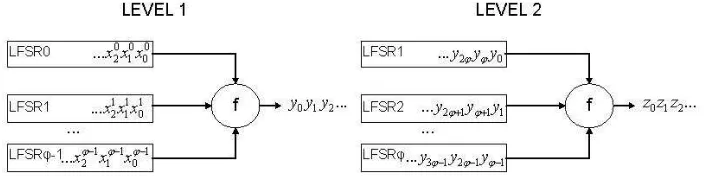
In this section, we will show that stream ciphers with a nonlinear resynchro-nization mechanism can also be vulnerable to resynchroresynchro-nization attacks. A first attack is a chosenIV attack; its principle is similar to that of Daemenet al.The second attack is a knownIV attack that uses the principle of linear approxima-tions as used in the known IV attack of Sect. 6.2. We will demonstrate these attacks on the two-level memoryless combiner. The framework of the attack is shown in Fig. 1. In a first level, the key and anIV are linearly loaded into the LFSRs. The input tof at timet of the level 1 initialization is denotedxt. The following holds:
The outputyi of level 1 is collected and is used as the initial state for the level 2
generator. We take here the simplifying assumption that this is done as shown in the figure. Level 2 generates the key streamzi.
Fig. 1.Model for a two-level combiner
8.1 A ChosenIV Attack
We will show an attack scenario on this construction which holds under the assumption that the attacker can choose the value of theivs which go into the Boolean function (this is for instance the case when the initial state equals the XOR of the key and the initialization vector).
We start with t = 0. We let iv0 take j different values, while keeping the otherivs constant. We obtain the following equations:
f(f(k0⊕iv1
0), y1, . . . yϕ−1) =z01 f(f(k0⊕iv2
0), y1, . . . yϕ−1) =z02 . . .
f(f(k0⊕ivj
0), y1, . . . yϕ−1) =z0j.
(38)
Denote the vector (y1, . . . yϕ−1) byr. In half of the cases, we will see that allzi 0 are equal (either all 0 or all 1). This is due to the fact thatf(0,r) =f(1,r). In the other half of the cases, which is of interest here, thezi
0 take both the values 0 and 1 in a random-looking way; which is due to the fact thatf(0,r)6=f(1,r). Assume that we are in the latter case. We now guess theϕ−1 bits ofr, let’s call this guessg. Iff(0,g) =f(1,g), then our guess is certainly not correct and we proceed to the next guess. Iff(0,g)6=f(1,g), the guess is possible; we now getj equations ink0of the form:
f(k0⊕ivi
In the same way, we can also recoverk1,k2, . . .which gives us the whole secret key of the system. The attack requires a total of about 2·kchosenIVs and has a time complexity of⌈k/ϕ⌉ ·22·ϕ−1. This attack has been implemented on various 8-bit Boolean functions, and we can easily recover the key.
8.2 A Known IV Attack
In this attack, we extend the approach in which we search a bias in theϕ-input Boolean function (see the knownIV attack in Sect. 6) in a straightforward way to the case of the two-level combiners. Each bit now goes twice through the function f, but we can show that a bias still persists. The equation we want to hold is as follows:
M
j∈BS kj=
M
j∈BS
ivij ⊕z0i, (40)
where the setBS consists of the bits of the setS involved in the linear bias, for all timest∈Sof the first level of the combiner. Similar equations can be written for the next iterations. Let’s denote the cardinality of the setS bys. Of course it holds thats≤ϕ. The cardinality of the setBS is then evidentlys2.
The piling-up lemma [17] learns that the probability that this equation holds is equal to 1/2 + 2s·ǫs+1, whereǫis the bias of the Boolean function. The bias of this equation is thus 2s·ǫs+1, which means we needR= 2−2·s·ǫ−2·s−2 resyncs to break this system by a knownIV attack.
We will show what this implies for actual Boolean functions. We take Boolean functions withϕinputs and resilienceρ. We will use two well-known lower bounds for the biasǫ:
ǫ≥2−ϕ/2−1
ǫ≥2ρ+1−ϕ, (41)
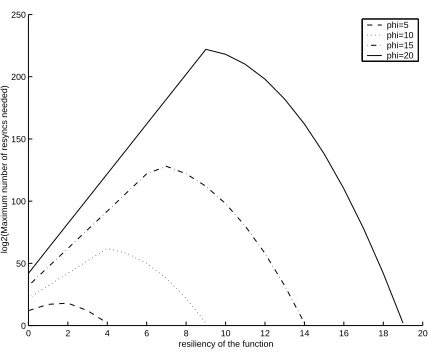
where the first bound is due to Parseval’s relation and the second to the trade-off between nonlinearity and resilience, see [27]. The cardinality of the setSis now8 s=ρ+ 1. We can calculate an upper bound for the number of resyncs needed for a successful attack as a function ofϕand of the resilienceρ. This is shown in Fig. 2 for some values ofϕ. These graphs show that memoryless combiners with few inputs cannot be made resistant against resynchronization attacks on a two-level combiner. For larger functions it should be checked whether the Boolean function is strong enough to withstand the above attack. The bounds given here may be refined by a more careful examination of the properties of the various classes of Boolean functions.
8 We conjecture that we will find the bias forρ+ 1 in practice. We will certainly find a
0 2 4 6 8 10 12 14 16 18 20 0
50 100 150 200 250
resiliency of the function
log2(Maximum number of resyncs needed)
phi=5 phi=10 phi=15 phi=20
Fig. 2.Upper bound for the number of resyncs as a function of the resilienceρwith as parameter the numberϕof input bits of the Boolean function
8.3 Implications of the Attacks
The known IV attack described above for the two-level memoryless combiner can be easily extended to other nonlinear resynchronization mechanisms. It is also possible to apply the attack on other designs, such as combiners with mem-ory, nonlinearly filtered generators and irregularly clocked shift registers. We can use techniques as described by Golic [12, 13] to find suitable linear approxima-tions. Our attack can be used to evaluate the strength of any resynchronization mechanism, and resistance against this attack is a minimum requirement for any design. We are currently investigating the impact of this attack on some actual designs, such as the resynchronization mechanisms of E0 and the NESSIE [21] candidates.
9
Application to some Key stream Generators
In this section we will describe some actual implementions of the attacks described in the previous sections. We will describe attacks on E0, Toyocrypt and the summation generator.
9.1 Attacks on E0
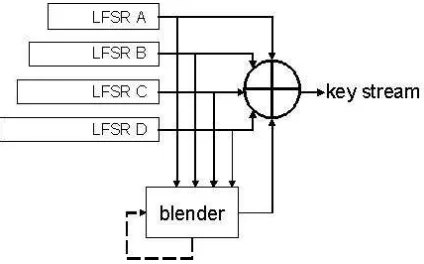
blender is calculated as a nonlinear function of its current state and of the 4 output bits of the LFSRs, and one bit of key stream is calculated as the XOR of the 4 output bits of the LFSRs and of the output bit of the blender.
We want to stress out that our results do not imply an immediate weakness. The reason is that the Bluetooth encryption consists of a two level encryption. Therefore any known differences at the beginning of level 1 do not produce known differences after level 2. On the other hand, the Bluetooth encryption scheme would be in danger if an ad-hoc equation would be known which depends only on the input of level 1 and the output of level 2 (= the key stream). The methods developed in [2] are not practical in this case9 but other ways to find such an equation may exist. Further on, our attacks show that if a feasible attack on level 2 of E0 can be found, it is very easy to recover the actual secret key used in level 1.
Fig. 3.Layout of the stream cipherE0
In level 1 the LFSRs are linearly loaded with the key and an initialization vector. The blender is set to zero. Then,E0 is clocked 200 times. The first 72 outputs are discarded, the next 128 outputs will be the initial state of the LFSRs in level 2. The initial state of the blender in the second level is set equal to the final state of the blender after the first level.
Known IV attack on level 1 of E0. In this section, we describe a resyn-chronization attack on level 1 ofE0 such as described in Sect. 7.1. This attack is similar to the attack of S. Fluhrer described in [10]. We show that this attack can be put into the the general framework of resynchronization attacks and hence gets very efficient onceR≥ϕ.
In this attack we assume that we have recovered the state of E0 for some instances of level 2. This could have been done by implementing attacks on frames of level 2,e.g., an algebraic attack as described by [3]. We now want to recover the
9 The reason is that the output of level 1 is permuted before it is used as the input of
actual secret key which is used in level 1. In our attack, we will use two properties ofE0. The first is the above mentioned fact that the final state of level 1 of the blender is also the initial state of level 2. This means that we will know the final state of the blender in level 1 in our resynchronization attack. The second is that the blender can be run backwards [24]. Namely, apart from the normal equation Mi
t+1 =h(kt⊕ivit, Mti), we can also easily determine the functionh′ such that
Mi
t =h′(kt⊕ivi
t, Mti+1).
Our attack is now a regular resynchronization attack on combiners with mem-ory andµ= 0, with as only particularity that the attack is executed on the level 1 generator running backwards in time. The attack has been implemented in the depth-first search manner described above. At each iteration we take the next state that fulfills all equations generated by the LFSRs, byf and byh′.
This attack has been implemented in C and turns out to be very efficient. Three resyncs already enable us to recover the secret key in several minutes. But it is only when the number of resyncs is equal to 4 (the number of LFSRs) that the attack gets very efficient. This is because the search that has to be done is very limited, as can be predicted by our framework for the resynchronization attack. The attack runs in a few milliseconds on a PC. The search algorithm only needs to go through a couple of thousands guesses for the states. If the number of resyncs is larger than 4, the algorithm is even faster because even more conditions are imposed and even less values need to be searched.
Actual algebraic attacks. The secret keyK= (a0, . . . , d38) is the initial state of four LFSRsA,B C and D. Letat, bt,ct anddt denote their output bits at
clockt. We define σ1
t :=at⊕bt⊕ct⊕dt, σ2t :=atbt⊕atct⊕atdt⊕btct⊕btdt⊕ctdt,
σ3t :=atbtct⊕atbtdt⊕atctdt⊕btctdt, σ4t :=atbtctdt
Then the ad-hoc equation found in [2] is
G(at−1, . . . , dt−1, . . . , at+2, . . . , dt+2, zt−1, . . . , zt+2)
= (zt−1⊕zt⊕zt+1⊕zt+2)⊕σ1t·(zt−1⊕zt+1⊕zt+2)·(1⊕zt)⊕
⊕σt2·(zt−1⊕zt⊕zt+1⊕zt+2)⊕
⊕σ1
t+1·(1⊕σt2)·(zt+1)⊕σt1+1·σ1t·(1⊕zt)·(zt+1)⊕
⊕σt1·(σt2+1⊕σ1t+2⊕σt1−1)·(1⊕zt)⊕σt4⊕σ2t+1·σt2
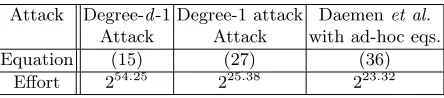
Obviously, it isr=d= 4 and|I|= 1 . We calculated that dimG= 39,|Md(G)|=
213,e= 1 (the minimum possible degree) andM1=n= 128,M4≈223.07 and
M3≈218.32. Figure 4 shows the estimated efforts for the attacks. Let ˜B := {G(kt⊕ivi
t, zti, zit+1, zit+2, zit+3)| 0 ≤ i ≤ R−1} be the set of functions available to the attacker. Using (19), we calculated the probability of
˜
Attack Degree-d-1 Degree-1 attack Daemenet al. Attack Attack with ad-hoc eqs.
Equation (15) (27) (36)
Effort 254.25 225.38 223.32
Fig. 4.Attacks on theE0key stream generator
Additionally, we’ve checked the estimation by repeating the following test 3000 times: For a fixed random value of k0 we generated randomly ivi
0 and corresponding expressionsG(k0⊕ivi0, zi0, z1i, z2i, zi3),until the number of linearly independent expressions was equal to dimG= 39. It turned out that the prob-abilities computed with (19) were too optimistic. The following table shows the results of our test:
R≤ 39 40 41 42 43 44 . . . 49 50 . . . 58 59 % 1.2 6.5 16 28.2 41.7 54.3 . . . 89.1 91.8 . . . 98.8 99.1
In more than 90% of all cases, the numberR of frames was between 39 and 50, and in more than 99% between 39 and 59. Hence, we assume that the
Degree-e attack and the Degree-1 attack work against E0 with a high probability for about 59 resynchronizations. Additionally, we expect similar effects for other key stream generators.
We did similar tests concerning the Daemenet al.attack using ad-hoc equa-tions. I.e., we did 6000 times the following test: We reinitialized the cipher for randomiv’s until 9 bit of information ofk0 were uniquely specified.10It turned out thatRwas always≥19. The following table shows the results of our test:
R≤ 19 20 21 22 . . . 32 33 . . . 43 44 . . . 58 59 % 0.1 0.3 1 1.9 . . . 49.2 55.3 . . . 89.5 91 . . . 98.5 99.2
In more than 90% of all cases, theRwas between 19 and 44, and in more than 99% between 19 and 59. As expected, the Daemenet al.attack needed less frames than the Degree-1 attack.
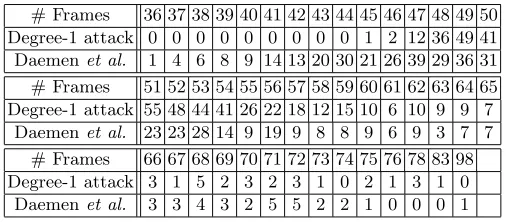
We simulated the Degree-1 attack and the Daemenet al.attack on the whole E0 keystream generator independently 500 times on a computer. I.e., for a fixed unknown keyK we generated new frames with random known differences until the bits a1, b1, c1, d1,. . . ,a39, b39, c39, d39 could be reconstructed.11 Figure 5 dis-plays the results. It shows how many times a given number of frames was needed. E.g., in 12 resp. 39 cases out of 500, the Degree-1 attack resp. the Daemen et al. attack needed 47 frames. In our simulations, the Degree-1 attack needed on average more frames. The same holds for the time effort: Degree-1 attack needed on average 239 s, Daemenet al.attack 4 only 91 s.
10 In fact, due to the form of G, only 8 of the ϕ·r = 16 bits can be reconstructed
directly. The other 8 bits occur only as a linear combination = 1 bit information.
11 The attack could be improved by using the fact thata
1, . . . , a25 uniquely determine a26, . . . , a39 etc. or by reconstructing only a part of the key and guess the missing
# Frames 36 37 38 39 40 41 42 43 44 45 46 47 48 49 50 Degree-1 attack 0 0 0 0 0 0 0 0 0 1 2 12 36 49 41 Daemenet al. 1 4 6 8 9 14 13 20 30 21 26 39 29 36 31 # Frames 51 52 53 54 55 56 57 58 59 60 61 62 63 64 65 Degree-1 attack 55 48 44 41 26 22 18 12 15 10 6 10 9 9 7
Daemenet al. 23 23 28 14 9 19 9 8 8 9 6 9 3 7 7 # Frames 66 67 68 69 70 71 72 73 74 75 76 78 83 98 Degree-1 attack 3 1 5 2 3 2 3 1 0 2 1 3 1 0
Daemenet al. 3 3 4 3 2 5 5 2 2 1 0 0 0 1
Fig. 5.Computer simulations of the Degree-1 attack and the Daemenet al.attack using ad-hoc equations on theE0 key stream generator
9.2 Attacks on Toyocrypt
Description of Toyocrypt. Toyocrypt was submitted to Cryptrec, the Japanese government call for cryptographic primitives, and was accepted to the second phase but has finally been rejected. A description can be found in [20]. At each clocktthe key stream bitztis produced by
zt=f(Lt(K)) =f(kt0, . . . , k127t ) =k127t ⊕ P62
i=0kitktαi⊕k t
10k23t k32t k42t ⊕
⊕kt
1kt2k9tk12t k18t k20t kt23k25t kt26k28t kt33k41t k42t kt51k53t kt59⊕ Q62
i=0kit,
(42)
with{α0, . . . , α62} being some permutation of the set{63, . . . ,125}.
Algebraic attacks. As noticed in [7], multiplyingf with (1⊕kt
23) resp. (1⊕kt42) provides two ad-hoc equationsG1 andG2 of degree 3.
Due to the large numberϕ·rof key bits used inG1andG2) (ϕ= 126,r= 1), the computation of dimG1resp. dimG2in the naive way is infeasible. Therefore, we concentrate only on the Degree-d-1 attack. As |I| = 1, M3 ≤ β(128,3) = 218.42 andM
2≤β(128,2) = 213.01, the number of operations is about is
|I|3+M3
· M2+M32≤(1 + 218.42)·213.01+ (213.01)3≈239.04
ChosenIV attack. We can see, for instance, that only the monomialx24·x63in (42) contains the variablex63. We now perform a chosenIV attack as in Sect. 6.1 with twoIVs that only differ in bitx63. Eliminating all terms as in (20) gives us the following simple equation fort= 0:
9.3 The Summation Generator with 4 Inputs
The summation generator was proposed by Rueppel [23]. The numberϕof inputs (i.e., the number of LFSRs) can be chosen arbitrarily. In [16], the authors proved that an ad-hoc equation of degree ≤ 2⌈log2ϕ⌉ always exists if r = ⌈log
2ϕ⌉+ 1 clocks are regarded. We consider only the case ofϕ= 4 inputs and use the ad-hoc functionGof degree 4 given in [16]:
0 =σ4t⊕(1⊕zt)·σt3⊕σt2·σ1t+1⊕(1⊕zt+1)·σ2t⊕σ2t+1⊕σ1t+2⊕zt+2
⊕(1⊕zt)·σ1t·σt1+1⊕(1⊕zt)·(1⊕zt+1)·σt1⊕(1⊕zt+1)·σ1t+1
We calculated that|I|= 1, dimG= 19,|Md(G)|= 69,e= 1 and appreciated
M4resp.M3byβ(128,4)≈223.32resp.β(128,3)≈218.43. Figure 6 displays our estimations for some attacks. To be comparable with the other results in this paper, we have chosen a key size ofn= 128.
Attack Degree-d-1 Degree-e- Daemenet al. Attack Attack using ad-hoc eqs.
Equation (15) (27) (36)
Effort 255.25 222.34 223.32
Fig. 6. The Degree-d-1 Attack, the Degree-e attack and the Daemen et al.attackon the summation generator with 4 LFSRs and a key size of 128
10
Conclusions
In [9], Daemen, Govaerts and Vandewalle presented the original resynchroniza-tion attack on synchronous stream ciphers. In this paper, we have extended this resynchronization attack in several directions, by using new attack methods and by combining the attack with cryptanalytic techniques such as algebraic attacks and linear cryptanalysis.
Our attacks on linear resynchronization mechanisms show that a linear resyn-chronization mechanism should never be used in practice. Even if the system uses few resyncs, has an input function with many inputs and has a non-linear mem-ory, it will still very likely contain weaknesses that can be exploited by one of our attack scenarios.
Nowadays, resynchronization mechanisms are typically designed in anad hoc
Acknowledgements
The authors would like to thank An Braeken, Joe Cho, Matthias Krause, Ste-fan Lucks, Erik Zenner and the anonymous referees for helpful comments and discussions.
References
1. R. Anderson,A5 (Was: Hacking Digital Phones), sci.crypt post, June 1994. 2. F. Armknecht, M. Krause,Algebraic Attacks on Combiners with Memory, Crypto
2003, LNCS 2729, D. Boneh, Ed., Springer-Verlag, pp. 162-176, 2003.
3. F. Armknecht,Improving Fast Algebraic Attacks, FSE 2004, LNCS 3017, B. Roy, W. Meier, Eds., Springer-Verlag, pp. 65–82, 2004.
4. F. Armknecht, On the Existence of Low-degree Equations for Algebraic Attacks, Cryptology ePrint Archive, Report 2004/185, 2004.
5. Bluetooth S.I.G.,Specification of the Bluetooth System, Version 1.2, available from www.bluetooth.org/spec, 2003.
6. Y. Borissov, S. Nikova, B. Preneel, J. Vandewalle,On a Resynchronization Weak-ness in a Class of Combiners with Memory, SCN 2002, LNCS 2576, S. Cimato, C. Galdi, G. Persiano, Eds., Springer-Verlag, pp. 164–173, 2002.
7. N. Courtois, W. Meier,Algebraic Attacks on Stream Ciphers with Linear Feedback, Eurocrypt 2003, LNCS 2656, E. Biham, Ed., Springer-Verlag, pp. 345–359, 2003. 8. N. Courtois,Fast Algebraic Attacks on Stream Ciphers with Linear Feedback, Crypto
2003, LNCS 2729, D. Boneh, Ed., Springer-Verlag, pp. 177–194, 2003.
9. J. Daemen, R. Govaerts, J. Vandewalle, Resynchronization Weaknesses in Syn-chronous Stream Ciphers, Eurocrypt 1993, LNCS 765, T. Helleseth, Ed., Springer-Verlag, pp. 159–167, 1993.
10. S. Fluhrer, Improved key recovery of level 1 of the Bluetooth Encryption System, Cryptology ePrint Archive, Report 2002/068, 2002.
11. C. Fontaine,Contribution `a la Recherche de Fonctions Bool´eennes Hautement Non Lin´eaires, et au Marquage d’Images en Vue de la Protection des Droits d’Auteur, PhD Thesis, Paris University, 1998.
12. J. Golic, Correlation via Linear Sequential Circuit Approximation of Combin-ers with Memory, Eurocrypt 1992, LNCS 658, R. Rueppel, Ed., Springer-Verlag, pp. 113–123, 1992.
13. J. Golic,Linear Cryptanalysis of Stream Ciphers, FSE 1994, LNCS 1008, B. Preneel, Ed., Springer-Verlag, pp. 154–169, 1994.
14. J. Golic, G. Morgari, On the Resynchronization Attack, FSE 2003, LNCS 2887, T. Johansson, Ed., Springer-Verlag, pp. 100–110, 2003.
15. A. Joux, F. Muller,A Chosen IV Attack against Turing, SAC 2003, LNCS 3006, M. Matsui, R. Zuccherato, Eds., Springer-Verlag, pp. 194–207, 2003.
16. D. Lee, J. Kim, J. Hong, J. Han, D. Moon,Algebraic Attacks on Summation Gen-erators, FSE 2004, LNCS 3017, B. Roy, W. Meier, Eds., Springer-Verlag, pp. 34–48, 2004.
17. M. Matsui, Linear Cryptanalysis Method for DES Cipher, Eurocrypt 1993, LNCS 765, T. Helleseth, Ed., Springer-Verlag, pp. 386–397, 1993.
19. W. Meier, O. Staffelbach, Correlation Properties of Combiners with Memory in Stream Ciphers (extended abstract), Eurocrypt 1990, LNCS 473, I. Damgard, Ed., Springer-Verlag, pp. 204–213, 1990.
20. M. Mihaljevi´c, H. Imai, Cryptanalysis of Toyocrypt-HS1 stream cipher, IEICE Transactions on Fundamentals, vol. E85-A, pp. 66–73, Jan. 2002. Available at http://www.csl.sony.co.jp/ATL/papers/IEICEjan02.pdf.
21. New European Schemes for Signature, Integrity and Encryption, http://www.cryptonessie.org
22. R. Rueppel, Correlation Immunity and the Summation Generator, Crypto 1985, LNCS 218, H. Williams, Ed., Springer-Verlag, pp. 260–272, 1985.
23. R. Rueppel,Analysis and Design of Stream Ciphers, Springer-Verlag, Berlin, 1986. 24. M. Saarinen,Bluetooth und E0, sci.crypt post, February 2002.
25. P. Sarkar, S. Maitra,Nonlinearity Bounds and Constructions of Resilient Boolean Functions, Crypto 2000, LNCS 1880, M. Bellare, Ed., Springer-Verlag, pp. 515–532, 2000.
26. V. Strassen, Gaussian Elimination is Not Optimal, Numerische Mathematik, vol. 13, pp. 354-356, 1969.
27. Y. Tarannikov, On Resilient Boolean Functions with Maximum Possible Nonlin-earity, Indocrypt 2000, LNCS 1977, B. Roy, E. Okamoto, Eds., Springer-Verlag, pp. 19–30, 2000.
28. G. Xiao, J. Massey,A Spectral Characterization of Correlation-immune Combining Functions, IEEE Trans. Inf. Theory, Vol. IT-34, pp. 569–571, 1988.
29. K. Zeng, C. Yang, T. Rao,On the Linear Consistency Test (LCT) in Cryptanaly-sis with Applications, Crypto 1989, LNCS 435, G. Brassard, Ed., Springer-Verlag, pp. 164–174, 1990.
30. Y. Zheng, X. Zhang,Plateaued Functions, ICICS 1999, LNCS 1726, V. Varadhara-jan, Y. Mu, Eds., Springer-Verlag, pp. 284–300, 1999.
A
Calculation of the Complexities for the Overlapping
Bits Attack
Suppose we have doneR resynchronizations, whereR < ϕ. This implies that on average 2ϕ−Rsolutions remain fork
t. The probability that one specific bit is the
same in all these solutions is (1/2)2ϕ−R
−1. We have found one bit of information if this is the case, else we didn’t learn anything. This holds for allϕbits ofkt.
The average frame length required is now equal to the amount of information required (the k bits of the key) divided by the average information learned at each time step:
frame length= kϕ
22ϕ−R−1
= k ϕ·2
2ϕ−R−1
. (44)
The time complexity of the attack now consists of performing an exhaustive search over 2ϕpossibilities at each time t. Hence the time complexity is equal to
2ϕ times the frame length, which gives n ϕ·2
2ϕ−R