Research Article
DESIGN & DEVELOPMENT OF GLIPIZIDE FAST DISSOLVING TABLETS USING NATURAL GUM
SUPERDISINTEGRANT
BANDARU NAGAJYOTHI*, M.KISHORE BABU
Department of Pharmaceutics, Bapatla College of Pharmacy Bapatla, Guntur (Dist) Andhra Pradesh-522101 Email: [email protected]
Received: 18 December 2013, Revised and Accepted: 16 January2013
ABSTRACT
The motive of this research work was to develop fast dissolving tablets of Glipizide by using fenugreek gum as a natural super disintegrating agent which also possessed anti diabetic property for rapid control over abnormal blood glucose levels. For obtaining the fenugreek gum an attempt was made to extract it from fenugreek seeds and subjected to various physicochemical studies. Some of the physical properties such as viscosity and swelling index were found to be 293 cps and 221 respectively. Direct compression technique was employed for formulation of fast dissolving tablets of Glipizide by varying the concentrations of fenugreek gum which acted as natural super disintegrant for optimization. The formulated fast dissolving tablets were subjected to various evaluation studies. The weight variation was well within the accepted limits. Thickness and hardness of the formulated tablets were between 4.3 to 5.5 kg/cm2 and 4.9 to 5.2 mm respectively. Wetting time of the tablets was found to be between 16 to 50
sec, with water absorption ratio ranging between73.2 to 94.38%. Invitro disintegration time of the tablets varied from 19 to 55 sec. of all the formulations, the formulation (F3) with the fenugreek gum of 5% showed higher drug release of 95% at the end of 25 min. further when composed with the renewed synthetic super disintegrants such as sodium starch glycolate (5%), croscarmellose sodium (5%) the release profiles of the F3 with fenugreek gum 5% was found to be superior in terms of release and mechanisms. The influence of the drug Glipizide and Fenugreek gum formulations on the anti-diabetic activity was evaluated using glucose induced model of experimental rats. The results suggested that the fenugreek gum showed a promising anti diabetic activity with Glipizide.
Keywords: Glipizide, Fenugreek gum, Fast dissolving tablets, Additive Antibiotic activity.
INTRODUCTION
Fast dissolving tablets are gaining prominence in the recent past as it is most conveniently administered with rapid dissolution and quicker absorption providing faster onset of action. The major advantage of this dosage form is that it can be administered without water. Fast dissolving tablets when placed in the oral cavity melts in it as the saliva quickly penetrates into the pores causing rapid disintegration.
Diabetes mellitus2 is a disease characterised by hyperglycaemia
resulting from both insulin resistance and insulin deficiency which is secondary to pancreatic beta cell failure. Clinically, diabetes is dividing into two major components. Type 1 or insulin dependent diabetes mellitus (IDDM) it requires continuous exogenous insulin replacement therapy in addition to diet. Type 2 or non-insulin dependent diabetes mellitus (NIDDM) which usually occurs in mature individuals. The blood glucose levels abnormally raise is based on severity of the condition.
Glipizide is a second generation sulfonyl urea anti diabetic drug, is widely used as an oral hypoglycaemic in the management Type 2 diabetis. When given orally it is rapidly absorbed from the gastro intestinal tract and peak plasma concentrations are achieved in a short period of time for controlling the abnormal blood glucose levels.
Gums of natural origin are a better choice over synthetic and semi synthetic substances since they are abundantly available and biocompatible. Gums of Fenugreek seeds possess super disintegrant property along with the anti-diabetic nature. An attempt was made to formulate fast dissolving tablets of Glipizide using Fenugreek gum as a natural super disintegrant for the additive anti diabetic activity.
MATERIALS AND METHODS
Materials
Glipizide was obtained as gift sample from Medrich, Banglore,India; quality grade Fenugreek seeds were purchased from local market in
India, Microcrystalline cellulose (avicel pH101), Sodium starch glycolate and croscarmellose sodium were purchased from SD Fine chemicals, Mumbai, India; and all other ingredients used throughout the study were of analytical grades.
Methods
Extraction and purification of fenugreek gum[3]
Fenugreek Seeds (100gm’s) were ground to 100 mesh using a laboratory mill. The fine powder was defatted by extracting with boiling hexane in soxhlet apparatus for 80 minutes. The obtained extract was treated with 95% ethanol (maintaining its boiling point) for 130 minutes in a conical flask to remove the unwanted saponin. Further enzyme deactivation and removal of small molecules were initiated by refluxing the extract with 70% ethanol for 180 minutes. The resulting mixture was repeatedly treated with ethanol to remove undissolved traces if necessary. The residue was filtered through sintered glass filter at room temperature. The filtered residue was subjected to mechanical stirring at 700 rpm with addition of water for 12hrs. The obtained mixture was centrifuged in cooling centrifuge at 5000 rpm for 12 minutes at 10°c. The supernatant contained crude fenugreek gum, which was decanted and precipitated by adding of ethanol (70%). The precipitated gum was washed with acetone, diethyl ether and water. The obtained pure fenugreek gum was oven dried.
Sterilization studies on fenugreek gum
100 mg of the gum samples were aseptically mixed with 9ml of sterile normal saline and the pH was adjusted to 7 with pH meter. From this, 1ml of each dispersion was mixed with 20ml of sterile lactose broth and placed separately in petridish. All the plate were incubated at 37±10 for 24hrs and observed for the presence of
microbial flora.
Physicochemical characterization of fenugreek gum
Swelling index[4]
Asian J Pharm Clin Res, Vol 7, Suppl 1, 2014,144-148 The study was carried out using a 100 ml stoppered graduated
cylinder. The initial bulk volume of 1gm of fenugreek gum was noted. Water was added in sufficient quantity to produce 100 ml of a uniform dispersion. The dispersion was stored at room temperature and the sediment volume of the swollen mass was measured after 24 hour.
Swelling index = 100 x(V2 - V1 /V1)
Where: V1 = initial volume of material before hydration.
V2 = volume of hydrated material.
Loss on drying
The gum sample was weighed (W1) and heated in an oven for 2 hrs.
Sample was cooled in the dry atmosphere of desiccators, and then finally weighed (W2).
% LOD = (W1–W2 / W1) x 100
W1 = Initial weight of the powder; W2 = Final weight of the powder.
Rheological studies on fenugreek gum[5]
Influence of concentration on viscosity:
1% w/v dispersions of fenugreek gum were prepared by placing the gum (1gm in each case) in 80ml distilled water and subjected to stirring for 1hr. The dispersions obtained were kept a side for 24hrs for the gum to hydrate and swell completely. Then the volume was made up with distilled water to produce a 1%w/v concentration and subjecting to stirring until uniform dispersion was obtained. Further fenugreek gum dispersions with the concentrations of 0.2%w/v, 0.4%w/v, 0.6%w/v and 0.8%w/v were prepared by suitably diluting the 1%w/v dispersion. The obtained dispersions were allowed to elapse for a period of 10hrs in order to attain their equilibrium viscosity.
The viscosity of the fenugreek gum dispersions were measured by using Brookfield viscometer (DV- 3 PLUS ULTRA) at spindle number SC4-18 with optimum torque values (11%-97%).
Characterization of Drug and Excipients
Drug-excipients compatibility studies
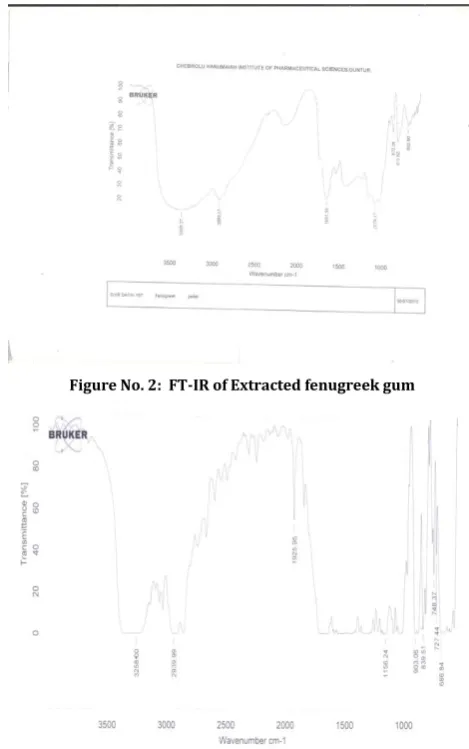
The physicochemical compatibility between Glipizide and Fenugreek gum power were carried out by subjecting to IR Spectral studies using Perkin Elmer FTIR Spectrophotometer, Shelten, USA. The samples were scanned under diffuse reflectance mould and plotted the graph by KBr pellet method and spectra were recorded in the wavelength region between 4000cm-1 to 400 cm-1. The spectra
obtained for Fenugreek gum, Glipizide and physical mixtures of Glipizide and Fenugreek gum were assessed as shown in fig-1,2&3.
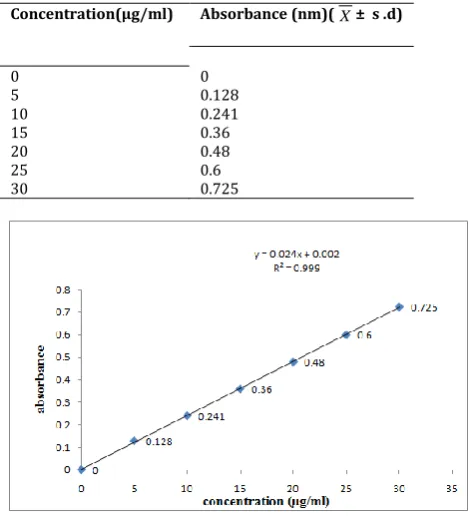
Standard calibration curve of Glipizide[6]
100mg of Glipizide was accurately weighed and dissolved in a 10ml of Methylene Chloride and made upto 100ml with pH 6.8 Phosphate buffer.. From this solution aliquots equivalent to 5-30 µg were prepared with the subsequent dilutions using 6.8pH phosphate buffer. The absorbance of these solutions was measured using the phosphate buffer pH 6.8 as blank at 276nm by UV-visible double beam spectrophotometer (Shimadzu-Mumbai)
Table .1 Standard calibration of Glipizide
Concentration(µg/ml) Absorbance (nm)( ± s .d)
0 0
5 0.128
10 0.241
15 0.36
20 0.48
25 0.6
30 0.725
Figure 1: Standard Graph of Glipizide In 6.8 pH Phosphate Buffer :
Formulation of Glipizide fast dissolving tablets[7]
Glipizide fast dissolving tablets were formulated by direct compression technique. The composition used in manufacturing of the tablets is listed in the table No.1. For formulation purpose all the ingredients were passed through sieve no.60 and mixed homogenously in a mortar. Finally calculated quantities of talc and magnesium stearate were added and admixed. The mixture obtained was compressed into tablets by using Cadmach 16 station tablet machine with convex faced punches (5mm diameter).
Table.2: Composition of Glipizide fast dissolving tablets
S.No Ingredients (mg/tablet)
F1 F2 F3 F4 F5 F6 F7 F8 F9
1 Glipizide 5 5 5 5 5 5 5 5 5 2 Fenugreek gum 3 4 5 - - - - 3 Croscarmellose
sodium
- - - 3 4 5 - - -
4 Sodium starch glycolate
- - - 3 4 5
5 Microcrystalline cellulose
90 89 88 90 89 88 90 89 88
6 Talc 1 1 1 1 1 1 1 1 1
7 Magnesium stearate
1 1 1 1 1 1 1 1 1
8 Total 100 100 100 100 100 100 100 100 100
Asian J Pharm Clin Res, Vol 7, Suppl 1, 2014,144-148
Evaluation of tablets
Thickness
The thickness of the formulated tablets was measured by using vernier callipers.
Weight variation
The formulated tablets weretested for weight uniformity. For this 20 tablets were weighed collectively and individually. From the collective weight, average weight was calculated. Each tablet weight was then compared with average weight to ascertain whether it is within permissible limits or not.
%Weight Variation = Average weight-Individual weight × 100
Average weight
Hardness8
Hardness of tablets was measured using Pfizer type hardness tester. Three tablets were selected from each formulation randomly and their hardness was measured. The mean ± SD of hardness values were calculated.
Friability
Friability of the tablets was determined using Roche friabilator. The weight of 20 tablets (Initial Weight) was placed in the friabilator, and subjected to 25 revolutions per 4 minutes. Tablets were then de-dusted, reweighed (Final Weight) and percentage loss was calculated. Friability is obtained by the following formula:
%Friability = Initial weight- Final weight × 100
Initial weight
Wetting time and water absorption ratio[9]
A double folded tissue paper was placed in a Petri dish. 6 ml of water containing a water-soluble dye (eosin) was added to the Petri dish. A tablet (pre-weighed) was carefully placed on the surface of tissue paper. The time required for water to reach the upper surface of the tablet was noted as the wetting time. The wetted tablet was then weighed and the
Water absorption ratio, R, was determined using the equation,
R = 100 (Wb-Wa)/Wb
Where Wa and Wb are the weights of tablet before (dry weight) and after water absorption (wet weight) respectively.
Drug content[10]
For the determination of Glipizide drug content, twenty tablets were weighed and powdered. The quantity of powder equivalent to 100 mg of Glipizide was dissolved in phosphate buffer pH 6.8 diluted to 100ml with the same and the solution was filtered and suitably diluted. The drug content was estimated spectrophotometrically at 276 nm.
InvitroDisintegration Test
Invitro disintegration time was determined using disintegration test apparatus (Electro lab, USP model ED-2L, Mumbai) without disk for six tablets. The disintegration medium was 900 ml of distilled water kept at 37 ± 0.5ºC and stirred at a rate of 30±2 cycles/min. The time was measured in seconds for complete disintegration of the tablet with no palpable mass remaining in the apparatus. The test was carried out in triplicate.
Invitro dissolution studies[11]
Dissolution rate was studied using USP type II paddle dissolution apparatus, in 900 ml of phosphate buffer pH 6.8 at 37±0.5o at 50
rpm. Aliquot of dissolution medium was withdrawn at regular time intervals and the same volume of pre-warmed (37±0.5o) fresh
dissolution medium was replaced. The samples were filtered and drug content of glipizide in each sample was analysed after suitable dilution, by Shimadzu UV-spectrophotometer at 276 nm.
Pharmacodynamic studies[12]
Pharmacodynamic study was carried out in Adult Male Wister Rats weighing 180-260g obtained from the Animal House of Bapatla College of Pharmacy (1032/ac/07/CPCSEA), Bapatla. The experiment protocol (IAEC/IV-6/BCOP/2012) was approved by the Institutional Animal Ethical Committee (IAEC) of Bapatla College of Pharmacy. To study the additive anti-hyperglycaemic activity of Glipizide and Fenugreek gum on Wistar rats (150-200 gms) were fasted for 18hrs with free access to water. Calculated quantities of Glipizide, Fenugreek gum and physical mixture of Glipizide and Fenugreek gum were suspended in 1% tween 80. Group I served as negative control; Group II was treated with the Glipizide (0.45mg/kg); Group III was treated with the Fenugreek gum (0.45mg/kg); and then Group IV was treated with the mixture of Glipizide (0.45mg/kg) and Fenugreek gum (0.45mg/kg). Zero hour blood sugar level was determined from the overnight fasted animals. After 30 min of the drug treatment, the animals were fed with glucose (4g/kg) and the blood glucose was determined after 0.5, 1,2and 3hrs of the glucose load. Blood sugar level was measured using Accucheck-Active TM test strips in
Accucheck-Active test meter.
RESULTS
The results obtained for IR spectroscopy which were conducted as a part of preformulation study between the drug Glipizide, Fenugreek extract & Physical Mixture of Glipizide & Fenugreek extract (Figures).
Figure No. 2: FT-IR of Extracted fenugreek gum
Asian J Pharm Clin Res, Vol 7, Suppl 1, 2014,144-148
Figure No. 4: FI-IR of Physical Mixture of Glipizide and Extracted Fenugreek gum
The extracted Fenugreek gum was subjected to physicochemical characterization (Table 2).
Table.2: Physico-Chemical characterization of Fenugreek gum
Parameters Results
Colour Light yellowish white Odour Odourless
Taste Tasteless
State Amorphous powder PH (1%w/v) 6.2
Loss on drying (%)
7.54
Swelling index 221
Solubility Slightly soluble in cold water, but moderately dissolves in warm water, forms viscous solution, insoluble in organic solvents.
Yield (%) 26.4 Viscosity (1%) 293.94 cps
%loss on drying was observed within the imit. The swelling index and the viscosity of Fenugreek gum were found to be 221% and 293.4 cps respectively.
Table.3: Micromeritic properties of Fenugreek gum
Bulk density 0.396g/cm3
Tapped density 0.413g/cm3
Compressibility index (%) 14.11 Hausner’s Ratio 1.042 Angle of Repose 22.4°
The derivated powder property values such as bulk density and tapped density was found to be 0.396 gm/cc and 0.413 gm/cc respectively. From the density data % cars index was 14.11%. Angle of repose was found to be 22.4% and Hausner’s ratio was found to be below 1.12 indicating in well acceptable limits. Various Glipizide fast dissolving tablets were formulated using fenugreek gum as natural super disintegrating agent by employing direct compression technique.
Table 5: Physical properties of Glipizide fast dissolving tablets:
Formulation Weight variation
(%)
Hardness (kg/cm2)
Thickness (mm)
Friability (%)
Drug content
(%)
Dis-integration
Time (sec)
Wetting Time (sec)
Water absorption
test (%)
In vitro-dissolution (cumulative %
release)
F1 1.65±0.02 4.9±0.12 5.1±0.17 0.52±0.08 99.64±0.14 40 32 84.12±0.16 84.45±0.03 F2 1.93±0.03 5.1±0.18 5.2±029 0.55±0.06 99.48±0.10 32 26 89.91±0.23 87.62±0.03 F3 2.24±0.05 5.3±0.24 5.1±013 0.53±0.07 99.66±0.09 19 16 94.38±1.04 95.88±0.04 F4 1.67±0.10 4.8±0.20 5.1±0.04 0.49±0.02 99.59±0.07 48 43 80.09±0.19 80.62±0.02 F5 2.24±0.09 4.9±0.12 5.0±0.16 0.52±0.06 99.39±0.06 36 30 82.28±0.96 85.27±0.01 F6 2.06±0.06 5.1±0.16 5.1±0.04 0.50±0.03 99.81±0.04 27 20 89.92±0.96 89.10±0.02 F7 1.79±0.04 5.2±0.20 5.1±0.09 0.51±0.06 99.79±0.06 55 50 73.20±0.78 76.80±0.09 F8 1.92±0.12 4.9±0.25 5.0±0.04 0.54±0.03 99.69±0.04 44 34 75.02±0.68 80.65±0.02 F9 2.03±0.05 5.1±0.28 5.0±0.08 0.53±0.04 99.83±0.09 32 23 83.12±0.71 86.80±0.01
All values are expressed as mean ± SD(n=3).SD=Standard Deviation.
The tablets thus formulated were subjected to various physical and animal studies. The weight variation of the tablets ranged between 1.65±0.02% and 2.24±0.03%. Hardness of the tablets was found to be 4.9±0.12kg/cm2 to 5.1±0.28kg/cm2. The thickness was found to
be between4.9mm to5.2mm. The obtained results indicated that the tablets were passed the friability test. The drug content of all the tablets was found to be more than 99%. Specific evaluation tests were performed for fast dissolving tablets. The wetting time and disintegration time were found in between16 to 34 sec and 19 to 40 sec respectively. The water absorption ratio ranged from 80.09% to 94.18 %.
Figure No. 5: Comparative dissolution profiles of Glipizide fast dissolving tablets formulated with varying concentrations of
Fenugreek gum
Figure No. 6: Comparative dissolution profiles of Glipizide fast dissolving tablets formulated with various concentrations of
Croscarmellose sodium
Asian J Pharm Clin Res, Vol 7, Suppl 1, 2014,144-148
Figure No. 7: Comparative dissolution profiles of Glipizide fast dissolving tablets formulated with various concentrations of
Sodium starch glycolate
Even when compared to the tablets formulated with the renewed synthetic super disintegrated agents such as sodium starch glycolate and cross caramellose sodium.
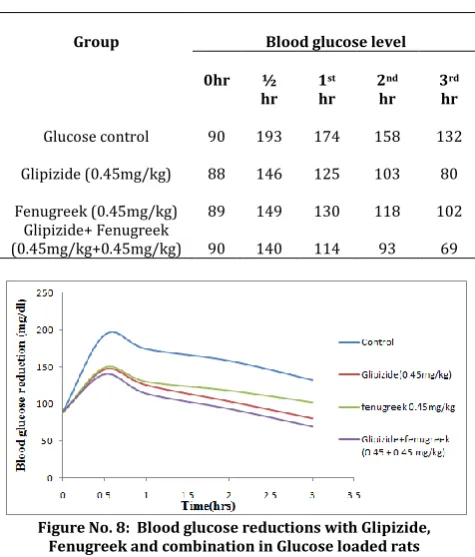
Table.6 Effect of Glipizide & Fenugreek in glucose loaded hyperglycaemic rats:
Group Blood glucose level
0hr ½ hr
1st hr
2nd hr
3rd hr
Glucose control 90 193 174 158 132
Glipizide (0.45mg/kg) 88 146 125 103 80
Fenugreek (0.45mg/kg) 89 149 130 118 102 Glipizide+ Fenugreek
(0.45mg/kg+0.45mg/kg) 90 140 114 93 69
Figure No. 8: Blood glucose reductions with Glipizide, Fenugreek and combination in Glucose loaded rats
Invivo Pharmacodynamic studies when conducted on male wistar rats revealed that blood glucose levels of the rats treated with Glipizide + fenugreek were low (69) when compared to fenugreek gum (102), Glipizide (80) and control(132) treated rats.
DISCUSSION
The procedure employed for the extraction of fenugreek gum from fenugreek seeds was found to be reproducible. Various physico chemical tests conducted on fenugreek gum such as swelling index loss on drying pH content confirmed the identity of fenugreek gum. Derived powder rheological properties such as bulk density, tapped density etc., found to have better flow properties. The characteristic peaks observed in Glipizide pure sample were mostly identical with the peaks in the physical mixture of Glipizide and fenugreek gum. So, Glipizide adhering fenugreek gum was within their ranges without change in the functionalities indicating their compatibility. The formulated fast dissolving tablets were found to be compact solid discs. The hardness and thickness of the tablets were well within the
acceptable limits. There was no significant weight variation observed between the average weight and individual weight of tablets. It was observed that the wetting time of the tablet increased with the thickness of the tablet. These results indicated that the wetting process of the tablets is closely related to the inner structure of the tablets that is pore size which may affect the water penetration into the tablets. Out of the various formulations the least wetting time was shown by F3 formulation. Further it was observed that the formulation F3 had high water absorption ratio and less disintegrating time when compared with other formulations. Good content of the drug uniformity was ensured in all the formulations. The drug release from all the formulations ascertained first order kinetics. The less disintegration time in the formulation F3 containing fenugreek gum confirm the property of super disintegrant. Further the optimised release profile of the tablets in the formulation F3 at the end of 25 min indicated it as a better choice amongst the other renewed super disintegrating agent.
REFERENCES
1. Karthikeyan M, Umarulmukhthar AK, Megha M, Shadeerhamza P; Formulation of fast dissolving tablets for pain relief; Asian pacific journal of tropical disease. (2011), 1-4.
2. 28. Benett PH. Diabetes: Definition and Pathogenesis. In: Ronald Kahn C, Weir GC, editors. Joslin’s Diabetes Mellitus. 13th Ed. New Delhi: Waverly Private Limited; 1996. p. 193-7. 3. .Y.Brummer, W.Cui, Q. Wang; Extraction, purification and
physicochemical characterization of fenugreek gum; Food hydrocolloids.(2003) 17,229-236.
4. VM Patel; BG Prajapati. Formulation , evaluation of mucoadhesive buccal devices of Propronolol Hydrochloride AAPS Pharmasci Tech, 2007, 8(1), Article 22.
5. K.V.Subhashini, M.Kishore Babu, N.Aruna, T.E.G.K.Murthy: rheological studies of gum karaya and gum kondagogu; 2011, vol-4(5), 775-778
6. ShahlaJamzad,RezaFassili.RoleofSurfactantandpHonDissoluti onPropertiesofFenofibrateand Glipizide –A technical Note. AAPS.Pharm.Sci.Tech.2006, 7(2)Article33Ansel HC, Popovich NG, Allen LV. Pharmaceutical dosage forms and drug delivery system. 8th ed. New Delhi. B.I. Waverly Pvt. Ltd., 1995; p. 189‐94, 235‐36.
7. B.S. Kuchekar, A.C.Bandhan, H.S.Mahajan. Mouth dissolving tablets of salbutamol sulphate : A novel drug delivery system. Indian drugs 2004; 41: 592-598.
8. GS Banker, NR Anderson. In: Lachman, HA Liberman, JL Kanig. The theory and practice of Industrial pharmacy.3rd ed.
Mumbai: Varghese publishing house; 1987. P.293-299, 316-317.
9. SA Sreenivas, AP Gadad, MB Patil. Formulation and Evaluation of Ondansetron hydrochrloride directly compressible mouth disintegrating tablets. Indian drugs. 2006; 43: 35-37
10. Yunxia B, Sunada H, Yonezawa Y, Danjo K. Evaluation of rapid disintegrating tablets prepared by direct compression method. Drug Dev Ind Pharm 1999; 25: 571.
11. United state pharmacopeia convention. NF Ashian edition; 2004. P.74-75.