Research Article
FORMULATION AND EVALUATION OF FAST DISSOLVING TABLETS OF RANITIDINE
HYDROCHLORIDE BY HOLE TECHNOLOGY
BABJI MOVVA*, D LAXMAN KUMAR, K MOHAN RAVI KUMAR
Department of Pharmaceutics, Vignan Institute of Pharmaceutical Technology Beside VSEZ, Duvvada, Vadlapudi POST, Gajuwaka,
Visakhapatnam Andhra Pradesh-India. Email: [email protected]
Received: 19 August 2013, Revised and Accepted: 10 September 2013 ABSTRACT
Attempts were made to prepare ranitidine fast dissolving tablets by Novel Hole technology. When these fast dissolving tablets contact with gastro intestinal fluids, the fluid will enters the hole present in the tablet and immediate breaking of the tablet is going to takes place. This fast disintegration of tablets is also influenced by the formation of new absolute area. The prepared FDTs were subjected to various pre and post formulation studies. Its disintegration and dissolution rates were studied. In-vitro drug release of FDTs (DH6) showed almost 100.92% of the drug was released at 6th minute. Overall, this technique is novel and most useful for formulation into fast dissolving tablets.
Keywords: Novel Fast Dissolving Tablets, Ranitidine, Hole technology
INTRODUCTION
The oral drug delivery has been known for decades as the most widely utilized route of administration among all the routes that have been explored for the systemic delivery of drugs via various pharmaceutical products of different dosage forms. The reasons that the oral route achieved such popularity may be in part attributed to its ease of administration as well as the traditional belief that by oral administration the drug is as well absorbed as the foodstuffs that are ingested daily. Pharmaceutical products designed for oral delivery and currently available on the prescription and over-the counter markets are mostly the immediate-release type, which are designed for immediate release of drug for rapid absorption. These fast-dissolving tablets [1-5] ensure complete solubilization of tablet through surface erosion, resulting in elimination of lag time for disintegration thereby offering faster absorption and rapid onset of action.
Despite increasing interest in controlled-release drug delivery systems, the most Common tablets are those intended to be swallowed whole and to disintegrate and release their medicaments rapidly in the gastro intestinal tract. Several technologies were developed to enhance the disintegration time but the tablets prepared by hole technology [6] have increased surface area due to formation of hole and increased pore structure. The main principle involved in hole technology is sublimation [7], Highly volatile ingredients like ammonium bicarbonate, ammonium carbonate, benzoic acid, camphor, naphthalene, urea, urethane and phthalic anhydride may be compressed along with other excipients into a tablet. This volatile material is then removed by sublimation leaving behind a highly porous matrix. Tablets manufactured by this technique have reported to usually disintegrate in 10-20 sec. The main reason behind developing fast dissolving tablets of ranitidine is its absorption in upper gastro intestinal tract and its instability in the intestine and colon [8]. Ranitidine is in a class of medications called H2 blockers [9]. It decreases the amount of acid
made in the stomach. Ranitidine is used to treat ulcers [10]; gastro esophageal reflux disease (GERD), a condition in which backward flow of acid from the stomach causes heartburn and injury of the food pipe (esophagus); and conditions where the stomach produces too much acid, such as Zollinger-Ellison syndrome. Over-the-counter ranitidine is used to prevent and treat symptoms of heartburn associated with acid indigestion and sour stomach.
MATERIALS AND METHODS Materials
Ranitidine was obtained as a gift sample from M/s Dr. Reddy’s Laboratories, Hyderabad, India. Sodium starch glycolate, crosscarmellose sodium, mannitol, sodium saccharine were procured from Yarrow Chem. Products, Mumbai, camphor was procured from Saptagir camphor limited, Ananthapur. Potassiumdihydrogen phosphate, methanol Reagent were procured from Merck limtd, Mumbai. Lactose, magnesium stearate and talc I.P were p.rocured from Molychem, Mumbai, India. All other chemicals were of analytical grade.
Preparation of FDTs by novel hole technology
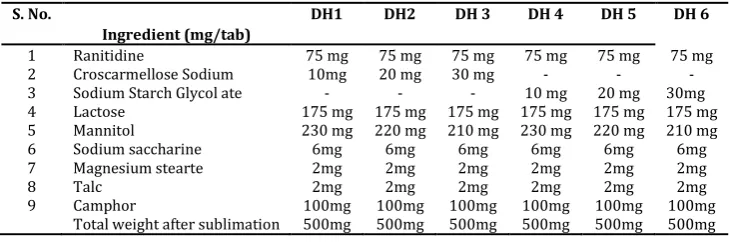
All the ingredients mentioned in the Table No 1 weighed accurately and taken. Plain 100mg camphor tablets were prepared by taking plain camphor granules and compressed into tablets. In the next step, ranitidine, excipient and super disintegrant were mixed in a plastic container. Magnesium stearate and Talc were passed through sieve # 60 mixed and blend with initial mixer in the plastic container. This mixer is then placed in the die cavity and at the center of the die cavity, previously compressed camphor tablets were kept then compressed into tablets. These tablets containing tablet in tablet. I.e. Camphor tablet is present in Ranitidine tablet. After compression, these tablets were dried at 60°c by keeping the tablets in a hot air oven until complete removal of camphor to make tablets with hole at the center leading to formation of extra absolute surface area.
EVALUATION OF TABLETS Pre compression parameters
Characteristics like tapped density, bulk density, carr’s index, hausner’s ratio were studied for powder blend of formulations which are ready to compress in to tablets.
Post compression parameters
All the prepared tablets were subjected to various physical characteristics like Crushing strength, Friability, Thickness, Diameter, Hole depth, Disintegration time, Wetting time, Weight variation, Drug content.
144
Weight variation test
Weight variation test was done by weighing 20 tablets individually, by using electronic balance. Calculating the average weight and comparing the individual tablet weight to the average weight.
Tablet thickness
The thickness was measured by placing tablet between two arms of the Vernier calipers. 5 tablets were taken and their thickness was measured.
Tablet hardness
The tablet hardness, which is the force required to break a tablet in a diametric compression force. The hardness tester used in the study was Monsanto hardness tester, which applies force to the tablet diametrically with the help of an inbuilt spring.
Tablet friability
The friability of the tablets was measured in a Roche friabilator (M/s. Elite Scientific & Equipments.). Tablets of a known weight (Wo) or a sample of 20 tablets are dedusted in a drum for a fixed time (100 revolutions) and weighed (W) again. Percentage friability was calculated from the loss in weight as given in equation as below. The weight loss should not be more than 1 %. Determination was made in triplicate.
% Friability = 100 (Wo -W) / Wo
Invitro characterization of prepared tablets
In-vitro disintegration time
In the disintegration time study, the tablets were taken and
introduced in each tube of disintegration apparatus, and the tablet rack of the disintegration apparatus was positioned into a 1-litre beaker containing 900ml of distilled water and time of disintegration was recorded at 37±2º c.
Wetting time study
In wetting time study a piece of tissue paper folded twice was placed in a petridish (with internal diameter 6.5cm) containing 5ml of distilled water. A tablet was placed on the paper and the time for complete wetting of the tablet was measured in seconds.
Drug content analysis
Total 10tablets were weighed and powdered. The powder equivalent to ranitidine was taken and dissolved in 0.1N HCl. After that an aliquot of the filtrate was diluted and analyzed spectrophotometrically (Elite UV- 150 double beam spectrophotometer.) at 314nm.
In vitro release studies
The in-vitro dissolution study was carried out in the USP dissolution test apparatus (M/s Lab India (Model – DS 8000) type 2 (paddle). 900 ml of the dissolution medium (0.1N HCl) was taken in vessel and the temperature was maintained at 37 ± 0.50C. The speed of the paddle was set at 50 rpm. 5ml of the dissolution medium was withdrawn and the same amount of fresh medium was replenished to the dissolution medium. The sample withdrawn was filtered and diluted with 0.1N HCl prior to analysis in the UV Spectrophotometer (Elite UV- 150 double beam spectrophotometer) at 314nm. .In vitro release profile was analyzed by various kinetic models (zero order, first order and Higuchi) in order to determine the mechanism of drug release.
Table 1: Formulation chart of ranitidine FDT with hole technology
S. No. DH1 DH2 DH 3 DH 4 DH 5 DH 6 0.51±0.005 to 0.56±0.005g/ml and tapped density was found to be in the range of 0.61±0.03 to 0.66 ± 0.03 g/ml (good flow property). The Angle of repose of powder blends of all formulation was found to be in the range of 19.21 ± 0.12 to 29.62º ± 0.2 (good flow property). The calculated Carrs index of all formulations was found to within the range of 13.84 ± 0.15 to 17.74% ± 0.16 (good flow property). The calculated Hausner’s ratio of all the formulations was found to be in the range of 1.162 ± 0.13 to 1.21 ± 0.03 (good flow property). The values of precompressional parameters evaluated were within the prescribed limits and indicated good free flowing properties.
Post compression parameters
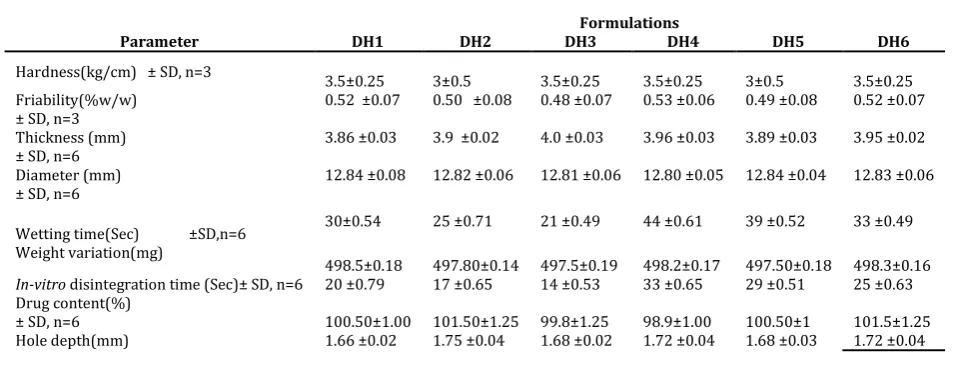
The post compression parameters of all batches were studied and
shown in table 2. The crushing strength of tablets prepared by hole technology were within the range of 3.5 ± 0.25 to 3.5 ± 0.5 kg/cm2.
145
Table 2: Physical characteristics of tablets
Formulations
Parameter DH1 DH2 DH3 DH4 DH5 DH6
Hardness(kg/cm) ± SD, n=3 3.5±0.25 3±0.5 3.5±0.25 3.5±0.25 3±0.5 3.5±0.25 Friability(%w/w) 0.52 ±0.07 0.50 ±0.08 0.48 ±0.07 0.53 ±0.06 0.49 ±0.08 0.52 ±0.07 ± SD, n=3
3.86 ±0.03 3.9 ±0.02 4.0 ±0.03 3.96 ±0.03 3.89 ±0.03 3.95 ±0.02 Thickness (mm)
± SD, n=6
12.84 ±0.08 12.82 ±0.06 12.81 ±0.06 12.80 ±0.05 12.84 ±0.04 12.83 ±0.06 Diameter (mm)
± SD, n=6
Wetting time(Sec) ±SD,n=6 Weight variation(mg)
30±0.54 25 ±0.71 21 ±0.49 44 ±0.61 39 ±0.52 33 ±0.49
498.5±0.18 497.80±0.14 497.5±0.19 498.2±0.17 497.50±0.18 498.3±0.16 In-vitro disintegration time (Sec)± SD, n=6 20 ±0.79 17 ±0.65 14 ±0.53 33 ±0.65 29 ±0.51 25 ±0.63 Drug content(%)
99.8±1.25 100.50±1
± SD, n=6 100.50±1.00 101.50±1.25 98.9±1.00 101.5±1.25 Hole depth(mm) 1.66 ±0.02 1.75 ±0.04 1.68 ±0.02 1.72 ±0.04 1.68 ±0.03 1.72 ±0.04
In vitro dissolution studies
The in-vitro dissolution study was carried out in the USP dissolution test apparatus (M/s Lab India (Model – DS 8000) type 2 (paddle). 900 ml of the dissolution medium (0.1N HCl) was taken in vessel and the temperature was maintained at 37 ± 0.50C. The cumulative % of drug release of formulations DH1 prepared by hole technology showed 100% drug released at 12 min, DH2 showed 98.35% drug released at 10 min,DH3 showed 100.92% drug released at 10 min, DH4 showed 97.71% drug released at 10 min,DH5 showed 96.42% drug released at 8 min, DH6 showed 100.92% drug released at 6 min. From the results DH6 was selected as best formulation since it showed total drug release in 6minutes.
Stability studies of optimized formulation
Optimized formulation was exposed for accelerated conditions as per ICH guidelines. (40ºC / 75% RH for a period of 3 months) .Tablets were evaluated for physicochemical properties, drug release. The Stability studies on optimized formulation of ranitidine fast dissolving tablets were conducted according to the ICH guidelines. The various parameters tested during studies of ranitidine fast dissolving tablets the formulation were withdrawn at suitable intervals (initial and 1 month) and analyzed visually for physical appearance and evaluated for different tests. The tablets showed no visual differences and compiled with description. The percentage of drug release from the formulation DH6 at different
intervals of time is given in table 5 and was found to be matching with specification. From the above results, it can be concluded that the formulation DH6 of ranitidine fast dissolving tablets was stable at accelerated conditions of temperature and humidity.
Table 3: Disintegration and wetting time
Formulation disintegration time
(sec) Wetting time ( sec )
DH1 20sec 30sec DH2 17sec 25sec DH3 14sec 21sec DH4 33sec 44sec DH5 29sec 39sec DH6 25sec 33sec
Table 4: Dissolution studies of formulations
Time in
min DH1 DH2 DH3 DH4 DH5 DH6
0 0 0 0 0 0 0 2 16.07 23.14 27.64 23.78 28.28 30.21 4 35.35 48.85 57.21 48.85 58.5 62.35 6 53.35 83.57 90 86.14 92.57 100.92 8 83.57 91.28 99.64 88.07 96.42 - 10 89.35 98.35 100.92 97.71 - - 12 100.28 - - - - -
Table 5: Results for stability studies
S.No. Test Initial 40ºC/75%RH After3 months
1 Thickness (mm) ± SD 3.95±0.25 3.85 ± 0.0057 2 Hardness (kg/cm2) ± SD 3.5 ±0.25 3 ± 0.011 3 Friability (% W/W) ± SD 0.52 ±0.07 0.89 ± 0.002 4 Weight variation (%) ± SD 498.3 ± 0.16 485 ±0.577 5 Drug content (% ) ± SD 101.5± 1.25 97.2 ±0.115 6 Wetting time(sec) 33sec ±0.49 30sec ±0.5 7 Disintegration time(sec) 25sec ±0.63 21sec ±0.39 8 Drug release 100%at 6min 97%at 6min
Table 6: Drug release kinetics (R2 values of formulations)
Formulation Zero order First order Higuchi plots Hixon and crowell Korsemeyer peppas plots
146
Drug release kinetics
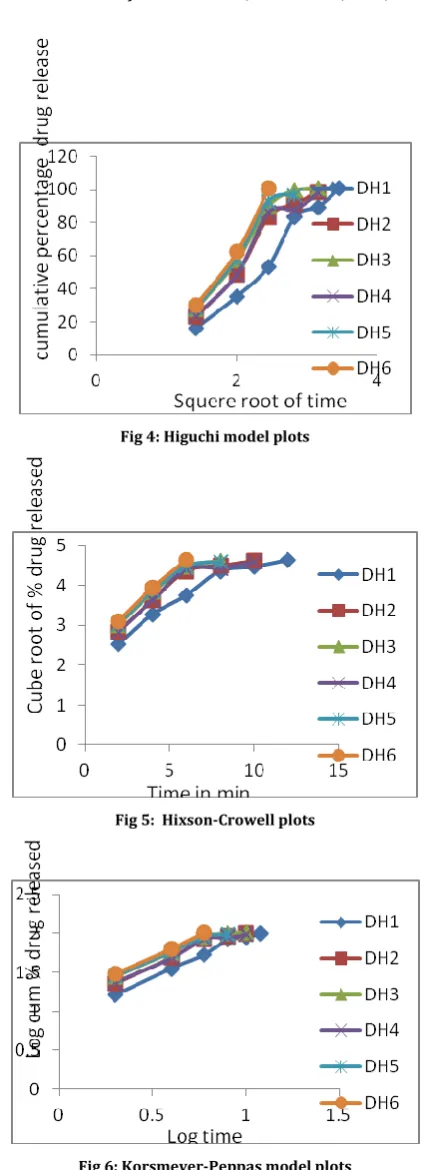
The drug release profiles of the tablets were studied includes zero order, First order, Higuchi square root of time model, Korsmeyer - peppas model, and Hixson- Crowell model. From the results it is implying that the release kinetics from the FDT tablet follows zero order kinetics. Especially batch DH6 showed R2 value of 0.9968
indicating the drug release followed zero order kinetics. The R2values of all formulations were showed in table 6 and plots were
graphically represented in fig2, fig3, fig4, fig5, fig6.
Fig 1: photographs of tablets prepared by hole technology
Fig 2: Zero order release kinetics plots
Fig 3: first order release kinetics
Fig 4: Higuchi model plots
Fig 5: Hixson-Crowell plots
Fig 6: Korsmeyer-Peppas model plots CONCLUSION
147
ACKNOWLEDGEMENTS
The authors are thankful to Dr. L.Rathaiah, Chairman of Lavu Educational Society for providing facility to carry out the above research work.
REFERENCES
1. Seager H. Drug delivery products and the zydis fast dissolving dosage forms. J. Pharm. Pharmacol. 1998; 50: 375-82.
2. Chang RK, Guo X, Burnside BA and Couch RA. Fast dissolving tablets. Pharm. Tech. 2000; 24(6): 52-8.
3. Reddy LH, Ghosh B, Rajneesh. Fast dissolving drug delivery systems: A review of the literature. Ind J Pharm Sci 2002; 64 (4): 331-336.
4. D Bhowmik, B Chiranjib, Krishnakanth, Pankaj, Chandira RM. Fast dissolving tablet: an overview. Journal of Chemical and Pharmaceutical Research, 2009; 1 (1): 163-177. 5. Chang RK, Guo X, Burnside BA and Couch RA. Fast dissolving
tablets. Pharm. Tech. 2000; 24(6): 52-8.
6. Kulkarni U, Rao NG, Design and Development of Aceclofenac Fast Dissolving Tablets by Novel Hole Technology: A Novel Approach to Decrease the Disintegration Time and Increase the patient compliance 2011, 3(6), 91-94.
7. Bhardwaj V, Bansal M, Sharma PK. Formulation and evaluation of fast dissolving tablets of amlodipine besylate using different super disintegrants and camphor as sublimating agent. American-Eurasian Journal of Scientific Research. 2010; 5 (4): 264-269.
8. Grant SM, Langtry HD, Brogden RN. Ranitidine. An updated review of its pharmacodynamic and pharmacokinetic properties and therapeutic use in peptic ulcer disease and other allied diseases. Drugs 1989; 37: 801-870.
9. Histamine H2 antagonists. In: Drug Facts and Comparisons. St Louis, MO: Wolters Kluwer Co., 2002, 1192-1197. 10.Hoogerwerf WA, Pasricha PJ. Agents used for control of
gastric acidity and treatment of peptic ulcers and gastroesophageal reflux disease In: Hardman JG, Limbird LE, Goodman Gilman A, ed. The Pharmacological Basis of Therapeutics. New York: McGraw-Hill, 2001: 1005-1020
11.Garg DC, Weidler DJ, Eshelman FN. Ranitidine bioavailability and kinetics in normal male subjects. Clin Pharmacol Ther 1983; 33: 445-452
12.Shenoy V, Agrawal S, Pandey S. Optimizing fast dissolving dosage form of diclofenac sodium by rapidly disintegrating agents. Indian J Pharm Sci. 2003: 197-201. 13.Gohel MC, Patel MM, Amin A, Agrawal R, Dave R, Bariya
N. Formulation design and optimization of mouth dissolving tablets of nimesulide using vacuum drying technique. AAPS Pharm. Sci. Tech. 2004; 5 (3): 1-6.
14.Corveleyn S, Remon JP. Formulation and production of rapidly disintegrating tablets by lyophilisation using hydrochlorothiazide as a model drug. International Journal of Pharmaceutics. 1997; 152: 215-225.
15.Ferrero C, Mufioz N, Velasco MV, Mufioz-Ruiz A, Jimenez-Castellanos R. Disintegrating efficiency of croscarmellose sodium in a direct compressible formulation. Int J Pharma. 1997; 147: 11- 21.
16.Zhao N, Augsburger LL. Functionality comparison of 3 classes of Superdisintegrants in promoting aspirin tablet disintegration and dissolution.AAPS Pharm.Sci.Tech. 2005; 6 (4): E634-E640.
17.Robin HB, Meghan FW. Fast dissolving tablets. US.Pharmacist (online).2002 Sep (cited 2006dec25);(1screen). Available from:
http://www.uspharmacist.com/oldformat.asp?url=newlook /files/feat/fastdissolving.htm.
18.Susan K, Mikota DVM and Donald C. Ranitidine HCl. The
Elephant Formulary
http://www.elephantcare.org/Drugs/ranitidi.htm
19.Koizumi K, Watanabe Y, Morita K, Utoguchi N, Matsumoto M. New method of preparing high-porosity rapidly saliva soluble compressed tablets using mannitol with camphor, a subliming material. International Journal of Pharmaceutics 1997; 152(1): 127-31.