Clinical Ophthalmology 2018:12 113–118
Clinical Ophthalmology
Dove
press
submit your manuscript | www.dovepress.com
113
H y p O t H e s i s
open access to scientific and medical research
Open Access Full text Article
Does herpes zoster predispose to giant cell
arteritis: a geo-epidemiologic study
edsel B. ing
1,2Royce ing
2Xinyang Liu
3Angela Zhang
1Nurhan torun
4Michael sey
5Christian pagnoux
61Ophthalmology and Vision sciences, University of toronto, toronto, ON, 2toronto eyelid strabismus & Orbit surgery Clinic, toronto, ON, Canada; 3Department of Medicine, internal Medicine, Fudan University, shanghai, China; 4Ophthalmology, Harvard Medical school, Boston, MA, UsA; 5Department of Medicine, Western University schulich school of Medicine, London, ON, 6Vasculitis Clinic, Rheumatology, Mount sinai Hospital, toronto, ON, Canada
Purpose: Giant cell arteritis (GCA) is the most common systemic vasculitis in the elderly and can cause irreversible blindness and aortitis. Varicella zoster (VZ), which is potentially preventable by vaccination, has been proposed as a possible immune trigger for GCA, but this is controversial. The incidence of GCA varies widely by country. If VZ virus contributes to the immunopathogenesis of GCA we hypothesized that nations with increased incidence of GCA would also have increased incidence of herpes zoster (HZ). We conducted an ecologic analysis to determine the relationship between the incidence of HZ and GCA in different countries.
Methods: A literature search for the incidence rates (IRs) of GCA and HZ from different countries was conducted. Correlation and linear regression was performed comparing the disease IR of each country for subjects 50 years of age or older.
Results: We found the IR for GCA and HZ from 14 countries. Comparing the IRs for GCA
and HZ in 50-year-olds, the Pearson product-moment correlation (r) was -0.51, with linear
regression coefficient (β) -2.92 (95% CI -5.41, -0.43; p=0.025) using robust standard errors.
Comparing the IRs for GCA and HZ in 70-year-olds, r was -0.40, with β-1.78, which was
not statistically significant (95% CI -4.10, 0.53; p=0.12).
Conclusion: Although this geo-epidemiologic study has potential for aggregation and selec-tion biases, there was no positive biologic gradient between the incidence of clinically evident HZ and GCA.
Keywords: epidemiology, shingles, temporal arteritis, immunopathogenesis
Introduction
Giant cell arteritis (GCA) is the most common systemic vasculitis in the elderly and
can cause irreversible blindness, myocardial infarction, aortic aneurysm, stroke and
rarely death.
1The incidence of GCA is projected to increase as our population ages,
with predicted cost of $76 billion in the United States alone, by the year 2050.
2Gilden et al and Nagel et al found varicella zoster virus (VZV) in the temporal
arteries of 73% of patients with biopsy-proven GCA and propose VZV as a possible
trigger in the immunopathogenesis of GCA.
3,4Although this potential role of VZV
in the development of GCA has not been substantiated by other investigators, and
remains controversial, Gilden suggested adjunctive antivirals be considered in the
treatment of GCA.
5The incidence rate (IR) of GCA varies widely by country, being the highest in
northern Europe and lowest in Asia.
2,6We hypothesized that if VZV contributed to
GCA, the GCA IRs per 100,000 subjects, 50 years of age or older (IR
GCA) per country
should correlate with the local herpes zoster IRs (IR
HZ). To test this hypothesis, we
performed a regression analysis using the published IR
GCAand IR
HZfrom different
countries.
Correspondence: edsel B. ing toronto eyelid strabismus & Orbit surgery Clinic, Michael Garron Hospital, 650 sammon Ave, K Wing 306, toronto, ON, M4C 5M5, Canada
tel +1 416 465 7900 Fax +1 416 465 2035
email [email protected]
Journal name: Clinical Ophthalmology Article Designation: Hypothesis Year: 2018
Volume: 12
Running head verso: Ing et al
Running head recto: Does herpes zoster predispose to giant cell arteritis? DOI: http://dx.doi.org/10.2147/OPTH.S151893
Clinical Ophthalmology downloaded from https://www.dovepress.com/ by 118.70.13.36 on 21-Aug-2020
For personal use only.
Dovepress
ing et al
Methods
The IR
GCAwas searched for on PubMed, Embase, and Google
Scholar from inception to July 1, 2017 using the search
terms: incidence, epidemiology, country, temporal arteritis
and GCA. The same search was repeated using herpes zoster
and shingles in place of the arteritis terms.
The country specific IRs for subjects 50 years of age and
older were recorded per 100,000 population for GCA, and per
1,000 person-years for HZ. If IRs were provided for multiple
years, the results were averaged (Table 1).
The IR
GCAin Japan was calculated using Koboyashi’s
reported prevalence rate of 1.47 per 100,000 in subjects aged
50 years or older, with average age of onset of 71.5 years.
7Lifespan is thought not to be affected by GCA unless the
patient has aortic aneurysm or dissection.
8The average life
expectancy in Japan is 83.3 years.
9As GCA is a rare disease
and recurrent, the IR was estimated as the prevalence rate/
duration of disease
=
1.3 per million subjects 50 years or older.
Since the peak onset of GCA is in the 8th decade,
10we
also examined the IR of HZ in 70 year-olds. If the age
brackets straddled our chosen age cut-offs, the IR values
from the two adjacent brackets were averaged.
Only countries/regions that had IRs available for both
GCA and HZ were used for analysis. Paired t-test was
used to examine the time difference in year of publication
between the GCA and HZ studies for each country. There was
inadequate information in the GCA articles to consistently
calculate the within-study standard errors needed for
meta-regression. Pearson product-moment correlation coefficients,
and linear regression with and without robust standard errors
was performed. White’s test was used to test for
heterosce-dasticity. All statistical tests were conducted with Stata 14.2
(StataCorp LP, College Station, TX, USA), and a two-sided
p<0.05 was considered statistically significant.
Results
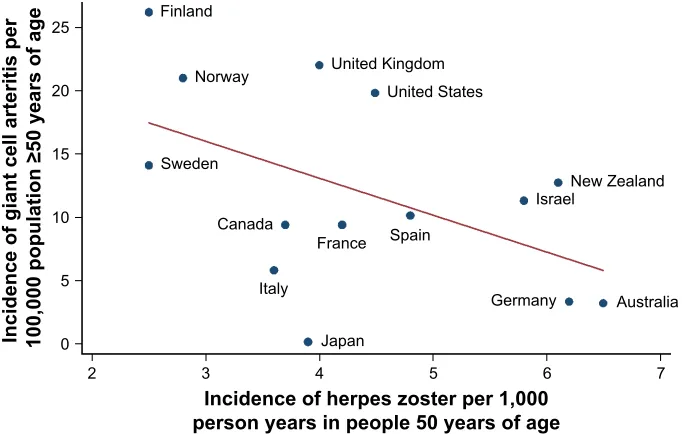
The IRs for both GCA and HZ were available for 14 countries
(Table 1), and plotted on Figure 1. With the exception of
Olmsted County and the United Kingdom, the availability
of IR
GCAand IR
HZfrom the same time frame and
correspond-ing geographic region was limited. Eight of the 14 countries
(57%) in Table 1 were overlapping in the time frame of the
corresponding GCA and HZ studies. On paired t-test, the
GCA studies were published on average 4.5 years before
the HZ studies (p
=
0.09). A published IR
GCAfor Iceland was
available. The IR
HZfor Iceland was only available for the
60-year age group only (4.7 per 1,000), but not the
50-year-old or 70-year-50-year-old age groups, and as such was not used.
Pearson product-moment correlation coefficient (r)
com-paring IR
GCAwith: IR
HZin 50 year-olds was
-
0.51 (p
=
0.07),
and IR
HZin 70-year-olds was
-
0.40 (p
=
0.16). Linear
regres-sion with robust standard errors showed a regresregres-sion
coef-ficient (
β
)
-
2.92 (95% CI
-
5.41,
-
0.43; p
=
0.025) between
the IR
GCA$
50-year-olds, and the IR
HZin 50-year-olds.
For the IR
HZin 70-year-olds, no statistically significant
linear dependence of the mean IR
GCAon IR
HZwas detected
(
β=-
1.78, 95% CI
-
4.10, 0.53; p
=
0.12). White’s test did not
suggest heteroscedasticity (Table 2).
Table 1 incidence rates of giant cell arteritis and herpes zoster per country
Country GCA study: year published (study period)/region
IRGCA HZ study: year/region IRHZ50 IRHZ70 Time overlap Norway, B+C37 2014 (2006–2012)/south 21 2016 (2008–2012)/National38 2.8 7.0 yes Finland, B+C39 1992 (1984–1988)/West Nyland 26.2 2010 (2000–2006)/tuusula, Kangasala, salo40 2.5 6.5 No sweden, B41 2015 (1997–2010)/skane 14.1 2013 (2006–2010)/National42 2.5 8.0 yes United Kingdom, B+C43 2006 (1990–2001)/National 22 2003 (1991–2000)/National44 4.0 9.3 yes UsA, C45 2015 (2000–2009)/Olmsted Cty 19.8 2016 (1945–2007)/Olmsted City46 4.5 8.4 yes spain, B47 2007 (1981–2005)/Lugo 10.13 2013 (2007–2010)/Valencian Community48 4.8 9.8 No New Zealand, B49 2011 (1996–2005)/Otago 12.73 2014 (2009–2013)/Lower Hutt50 6.1 7.3 No israel, B+C51 2007 (1980–2004)/Jerusalem 11.3 2013 (2006–2010)/tel Aviv52 5.8 11.8 No Canada, B53 2007 (1998–2003)/saskatoon 9.4 2011 (1992–2010)/Ontario54 3.7 7.4 yes France, B+C55 1982 (1970–1979)/Loire-Atlantique 9.4 2010 (2005–2007)/National56 4.2 8.7 No italy, B+C57 2017 (1986–2012)/Reggio emilia 5.8 2010 (2003–2005)/National58 3.6 7.7 yes Australia, B59 2013 (1992–2011)/Adelaide 3.2 2008 (1998–2006)/National60 6.5 11.5 yes Germany, C61 2005 (1998–2002)/schlewig-Holstein 3.3 2011 (2007–2008)/National62 6.2 11.3 No Japan, Cal7 2003 (1998)/National 0.13 2009 (1997–2006)/Miyazaki63 3.9 7.4 yes
Notes: B, biopsy proven; C, clinical criteria for diagnosis; Cal, calculated from published prevalence rate; time overlap, the incidence rates for GCA and HZ were from the same time period.
Abbreviations: GCA, giant cell arteritis; iR, incidence rate; iRGCA, giant cell arteritis incidence rates per 100,000 subjects, 50 years of age or older; HZ, herpes zoster; iRHZ50, herpes zoster incidence rates in 50-year-old subjects per 1,000 person years; iRHZ70, herpes zoster incidence rates in 70-year-old subjects per 1,000 person years.
Clinical Ophthalmology downloaded from https://www.dovepress.com/ by 118.70.13.36 on 21-Aug-2020
Dovepress Does herpes zoster predispose to giant cell arteritis?
This ecologic study does not support a positive biologic
gradient between the IR
HZand IR
GCA. Subgroup regression
analyses of the per country IR
GCAand IR
HZ, with and without
overlapping timeframes were not statistically significant and
did not show a positive regression coefficient.
Discussion
Infections can predispose to systemic vasculitis by
mecha-nisms such as molecular mimicry, epitope spreading, immune
response to subdominant epitopes normally hidden from
T-cell recognition, or bystander activation.
11If there is a
causal relationship between HZ and GCA it is important
to define since HZ can be potentially prevented with the
shingles vaccine, and because the treatment of GCA might
benefit from adjunctive antivirals.
VZV and GCA have some overlapping features. Dendritic
cells are thought to play a central role in VZV infection and
the immunopathogenesis of GCA.
12–14HZ ophthalmicus or
multifocal VZV vasculopathy with temporal artery
infec-tion may mimic the presentainfec-tion of GCA. Varicella zoster
vasculopathy and GCA can both cause optic neuropathy,
cranial nerve palsy, and stroke.
Temporal artery biopsy studies have shown conflicting
results on the association of VZV and GCA. Gilden et al and
Nagel et al suggested that VZV triggers the immunopathology
of GCA, and found increase of 74% VZV in temporal artery
biopsy specimens from patients with GCA.
3–5,15However,
with the exception of Mitchell and Font,
16other investigators
have not found substantial VZV in the arterial specimens
of biopsy-proven GCA or clinically diagnosed GCA.
17–22False positive immunohistochemistry from antibody
cross-reactivity to shared epitopes between VZV proteins and
arterial smooth muscle elements suggest caution when
inter-preting pathology findings.
23Gilden and Nagel acknowledge
Table 2 Correlation and linear regression of the incidence rates of giant cell arteritis versus herpes zoster
Zoster incidence rate age groups
Number of countries
Correlation coefficient
Regression coefficient
p-value, R2 p-value with robust SE
p-value for white’s test 50-year-olds, all countries 14 -0.51 -2.92 p=0.07, R2=0.26 p=0.025 p=0.28 70-year-olds, all countries 14 -0.40 -1.78 p=0.16, R2=0.16 p=0.12 p=0.42
50-year-olds, time overlap 8 -0.38 -2.66 p=0.35, R2=0.14 p=0.06 p=0.12
70-year-olds, time overlap 8 -0.15 -0.88 p=0.72, R2=0.02 p=0.69 p=0.88
50-year-olds, no overlap 6 -0.80 -4.24 p=0.06, R2=0.63 p=0.05 p=0.93
70-year-olds, no overlap 6 -0.74 -2.63 p=0.09, R2=0.54 p=0.14 p=0.09
Notes: Correlation coefficient, Pearson product-moment correlation coefficient (r); regression coefficient, linear regression coefficient; time overlap, the incidence rates for GCA and HZ were from the same time period; no overlap, the incidence rates for GCA and HZ were from different time periods.
Abbreviations: GCA, giant cell arteritis; HZ, herpes zoster; se, standard error.
Figure 1 incidence of giant cell arteritis versus incidence of herpes zoster per country.
Notes: each dot represents a country’s intersecting incidence rates for giant cell arteritis in subjects 50 years or older, and herpes zoster in 50 year-old subjects. the negative sloping red line is the line of best linear fit using the least squares method.
,QFLGHQFHRIKHUSHV]RVWHUSHU
SHUVRQ\HDUVLQSHRSOH\HDUVRIDJH
,QFLGHQFHRIJLDQWFHOODUWHULWLVSHU SRSXODWLRQ\HDUVRIDJH
)LQODQG
1RUZD\ 8QLWHG.LQJGRP 8QLWHG6WDWHV
6ZHGHQ
&DQDGD
,WDO\
-DSDQ )UDQFH 6SDLQ
*HUPDQ\ $XVWUDOLD 1HZ=HDODQG ,VUDHO
Clinical Ophthalmology downloaded from https://www.dovepress.com/ by 118.70.13.36 on 21-Aug-2020
Dovepress
ing et al
that “the presence of VZV in about 20% of temporal artery
biopsies from non-GCA post-mortem controls also suggests
that VZV alone is not sufficient to produce disease”.
5A population-based cohort study did not find an increased
risk of HZ in patients with GCA compared to non-GCA
subjects, even during the first 6 months after glucocorticoid
initiation, when patients are on the highest doses.
24A large
nested case control study determined that HZ had a
mod-est incidence rate ratio of 1.17 in association with incident
GCA.
25A review of two large administrative databases found
a two-fold increased risk of GCA with complicated HZ.
26Our ecologic study did not show a positive biologic
gra-dient between the IR
HZand IR
GCA. Limitations of this study
include possible ecologic fallacy, time, location and/or
selec-tion biases, the limited availability of IR
GCAand IR
HZ, and
variable trends in IR. By and large the IR
HZare increasing.
27Zoster sine herpete and asymptomatic VZV infection may
have affected our analysis. The IR
GCAmay be increasing,
2decreasing,
6or cyclical.
28Furthermore, the IR
GCA
are higher
when cases of clinically diagnosed GCA are included with
biopsy-proven GCA. It is unlikely that the IR
HZin Table 1 were
significantly affected by zoster vaccination. The Oka/Merck
zoster vaccine decreases the risk of shingles by only 51%,
29and
was approved for use in the United States and European Union
in 2006,
30,31and in Canada in 2008.
32The Olmsted county HZ
study published in 2016 reviewed two sets of patients, the latest
of which were from 1980 to 2007. In the United States a 5%
random sample of Medicare seniors were first offered zoster
vaccine in 2007, and uptake was low at 3.9%.
33The first two
European countries to recommend nation-wide zoster
vaccina-tion for seniors 65 to 74 years of age were the United Kingdom
and France in 2013.
34The Australian and Ontario, Canada
immunization programs for seniors began in 2016.
35,36Conclusion
The discordant IRs for HZ and GCA question the biologic
plausibility of clinically overt HZ as the sole
immunopatho-genic trigger for GCA. Geo-epidemiology may help elucidate
the relationship between VZV and GCA, but more widely
available, accurate and updated IRs from different countries
are required.
Disclosure
The authors report no conflicts of interest in this work.
References
1. Lie J. Aortic and extracranial large vessel giant cell arteritis: a review of 72 cases with histopathologic documentation. Semin Arthritis Rheum. 1995;24(6):422–431.
2. De Smit E, Palmer AJ, Hewitt AW. Projected worldwide disease burden from giant cell arteritis by 2050. J Rheumatol. 2015;42(1):119–125.
3. Gilden D, White T, Khmeleva N, et al. Prevalence and distribution of VZV in temporal arteries of patients with giant cell arteritis. Neurology. 2015;84(19):1948–1955.
4. Nagel MA, White T, Khmeleva N, et al. Analysis of varicella-zoster virus in temporal arteries biopsy positive and negative for giant cell arteritis. JAMA Neurol. 2015;72(11):1281–1287.
5. Gilden D, Nagel MA. Varicella zoster virus and giant cell arteritis. Curr
Opin Infect Dis. 2016;29(3):275–279.
6. Mahr A, Aouba A, Richebé P, Gonzalez-Chiappe S. Épidémiologie et histoire naturelle de l’artérite à cellules géantes (Horton). [Epidemiology and natural history of giant cell arteritis]. Rev Med Interne. 2017;38(10): 663–669. French.
7. Kobayashi S, Yano T, Matsumoto Y, et al. Clinical and epidemiologic analysis of giant cell (temporal) arteritis from a nationwide survey in 1998 in Japan: the first government-supported nationwide survey.
Arthritis Rheum. 2003;49(4):594–598.
8. Kermani TA, Kenneth J, Warrington KJ, et al. Large-vessel involvement in giant cell arteritis: a population-based cohort study of the incidence-trends and prognosis. Ann Rheum Dis. 2013;72(12):1989–1994. 9. United Nations. World population prospects: The 2015 revision,
volume I, comprehensive tables. New York 2015. ST/ESA/SER.A/379. Available from: https://esa.un.org/unpd/wpp/publications/Files/ WPP2015_Volume-I_Comprehensive-Tables.pdf. Accessed August 01, 2017.
10. Gonzalez-Gay MA, Vazquez-Rodriguez TR, Lopez-Diaz MJ, Miranda-Filloy JA, Gonzalez-Juanatey C, Martin J, Llorca J. Epidemiology of giant cell arteritis and polymyalgia rheumatica. Arthritis Rheum. 2009;61(10):1454–1461.
11. Moiseev S, Novikov P, Smitienko I, Shchegoleva E. Giant cell arteritis, infections and biologics. Ann Rheum Dis. 2017;76(9):e29.
12. Ciccia F, Rizzo A, Ferrante A, et al. New insights into the pathogenesis of giant cell arteritis. Autoimmun Rev. 2017;16(7):675–683. 13. Samson M, Corbera-Bellalta M, Audia S, Planas-Rigol E, Martin L,
Cid MC, Bonnotte B. Recent advances in our understanding of giant cell arteritis pathogenesis. Autoimmun Rev. 2017;16(8):833–844. 14. Schönrich G, Raftery MJ. Dendritic cells as Achilles’ heel and
Trojan horse during varicella zoster virus infection. Front Microbiol. 2015;6:417.
15. Gilden D, White T, Khmeleva N, Katz BJ, Nagel MA. Blinded search for varicella zoster virus in giant cell arteritis (GCA)-positive and GCA-negative temporal arteries. J Neurol Sci. 2016;364:141–143. 16. Mitchell BM, Font RL. Detection of varicella zoster virus DNA in
some patients with giant cell arteritis. Invest Opthalmol Vis Sci. 2001; 42(11):2572–2577.
17. Muratore F, Croci S, Tamagnini I, et al. No detection of varicella-zoster virus in temporal arteries of patients with giant cell arteritis. Semin
Arthritis Rheum. 2017;47(2):235–240.
18. Kennedy PG, Grinfeld E, Esiri MM. Absence of detection of varicella-zoster virus DNA in temporal artery biopsies obtained from patients with giant cell arteritis. J Neurol Sci. 2003;215(1–2):27–29. 19. Helweg-Larsen J, Tarp B, Obel N, Baslund B. No evidence of
parvovirus B19, chlamydia pneumoniae or human herpes virus infec-tion in temporal artery biopsies in patients with giant cell arteritis.
Rheumatology (Oxford). 2002;41(4):445–449.
20. Rodriguez-Pla A, Bosch-Gil JA, Echevarria-Mayo JE, et al. No detec-tion of parvovirus B19 or herpesvirus DNA in giant cell arteritis. J Clin
Virol. 2004;31(1):11–15.
21. Álvarez-Lafuente R, Fernández-Gutiérrez B, Jover JA, et al. Human parvovirus B19, varicella zoster virus, and human herpes virus 6 in temporal artery biopsy specimens of patients with giant cell arteritis: analysis with quantitative real time polymerase chain reaction. Ann
Rheum Dis. 2005;64(5):780–782.
22. Nordborg C, Nordborg E, Petursdottir V, LaGuardia J, Mahalingam R, Wellish M, Gilden DH. Search for varicella zoster virus in giant cell arteritis. Ann Neurol. 1998;44(3):413–414.
23. Pisapia DJ, Lavi E. VZV, temporal arteritis, and clinical practice: False positive immunohistochemical detection due to antibody cross-reactivity. Exp Mol Pathol. 2016;100(1):114–115.
Clinical Ophthalmology downloaded from https://www.dovepress.com/ by 118.70.13.36 on 21-Aug-2020
Dovepress Does herpes zoster predispose to giant cell arteritis?
24. Schäfer VS, Kermani TA, Crowson CS, et al. Incidence of herpes zoster in patients with giant cell arteritis: a population-based cohort study.
Rheumatology (Oxford). 2010;49(11):2104–2108.
25. Rhee RL, Grayson PC, Merkel PA, Tomasson G. Infections and the risk of incident giant cell arteritis: a population-based, case-control study.
Ann Rheum Dis. 2017;76(6):1031–1035.
26. England BR, Mikuls TR, Xie F, Yang S, Chen L, Curtis J. Herpes zoster and the risk of incident giant cell arteritis. Arthritis Rheumatol. 2017;69(12):2351–2358.
27. Kawai K, Gebremeskel G, Acosta CJ. Systematic review of incidence and complications of herpes zoster: towards a global perspective.
BMJ Open. 2014;4(6):e004833.
28. Wing S, Rider LG, Johnson JR, Miller FW, Matteson EL, Crowson CS, Gabriel SE. Do solar cycles influence giant cell arteritis and rheumatoid arthritis incidence? BMJ Open. 2015;15(5):e006636.
29. Oxman MN, Levin MJ, Johnson GR, et al. A vaccine to prevent her-pes zoster and postherpetic neuralgia in older adults. N Engl J Med. 2005;352(22):2271–2284.
30. Centers for Disease Control and Prevention. What everyone should know
about shingles vaccine. CDC; 2016. Available from: https://www.cdc.gov/
vaccines/vpd/shingles/public/index.html. Accessed December 8, 2017. 31. European Medicines Agency. Zostavax European public assessment
report. European Medicines Agency (EMEA); 2006. Available from:
http://www.ema.europa.eu/docs/en_GB/document_library/EPAR_-_ Summary_for_the_public/human/000674/WC500053457.pdf. Accessed December 8, 2017.
32. newswire.ca [homepage on the Internet]. ZOSTAVAX(TM) approved in Canada – The first and only vaccine for the prevention of shingles. CISION News Wire; 2008. Available from: http://www.newswire.ca/ news-releases/zostavaxtm-approved-in-canada---the-first-and-only-vaccine-for-the-prevention-of-shingles-536564411.html. Accessed December 8, 2017.
33. Langan SM, Smeeth L, Margolis DJ, Thomas SL. Herpes zoster vac-cine effectiveness against incident herpes zoster and post-herpetic neuralgia in an older US population: a cohort study. PLoS Med. 2013; 10(4):e1001420.
34. NHS England. Enhanced service specification Shingles (catch-up) vaccination programme 2014. NHS England gateway reference: 01773. Available from: https://www.england.nhs.uk/wp-content/ uploads/2014/06/shingles-serv-spec.pdf. Accessed August 01, 2017. 35. immunise.health.gov.au [homepage on the Internet]. Immunise
Australia Program. Australian Government Department of Health; 2016. Available from: http://immunise.health.gov.au/internet/immunise/ publishing.nsf/Content/IT0213.cnt. Accessed December 8, 2017. 36. news.ontario.ca [homepage on the Internet]. Ontario making shingles
vaccine free for seniors. Government of Ontario; 2016. Available from: https://news.ontario.ca/mohltc/en/2016/09/ontario-making-shingles-vaccine-free-for-seniors.html. Accessed December 8, 2017.
37. Diamantopoulos A, Myklebust G, Wigaard E, Amundsen L, Soldal DM, Haugeberg G. The incidence rate of giant cell arteritis in southern Norway is lower than previously reported: A result of temporal varia-tions or a sign of a true shift in incidence rates? Paper presented at: EULAR 2014: Scientific Abstracts, June 13; 2014; Paris, France. 38. Rimseliene G, Vainio K, Gibory M, Salamanca BV, Flem E.
Varicella-zoster virus susceptibility and primary healthcare consultations in Norway. BMC Infect Dis. 2016;16:254.
39. Franzén P, Sutinen S, von Knorring J. Giant cell arteritis and polymy-algia rheumatica in a region of Finland: an epidemiologic, clinical and pathologic study, 1984–1988. J Rheumatol. 1992;19(2):273–276. 40. Karhunen M, Leino T, Salo H, Davidkin I, Kilpi T, Auranen K.
Modelling the impact of varicella vaccination on varicella and zoster.
Epidemiol Infect. 2010;138(4):469–481.
41. Mohammad AJ, Nilsson J, Jacobsson LT, Merkel PA, Turesson C. Incidence and mortality rates of biopsy-proven giant cell arteritis in southern Sweden. Ann Rheum Dis. 2015;74(6):993–997.
42. Studahl M, Petzold M, Cassel T. Disease burden of herpes zoster in Sweden – predominance in the elderly and in women – a register based study. BMC Infect Dis. 2013;13:586.
43. Smeeth L, Cook C, Hall AJ. Incidence of diagnosed polymyalgia rheumatica and temporal arteritis in the United Kingdom, 1990–2001.
Ann Rheum Dis. 2006;65(8):1093–1098.
44. Brisson M, Edmunds WJ. Epidemiology of varicella-zoster virus in England and Wales. J Med Virol. 2003;70 (Suppl 1):S9–S14. 45. Chandran AK, Udayakumar PD, Crowson CS, Warrington KJ,
Matteson EL. The incidence of giant cell arteritis in Olmsted County, Minnesota, over a 60-year period 1950–2009. Scand J Rheumatol. 2015;44(3):215–218.
46. Kawai K, Yawn BP, Wollan P, Harpaz R. Increasing incidence of herpes zoster over a 60-year period from a population-based study. Clin Infect
Dis. 2016;63(2):221–226.
47. Gonzalez-Gay MA, Miranda-Filloy JA, Lopez-Diaz MJ, et al. Giant cell arteritis in northwestern Spain: A 25-year epidemiologic study.
Medicine (Baltimore). 2007;86(2):61–68.
48. Morant-Talamante N, Diez-Domingo J, Martínez-Úbeda S, Puig-Barberá J, Alemán-Sánchez S, Pérez-Breva L. Herpes zoster surveil-lance using electronic databases in the Valencian Community (Spain).
BMC Infect Dis. 2013;13:463.
49. Abdul-Rahman AM, Molteno ACB, Bevin TH. The epidemiology of giant cell arteritis in Otago, New Zealand: a 9-year analysis. N Z Med J. 2011;124(1329):44–52.
50. Reid JS, Ah Wong B. Herpes zoster (shingles) at a large New Zealand general practice: incidence over 5 years. N Z Med J. 2014;127(1407): 56–60.
51. Bas-Lando M, Breuer GS, Berkun Y, Mates M, Sonnenblick M, Nesher G. The incidence of giant cell arteritis in Jerusalem over a 25-year period: annual and seasonal fluctuations. Clin Exp Rheumatol. 2007;25(1 Suppl 44):S15–S17.
52. Weitzman D, Shavit O, Stein M, Cohen R, Chodick G, Shalev V. A population based study of the epidemiology of herpes zoster and its complications. J Infect. 2013;67(5):463–469.
53. Ramstead CL, Patel AD. Giant cell arteritis in a neuro-ophthalmology clinic in Saskatoon, 1998–2003. Can J Ophthalmol. 2007;42(2): 295–298.
54. Tanuseputro P, Zagorski B, Chan KJ, Kwong JC. Population-based incidence of herpes zoster after introduction of a publicly funded varicella vaccination program. Vaccine. 2011;29(47):8580–8584. 55. Barrier J, Pion P, Massari R, Peltier P, Rojouan J, Grolleau JY. Approche
epidemiologique de la maladie de Horton dans le departement de Loire-Atlantique 110 cas en 10 ans (1970–1979). [Epidemiologic approach to Horton’s disease in the department of Loire-Atlantique. 110 cases in 10 years (1970–1979)]. Rev Med Interne. 1982;3(1):13–20. French. 56. Gonzalez Chiappe S, Sarazin M, Turbelin C, et al. Herpes zoster: Burden
of disease in France. Vaccine. 2010;28(50):7933–7938.
57. Catanoso M, Macchioni P, Boiardi L, et al. Incidence, prevalence, and survival of biopsy-proven giant cell arteritis in Northern Italy during a 26-year period. Arthritis Care Res (Hoboken). 2017;69(3):430–438. 58. Gialloreti LE, Merito M, Pezzotti P, et al. Epidemiology and economic
burden of herpes zoster and post-herpetic neuralgia in Italy: a retrospec-tive, population-based study. BMC Infect Dis. 2010;10:230. 59. Dunstan E, Lester SL, Rischmueller M, et al. Epidemiology of
biopsy-proven giant cell arteritis in South Australia. Intern Med J. 2014; 44(1):32–39.
60. Stein AN, Britt H, Harrison C, Conway EL, Cunningham A, Macintyre CR. Herpes zoster burden of illness and health care resource utilisation in the Australian population aged 50 years and older. Vaccine. 2009;27(4): 520–529.
61. Reinhold-Keller E, Herlyn K, Wagner-Bastmeyer R, Gross WL. Stable incidence of primary systemic vasculitides over five years: Results from the German vasculitis register. Arthritis Rheum. 2005;53(1):93–99. 62. Ultsch B, Siedler A, Rieck T, Reinhold T, Krause G, Wichmann O.
Herpes zoster in Germany: quantifying the burden of disease. BMC
Infect Dis. 2011;11:173.
63. Toyama N, Shiraki K; Society of the Miyazaki Prefecture Dermatolo-gists. Epidemiology of herpes zoster and its relationship to varicella in Japan: a 10-year survey of 48,388 herpes zoster cases in Miyazaki prefecture. J Med Virol. 2009;81(12):2053–2058.
Clinical Ophthalmology downloaded from https://www.dovepress.com/ by 118.70.13.36 on 21-Aug-2020
Clinical Ophthalmology
Publish your work in this journal
Submit your manuscript here: http://www.dovepress.com/clinical-ophthalmology-journal Clinical Ophthalmology is an international, peer-reviewed journal covering all subspecialties within ophthalmology. Key topics include: Optometry; Visual science; Pharmacology and drug therapy in eye diseases; Basic Sciences; Primary and Secondary eye care; Patient Safety and Quality of Care Improvements. This journal is indexed on
PubMed Central and CAS, and is the official journal of The Society of Clinical Ophthalmology (SCO). The manuscript management system is completely online and includes a very quick and fair peer-review system, which is all easy to use. Visit http://www.dovepress.com/ testimonials.php to read real quotes from published authors.
Dovepress
Dove
press
ing et al
Clinical Ophthalmology downloaded from https://www.dovepress.com/ by 118.70.13.36 on 21-Aug-2020