_____________________________________________________________________________________________________
*Corresponding author: E-mail: [email protected];
(Past name: British Journal of Medicine and Medical Research, Past ISSN: 2231-0614, NLM ID: 101570965)
Protecting 2nd Thoracal Sympathetic Ganglion
Decrease Compensatory Sweating in Palmar
Hyperhidrosis?
Murat Oncel
1*, Huseyin Yıldıran
2and Guven Sadi Sunam
11
Department of Thoracic Surgery, Selcuk University Medical School, Konya, Turkey.
2Department of Thoracic Surgery, Numune State Hospital, Konya, Turkey.
Authors’ contributions
This work was carried out in collaboration between all authors. Author MO designed the study, wrote the protocol and wrote the first draft of the manuscript. Author HY managed the literature searches, analyses of the study performed the spectroscopy analysis and Author GSS managed the experimental process. All authors read and approved the final manuscript.
Article Information
DOI: 10.9734/JAMMR/2018/26913
Editor(s):
(1) Dr. Ashish Anand, Department of Orthopaedic Surgery, GV Montgomery Veteran Affairs Medical Center, Jackson, MS, USA. (2)Chan Shen, Assistant Professor, Department of Biostatistics, University of Texas, USA.
Reviewers:
(1) Shailendra Sigdel, Tribhuvan University Teaching Hospital, Nepal. (2)Nelson Wolosker, Hospital Israelita Albert Sabin, Brazil. (3)Issam Khayata, USA. (4)Jia Zhou, Shuguang Hospital Affiliated to the Shanghai University of Traditional Chinese Medicine, China. Complete Peer review History:http://www.sciencedomain.org/review-history/25807
Received 10th May 2016 Accepted 4th August 2018 Published 8th August 2018
ABSTRACT
Aims: The aim of this retrospecive study was to compare the outcomes of T2 protected and T2 included video-assisted thoracoscopic sympathectomy for palmar hyperhidrosis.
Place and Duration of Study: Department of Thoracic Surgery, Selcuk University Medical Faculty, Research and Educational Hospital, between January 2007 and January 2018.
Methodology: 278 patients were reviewed who got surgical sympathectomy for hyperhydrosis. They were divided into two groups, in first group we transected sympathic chain on level the third rib (T3) and we preserved the sympathic chain on level the second rib (T2), in second group we transected the sympathic chain totally on T2 and T3 level. For all patients blood tests were studied for endocrine diseases such as hyperthyroidism, pheochromocytoma and Cushing’s syndrome. The surgery was performed by opening the parietal pleura, identifying the sympathetic chain and
dividing communicating branches using cautery. Postoperative complications were recorded.
Results: The mean follow-up period was 9 months. Most of the patients presented an improvement in palmar hyperhidrosis, without any difference between the groups. The initial satisfaction rate was 97,7% (n=176) in T2 protected group while in T2 included group was 96,9% (n = 95). Postoperatively, compensatory sweating was present in 13 (13,2%) patients of the T2 included group and in 10 (5,5%) patients in the T2 protected group. In addition, compensatory sweating was less severe in the T2 protected patients. There were no mortality or significant postoperative complications in this study.
Conclusion: Both techniques are effective for treating palmar hyperhidrosis, but T2 protected sympathectomy decreases the rate and severity of compensatory sweating.
Keywords: Primary hyperhydrosis; sympathectomy; surgery; thoracoscopy.
1. INTRODUCTION
Essential (primary) hyperhidrosis is an important problem that may lead to serious emotional and occupational disturbances. It is a sympathetic disorder characterized by excessive sweating. Hyperhidrosis affects between 0.5 - 1% of the general population and it is a problem of sympathetic dysregulation that may have an underlying genetic component [1]. Symptoms
generally begin in childhood or early
adolescence and rarely improve with age. To control their sweating, patients initially try nonsurgical conservative therapies, such as systemic anticholinergic drugs, psychotherapy or botulinum toxin injections, topical agents, and ionothophoresis [2-3].
Sympathectomy is one of the most safe and effective treatment choices for essential hyperhidrosis. Surgical sympathectomies have been carried out since the 1900s [4]. Currently,
the advancement in minimally invasive
techniques revolutionized sympathetic surgery, allowing the surgeon to view the sympathetic ganglia through a small incision. (Fig. 1) Video-assisted thoracoscopic sympathectomy (VATS) is now the first line procedure chosen by surgeons for the treatment of hyperhidrosis. It is considered to be safe and successful in almost 98% of cases, since only 1-2% of patients experience recurrence of their hyperhidrosis [5]. However, compensatory sweating (CS) is a common complication of this procedure.
In this retrospective study we aimed to present the outcomes of our surgical experience in the management of palmar hyperhidrosis.
2. MATERIALS AND METHODS
Between January 2007 and January 2018, a total of 278 consecutive patients treated for palmar hyperhidrosis with VATS were retrospectively reviewed. Local ethical committee approved for
the study and informed consents from the patients were obtained. During the assessment, the patients were divided into 2 groups according to the level of sympathectomy: First group consisted of patients of whom sympathetic chain was transected completely at the level of the third (T3) rib bed and the second (T2) rib bed was preserved during surgery. And the second group consisted of patients of whom the sympathetic chain was transected completely at the level of the both T2 and T3 rib bed. The ganglion was left intact in all patients in both groups. Selection criteria included absence of previous thoracic surgery, repercussion on social life and professional activity, alteration of intimate relationship, inefficacy of medical treatment,
patient motivation and determination.
Preoperatively, all patients were investigated in
terms of endocrine diseases such as
hyperthyroidism, pheochromocytoma and
Cushing’s syndrome.
Fig. 1. The sympathetic chain (The arrow shows T3 sympathetic ganglion)
Each patient signed an informed consent after having been carefully informed about the possible side effects such as: Transient CS,
interscapular pain, Horner’s syndrome,
pulse oxymeter (SpO2), non-invasive blood
pressure (NIBP) and a continuous
electrocardiogram were applied. Anesthesia induction was achieved with 2 mg/kg of propofol, 0.5 mg/kg of rocuronium, and 2 mcg/kg of fentanyl. Total intravenous anesthesia (TIVA) was maintained with propofol 50 μg/kg/min and remifentanil 0.1 μg/kg/min. One-lung ventilation
was administered, using a double-lumen
endotracheal tube. Invasive arterial
monitorization was achieved to all patients after induction. Surgery was performed with the patients in semi-Fowler’s position with arms abducted.
Thoracoscopic ports were placed respectively, in the fourth intercostal space on anterior axillary line. The lung was collapsed by CO2 insufflation
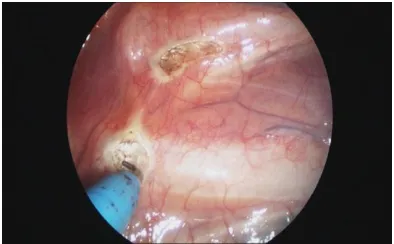
into the pleural cavity. The surgical technique usually consisted of opening the parietal pleura, identifying the sympathetic chain and dividing communicating branches using cautery (Fig. 2). Additionally, electro cautery ablation of accessory branches and Kuntz nerve (when present) was performed in all cases to prevent relapses. Postoperative chest radiography was performed routinely. Patients were followed up for a mean of 9 (6-24) months postoperatively.
Evaluation included the success of the
hyperhidrosis treatment, and the presence, location, and severity of CS. Postoperative complications such as CS, wound infection,
chest pain, Horner’s syndrome,
hemo-pneumothorax were recorded. Chi-square test was used for comparison of nominal data. Significance level was considered as 0,05.
3. RESULTS
Demographic data of the patients are presented in table 1. There was no difference between the two groups in terms of demographic data.
There were no mortality and significant postoperative complications in this study and none of the patient was re-operated. No recurrence of palmar hyperhidrosis was reported at the follow-up periods in either of the groups. All of the patients presented an improvement in palmar hyperhidrosis, without any difference between the groups. Rate of complications in both groups were similar except for CS. Postoperatively, CS was present in 13 (13,2%) patients of the T2I group and in 10 (5,5%) patients of the T2P group (p<0.05). The areas of CS varied among patients. CS occurred in abdominal and gluteal region, anterior thoracic
wall and gluteal region only, in 13, 7 and 3 patients, respectively.
Fig. 2. Dividing communicating branches using cautery
A total of 3 patients had local wound infection (one in group T2P and 2 in group T2I - NS) and
local wound healing was achieved with
appropriate antibiotic therapy and local debridement. A total of 7 patients (2,5%) in both groups (4 T2I group, 3 T2P group - NS) developed pneumothorax and most of them were reabsorbed spontaneously and did not need further intervention. However, 3 patients (1,1%)
required chest tube drainage. Temporary
Horner’s syndrome was observed in one patient in T2I group (0.50%) and this complication was completely resolved spontaneously within 2 weeks after operation. There was hemothorax for one patient (Table 1). Two patients in T2P group (1%) experienced hyperesthesia at the incision area. One patient complained of intercostal pain in T2P group that lasted approximately 1 year. Most of the patients were discharged within 24-48 hours after operation. Pneumothorax occurred in 7 patients and 5 of them discharged on the 4th
postoperative day and 2 patients were
discharged on the 10th postoperative day due to the persistent air leakage.
4. DISCUSSION
Table 1. Patients characteristics
Patientscharacteristics T2P Group T2I Group
Gender Male 82 (45,5%) 40 (40,8%)
Female 98 (54,5%) 58 (59,1%)
Age mean (min-max) (years) 24,1 (14-56) 26,9 (15-57)
Satisfaction rate 176 (97,7%) 95 (96,9%)
Complications Compensatory sweating 10 (5,5%) 13 (13,2%)
Pneumothorax 3 (1,6%) 4 (4%)
Wound infection 1 (0,5%) 2 (2%)
Horner’s syndrome 0 1 (1%)
Hemothorax 1(0,5%) 0
Mortality 0 0
compared to men. There was no significant difference between genders (156 female versus 122 male) in our study. Similar to other studies on this subject, most of our patients initially showed symptoms during childhood and more than half had evidence of family distribution and history [9]. Because of the early clinical presentation for individuals with hyperhidrosis, most studies have assessed very young populations, usually in their second and third decades of life. In our study, the patients were also young, with a mean age of 24,1 years (T2P group) and 26,9 years (T2I group).
Although hyperhidrosis is a benign disorder and does not affect health, daily and social activities are affected. Therefore, a cure is usually desired.
Conservative medical treatments (ie,
anticholinergic drugs, psychotherapy or
botulinum toxin injections) are not always effective and often requires repeated courses of therapy that can be dismantling on the long run [1-3]. Significant improvement in the quality of life can result from the surgery for hyperhidrosis. For many years, it was believed that the ideal treatment for palmar hyperhidrosis would be
sympathectomy. However, patients with
hyperhidrosis had the greatest relief from surgery. In such cases, VATS has become established as a safe, esthetic and effective minimally invasive method, with a success rate greater than 95% in most series [10]. Since the introduction of video-assisted thoracic surgery in the early 1990s and as a result of improved telescopes and video imaging technology, VATS has become a standard therapy for hyperhidrosis worldwide [11]. With the use of thoracoscopy equipment enabling small incisions and less surgical trauma, this surgical procedure has largely come to present excellent results, with low morbidity, rapid postoperative recovery, and imperceptible scars [12].
VATS can be performed by different surgical and anesthetic techniques, yet the degree of patient’s compliance and satisfaction for such a procedure must be taken into account. As far as the type of anesthesia is concerned, this type of procedure usually requires single-lung ventilation to collapse the lung under general anesthesia even though more recently some authors have slowly discontinued the use of double-lumen tubes in favor of simple orotracheal catheters [7]. Maintaining the subsequent collapse of ipsilateral lung is usually achieved by the technique of one-lung ventilation. Both of these techniques can be preferred in appropriate patients.
The use of CO2 insufflation undoubtedly enhances visualization by displacing the lung and expediting the procedure; however, the report of serious complications has prevented us from using this type of aid [13]. As previously reported by Garcia and Espania in all cases via VATS: one or more ganglia between T2 and T5 are usually resected depending on the area affected by hyperhidrosis [14]. They recommend intervention on the T2 ganglia for facial hyperhidrosis and rubor, on the T3 ganglia for palmar hyperhidrosis and on the T3 and T4
ganglia for axillary hyperhidrosis. The
effectiveness of the surgery can be evaluated by palmar skin temperature [15].
5,5% T2P group) of the patients presented CS. The body area affected by CS is another important point. The CS observed in our study was distributed in the body in the same way as described in the literature (ie, chest, abdomen, back, feet, and gluteal region) [16]. In most patients, it is tolerable and does not lead to social or occupational disturbances. Still, patients must always be warned before the surgery about the possibility of this complication [18].
Various methods have been evaluated to decrease the occurrence rates and severity of CS. The most important point is the number and level of excised ganglia. There seems to be a correlation between the CS and the extent and level of the sympathectomy. Several authors limited the extent of resections for hyperhidrosis to a single level to decrease the incidence of severe compensatory symptoms [12,19,20]. Neumayer et al and Choi et al reported their series of T4 sympathetic block for palmar hyperhidrosis [21,22]. The success rates were 100%, and the CS rates were 8% and 3%, respectively. Bonjer et al reported on a series in which only the T3 was resected and, thus, decreased CS [23]. In addition, the severity of CS might be reduced by limiting the extent of the denervation. When denervation is restricted, CS is expected to be mild [24]. On the other hand, some authors argue that limited sympathectomy does not reduce the incidence and severity of this complication [8]. In our studies, we found that 13% of the patients in the T2I group and 5,5% in the T2P group presented this complication after operations. Kuntz’s fibres which usually cross the 3rd and 2nd thoracic ganglion, but sometimes they directly reach the brachial plexus running outside the main trunk and then these fibres should always be searched and when identified they should be sectioned selectively. Lin and Telaranta assumed that compensatory hyperhidrosis could be secondary to the interruption of the afferent fibres to the anterior part of the hypothalamus [25]. Dierent degrees of postoperative sweating have been found after dierent levels of sympathectomy. For example, severe reflex sweating is expected with the T2 procedure, whereas an unknown amount or no reflex sweating is found with the T4 procedure [26].
Shelley and Florence explained the phenomenon
of CS after sympathectomy as a
thermoregulatory function [27]. The sympathetic
nervous fibers originate from the
intermediolateral horns of the spinal cord between T1 and L2. Nervous impulses from the
target organs are transmitted as afferent negative feedback signals to the central nervous system, from where the efferent positive feedback signals return to the target organ. This system means that T2 interruption stops most negative feedback signals from T2 and below and provides the strongest positive feedback signal. Therefore, the efferent positive feedback signals to the sweat gland are strong and most severe CS results.T3 ganglionic interruption disrupts fewer afferent negative feedback signals, thus efferent positive feedback signals are weaker and CS is less severe. T4 interruption causes the least or almost no CS, because most of the afferent negative feedback signals are preserved. CS occurs in 30–70% of patients after T2, 17–25% after T3, and 3–8% after T4 sympathetic block [21]. According to many studies, the higher the level of ganglionic blockage (ie, T2 or T3), the greater the incidence of severe compensatory symptoms [28]. In other words, inclusion of T2 ablation results in significantly more severe CS than other levels not incorporating T2 [12].
Horner’s syndrome has become a rare
complication currently because the method has developed, surgical teams have become more experienced and video equipment providing adequate viewing of the sympathetic chain is now used. Its occurrence is limited to cases of indirect lesion of the stellate ganglion (T1) due to heat diffusion or excessive traction of the chain [29]. Heat transmission during this procedure led to the appearance of Horner’s sign, but it had completely regressed by the time of the one-month follow-up. In our study, temporary Horner’s syndrome was observed in a patient in T2 included group and this complication was completely resolved spontaneously within 2 weeks after operation.
5. CONCLUSION
COMPETING INTERESTS
Authors have declared that no competing interests exist.
REFERENCES
1. Ro KM, Cantor RM, Lange KL, Ahn SS. Palmer hyperhidrosis: Evidence of genetic origin. J Vasc Surg. 2002;35:382–386.
2. Shelly WB, Talanin NY, Shelly ED.
Botulinum toxin therapy for palmar hyperhidrosis. J Am Acad Dermatol. 1998; 38:227–229.
3. Stolman LP. Treatment of hyperhidrosis. Dermatol Clin. 1998;16:863–867.
4. Hashmonai M, Kopelman D. History of sympathetic surgery. Clin Auton Res. 2003;1:16–19.
5. Reisfeld R, Nguyen R, Pnini A. Endoscopic thoracic sympathectomy for hyperhidrosis experience with both cauterization and clamping methods. Surg Laparosc Endosc Percutan Tech. 2002;12:255–267.
6. Dewey TM, Herbert MA, Hill SL, et al.
One-year follow-up after thoracoscopic
sympathectomy for hyperhidrosis:
Outcomes and consequences. Ann Thorac Surg. 2006;81:1227–1232.
7. Dumont P, Denoyer A, Robin P. Long-term
results of thoracoscopic sympathectomy for hyperhidrosis. Ann Thorac Surg. 2004; 78:1801–1807.
8. Leseche G, Castier Y, Thabut G, et al. Endoscopic transthoracic sympathectomy for upper limb hyperhidrosis: Limited
sympathectomy does not reduce
postoperative compensatory sweating. J Vasc Surg. 2003;37:124-128.
9. Kao MC, Lin JY, Chen YL, Hsieh CS, Cheng LC, Huang SJ. Minimally invasive
surgery: Video endoscopic thoracic
sympathectomy for palmar hyperhidrosis. Ann Acad Med Singapore. 1996;25:673-678.
10. de Campos JR, Kauffman P, Werebe Ede C, et al. Quality of life, before and after thoracic sympathectomy: Report on 378 operated patients. Ann Thorac Surg. 2003; 76:886-891.
11. Gossot D, Toledo L, Fritsch S, Celerier M. Thoracoscopic sympathectomy for upper limb hyperhidrosis: Looking for the right operation. Ann Thorac Surg. 1997;64:975-978.
12. Yazbek G, Wolosker N, de Campos JR, Kauffman P, Ishy A, Puech-Leao P.
Palmar hyperhidrosis-which is the best level of denervation using video-assisted thoracoscopic sympathectomy: T2 or T3 ganglion? J Vasc Surg. 2005;42:281-285.
13. Baumgartner FJ, Toh Y. Severe
hyperhidrosis: Clinical features andcurrent thoracoscopic surgical management. Ann Thorac Surg. 2003;76:1878-1883.
14. Garcia F, Espania A. Usefulness of bilateral sympathectomy using video-assisted thorascopic surgery in the treatment of essential hyperhidrosis. Actas Dermosifiliogr. 2008;99:523–711.
15. Oncel M, Sunam GS, Karabagli H, Kara I,
Celik JB. Palmar skin temperature
importance during transthoracic end-oscopic sympathectomy for palmar hyper-hidrosis. J Neurol Sci. 2012;29(2):285-290. 16. Araújo CAA, Azevedo ÍM, Ferreira MAF, Ferreira HPC, Dantas JLCM, Medeiros
AC. Compensatory sweating after
thoracoscopic sympathectomy: Charact-eristics, prevalence andinfluence on patient satisfaction. J Bras Pneumol. 2009; 35(3):213-220.
17. Panhofer P, Zacherl J, Jakesz R, Bischof G, Neumayer C. Improvedquality of life
after sympathetic block for upper
limbhyperhidrosis. Br J Surg. 2006;93:582-586.
18. Libson S, Kirshtein B, Mizrahi S, Lantsberg L. Evaluation of compensatory sweating after bilateral thoracoscopic sympath-ectomy for palmar hyperhidrosis. Surg Laparosc Endosc Percutan Tech. 2007; 17(6):511-513.
19. Wolosker N, Yazbek G, Ishy A, de
Campos JR, Kauffman P, Puech-Leao P. Is sympathectomy at T4 level better than
at T3 level for treating palmar
hyperhidrosis? J Laparoendosc Adv Surg Tech A. 2008;18:102-106.
20. Yoon DH, Ha Y, Park YG, et al.
Thoracoscopic limited T-3 sympathicotomy for primary hyperhidrosis: Prevention for compensatory hyperhidrosis. J Neurosurg. 2003;99(Suppl1):39–43.
21. Neumayer C, Zacherl J, Holak G, et al. Limited endoscopic thoracic sympathetic block of hyperhidrosis of the upper limb: Reduction of compensatory sweating by clipping T4. Surg Endosc. 2004;18:152-156.
22. Choi BC, Lee YC, Sim SB. Treatment of
palmar hyperhidrosisby endoscopic
sympathetic ganglion. Preliminary Results. Clin Auton Res. 2003;13:48-51.
23. Bonjer HJ, Hamming JF, DuBois NAJJ.
Advantage of limited thoracoscopic
sympathectomy. Surg Endosc. 1996;10: 721-723.
24. de Campos JR, Wolosker N, Takeda FR, et al. The body mass index and level of resection: Predictive factors for compen-satory sweating after sympathectomy. Clin Auton Res. 2005;15(2):116-120.
25. Lin CC, Telaranta T. Lin–Telaranta
classification: The importance of different procedures for different indications in sympathetic surgery. Ann Chir Gynaecol. 2001;90:161–166.
26. Neumayer C, Zacherl J, Holak G, Fugger R, Jakesz R, Herbst F, Bischof G. Limited endoscopic thoracic sympathetic block of hyperhidrosis of the upper limb: Reduction of compensatory sweating by clipping T4. Surg Endosc. 2004;18:152–156.
27. Shelley WB, Florence R. Compensatory
hyperhidrosis after sympathectomy. N Eng J Med. 1960;263:1056-1058.
28. Chou SH, Kao EL, Li HP, Lin CC, Huang
MF. T4 sympathectomy for palmar
hyperhidrosis: An effective approach that simultaneously minimizes compensatory hyperhidrosis. Kaohsiung J Med Sci. 2005; 21:310-313.
29. Singh B, Moodley J, Allopi L, Cassimjee HM. Horner syndrome after sympath-ectomy in the thoracoscopic era. Surg Laparosc Endosc Percutan Tech. 2006; 16:222-225.
30. Oncel M, Sunam GS, Yildiran H. Is clipping the sympathetic chain effective for palmar skin temperature? Thorac Cardiovasc Surg. 2016;64(6):545.
31. Oncel M, Sunam GS, Erdem E, Dereli Y,
Tezcan B, Akyol KG. Bilateral
thoracoscopic sympathectomy for primary hyperhidrosis: A review of 335 cases. Cardiovasc J South Af. 2013;24(4):137-140.
_________________________________________________________________________________ © 2018 Oncel et al.; This is an Open Access article distributed under the terms of the Creative Commons Attribution License (http://creativecommons.org/licenses/by/4.0), which permits unrestricted use, distribution, and reproduction in any medium, provided the original work is properly cited.
Peer-review history: