Improved Authenticity Bound of EAX, and Refinements
(full version of a paper presented at ProvSec 2013 [13])
Kazuhiko Minematsu1, Stefan Lucks2, and Tetsu Iwata3 1 NEC Corporation, Japan,
Bauhaus-Universit¨at Weimar, Germany,[email protected] 3 Nagoya University, Japan,[email protected]
Abstract. EAX is a mode of operation for blockciphers to implement an authenticated encryption. The original paper of EAX proved that EAX is unforgeable up toO(2n/2) data with one verification
query. However, this generally guarantees a rather weak bound for the unforgeability under multiple verification queries, i.e., only (2n/3) data is acceptable.
This paper provides an improvement over the previous security proof, by showing that EAX is unforgeable up toO(2n/2) data with multiple verification queries. Our security proof is based on
the techniques appeared in a paper of FSE 2013 by Minematsu et al. which studied the security of a variant of EAX called EAX-prime. We also provide some ideas to reduce the complexity of EAX while keeping our new security bound. In particular, EAX needs three blockcipher calls and keep them in memory as a pre-processing, and our proposals can effectively reduce three calls to one call. This would be useful when computational power and memory are constrained.
Keywords: Authenticated encryption, EAX, security bound.
1 Introduction
EAX [5] is a mode of operation for blockciphers proposed by Bellare, Rogaway and Wagner at FSE 1994. It implements an authenticated encryption with associated data, AEAD for short. EAX has been standardized by ISO/IEC [2] and included in some popular software libraries [1,8,9]. In FSE 2013, Minematsu, Lucks, Morita, and Iwata [14] investigated a variant of EAX defined by ANSI C12.22, called EAX-prime. They showed that EAX-prime is totally broken if the ‘cleartext’ part of the input is as short as a single block or shorter. At the same time, the authors proved EAX-prime is secure if cleartexts are required to be longer than a single block.
In this paper, we study the implications of [14] to the original EAX. Though the original EAX has already been proved to be secure, the security bound provided by [5], in particular the authenticity bound, does not show the standard birthday-type security when the adversary is allowed to make multiple verification queries. More formally, the original bound is O(σ2/2n+ 1/2τ) where σ denotes the total input blocks, n denotes the block size, and τ denotes the tag
length,if the number of verification queries is one. From the well-known result of [3], this bound generally implies O(qvσ2/2n+qv/2τ) when the number of verification queries is qv ≥1, hence
the provable security is degraded, roughly from 2n/2 to 2n/3, assumingq
v ≈ σ. We note that,
since many systems in practice do accept multiple verification queries, the analysis for this case is relevant. Based on the idea of [14], we provide an improved authenticity bound for EAX, namely O(σ2/2n+qv/2τ), hence the security up to 2n/2 data. When n= 128, this means that
the provable security is improved from 43 bits to 64 bits. In addition, we prove our new bound in a slight more general setting than the original specification, in the sense that the empty header is acceptable, which is plausible in practice.
decryption queries, or vice versa. In this case, we may not have “fresh” randomness in order to show that the success probability of the last decryption query is small.
We also provide ideas to reduce the computation overhead of EAX, which we assume the primal goal of EAX-prime. In EAX, three blockcipher calls are required in advance to the actual processing, and this may make it less attractive to constrained devices. In our proposals, the overhead is reduced to one blockcipher call while keeping the security bound that we proved for the original EAX. This also achieves a more memory-efficient, faster operation than the original. In this respect our proposal can be seen as a provably-secure alternative to EAX-prime having no input-length restriction.
The main technical point in our proposals is the generation of five mask values, originally generated from three blockcipher calls. We propose three mask-generation methods, where the first one is based on the constant Galois field multiplication similar to [15], and the second and third ones are based on the word permutation and XOR. The underlying problem has a relationship to word-oriented LFSR [19] discussed by Chakraborty and Sarkar [7] and by Krovetz and Rogaway [12].
2 Preliminaries
Notations.For a binary stringX,|X|denotes the bit length ofX. For a positive integer nwe define |X|n
def
= max{1,⌈|X|/n⌉}. The first sbits of X for |X| ≥ sis written as msbs(X). Let ε
denote the empty string, which is a binary string of length 0. Thus we have|ε|= 0 and|ε|n= 1.
The set of all finite-length binary strings, includingε, is denoted by{0,1}∗. LetN={0,1, . . .}. If X∈ X is uniformly chosen fromX we write X← X$ . ForX, Y ∈ {0,1}∗, their concatenation is denoted byX∥Y orXY. A sequence ofazeros (ones) is denoted by 0a (1a). Following [5], let [i]n denote a standardn-bit encoding of integeri≥0, e.g., [2]ndenotes 0n−210. Let ({0,1}n)>0
denote the set of strings of lengthn,2n, . . .. We also define{0,1}≥kand ({0,1}n)≥kanalogously. For X, Y ∈ {0,1}n,X+Y orX−Y is defined as an addition or a subtraction modulo 2n.
For X ∈ {0,1}∗, letX[1]∥X[2]∥. . .∥X[m] ←n X denote the partition into n-bit blocks, i.e., we havem=|X|nand|X[i]|=nfori < mand|X[m]| ≤n. ForX, Y ∈ {0,1}∗, letX⊕endY be
the XOR of the shorter variable into the end of the longer one: i.e.X⊕endY = (0|Y|−|X|∥X)⊕Y
if|Y| ≥ |X|and otherwiseX⊕endY =X⊕(0|X|−|Y|∥Y).
Random Function. The set of all functions {0,1}n → {0,1}m is denoted by Func(n, m). We will write Func(n) to mean Func(n, n). The set of all permutations over {0,1}n is denoted by Perm(n). Following [14], we define a uniform random function (URF) as a random function uniformly distributed over Func(n, m) for some nand m. A URF is denoted by R, assuming n and mare clear from the context. In a similar manner we define a uniform random permutation (URP) as a random permutation uniformly distributed over Perm(n) for some n. A URP is denoted by P.
Field with 2n Points. We may view X ∈ {0,1}n as a coefficient vector of the polynomial of GF(2n), yielding a one-to-one mapping. By writing 2X we mean the multiplication of the generator of GF(2n) and X over GF(2n). Here, 2(2L) is denoted by 4L or 22L. The operation 2X is called doubling, and is efficiently implemented by one-bit shift with constant XOR, see e.g. [10].
3 Provable Security of EAX
3.1 Specification of EAX
AlgorithmEAX-EK,τ(N, H, M)
1. N←CMAC(0)K (N) 2. H←CMAC(1)K (H) 3. C←CTRK(N , M)
4. T←N⊕H⊕CMAC(2)K (C) 5. T←msbτ(T)
6. return(C, T)
AlgorithmEAX-DK,τ(N, H, C, T)
1. N←CMAC(0)K (N) 2. H←CMAC(1)K (H) 3. T ←N⊕H⊕CMAC(2)K (C) 4. Tb←msbτ(T)
5. ifTb̸=T return⊥
6. elseM←CTRK(N , C)
7. returnM
AlgorithmCMAC(i)K(M) (fori∈ {0,1,2}) 1. L←EK([0]n),L′←EK([1]n),L′′←EK([2]n)
2. D←2L,Q←4L
3. ifM=εreturnEK([i]n⊕D)
4. else
5. ifi= 0returnCBCK(L,pad(M;D, Q))
6. ifi= 1returnCBCK(L′,pad(M;D, Q))
7. ifi= 2returnCBCK(L′′,pad(M;D, Q)) AlgorithmCTRK(N , M)
1. m← |M|n
2. S←EK(N)∥EK(N+ 1)∥ · · · ∥EK(N+m−1)
3. C←M⊕msb|M|(S) 4. returnC
AlgorithmCBCK(I, M)
1. M[1]∥M[2]∥ · · · ∥M[m]←n M
2. C[0]←I
3. fori←1tomdo
C[i]←EK(M[i]⊕C[i−1])
4. returnC[m]
Algorithmpad(M;B1, B2)
1. if|M| ∈ {n,2n,3n, . . . ,}
2. then returnM⊕endB1
3. else return
(M∥10n−1−(|M|modn))⊕ endB2
Fig. 1. (Upper) The encryption and decryption algorithms of EAX[E, τ]. Here H and M can be the empty string,ε, whileH ̸=ε was originally required in [5]. (Lower) Component algorithms of EAX[E, τ]. For CBCK,
|M| ∈ {n,2n, . . .}.
called associated data) H, and the plaintextM and generates the ciphertextC and the tagT. The decryption (verification) function accepts N, H, C, and T, and generates the decrypted plaintextM if (N, C, T) is valid, or the flag ⊥if invalid.
The specification EAX is shown in Fig. 1. EAX is based on ann-bit blockcipher,E, where the key of E is written asK. EAX taking a blockcipherE and using theτ-bit tag for τ ≤n is denoted by EAX[E, τ]. The encryption and decryption functions are written as EAX-EK,τ and
EAX-DK,τ, or EAX-EK and EAX-DK ifτ is clear from the context.
In EAX[E, τ], we assume that N, H, M ∈ {0,1}∗ with N ̸= ε. In the original specification, N and H are assumed to be non-empty (see Section 6 of [4]). However, this paper slightly generalizes the setting, allowingHto be empty4. The plaintextM can be empty, and in that case
the corresponding C is also empty. The ciphertext C has the same length as the corresponding plaintext, M, and the tagT is τ bits.
In [5] the definition of CMAC(Ki)(M) is simpler than ours, i.e. it is defined as CMAC(Ki)(M)def= CMACK([i]n∥M). Here, CMACK(M) denotes the original CMAC defined as CMACK(M) =
CBCK(pad(M;D, Q)). Our definition is equivalent and we employ it to emphasize the three
redundant EK calls, L, L′, and L′′, and make explicit the computation of CMAC
(i)
K(ε) with
them.
3.2 Security Notions
The security of AE can be defined by two notions, privacy and authenticity [5,16]. In defining them, let AO1,O2,...,Oc denote the adversary A accessing c oracles, O
1, . . . , Oc, in an arbitrarily
4
+1
EK EK EK
+1 N
M[1] M[2]
·
·
·
M[m]
C[1] C[2] · · · msb CTRK
C[m]
EK EK EK bp · · ·
D/Q C[1] C[2] C[m]
L
CMAC(2)K (C=ε)
0n−210
EK D CMAC(2)K (C=ε)
N
H msb T
EK EK EK bp N[1] N[2] · · · N[b]
D/Q
N L
CMAC(0)K
0n −11 CMAC(1)K (H=ε)
CMAC(1)K (H=ε)
EK EK EK bp
D/Q EK
D H[1] H[2] · · · H[h]
L
H
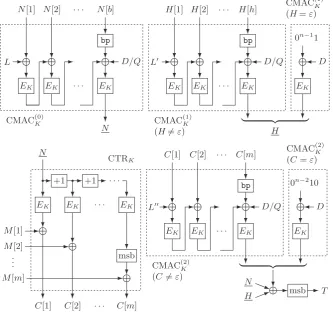
Fig. 2.The encryption algorithm of EAX. The specification is extended to acceptH=ε. In the figure,bp(x) =x if|x|=nandbp(x) =x∥10n−1−(|x|modn)if|x|< n.
order. If Oi and Oj are oracles having the same input and output domains, we say they are
compatible. Let AE[τ] be an AE compatible with EAX having τ-bit tag. The encryption and decryption algorithms are AE-Eτ and AE-Dτ. IfA is a CPA-adversary againstAE[τ], it accesses
AE-Eτ. The encryption queries made byA are written as (N1, H1, M1), . . . ,(Nq, Hq, Mq), where
the number of queries, q, is a parameter of A. We also consider σX
def
= ∑qi=1|Xi|n for X ∈
{N, H, M}, and assume a parameter list (q, σN, σH, σM) to define the resource of A.
Let $ denote the random-bit oracle, which takes (N, H, M) and returns (C, T)← {$ 0,1}|M|×
{0,1}τ. Then the privacy of AEfor CPA-adversary Ais defined as
AdvprivAE[τ](A)def= Pr[K← K$ :AAE-Eτ ⇒1]−Pr[A$⇒1]. Here, Ais nonce-respecting, i.e., all Nis chosen byA are distinct.
To define the authenticity, we assume a CCA-adversary A againstAE[τ]. It accessesAE-Eτ
and AE-Dτ. The set of encryption queries is denoted by (N1, H1, M1), . . . ,(Nq, Hq, Mq), and the
set of decryption queries is denoted by (Ne1,He1,Ce1,Te1), . . . ,(Neqv,Heqv,Ceqv,Teqv). We assume a pa-rameter list (q, qv, σN, σH, σM, σNe, σHe, σCe) to define the attack resource, whereσY =
∑qv
i=1|Yi|n
forY∈ {N ,e H,e C}, in addition toe σN,σH, and σM. The authenticity ofAE is defined as
AdvauthAE[τ](A)def= Pr[K ← K$ :AAE-Eτ,AE-Dτ forges ],
whereAforges if it receives a bit string (not⊥) fromAE-Dτ for a non-trivial query (Nei,Hei,Cei,Tei)
(Nj, Hj, Mj, Cj, Tj) obtained before satisfies (Nei,Hei,Cei,Tei)̸= (Nj, Hj, Cj, Tj). We remark that
CCA-adversary is always nonce-respecting with respect to encryption queries. This implies that, we can have Ni =Nej orNei =Nej for some iand j. In the security proofs we use the following
notion. Let FK and GK′ be two compatible keyed functions withK ∈ Kand K′ ∈ K′. Then
AdvcpaF,G(A)def= Pr[K ← K$ :AFK ⇒1]−Pr[K′ ← K$ ′ :AGK′ ⇒1].
Note that this definition can be naturally extended when GK′ is substituted with the
random-bit oracle compatible to FK. In addition when FK and GK′ are compatible with AE-Eτ, we
defineAdvcpa-nrF,G (A) as the same function as AdvcpaF,G(A) but CPA-adversaryAis restricted to be nonce-respecting. Also, letF= (FKe, FKd) andG= (GeK′, GdK′) be the pairs of functions that are
compatible with (AE-Eτ,AE-Dτ). We define
AdvFcca-nr,G (A)def= Pr[K ← K$ :AFKe,FKd ⇒1]−Pr[K′ ← K$ ′:AG e
K′,GdK′ ⇒1],
where the underlyingA is assumed to be nonce-respecting for encryption queries. Note that we have AdvprivAE[τ](A) =Advcpa-nrAE-E
τ,$(A) for any nonce-respecting CPA-adversary A.
3.3 Security Bounds
Original Bounds. We denote EAX using ann-bit URP as a blockcipher by EAX[Perm(n), τ] and the corresponding encryption and decryption functions by EAX-EPand EAX-DP. Similarly,
the subscriptK in the component algorithms is substituted withP, e.g. CMAC(Pi). We focus on the security bounds for EAX[Perm(n), τ] as the computational counterparts for EAX[E, τ] are trivial.
In [5], Bellare et al. introduceddata complexity denoted byσ, which is slightly different from our parameters5. The provided bounds are as follows. Note that these theorems assumeH̸=ε.
Theorem 1 ([5]). Fix τ ∈ {1, . . . , n}. Let A be the CPA-adversary against EAX[Perm(n), τ]
with data complexity σ. Then the privacy is bounded as AdvprivEAX[Perm(n),τ](A)≤9.5σ2/2n.
Theorem 2 ([5]). Fix τ ∈ {1, . . . , n}. Let A be the CCA-adversary against EAX[Perm(n), τ]
with data complexity σ and qv = 1. Then the authenticity is bounded as AdvEAX[Perm(auth n),τ](A)≤
11σ2/2n+ 1/2τ.
Our Bounds. The privacy bound of Theorem 1 is the standard birthday bound security. The bound is tight in the sense that there is an adversary that meets the stated security bound up to a constant factor. However, the authenticity bound of Theorem 2 is not satisfactory as it requires qv = 1. There is a known result [3] proving that, if authenticity bound of a scheme for
one verification query isϵ, authenticity bound forcverification queries is bounded bycϵ, for any c >1. Applying this result to Theorem 2, we haveAdvauthEAX[Perm(n),τ](A)≤11qvσ2/2n+qv/2τ for
qv ≥1, implying that the security is guaranteed up to 2n/3 data whenqv ≈σ. Now we show an
improved authenticity bound for EAX that provides security up to 2n/2 data even for qv ≥ 1,
with an extended specification allowing H =ε.
Theorem 3. Fix τ ∈ {1, . . . , n}. Let A be the CCA-adversary against EAX[Perm(n), τ] with parameter list(q, qv, σN, σH, σM, σNe, σHe, σCe). Letσauth=σN+σH+σM+σNe+σHe+σCe. Then
we have
AdvauthEAX[Perm(n),τ](A)≤ 18.5σ 2
auth+ 4.5
2n +
qv
2τ.
5
Note that σauth is largely the same as the plainσ of Theorems 1 and 2. Theorem 3 shows that
EAX preserves birthday-type security in the authenticity notion for any qv ≥1, rather than for
qv = 1, only.
As we extended the specification to allowH=ε, a corresponding privacy bound should also be given in principle. For completeness we show the privacy bound in this extended specification.
Theorem 4. Fixτ ∈ {1, . . . , n}. LetAbe the CPA-adversary against EAX[Perm(n), τ]who has parameter list(q, σN, σH, σM). Letσpriv =σN+σH+σM. Then we haveAdvprivEAX[Perm(n),τ](A)≤
(18.5σpriv2 + 4.5)/2n.
The proofs of the above theorems are provided in Section 5.1.
4 Refinements of EAX
EAX needs three blockcipher calls in advance to the actual processing, namely L =EK([0]n),
L′ = EK([1]n), and L′′ = EK([2]n). They are used as masks for the initial block of CMAC.
In addition, CMAC itself needs two masks for the last block, namely 2L and 4L, hence five mask values in total. To achieve the fastest operation, these mask values, at least the first three ones, must be kept in memory while processing. This fact implies that EAX is not ultimately optimized, in particular for short messages, when the amount of pre-processing is critical. This is possible due to some practical reasons, e.g., a huge number of keys, or frequent key changes. In addition retaining many mask values in memory may not be desirable for constrained devices, such as low-end micro-controllers or tiny hardware.
We propose a refinement of EAX, which we call EAX+, to minimize these drawbacks. We note that EAX seems to have a design philosophy for keeping the algorithm of CMAC intact, and our proposal does not follow this design philosophy in return for the efficiency gain.
Specifically, EAX+ changes the definitions of five mask values so that they are simple func-tions of L=EK([0]n). EAX+ also sets some initial counter bits off to suppress carry bit
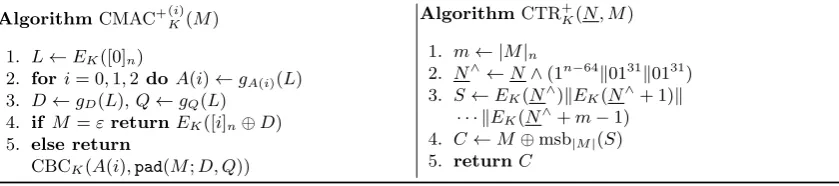
propa-gation. This is the technique used by SIV [17] and EAX-prime to simplify the implementation of the counter mode. These changes affect the definitions of two internal components, CMAC(i) and CTR. EAX+uses CMAC+(i) and CTR+, as shown in Fig. 3, instead of CMAC(i) and CTR of Fig. 1. For simplicity Fig. 3 assumes n = 128 for fixing the constant adjusting the initial counter, however other values ofnare possible. In CMAC+(i), the five mask values are denoted by A(0), A(1), A(2),D, and Q, and they are functions ofL=EK([0]n) denoted by gA(0),gA(1),
and so on. In the following, we give three concrete masking schemes.
Scheme 1: Use GF Doubling. The first scheme, which we call EAX+1, uses the following masks. Here, 3L denotes 2L⊕L.
A(0) = 3L, A(1) = 2·3L, A(2) = 22·3L,
D= 2L, Q= 22L
This keeps the definitions of CMAC masks for the last blocks (D and Q). Note that we have A(0) = 2L⊕L,A(1) = 22L⊕2L, and A(2) = 23L⊕22L. Any mask is efficiently computed by holdingX=LandY= 22L, as we haveA(0) = 2X⊕X,A(1) =Y⊕2X,A(2) = 2Y⊕Y,D= 2X, and Q=Y. Each mask computation requires at most one doubling and one XOR.
Scheme 2: Use Sum of Four Quarters of L. The second scheme, which we call EAX+2, assumes thatnis divisible by 4, and uses operations over GF((2n/4)4). LetL= (L1, L2, L3, L4),
where Li∈GF(2n/4). The masks are as follows.
A(0) = (L1, L2, L3, L4), A(1) = (L∗, L1, L2, L3), A(2) = (L4, L∗, L1, L2),
AlgorithmCMAC+(Ki)(M)
1. L←EK([0]n)
2. for i= 0,1,2doA(i)←gA(i)(L)
3. D←gD(L),Q←gQ(L)
4. if M =εreturnEK([i]n⊕D)
5. else return
CBCK(A(i),pad(M;D, Q))
AlgorithmCTR+K(N , M) 1. m← |M|n
2. N∧ ←N∧(1n−64∥0131∥0131) 3. S←EK(N∧)∥EK(N∧+ 1)∥
· · · ∥EK(N∧+m−1)
4. C←M⊕msb|M|(S)
5. returnC
Fig. 3.Our refinement of EAX, EAX+. Here, CMAC+(i) fori∈ {0,1,2}and CTR+are used instead of CMAC(i) and CTR, and other functions are not changed. The definitions ofgA(i), gD, and gQ are written in Section 4,
yielding the three versions.
where L∗ = L1⊕L2⊕L3⊕L4. The scheme is efficient, in particular for software, since it is
merely a combination of n/4-bit word permutations and XORs. Specifically, any mask can be efficiently computed by holdingL and L∗, which are 5n/4 bits in total.
Scheme 3: Use Two Sums.The third scheme, which we call EAX+3, is another instance using word permutation and XOR. The masks are;
A(0) = (L1, L2, L3, L4), A(1) = (L2, L♯, L4, L♭), A(2) = (L♯, L1, L♭, L3),
D= (L3, L♭, L2, L1), Q= (L4, L3, L♯, L2),
where L♯ =L1⊕L2 and L♭=L3⊕L4. The mask generation is a simple word permutation by
holding L, L♯, and L♭. Even if we only hold L, each mask is computed by at most 2 XORs of
words and a permutation, and the number of word XORs required for generating all masks from L is 6.
The following theorem shows the security of these schemes.
Theorem 5. Forj ∈ {1,2,3}, let EAXj+[Perm(n), τ]be EAX+j usingn-bit URP. For any j we have
Advpriv
EAX+j[Perm(n),τ](A)≤
15σ2 priv
2n , and
AdvauthEAX+
j[Perm(n),τ]
(A)≤ 15σ
2 auth
2n +
qv
2τ.
The core part of the proof of Theorem 5 is given in Section 5.2. We can build variants of these schemes by applying a permutation Pthat commutes with respect to XOR, i.e. P(x)⊕P(y) =
P(x⊕y), to all masks. An example is a regular matrix over GF(2n/a)a forabeing a factor ofn, and a variant using such masks will have the same bounds as Theorem 5.
We note that [14] suggested some variants of EAX-prime that are provably secure without input-length restriction. However the proposals of [14] focuses on the black-box usage of EAX-prime. As a result the proposals of [14] are not as efficient as ours, or require a stronger security assumption on the blockcipher.
5 Security Proofs
5.1 Proofs of Theorem 3 and Theorem 4
AlgorithmOMAC-e[P] :
Initialization
00 L←P([0]n),L′←P([1]n),L′′←P([2]n) On query (t, X, d)∈ {0,1,2} × {0,1}∗×N 10 X[1]∥X[2]∥ · · · ∥X[m]←n X
11 if|X|modn̸= 0orX=εthenw←1, elsew←0 12 ift= 0
13 if1≤ |X| ≤nthenY ←P(bp(X)⊕L⊕2w+1L); returnY
14 else Y[1]←P(L⊕X[1])
15 fori= 1tom−2do Y[i+ 1]←P(Y[i]⊕X[i+ 1]) 16 Y ←P(Y[m−1]⊕bp(X[m])⊕2w+1L)
17 ifd= 0returnY
18 forj= 0tod−1do S[j+ 1]←P(Y +j) 19 returnY∥S[1]S[2]· · ·S[d]
20 ift= 1
21 if|X|= 0thenY′←P(2L⊕[1]n); returnY′
22 if1≤ |X| ≤nthenY′←P(bp(X)⊕L′⊕2w+1L); returnY′
23 else Y′[1]←P(L′⊕X[1])
24 fori= 1tom−2do Y′[i+ 1]←P(Y′[i]⊕X[i+ 1]) 25 Y′←P(Y′[m−1]⊕bp(X[m])⊕2w+1L)
26 returnY′
27 ift= 2
28 if|X|= 0thenY′′←P(2L⊕[2]n); returnY′′
29 if1≤ |X| ≤nthenY′′←P(bp(X)⊕L′′⊕2w+1L); returnY′′
30 else Y′′[1]←P(L′′⊕X[1])
31 fori= 1tom−2do Y′′[i+ 1]←P(Y′′[i]⊕X[i+ 1]) 32 Y′′←P(Y′′[m−1]⊕bp(X[m])⊕2w+1L)
33 returnY′′
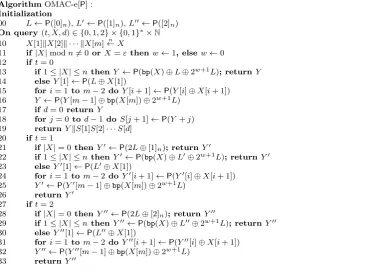
Fig. 4.OMAC-extension using ann-bit URP,P.
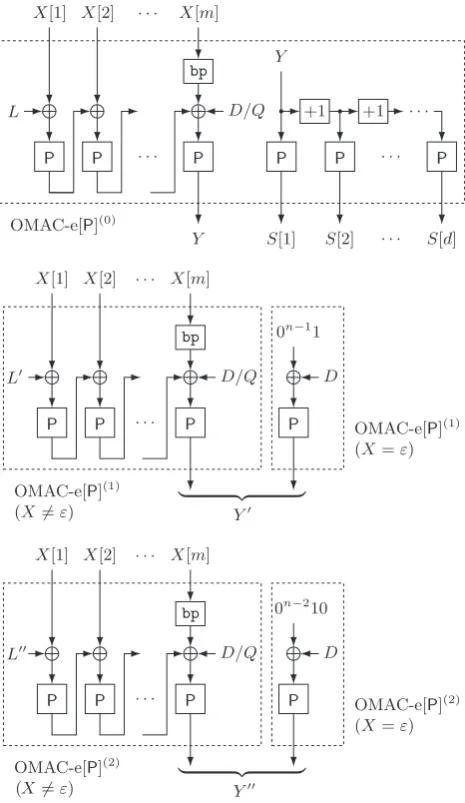
We start with the most involved part: the pseudorandomness of extension. extension is a set of functions obtained by decomposing EAX [5,14]. Formally, we define OMAC-extension6 as a set of three functions using an n-bit URP, P, obtained from EAX[Perm(n), τ]. It is denoted by OMAC-e[P] = (OMAC-e[P](0),OMAC-e[P](1),OMAC-e[P](2)). See Figs. 4 and 7. Here, OMAC-e[P](0) is a function that takes (N, d), where d = |M|n (d = |C|n) for
en-cryption (deen-cryption), and produces N and the d-block keystream before truncation, i.e., S of Fig. 1. Similarly, OMAC-e[P](1) takes H, and OMAC-e[P](2) takesC. We may view OMAC-e[P] as single function taking (t, X, d) as input and outputs OMAC-e[P](t)(X, d) when t = 0 and OMAC-e[P](t)(X) when t= 1,2, assumingdis a default value.
Similarly to Proposition 1 of [14], we have the following proposition.
Proposition 1. For any fixed τ, there exist deterministic procedures, fe(·) and fd(·), that use
OMAC-e[P] as a black-box and perfectly simulate EAX-EP and EAX-DP. That is, we have
EAX-EP≡fe(OMAC-e[P]) andEAX-DP ≡fd(OMAC-e[P]).
Here, F ≡Gmeans the equivalence of the output probability distribution functions for F and G, i.e. Pr[F(x1) = y1, . . . , F(xq) = yq] = Pr[G(x1) = y1, . . . , G(xq) = yq] for any fixed possible
x1, . . . , xq and y1, . . . , yq. Proposition 1 can be verified by comparing Figs. 2 and 7.
Then we need to evaluate the indistinguishability between OMAC-e[P] and a set of three ran-dom functionsRND= (RND(0),RND(1),RND(2)), whereRND(i)is compatible with OMAC-e[P](i). Here RND(0)(X, d) samples Y ←$ ({0,1}n)dmax+1 and outputs msb
n(d+1)(Y) if X is new, where
dmax is the largest possible value of ddetermined by the game we consider.
To bound the indistinguishability, we further break down OMAC-e[P] into a set of 19 small functions,Q={Qi}i=1,...,19.
6
Definition 1. LetQi:{0,1}n→ {0,1}n fori∈ {1,2, . . . ,19}\{3,4,5,6}and letQj :{0,1}n×
N→({0,1}n)>0 for j= 3,4,5,6. We define
Q1(x)def=P(L⊕x)⊕Rnd1, Q2(x)
def
=P(Rnd1⊕x)⊕Rnd1, Q3(x, d)def=GP(P(2L⊕Rnd1⊕x), d), Q4(x, d)
def
=GP(P(4L⊕Rnd1⊕x), d), Q5(x, d)def=GP(P(L⊕2L⊕x), d), Q6(x, d)
def
=GP(P(L⊕4L⊕x), d),
Q7(x)def=P(L′⊕x)⊕Rnd2, Q8(x)
def
=P(Rnd2⊕x)⊕Rnd2, Q9(x)def=P(2L⊕Rnd2⊕x), Q10(x)
def
=P(4L⊕Rnd2⊕x), Q11(x)def=P(L′⊕2L⊕x), Q12(x)def=P(L′⊕4L⊕x),
Q13(x)def=P(L′′⊕x)⊕Rnd3, Q14(x)
def
=P(Rnd3⊕x)⊕Rnd3, Q15(x)def=P(2L⊕Rnd3⊕x), Q16(x)
def
=P(4L⊕Rnd3⊕x), Q17(x)def=P(L′′⊕2L⊕x), Q18(x)def=P(L′′⊕4L⊕x),
Q19(x)def=P(2L⊕x),
where P is an n-bit URP, and L = P([0]n), L′ =P([1]n), and L′′ = P([2]n). Also, Rnd1, Rnd2 andRnd3 are independent n-bit random sequences, and GP(v, d) isvif d= 0and(v∥P(v)∥P(v+
1)∥ · · · ∥P(v+ (d−1))) if d > 0. The sampling procedures for P,Rndj for j = 1,2,3 are shared
for all Qis.
We treat Q as a tweakable function with tweak t ∈ {1, . . . ,19} by writing Q(t, x, d) =
Qt(x, d) when t ∈ {3,4,5,6} and otherwise Q(t, x, d) = Qt(x). We observe that OMAC-e[P] can be simulated with black-box accesses to Q. For example, when we want to simulate the computation of OMAC-e[P](0, N,2) for |N| = 3n, we first parse N into n-bit blocks, i.e., N[1]∥N[2]∥N[3] ←n N and then proceed as Y[1] ← Q1(N[1]), and Y[2] ← Q3(N[2]⊕Y[1]), andY[3]∥S[1]S[2]←Q5(N[3]⊕Y[2],2). Note that,Q19is only used to simulate CMAC(1)K given H =ε, or CMAC(2)K givenC =ε, i.e., to computeP(2L⊕[1]n) or P(2L⊕[2]n).
We next defineQe ={Qei}i=1,...,19. For alli= 1, . . . ,19, Qei is compatible toQi.
Definition 2. Let Pi for i = 1,2,7,8,13,14 be six independent n-bit URPs, and let Rj for
j ∈ {9, . . . ,19} \ {13,14} be nine independent n-bit URFs, and let Rj for j = 3,4,5,6 be four
independent URFs with n-bit input and (dmax+ 1)n-bit output. Using them we define e
Qi(x)def=Pi(x), for i= 1,2,7,8,13,14
e
Qj(x, d)def=Rdj+1(x), for j= 3,4,5,6
e
Qh(x)def=Rh(x), for h= 9, . . . ,12,15, . . . ,19,
where Rdi+1(x) = msbn(d+1)(Ri(x)) fori= 3,4,5,6. Here dmax is the maximum possible value of queried d, which will be determined by the underlying game and adversary’s parameter.
A function compatible toQis said to have Qprofile. An adversary querying a function ofQ
profile is characterized by the number of queries,q, and the number of total outputn-bit blocks fort∈ {3,4,5,6},σout. The next lemma shows the CPA-advantage in distinguishingQand Qe. Lemma 1. LetAbe the adversary querying a function of Qprofile with parameter list(q, σout). Then we have
Advcpa
Q,Qe(A)≤
(4.5q2+ 10σoutq+σout2 + 4.5)
AlgorithmCBC(givendmax): Initialization
00 fori= 1,2,7,8,13,14doPi
$
←Perm(n) 01 forj= 3,4,5,6do Rj
$
←Func(n, dmax)
02 fork= 9,10,11,12,15,16,17,18,19do Rk←$ Func(n) On query (t, X, d)∈ {0,1,2} × {0,1}∗×N
10 X[1]∥X[2]∥ · · · ∥X[m]←n X
11 if|X|modn̸= 0orX=εthenw←1, elsew←0 12 ift= 0
13 ifm= 1andd= 0returnY ←R1
5+w(bp(X))
14 ifm= 1andd >0returnY∥S[1]∥S[2]∥ · · · ∥S[d]←Rd+15+w(bp(X)) 15 Y[1]←P1(X[1])
16 fori= 1tom−2do Y[i+ 1]←P2(Y[i]⊕X[i+ 1])
17 ifd= 0thenY ←R1
3+w(Y[m−1]⊕bp(X[m])); returnY
18 else Y∥S[1]∥S[2]∥ · · · ∥S[d]←Rd+13+w(Y[m−1]⊕bp(X[m])) 19 returnY∥S[1]∥S[2]∥ · · · ∥S[d]
20 ift= 1
21 ifX=εthenY′←R19([1]n); returnY′
22 else ifm= 1thenY′←R11+w(bp(X)); returnY′
23 else Y′[1]←P7(X[1])
24 fori= 1tom−2do Y′[i+ 1]←P8(Y′[i]⊕X[i+ 1])
25 Y′←R9+w(Y′[m−1]⊕bp(X[m]))
26 returnY′
27 ift= 2
28 ifX=εthenY′′←R19([2]n); returnY′′
29 else ifm= 1thenY′′←R17+w([2]n); returnY′′
30 else Y′′[1]←P13(X[1])
31 fori= 1tom−2do Y′′[i+ 1]←P14(Y′′[i]⊕X[i+ 1])
32 Y′′←R15+w(Y′′[m−1]⊕bp(X[m]))
33 returnY′′
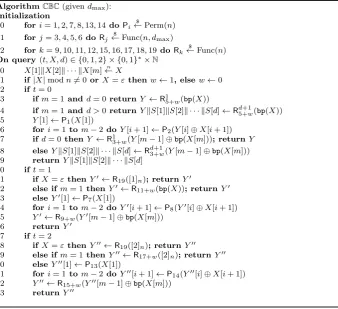
Fig. 5.Modified CBC-MAC.
The proof is in Appendix A.
The remaining part of the proof is almost the same as the proof of EAX-prime. We define the Modified CBC-MAC,CBC, which is compatible with OMAC-e[P] and consists of three functions taking t= 0,1,2, written as CBC(t). A combined form of CBCis shown in Fig. 5. Here, Rij(X) for j = 3,4,5,6 denotes msbn·i(Rj(X)). Then, we obtain the following proposition and lemma
as counterparts of Proposition 2 and Lemma 2 of [14]. Proof of Proposition 2 is almost the same as [14]. Proof of Lemma 2 is given in Appendix B.
Proposition 2. There exists a procedureh(·) that usesQas a black box and perfectly simulates
OMAC-e[P], i.e. h(Q)≡OMAC-e[P]. Moreover, we have h(Qe)≡CBCfor this h(·).
Lemma 2. Let A be an adversary querying a function of OMAC-e profile, and let σin denote the number of total blocks of queries made by A. Then, AdvcpaCBC,RND(A)≤3σ2
in/2n.
Our PRIV bound is derived by combining Propositions 1 and 2 and Lemma 2 in the same manner to [14]. Formally, let A be the CPA-adversary against AE with parameter list (q, σN, σH, σM). Then there exist adversaryBquerying to a function of OMAC-e profile with 3q
queries,σin= (σN+σH+σM) input blocks, andσout =σM+ 3q output blocks, and adversaryC
querying to a set of 19 functions with Qprofile, usingσN+σH+σM queries andσM+qoutput
AdvprivEAX[Perm(n),τ](A) =Advcpa-nrEAX-E
P,$(A)
=Advcpa-nrf
e(OMAC-e[P]),$(A) (from Proposition 1) ≤Advcpa-nrf
e(OMAC-e[P]),fe(CBC)(A) +Adv
cpa-nr
fe(CBC),fe(RND)(A) +Adv
cpa-nr fe(RND),$(A)
| {z }
=0
≤AdvcpaOMAC-e[P],CBC(B) +AdvcpaCBC,RND(B)
=Advcpa
h(Q),h(Qe)(B) +Adv
cpa
CBC,RND(B) (from Proposition 2)
≤Advcpa
Q,Qe(C) +
3(σN +σH +σM)2
2n (from Lemma 2)
≤ 4.5(σN +σH +σM)2+ 10(σM +q)(σN +σH+σM) + (σM +q)2+ 4.5
2n
+3(σN+σH +σM)
2
2n (from Lemma 1)
≤ 18.5(σN+σH +σM)2+ 4.5
2n
≤ 18.5σ
2
priv+ 4.5
2n .
Here, Advcpa-nrf
e(RND),$(A) = 0 holds because when A queries (N, H, M) to fe(RND) the output is a subsequence of RND(0)(N,|M|n) with the first n bits XORed by the output of RND(1) and RND(2) (whose input is a part ofRND(0)(N,|M|
n)). AsN is always fresh, the output is always
random. This concludes the proof of Theorem 4.
In proving AUTH bound, letEAXbe the AE algorithm compatible to EAX[Perm(n)] using fe(RND) and fd(RND) for the encryption and decryption algorithms. We let A be the
CCA-adversary with parameter list (q, qv, σN, σH, σM, σNe, σHe, σCe). Then we have
AdvauthEAX(A)≤ qv
2τ (1)
with almost the same proof as Eq. (14) of [14]. For completeness the proof is given in Appendix C. In the same way as Eq. (15) to (22) of [14], we assume adversary B querying to a function of OMAC-e profile with 3(q+qv) queries withσin=σN+σH+σM+σNe+σHe+σCe andσout =σM+
3q+σCe+3qv, and adversaryCquerying to a function ofQprofile withσN+σH+σM+σNe+σHe+σCe
queries andσM+q+σCe+qvoutput blocks for queries witht= 3,4,5,6. Then using Proposition 1
and Eq. (1) we have
AdvauthEAX[Perm(n)](A)≤Advcca-nr(EAX-E
P,EAX-DP),(fe(RND),fd(RND))(A) +Adv
auth
EAX(A)
≤Advcca-nr(fe(OMAC-e[P]),fd(OMAC-e[P])),(fe(RND),fd(RND))(A) + qv 2τ
The right hand side of the last equation is bounded by
AdvcpaOMAC-e[P],CBC(B) +AdvcpaCBC,RND(B) + qv 2τ
=Advcpa
h(Q),h(Qe)(B) +Adv
cpa
CBC,RND(B) +
qv
2τ (from Proposition 2)
≤Advcpa
Q,Qe(C) +
3(σN +σH+σM +σNe +σHe +σCe)2
2n +
qv
2τ (from Lemma 2)
≤ 4.5(σN+σH +σM+σNe +σHe +σCe)2
2n
+10(σM +q+σCe+qv)(σN +σH +σM +σNe+σHe +σCe) 2n
+(σM +q+σCe+qv)
2+ 4.5
2n +
3(σN +σH+σM +σNe +σHe +σCe)2
2n +
qv
2τ (from Lemma 1)
≤ 18.5σauth2 + 4.5
2n +
qv
2τ,
sinceσM +q+σCe+qv ≤σN+σM +σNe+σCe. This concludes the proof of Theorem 3.
5.2 Proof of Theorem 5
As the proof of Theorem 5 is quite the same as those of Theorem 3 and Theorem 4, we only show the differences. The main difference is in Lemma 1. We in fact need to change the definitions of OMAC-e[P] and Q, and evaluate the indistinguishability of Q from Qe, where the definition of
e
Q does not change, to have a counterpart of Lemma 1. We defineQ′ as follows.
Definition 3. Let Q′ ={Q′i}i=1,...,19 be a set of 19 functions defined as
Q′1(x)def=P(A(0)⊕x)⊕Rnd1, Q′2(x)
def
=P(Rnd1⊕x)⊕Rnd1, Q′3(x, d)def=GP(P(D⊕Rnd1⊕x), d), Q′4(x, d)
def
=GP(P(Q⊕Rnd1⊕x), d), Q′5(x, d)def=GP(P(A(0)⊕D⊕x), d), Q′6(x, d)
def
=GP(P(A(0)⊕Q⊕x), d),
Q′7(x)def=P(A(1)⊕x)⊕Rnd2, Q′8(x)
def
=P(Rnd2⊕x)⊕Rnd2, Q′9(x)def=P(D⊕Rnd2⊕x), Q′10(x)
def
=P(Q⊕Rnd2⊕x), Q′11(x)def=P(A(1)⊕D⊕x), Q′12(x)def=P(A(1)⊕Q⊕x),
Q′13(x)def=P(A(2)⊕x)⊕Rnd3, Q′14(x)
def
=P(Rnd3⊕x)⊕Rnd3, Q′15(x)def=P(D⊕Rnd3⊕x), Q′16(x)
def
=P(Q⊕Rnd3⊕x), Q′17(x)def=P(A(2)⊕D⊕x), Q′18(x)def=P(A(2)⊕Q⊕x),
Q′19(x)def=P(D⊕x),
where P is an URP, and A(i) = gA(i)(L) for i = 0,1,2, D = gD(L) and Q = gQ(L) with
L =P([0]n). The set of g functions are one of the schemes in Section 4. Rndi is independently
random, and GP(v, d) isv if d= 0 and (v∥P(v∧α)∥P((v∧α) + 1)∥ · · · ∥P((v∧α) + (d−1))) if
d >0, withα= (1n−64∥0131∥0131).
The indistinguishability between Q′ and Qe is bounded as follows.
Lemma 3. For Q′ of Definition 3, and Qe of Definition 2, and for any A with parameter list
(q, σout), we have
Advcpa
Q′,Qe(A)≤
3q2+ 6.5σoutq+ 2.5σ2out
The proof of Lemma 3 is largely the same as that of Lemma 1. We obtain the mask function corresponding to Eq. (3) of Appendix A by the substitution of masks, i.e., (L, L′, L′′,2L,4L) is now (A(0), A(1), A(2), D, Q), while omask function does not change.
LetM1={A(0), A(1), A(2)}andM2={D, Q}andM=M1∪M2. With these definitions,
we need to prove counterparts of Eqs. (4) and (5) of Appendix A. As masks in Mare functions of L, when the equation contains an XOR of Rndi for some i, the probability is always 1/2n.
Consequently, we only need to see if the masks satisfy the following conditions7;
1. maxX∈M,c∈{0,1}nPr[L $
← {0,1}n:X =c]≤1/2n 2. maxX,X′∈M,X̸=X′,c∈{0,1}nPr[L
$
← {0,1}n:X⊕X′=c]≤1/2n
3. maxX,X′∈M1,X̸=X′,c∈{0,1}nPr[L $
← {0,1}n:X⊕X′⊕D=c]≤1/2n
4. maxX,X′∈M1,X̸=X′,c∈{0,1}nPr[L $
← {0,1}n:X⊕X′⊕Q=c]≤1/2n 5. maxX,X′∈M1,X̸=X′,c∈{0,1}nPr[L
$
← {0,1}n:X⊕X′⊕D⊕Q=c]≤1/2n
In fact, for any instance of EAX+j , we observe that all five conditions are satisfied.
Proposition 3. For any j = 1,2,3, the mask-generation of EAX+j satisfies the above 5 condi-tions.
Here is the rough proof sketch. For EAX+1, the first and second conditions hold true, as X and X ⊕X′ (for X ≠ X′) can be written as an element of GF(2n), c ·L, with a non-zero constant c. For the third to fifth conditions, we observe that A(0)⊕A(1) = 22L⊕L, A(0)⊕A(2) = 23L⊕22L⊕2L⊕L, and A(1)⊕A(2) = 23L⊕2L. Any of these sums is not
included in {D, Q, D⊕Q}, which is {2L,22L,22L⊕2L}. This shows that the third to fifth conditions are satisfied.
For EAX+2 and EAX+3, each mask generation function can be defined as a matrix-vector multiplication with a binary 4×4 matrix, where each element is in GF(2n/4). For instance, the sequence of gA(0), gA(1), gA(2), gD, gQ of EAX+2 is represented by the following five matrices.
1 0 0 0 0 1 0 0 0 0 1 0 0 0 0 1
,
1 1 1 1 1 0 0 0 0 1 0 0 0 0 1 0
,
0 0 0 1 1 1 1 1 1 0 0 0 0 1 0 0
,
0 0 1 0 0 0 0 1 1 1 1 1 1 0 0 0
,
0 1 0 0 0 0 1 0 0 0 0 1 1 1 1 1
.
Then we observe that the five conditions are decomposed into the following 24 cases with ϵ= 1/2n.
Pr[A(0) =c]≤ϵ Pr[A(1) =c]≤ϵ Pr[A(2) =c]≤ϵ Pr[D=c]≤ϵ Pr[Q=c]≤ϵ
Pr[A(0)⊕A(1) =c]≤ϵ Pr[A(0)⊕A(2) =c]≤ϵ Pr[A(0)⊕D=c]≤ϵ
Pr[A(0)⊕Q=c]≤ϵ Pr[A(1)⊕A(2) =c]≤ϵ Pr[A(1)⊕D=c]≤ϵ Pr[A(1)⊕Q=c]≤ϵ Pr[A(2)⊕D=c]≤ϵ Pr[A(2)⊕Q=c]≤ϵ Pr[D⊕Q=c]≤ϵ
Pr[A(0)⊕A(1)⊕D=c]≤ϵ
Pr[A(0)⊕A(2)⊕D=c]≤ϵ Pr[A(1)⊕A(2)⊕D=c]≤ϵ Pr[A(0)⊕A(1)⊕Q=c]≤ϵ Pr[A(0)⊕A(2)⊕Q=c]≤ϵ Pr[A(1)⊕A(2)⊕Q=c]≤ϵ Pr[A(0)⊕A(1)⊕D⊕Q=c]≤ϵ Pr[A(0)⊕A(2)⊕D⊕Q=c]≤ϵ Pr[A(1)⊕A(2)⊕D⊕Q=c]≤ϵ
We can verify Proposition 3 by computing the rank (modulo 2) of the sums of the matrices, and seeing that the rank is full, for all of the above 24 cases. For EAX+2 and EAX+3, we confirmed
7
this by software. Lemma 2, Proposition 2 and Eq. (1) can be used without a change, including functionh(∗). Using Lemma 3,Advpriv
EAX+j[Perm(n),τ](A) can be bounded as
Advpriv
EAX+j[Perm(n),τ](A)≤Adv
cpa
h(Q′),h(Qe)(B) +Adv
cpa
CBC,RND(B)
≤Advcpa
Q′,Qe(C) +
3(σN+σH +σM)2
2n
≤ 2.5σ
2
priv+ 6.5σ2priv+ 3σpriv2
2n +
3σ2 priv
2n =
15σ2 priv
2n ,
for any j= 1,2,3, by defining appropriate adversaries B and C. In a similar manner, we derive the AUTH bound as
AdvauthEAX+
j[Perm(n),τ]
(A)≤Advcpa
h(Q′),h(Qe)(B) +Adv
cpa
CBC,RND(B) +
qv
2τ
≤Advcpa
Q′,Qe(C) +
3(σN +σH +σM +σNe+σHe +σCe)2
2n +
qv
2τ
≤ 2.5σ2auth+ 6.5σauth2 + 3σauth2
2n +
qv
2τ ≤
15σ2auth 2n +
qv
2τ
for anyj= 1,2,3.
6 Conclusion
In this paper, we have presented an improved authenticity bound for EAX, an authenticated encryption mode proposed by Bellare, Rogaway and Wagner. While the original bound guar-antees the standard birthday-type security in the case of one verification query, we proved the birthday-type security in the case of multiple verification queries. We also showed refinements of EAX for reducing the amounts of pre-processing blockcipher calls and working memory, which will be useful for constrained devices.
Acknowledgments. The authors thank the anonymous reviewers for helpful comments. A part of the work by Tetsu Iwata was carried out while visiting Nanyang Technological University, Singapore.
References
1. Bouncy Castle,http://www.bouncycastle.org/
2. Information technology - Security techniques - Authenticated encryption. ISO/IEC 19772:2009 (2009) 3. Bellare, M., Goldreich, O., Mityagin, A.: The Power of Verification Queries in Message Authentication and
Authenticated Encryption. Cryptology ePrint Archive, Report 2004/309 (2004),http://eprint.iacr.org/
4. Bellare, M., Rogaway, P., Wagner, D.: The EAX Mode of Operation (A Two-Pass Authenticated-Encryption Scheme Optimized for Simplicity and Efficiency),www.cs.ucdavis.edu/∼rogaway/papers/eax.pdf
5. Bellare, M., Rogaway, P., Wagner, D.: The EAX Mode of Operation. In: Roy and Meier [18], pp. 389–407 6. Black, J., Rogaway, P.: CBC MACs for Arbitrary-Length Messages: The Three-Key Constructions. In: Bellare,
M. (ed.) CRYPTO. Lecture Notes in Computer Science, vol. 1880, pp. 197–215. Springer (2000)
7. Chakraborty, D., Sarkar, P.: A general construction of tweakable block ciphers and different modes of opera-tions. IEEE Transactions on Information Theory 54(5), 1991–2006 (2008)
8. Dai, W.: Crypto++ Library,http://www.cryptopp.com/
9. Gladman, B.:http://www.gladman.me.uk/
10. Iwata, T., Kurosawa, K.: OMAC: One-Key CBC MAC. In: Johansson, T. (ed.) FSE. Lecture Notes in Com-puter Science, vol. 2887, pp. 129–153. Springer (2003)
12. Krovetz, T., Rogaway, P.: The Software Performance of Authenticated-Encryption Modes. In: Joux, A. (ed.) FSE. Lecture Notes in Computer Science, vol. 6733, pp. 306–327. Springer (2011)
13. Minematsu, K., Lucks, S., Iwata, T.: Improved Authenticity Bound of EAX, and Refinements. In: Susilo, W., Reyhanitabar, R. (eds.) ProvSec. Lecture Notes in Computer Science, vol. 8209, pp. 184–201. Springer (2013) 14. Minematsu, K., Lucks, S., Morita, H., Iwata, T.: Attacks and Security Proofs of EAX-Prime. Pre-proceedings
of Fast Software Encryption 2013 (2013), full-version available athttp://eprint.iacr.org/2012/018
15. Rogaway, P.: Efficient Instantiations of Tweakable Blockciphers and Refinements to Modes OCB and PMAC. In: Lee, P.J. (ed.) ASIACRYPT. Lecture Notes in Computer Science, vol. 3329, pp. 16–31. Springer (2004) 16. Rogaway, P.: Nonce-Based Symmetric Encryption. In: Roy and Meier [18], pp. 348–359
17. Rogaway, P., Shrimpton, T.: A Provable-Security Treatment of the Key-Wrap Problem. In: Vaudenay, S. (ed.) EUROCRYPT. Lecture Notes in Computer Science, vol. 4004, pp. 373–390. Springer (2006)
18. Roy, B.K., Meier, W. (eds.): Fast Software Encryption, 11th International Workshop, FSE 2004, Delhi, India, February 5-7, 2004, Revised Papers, Lecture Notes in Computer Science, vol. 3017. Springer (2004)
19. Zeng, G., Han, W., He, K.: High Efficiency Feedback Shift Register: σ-LFSR. Cryptology ePrint Archive, Report 2007/114 (2007),http://eprint.iacr.org/
A Proof of Lemma 1
LetQr={Qri}i=1,...,19be the set of 19 functions defined in the same way asQ but the internal
n-bit URP,P, is substituted withn-bit URF,R. From the PRF/PRP switching lemma (e.g. [6]), we have
AdvcpaQ,Qr(A)≤(q+σout+ 3)2/2n+1, (2)
for any adversary A with parameter list (q, σout). Let R = {Ri}i=1,...,19 be defined in the
same way as Qe, except that Ri for i = 1,2,7,8,13,14 are independent n-bit URFs. That is,
each Ri is compatible to Qi and outputs are completely random. We consider the advantage
in distinguishing between Q and R. Then, let mask(i, L, L′, L′′,Rnd1,Rnd2,Rnd3) be the input
masking value used by Qi. The value of mask(i, L, L′, L′′,Rnd1,Rnd2,Rnd3) for each iis defined
as follows.
mask(i, L, L′, L′′,Rnd1,Rnd2,Rnd3) =
L ifi= 1
Rnd1 ifi= 2
2L⊕Rnd1 ifi= 3
4L⊕Rnd1 ifi= 4
L⊕2L ifi= 5 L⊕4L ifi= 6 L′ ifi= 7
Rnd2 ifi= 8
2L⊕Rnd2 ifi= 9
4L⊕Rnd2 ifi= 10
L′⊕2L ifi= 11 L′⊕4L ifi= 12 L′′ ifi= 13
Rnd3 ifi= 14
2L⊕Rnd3 ifi= 15
4L⊕Rnd3 ifi= 16
L′′⊕2L ifi= 17 L′′⊕4L ifi= 18
2L ifi= 19
Similarly let omask(t,Rnd1,Rnd2,Rnd3) be the outer masking value, defined as Rnd1 if t ∈
{1,2} and Rnd2 ift∈ {7,8}and Rnd3 ift∈ {13,14}, and otherwise 0n, that is,
omask(i,Rnd1,Rnd2,Rnd3) =
Rnd1 ifi∈ {1,2} Rnd2 ifi∈ {7,8} Rnd3 ifi∈ {13,14}
0n otherwise
We may abbreviate mask(i, L, L′, L′′,Rnd1,Rnd2,Rnd3) to mask(i), and omask(j,Rnd1,Rnd2, Rnd3) to omask(j). Here,P(mask(i)⊕x)⊕omask(i) corresponds toQi(x) when i̸= 3,4,5,6 and
msbn(Qi(x, d)) when i= 3,4,5,6. From the property of Galois field it is easy to see that
max
1≤i<j≤19,δ∈{0,1}nPr[mask(i)⊕mask(j) =δ]≤1/2
n (4)
max
1≤i≤19,δ∈{0,1}nPr[mask(i) =δ]≤1/2
n (5)
where both probabilities are defined by the independent uniform samplings of L, L′, L′′, and
Rndi fori= 1,2,3.
For any adversary queryingQr orR, let (ti, Xi, di) be thei-th query. Without loss of
gen-erality, we assume di is fixed to 0 whenever ti ̸∈ {3,4,5,6}, and all queries are distinct, i.e.
(ti, Xi, di)̸= (tj, Xj, dj) for any 1≤i < j ≤q, and when ti= 19, Xi is fixed to [1]n or [2]n. For
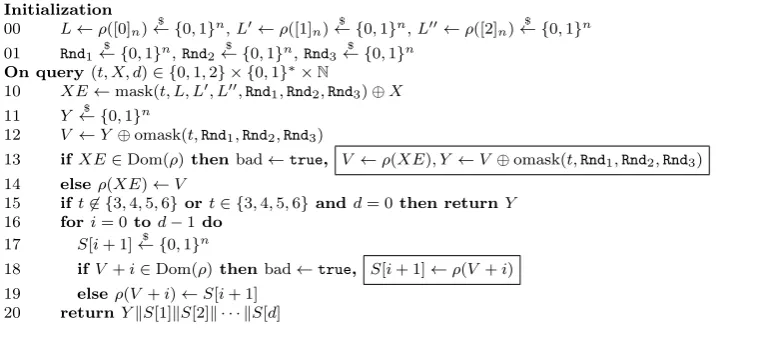
query (t, X, d), we defineXE =X⊕mask(t) which is an actual input to the underlying random function when Qr is queried.
Fig. 6 defines two games, GameQrand GameR, and it is easy to observe that GameQr per-fectly simulatesQr. Note that GameRbehaves identically toR, asY isV⊕omask(t,Rnd1,Rnd2, Rnd3) and V is uniform and independent of Rnd1,Rnd2. Because a collision in (t, X, d) is not
al-lowed the output of GameR is always independent and uniformly random. We define the flag
bad and set it when two inputs with input maskings collide. Then both games are identical until
bad gets set totrue, thusAdvcpaQr,R(A) is bounded by
Pr[AGameQr ⇒1]−Pr[AGameR⇒1]≤Pr[AGameR setsbad]. (6)
That is, what we need is to bound the last probability.
We first focus onbad at line 13. The probability of this event is not increased by an adaptive choice of queries, since outputs are completely random and independent of XE for both games until bad sets. The existence of omask(t) in the output does not help, since it is XORed to a perfectly random value. Thus we fix all queries and measure the probability of bad.
Let us assume bad first occurs at line 13 with the i-th query, (ti, Xi, di). We define XEi
and Yi,h
def
=Yi+h as the corresponding internal variables appeared in the i-th run of the game
(where the latter only appears whenti ∈ {3,4,5,6}and di ≥1). We must have one of the three
sub-events,
– XEi=XEj for i≤q,j < i, or
– XEi∈ {[0]n,[1]n,[2]n}fori≤q or
– XEi=Yj+hfor i≤q and j < i and 0≤h≤dj −1.
– Yi+h=XEj for some i≤q,j≤i, 0≤h≤di−1 or
– Yi+h∈ {[0]n,[1]n,[2]n}for somei≤q and 0≤h≤di−1, or
– Yi+h=Yj+h′ for some (i, h)̸= (j, h′),i, j≤q and 0≤h≤di−1 and 0≤h′ ≤dj−1.
AsYi is random and independent of all previous variables, we have
Pr[Yi+h=Xj] = max
δ Pr[Yi =δ−h] = 1/2 n.
Now we have Pr[Yi+h∈ {[0]n,[1]n,[2]n}]≤3/2n and Pr[Yi+h=Yj+h′]≤1/2n. By counting
the number of sub-events, we have
Pr[AGameR setsbad]≤
(
q 2
)
1 2n
| {z }
XEi=XEj
+ 3q
2n
|{z}
XEi∈{[0]n,[1]n,[2]n}
+ σoutq 2n
| {z }
XEi=Yj+h
for bothi < j andj≤i
+ 3σout 2n
| {z }
Yi+h∈{[0]n,[1]n,[2]n} +
(
σout
2
)
1 2n
| {z }
Yi+h=Yj+h′ ≤ (0.5q2+ 6σoutq+ 0.5σ2out)
2n . (7)
We also need to evaluate the distinguishing advantage of Rand Qe. The difference between them is that R uses n-bit URFs when t is in {1,2,7,8,13,14} while Qe uses n-bit URPs. For other values of t their behaviors are identical and independent of the responses obtained when t= 1,2,7,8,13,14. Combining this observation and the PRP/PRF switching lemma we have
Advcpa
R,Qe(A)≤q
2/2n+1. (8)
Combining Eqs. (2), (8), (7), and (6), we have
Advcpa
Q,Qe(A)≤Adv
cpa
Q,Qr(A) +AdvQcpar,R(A) +Advcpa
R,Qe(A) ≤ (q+σout+ 3)2
2n+1 +
0.5q2+ 6σ
outq+ 0.5σ2out
2n +
q2
2n+1
≤ 4.5q2+ 10σoutq+σout2 + 4.5
2n ,
which concludes the proof.
B Proof of Lemma 2
First we define CBCG,G′ : ({0,1}n)>0 → {0,1}n for anyn-bit (keyed) permutations, Gand G′.
It is defined as
CBCG,G′(X[1]∥. . .∥X[m]) =
{
G(X[1]) ifm= 1
CBCG′(G(X[1])∥X[2]∥. . .∥X[m]) ifm≥2,
where CBCG′ is the standard CBC-MAC using permutationG′. For convenience we also define
CBC⊕G,G′ : ({0,1}n)≥2 → {0,1}n as CBC⊕G,G′(X[1]∥. . .∥X[m]) = CBCG,G′(X[1]∥. . .∥X[m−
1])⊕X[m] for m ≥ 2, i.e. CBCG,G′ without the final application of G′. Let us focus on the
![Fig. 1. (Upper) The encryption and decryption algorithms of EAX[string,E, τ]. Here H and M can be the empty ε, while H ̸= ε was originally required in [5]](https://thumb-us.123doks.com/thumbv2/123dok_us/7897408.1310839/3.595.77.509.84.346/fig-upper-encryption-decryption-algorithms-string-originally-required.webp)