Aeromechanical Optimization of First Row Compressor Test Stand Blades
Mohammad Ghalandari 1, Alireza Ziamolki 1, Amir Mosavi 2,3 ,Shahaboddin Shamshirband 4,5 Kwok-Wing Chau6
1 Research and Deveopelemt Department of MAPNA Turbine Engineering and Manufacturing Company (TUGA),
Alborz Province, Karaj, Fardis, Mapna Blvd, Iran; [email protected] &
2 School of the Built Environment, Oxford Brookes University, Oxford OX3 0BP, UK; [email protected] 3 Institute of Automation, Kando Kalman Faculty of Electrical Engineering, Obuda University, Budapest-1034,
Hungary: [email protected]
4 Department for Management of Science and Technology Development, Ton Duc Thang University, Ho Chi Minh
City, Vietnam
5 Faculty of Information Technology, Ton Duc Thang University, Ho Chi Minh City, Vietnam; [email protected]
6 Department of Civil and Environmental Engineering, Hong Kong Polytechnic University, Hong Kong, People’s
Republic of China; [email protected]
ABSTRACT
In this study, an optimization of the first blade in new test rig presented. Blade tuning is
conducted using 3D geometrical parameters. Sweep and dihedral play an essential role in this
study. Compressor characteristics and blades vibrational behavior are the main objective of the
evaluation. Here, the attachments are designed to isolate blade dynamics from Disk. So, the
Vibrational behaviors of the one's blade are tuned based on the self-excited and forced vibration
phenomenon. Using a semi analytical MATLAB code instability conditions are satisfied. The
code takes advantages of whitehead and force response theory to predict classically and stall
flutter speeds. Beside, Forced vibrations instability is controlled using a theory presented by
Campbell. Aerodynamics of new blade geometry determined using multistage simulations
Computational fluid dynamics (CFD) software. Numerical results show increasing performance
near the surge line and working interval along with increasing mass flow.
Keywords: design optimization; axial compressor blade, Sweep angle, Taper, Dihedral angles, Aero elasticity, multidisciplinary design optimization, Computational fluid dynamics
INTRODUCTION
Aeromechanical considerations are the major issues in developing advanced turbomachinery blades. Flutter, Forced response, and asynchronous vibration are the main critical aero-elastic phenomena which affect the design criteria’s of the blades. Forced response and asynchronous vibrations originated from the aerodynamic sources; however, flutter instability caused by the interaction of the blades motions and the aerodynamics forces. Flutter instabilities which appear as limit cycle oscillation in practice can cause the failure of the turbomachinery blades, especially in the high aspect ratio ones. Oscillatory aerodynamic loading is another design factor. The stress induced by these excitations maintained at a minimum level. At resonance condition, the vibration amplitude remarkably increases which can lead to high cycle fatigue failure.
The early research studies of the turbomachinery blades flutter concentrated on the developing of the simple aero-elastic models for the cascades exposed in a subsonic airflow. In 1960 Whitehead [8], with using vortex panel theory and non-penetrating flow boundary conditions, extracted the analytical solution for lift and moment of a cascade in flexural and torsional oscillating modes. His theory established based on the Theodorsen aerodynamic
model predicts classical flutter for a single oscillating airfoil. The incompressibility of flow, inviscid, and low angle of attack for prescribe vibration properties of flat airfoils are fundamental assumptions of the Whitehead model. Later Mikolajczak[7], Srinivasan[8], Kielb [9],Lubomski[10], and Kurkov[11], suggested a different limit for classical and stall flutter instability.
Besides Shrouds, clappers or damper which are usually designed to postpone flutter speed, geometrical parameters likes sweep angle, dihedral angle, and taper ratio can play positive role in aero structural modifications of the blades [4]. Indeed, they can change the elastic axis position and influence on behavior of the structure.
Using this parameter as well as multidisciplinary design optimization technique (MDO), the best shape of the blades extracted. Wang Jingchao [1] took advantages of MDO approach to create best shape of the disk and blades turbine components. Shen et al. [3] using MDO and Thermo-Elastic-Plastic Analysis presented the algorithm to extract best shape of the disk and blades Integration and multidisciplinary design optimization of a simplified gas turbine model are carried out by Jasmin[2].
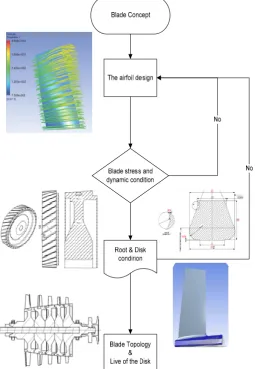
In this paper, Design and modification of the first rotary blades in a new axial compressor test stand is presented. The compressor has five stages with 3.5 pressure ratio and operates in the speed range of 8500-16500 RPM Fig(1). Using multidisciplinary design optimization technique and based on CFD and Finite Element Method the aeromechanical optimization is carried out. Sweep and dihedral angles are the main geometrical parameters in the optimizations process. Flutter Speed preventing and blades forced response considerations are our structural constraint.Also, Compressor characteristics and evaluation of its performance which extracted by CFD method consist the aerodynamics constraints.
GEOMETRICAL PARAMETER (SWEEP AND TAPER EFFECTS)
Usually, turbomachinery blades create with variable cross-section airfoils which stack on each other. Different position of the airfoil cross sections on a row can change the aeromechanical properties of the whole compressor. Sweep angle which creates with dislocating of the cross section of the airfoil along the chord. They play an essential role in the performance of the axial turbomachinery. Generally, three dimensional influences of the Swept blades enhance the amount of the efficiency and range of the operation. In the mechanical aspect of the view swept blade because of changing elastic axis position have different frequency value than the un-swept blade. Aerodynamics study also proof that this parameter can increase the pressure ratio value limits the secondary loss effects and decreasing the loading near leading edge and blockage in the vicinity of blades tip. The Sweep angle can also change the shock waves structures and improve the loss effects in transonic regimes. The advantages of the forward sweep blades are the alleviation of leading edge loading, incidence angle effects, and leakage [4].
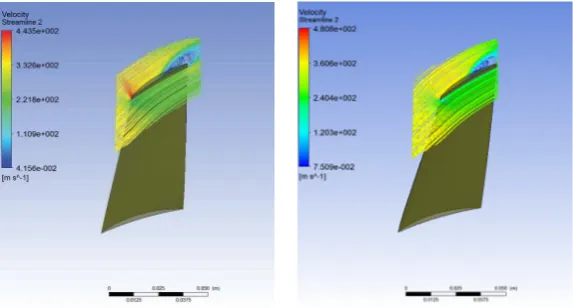
Taper and dihedral [4] can also effect on the performance of the turbomachinery. From mechanical aspect, especially vibrational view tapering can increase the frequency of the blades but aerodynamic shown the negative effect of this parameter in the whole of our compressor Fig [2]
Fig 2.Aerodynamic effects of taper blade
DESIGN VARIABLE AND OBJECTIVE FUNCTION
Optimization of the axial turbomachinery as a prevalent activity in the enhancement ofthe efficiency of the blade commonly is performed in recent year. Using multi-disciplinary design optimization (MDO) [1], [2], [13-15] which found in the ANSYS Workbench as a new conventional method and other turbomachinery analysis modules, axial turbomachinery blade concept can approach to its best performance and mechanical properties. Geometrical parameters consisting of stack line position (thickness and Sweep angle) can be considered as our design variable to maximize stage characteristics. Coupled study play key role in the design process of blades. In order to prevent flutter and forced response, the frequency of the blade can be set as our objective.
original optimized
74 76 78 80 82 84 86 88 90
17.5 18 18.5 19 19.5
Fig 3.Aerodynamic comparison of the original and optimized blades
Parametric modeling of the airfoil section is conducted using UG software. Taper, sweep and dihedral angle is used as our design variable.
Fig 5.The optimized blade shape of the compressor test rig
AERODYNAMIC LOADING CALCULATION
Coupled Aero-Thermal analysis of the first row of the test rig was performed using the loosely coupled method. With a specific aerodynamic loading and temperature distribution of the blade obtained with the definition of wall boundary condition and fluid domain analysis. Boundary condition consists of inlet and outlet boundary, and cyclic symmetry conditions.
75 80 85 90
14 16 18 20
Ef
ficie
n
cy
mass flow
original blade 100% rpm
original blade 90% rpm
optimized blade 100% rpm 2 2.2 2.4 2.6 2.8 3 3.2 3.4
14 16 18 20
Pressure
R
atio
mass flow
original blade 100% rpm
original blade 90% rpm
optimized blade 100% rpm
COUPLED MODEL
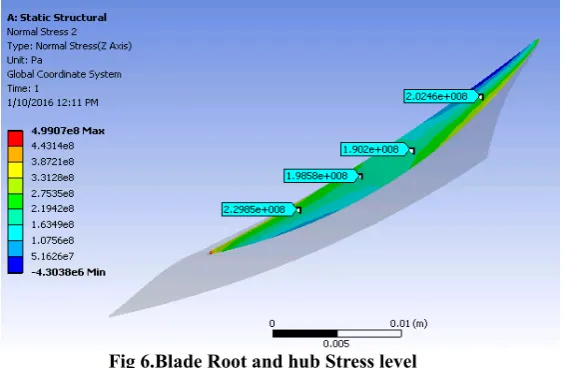
The static and dynamic structural analyses were conducted using pre-stress modal analysis [3]. In addition to safety factor strength satisfaction, the vibrational behavior tuned regard to force response and flutter speed prevention.
Fig 6.Blade Root and hub Stress level
Stall flutter postpones base on the literature recommendation [6-8]. Indeed, Reduced order value for torsional mode should be more than 1.5 and for flexural mode suggested the value number larger than 0.35.
Table 1.Stall Flutter investigation Mode Reduced Frequency Original Blade 1 0.527 2 1.5 Optimized Blade 1 0.54 2 1.56 70 75 80 85 90
2 2.5 3 3.5
Efficie
n
cy
Pressure Ratio
original blade 90% rpm
original blade 100% rpm
optimized blade 100% rpm
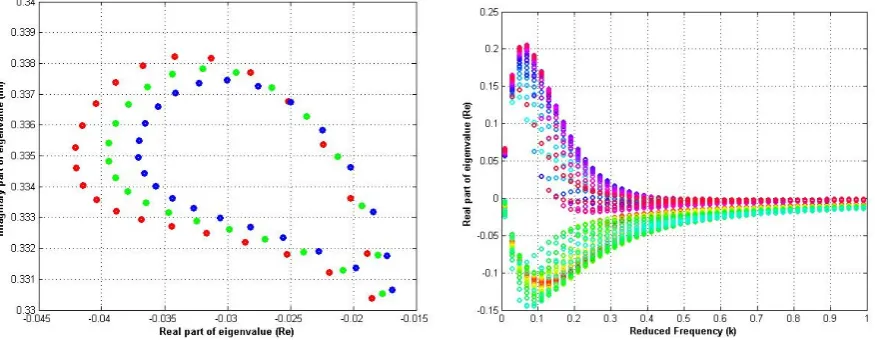
.Semi-analytical in-house code base on the whitehead theory was developed to predict classical flutter instability. Limitation of the designed reduced frequency point for classical flutter is set between 0.4-0.75 [6-12] . Result shows that the classical flutter speed condition in the optimized blade is improved.
Fig7. Real and Imaginary part of the flutter speed
Table 2.Classical Flutter Results
Matlab Code
Empirical
Stage Torsion Bending Torsion
Optimized original Optimized original Optimized original
R1 0.488 0.47 0.26 0.25 0.73 0.70
Fig 8.Campbell diagram of the blade CONCLUSION
An optimization procedure base on the ANSYS workbench on First stages of the new compressor test rig was defined. Blade geometry was parameterized to have best aeromechanical performances. Limitation on the stacking line position or in the other word Taper, Sweep, and dihedral angle plays an important role during optimization.Using 3D simulations design explore the 3D shape of the optimized blade generated. Aerodynamic performance, stress level and aero elastic behavior of the blade set as the aeromechanical limitation. After optimization results, showed that the coupled behavior of the blade and aerodynamic performance improve about 4%.
REFERENCES
[
1] Wang Jingchao, Li Lizhou. “Multidisciplinary design optimization development for turbine blade,” Journal of aerospace power. 2005[2] Jasmin Turcotte. “Integration and multidisciplinary design optimization of a simplified gas turbine model using Perl and isight,” AIAA 2004
[3]Shen Wencai, Cao Yueyun. “Thermo-Elastic-Plastic Analysis of Coupling Field and Touch Problem of Turbine Disc and Blade”. Thermal
turbine. Vol.38,No.1,25~28,2009.3
[4] L. H. Smith Jr. and H. Yeh, “Sweep and dihedral effects in axial-flow turbomachinery” Journal of Basic Engineering, vol. 85, no. 3, pp. 401–416, 1963.
[5] API standard 616, Institute American Petroleum, Fifth edition, January 2011
[6] Srinivasan, A. V. "Flutter and resonant vibration characteristics of engine blades." Journal of Engineering for Gas Turbines and Power 119, no. 4 (1997), 742-775
[7] Mikolajczak, A. A,, Snyder, L. E., Arnoldi, R. A., and Sfargardter. H., 1975 "Advances in Fan and Compressor Blade Flutter Analysis and Predictions," AlAA
[9] Kielb, R. E. and Kaza, K. R. V., 1983, "Aeroelastic characteristics of a cascade of mistuned blades in subsonic and supersonic flows", ASME Journal of Vibration, Acoustics, Stress, and Reliabiliry in Design. Vol. 103, No. 4, pp. 425-433
[10] Lubomski, J. F., 1980, "Status of NASA full-scale engine aeroelasticity research", NASA TiM 8 1500
[11] Kurkov A., "Flutter of flow derivative to engine", ASME Journal of Engineering for Gas Turbines and Power, 1984, Vol. 106, pp. 44-49
[12] Yang, Hui, "3D unsteady flow in oscillating compressor cascade", School of Engineering, University of Durham, PhD Thesis, March 2004.
[13] Dehghani, M., et al., 2019. Prediction of hydropower generation using grey wolf optimization adaptive neuro-fuzzy inference system. Energies, 12(2), p.289.
[14] Mosavi, A., 2009, November. Hydrodynamic design and optimization: application to design a general case for extra equipments on the submarine's hull. In 2009 International Conference on Computer Technology and Development (Vol. 2, pp. 139-143). IEEE.
[15] Esmaeili, M., A., 2010, April. Notice of retraction variable reduction for multi-objective optimization using data mining techniques; application to aerospace structures. In 2010 2nd International Conference on Computer Engineering and Technology (Vol. 5, pp. V5-333). IEEE.