On the Existence of Extractable One-Way Functions
∗Nir Bitansky† Ran Canetti‡ Omer Paneth§ Alon Rosen¶
May 31, 2014
Abstract
A functionfis extractable if it is possible to algorithmically “extract,” from any adversarial program that outputs a valuey in the image off, a preimage ofy. When combined with hardness properties such as one-wayness or collision-resistance, extractability has proven to be a powerful tool. However, so far, extractability has not been explicitly shown. Instead, it has only been considered as a non-standard knowledge assumptionon certain functions.
We make two headways in the study of the existence of extractable one-way functions (EOWFs). On the negative side, we show that if there exist indistinguishability obfuscators for a certain class of circuits then there do not exist EOWFs where extraction works for any adversarial program with auxiliary-input of unbounded polynomial length.
On the positive side, for adversarial programs with bounded auxiliary-input (and unbounded poly-nomial running time), we give the first construction of EOWFs with an explicit extraction procedure, based on relatively standard assumptions (e.g., sub-exponential hardness of Learning with Errors). We then use these functions to construct the first 2-message knowledge arguments and 3-message zero-knowledge arguments of zero-knowledge, against the same class of adversarial verifiers, from essentially the same assumptions.
∗
This is a merged version of two works: “How to construct extractable one-way functions against uniform adversaries” (IACR Eprint 2013/468) and “Indistinguishability obfuscation vs. Extractable one-way functions: One must fall” (IACR Eprint 2013/641). An extended abstract of this work appears in STOC 2014.
†
Tel Aviv University. Email:[email protected]. Supported by an IBM Ph.D. Fellowship and the Check Point Institute for Information Security.
‡
Boston University and Tel Aviv University. Email:[email protected]. Supported by the Check Point Institute for Informa-tion Security, an NSF EAGER grant, and NSF Algorithmic foundaInforma-tions grant 1218461.
§
Boston University. Email: [email protected]. Supported by the Simons award for graduate students in theoretical computer science and an NSF Algorithmic foundations grant 1218461.
¶
1
Introduction
The ability to argue about what adversarial programs “know” in the context of a given interaction is central to modern cryptography. A primary facet of such argumentation is the ability to efficiently “extract” knowl-edge from the adversarial program. Establishing this ability is often a crucial step in security analysis of cryptographic protocols and schemes.
Cryptographic proofs of knowledge are an obvious example for the use of knowledge extraction. In fact, here ‘knowledge’ is definedby way of existence of an efficient extraction procedure. The ability to extract values from the adversary is also useful for asserting secrecy properties by simulating the adversary’s view of an execution of a given protocol, as in the case of zero-knowledge or multi-party computation [GMR89, GMW87]. A quintessential example here is the Feige-Lapidot-Shamir paradigm [FLS99]. Other contexts are mentioned within.
How is knowledge extracted? Traditionally, the basic technique for extracting knowledge from an adver-sary is to run it on multiple related inputs to deduce what it “knows” from the resulting outputs. The power of this technique (often called “rewinding”) is in that it treats the adversary as a black-box without knowing anything regarding its “internals”. However, as a number of impossibility results for black-box reductions and simulation show, this technique is also quite limited. One main limitation of rewinding-based extraction is that it requires multiple rounds of interaction with the adversary. Indeed, proving security of candidate 3-message zero-knowledge protocols, succinct non-interactive arguments (SNARGs), and other tasks are out of the technique’s reach [GK96, GW11].
Starting with the work of Barak et al. [Bar01], a handful of extraction techniques that go beyond the limitations of black-box extraction have been developed. These techniques use the actual adversarial pro-gram in an essential way, rather than only the adversary’s input-output functionality. However, these too require several rounds of protocol interaction, thus they do not work in the above contexts.
Knowledge assumptions and extractable functions.Damg˚ard [Dam92] proposes an alternative approach to knowledge extraction in the form of theknowledge of exponent assumption (KEA). The assumption es-sentially states that it is possible to extract the secret value x from any program that, given two random generatorsg, h of an appropriate groupG, outputs a pair of group elements of the formgx, hx. This ap-proach was then abstracted by Canetti and Dakdouk [CD08, CD09] who formulated a notion ofextractable functions. These are function families{fe}where, in addition to standard hardness properties, such as
one-wayness or collision-resistance, any (possibly adversarial) programAthat giveneoutputsyin the image of fehas an “extractor”Ethat giveneand the code ofA, outputs a preimage ofy.
Extractable functions provide an alternative (albeit non-explicit) “extraction method” that does not rely on interaction with the adversary. As an expression of the method’s power, KEA [HT98, BP04a], or even general extractable one-way functions [CD09, BCC+13], are known to suffice for constructing 3-message zero-knowledge protocols, and extractable collision-resistant hash functions are known to suffice for con-structing succinct non-interactive arguments (SNARGs) [BCCT12]. KEA had also led to relatively efficient CCA constructions [Dam92, BP04a].
to algorithmically test whether a given adversary breaks the assumption. In addition, the impossibility of extractable functions with black-box extraction only further decreases our confidence in such assumptions, as our current understanding of non-black-box techniques and their limitations is quite partial.
Thus, a natural question arises:
Can we construct extractable functions from standard hardness assumptions? Alternatively, Can we show that extractable functions cannot exist?
On the role of auxiliary input.It turns out that the question is more nuanced. Specifically, we show that the answer crucially depends on how we model the “auxiliary information” available to the evaluatorAand the extractorE. Let us elaborate. One straightforward formulation of extractable functions requires that, for any possible adversary (modeled as a uniform algorithm) there exists an extractor (again, modeled as a uniform algorithm) that successfully extracts as described above given the adversary’s coin tosses. An alternative is to model both the adversary and the extractor as non-uniform families of deterministic polysize circuits.
However, it turns out that in many applications neither formulation suffices. Indeed, when using ex-tractable functions with other components in a larger cryptographic scheme or protocol, an adversary A
may gather informationzfrom other components and use it asadditionalauxiliary input when evaluating the extractable function. To be useful in these cases, the extractor needs to be able to deal with auxiliary information that’s determinedafterthe extractor has been fixed. That is, we require that for any adversaryA
there exists an extractorEsuch that for any polysizez, and for a randomly chosen keye, wheneverA(z, e) outputs an imagey,E(z, e)output a corresponding preimage ofy. In the above, we can either model both the adversaryAand the extractorE as uniform polytime machines, or as non-uniform machines with poly-nomial size advice. We callzthecommon auxiliary input, and ifAandEare non-uniform we refer to their advice asindividual auxiliary input.
We note that the concept of common auxiliary input appears elsewhere in cryptography. For instance, to make sure that zero-knowledge protocols remain zero-knowledge under sequential composition, the verifier and simulator get common auxiliary input. Indeed, to obtain this standard formulation of zero-knowledge using extractable functions, extractability with common auxiliary input is needed. In other settings, the definition can be relaxed to consider only the case where the common auxiliary input is taken from some specific distribution that captures the “possible” auxiliary information in a given system, see e.g. [BCCT12].
1.1 Overview of Results
We give two quite different answers to the above question. On the negative side, following the common belief (first expressed in [HT98]), we give formal evidence that extractable one-way functions with common auxiliary input ofunboundedlength may not exist:
Theorem 1.1(informal). If there exist indistinguishability obfuscators for a certain class of circuits, then there do not exist extractable one-way functions with respect to common auxiliary-input of unbounded poly-nomial length.
This seems to suggest that the concept of extractable one-way functions (and other concepts that imply it, such as extractable collision-resistant hashing or SNARKs) may be shaky overall, especially in light of the recent candidate indistinguishability obfuscator for all circuits [GGH+13b].
Theorem 1.2 (informal). Assuming one-way functions and publicly-verifiable P-delegation, there exist EOWFs with respect to (common or individual) auxiliary-input of bounded polynomial length.
While the existence of publicly-verifiable P-delegation schemes is perhaps not considered as a standard assumption, it is afalsifiableassumption [Nao03],1with candidates such as CS proofs [Mic00] or SNARGs [BCCT13] (when restricted to P). We view this construction mainly as a proof of concept, showing that ruling out such extractable functions may be a hard task.
Trying to head towards a construction from standard assumptions, we formulate a generalized variant of extractable one-way functions (GEOWFs), capturing the properties which make EOWFs useful, and in-deed construct bounded-auxiliary-input GEOWFs from relatively standard assumptions. Specifically, our construction relies on the existence of privately-verifiable P-delegation, which was recently established by [KRR14], based, for instance, on the Learning with Errors Assumption. We additionally show that the limitation given by Theorem 1.1 also holds for GEOWFs.
Relying on GEOWFs, we give the first constructions from standard assumptions of 2-message zero-knowledge arguments and 3-message zero-zero-knowledge arguments of zero-knowledge, against verifiers with bounded-auxiliary-input.
Theorem 1.3(informal).
1. Assuming (even privately-verifiable) P-delegation, there exist GEOWFs with respect to (common or individual) auxiliary-input of bounded polynomial length.
2. Assuming GEOWFs, ZAPs [DN07], and (even 1-hop [GHV10]) homomorphic encryption, there exists a 3-message ZK argument of knowledge against bounded-auxiliary-input verifiers. Assuming the GEOWFs are one-way against subexponential adversaries, there exists a 2-message ZK argument against bounded-auxiliary-input verifiers.
We now elaborate on each of the results.
1.2 Impossibility with respect to Unbounded Auxiliary-Input
To introduce the negative result regarding EOWFs with unbounded (common) auxiliary-input, we first recall the notion of obfuscation, and explain their contrast with auxiliary-input extractability.
Obfuscation.Program obfuscation is aimed at making code unintelligible while preserving its functionality, and has been long considered to be a holy grail of cryptography, with diverse and far reaching applications. Barak et al. [BGI+01] initiated the rigourous treatment of obfuscation, formulating a number of definitions of security for the task. However, until recently, we only knew how to obfuscate a number of restricted classes of programs under any of these definitions. Furthermore, Barak et al. demonstrated a class of programs that are unobfuscatable according the natural virtual black-box (VBB) definition, guaranteeing that access to the obfuscated program gives no more power than access to an impenetrable black box with the same input-output functionality.
This state of affairs changed with the work by Garg et al. [GGH+13b] who proposed a candidate con-struction of general-purpose obfuscators. They show that, under algebraic assumptions closely related to multilinear maps [GGH13a, CLT13], their construction satisfies the relaxed notion of indistinguishability obfuscation(IO) [BGI+01], for which no impossibility results are known. The IO notion only requires that
1
it is hard to distinguish an obfuscation ofC0from an obfuscation ofC1, for any two circuitsC0 andC1of
the same size that compute the exact same function.
Since the emergence of the Garg et al. candidate, IO has been shown to have variety of powerful positive applications, such as functional encryption, public-key encryption from one way functions, deniable encryption, 2-message multi-party computation, and more [GGH+13b, SW14, HSW13, GGHR13, BZ13, KRW13].
The tension between obfuscation and extractable functions. As noted already in the work of Hada and Tanaka [HT98], extractability with respect to common auxiliary-input is a strong requirement. Indeed, the common auxiliary-input zmay potentially encode an arbitrary circuit to be executed by the adversary in order to produce an imagey. The extractor should, thus, be able to efficiently “reverse engineer” such a circuit, in order to figure out a preimage ofy. This reveals a clear tension with obfuscation: ifzcontains obfuscated code that chooses a preimage in some complicated way, it may be impossible to extract from.
The question is how to turn this intuition into a formal impossibility. While VBB obfuscation may be the natural choice, we do not have any evidence that there exist VBB obfuscators for a complicated task such as the one described above (in fact, there is evidence that they do not [GK05, BCC+14]. We show that general IO suffices to make this intuition rigorous.
Proof idea. We focus on the ‘hardest scenario’, where the auxiliary input z may represent an arbitrary malicious and potentially obfuscated code. Specifically, we consider the following folklore case (sketched for example in [BCCT12]) wherez is an obfuscation of a circuitCk that, given key efor an extractable
functionfe, chooses its preimage in an unpredictable way: it applies a pseudo-random functionPRFkto the
key, and outputs the resultfe(PRFk(e)).
An adversary, given such an obfuscated circuit as auxiliary input z, can run it on the key e for the extractable function and always obtain a proper image. The question is whether the extractor, given the same(e, z), can output a preimage. Intuitively, had we given the extractor black-box access to the circuit Ck, instead of an obfuscation ofCk, it would have to invert the one-way function to obtain such a preimage.
Indeed, since the oracleCkanswers any querye0 withfe0(PRFk(e0)), it follows from pseudo-randomness
that finding a preimage offe(PRFk(e))is as hard as finding a preimage offe(u), for a uniformly randomu.
Can the above intuition be translated to a proof using IO? Indeed, whenzis an IO obfuscationiO(Ck)
of the circuitCk, it is not clear what kind of information leaks on the PRF keyk.2Nevertheless, we show
that the above intuition can still be fulfilled. The idea is to consider an alternative to the the circuitCkthat
computes the same function, but without actually “knowing” the preimagePRFk(e). This is achieved using
thepuncturing techniqueof Sahai and Waters [SW14].
Specifically, instead of using any PRF family, we use apuncturable PRF. In such PRFs it is possible to puncture a given key kat an arbitrary pointx∗ in the domain of the function. The punctured function
PRFkx∗, with punctured keykx∗, preserves functionality at any other point, but hides any information on
the point PRFk(x∗); namely, the valuePRFk(x∗) is pseudo-random, even given (x∗, kx∗). As shown in
several recent works [BW13, BGI13, KPTZ13], such puncturable PRFs follow from the GGM construction [GGM86].
Using a puncturable PRF in the implementation ofCk, we can now show that if the extractor succeeds
in finding a preimage ofy=fe(PRFk(e)), it would also succeed had we provided it with an obfuscation of
the alternative circuitCke,y. The circuitCke,y computes the same function asCk, but in a different way: it
only has the punctured keyke, and has the valuey=fe(PRFk(e))directly hardwired into it, so that it does
2In fact, formalizing the above intuition is tricky even with VBB, because one has to reduce extraction of one of, perhaps many,
not have to evaluate the PRF in order to compute it. Thus, the fact that the extractor still succeeds follows by the guarantee of indistinguishability obfuscation. However, now by the pseudo-randomness guarantee at the punctured pointe, we know thatPRFk(e)is pseudo random, even given the circuitCke,y, and thus the
extractor can be used to invert the one-way functionfefrom scratch.
Finally, we note that since puncturable PRFs can be constructed from one-way functions, and any EOWF is in particular a OWF, it follows that the impossibility of EOWFs is implied by indistinguishability obfus-cation without any further assumptions. We also note that the result naturally extends to the notion of generalized EOWFs (presented in more detail in the following subsection).
So, is the knowledge of exponent assumption wrong? In its original formulation [Dam92] and in subse-quent formulations [HT98, BP04a, BP04b], the knowledge of exponent assumption (KEA) was not stated with respect to common auxiliary-input, but rather only for individual auxiliary-input (or completely uni-form machines), where any A with advice zA has an extractor E with its own advice zE, and the only common extra information is the adversary’s coin tosses and key for the function. In particular, given a non-uniform adversaryAwith an obfuscated code as advicezA, the extractor is allowed to have a differ-ent advicezE, representing the “deobfuscated” code. Indeed, our result does not rule out such a notion of extraction (even assuming IO for all circuits).
Our result does not disvalidate the intuition that “the only way” to compute(gx, hx), given(g, h)is by “knowing”x. As we saw, our adversary and auxiliary-input are devised so thatxis actually known, but only by an underlying obfuscated computation, and thus cannot be figured out efficiently by an external extractor. We also note that our result does not rule out extractable functions with respect to common auxiliary input that is taken from specific distributions that may be conjectured to be “benign”, e.g. the uniform distribution, required in [BCCT12].
Subsequent work.The negative result presented above, in fact, shows that for any candidate EOWF family
F, there exists a distribution ZF, and an adversary A, such that any extractor E forA, would fail with respect to common auxiliary-input sampled fromZF. As noted by Boyle and Pass [BP13b], our result can be generalized so thatZdoes not depend onF, but only on some upper boundTF on its running time (by havingZ encode a proper universal circuit). Boyle and Pass further show that, assuming a strengthening of IO calledextractable obfuscation (a.k.a. differing inputs obfuscation),Z can be made independent ofTF and only depend on its output length`F; in particular, elements sampled fromZcan be longer than`F. We note that their result does not clash with our positive result for bounded auxiliary-input, in which`F is made longer than the bound on auxiliary inputs. We also note that both ours and Boyle and Pass’ impossibility apply for a specific and rather contrived distribution. No impossibility is yet known for distributions that may be considered “benign”, such as the uniform distribution.
1.3 Constructions with respect to Bounded Auxiliary-Input
We first formulate a generalized version of EOWFs (GEOWFs), and show how GEOWFs can be constructed from standard assumptions. Then, we shall see that, under appropriate conditions, we can leverage the same ideas in order to get standard EOWFs.
Generalized EOWFs. The essence of EOWFs, and what makes them useful, is the asymmetry between a black-box inverter and a non-black-box extractor: an inverter, which only gets a random imagey =fe(x)
of an EOWF, cannot find a corresponding preimagex0, whereas a non-black-box extractor, which is given a code that produces such an image, can find a preimagex0. GEOWFs allow to express this asymmetry in a more flexible way. Concretely, a function familyF is now associated with a “hard” binary relationRF
e on
thatRF
e(y, x0) = 1. In contrast, a non-black-box extractor that is given a code that produces such an image
can find such a witnessx0.
It is natural to require that the relation RFe is efficiently testable, in this case we say that the GEOWF ispublicly-verifiable. However, we shall see that GEOWFs are useful, even for hard relations that are not publicly-verifiable. Specifically, we will consider privately-verifiable GEOWFs where RF
e(y, x0) is not
efficiently testable given only(y =fe(x), x0), but can be efficiently tested givenxin addition.
The main idea behind the construction. To convey the basic idea behind our constructions of GEOWFs with respect to bounded auxiliary-input, consider the following first attempt. The GEOWFf is key-less, it is simply a pseudorandom generator stretching inputs of lengthnto outputs of length2n. The relation
RF contains pairs(y,M)such that the witnessMis a description of a machine of length at mostn, and
M(1n)outputsy. The fact that the relationRF(y,·)is hard to satisfy fory=f(x)and a randomx, follows from the pseudo-randomness of the outputy. Indeed, a truly random output that is indistinguishable fromy would have high Kolmogorov complexity. However, given any adversarial programMAwhose description size is bounded by nand that outputs somey ∈ {0,1}2n, the description of the programM
A itself is a witness that satisfies the relationRF(y,MA), and thus extraction is trivial.
The main problem is that the time required to test the relationRF (even given some preimage ofy) is not bounded by any particular polynomial; indeed, the running time ofMAmay be an arbitrary polynomial. One can try to fix this by padding the witnessMAwith1t wheretis the running time ofMA. However, now the length of the extracted witness depends on the running time of the adversarial programMAand is not bounded by any particular polynomial in the length of the image. Such generalized extractable functions do not seem to be as powerful though; in particular, we do not know how to use them for constructing 2-message and 3-message ZK protocols.
A similar problem is encountered in Barak’s zero-knowledge protocol [Bar01], where the entire com-putation of a malicious verifier is used as the simulation trapdoor. As in the protocol of Barak, Lindell, and Vadhan [BLV06], we get around this problem using a non-interactive proof system that allows forquick ver-ificationof (possibly long) computations. Instead of computing the outputyof the witness programMA,
RF will (quickly) verify a proof for the fact thatMA(1n)outputsy. That is,(y,(M, π))∈ RF only ifπ is a convincing proof thatM(1n) =y. Intuitively, the soundness of the proof guarantees that the relation is still hard to satisfy. Extraction from a bounded-auxiliary-input adversaryMAis done by simply computing a proof for its computation.
P-delegation. The proof system required in our constructions is a non-interactive computationally sound proof for deterministic polytime statements, from hereon referred to as a P-delegation scheme. More pre-cisely, in a P-delegation scheme, the verifier generates, once and for all, an “offline message”σ together with a private verification stateτ and sendsσto the prover. Then, the prover can compute a non-interactive proofπfor any adaptively chosen statement of the sort: “machineMoutputsvwithintsteps”. We require that the verifier runs in time polynomial in the security parametern, but only polylogarithmic int, and the prover runs in time polynomial in(t, n). We say that a delegation scheme ispublicly-verifiableif the ver-ification stateτ can be published without compromising soundness. Otherwise we say that the scheme is
privately-verifiable.
GEOWF from P-delegation. We now sketch how P-delegation is used in our constructions. We obtain publicly-verifiable (respectively, privately-verifiable) GEOWFs based on publicly-verifiable (respectively, privately-verifiable) delegation. In both cases, the GEOWFf is key-less, it is given as input a seedsand a random string r. f applies a pseudo-random generator ons and obtains an image v. f then uses the randomnessrto sample an offline messageσtogether with a verification stateτ for a P-delegation scheme. Finally,f outputs(v, σ). We assume that if the delegation scheme is publicly-verifiable, the offline message σ includes the verification stateτ. Also, if the delegation scheme is privately-verifiable, we assume thatτ can be inefficiently computed fromσ. (Both assumption are WLOG.)
The relationRF contains pairs consisting of an image(v, σ)and witness(M, π), such that the length ofMis much shorter then the length ofvandπ is an accepting proof for the statement “M(1n) outputs v”, with respect to the verification stateτ corresponding to the offline messageσ. Indeed, if the delegation scheme is publicly-verifiable, τ can be efficiently computed fromσ, and therefore the relation RF is effi-ciently testable. And if the delegation scheme is privately-verifiable,τ can be efficiently computed given a primage of(v, σ)that contains the randomness used to sampleσandτ.
Constructing standard EOWFs. We show how to construct a standard (not generalized) EOWF gfrom a publicly-verifiable GEOWFf. The basic high-level idea is to embed the structure of the GEOWFf and the relationRF into the standard EOWFg. For this purpose,gwill get as input a stringi∈ {0,1}n, which
intuitively picks one of two branches for computing the function. Ifi6= 0n(which is almost always the case for a random input) the output is computed in the “normal branch”, wheregtakes an inputxfor the GEOWF f and outputsf(x). Ifi 6= 0n, the output is computed in the “trapdoor branch”, which is is almost never taken for a random input, but is used by the extractor. In the trapdoor branch,gtakes as input a candidate outputy for f and a witnessx0 for RF(y,·). g verifies that(y, x0) ∈ RF and if so, it outputsy. Given an adversarial programMA that outputsyin the image off, the extractor forg can invoke the extractor forf, obtain a witnessx0 such that(y, x0)∈ RF, and from this witness construct a valid (trapdoor branch) primage(i= 0n, y, x0)fory.
The above transformation cannot start from a privately-verifiable GEOWF; indeed public-verification is required so to allow the function to efficiently evaluate the relationRF in the trapdoor branch. We also note that the above transformation is oversimplified and implicitly assumes that an adversarial evaluator cannot use the trapdoor branch of the function to produce an output that is in the image ofgbut not in the image off, in which case extraction may fail. In the body, we show how to avoid this problem by relying on the specific construction of publicly-verifiable GEOWFs from publicly-verifiable P-delegation with an extra property (satisfied by existing candidates).
1.4 Zero Knowledge against Verifiers with Bounded Auxiliary-Input
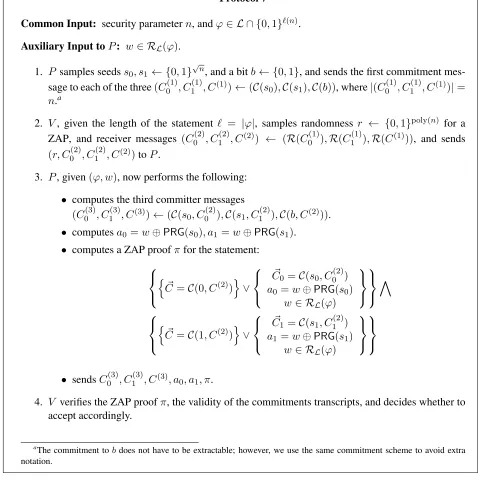
We start by describing how to construct 2-message and 3-message zero-knowledge protocols from standard (non-generalized) EOWFs, and then explain how to replace the EOWFs with GEOWFs.
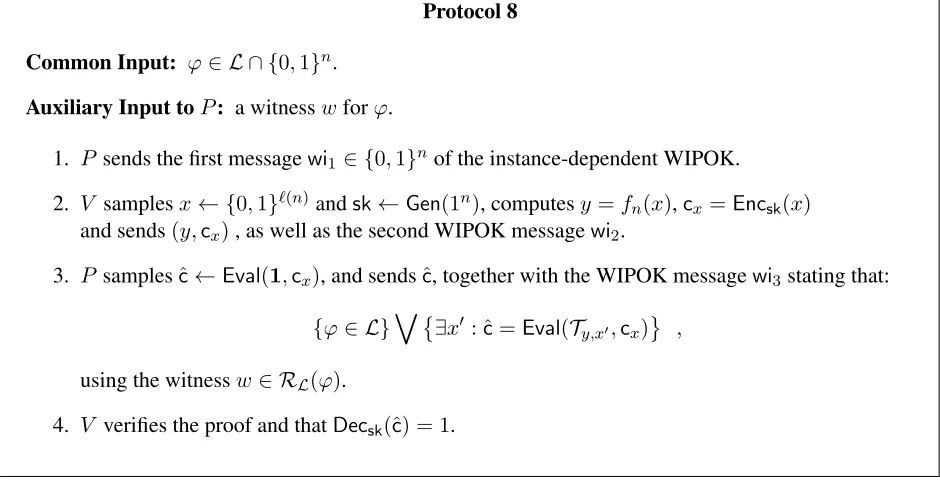
Following through on this intuition encounters several difficulties. First, a WI proof of knowledge requires three messages, and thus a first WI prover message must be sent in the first message of the protocol. Furthermore, the WI statement is only determined when the verifier sendsyin the second protocol message. Therefore, we must make sure to use a WI proof of knowledge where the first prover message does not depend on the statement. Another basic problem concerns the length of the first WI message. Recall that, in our construction of EOWFs against bounded auxiliary-input adversaries, the function’s output is longer than the adversary’s advice. Since a cheating verifier may computey using the first WI message as an advice, we must therefore use a WI system where the length of the first message is independent of the length of the proven statement. We design a WI argument with the required properties based on ZAPs [DN07] and extractable commitments [PW09].
An additional potential problem is that a malicious verifier may output an element y˜ outside of the function’s image, an event which in general may not be efficiently recognizable, and cause the simulator to fail. This can be solved in a couple of generic ways, below we outline one such solution, based on 1-hop homomorphic encryption. A different approach to the problem, based on ZAPs is described in [BCC+13].
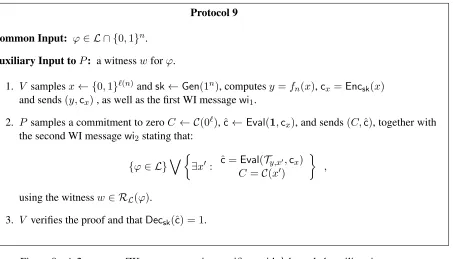
From EOWFs to 2-message zero knowledge. In the 2-message protocol, we replace the 3-message WI proof of knowledge with a 2-message WI proof (e.g. a ZAP). However, in the above 3-message protocol, soundness is established by using the proof-of-knowledge property of the WI, whereas 2-message WI proofs of knowledge are not known. Instead, we prove soundness using complexity leveraging. The prover adds to its message a statistically-binding commitment to junk, and proves that either “x ∈ L”, or “f(x) =yand the commitment is to x”. We require that the commitment is invertible in some superpolynomial timeT, whereas the one-wayness off still holds against adversaries that run in timepoly(T). Now, an inverter of f can run the cheating prover with a verifier message that contains its input imagey, and brute-force break the commitment to obtain a preimage ofy.
Replacing EOWF with GEOWF. We would like to base our zero-knowledge protocols on privately-verifiable GEOWFs (that can be constructed from standard assumptions) instead of on EOWFs. A natural first attempt is to modify the protocol as follows: the verifier sends an imagey = f(x), as before, and the prover then gives a WI proof of knowledge attesting that it either knows a witness w for the proven statement, or that it knows, not a preimage, but a witnessx0 such thatRF(y, x0) = 1. The main problem with this first attempt is that the relationRF is not publicly-verifiable, and thus the simulator has no way of proving the statement. Another possible problem is that a malicious verifier may output an element outside of the function’s image, an event which in general may not be efficiently recognizable. In such a case there is no extraction guarantee, and simulation may fail.
The solution for both problems is to test the relationRF, and the validity of the verifier’s image, using a two-message secure function evaluation protocol, based for example on a 1-hop homomorphic encryption [GHV10]. More concretely, the verifier, in addition to the the function outputy, sends an encryptioncof the inputx. The simulator then homomorphically evaluates a circuit that efficiently computesRF(y, x0) givenx, as well as verifies that indeedy =f(x). The simulator then obtains an evaluated ciphertextˆcthat decrypts to1(the honest prover will simply simulate an encryptionˆcof 1). Finally, the prover (or simulator) sends backˆc, and gives a WI proof of knowledge attesting that it either knows a witnesswfor the proven statement, or that the ciphertextˆcwas generated as described. The verifier verifies the WI proof is accepting and thatˆcdecrypts to 1.
more details). Previous three-message zero-knowledge protocols were based either on the knowledge of exponent assumption [HT98, BP04a], on extractable one-way functions[BCC+13], or on other extractability assumptions [CD08]. In all, the simulator uses a non-black extractor that is only assumed to exist, but not explicitly constructed.
Two-message zero-knowledge arguments against adversaries with unbounded polynomial advice exist only for trivial languages (regardless of how simulation is done) [GO94]. In fact, impossibility extends even to adversaries with bounded advice, provided that the advice string is longer than the verifier’s message. Barak, Lindell, and Vadhan [BLV06] construct a two-message argument that is zero-knowledge as long as the verifier’s advice is shorter than the verifier message by super-logarithmic additive factor. Indeed, our two-message protocol has the same skeleton. However, security of the Barak et al. protocol is only shown assuming existence of P-delegation schemes (or universal arguments for non-deterministic languages) that arepublicly verifiable, which as discussed earlier is not considered to be a standard assumption.
1.5 Open Questions
This work leaves open several questions regarding the existence of extractable function. We next, highlight some of these questions that we find mostly intriguing:
1. There is a gap between the positive and negative results in terms of the type and length of auxiliary input. Specifically, we do not know if there exist EOWFs with respect to individual auxiliary-input of unbounded polynomial length and no common auxiliary-input (or common auxiliary-input of bounded polynomial length).
2. Another question regards the existence of extractable function (even with respect to completely uni-form adversaries) that satisfy stronger one-wayness properties. Particularly interesting is the pos-sibility of extractable functions where the adversary’s output computationally binds it to a specific input. For example, extractable collision-resistant hash-functions and extractable injective one-way functions.
3. Finally, we ask whether there exist EOWF’s with respect to common auxiliary input that is taken from specific “benign” distribution, such as the uniform distribution.
Organization
In Section 2 we give the relevant definitions for EOWF and GEOWF. In Section 3, we present the limitation on unbounded auxiliary-input EOWFs based on indistinguishability obfuscation. In Section 4, we present the constructions of bounded-auxiliary-input EOWFs and GEOWFs. In Section 5.4, we present the zero-knowledge protocols constructed from GEOWFs. In Section A, we discuss relevant black-box lower for EOWFs, and ZK.
2
Extractable One-Way Functions
Definition 2.1 (Auxiliary-input EOWFs [CD08]). Let`, `0, m be polynomially bounded length functions. An efficiently computable family of functions
F = n
fe:{0,1}`(n) → {0,1}`
0(n)
e∈ {0,1}
m(n), n∈
N o
,
associated with an efficient (probabilistic) key samplerKF, is an auxiliary-input EOWF if it is:
1. One-way:For any PPTA, polynomialb, large enough security parametern∈N, andz∈ {0,1}b(n):
Pr
e←KF(1n)
x←{0,1}`(n)
x0 ← A(e, fe(x);z)
fe(x0) =fe(x)
≤negl(n) .
2. Extractable:For any PPT adversaryA, there exists a PPT extractorEsuch that, for any polynomial
b, large enough security parametern∈N, andz∈ {0,1}b(n):
Pr
e←KF(1n)
y← A(e;z)
∃x:fe(x) =y
∧ x
0← E(e;z) fe(x0)6=y
≤negl(n) .
Bounded auxiliary input. We now define bounded-auxiliary-input EOWFs. Unlike the definition above, where extraction is guaranteed with respect to auxiliary input of any polynomial sizeb, herebis fixed in advance and the function is designed accordingly. That is, extraction is only guaranteed against adversaries whose advice is bounded by b, whereas their running time may still be an arbitrary polynomial; this, in particular, captures the class ofuniform polytime adversaries.
For b-bounded auxiliary input, we also define key-less families. While for unbounded auxiliary input, extraction is impossible for key-less families (the adversary may get as auxiliary input a random image, thus forcing the extractor to break one-wayness), forb-bounded auxiliary input, it may be possible, since the output length`0 can be larger than the boundbon the auxiliary input. Our constructions will yield such key-less functions.
Definition 2.2 (b-bounded-auxiliary-input EOWFs). Let b, `, `0, mbe polynomially bounded length func-tions (where`, `0, mmay depend onb). An efficiently computable family of functions
F = n
fe:{0,1}`(n) → {0,1}`
0(n)
e∈ {0,1}
m(n), n∈
N o
,
associated with an efficient (probabilistic) key samplerKF, is ab-bounded auxiliary-input EOWF if it is:
1. One-way:As in Definition 2.1.
2. Extractable againstb-bounded adversaries:For any PPT adversaryA, there exists a PPT extractor
Esuch that, for any large enough security parametern∈N, andz∈ {0,1}b(n):
Pr
e←KF(1n)
y← A(e;z)
∃x:fe(x) =y
∧ x
0← E(e;z) fe(x0)6=y
≤negl(n) .
Remark2.2 (Other forms of auxiliary-input).
1. Individual vs. common auxiliary-input:In the above formulation of extractability, the adversaryA
(producing an image) and the extractorEare modeled as uniform PPT machines that obtain the same
commonauxiliary-inputz. This formulation is aligned with the treatment of auxiliary-input in other settings such as zero-knowledge or obfuscation and, as explained in the intro, is instrumental when arguing about extractable functions in the context of a larger system. As also mentioned in the intro, in certain contexts it may be sufficient to considerindividualauxiliary-input, where we only require that for anyAwith auxiliary-inputzA, there exists an extractorEwith auxiliary-inputzE. The extractor’s zEmay arbitrarily and inefficiently depend onzA, and could be of an arbitrary polynomial size. This weaker notion may be useful in cases where the adversary’s auxiliary inputs do not depend on com-putations that may have taken place in the system before the extractable function is used. Examples include CCA and plaintext-aware encryption with non-uniform security reductions [Dam92, BP04b]. (We may also consider a definition that allows both individual and common auxiliary-input.)
2. Common but “benign” auxiliary-input: In the above formulation, it is required that extraction works for a worst-case choice of the common auxiliary-inputz. In certain contexts, however, it is suf-ficient to consider a definition where the common auxiliary inputzis drawn from a specific distribu-tion that isconjecturedto be ‘benign’, in the sense that it is unlikely to encode a malicious obfuscation. For instance, the distribution can be uniform or an encryption of a random string. Examples where this is sufficient includes essentially all the works on succinct non-interactive arguments (SNARGs), succinct NIZKs, and targeted malleability, that rely on extractable primitives [DCL08, Mie08, Gro10, GLR11, BSW12, BCCT12, BC12, DFH12, Lip12, BCCT13, BCI+13, GGPR13, Lip13].
2.1 Generalized Extractable One-Way Functions
The essence of EOWFs, and what makes them useful, is the asymmetry between an inverter and a non-black-box extractor: a black-non-black-box inverter that only gets a random imagey = fe(x)cannot find a corresponding
preimagex0, whereas a non-black-box extractor, which is given a code that produces such an image, can find a preimagex0. Generalized EOWFs(GEOWFs) allows to express this asymmetry in a more flexible way. Concretely, a function familyF is now associated with a “hard” relationRF
e(fe(x), x0)on image-witness
pairs(fe(x), x0)∈ {0,1}`
0
× {0,1}`. Giveny=f
e(x)for a randomx, it is infeasible to find a witnessx0,
such thatRF
e(y, x0) = 1. In contrast, a non-black-box extractor that is given a code that produces such an
image can find such a witnessx0.
We consider two variants of GEOWFs: The first is publicly-verifiable GEOWFs, where for (y = fe(x), x0), the relationRFe(y, x0), can be efficiently tested given yandx0 only (and the key eif the
func-tion is keyed). The second is privately-verifiable GEOWFs, where the relation RF
e(y, x0), might not be
efficiently testable given only (y = fe(x), x0), but it is possible to efficiently test the relation givenx in
addition.
We note that standard EOWFs, as given in Definition 2.1, fall under the category of publicly-verifiable GEOWFs, where the relationRFe(y, x)simply tests whethery=fe(x).
Definition 2.3(GEOWFs). An efficiently computable family of functions
F = n
fe:{0,1}`(n)→ {0,1}`
0(n)
e∈ {0,1}
m(n), n∈
N o
,
associated with an efficient (probabilistic) key sampler KF, is a GEOWF, with respect to a relation
1. RF-Hard: For any PPT A, polynomial b, large enough security parameter n ∈
N, and z ∈ {0,1}b(n):
Pr
e←KF(1n)
x←{0,1}`(n)
x0 ← A(e, fe(x);z)
RFe(fe(x), x0) = 1
≤negl(n) .
2. RF-Extractable:For any PPT adversaryA, there exists a PPT extractorEsuch that, for any poly-nomialb, large enough security parametern∈N, andz∈ {0,1}b(n):
Pr
e←KF(1n)
y← A(e;z)
∃x:fe(x) =y
∧ x
0← E(e;z)
RF
e(fe(x), x0)6= 1
≤negl(n) .
We further say that the function is
• Publicly-verifiableifRF
e(fe(x), x0)can always be efficiently computed by a testerT(e, fe(x), x0).
• Privately-verifiableifRFe(fe(x), x0)can be efficiently computed by a tester a testerT(e, x, x0).
Bounded auxiliary input GEOWFs(b-bounded auxiliary-input GEOWFs) are defined analogously to b-bounded auxiliary-input-EOWFs. That is, RF-hardness is defined exactly as in Definition 2.3, whereas
RF-hardness is only against adversaries with auxiliary input of an apriori fixed polynomial sizeb(n).
Remark2.3 (DoesRF-hardness imply one-wayness). In principle,RF-hardness may not imply one-wayness ofF. Although this is not needed for our purposes, we may further require that the relationRF includes all pairs(fe(x), x), and thus ensure thatRF-hardness does imply one-wayness.
Remark2.4 (GEOWFs vs. Proximity EOWFs). In [BCCT12], a different variant of EOWFs calledproximity EOWFsis defined. There a proximity relation ∼is defined on the range of the function. One-wayness is strengthened to require that not only is invertingfe(x)is hard, but also findingx0 such thatfe(x)∼fe(x0)
is hard. Extractability is weakened so that the extractor is allowed to outputx0 as above, rather than an actual preimage. GEOWF simply allow the relation to be even more general. In particular, any proximity EOWF with relation∼implies a GEOWF with relationR, such thatR(fe(x), x0) = 1ifffe(x) ∼fe(x0).
In particular, the limitations we show in Section 3 on GEOWFs apply to proximity EOWFs as well.
3
From IO to Impossibility of Unbounded-Auxiliary-Input EOWFs
We show that if there exists indistinguishability obfuscation (IO), there do not exist (generalized) auxiliary-input extractable one-way functions. We start by definingiOand puncturable PRFs.
3.1 Indistinguishability Obfuscation
Indistinguishability obfuscation was introduced in [BGI+01] and given a candidate construction in [GGH+13b], and subsequently in [BR13, BGTK+13].
1. Functionality:For anyC∈ C,
Pr
iO[∀x:iO(C)(x) =C(x)] = 1 .
2. Indistinguishability:For any class of circuit pairs{(Cn(1), Cn(2))∈ C ×C}n∈N, where the two circuits
in each pair are of the same size and functionality, it holds that:
n
iO(Cn(1)) o
n∈N
≈c
n
iO(Cn(2)) o
n∈N
.
Remark3.1 (Efficiently-falsifiable iO). The assumption that iOobfuscators exist according to the above (standard) formulation is notefficiently falsifiablein the language of [Nao03]. Specifically, it can be formu-lated as acryptographic game[DOP05, HH09] between a challenger and an attacker: the attacker submits two circuitsC0,C1, gets an obfuscationiO(Cb)for a randomb, and has to guessb. However, the challenger
cannot efficiently check whether the adversarially chosen circuits indeed compute the same function. Thus, it is not efficiently falsifiable.
We note, however, that for our specific application, we can settle for a restriction ofiOthat is falsifiable: we only require that, for some fixed efficiently samplable distributionDon pairs of circuits with the same functionality,iO holds for an honestly sampled pair. That is, instead of letting the attacker adversarially choose the circuits, the challenger samples a pair of circuits C0,C1 from D and hands them to attacker
together withiO(Cb).
3.2 Puncturable PRFs
We next define puncturable PRFs. We consider a simple case of the puncturable PRFs where any PRF might be punctured at a single point. The definition is formulated as in [SW14].
Definition 3.2(Puncturable PRFs). Let`, mbe polynomially bounded length functions. An efficiently com-putable family of functions
PRF = n
PRFk:{0,1}m(n)→ {0,1}`(n)
k∈ {0,1}
n, n∈
N o
,
associated with an efficient (probabilistic) key samplerKPRF, is a puncturable PRF if there exists a
punc-turing algorithmPuncthat takes as input a keyk ∈ {0,1}n, and a pointx∗, and outputs a punctured key kx∗, so that the following conditions are satisfied:
1. Functionality is preserved under puncturing:For everyx∗ ∈ {0,1}`(n),
Pr
k←KPRF(1n)
∀x6=x∗ :PRFk(x) =PRFkx∗(x)
kx∗ =Punc(k, x∗)
= 1 .
2. Indistinguishability at punctured points: The following ensembles are computationally indistin-guishable:
• {x∗, kx∗,PRFk(x∗)|k← KPRF(1n), kx∗ =Punc(k, x∗)}
x∗∈{0,1}m(n),n∈
N
•
x∗, kx∗, uk← KPRF(1n), kx∗ =Punc(k, x∗), u← {0,1}`(n)
x∗∈{0,1}m(n),n∈
N.
To be explicit, we include x∗ in the distribution; throughout, we shall assume for simplicity that a punctured keykx∗ includesx∗ in the clear. As shown in [BGI13, BW13, KPTZ13], the GGM [GGM86]
3.3 The Impossibility Result
We now show that if indistinguishability obfuscators exist, there do not exist auxiliary-input EOWFs or generalized EOWFs (GEOWFs) according to Definitions 2.1,2.3:
Theorem 3.1. Assuming indistinguishability obfuscation for all circuits, neither EOWFs nor GEOWFs exist, with respect to common auxiliary-input of unbounded polynomial length.
Before proving the theorem two remarks are in place:
Remark 3.2 (Implications for other extractable primitives). GEOWFs are a minimal extractable crypto-graphic primitive, in the sense that other extractable primitives such as extractable collision-resistance hash functions (ECRHs), or succinct non-interactive arguments of knowledge (SNARKs) imply them. (For ex-ample, in [BCCT12], it is shown that SNARKs imply proximity ECRHs, which in turn imply proximity EOWFs, which as noted in Remark 2.4 imply GEOWFs.) These implications are invariant with respect to auxiliary-input, and thus our limitation on common auxiliary input also holds with respect to these ex-tractable primitives.
Remark 3.3 (Auxiliary-input notions that are not ruled out). The limitation we prove relies critically on the adversary and extractor havingcommon auxiliary-input, and does not if we only require extractability with respect toindividualauxiliary-input, as defined in Remark 2.2. The result does hold if we allow both individual and common auxiliary-input.
Also, our result does not apply for any distribution on common auxiliary-inputs, but rather shows that some specific auxiliary-input distribution fails extractability. In particular, we do not rule out natural distri-butions that may be conjectured to be “benign” (see Remark 2.2), such as the uniform distribution.
To prove the Theorem 3.1, for any EOWF (respectively, GEOWF) familyF, we shall describe an adversary
Aand a distributionZ on auxiliary inputs, such thatanyextractor fails, for auxiliary inputs sampled from
Z. For simplicity of exposition, we first concentrate on the case of plain EOWFs, and then show how it directly extends to the case of GEOWFs.
3.3.1 The Universal Adversary
We consider a universal PPT adversaryAthat given(e, z)∈ {0,1}m(n)× {0,1}poly(n), parseszas a circuit
and returnsz(e).
3.3.2 The Auxiliary Input Distribution
LetFbe a family of extractable one-way functions and letPRF be a puncturable pseudo-random function family. We start by defining two families of circuits
C= n
Ck:{0,1}m(n)→ {0,1}`
0(n)
k∈ {0,1}
n, n∈
N o
,
C∗ =nCke∗,y∗ :{0,1}
m(n)→ {0,1}`0(n)
k∈ {0,1}
n, e∈ {0,1}m(n), y∗ ∈ {0,1}`0
, n∈No .
The circuitCk, given a keyefor an EOWF, appliesPRFktoe, obtains an inputx, and returns the result
Ck
Hardwired: a PRF keyk∈ {0,1}n.
Input: an EOWF keye∈ {0,1}m(n).
1. Computex=PRFk(e).
2. Returny=fe(x).
Figure 1: The circuitCk.
Cke∗,y∗
Hardwired: a punctured PRF keyke∗ =Punc(k, e∗)andy∗∈ {0,1}` 0(n)
.
Input: an EOWF keye∈ {0,1}m(n).
1. Ife6=e∗, computex=PRFke∗(e), and returny=fe(x).
2. Ife=e∗, returny∗.
Figure 2: The circuitCke∗,y∗.
The circuitCke∗,y∗, has a hardwired PRF keyke∗ that was derived fromkby puncturing it at the point
e∗. In addition, it has hardwired an outputy∗ to replace the punctured result. In particular, wheny∗ = fe∗(PRFk(e∗))the circuitCk
e∗,y∗ computes the same function asCk.
We are now ready to define our auxiliary input distribution Z = {Zn}n∈N. Let s = s(n) be the
maximal size of circuits in either C or C∗, corresponding to security parameter n, and denote by[C]s a
circuitC padded with zeros to sizes. Let iO be an indistinguishability obfuscator. The distributionZn
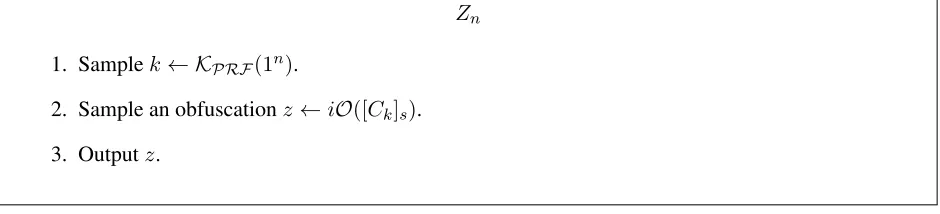
simply consists of an obfuscated (padded) circuitCk.
Zn
1. Samplek← KPRF(1n).
2. Sample an obfuscationz←iO([Ck]s).
3. Outputz.
3.3.3 ADoes Not Have an Extractor
We next show thatA cannot have any extractor E satisfying Definition 2.1. In fact, we show a stronger claim; namely, that for the auxiliary input distributionZ, any extractor fails with overwhelming probability.
Proposition 3.1. LetEbe any PPT candidate extractor forAthen
Pr
e←KF(1n)
z←Zn
y ← A(e;z)
∃x:fe(x) =y
∧ x
0 ← E(e;z) fe(x0)6=y
≥1−negl(n) .
We note that, since the keyeis sampled above independently of the auxiliary inputz, the above indeed disproves extractability.
Proof of Proposition 3.1. First, we note that
Pr
e←KF(1n)
z←Zn
y← A(e;z)
∃x:fe(x) =y
= 1 ;
indeed, by the definition ofAandZn, and the correctness ofiO,
A(e, z) =z(e) =Ck(e) =fe(PRFk(e)) ,
whereCk∈ Cis the circuit obfuscated inz, i.e.z=iO([Ck]s).
Now, assume towards contradiction that, for infinitely manyn∈N, the extractorEsuccessfully outputs a preimage with noticeable probabilityε(n), i.e.
Pr
e←KF(1n)
z←Zn
x0← E(e;z)
fe(x0) =z(e) =fe(PRFk(e))
≥ε(n) ,
where as before,z=iO([Ck]s).
Next, for everye∗we consider an alternative distributionZn(e∗, y∗)that, instead of sampling a circuit
Ck, samples a circuit Cke∗,y∗, by first samplingkas usual, and then computingy
∗ = f
e∗(PRFk(e∗)), and
the punctured keyke∗. (Note thatZn(e∗, y∗)is actually only parameterized bye∗, we addy∗to the notation,
to be more explicit.) We claim that the extractor still succeeds in finding a preimage, i.e.,
Pr
e∗←KF(1n) z∗←Zn(e∗,y∗)
x0 ← E(e∗;z∗)
fe∗(x0) =z∗(e∗) =y∗=fe∗(PRFk(e∗))
≥ε(n)−negl(n) .
This follows from the fact that, for anye∗ andk,Ck andCke∗,y∗ compute the same function, and theiO
indistinguishability guarantee.
Next, we consider another experiment whereZn(e∗, y∗)is altered to a new distributionZn(e∗, u)that,
instead of sampling y∗ = fe∗(PRFk(e∗))in Ck
e∗,y∗, samples y
∗ = f
e∗(r), for an independent random
r← {0,1}`. We claim that
Pr
e∗←KF(1n)
z∗←Zn(e∗,r)
x0 ← E(e∗;z∗)
fe∗(x0) =z∗(e∗) =y∗ =fe∗(r)
indeed, this follows from the fact thatPRFk(e∗)is pseudo-random, even given the punctured keyke∗.
This means that E can be used to break the one-wayness of F. Indeed, given a random key e∗, and a challenge y∗ = fe∗(r), an inverter can simply sample a punctured ke∗ on its own, construct the circuit
Cke∗,y∗, with its challengey∗ hardwired in, and sample an obfuscationz∗ ← iO(Cke∗,y∗). Finally, it runs E(e∗, z∗)to inverty∗, with the same probabilityε(n)−negl(n).
Extending the result to GEOWFs.The result directly extends to show that noFcan even be a generalized EOWF (GEOWF) with respect to auxiliary input, and any relationRF. Concretely, we would consider the exact same universal adversary and auxiliary-input distributionZ. The proof goes along the same lines: instead of an extractor that finds a pre-imagexofy=z(e), we start from an extractor that findsx∈ RFe(y). Then, instead of obtaining an inverter that breaks the one-wayness ofF, we obtain an inverter that breaks theRF-hardness ofF. The proofs follows the exact same arguments. The only thing that should be noted is that when invoking the indistinguishability given byiO, in the first hybrid, and then the indistinguishability given by pseudo-randomness at punctured points, in the second, it can indeed be efficiently tested whether the extractor successfully obtained a witnessx ∈ RF
e(y). This is clear in the case thatRF is
publicly-verifiable and also true in the case that it is privately-publicly-verifiable, as in both casesyis computed directly from a pre-image (PRFk(e∗), in the first, andr, in the second) that is known to the distinguisher, and which allows
testing the relation.
Finally, to deduce Theorem 3.1, we note that puncturable PRFs can be constructed from one-way functions. Furthermore, EOWF is already a OWF, and any GEOWF with RF-hardness implies that NP 6= coRP, which in conjunction withiOimplies OWFs [MR13]. Thus, the impossibility of auxiliary-input EOWFs and GEOWFs is implied by indistinguishability obfuscation without any further assumptions.
4
Bounded-Auxiliary-Input Extractable One-Way Functions
In this section, we construct bounded-auxiliary-input extractable one-way functions (EOWFs) and bounded auxiliary-input-generalized EOWFs (GEOWFs). Before presenting the construction, we definenon-interactive universal
arguments for deterministic computations, which is the main tool we rely on, and discuss an instantiation based on the delegation scheme of Kalai, Raz, and Rothblum [KRR14].
4.1 Non-Interactive Universal Arguments for Deterministic Computations & Delegation
In what follows, we denote byLU the universal language consisting of all tuples(M, x, t) such thatM acceptsxwithintsteps. We denote byLU(T)all pairs(M, x)such that(M, x, T)∈ LU.
Let T(n) ∈ (2ω(logn),2poly(n)) be a computable superpolynomial function. An NIUA system for Dtime(T) consists of three algorithms (G,P,V) that work as follows. The (probabilistic) generator G, given a security parameter1n, outputs areference stringσand a correspondingverification stateτ; in par-ticular, G is independent of any statement to be proven later. The honest prover P(M, x;σ) produces a certificateπ for the fact that (M, x) ∈ LU(T(n)). The verifierV(M, x;π, τ) verifies the validity of π. Formally, an NIUA system is defined as follows.
Definition 4.1(NIUA). A triple(G,P,V)is a non-interactive universal argument system for for Dtime(T)
1. Perfect Completeness:For anyn∈Nand(M, x)∈ LU(T(n)):
Pr
V(M, x;π, τ) = 1
(σ, τ)← G(1n) π ← P(M, x;σ)
= 1 .
2. Adaptive soundness for a bounded number of statements: There is a polynomial b, such that for any polysize prover P∗, large enough n ∈ N, and set of at most 2b(n) false statements S ⊆ {0,1}poly(n)\ L
U(T(n)):
Pr
V(M, x;π, τ) = 1
(σ, τ)← G(1n) (M, x, π)← P∗(σ) (M, x)∈S
≤negl(n) .
3. Fast verification and relative prover efficiency: There exists a polynomialp such that for every
n∈N,t≤T(n), and(M, x)∈ LU(t):
• the generatorGruns in timep(n);
• the verifierV runs in timep(n+|M|+|x|);
• the proverP runs in timep(n+|M|+|x|+t).
The system is said to bepublicly-verifiableif soundness is maintained when the malicious prover is also given the verification stateτ. In this case, we will assume WLOG that the verification stateτ appears in the clear in the reference stringσ.
Existence and connection to delegation of computation.There are two differences between the notion of delegation for deterministic computations (See, e.g., [KRR14]) and the NIUA notion defined above. The first is that a delegation system is associated with a given languageL(M)for a fixed deterministic machine
M, and the corresponding efficiency parameters depend on the worst-case running time TM of M. In particular, the generatorG depends onTMas an extra parameter, and the prover’s efficiency is polynomial in the worst-case running timeTM. The second difference is that only non-adaptive soundness is guaranteed; in particular, the generator’s messageσmay, in principle, depend on the inputx.
Kalai, Raz, and Rothblum [KRR14] show how to construct such a privately verifiabledelegation scheme
for every language in Dtime(T) ⊆ EXP, assuming subexponentially secure private information retrieval schemes, which can in turn be constructed based the subexponential Learning with Errors assumption [BV11].
In order to get a (privately verifiable) NIUA for Dtime(T), we could potentially use their result with respect to a universal machine and worst-case running timeO(T). However, this solution would lack the required prover efficiency, as the prover will always run in timepoly(T), even for machinesMwith running time tM << T. This is undesired in our case, as we will be interested in T that is super-polynomial. Fortunately, a rather standard transformation does allow to get the required efficiency from their result. Specifically, we could run the generator in their solution to generate a reference string and verification state (σ, τ)for computations of sizetfor allt ∈
1,2,22, . . . ,2logT , and have the prover and verifier use the right(σ, τ)according to the concrete running timetM < T, guaranteeing that the prover’s running time is at mostpoly(2tM)as required.
non-x. To guarantee soundness for adaptively chosen inputsxfrom a setS of size at most2b(n), we may repeat the above argument O(b(n)) times. Assuming that the underlying delegation scheme is secure against provers that run in time2O(b(n))(by choosing the security parameter in the [KRR14] scheme appropriately), the parallel repetition exponentially reduces the soundness error (see e.g., [BIN97]). Then, we can take a union bound over all2b(n)adaptive choices ofxand get the required soundness. TheO(b(n))-factor hit in succinctness and verification time are still tolerable for our purposes (and still satisfy the above definition).
Theorem 4.1(Following from [KRR14]). Assuming the Learning with Errors Problem is sub-exponentially hard, for anyb(n) = poly(n), andT(n) ∈ (2ω(logn),2poly(n)), there exists a (privately-verifiable) NIUA with adaptive soundness for2b(n)statements.
4.2 Constructions
We now present our constructions of bounded-auxiliary-input EOWFs and GEOWFs. We start with the construction of GEOWFs, based on any NIUA. We then give a construction of the standard (rather than gen-eralized) EOWFs based on publicly-verifiable NIUAs with an additional key validation property (satisfied by existing candidates).
4.2.1 The generalized extractable one-way function
Letb(n)be a polynomial. Let(G,P,V)be an NIUA system for Dtime(T(n))for some functionT(n) ∈
(2ω(logn),2poly(n)), with adaptive soundness for2b(n)statements. We assume that the system handles state-ments of the form(M, v) ∈ {0,1}b(n)× {0,1}b(n)+n asserting that “M(1n) outputs v in T(n) steps”.
Assume that,G(1n;r)uses randomness of sizento output a reference string of polynomial sizem(n), and a verification stateτ(if the system is publicly-verifiable, thenτappears inσ). Assume thatPoutputs certifi-catesπof sizep(n). LetPRGbe a pseudo random generator stretchingnbits tob(n) +nbits. We construct a key-less family of functionsF = {fn}n∈N, consisting of one functionfn :{0,1}`(n) → {0,1}`
0(n)
, for each security parametern, where`(n) = max(2n, b(n) +p(n))and`0(n) =m(n) +b(n) +n.
The function is given in Figure 4, and is followed by the corresponding relationRF.
Inputs:(s, r,pad)of respective lengths(n, n, `(n)−2n).
1. Computev=PRG(s).
2. Sample NIUA reference string and verification state(σ, τ)← G(1n;r).
3. Output(σ, v).
Figure 4: The functionfn.
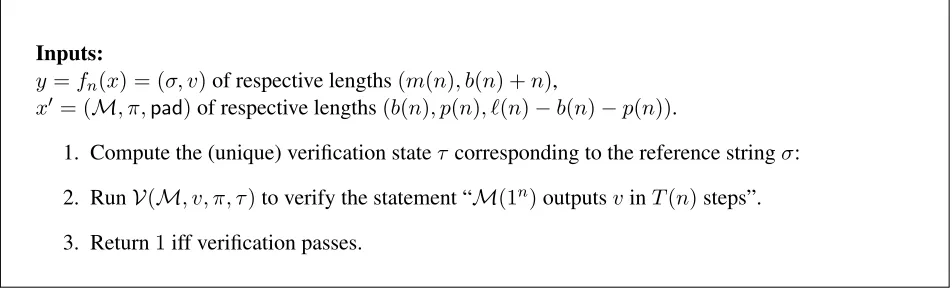
We now define the corresponding relation RF =
RF
n n∈N in Figure 5, which will be
Inputs:
y=fn(x) = (σ, v)of respective lengths(m(n), b(n) +n),
x0 = (M, π,pad)of respective lengths(b(n), p(n), `(n)−b(n)−p(n)).
1. Compute the (unique) verification stateτ corresponding to the reference stringσ:
2. RunV(M, v, π, τ)to verify the statement “M(1n)outputsvinT(n)steps”.
3. Return1iff verification passes.
Figure 5: The relationRFn(fn(x), x0).
Claim 4.1. RF is publicly-verifiable (respectively privately-verifiable), if(G,P,V) is publicly-verifiable
(respectively privately-verifiable).
Proof. First, by definition, when(G,P,V)is publicly-verifiable,τ can be obtained fromσ, NIUA verifica-tion can be done efficiently, and thus the relaverifica-tionRFn can be efficiently tested.
Next, assume that(G,P,V)is privately-verifiable. Recall that showing thatRFn is privately-verifiable, means that given any preimage x such thaty = fn(x), we can efficiently testRFn(y, x0). Indeed, given
such a preimagex= (s, r,pad), we can obtain the generator randomnessr, and runG(1n;r)to obtain the (unique) verification stateτ corresponding toσ, and efficiently testRFn.
Remark4.1 (One-wayness vs. RF-hardness ofF). The relationRF defined above is such that(fn(x), x)
may not satisfy the relation. In particular, this means that RF-hardness may not imply one-wayness of
F. While this is not needed for our purposes, the relationRF can be augmented to also include all pairs (fn(x), x), andRF-hardness will still be preserved; that is, the function we define is one-way in the usual
sense.
We now turn to show thatFis a GEOWF with respect toRF.
Theorem 4.2. The function familyF = {fn}n∈N, given in Figure 4 is a GEOWF, with respect to R
F,
against (b(n)−ω(1))-bounded auxiliary-input.
High-level idea behind the proof.To see thatFisRF-hard, note that to breakRF-hardness, an adversary given a random image(σ, v), wherev = PRG(s) is of lengthb(n) +n, has to come up with a “small” machineM, whose description length is at mostb(n), and a proof thatMoutputsv(within aT(n)steps). However, in an indistinguishable world wherevis a truly random string,vwould almost surely have high Kolomogorov complexity, and a short machineMthat outputsv would not exist. Thus, in this case, the breaker has to produce an accepting proof for a false statement, and violate the soundness of the NIUA.
As for extraction, given a poly-time machineMz with short advicezthat outputs(σ, v), whereσ is a
valid reference string for the NIUA system, the extractor simply computes a proofπ for the fact thatMz
outputsv, and outputs the witness(Mz, π;pad). By the completeness of the NIUA system, the proofπis
indeed accepting, and the witness satisfiesRF. Furthermore, by the relative prover efficiency of the NIUA, the extractor runs in time that is polynomial in the running time of the adversaryMz.
RF-hardness. Assume there exists a breaker B that, given y = (σ, v), where σ ← G(1n), and v ←
PRG(Un), findsx = (M, π,pad)such thatRFn(y, x) = 1with noticeable probabilityε(n). We construct
a proverP∗that breaks the adaptive soundness of the NIUA (for2b(n)statements), with probabilityε(n)−
negl(n).P∗, givenσ, first samples on its ownv˜←U
b(n)+n(independently ofσ), and then runsB(σ,v˜)to
obtain a machineMof sizeb(n), and a proofπ.
We first claim that with probabilityε(n)−negl(n),π is an accepting proof for the statement(M,v˜) asserting that “M(1n)outputsv˜inT(n)steps”. Indeed, the view ofBin the above experiment is identical to its real view, except that it gets a truly randomv, rather than a pseudo-random˜ vthat was generated using
PRG. Thus, the claim follows by thePRGguarantee.
Next, we note that sincev˜is a(b(n) +n)-long random string, except with negligible probability2−n, there does not existMof sizeb(n)that outputsv. Thus,˜ P∗ produces an accepting proof for one of2b(n)
false statements given by the adaptive choice ofM ∈ {0,1}b(n), and violates the soundness of the NIUA. RF-extractability. We now show RF-extractability. We, in fact, show that there is one universal PPT extractorEthat can handle and PPT adversaryMwith advice of size at mostb(n)−ω(1). For an adversarial codeMand advicez∈ {0,1}b(n)−ω(1), denote byM
zthe machine that, on input1n, runs runsM(1n;z).
The extractor E is given (M, z), where Mz has description size at most b(n) and running time at most tM < T(n), andMz(1n) =y = (σ, v) ∈Image(fn). To compute a witnessx0 ∈ RF(y),E computes a
certificateπfor the fact that “Mz(1n) =v”, and then outputsx0 = (Mz, π,pad). The fact thatx0 is indeed
a valid witness follows directly from the perfect completeness of the scheme. Finally, we note that by the relative prover efficiency of the NIUA the extractor runs in time that is polynomial in the running timetM of the adversary .
Remark4.2 (RF-hardness against superpolynomial adversaries). In Section 5.4.2, we shall require GEOWFs that areRF-hard even against adversaries of size poly(T(n)), for some superpolynomial function T(n). Such GEOWFs can be obtained from the above construction, by using a PRG that is secure againstpoly(T(n)) adversaries, and an NIUA that is sound against such adversaries (such an NIUA can be obtained from [KRR14], based on an appropriately strong private information retrieval scheme).
4.2.2 The standard extractable one-way function
We construct a standard extractable one-way function based on publicly-verifiable NIUAs that have an additional property that says that, in addition to perfect completeness for an honestly chosen reference string σ (which in the publicly-verifiable case is also the verification state), it is also possible to check whether any given σ is valid, or more generally admits perfect completeness. We note that exiting candidates for publicly-verifiable NIUAs indeed have this property.3
Definition 4.2(NIUA with key validation). A publicly-verifiable NIUA system is said to have key validation if there exists an efficient algorithmValid, such that for anyσ ∈ {0,1}m(n), if Valid(σ) = 1, then the system
has perfect completeness with respect toσ. That is, proofs for true statements, generated and verified using
σ, are always accepted.
We now turn to describe the construction, which at a very high-level attempts to embed the structure of the previous GEOWF function and relation into a standard EOWF.
3Indeed, in Micali’s CS proofs, perfect completeness holds with respect to all possible keys for a hash function. In the
Letb(n)be a polynomial. Let(G,P,V)be an NIUA system with the same parameters as in the above GEOWF construction, and with the additional key-validation property. LetPRGbe a pseudo random gen-erator stretchingnbits tob(n) +nbits.
We construct a key-less family of functionsF ={fn}n∈N, consisting of one functionfn:{0,1}`(n) →
{0,1}`0(n)
, for each security parametern, where`(n) = 4n+ 2b(n) +m(n) +p(n)and`0(n) = m(n) + b(n) +n. The function is given in Figure 6.
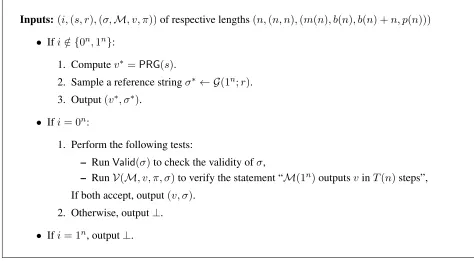
Inputs:(i,(s, r),(σ,M, v, π))of respective lengths(n,(n, n),(m(n), b(n), b(n) +n, p(n)))
• Ifi /∈ {0n,1n}:
1. Computev∗ =PRG(s).
2. Sample a reference stringσ∗ ← G(1n;r). 3. Output(v∗, σ∗).
• Ifi= 0n:
1. Perform the following tests:
– RunValid(σ)to check the validity ofσ,
– RunV(M, v, π, σ)to verify the statement “M(1n)outputsvinT(n)steps”, If both accept, output(v, σ).
2. Otherwise, output⊥.
• Ifi= 1n, output⊥.
Figure 6: The functionfn.
We now turn to show thatF is an EOWF.
Theorem 4.3. The function familyF = {fn}n∈N, given in Figure 6 is an EOWF, against (b(n)−ω(1)
)-bounded auxiliary-input.
High-level idea behind the proof. To see thatF is one-way, note that, except with negligible probability, a random image comes from the “normal branch of the function”, where i /∈ {0n,1n} and includes an honestly sampledσand a pseudorandom stringv = PRG(s). To invert it, an adversary must either invert
PRG(s), allowing it to produce a “normal branch” preimage, or obtain a short machineMand an accepting proofπ, thatMoutputsv, allowing it to produce a “trapdoor branch” preimage. In the first case, the inverter violates the one-wayness ofPRG. In the second case, the inverter can be used to break the soundness of the NIUA as in the proof of Theorem 4.2 (leveraging the fact that a truly random˜valmost surely cannot be computed by a short machine).
As for extraction, given a poly-time machineMz with short advicezthat outputs(σ, v) 6= ⊥, by the
definition of fn, σ is a valid reference string for the NIUA system (indeed,⊥ is an image that indicates
an improper reference stringσ, or a non-accepting proof π). In this case, the extractor simply computes