Available online:
https://edupediapublications.org/journals/index.php/IJR/
P a g e | 2278PSOC Based Isolated Speech Recognition System For
Appliances Control
1Bh u ky a Bh arath i, 2M r.V.RamaKris h n a Red d y 1M.Tech, Balaji Institute of Technology & Science,Telanagana, India 2Assistant Professor,Dept. of ECE, Balaji Institute of Technology & Science, India
ABST RACT :Speech Recognition Systems(SRS)
have been implemented by various processors including thedigital signal processors(DSPs) and field programmable gate arrays(FPGAs) and their performance has been reported in literature.The recognition of speech requires feature extractionand classification. The systems that use speech as input require a microcontroller to carry out the desiredactions. In this paper, Cypress Programmable System on Chip (PSoC) has been studied and used forimplementation of SRS. From all the available PSoCs, PSoC4 containing ARM Cortex-M3 as its CPU is used.Recognition performance isstudied using three feature extraction techniques (Zerocrossing, Zero crossing with end point detection and Zerocrossing with end point detection and Cochlear filter) andminimum distance classifier.Here we are using speech recognition torecognize the speech and compare with data base speech if itmatches one of the action will occurs either Device will beON or OFF.
In d exTerms:PSoC4, HC-05 Bluetooth Module, Automation, Smartphone, Voice Control.
I. INTRODUCTION
Speech recognition is the process by which a computer (orother type of machine) identifies spoken words. Basically, itmeans talking to your computer, and having it correctlyrecognize what you are saying. This is the key to any speechrelated application. When we say voice control, the first termto be considered is Speech Recognition i.e. making the systemto understand human voice. Speech recognition is atechnology where the system understands the words (not itsmeaning) given through speech. Speech is an ideal method forrobotic control and communication. The speech recognitioncircuit we will outline, functions independently from themachine’s main intelligence
Available online:
https://edupediapublications.org/journals/index.php/IJR/
P a g e | 2279machine menu. Howmany distinct commands do they require. Objective of thisproject is to Implement Isolated Speech recognition systemsfor voice operated application.In this project we are doinghrough voice commands we can control our devices. Here weare using speech recognition kit to recognize the speech andcompare with data base speech if it matches one of the actionwill occurs either Device will be ON or OFF. The motivationfor Isolated Speech Recognition is simple; it is man’sprinciple means of communication and is, therefore, aconvenient and desirable mode of communication withmachines. Speech communication has evolved to be efficientand robust and it is clear that the route to computer basedspeech recognition is the modeling of the human system.
II. PROPOSED FRA M EW ORK
In this System input voice commands are taken from android application that compare with desired command and causesinterrupt, holding the controller understand a recognized word had been spoken. The advantage of mistreatmentassociate interrupt is that polling the circuit’s recognitionline often would not be necessary, further reducing anyoverhead. Another advantage to this android primarily basedapplication is its programmability. We’ll be able to programand train the appliance to recognize the distinctive wordsyou would like recognized. The appliance is often simplyinterfaced to the controller. To regulate and command anappliance by talking to it, can make it easier, whereasincreasing the efficiency and effectiveness of operatingtherewith device.
Fig.1 Hardware Block diagram of system
Here the communication is done between androidapplication and hardware using Bluetooth interface. Speechrecognition application will receives voice commands fromuser and send text over Bluetooth and produces interrupt. Atcontroller side, text will compare with set text command thatwill allow operating final control element. The advantage ofthis is that controller no longer to make pooling rxpin, nowcontroller will occasionally need to poll that pin this willreduces any overhead.
The proposed method which uses the low costautomation systems which controls thedevices remotely by using keyword matchingwhich is shown in Fig.2.The environment can becontrolled and monitored using android app whichwill communicate to the receving node throughbluetooth. The proposed system offers the control oflighting, DC motor, and fan.
Fig.2 Block diagram of functional unit
A. Pro grammable System on Ch ip (PSo C4)
Available online:
https://edupediapublications.org/journals/index.php/IJR/
P a g e | 2280This enables fully compatible binary upward migration of the code to higher performance processors such as the Cortex-M3 and M4, thus enabling upward compatibility. The Cypress implementation includes a hardware multiplier that provides a 32-bit result in one cycle. It includes a nested vectored interrupt controller (NVIC) block with 32 interrupt inputs and also includes a Wakeup Interrupt Controller (WIC). The WIC can wake the processor up from the Deep Sleep mode, allowing power to be switched off to the main processor when the chip is in the Deep Sleep mode.
B. A n d ro id Platfo rm
Android devices are powerful mobile computers and they become more and more popular smart phones used worldwide. They becomes more and more popular for software developers because of its powerful capabilities and open architecture, also it’s based on the java programming language.For the communication of the receving node with the mobile we are using the Bluetooth device. The Bluetooth device (HC-05) is attached to the node that receives the data from the mobile and also can transmit the data.
1. Key word Match in g : Keyword matchingmakes a context search with existingdatabase for a nearest keyword. If akeyword is matched the action isperformed.
2. Sp eech Reco g n itio n : A speechrecognition program process voicecommands by using an Android SDK andthe processed voice command will thensend to a CSP
3. Co ntrol sig n al p ro g ram: Control signalprogram send a command to amicrocontroller with its address andCommand in bytes.The system is further simplified by allowing appliances tobe controlled by our voice. The user need not have to haveto immense knowledge over the language of English. Justby saying the appliance name and the correspondingnumber assigned to that particular appliance, and telling itto switch on or off will enable the user to have completecontrol over any appliance without any effort.
4. Sp eech Reco g n itio n Sy s tem
The fundamental purpose of speech iscommunication, i.e., the transmission of messages. In thecase of speech, the fundamental analog form of themessage is an acoustic waveform, which we call thespeech signal. Speech signals can be converted to anelectrical waveform by a microphone, further manipulatedby both analog and digital signal processing, and thenconverted back to acoustic form by a loudspeaker. Therecognition of speech requires feature extraction andclassification.
Feature extractio n : It is the important step required for the representation and recognition of speech signals. It extracts the necessary information required for speech recognition from raw speech signal; this step has to be done for all the words in our dictionary. In this paper, ISRS is used for the recognition of the three words - 'one', 'two' and 'three'.
Fig. 3 Feature extraction using ZCP
ZCP (Zero Cro s s in g Po in t): The speech samples (s[n]) at the output of the delta sigma A/D converter are blocked into overlapping frames of N samples each, with adjacent frames being overlapped by M samples of previous frame as shown in Fig.4.
Fig. 4 overlapping the speech frames
III. RESULTS A ND DISCUSSIONS
Available online:
https://edupediapublications.org/journals/index.php/IJR/
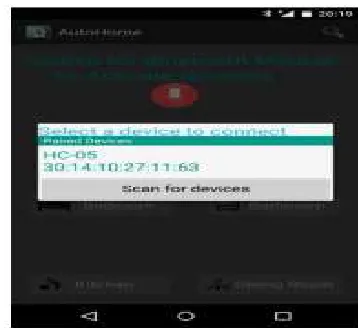
P a g e | 2281microcontroller device with the Bluetooth module and relay circuit needs to be attachedwith the switch board. Then we need to launch the android based application-“AutoHome” on our Smartphone. Through the application we can instruct the microcontroller to switch on/off an appliance. After getting the instruction through the Bluetooth module the microcontroller gives the signal to the relay board. The application first searches for the Bluetooth device. If it is available then it launches the voice recognizer. It reads the voice and converts the audio signal into a string. It produces a value for each appliance which will be given to the microcontroller device. The microcontroller uses the port in serial mode. After reading the data it decodes the input value and sends a signal to the parallel port through which the relay circuit will be activated.
Fig 5 Flow chart for Android application.
Fig 6 Flow chart for PSoC.
Some images to illustrate the working of the system have been given below.
Fig.7 Application connecting to the Bluetooth device
The Bluetooth module transmits the text to the Arduino Uno serial port. The text is matched against the various combinations of predefined texts to switch the applianceson/off. The appliance name and a command for on/off are stored as predefined command. For example, to switch on a television the user needs to say “bulb on” and to switch it off he needs to say “bulb off”. The appliances are connected via the relay boards to pin numbers 2, 3 and 4 of the PSoC4. When the matching text is detected the corresponding pin number is given a high or low output signal to switch the applianceon and off respectively.
Available online:
https://edupediapublications.org/journals/index.php/IJR/
P a g e | 2282Fig.9Zero crossing rate
Fig.10short term energy
IV. CONCLUSION
In this paper we are doing through voicecommands we can control our devices. Here we are usingspeech recognition kit to recognize the speech andcompare with data base speech if it matches one of theaction will occurs either Device will be ON or OFF.Isolated Speech recognition systems (ISRS) have beenimplemented using microprocessors, digital signalprocessors and FPGAs and have ben reported in theliterature. In this paper, the study and implementation ofan ISRS using Cypress Programmable System on Chip(PSoC) is presented. For the implementation, PSoC4 containing the ARM Cortex-M3 CPU is used.Recognition performance is studied using three featureextraction techniques (Zero crossing, Zero crossing withend point detection and Zero crossing with end pointdetection and Cochlear filter) and minimum distanceclassifier.
REFERENCES
1. V. Naresh, B. Venkataramani, Abhishek Karan and J.Manikandan.,"PSoC based isolated speech recognitionsystem" International conference on Communication andSignal Processing, April 3-5, 2013
2.SantoshK.Gaikwad,BhartiW.Gawali,PravinYann awar,” AReview on Speech Recognition Technique” InternationalJournal of Computer Applications Volume 10– No.3,November 2010
3. M.A.Anusuya, S.K.Katti “Speech Recognition by Machine:A Review”, International Journal of Computer Science andInformation Security,Vol. 6, No. 3, 2009
4. Dr. SunitaRana “The process of speech recognition,perception, speech signals and speech production in humanbeings”, International Journal of Advanced Research inComputer Engineering & Technology Volume 1, Issue 9,November 2012
5. Nidhi Desai, Prof.KinnalDhameliya, Prof.VijayendraDesai “Feature Extraction and Classification Techniquesfor Speech Recognition: A Review”, International Journalof Emerging Technology and Advanced Engineering,Volume 3, Issue 12, December 2013
6. Ms. Vrinda ,Mr. ChanderShekhar “Speech recognitionsystem for English language”, International Journal ofAdvanced Research in Computer and CommunicationEngineering Vol. 2, Issue 1, January 2013
7. Sonali N. Malshikare, Prof. V. M. Sardar “SpeechEnhancement through Elimination of ImpulsiveDisturbance Using Log MMSE Filtering”, InternationalJournal of Engineering Research and General ScienceVolume 3, Issue 1, January-February, 2015
Available online:
https://edupediapublications.org/journals/index.php/IJR/
P a g e | 22839. Shipra J. Arora ,Rishi Pal Singh “Automatic SpeechRecognition: A Review”, International Journal ofComputer Applications (0975 – 8887) Volume 60– No.9,December 2012
10. SadaokiFurui “50 Years of Progress in Speech andSpeaker Recognition Research” ECTI transactions oncomputer and information technology vol.1, no.2 november2005.
11. James M. Kates, Senior Member, IEEEA Time-DomainDigital Cochlear Model”, IEEE TRANSACTIONS ONSIGNAL PROCESSING, VOL 39. NO. 12, DECEMBER1991