PillarBox: Combating next-generation malware
with fast forward-secure logging
Kevin D. Bowers RSA Laboratories
Cambridge, USA
Catherine Hart Bell Canada Vancouver, Canada
Ari Juels Cornell Tech New York, USA
Nikos Triandopoulos RSA Laboratories
Cambridge, USA October 23, 2014
Abstract
Security analyticsis a catchall term for vulnerability assessment in large organizations capturing a new emerging approach to intrusion detection. It leverages a combination of automated and manual analysis of security logs and alerts which originate from a wide and varying array of sources and are often aggregated into a massive data repository. Such log and alert sources include firewalls, VPNs, and endpoint instrumentation, such as intrusion-detection systems, syslog or other alerting host facilities, that we generically callSecurity Analytics Sources (SASs).
Security analytics are only as good as the data being analyzed. Yet nearly all security analytics systems today suffer from a lack of even basic data protections on data collection. By merely monitoring network traffic, an adversary caneavesdropon SAS outputs todiscoversensitive SAS instrumentation and security-alerting behaviors. Moreover, by using advance malware, an adversary canundetectably suppressortamperwith SAS messages to conceal attack evidence and disrupt intrusion detection.
We introducePillarBox, a tool for securely relaying SAS data in a security analytics system. PillarBox enforcesintegrity: It secures SAS data against tampering, even when such data is buffered on a com-promised host within an adversarially controlled network. Additionally, PillarBox (optionally) offers stealth: It can conceal SAS data, alert-generation activity and potentially even alerting rules on a com-promised host, thus hiding select SAS alerting actions from an adversary.
We present an implementation of PillarBox and show experimentally that it can secure messages against attacker suppression, tampering or discovery even in the most challenging environments where SASs generate real-time security alerts related to a host compromise directly targeting to diminish their alerting power. We also show, based on data from a large enterprise and on-host performance measure-ments, that PillarBox has minimal overhead and is practical for real-world security analytics systems.
1 Introduction
Big data security analyticsis a popular term for the growing practice of organizations to gather and analyze massive amounts of security data to detect systemic vulnerabilities and intrusions, both in real-time and retrospectively. 44% of enterprise organizations today identify their security operations as including big data security analytics [32]. To obtain data for such systems, organizations instrument a variety of hosts with a range ofSecurity Analytics Sources(SASs) (pronounced “sass”). By SAS here, we mean generically a system that generates messages or alerts and transmits them to atrusted serverfor analysis and action.
a remote service, e.g., a Security and Information Event Monitoring (SIEM) system. Further afield, a SAS could be a dedicated Network Intrusion Detection System, or, in an embedded device, a feature that reports physical tampering. A SAS could also be the reporting facility in a firewall or proxy.
SASs play a central role in broad IT defense strategies based on security analytics, furnishing the data to detect systemic vulnerabilities and intrusions. But a big data security analytics system is only as good as the SAS data it relies on. Worryingly, current-generation SASs lack two key protections against a local attacker. First, an attacker canundetectably suppress or tamper withSAS messages. Today’s approach to securing SAS messages is to transmit them immediately to a trusted server. By disrupting such transmissions, an attacker can create false alarms or prevent real alarms from being received. Even a SAS with a secure host-to-server channel (such as SSL/TLS) is vulnerable: An attacker can undetectably blackhole/suppress transmissions until it fully compromises the host, and then break off SAS communications. (We demonstrate the feasibility of such an attack in this paper in Section 6.3.) And logged or buffered SAS messages are vulnerable to deletion or modification after host compromise.1
Consider, for instance, a rootkit Trojan that exploits a host vulnerability to achieve a privilege escala-tion on an enterprise host. A HIDS or anti-virus engine might immediately detect the suspicious privilege escalation and log an alert, “Privilege Escalation.” An attacker can block transmission of this message and, once installed, the rootkit can modify or remove critical logs stored locally (as many rootkits do today, e.g., ZeroAccess [14,15], Infostealer.Shiz [10], Android.Bmaster [1]).2 Because any buffered alert can simply be deleted, and any transmission easily blocked, an enterprise server receiving the host’s logs will fail to observe the alert and detect the rootkit.
A second problem with today’s SASs is that an attacker candiscoverintelligence about their configura-tion and outputs. By observing host emissions on a network prior to compromise, an attacker can determine if and when a SAS is transmitting alerts and potentially infer alert-generation rules. After host compromise, an attacker can observe host instrumentation, e.g., HIDS rule sets, logs, buffered alerts, etc., to determine the likelihood that its activities have been observed and learn how to evade future detection.
For enterprises facing sophisticated adversaries, e.g., Advanced Persistent Threats(APTs) such as Op-eration Aurora [2,3], the Stuxnet attack [5,7,13], the RSA breach [11,12], and attacks related to malware Duqu [8], such shortcomings are critical. Threat-vector intelligence is widely known to play a key role in defense of such attacks, and its leakage to cause serious setbacks [29].
Thus an attacker’s ability to suppress alerts undetectably and obtain leaked alert intelligence in today’s SAS systems is a fundamental vulnerability in the host-to-server chain of custody and a considerable flaw in big data security analytics architectures.
Pillarbox. As a solution to these challenges, we introduce a tool called PillarBox.3 PillarBox securely relays alerts from any SAS to a trusted analytics server. It creates a secure host-to-server chain of custody with two key properties:
1. Integrity: PillarBox protects a host’s SAS messages against attacker tampering or suppression. It guarantees that the server receives all messages generated prior to host compromise (or detects a malicious system failure). PillarBox also aims to secure real-time alert messagesduringhost compro-mise faster than the attacker can intercept them. Afterhost compromise, PillarBox protects already generated SAS messages, even if an attacker can suppress new ones.
1To the best of our knowledge, we are unaware of any cryptographic integrity protection on messages at rest in today’s SIEM
products.
2These are just recent examples. Many rootkits remove or obfuscate logs by modifying the binary of the logging facility itself. 3Apillar boxis a Royal Mail (U.K.) mailbox in the form of a red metal pillar. It provides a secure and stealthy chain of custody,
2. Stealth: As an optional feature, PillarBox conceals when and whether a SAS has generated alerts, helping prevent leakage of intelligence about SAS instrumentation. It does so against an attacker that sniffs network traffic before compromise and learns all host state after compromise. Stealth can also involve making SAS alert-generation rulesvanish(be erased) during compromise.
Counterintuitively, PillarBoxbuffers SAS messages on the (vulnerable) host. As we show, this strategy is better than pushing alerts instantly to the server for safekeeping: It’s equally fast, more robust to message suppression, and important for stealth.
Challenges.While PillarBox is useful for any type of SAS, the most stringent case is that ofself-protection, which means thatthe SAS messages to be protected regard the very host producing the messages, potentially while the host is being compromised (as with, e.g., a HIDS). Thus, integrity has two facets. First, a host’s buffered alerts must receive ongoing integrity protection evenafter host compromise. Second, alerts must be securedquickly—before an attacker can suppress or tamper with them as it compromises the host. We show experimentally that even in the most challenging case of self-protection, PillarBox secures SAS alerts before a fast attacker can suppress them—even if the attacker has full knowledge of and explicitly targets PillarBox.
Stealth (optional in PillarBox) requires that the host’s internal data structures be invariant to SAS mes-sage generation, so that they reveal no information to an attacker after host compromise. Mesmes-sage buffers must therefore be of fixed size, making the threat of overwriting by an attacker an important technical chal-lenge. Additionally, to protect against an adversary that controls the network, stealth requires that PillarBox transmissions resist traffic analysis, e.g., do not reveal message logging times. A final challenge in achiev-ing stealth is the fact that an attacker that compromises a host learns the host’s current PillarBox encryption keys.
Contributions. In this paper we highlight and demonstrate the transmission vulnerability in security an-alytics systems and propose a solution, which we call PillarBox. In designing PillarBox, we also specify (and formally define) the properties of integrity and stealth, which are general and fundamental to the ar-chitecture of any security analytics system. We show how to combine standard forward-secure logging and activity-concealment techniques to simultaneously achieve both properties in the self-protection SAS mode of operation.
We present an architecture for PillarBox and a prototype end-to-end integration of the tool with syslog, a common SAS. We show experimentally that PillarBox can secure SAS messages in the challenging self-protection case before an attacker can suppress them by killing PillarBox processes. Since the majority of host compromises involve privilege escalation, we also show that for a common attack (the “Full-Nelson” privilege escalation attack), an alerter can be configured to detect the attack and the resulting SAS message can be secured before the attacker can shut down PillarBox. Additionally, we use alert-generation data from a large enterprise to confirm that PillarBox can be parameterized practically, with low performance overhead on hosts.
We emphasize that we do not address the design of SASs in this paper. That is, we neither propose new ways of generating intrusion detection alerts nor explore the direct efficacy of secure alerting in intrusion and malware detection. How SAS messages are generated or consumed and their exact content are outside the scope of this paper. Indeed, PillarBox is an alert relaying tool which is agnostic to the content of alerts and how they are generated. Instead it can be viewed as a black box4that can provide additional value to any currently deployed security analytics system by serving as a designated secure transmission channel between
4PillarBox is a black box both senses; firstly in that the SAS does not need to know how it works to use it, and secondly in the
any existing (alert-generating) SAS and any existing corresponding (alert-collecting and consuming) SIEM that guarantees the properties of integrity and (optionally) stealth. Therefore, PillarBox is a practical, general tool to harden the host-to-server chain of custody for any SAS, providing a secure foundation for security analytics systems.
Organization. Section2introduces PillarBox’s adversarial model and design principles, while Section 3 describes its architecture and integration with a SAS. Section4gives technical details on buffer construction and supporting protocols. Sections5and6present a prototype implementation and experimental evaluation of PillarBox. We review related work in Section7and conclude in Section8. Cryptographic formalisms related to the security model and tools over which PillarBox’s design is based are relegated to the Appendix.
2 Modeling and design principles
We now describe the adversarial model within which PillarBox operates. We then explain how host-side buffering serves to secure SAS alerts within this model and follow with details on the technical approaches in PillarBox to achieving integrity and stealth.
2.1 Threat model
Our threat model considers three entities, theSAS(which we refer to interchangeably as the host),the at-tacker, and theserver. We model the attacker to be the strongest possible adversary, one attacking a host in the self-protecting setting. (Achieving security against this strong adversary ensures security against weaker ones, e.g., those attacking only the network or a firewall whose SAS only reports on network events.)
Recall that in the self-protecting case, a SAS reports alerts about the host itself: While the compromise is taking place, the SAS generates one or more alert messages relevant to the ongoing attack and attempts to relay them to the server.
The adversary controls the network in the standard Dolev-Yao sense [19]: That is, it can intercept, modify, and delay messages at will. When its intrusion is complete, the attacker achieves what we call a complete compromiseof the host: It learns the host’s complete state, including all memory contents— cryptographic keys, buffer messages, etc.—and fully controls the host’s future behavior, including its SAS activity.
To violate integrity, the attacker’s goal is to compromise the host: (1) Without any unmodified alerts reaching the server and (2) Without the server learning of any modification or suppression of alerts by the attacker.
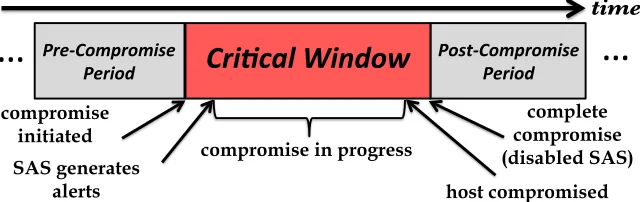
The SAS can only start generating meaningful alerts, of course, once the intrusion is in progress. After the attacker has achieved complete compromise, it can shut down the SAS or tamper with its outputs. So a SAS produces valid and trustworthy alerts onlyafterintrusion initiation butpriorto complete compromise. We call the intervening time interval thecritical windowof an attack, as illustrated in Figure1. This is the interval of time when intrusions are detectable and alerts can be secured (e.g. buffered in PillarBox) before the attacker intercepts them.
compromise in progress
Pre$Compromise+
Period+ Post$Compromise+Period+
SAS generates alerts
complete compromise (disabled SAS) host compromised
time
compromise initiated
Cri.cal+Window+
…"
…"
Figure 1: Event timeline of host compromise
To violate stealth, the attacker tries to learn information about SAS rules and actions, e.g., if the SAS has issued alerts during an attack, by making adaptive use of the network and of post-compromise host state, such as buffer state. SAS detection rules can also be used to infer behavior, but are outside the scope of PillarBox. However, as we discuss below,vanishing rules, that is, rules that are deleted if they ever trigger an alert, can be used to protect against adversarial rule discovery in the SAS.5 By analogy with cryptographic indistinguishability definitions, a concise definition of stealth is possible: The stealth property holds if, for any SAS detection rule and any attack strategy, no attacker can distinguish between PillarBox instantiations with and without the rule (and, thus, between the associated observed SAS alerting activities).
We next describe the design principles used in PillarBox, gaining intuition behind the importance of alert buffering in building a secure alert relaying tool, as well as insight about the technical challenges introduced by alert buffering when trying to preserve integrity and stealth.
2.2 Secure alert relaying via buffering
A key design choice in PillarBox, as mentioned, is the use of host-side alert buffering. For brevity, we refer to thePillarBox bufferwhere alerts are secured as thePBB. The objective of PillarBox is to secure alerts in the PBB during the critical window, as shown in Figure2. Once in the PBB, alert messages are protected in two senses: They are both integrity-protected and “invisible” to the attacker, i.e., they support systemic stealth. (Informally, the PBB serves as a “lockbox.”) Also, as we explain, either alerts reliably reach the server, or the server learns of a delivery failure.
Host
SAS# PBB# “Alert!”)
Pre(compromise#period# Cri1cal#window# Post(compromise#period# Host
SAS# PBB#
“Alert!”) Host
SAS# “Alert!”)PBB#
(A)#
(B)#
(C)#
malware#
malware#
malware#
Figure 2: PillarBox across compromise phases: (A) The host has not yet been attacked. (B) The SAS detects in-progress compromise and places an alert in the PillarBox buffer PBB. (C) The host is under the attacker’s full control, but PBB securely stores and transmits the alert.
We first explain why buffering is important to secure the SAS chain of custody in PillarBox and then how we address the technical challenges it introduces.
5Vanishing rules operate in the same adversarial model: The SAS tries to erase rules during the critical window, while the
Why buffering is necessary. The approach of most SAS systems today, e.g., syslog and HIDSs, is to push alerts to a remote server in real time, and thus secure them at the server during the critical window. There are many important cases, though, both adversarial and benign, in which SAS messagescannot be pushed reliably, for two main reasons:
• Imperfect connectivity: Many host SAS systems lack continuous connectivity to the server. For in-stance, laptops that shuttle between an office and home have limited connection with corporate se-curity servers but are open to infection in the home. Lightweight embedded devices often cannot ensure or even verify delivery of transmitted messages. For instance, wireless sensor networks6often experience transmission failures.
Even fully connected systems can experience benign transport failures. For instance, syslog messages often travel over UDP, which doesn’t guarantee packet delivery [31].
• Network attacks: An attacker can actively suppress on-the-fly SAS transmissions by causing malicious network failures. It can selectively disrupt network traffic, via, e.g., ARP stack smashing (see, e.g., [4, 6]), or flood target hosts to achieve denial-of-service (DoS) during a compromise, causing message delay or suppression. The result is complete occlusion of server visibility into the critical window— potentially appearing to be a benign network failure. We describe our own implementation of such an alert-suppression attack later in Section6.3.
Even if reliable, immediate SAS message-pushing were generally feasible, it wouldstillhave an unde-sirable effect:
• SAS intelligence leakage: If a host pushes alerts instantaneously, then its outbound traffic reveals SAS activity to an attacker monitoring its output. An attacker can then probe a host to learn SAS detection rules and/or determine after the fact whether its intrusion into a host was detected. Note that encryption does not solve this problem: Traffic analysis alone can reveal SAS rule-triggering. (As noted above, PillarBox overcomes this problem via regular alert-buffer transmission.)
• Delayed alert custody: SASs today push alerts on to the wire as quickly as possible to remove them from a host under attack and secure them on a trusted server. But in Section6.2, we show experimen-tally that it is generallyfasterto secure alerts in a bufferon the host. In fact, PillarBox secures alerts even faster than (unreliable and unprotected) UDP transmissions.
For these reasons,message buffering—as opposed to on-the-fly event-triggered transmission—is of key importance in a SAS chain of custody and the cornerstone of PillarBox. Buffering SAS messages, though, poses security challenges. If an attacker completely compromises a host, there is no way of course to prevent it from disabling a SAS or tampering with its future outputs. But there is a separate problem after host compromise: Inadequately protected buffered SAS messages are vulnerable to modification/suppression and intelligence leakage, as discussed before. We next elaborate on these problems and our solution to them in PillarBox.
6These systems do not have full-blown SASs but can have lightweight versions, e.g., the hardware tripwire proposed for
2.3 Achieving integrity
A main challenge in creating a secure chain of custody in PillarBox is the need to secure alert messages after compromise, while they are still buffered and exposed to an attacker. Log-scrubbing malware can attempt to modify buffered alerts (e.g., replace the strong alert “Privilege Escalation” with the more benign “Port Scan Observed”) or just purge alerts.Post-compromise integrity protectionfor buffered SAS messages is thus crucial in PillarBox—but at first glance, this might seem unachievable.
Indeed, a digital signature or message-authentication code (MAC) alone, as proposed, e.g., for syslog [25], does not protect against tampering: After host compromise an attacker learns the signing key and can forge messages. Message encryption similarly does not protect messages against deletion, nor does tagging them with sequence numbers, as an attacker with control of a host can forge its own sequence numbers.
Fortunately, post-compromise alert integrity is achievable using the well-known cryptographic technique offorward-secureintegrity protection. The main idea is to generate new keys on the host after every alert generation and delete keys immediately after use. Forward-secure integrity protection is commonly used for forward-secure logging (e.g., [28,34,41,42]), an application closely related to SAS protection.7 Similarly, PillarBox uses forward-secure pseudorandom number generation (FS-PRNG) to create MAC keys. Each MAC key is used to secure a single message at the PillarBox host and is then deleted. An FS-PRNG has the property that past keys cannot be inferred from a current key, preventing tampering of messages that have already been secured. The server runs this FS-PRNG to compute the (same series of indexed) shared keys with the host, allowing it to detect tampering or erasure.
What’s new in the use of forward security in PillarBox is primarily its application for self-protecting alerting: Indeed, recall that the main aspect of integrity here is securing alerts in the PBB as fast as possible during a compromise, i.e., in the critical window. Effectively, PillarBox engages in a race to secure alerts before the attacker intercepts them. Ensuring that PillarBox can win this race is not a matter of cryptography, but of the system design of PillarBox, including the design choice of host-side buffering! An important contribution of our work is an experimental validation that winning this race, and thus the whole PillarBox approach to securing alerts, is feasible. Our experiments in Section6show this to hold even against a fast, local, PillarBox-aware attacker that tries to kill PillarBox processes as quickly as possible.
2.4 Achieving stealth
Stealth, as we define it, requires concealment of the entire alerting behavior of a SAS, including detection rules, alert message contents, alert generation times, and alert message existence in compromised hosts. Stealth is a key defense against sophisticated attackers. (One example: Host contact with “hot” IP addresses can help flag an APT, but an attacker that learns these addresses can just avoid them [29].)
Achieving stealth is not possible with direct use of existing techniques; in particular, straightforward encryption alone does not achieve stealth. To protect against buffer captures, encryption of alerts alone (forward-secure or otherwise) cannot help: For example, if buffer alerts are encrypted on a host, an attacker can infer alert generation simply by counting buffer ciphertexts upon host compromise, thus potentially inferring whether an alert was triggered during compromise. Similarly, encrypted host-to-server traffic leaks information: An attacker that does not just compromise hosts, but also controls the network, can determine via traffic analysis when a host has triggered an alert. An attacker that has monitored past buffer transmissions can even perform a black-box probing attack against a host to discover SAS detection rules:
7Forward-secure logging systems, however, are designed mainly for forensic purposes rather than detection, e.g., they are
By inspecting the state of the buffer the attacker can determine whensomeSAS rule was triggered, and thus test specific attacks to infer which are or are not detectable. Instead, stealth in PillarBox requires a combination of several ideas.
In particular, PillarBox employs a buffer sizeT, and buffer transmission-time interval µ, that areboth fixed, i.e., invariant. Each message is also of fixed size (or padded to that size). (We discuss the option to have variable-sized messages in Section4.) When PillarBox transmits, it re-encrypts and sends theentire fixed-size buffer, not just fresh (encrypted) alerts. Such fixed-length transmissions prevent an attacker from determining when new alerts have accumulated in the host buffer, while its fixed communication patterns defeat traffic analysis. Otherwise, information about alert generation can be leaked to an attacker who harvests past host-to-server buffer transmissions before fully compromising the host: For instance, if only new alerts are transmitted, the transmission will itself leak information about alert-generation patterns, and if the buffer size is variable, whether the host compromise fired an alert will be inferred by examining the host’s current buffer state in relation to older transmissions.
As the host buffer is of fixed size T, PillarBox writes messages to it in a round-robin fashion. Thus messages persist in the buffer until overwritten. (They may be transmitted multiple times. Such persistent transmission consumes bandwidth, but has a potentially useful side effect as it may allow temporarily sup-pressed messages to eventually reach the server.) This feature of fixed-size buffer in PillarBox creates a need for careful parameterization: We must ensure thatTis large enough to hold all alert messages generated un-der benign conditions within a time intervalµ; this condition also ensures that the buffer is also large enough so that if round-robin overwriting occurs, PillarBox implicitly signals to the server a “buffer-stuffing” at-tempt by an attacker. (Below, in Section3, we develop a framework for parameterization ofT andµand then, in Section6, we explore practical settings by analyzing real-world alert transmission patterns in a large enterprise.)
PillarBox generates encryption keys in a forward-secure way (using an FS-PRNG) to protect against decryption attacks after an attacker compromises a host’s keys. To protect against an attacker that controls the network and eventually the host as well, encryption is applied intwo layers: (1) Tobuffered messages, to ensure confidentiality after host compromise, and (2) tohost-to-server buffer transmissions, to ensure against discovery of alert data from buffer ciphertext changes. Note that buffer encryption alone is insufficient: E.g., if identical buffer ciphertexts leave a host twice, the attacker learns that no new alert has been generated in between. Also note that semantically secure public-key encryption would enable use of just one layer, but with impractically high cost overheads for PillarBox.
Complete stealth in PillarBox carries an unavoidable cost: Periodic rather than immediate transmissions can delay server detection of intrusions. But we note that stealth is an optional feature in PillarBox. It can be removed or weakened for limited attackers.
Vanishing detection rules.Finally, we note that a key complement to stealth in PillarBox is concealment of detection rules in hosts: Indeed, encryption alone (in our work at two layers) ensures confidentiality in the buffer and over the network, but not in the SAS alerting engine itself. Then, deleting a detection rule from the SAS as soon as it triggers an alert for the very first time offers an effective concealment method. In our experiments in Section6, we show the viability of instrumenting the SAS with vanishing rules.
3 Architecture
As explained, PillarBox secures alerts through buffering: The PillarBox buffer, called PBB for short, is the cornerstone in our design that serves as a special “lockbox” which protects at rest or in transit alerts against tampering, suppression or leakage, even in post-compromise environments. PillarBox combines sim-ple cryptographic protections (namely, forward secure MAC and encryption) with a data structure and buffer transmission protocol for the PBB that are invariant to the number of alert messages and their buffering his-tory. In essence, this implements a low-level crypto-assisted reliable channel that, even under adversarial conditions, ensures tamper-evident and stealthy delivery of transmitted messages to a remote server. Details on the PBB design, its associated protocols as well as their properties are provided in Section4.
PillarBox helps a SAS transmit security alerts to a remote, trusted service. This service can perform analysis and remediation that is impractical on hosts themselves. As it operates on a device other than the host, it is (generally) insulated from the intrusion. Additionally, the service can correlate events across multiple reporting hosts, enabling it to filter out false positives. It can also house sensitive threat intelligence that cannot be safely exposed on hosts and can trigger action by human system administrators or Security Operations Center (SOC) personnel.
3.1 Interface with SAS
Being agnostic to message content, PillarBox works with any SAS. It can serve as the main channel for SAS alerts or can deliver SAS alerts selectively and work in parallel with an existing transport layer. Exactly how SAS messages are produced at the host or consumed at the receiving server depends on SAS instrumentation and alert-consuming processes. (As such, it is outside the scope of our work.)
Similarly, our architecture abstracts away the communication path between the host and server, which can be complicated in practice. In modern enterprises, networks carry many SAS-based security controls that alert upon malfeasance. Typically, alerts are sent via unprotected TCP/IP transmission mechanisms, such as the syslog protocol (which actually uses UDP by default), the Simple Network Messaging Protocol (SNMP), or the Internet Control and Messaging Protocol (ICMP). These alerts are typically generated by endpoint software on host systems (such as anti-virus, anti-malware, or HIDS) or by networked security control devices. These devices are commonly managed by a SIEM systems, which may be monitored by human operators (e.g., by SOC staff) on a continuous basis. For the purposes of our architecture, though, we simply consider a generic SAS-instrumented host communicating with a server.
Alerter. We refer generically to the SAS component that generates alert messages as analertermodule.8 This module monitors the host environment to identify events that match one of a set of specified alertrules. When an event triggers a rule, the alerter outputs a distinct alert message. An alert template may either be static (predefined at some setup time for the host) or dynamic (updated regularly or on-demand through communication with the server). Rules may take any form. They may test individual state variables (spec-ified as what is generally called asignature) or they may correlate more than one event via a complicated predicate or classifier. As mentioned before, the SAS may tag select rules as “vanishing.” When such a rule is triggered, it is erased from the current rule set to further enhance the stealth properties provided by PillarBox.
In our basic architecture, the alerter’s interface with PillarBox is unidirectional. The alerter outputs alert messages, and PillarBox consumes them. Although many architectures are possible, given PillarBox’s em-phasis on critical alerts, in our canonical operational setting, the SAS may send onlyhigh severitymessages
8Of course, a SAS (e.g., HIDS or anti-virus software) includes other components, e.g., a transport layer, update functionality,
Host%
Network
(
Server%
ALERTER( BUFFERER( TRANS2MITTER( RECEIVER( DECRYPTER( CHECKER(GAP2 SAS%inputs%
Figure 3: PillarBox architecture and data flow. Shaded areas show the PillarBox components (which exclude the alerter) and striped ones (the bufferer and decrypter) comprise those that make up PillarBox’s crypto-assisted core reliable channel.
(e.g., those that seem to indicate impending compromise) to PillarBox, and relay regular logs through its ordinary low-priority transport layer.
3.2 PillarBox components
The general message flow in PillarBox is fairly simple. Most of the complexity is hidden by the PBB “lockbox.” PillarBox consists of five modules, shown in Figure3.
Bufferer.This module controls the core message buffer, the PBB (which is detailed in Section4). It accepts two calls: AWritecall from the alerter to insert a message into the PBB (in encrypted form) and aWrapcall from the transmitter—described below—requesting export of the current buffer contents (also in a securely encapsulated form). The bufferer responds to message-insertion requests by encrypting and storing the new message in the PBB and accordingly updating the secret PBB state, and to buffer-wrapping requests by further encrypting (as a whole) the current contents of PBB and returning the corresponding ciphertext. This module is also responsible for maintaining the secret state of the PBB and updating cryptographic (MAC and encryption) keys, which are effectively used to securely label messages and buffers with sequence numbers. The bufferer does not discard messages from the buffer when they are transmitted: A message is encapsulated and transmitted until overwritten, offering the extra feature of persistence. This byproduct of stealth can be leveraged to accommodate lossy networks, as explained later.
Transmitter. This module schedules and executes buffer transmissions from the host to the server. Trans-missions may be scheduled everyµseconds, for parameterµ, like a “heartbeat.” The module sendsWrap requests to the bufferer and transmits encapsulated buffers to the server over the network using any suitable protocol.
Receiver. This module receives encapsulated-buffer transmissions on the server from the host-based trans-mitter over the network. When it receives a transmission pushed from the host, it relays it with a Read instruction to the decrypter.
Decrypter.In response to aReadrequest from the receiver, the decrypter decrypts and processes an encap-sulated buffer. It verifies the buffer’s integrity and either outputs its constituent messages, or else outputs a
?symbol indicating a buffer corruption. It also labels the buffer and its messages with their corresponding (verified) sequence numbers.
in the message stream. Because messages continue to be transmitted until overwritten, note that in normal operation sequence numbers will generallyoverlapbetween buffers. The gap-checker can optionally filter out redundant messages. To detect an attacker that suppresses buffer transmission completely, the gap-checker also issues an alert (namely, a transmission-failure alert) if buffers have stopped arriving for an extended period of time, as we discuss below.
3.3 Parameterizing PillarBox
The gap-checker always detects when a true gap occurs, i.e., there are no false-negatives in its gap-alert output. To ensure a low false-positive rate, i.e., to prevent spurious detection of maliciously created gaps, it is important to calibrate PillarBox appropriately.
The sizeT of the PBB dictates a tradeoff between the speed at which alerts can be written to the buffer and the rate at which they must be sent to the server. Let⌧ denote an estimate of the maximum number
of alerts written by the host per second under normal (non-adversarial) conditions. Then provided that the encapsulation or heartbeat intervalµ(the time between “snapshots” of buffers sent by the host) is at most T /⌧ seconds, a normal host will not trigger a false gap alert.
We characterize⌧, the maximum SAS message-generation rate of normal hosts, in Section 6. Using a
moderate buffer sizeT we are able to achieve extremely low false-positive gap-alert rate in most cases. In networks vulnerable to message loss, the persistence feature of PillarBox can be useful: The largerT (or the smallerµ), the more repeated transmissions of every message. In particular, this feature is desirable to accommodate normal network disruptions as well as adversarial attempts to block network messages: If an inter-transmission time or heartbeat interval µ (which is less than T /⌧) is used (thus, making the
transmission rate1/µ), then whenever the actual alerting rate drops to⌧/k, for somek >0, every message will betransmitted at leastktimes. Accordingly, if the server successfully receives encapsulated buffers at a rate higher than⌧/T, it candownsample for efficiency.
Handling message disruptions. If an attacker suppresses buffer transmission completely, the gap-checker will cease to receive buffers. The gap-checker issues atransmission-failure alertif more than seconds have elapsed without the receipt of a buffer, for parameter setting > T /⌧. This is the task of the gap-checker,
rather than the receiver or decrypter, as only the gap-checker can identify situations in which buffers arrive, but are replays, and thus a transmission-failure alert is appropriate. We note that a PillarBox deployment can in principle perform a more sophisticated check on buffer-transmission stoppage than the timeout alone. For instance, if a device is displaying network activity, but is not transmitting alerts as expected, that is an additional evidence for a SAS failure, malicious or otherwise.
4 PillarBox buffer and protocols
We now present the main component of PillarBox, the PBB, and its protocols (run by the bufferer and the decrypter modules), which realize a reliable messaging channel for PillarBox. We also discuss the functionality that the PBB exports to the alerter and the gap-checker modules to secure the SAS chain of custody. Overall, as we have mentioned earlier, PillarBox relies on a simple, novel, crypto-assisted “lockbox” which we now describe in detail. (The reader uninterested in the internals of these low-level functionality can skip this discussion without a loss of understanding of PillarBox.)
4.1 Ideal “lockbox” security model
Conceptually, in itsideal form, the PBB serves as a “lockbox” for message transport. We overview this simplified view of PBB as it helps better comprehend the core security properties of PillarBox. A formal description of this ideal lockbox model and a detailed discussion about its relation to PillarBox (as well as to existing forward-secure logging solutions) is given in AppendixA.
The PBB is a buffer consisting ofT fixed-size slots that supports the following two basic operations:
1. write: ThesenderS(the client in PillarBox) inserts individual messages into the buffer viawritein
around-robinfashion. Given currentlyavailablepositionI 2{0, . . . , T 1}(initially set at random), a new message is written in slotI(replacing the oldest message), andIis incremented by1 ( mod T).
2. read: The receiver R (the server in PillarBox) invokes read, which outputs the (monotonically
increasing) sequence numbers jof the buffer and sj of the last inserted message, along with theT
messages in the buffer starting at positionsj modT, with wraparound.
Messages buffered in this ideal “lockbox” can only be read via thereadinterface and can only be
mod-ified (authentically) via thewriteinterface. When read byR, a messagemi stored at slotiis guaranteed
to be either the most recent message written to sloti(the empty message;if no message was ever written), or a special corruption symbol?that indelibly replaces all the buffer’s contents if the buffer was tampered with or modified otherwise bywrite.
The goal of an attacker on compromising a host is to learn SAS actions and suppress alerts buffered during the critical window. The idealread interface of the “lockbox” buffer protects against violations of
stealth (the attacker cannot observe whenRreads the buffer). Given thewriteinterface, the attacker can
only violate buffer integrity in the post-compromise period in one of four ways:
1. Buffer modification/destruction: The attacker can tamper with the contents of the buffer to suppress critical-window alerts. As noted above, this causes buffered messages to be replaced with a special symbol?.
2. Buffer overwriting:Although tampering with PBB contents will reliably produce a detectable message-integrity failure, the attacker can still write messages into the PBB buffer without destroying it: By writingT relatively benign messages, i.e., exploiting buffer wraparound to refill the PBB, it can over-writeand thereby destroy all messages generated during the critical window.
3. Buffer dropping:The attacker can simply drop buffers or delay their transmission.9
9The attacker can also potentially cause buffers to drop by means of a network attack during the critical window, but the effect
Normal'buffer''
succession' Missing'messages''(gap'alert)'
Overlapping+messages+ Lost+messages+
Sj+ Sj+
Sj’+=+Sj+++7' Sj+++12'='Sj’+'
C1+
(A)' (B)'
C2+
C1+
C2+
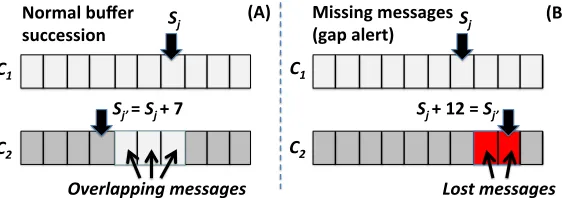
Figure 4: Gap rule example on successively received buffersC1,C2, indexed by sequence numbers j, j0
andT = 10: (A) Normal message overlap between buffers; (B) A detectable gap: Messages with sequence numberssj+ 1andsj + 2have been lost.
4. Transmission stoppage: The attacker can break the PBB completely, causing no buffer transmission for an extended period of time, or indefinitely.
During the critical window, the attacker can alternatively try to attack so quickly that the critical window is nearly zero. In this case, there isn’t sufficient time for PillarBox to take in a SAS alert message and put it in the PBB. Our experiments in Section6show in some settings of interest that this attack is unlikely.
Adversarial buffer modification or destruction, as explained above, is an easily detectable attack. It causes the server to receive a symbol?, indicating a cryptographic integrity-check failure. The gap-checker in PillarBox detects both buffer overwriting attacks and buffer dropping attacks by the same means: It looks for lost messages, as indicated by a gap in message sequence numbers. That is, a gap alert is issued when the sequence numberssj andsj0 of (the last inserted messages in) two successively received buffersjand j0are such thatsj0 sj T. Figure4depicts a normal buffer transmission and one, ostensibly during an
attack, in which messages have been lost to an alert flood or to buffer overwriting. A transmission stoppage is detectable simply when the server has received no buffers for an extended period of time, producing a transmission-failure alert, as noted above.
4.2 Security definitions
We now provide informal definitions for the security and system correctness properties that must hold in a real implementation of this ideal “lockbox.” Formal definitions are given in AppendixB.
Our implementation of this ideal “lockbox” consists of the PBB and three operations: (i) The sender S runsWriteto insert a message into the PBB and (ii)Wrapto encapsulate the PBB for transmission, and (iii) The receiverRrunsRead to extract all messages from a received, encapsulated PBB. We denote by Cthe contents of the PBB after a series ofWriteoperations byS, and byCˆa cryptographic encapsulation transmitted toR. In this operational setting, we require the security properties ofimmutabilityandstealth, as well as the non-cryptographic properties ofcorrectnessandpersistence.
Informally,correctnessdictates that under normal operation any sequence of messages of size at most T added toCbyScan be correctly read byRin an order-preserving way; in particular, theT most recent messages ofC and theirexact ordercan be determined byR. Persistencemeans that by encapsulating the bufferCrepeatedly, it is possible to produce a given message inCmore than once.
and re-order transmissions betweenS andR;Amay also determine what messagesS writes to PBB and whenS encapsulates and sends the PBB, and may also learn what pre-compromise messagesRreceives, and may finally choose its time of compromise; (2) On compromisingS, A corruptsS, learns its secret state, and fully controls it from then on.
Immutability means, informally, that pre-compromise messages inC are either received unaltered by R in the order they were written, or are marked as invalid; i.e., even after compromising S, A cannot undetectably drop, alter or re-order messages in C. Stealth means, informally, thatA cannot learn any information about messages buffered prior to compromise (that were not explicitly determined byA). It is stronger than confidentiality. Not only cannotAlearn the contents of messages, it also cannot learn the number of buffered messages—or if any were buffered at all. This holds even afterAhas compromisedS.
We define stealth through a security experiment analogous to IND-CCA2 (indistinguishability under an adaptive chosen ciphertext attack): Achooses two challenge messagesm0, m1; optionally, one may be
blank, signifying “no message insertion.” For a randomly selected bitb, messagemb is placed in PBB just
prior to compromise;Abreaks stealth if he can guessbwith (non-negligible) probability greater than 1/2. (As noted above,Acan learn messages received byRin the pre-compromised phase of the experiment.)
4.3 Intuition behind construction
Our lockbox construction uses standard forward-secure cryptographic primitives to secure buffered mes-sages against capture of the PBB after a host’s full compromise: Secret keys, used in tools providing integrity and confidentiality on transmitted messages,evolveover time so that no current key reveals past ones. For-ward security is used widely in existing literature to protect the integrity and confidentiality of security logs (e.g., [28,34,41,42]). Our key observation, though, is that forward security alonecannot achieve stealth or persistence. In particular, existing forward-secure logging solutions make no attempt to conceal the num-ber of accumulated messages. These solutions employ anappend-onlybuffer that isread onceand can be arbitrary longin size. Indeed, authenticated and/or encrypted messages are typically organized in a linked list of arbitrary size, where any new message is added at the end of the list. This append-only technique, however, clearly does not achieve stealth: An adversary can, for instance, infer message-writing behavior from the length of buffer transmissions. Additionally, in such schemes, aWrapoperation typically sends to Rall messages in the list, which are then deleted from the list, thus not achieving persistence, as individual messages can only be transmitted once.
4.4 Detailed construction
Our construction employs a forward-secure pseudorandom number generator FS-PRNG (see, e.g., [23]) that exports two operationsGenKeyandNextto compute the next pseudorandom numbers, as well as an authenticated encryption scheme(see, e.g., [16]) that exports operationsAEKeyGen,AuthEncandAuthDec to encrypt messagesm of sizekto ciphertexts of sizeg(k) k. We, here, assume basic familiarity with these primitives; formal definitions and posible instantiations of these primitives are presented AppendixC.
Data structure.The senderS maintains the following data structure:
1. asecret key (also kept by the receiverR);
2. a buffer C, C = (C[0], C[1], . . . , C[T 1]), initially filled with random data, that takes the form of an array of sizeT + 1, whereC[i], 0 i T, denotes theith position inC; we set the size of each slotC[i]to bes=g(`), where`is an appropriate given message length (defining message space
{0,1}`).10
3. acurrent indexI, initialized at arandomposition inC, and itself stored at (special extra) slotC[T].
Input:security parameter
Output:initial evolving secret keys( w,0, r,0), public keypk
1. AE AEKeyGen(1)
2. s0 GenKey(1),s00 GenKey(1)
3. (r0, s1) Next(s0,1),(r00, s01) Next(s00,1)
4. w,0= r,0= (r0, s1, r00, s01,0,0),pk=;
5. return(( w,0, r,0), pk)
Figure 5: OperationKGen.
Input:secret key(ri, rj0, i, j), stept, controlb
Output:new secret key(ri+t, r0j, i+t, j)or(ri, r0j+t, i, j+t)
1. ift0then return(ri, r0j, i, j).
2. ifb=low thenri+t Next(ri, t)
elser0
j+t Next(r0j, t)
3. deleteri
4. ifb=high then return(ri+t, r0j, i+t, j)
else return(ri, rj0+t, i, j+t)
Figure 6: OperationKEvolve.
Key management. Key generation and evolution operate as follows. Given a security parameter,
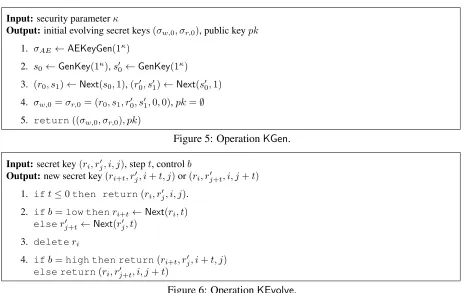
algo-rithmKGenfirst initiates an authenticated encryption scheme as well as two FS-PRNGs, onelow-layerto generate sequencer0, r1, . . . (for message encryption) and onehigh-layer to generate sequencer00, r01, . . .
(for buffer encryption). It then initializes the secret states of S andR, which take the (simplified) form (ri, rj0, i, j), denoting themost recent forward-securepseudorandom numbers for the low and high layers,
along with their sequence numbers—see the algorithm in Figure 5. Also, given the current secret state (ri, rj0, i, j), an integertand a control stringb2{low,high}, algorithmKEvolvecreates the
correspond-ing low- or high-layert-th next forward-secure pseudorandom number—see the algorithm in Figure6.
Input:secret key(ri, rj0, i, j), messagem2{0,1}`, bufferC
Output:new secret key(ri+1, rj0, i+ 1, j), updated bufferC
1. c AuthEncri(m)
2. C[C[T]] = (c, i)
3. C[T] =C[T] + 1 modT
4. (ri+1, rj0, i+ 1, j) KEvolve(ri, r0j, i, j,1,low)
5. deleteri
6. return[(ri+1, r0j, i+ 1, j), C]
Figure 7: OperationWrite.
Input:secret key(ri, rj0, i, j), bufferC
Output:new secret key(ri, rj0+1, i, j+ 1), encapsulated bufferCˆ
1. c0 AuthEnc
r0
j(C)
2. Cˆ= (c0, j)
3. (ri, rj0+1, i, j+ 1) KEvolve(ri, r0j, i, j,1,high)
4. delete r0
j
5. return[(ri, r0j+1, i, j+ 1),Cˆ]
Figure 8: OperationWrap.
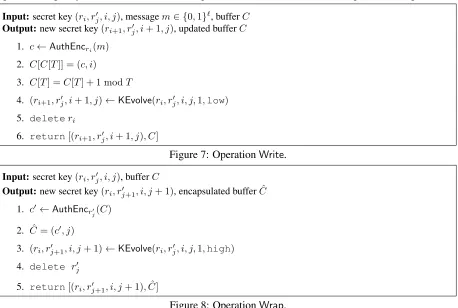
Write, transmit and read operations. Then our main protocols operate as follows. First, given secret writing key(ri, r0j, i, j), messagemand bufferC,Writesecurely encodesm, adds it inCand updates the
secret key—see the algorithm in Figure7. Then, given secret writing key(ri, rj0, i, j)and a bufferC,Wrap
securely encapsulates C to Cˆ and updates the secret key—see the algorithm in Figure8. Finally, given secret reading key(ri, r0j, i, j)and an encapsulated bufferCˆ = (c0, j0),Readdecrypts the buffer and all of
its contents returning a set ofT messages and updates the secret key—see the algorithm in Figure9. A security analysis of our “lockbox” construction appears in AppendixD.
Possible modifications. In certain implementation settings, the following simple modifications may lead to better efficiency. First, instead of applying high-layer encryption on the contents of the entire buffer, such encryption may alternatively be performed in a per-message manner (similar to low-layer encryption but for all messages in the buffer). Moreover, instead of having the two FS-PRNG sequences evolve asyn-chronously, where the secret keysri for low-layer encryption are computed independently of the keys rj0
for high-layer encryption, a combined, synchronous key generation process may be alternatively employed, where the two sequences ri andr0i evolve simultaneously using only one FS-PRNG, even if some of the
produced keys are never used.
For simplicity, we here consider a fixed-size PBB that holds fixed-size messages (parameters T and`
Input:secret key(ri, rj0, i, j), encapsulated bufferCˆ
Output:new secret key(rl, r0j0, l, j0),(m0, . . . , mT 1)
1. ifj0jthen return[(r
i, rj0, i, j),?]
2. (ri, rj00, i, j0) KEvolve(ri, r0j, i, j, j0 j,high)
3. C AuthDecr0
j0(c
0)
4. ifC=?then return[(ri, rj0, i, j),?]
5. (ViewCas an arrayC[0], C[1], . . . , C[T 1], C[T])
I=C[T];x= 0
6. for0k < T do
(a) (c, l) =C[k+I modT]
(b) ifk= 0^lithen return[(ri, rj0, i, j),?]
(c) ifk6= 0^l6=LAST+ 1then return[(ri, r0j, i, j),?]
(d) (rl, r0j0, l, j0) KEvolve(ri, rj00, i, j0, l i,low)
(e) mk AuthDecrl(c);LAST =l
7. return[(rl T+1, r0j0, l T+ 1, j0),(m0, . . . , mT 1)]
Figure 9: OperationRead.
Handling variable-length messages. Without loss of generality, we have considered messages of fixed size `. PillarBox can easily relay messages of variable length using the following simple extension: A
variable-length messagem(of size`0) is padded (in a self-delimiting way) to sizeksuch thats|g(k)and the resulting ciphertext occupiesg(k)/sconsecutive buffer slots—it is straightforward to extend the algorithms in Figures7and9accordingly.
Dynamically sizing the PBB. A fixed-size PBB, i.e., parameter T, is necessary to achieve stealth in PillarBox, as noted above. To ensure moderate communication and server-side processing costs, it is help-ful to makeT as small as possible for the system choice of inter-transmission time or heartbeat interval µ. During prolonged buffer transmission failures, however, even benign ones, a small buffer size T can result in the loss, i.e., overwriting, of alert messages. This problem cannot be solved by enlarging the PBB on demand as new alerts are generated, because T would then correlate with alerting history, and stealth would be lost. However, for the (common) case where the host-side PillarBox module can detect a loss of its network connection with the PillarBox server, it is possible to keepT small, yet preserve alert messages during periods of disconnection.
The idea is to have PillarBox performdynamicenlargement of the PBB:Tgrows as a function of the time elapsed since the last successful connection.11 For example, after every hour of lost network connection, PillarBox may addS extra slots to the PBB on the host: A special messagem⇤ (encoding that the buffer adaptation policy is activated) is written in the PBB, to securely bind old and new slots and protect against truncation attacks, and new buffer slots are inserted at the position of the current indexI, to ensure new slots are used before old ones are overwritten. When the PillarBox connection is reestablished, the PBB size may again be reduced to sizeT. (The most recently writtenT slots, behind pointerI, are retained.) With this approach, T is a function of connection history, notalerting history, and stealth is preserved. At the
11Note that detecting network connection failures does not require PillarBox server message acknowledgments. For instance, an
same time, an adversary cannot simulate benign host disconnection and then overwrite alerts: The PillarBox server can record disconnection periods and adjust its expectation of PBB transmission sizes from the host accordingly.
5 Prototype implementation
We implemented a prototype of PillarBox in C++. As shown in Figure3, PillarBox includes several com-ponents, both on the host and on the server. Host-based components depend on an alerter for detection of events indicating a compromise, but PillarBox is designed to be agnostic to the particular choice of alerter. In our implementation we instantiate the alerter with syslog.
The PBB data structure, described in Section4, is implemented as a class which exports two methods, Write and Wrap. When the host-based application is started it creates a new buffer, which remains in memory, and interacts with the bufferer and transmitter. Its size is specified at creation time, and its starting position is randomly selected.
After creating the buffer, the host application launches two threads, one implementing the bufferer, the other implementing the transmitter. For independence from the alerter, the bufferer reads from a named pipe to which the alerter writes. Anytime the alerter writes to the pipe, it is received by the bufferer and then encrypted before being added to the buffer as described in the algorithm in Figure7. The transmitter uses theWrapfunctionality of the algorithm in Figure8to re-encrypt a copy of the buffer before sending it over the network to the server.
To implement the authenticated encryption necessary in our system we utilize an open-source version of EAX-mode encryption. We developed a custom forward-secure pseudorandom number (FS-PRN) generator that we use to generate the necessary encryption keys. We generate keys for both the message encryption before addition to the buffer, as well as the re-encryption of the buffer before transmission.
The server-based application of PillarBox implements three primary functions described in Figure3. The receiver simply listens for incoming connections from the transmitter, passing them along to the decrypter as they arrive. The decrypter then decrypts the new messages using theReadmethod described in the algorithm of Figure9. Once complete the messages are passed off to the gap-checker who raises an alert in the event that the current set of messages does not overlap the previous messages. The gap-checker also uses a second thread which wakes on regular intervals to ensure delivery of heartbeat messages. If, when the thread wakes, no messages have been received in the specified window, an alert is raised.
6 Experimental evaluation
6.1 Demonstrating direct-send vulnerability
We motivate the need for securing the chain of custody in SASs and justify our design choice of host-side buffering, rather than immediately putting alerts on the wire, by showing the feasibility of an attacker inter-cepting on-the-wire host alert transmissions silently (without sender/receiver detection) in a rather simple setting.
Using the Ettercap tool [9] we inserted an attack machine (attacker) as a man-in-the-middle between our client and server communicating over a switch. The attacker performed ARP spoofing against the switch, to which most non-military-grade hubs and switches are vulnerable. Because it attacked the switch, neither endpoint observed the attack. Once inserted between the two machines, our attacker was able to drop or rewrite undesired packets on the fly. Even if the client and server had been communicating over a secured channel (a rarity in current practice), alert messages could still easily have been dropped, preventing any indication of the attack from reaching the server.
If executed within a subnet, the attack described here would rarely be detected, even by a forensic tool performing network packet capture, as these tools are typically deployed to monitor only inbound/outbound traffic, or at best across subnets.
Given the ease with which we were able to not only prevent communication between a client and server, but moreover modify what the server received, without detection, it should be clear just how important chain-of-custody is in SASs. If the messages being transmitted are of any value, then they need to be protected. Otherwise an attacker can simply block or modify all SAS communication while attacking a host, after which he can turn off or otherwise modify what the SAS sends from the client side. Attacking in such a way makes it impossible for the server to detect anything has gone wrong and motivates our desire to provide a better way to secure log messages.
6.2 PillarBox vs. direct alert pushing
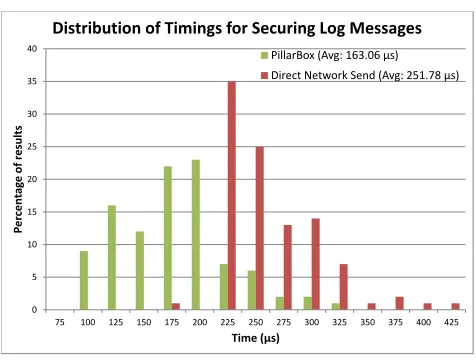
In addition to combatting the network-based attack demonstrated above, PillarBox can also provide integrity protection more quickly than current direct-send approaches where the transmission must reach the server before it is protected. Essentially we show that authenticated encryption and storage is faster than any network transmission. We avoid the overhead of socket connections by using UDP and measure only the time necessary to send a packet, which we then compare to the time needed to encrypt the same information and store it locally in the PBB. Distributions over 100 tests are presented in Figure10.
As our experiments show, PillarBox achieves a clear advantage in the speed with which it secures alerts. These alerts must still be transmitted to the server, but PillarBox protects the integrity of the alert contents faster than most current on-the-wire pushing systems.
6.3 Race-condition experiments
0 5 10 15 20 25 30 35 40
75 100 125 150 175 200 225 250 275 300 325 350 375 400 425
P
e
rce
n
tag
e
of r
e
su
lts
Time (μs)
Distribution of Timings for Securing Log Messages
PillarBox (Avg: 163.06 μs) Direct Network Send (Avg: 251.78 μs)
Figure 10: Distribution of timings for PillarBox cryptographically securing log messages locally vs. direct network transmission.
To demonstrate PillarBox winning the race condition, we now explore how quickly each of the necessary components can be shut down relative to the speed with which such events themselves can be logged. To bias our experiments in favor of an attacker, we assume the attacker has gained access to a privileged account that already has the necessary permissions to kill any of the components. We record time required for the attacker to issue asingle command to kill the process and show that the command itself gets secured by PillarBox before the targeted component is terminated. Our tests were performed on an 2.5GHz Intel Core 2 Duo T9300 processor with 4 GB of memory and Ubuntu 12.04 as the operating system.
Killing PillarBox. PillarBox is a simple application that is easily terminated by an attacker, although it can be run as root to provide some protection. To be secured, alerts must be generated, routed by syslog to the named pipe, and then picked up by PillarBox, encrypted and added to the buffer. An attacker’s best bet at disrupting the securing of alerts is to try and shutdown PillarBox itself. If run as root, PillarBox can be terminated by invoking root privilege and issuing akillcommand.12 Callingkillwith the 9signal immediately terminates any program, unless it’s in the process of making a system call; it then terminates when the system call returns. Usingsudoruns the command as root, but also generates an authentication alert message which syslog picks up. The full one-line commandsudo kill 9 <PillarBox pid>immediately terminates PillarBox, but usually not before a log event is created, routed by syslog through the named pipe, and secured.
As Table 1 shows, in the majority of runs the alert message is locked away in ⇡ 4ms. Unlike our previous experiments, these timings include alert generation, routing by syslog through the named pipe, and securing by PillarBox. As Figure10 shows, PillarBox accounts for a minuscule fraction of the total time observed. Alert messages are, on average, secured in PillarBox before it is killed with almost 3 ms. to spare.13 However, in about 1% of our experiments, PillarBox was killed before receiving the alert message
12killorpkillcould be used to terminate the process:pkilltakes in the process name, whilekilltakes a process id; otherwise they
operate the same.
success-Table 1: Average time from the start of a command until log is secured in PillarBox and total time for command completion.
Secured Std. Dev. Disrupted Std. Dev. Command
Syslog (typical) 4.09ms 0.30ms 8.86ms 2.43ms sudo kill 9 <syslog pid> Syslog (worst)14 32.33ms 5.38ms 9.32ms 2.81ms sudo kill 9 <syslog pid>
Named pipe 6.36ms 3.02ms 8.99ms 3.30ms sudo rm named pipe PillarBox 4.01ms 0.19ms 6.95ms 0.37ms sudo kill 9 <PillarBoxpid>
and encrypting it. All of the commands in Table1were run 100 times with averages and standard deviations shown.
Impacts of system load.To further test the ability of the attacker to beat PillarBox, we also ran tests under varying amounts of disk, memory, and CPU load. Disk load appeared to have little to no effect on either the success of PillarBox, or the timing measurements. As expected, load on the system memory slowed everything down—lengthening both the time to secure, but also the time until thekillcompletes—but did not appear to impact the success of PillarBox winning the race condition. For unexplained reasons, CPU load did seem to impact PillarBox on our test machine. Oddly, PillarBox did well (0% failure) at near 100% load, but relatively poorly (< 4% failure) at 20% load. These tests were run 1000 times to further reduce noise. Additionally, we re-ran our tests on a 2.13 GHz Intel Xeon E5506 Quad Core processor with 3GB of RAM running Red Hat Enterprise Linux WS v5.3 x86 64. On that machine we again noticed⇡1% of tests failing, but did not find a correlation between load and failure rate. We expect CPU scheduling to be at fault but leave a more thorough investigation of the effects of load as well as the impact of virtualization or greater numbers of cores as future work. If CPU scheduling is indeed the cause, running PillarBox with higher priority should further lower the probability of an attacker winning the race condition.
Killing the named pipe. We also considered attacks against the other components (syslog and the named pipe). We use a named pipe to pass alerts from syslog to PillarBox. A named pipe is a permanent pipe created in the filesystem which can be read from and written to by any process. To destroy a named pipe created by root an attacker would need to run sudo rm named pipe. Again, the invocation of sudo (or otherwise transitioning to root privilege) generates a log event. As Table1shows, the log messages created pass through the pipe before it is closed. There were no failures in these tests.
Killing syslog. The alerter (syslog) is the first to handle the log message, and can be shutdown or killed by runningsudo kill 9 <syslog pid>.14 Table1shows that the log message is sent by syslog before it is killed. However, presumably due to process scheduling, in several runs thekillcommand returns before the alert message is secured in the PBB. Because the messagealwaysarrives in the PBB (again, there were no failures), we assume these represent runs where the alert is passed to the named pipe before syslog terminates and then read from the pipe when the PillarBox process is later scheduled by the OS. This issue is diminished in the tests against the named pipe and PillarBox, explaining their perceived lower average timings (and standard deviations).
Vanishing rules.When PillarBox provides stealth, it is best combined with vanishing SAS rules to prevent critical information leakage. Recall that if an attacker cannot prevent PillarBox from securing events in the critical window, the attacker benefits from at least learning how the system is instrumented and what
fullysecured in PillarBox. These results show the timings observed in those cases.
14The alerter could be more integrated into the kernel itself, making it even harder to intercept and/or kill. In our case, syslog
Table 2: Timeline of events related to the execution of the attacker’s command sudo cp/etc/rsyslog.d/vanish.conf/home/vanish.copy.
Event Start Message Secured Rule Deleted Copy Fails
Avg. Time (ms) 0.00 4.00ms 4.04ms 7.21ms
Std. Dev. N/A 0.44ms 0.44ms 0.81ms
alerts were likely to have been generated. In our test setup, the vanishing alerts generate an alert whenever a root user logs in. To test the race condition, we instrumented PillarBox to delete the vanishing alerts configuration file after securing the alert message. The attacker attempts to create a copy of the sensitive alerter configuration file. As it is shown by the relative timing of events over 100 test runs in Table2, after securing the alert message, PillarBox always successfully deletes the configuration file at least 2.72 ms. before the attempted copy.
Privilege escalation.Having shown that PillarBox can win the race conditions related to securing alerts and causing them to vanish, even in the pessimistic case where the attackerstarts with the necessary permissions, we now consider the issue of privilege escalation. The concern is that if the attacker exploits vulnerabilities the transition to root privilege may not get logged. We assume that most privilege escalations could be detected given the proper instrumentation and that disrupting any of the necessary components in our system (e.g. corrupting its memory address space) without root privilege is infeasible given current architectures (e.g., Address Space Randomization [36], etc.).
As an example of a common privilege escalation, we consider the “Full Nelson” attack, which exploits CVE-2010-4258, CVE-2010-3849, and CVE-2010-3850 to gain root access. We find that this attack gen-erates kernel messages that syslog can pick up and pass through the named pipe and into the PBB before the exploit completes and the attacker terminates essential SAS or PillarBox components or reads the con-figuration file. In fact, the attack includes a necessarysleepcommand that further benefits timely securing of alerts in PillarBox. Even in the most pessimistic case, in which the exploit code uses the kill system call before ever launching a shell, and thesleepcommand is removed (causing the exploit to fail), the log mes-sages arestilllocked away in PBB before the exploit program tries to disrupt PillarBox. Since the system must be restored after the privilege escalation, we were not able to run 100 instances, but we repeatedly demonstrated that the kernel log messages can be secured in PBB before being killed.
While the “Full Nelson” attack is representative of other local privilege escalation attacks, this by no means guarantees that faster or quieter privilege escalations don’t exist. What it does demonstrate is that the event signaling the end of the critical window (the elevation of privilege giving the attacker full control) can itself often be detected and secured in PillarBox before such privilege enables disruption of the PillarBox tool.
Table 3: Race condition timings (measured from the launch of the attack).
Defender Event Attack detected Log secured Rule deleted Average 1,645.441ms 1,645.609ms 1,645.772ms Std. Dev. 1,069.843ms 1,069.842ms 1,069.840ms
Attacker Event Remote shell Privilege escalation Rules copied Log file deleted Average 2,692.536ms 2,693.474ms 2,696.524ms 2,696.590ms Std. Dev. 1,324.419ms 1,324.432ms 1,324.919ms 1,324.990ms
6.4 Observed alerting frequencies
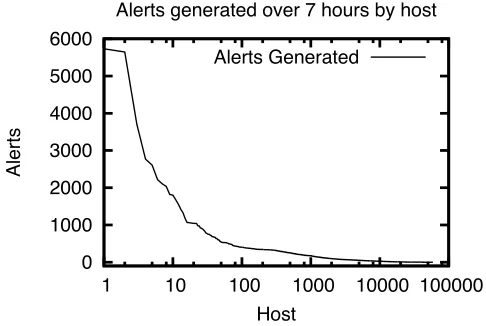
We performed an analysis of a large enterprise (>50,000 users) dataset across a period of 7 hours. This dataset contains all collectable logs from this network, including servers, laptops, network devices, security appliances, and many more. The goal was to derive information about the typical alert frequency across a representative work day.
It is critical to note that only certain messages pertaining to, e.g., indicators of compromise, will be se-lected for inclusion in the PillarBox protected queue. As such, the data found here represents an overloaded maximum: It is unlikely that most networks will generate such volumes of alerts, and most alerts will not be applicable to PillarBox.
0 1000 2000 3000 4000 5000 6000
1 10 100 1000 10000 100000
Alerts
Host
Alerts generated over 7 hours by host
Alerts Generated
Figure 11: Host-generated alerts over 7h.