Designing and Implementation of Efficient Fuzzy
Logic Based Fractal Image Compression Technique
in DCT Domain Using Quadtree Algorithm
Preeti Banerjee
Student :-Mtech Computer science Mats University
Raipur, India
Deepak Kumar Xaxa Dept. of computer science
Mats University Raipur, India
Abstract- Fractal image compression (FIC) is an image coding Technology based on the local similarity of image structure. It is broadly used in many fields such as image recovery, image denoising, image verification, and encryption. FIC, still, bear the high computational complexity in encoding. Although many schemes are available to speed up encoding, they do not easily satisfy the encoding time or the reconstructed image quality requirements.
In this paper a new novel approach for efficient fuzzy logic based fractal image compression in DCT domain using quadtree algorithm is proposed. This paper deals with the fuzzy logic based method because, fuzzy logic is a strong tool to handle vagueness, and since images are vague in terms of pixel values fuzzy logic is most appropriate logic for its analysis. In the proposed technique one domain block is considered for each range block and searched only for matched contrast scaling. Hence the outcomes fractal code does not contain coordinates of the matched domain block. This leads the advantage that the Quadtree algorithm can be here applied and the size of range block can be reduce as small as 2x2 pixels. Hence the quality of decoded image can be improved while the compression ratio can be maintained. The advantage of using fuzzy based technique is that, Fuzzification of an image leads to the reduction in the contrast and brightness of input image to be compressed. The advantage of this reduction in contrast and brightness is that this reduction leads to increase the pixel redundancy and hence help to increase the compression ratio (CR) and peak signal to noise ratio (PSNR) during the image compression. The results obtained after implementation of the proposed fractal image compression technique shows that the encoding time required is very small as compare to conventional fractal image compression (CFIC) techniques. Moreover the PSNR and compression values obtained from proposed work are higher than CFIC.
Key Words:- Fractal image compression, Discrete cosine transform (DCT), quadtree encoding and decoding, PSNR, compression ratio, Fuzzy image processing, Fuzzification, Defuzzification.
1.
INTRODUCTIONFractal image compression (FIC) is an image coding technology based on the local similarity of image structure. It was proposed by Michael F. Barnsley in 1988 [1], and improved by Arnaud E. Jacquin in 1992 [2]. Jacquin’s FIC scheme is called the baseline fractal image compression (BFIC), which uses the partitioned iterated function system (PIFS) to search the matching block pairs without
human-computer interactions. Since then, FIC has a quick development and numerous FIC schemes have been published.
Traditional image coding technologies encode an image by pixel-based and statistical methods, and FIC is an interesting attempt at the structure-based image coding. FIC has been used not only in image coding, but also in some interesting image problems [3]–[9] and pattern recognition problems such as facial recognition [10]. However, compared with traditional image coding technologies, fractal compression suffers from the high computational complexity in encoding.
Generally, one image is firstly partitioned into some square blocks in FIC, and then these square blocks compose a set called the pool. According to two kinds of size, an image is partitioned into two different pools. The pool composed by the blocks with larger size is called the domain pool, and the other pool is called the range pool. The cells in the range pool are the blocks to be encoded. The blocks in the domain pool are contracted to the same size as the range blocks, and then FIC takes the domain pool as a virtual codebook. The matching domain block for each range block needs to be searched. Exhaustive search of the matching block pairs costs too much time, which is one of the major difficulties in BFIC.
Although numerous schemes were proposed to speed up encoding in FIC, the encoding time is still too long so far. For example, the encoding time for a 512 × 512 image with 4 × 4 range blocks is more than 20 seconds in the DRDC scheme proposed by Riccardo Distasi et al in 2006 [18], and the encoding time for a 256 × 256 image is more than 2.8 seconds in the DUFC scheme proposed by Yi-Ming Zhou et al in 2009 [19]. Of course, it should be considered that the number of pair wise block-comparisons for a 512 × 512 image is 16 times more than the number of pair wise comparisons for a 256 × 256 image in BFIC with the same partition. Although these schemes should not be compared without the same computer environment, they still show that there is a lot of work to do for speeding up encoding in FIC.
images are vague in terms of pixel values fuzzy logic is most appropriate logic for its analysis. In the proposed technique one domain block is considered for each range block and searched only for matched contrast scaling. Hence the outcomes fractal code does not contain coordinates of the matched domain block. This leads the advantage that the Quadtree algorithm can be here applied and the size of range block can be reduce as small as 2x2 pixels. Hence the quality of decoded image can be improved while the compression ratio can be maintained. The advantage of using fuzzy based technique is that, Fuzzification of an image leads to the reduction in the contrast and brightness of input image to be compressed. The advantage of this reduction in contrast and brightness is that this reduction leads to increase the pixel redundancy and hence help to increase the compression ratio (CR) and peak signal to noise ratio (PSNR) during the image compression. The results obtained after implementation of the proposed fractal image compression technique shows that the encoding time required is very small as compare to conventional fractal image compression (CFIC) techniques. Moreover the PSNR and compression values obtained from proposed work are higher than CFIC.
2.
FRACTAL IMAGE CODINGConventional fractal coding starts from the portioning the input image into non overlapping range blocks of size, where, X is a predefined parameter. Then a set of domain block is created from original image, all square blocks of size with integer step L, in horizontal and vertical directions. Related to each no in domain pool, where new domain blocks are created with clock wise rotating it, 180 , and 270 , also these three and the original domain block all are mirrored. Here, in addition to the original domain block, there are seven new domain blocks, these new seven domain blocks are added to the domain pool, related to each range block the best domain block must be selected from domain pool and then the affine transform is calculated which maps the selected domain block to it with minimum distance. The mentioned distance between a range block R, and a decimated domain block D both with n pixels is defined as follows:
…(1) That the best coefficient of S and O are [1]:
…(2)
…(3)
are inner product, range block, domain block, mean of R and mean of D respectively. Because of high computational cost of equation 2, it is convenient to search
S across a pre sampled set of [0, 1] instead of calculating equation 2.
Along the matching process, the best found transformation only saved for range blocks which, have been mapped with an acceptable error. The remaining range blocks are split into four new smaller range blocks, and the matching process is restarted for them as a new step. For example if ranges initially have size of 16 x 16 pixels, the range blocks of the succeeding steps will have size of 8 x 8, 4 x 4 and 2 x 2 respectively, that leaves a four step algorithm. This is called Quadtree algorithm. Two strategies were used to reduce the encoding time in fractal coding algorithms. In a research strategy, finding out the domain pool is not necessary include all the possible domain blocks, only the high variance blocks are sufficient [5]. In other work like mentioned above the entropy measure was used instead of variance [6]. These methods are fast enough but the no search method is the best choice for real time fractal encoding. In the next section we will describe the proposed technique for fractal image compression.
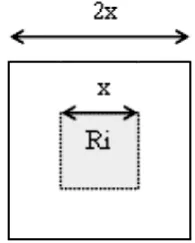
Figure (2.1) Position of range block and corresponding domain block.
3. FRACTAL IMAGE CODING IN DCT DOMAIN Discrete cosine transform (DCT) has shown its capability of information compacting. Therefore it is widely used in image compression applications as compare to other transforms. The 2DCT transform of a L
x L image is defined as
follow
…(4) Where m,n=0, 1…..L-1 and
quantization table related to human vision system. For example a smaller error on one coefficient adds an artificial sine wave to the whole image that can be seen easily in the smooth regions. Another problem is that the coefficient with small magnitude corresponds to edges of picture may be rounded to zero. Also as mentioned above applying DCT transform to whole image is very time consuming. The conventional way to solve this problem is to partition the image into blocks and then apply DCT to these blocks. These blocks become range blocks for fractal image coding.
4. FUZZY IMAGE PROCESSING
Fuzzy image processing is not a unique theory. It is a collection of distinct fuzzy approaches to image processing. It is the collection of all approaches that recognize, represent and process the images, their segments and features as fuzzy sets. The demonstration and processing depend on the selected fuzzy technique and on the problem to be solved [3], [4]. Here is a list of general observations about fuzzy logic:
Fuzzy logic is theoretically easy to understand. Fuzzy logic is flexible.
Fuzzy logic is tolerant of inaccurate data.
Fuzzy logic can model nonlinear functions of uninformed complexity.
Fuzzy logic can be built on top of the knowledge of experts.
Fuzzy logic can be merged with conventional control techniques.
Fuzzy logic is based on natural language.
The basis for fuzzy logic is the basis for human interaction. This opinion underpins various other statements regarding fuzzy logic. Because fuzzy logic is built on the structures of qualitative description used in everyday language, fuzzy logic is easy to use [16], [17]. The last statement is perhaps the most important one and deserves more conversation. Natural language, which is utilize by common people on a daily basis, has been shaped by thousands of years of human history to be convenient and well-organized. Sentences written in ordinary language denote a triumph of efficient communication [15].
Fuzzy image processing has three main stages: image Fuzzification, modification of membership values, and, if necessary, image Defuzzification. Figure (4.1) shows the block diagram representation of Fuzzy Image processing.
The Fuzzification and Defuzzification steps are due to the fact that we do not possess fuzzy hardware. Therefore, the coding of image data (Fuzzification) and decoding of the results (Defuzzification) are steps that make possible to process images with fuzzy procedure. The main power of fuzzy image processing is in the mid step (modification of membership values). After the image data are transformed from gray-level plane to the membership plane (Fuzzification), suitable fuzzy techniques change the membership values [16]. This can be a fuzzy clustering, a fuzzy rule based approach, and a fuzzy integration approach and so on.
Figure(4.1) Fuzzy Image processing.
5. PROPOSED METHODOLOGY
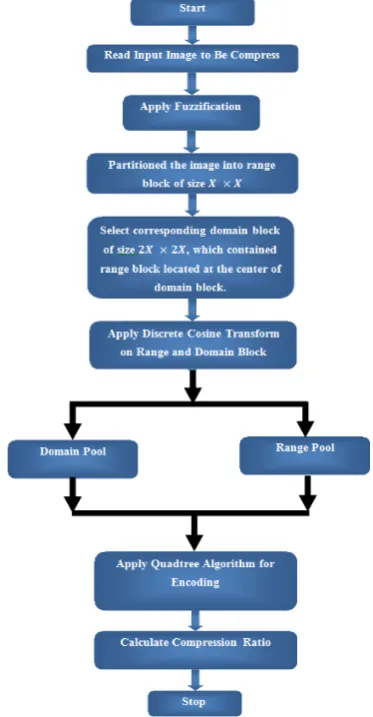
The proposed work deals with the fusion of fuzzy logic advantages with conventional DCT based fractal image compression to produce higher compression ratio and PSNR with less compression error. The propose technique also leads to reduction in encoding time. Figure (5.1) shows the flow chart representation of the proposed work.
6. RESULTS AND DISCUSSIONS
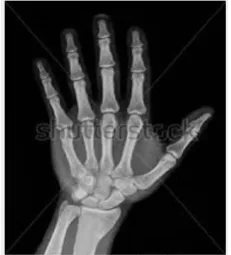
The proposed fractal image compression technique has been successfully implemented in MATLAB 2012b. For the testing purpose four images have been used, they are shown from figure (6.1) to figure (6.4). After the compression and decompression process using proposed technique the resultant images are also shown in this
section. For example Figure (6.1) shows the original image and figure (6.1a) shows decompressed image after the decompression of first image. For the proper result analysis consider fractal image compression parameter quality constant to 10.
Figure (6.1) First input image Lena.jpg Figure (6.1a) Decompressed Lena Image after using proposed work
Figure (6.2) Second input image Vegi.jpg. Figure (6.2a) Decompressed Vegi Image after using proposed work.
Figure (6.3) Third input image Man.jpg Figure (6.3a) Decompressed Man Image using proposed work
Now table 6.1 shows the parameter obtained after compression and decompression of first, second, third and fourth input images respectively using proposed fractal image compression technique.
Table 6-1 Parameter values Obtained
From table 6.1 it is clearly evident that, the developed fractal image compression technique can able to achieve higher compression ratio and PSNR along with smaller encoding time. In the next subsection we will present a comparative analysis of the developed work with available fractal image compression technique on the basis of parameter obtained.
6.1 Comparative Analysis of the developed project work
This subsection presents a comparative analysis of the developed work with available fractal image compression technique on the basis of parameter obtained. Table 6.2 shows the values of parameter encoding time, compression ratio and PSNR for the existing fractal image compression technique and developed fractal image compression technique. All the parameter obtained are calculated for the input image dimensions 512 x 512.
Table 6-2 Comparative Analysis Name
of input Image
Parameters Existing Technique
Developed Technique
Lena
Encoding Time in Seconds
36.46 37.99
PSNR 0.26 0.19
Vegi
Encoding Time in Seconds
37.13 38.83
PSNR 3.72 0.1415
Man
Encoding Time in Seconds
29.92 37.025
PSNR 3.92 0.2357
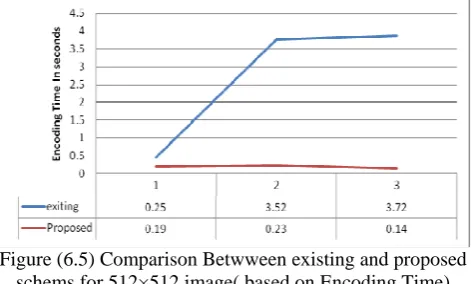
From here on wards, for the proper comparison obtained values must be analyze in the graphical mode and for that analysis figure (6.5) shows the comparison of encoding time obtained for exiting and developed fractal image compression technique. On the similar fashion figure (6.6) shows the comparison of PSNR values obtained for exiting and developed fractal image compression technique.
Figure (6.5) Comparison Betwween existing and proposed schems for 512×512 image( based on Encoding Time)
Figure (6.6) Comparison Between existing and proposed schemes for 512×512 image (based on PSNR)
On the basis of plots shown in figure (6.5) and figure (6.6) it is clearly observable that the developed fractal image compression technique not only generates good quality image compression because PSNR values obtained are higher for developed technique as compare to existing technique as well as takes very small encoding time to code the input image for compression.
7. CONCLUSIONS
In this work a new novel approach for efficient fuzzy logic based fractal image compression in DCT domain using quadtree algorithm is developed. The planned method deals with the fuzzy logic based method because, fuzzy logic is a strong tool to handle vagueness, and since images are vague in terms of pixel values fuzzy logic is most appropriate logic for its analysis. In the developed fractal image compression technique one domain block is considered for each range block and searched only for matched contrast scaling. Hence the outcomes fractal code does not contain coordinates of the matched domain block. This leads the advantage that the Quadtree algorithm can be here applied and the size of range block can be reduce as small as 2x2 pixels. Hence the quality of decoded image can be improved while the compression ratio can be maintained. The advantage of using fuzzy based technique is that, Fuzzification of an image leads to the reduction in the contrast and brightness of input image to be compressed. The advantage of this reduction in contrast and brightness is that, this reduction leads to increase the pixel redundancy and hence help to increase the compression ratio (CR) and peak signal to noise ratio (PSNR) during the image compression.
Input Images
Encoding
Time PSNR
Compression Ratio
Lena 0.1955 37.89 35.95
Vegi 0.1334 38.83 38.74
Man 0.2142 37.02 27.50
During analysis of results obtained in the result section the table 6.1 it is clearly evident that, the developed fractal image compression technique can able to achieve higher compression ratio and PSNR along with smaller encoding time. In addition to this on the basis of plots shown in figure (6.5) and figure (6.6) it is clearly observable that the developed fractal image compression technique not only generates good quality image compression because PSNR values obtained are higher for developed technique as compare to existing technique as well as takes very small encoding time to code the input image for compression. Hence after successful development and implementation of the project work for image dimensions of 512 x 512, it is clearly observed and proved that the developed fractal image compression technique is much more efficient in providing higher compression ratio, PSNR and very smaller encoding time as compare to exiting fractal image compression technique.
REFERENCES
[1] M. F. Barnsley and A. E. Jacquin, “Application of recurrent iterated function systems to images,” Proc. SPIE, vol. 1001, pp. 122–131, Nov. 1988.
[2] A. E. Jacquin, “Image coding based on a fractal theory of iterated contractive image transformations,” IEEE Trans. Image Process., vol. 1, no. 1, pp. 18–30, Jan. 1992.
[3] M. Pi, M. K. Mandal, and A. Basu, “Image retrieval based on histogram of fractal parameters,” IEEE Trans. Multimedia, vol. 7, no. 4, pp. 597–605, Aug. 2005.
[4] J. H. Jeng, C. C. Tseng, and J. G. Hsieh, “Study on Huber fractal image compression,” IEEE Trans. Image Process., vol. 18, no. 5, pp. 995–1003, May 2009.
[5] M. Ghazel, G. H. Freeman, and E. R. Vrscay, “Fractal image denoising,” IEEE Trans. Image Process., vol. 12, no. 12, pp. 1560– 1578, Dec. 2003.
[6] M. Ghazel, G. H. Freeman, and E. R. Vrscay, “Fractal-wavelet image denoising revisited,” IEEE Trans. Image Process., vol. 15, no. 9, pp. 2669–2675, Sep. 2006.
[7] S. S.Wang and S. L. Tsai, “Automatic image authentication and recovery using fractal code embedding and image inpainting,” Pattern Recognit., vol. 41, no. 2, pp. 701–712, 2008.
[8] S. G. Lian, “Image authentication based on fractal features,” Fractals, vol. 16, no. 4, pp. 287–297, 2008.
[9] K. T. Lin and S. L. Yeh, “Encrypting image by assembling the fractalimage addition method and the binary encoding method,” Opt. Commun.,vol. 285, no. 9, pp. 2335–2342, 2012.
[10] X. Tang and C. Qu, “Facial image recognition based on fractal image encoding,” Bell Labs Tech. J., vol. 15, no. 1, pp. 209–214, 2010.
[11] B. Wohlberg and G. de Jager, “A review of the fractal image coding literature,” IEEE Trans. Image Process., vol. 8, no. 12, pp. 1716– 1729, Dec. 1999.
[12] H. Hartenstein, M. Ruhl, and D. Saupe, “Region-based fractal image compression,” IEEE Trans. Image Process., vol. 9, no. 7, pp. 1171– 1184, Jul. 2000.
[13] T. K. Truong, C. M. Kung, J. H. Jeng, and M. L. Hsieh, “Fast fractal image compression using spatial correlation,” Chaos Solitons Fractals, vol. 22, no. 5, pp. 1071–1076, 2004.
[14] X. Wang, Y. Wang, and J. Yun, “An improved fast fractal image compression using spatial texture correlation,” Chin. Phys. B, vol. 20, no. 10, pp. 104202-1–104202-11, 2011.
[15] Y. Fisher, E. W. Jacobs, and R. D. Boss, “Fractal image compression using iterated transforms,” Image Text Compress., vol. 176, pp. 35–61, May 1992.
[16] W. R. Schwartz and H. Pedrini, “Improved fractal image compression based on robust feature descriptors,” Int. J. Image Graph., vol. 11, no. 4, pp. 571-587, 2011.
[17] T. Kovacs, “A fast classification based method for fractal image encoding,” Image and Vision Computing, vol. 26, no. 8, pp. 1129– 1136, 2008.
[18] R. Distasi, M. Nappi, and D. Riccio, “A range/domain approximation error-based approach for fractal image compression,” IEEE Trans. Image Process., vol. 15, no. 1, pp. 89–97, Jan. 2006. [19] Y. Zhou, C. Zhang, and Z. Zhang, “An efficient fractal image
coding algorithm using unified feature and DCT,” Chaos Solutions Fractals, vol. 39, no. 4, pp. 1823–1830, 2009.
[20] C. He, S. Yang, and X. Huang, “Variance-based accelerating scheme for fractal image encoding,” Electron. Lett., vol. 40, no. 2, pp. 1052–1053, 2004.
[21] H. N. Chen, K. L. Chung, and J. E. Hung, “Novel fractal image encoding algorithm using normalized one-norm and kick-out condition,” Image Vis. Comput., vol. 28, no. 3, pp. 518–525, 2010. [22] C. He, X. Xu, and G. Li, “Improvement of fast algorithm based on
correlation coefficients for fractal image encoding,” Comput. Simul., vol. 12, no. 4, pp. 60-63, 2005.
[23] J. Wang, Y. Liu, P. Wei, Z. Tian, Y. Li, and N. Zheng, “Fractal image coding using SSIM,” in Proc. 18th ICIP, Sep. 2011, pp. 245– 248.
[24] A. E. Jacquin, “Fractal image coding: A review,” Proc. IEEE, vol. 81, no. 10, pp. 1451–1465, Oct. 1993.