Firefly Algorithm to Solve Two Dimensional Bin
Packing Problem
Kratika Chandra , Sudhir Singh
Department of Computer Science and Engineering, U.P.T.U. Kanpur Institute of Technology, Kanpur, India.
Abstract
—
The Firefly algorithm is one of the several nature inspired algorithms that have been developed in the recent past and is inspired from the flashing behaviour of the fireflies. The field of nature inspired computing and optimization techniques have evolved to solve the difficult optimization problems in diverse fields of engineering, science and technology. Several nature inspired algorithms have been proposed to solve NP hard optimization problems. Bin packing Problem is NP hard optimization problem. Firefly algorithm inspired by the flashing behaviour of fireflies The flashing behaviour of the fireflies is to attract other fireflies in the group for mating. The less bright firefly will be attracted by the brighter one. As all the fireflies are assumed to be unisexual, each firefly is attracted to the other. In this paper, Firefly Algorithm (FFA) is used to solve Two Dimensional Bin packing problem. And further compare it with First-Fit and Best-Fit algorithms. 2-BPP is to pack a set of items with different weights orthogonally into a minimum number of bins, minimizing bin space wastage and execution time. The performance of these algorithms was evaluated by testing on three classes of benchmark Data sets which was taken from OR Library. The results have shown that the firefly and best fit is approximately same and well rather than first fit for most of the problem cases.Keywords—Firefly Algorithm, Bin packing problem, first fit
algorithm, Best fit algorithm
I. INTRODUCTION
Bin packing problem is a multi-disciplinary classic combinational optimization problem. It is computationally non-deterministic polynomial-time (NP) hard. In a Two Dimensional bin packing problem objects of different volumes must be orthogonally packed into finite number of bins of same volume. In the real world, the critical issue is to make efficient use of time and space. [6, 10].
Firefly has been first proposed Yang in 2007 [8]. The firefly algorithm is a meta-heuristic optimization algorithm that follows the flashing behavior of fireflies. The brightness of the fireflies is affiliated with the objective function under consideration. The algorithm has been formulated with three main assumptions [8]:
i) All fireflies are unisexual, eliminating the possibility of attraction based on gender that is, each firefly will be attracted by all other fireflies.
ii) Attraction is dependent on the amount of brightness that is a less brighter firefly is attracted to a brighter one. iii) The brightness of the firefly is equivalent to the objective function.
In this research work 2-BPP was solved by using Firefly algorithm and compare it with First- fit and Best-fit algorithms.
II. BIN PACKING PROBLEM
The Bin Packing problem can be formulated as follows:
With, yi= 1 if the bin i is used; else 0
Xij= 1 if the item j is stocked in bin i.
Notations
c: Bin capacity,
i,j: Index of items and bins respectively wi: Weight or size of item i
m: minimal number of bins
Equation (1) states the objective function to minimize the number of bins assigned. Equation (2) assures constraint that the bin capacity is not exceeded by the sum of item sizes assigned to this bin. It is often called the capacity constraint. Equation (3) ensures that every item is packed to exactly one bin. Equation (4) and (5) determine that all variables are binary [2, 4].
Firefly algorithm , First- fit and Best-fit algorithms were used to solve Bin packing problem.
A. Firefly Algorithm
Flashing behaviour of the fireflies is unique to the kind of species they belong to and varies from one type of species to the other. The aim of such flashing behaviour can be either of attracting mates or for attracting prey. The flashing light can be formulated to mimic the objective function under consideration and formulate a new optimization algorithm.
The attractiveness of different fireflies leads to the movement of firefly towards the other. Luminescence or light intensity is defined as the amount of light energy transmitted and it varies with the distance. The attractiveness of the fireflies varies with the brightness which is in turn related to the objective function in the mathematical domain. The intensity decreases with the increase in distance, and hence, a given firefly will be attracted to a firefly that is close to it even though it is less bright than a farther but brighter firefly. The intensity of light is known to vary inversely with the square of increasing distance or radius given by [11]:
I=I0e-γr
absorption coefficient.
On the attractiveness of the FFA the main form of attractiveness function or β(r) can be any monotonically decreasing functions such as the following generalized form of
β(r) = β0e−γr 2
where r or rij is the distance between the ith and jth of two
fireflies. Β0 is the attractiveness at r = 0 and γ is a fixed light absorption coefficient. The distance between any two fireflies i and j at xi and xj is the Cartesian distance as
follows:
rij=||xi-xj ||2=
where xi,k is the k-th component of the i-th firefly (xi). The
movement of a firefly, i is attracted to another more attractive (brighter) firefly j, is determined by
xi=xi+ β0e-γ r2ij (xj-xi) + α*(rand-0.5)
where the 2nd term is due to the attraction while the 3rd term is the randomization with α being the randomization parameter. Rand is a random number generator uniformly distributed in the range of [0, 1]. In this paper, initially 5 firefly take action and the iterations are 15. In the each iteration 5 different fireflies pack the number of items with different weights and its corresponding capacity from different positions and produce different solutions. Each firefly calculates the light intensity based on the objective function of the BPP and also based on the distance. The attractiveness of a firefly is determined by its brightness and varies according to the distance. The distance of each firefly is calculated based on the starting position which it starts packing the items. In this research work the distance between fireflies is calculated by using Cartesian distance. The movement of one firefly is attracted to another more attractive (brighter) firefly [1, 5].
The following section describes the pseudo code [21]. 1. Define an initialize parameters f(x), x = (x1, ..., xd)
2. Generate initial population of fireflies xi(i = 1, 2, ..., n)
3. Determine light intensity for xiby calculating f(xi )
4. Define light absorption coefficient γ
5. While t < Maximum Generation
6. Make a copy of the generated firefly population for move function
7. For i = 1 : n all n fireflies
8. For j = 1 : i all n fireflies
9. If (Ij > Ii ),
10. Move fireflies i and j according to attractiveness Evaluating new solutions and updating light intensity for next iteration
11. End if
12. End for j
13. End for i
14. Sorting the fireflies to find the present best 15. End while
16. Begin post process on best results obtained
TABLEI PARAMETERS & DEFINITION
B. First- fit Algorithm
First-Fit algorithm (FFA) contains all empty bins open. It places the next item in the lowest numbered bin in which the item fits. A new bin is opened, If it does not fit in any bin, First-Fit tries to pack every item in these bins before opening a new one with more execution time. In this algorithm the rule followed is:
First place an item in the first bin, called lowest indexed bin into which it will fit, i.e., if there is any partially filled bin then place the item in the lowest indexed bin otherwise, start a new bin [9].
The following section describes the pseudo code
Procedure First-Fit () Begin
for All objects i = 1, 2, . . . , n do for All bins j = 1, 2, . . . do if Object i fits in bin j then
Pack objects i in bin j.
Break the loop and pack the next object end if
end for
if Object i did not fit in any available bin
then
Create new bin and pack object i end if
end for end procedure
C. Best- fit Algorithm
Best-Fit (BFA) is simple and behaves well in practice. Best-Fit (BF) is the best known algorithm for Bin Packing problem. It picks the bin with the least amount of free space in which it can still hold the current element. This algorithm tries to choose the fullest bin possible with enough space each time an item is assigned. All unoccupied bins are kept open until the end. It places the next item in the bin whose current contents is the largest, but should not exceed its capacity. If it does not fit in any bin, new bin is opened [7].
The following section describes the pseudo code
Procedure Best-Fit () begin
for All objects i = 1, 2, . . . , n do for All bins j = 1, 2, . . . do if Object i fits in bin j then
Calculate remaining capacity after the object has been added
end if end for
Parameter Notation in Algorithm
Brightness Objective function
Alpha (α) Randomization parameter Beta (β) Attractiveness
Gamma (γ) Absorption coefficient Number of generations Iterations
Number of fireflies Population
Pack object i in bin j, where j is the bin with minimum remaining capacity after adding the object (i.e. the object “fits
best”)
If no such bin exists, open a new one and add the objects
end for end procedure
III. IMPLEMENTATION RESULTS
The results obtained from FireFly Algorithm were compared with First-Fit and Best-Fit algorithm. Experimental results are discussed in this section.
A. Two dimensional Bin Packing test Problem In this research work three classes of benchmark Data set 1, Data set 2 and Data set 3 for BPP-2 are classified as Easy, Medium and Hard classes instances. The benchmark in the easy class instance, n (number of items) ranges from 50 – 500 and c (bin capacity) ranges from 100-150. In the medium class instance n ranges from 50 – 500 and c equals 1000 and in hard class instances n equals 1000 and c equals 100000 [12].
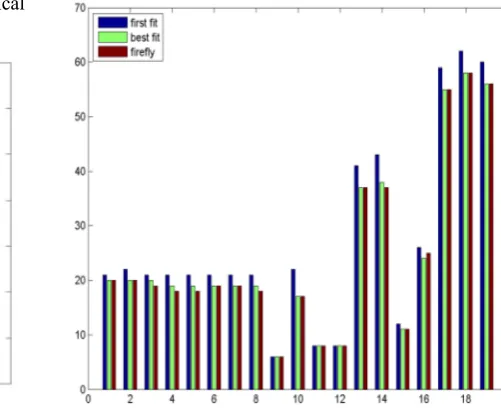
B. Implementation Results of Easy class Instances In this research work, 15 instances of easy class were solved by using First-Fit, Best-Fit and FireFly Algorithms. The results of three algorithms were compared and analysed. FireFly Algorithm gave optimal solutions for 3 instances out of 15 with minimum bin used. Best-Fit algorithm gave optimal solutions for remaining 12 instances with minimum bin used, its value is approximately same when compared to FireFly Algorithm. Whereas, First-Fit algorithm was found to be used more bin and more free space. It could not achieve optimal solutions. While comparing to the three techniques, FireFly technique have shown good performance for 3 instances out of 15 instances in comparisons to best fit algorithm and for remaining its approximately same. It was found from the results that both FireFly and Best-Fit algorithm are efficient in terms of bin used and free space when compare to First-Fit algorithm. The computational results are given in Table 2 and the Figure 1 and Figure 2 shows the graphical representation of Table 2.
Fig. 1 number of bins used for easy class
Fig. 2 free space for easy class
C. Implementation Results of Medium class Instances In medium class, 20 instances were solved. FireFly Algorithm gave optimal solutions for 5 instances with minimum bin used and free space and for remaining 15 instances it obtained optimal solution as same as Best-Fit algorithm gave optimal solutions with minimum bin used and free space . Whereas, First-Fit algorithm was found to be used more bin and free space as compare to best fit and firefly algorithm.
It was found from the results that FireFly technique have shown good performance for 5 instances out of 20 instances when compare to other two techniques. Both FireFly and Best-Fit algorithm are efficient in terms of bin used and free space when compare to First-Fit algorithm. The computational results are given in Table 3. Figure 3 and Figure 4 and shows the graphical representation of Table 3.
Fig. 4 free space for medium class
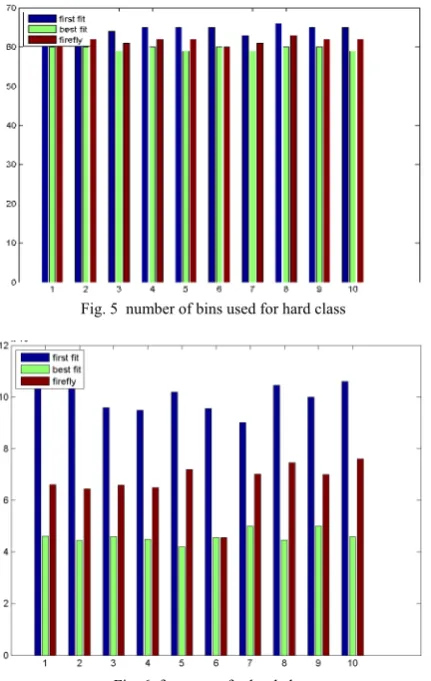
D. Implementation Results of Hard class Instances Hard class instances of Bin Packing problem finds more difficult and challenging to solve. In hard class, 10 instances were solved. It was found from the results that best fit and firefly algorithms have obtained near optimal solutions. FireFly Algorithm and best fit algorithm shows good performance for all the instances when compared to First-Fit techniques. The computational results are given in Table 4. Figure 5 and Figure 6 shows the graphical representation of Table 4.
Fig. 5 number of bins used for hard class
Fig. 6 free space for hard class
TABLE2
COMPARATIVE RESULT OF EASY CLASS BPP
Ins name N C opt First fit Best fit firefly
Used bins Free space Used bins Free space Used bins Free space
N1C1W1B 50 100 31 35 718 31 318 31 318
N1C1W1C 50 100 21 26 616 21 116 21 116
N1C1W1N 50 100 26 30 579 26 179 26 179
N1C2W1H 50 120 23 30 977 23 137 23 137
N1C2W1_I 50 120 27 35 1280 27 320 27 320
N1C2W1K 50 120 23 32 1144 24 184 23 184
N1C2W1L 50 120 25 32 1093 25 253 25 253
N1C3W1F 50 150 19 29 1435 20 85 19 85
N2C1W1A 100 100 48 61 1428 48 128 48 128
N2C2W1J 100 120 42 58 2029 42 109 42 109
N2C3W1A 100 150 35 50 2274 35 24 36 174
N3C1W4S 200 100 145 169 4025 145 1625 145 2325
N3C1W1A 200 100 106 131 3012 106 512 106 512
N4C1W1L 500 100 257 329 7557 258 457 257 657
TABLE3
COMPARATIVE RESULT OF MEDIUM CLASS BPP
TABLE4
COMPARATIVE RESULT OF HARD CLASS BPP
IV. CONCLUSIONS
In this research work, FireFly Algorithm (FFA), Best fit algorithm and First-Fit algorithm were implemented for Two Dimensional BPP with fixed sized bins. These algorithms were tested on standard benchmark problem instances. The results obtained by the FireFly Algorithm shows good performance for most of the problem cases when compared to First-Fit algorithm and approximately
same when compared to Best fit algorithm results. This work can be extended by modifying the parameter settings for FireFly Algorithm to improve the results. FireFly Algorithm can be effectively modified for other types of combinatorial optimization problems. FireFly Algorithm can also be applied to solve three dimensional Bin Packing problem.
Ins name N C opt First fit Best fit firefly
Used bins Free space Used bins Free space Used bins Free space
N1W1B1R0 50 1000 20 21 4066 20 3066 20 3066
N1W1B1R1 50 1000 20 22 5054 20 3054 20 3054
N1W1B1R3 50 1000 19 21 4155 20 3155 19 2155
N1W1B1R4 50 1000 18 21 4590 19 2590 18 1590
N1W1B1R5 50 1000 18 21 4534 19 2534 18 1534
N1W1B1R6 50 1000 19 21 4239 19 2239 19 2239
N1W1B1R7 50 1000 19 21 4411 19 2411 19 2411
N1W1B1R8 50 1000 18 21 4184 19 2184 18 1184
N1W4B1R8 50 1000 6 6 624 6 624 6 624
N1W1B3R0 50 1000 17 22 5866 17 866 17 866
N1W1B3R7 50 1000 19 26 8069 19 1069 19 1069
N1W3B2R0 50 1000 8 8 842 8 842 8 842
N1W3B3R4 50 1000 8 8 715 8 715 8 715
N2W1B1R0 100 1000 37 41 8106 37 4106 37 4106
N2W1B1R6 100 1000 37 43 9511 38 4511 37 3511
N2W4B2R1 100 1000 11 12 1331 11 331 11 331
N3W4B3R0 200 1000 24 26 2068 24 1068 25 1068
N4W4B3R4 500 1000 55 59 4543 55 543 55 543
N4W4B3R6 500 1000 58 62 4595 58 595 58 595
N4W4B3R9 500 1000 56 60 4696 56 696 56 696
Ins name N C opt First fit Best fit firefly
Used bins Free space Used bins Free space Used bins Free space
HARD1 200 10000 60 66 1061159 60 461159 62 661159
HARD2 200 10000 60 66 1044214 60 444214 62 644214
HARD3 200 10000 59 64 958397 59 458397 61 658397
HARD4 200 10000 60 65 949303 60 449303 62 649303
HARD5 200 10000 59 65 1019247 59 419247 62 719247
HARD6 200 10000 60 65 955534 60 455534 60 455534
HARD7 200 10000 59 63 900807 59 500807 61 700807
HARD8 200 10000 60 66 104602 60 446029 63 746029
HARD9 200 10000 60 65 999542 60 499542 62 699542
REFERENCES
[1] R.yesodha & T.Amudha , “ Effectiveness of FireFly Algorithm in
solving Bin Packing Problem”, International Journal of Advanced
Research in Computer Science and Software Engineering, Volume 3, Issue 5, May 2013
[2] Abdesslem Layeb & Seriel Rayene Boussalia, “A Novel Quantum
Inspired Cuckoo Search Algorithm for Bin Packing Problem”, I.J.
Information Technology and Computer Science, 5, 58-67 2012. [3] Khadwilard, A., Chansombat, S., Thepphakorn, T., Chainate, W., &
Pongcharoen, P. (2012). Application of Firefly Algorithm and its
parameter setting for job shop scheduling. 49-58.
[4] Doina Bein, Wolfgang Bein and Swathi Venigella, "Cloud Storage
and Online Bin Packing", accepted at Intelligent Distributed
Computing Conference (IDC 2011), The Delft, Netherlands, October 5-7, 2011.
[5] Aphirak Khadwilard, Sirikarn Chansombat, Thatchai Thepphakorn, Peeraya Thapatsuwan, Warattapop Chainate and Pupong
Pongcharoen, “Investigation of Firefly Algorithm Parameter Setting
for Solving Job Shop Scheduling Problems”, 2011.
[6] Prof. Dr. Karsten Weihe and Prof. Dr. Matthias Müller-Hannemann, "Solution Techniques for specific Bin Packing Problems with Applications to Assembly Line Optimization", 2008.
[7] Swathi Venigella, "Cloud Storage and Online Bin Packing", May 2008.
[8] Yang, X. S. (2010). Nature-inspired metaheuristic algorithms. Luniver Press
[9] Ullas Mohan, “Bio Inspired Computing”, Division Of computer science, SOE, CUSAT, July 2008
[10] Zhihua Cui, Zhongzhi Shi and Janos Abonyi, "New trends on bio-inspired computation", Transactions of the Institute of Measurement
and Control 34(6) 665– 667, 2011.
[11] Yang, X. S. (2009). Firefly algorithms for multimodal optimization.
In Stochastic algorithms: foundations and applications Springer
Berlin Heidelberg
.
[12] http://www.wiwi.uni-jena.de/Entscheidung/binpp