Enhanced Chosen-Ciphertext Security and Applications
Dana Dachman-Soled1 Georg Fuchsbauer2 Payman Mohassel3
Adam O’Neill4
Abstract
We introduce and study a new notion of enhanced chosen-ciphertext security (ECCA) for public-key encryption. Loosely speaking, in the ECCA security experiment, the decryption oracle provided to the adversary is augmented to return not only the output of the decryption algorithm on a queried ciphertext but also of a randomness recovery algorithm associated to the scheme. Our results mainly concern the case where the randomness recovery algorithm is efficient.
We provide constructions of ECCA-secure encryption from adaptive trapdoor functions as defined by Kiltzet al.(EUROCRYPT 2010), resulting in ECCA encryption from standard number-theoretic assumptions. We then give two applications of ECCA-secure encryption: (1) We use it as a unify-ing concept in showunify-ing equivalence of adaptive trapdoor functions and tag-based adaptive trapdoor functions, resolving an open question of Kiltzet al. (2) We show that ECCA-secure encryption can be used to securely realize an approach to public-key encryption with non-interactive opening (PKENO) originally suggested by Damg˚ard and Thorbek (EUROCRYPT 2007), resulting in new and practical PKENO schemes quite different from those in prior work.
Our results demonstrate that ECCA security is of both practical and theoretical interest.
1
Department of Electrical and Computer Engineering, University of Maryland, 3407 A.V. Williams Building, College Park, MD 20742, USA. Email: [email protected]. URL:http://ece.umd.edu/danadach.
2
Institute of Science and Technology Austria, Am Campus 1, 3400 Klosterneuburg, Austria. Email:
[email protected]. URL: http://www.di.ens.fr/~fuchsbau. Work started when at Bristol University, sup-ported by EPSRC via grant EP/H043454/1.
3 Department of Computer Science, University of Calgary, 2500 University Dr. NW, Calgary, AB. Email:
[email protected]. URL:http://pages.cpsc.ucalgary.ca/~pmohasse. 4
Department of Computer Science, Georgetown University, 3700 Reservoir Road NW Washington, DC 20057. Email:
Contents
1 Introduction 1
1.1 ECCA Security Definition and Variants . . . 1
1.2 Constructions of ECCA-Secure PKE . . . 1
1.3 Applications to Adaptive Trapdoor Functions . . . 2
1.4 Applications to Public-Key Encryption with Non-Interactive Opening . . . 2
1.5 Related Work . . . 4
2 Preliminaries 4 2.1 Notation and Conventions . . . 4
2.2 Public-key Encryption . . . 5
3 Enhanced Chosen-Ciphertext Security 5 4 Constructions of ECCA-Secure PKE 8 4.1 Adaptivity for Trapdoor Functions . . . 8
4.2 ECCA Security from Adaptive Trapdoor Functions . . . 8
4.2.1 Enhanced DCCA Security . . . 9
4.2.2 EDCCA Security from ATDFs . . . 10
4.2.3 From EDCCA to ECCA Security . . . 11
4.3 ECCA Security from Tag-Based Adaptive Trapdoor Functions . . . 15
5 Application to Adaptive Trapdoor Functions 17 5.1 From ECCA Security to Adaptivity . . . 17
5.2 From ECCA Security to Tag-Based Adaptivity . . . 18
6 Application to PKE with Non-Interactive Opening 18 6.1 PKENO-Compatible ECCA-Secure PKE . . . 19
6.2 PKENO-Compatible PKE using Non-Interactive Zero-Knowledge . . . 21
7 Efficient PKENO Constructions 22 7.1 Construction from DLIN Using Groth-Sahai . . . 22
7.2 Construction from Instance-Independent RSA . . . 25
A Standard Primitives 27
B From ATDF to ECCA via KEM/DEM 28
C PKENO-Compatible Tag-based PKE to PKENO-Compatible PKE 30
1
Introduction
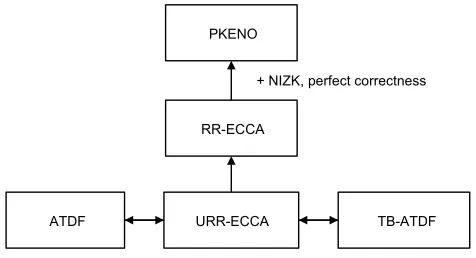
This paper introduces and studies a new notion of security for public-key encryption (PKE) we call en-hanced chosen-ciphertext security (ECCA). Besides being interesting in its own right, we find that ECCA security plays a fundamental role in contexts where randomness-recovering encryption (as discussed in-formally in e.g. [36]) is important, such as adaptive trapdoor functions [29] and PKE with non-interactive opening [15] (which is useful in secure multiparty computation). We also believe ECCA will find further applications in the future. Below we describe our results concerning ECCA in more detail; for a pictorial summary, see Figure 1.
1.1 ECCA Security Definition and Variants
Recall that in the standard formulation of CCA security [37], the adversary, given a public key pk, must guess which of the two possible messages its challenge ciphertextcencrypts, while being allowed to query a decryption oracle on any ciphertext c0 different fromc. Very informally, our “enhancement” is that the decryption oracle, when queried on a ciphertextc0, returns not only the output of the decryption algorithm of the scheme run on c0, but also of an associated randomness-recovery algorithm. This randomness-recovery algorithm, given sk and an honestly generated encryption cof m with coinsr, is guaranteed to output some coinsr0 such that the encryption ofm with coinsr0 is alsoc. (However, like the decryption algorithm — which is only guaranteed to output the right message on honestly generated ciphertexts — its behavior on other, maliciously generated ciphertexts depends on its specification.)
Note that in general we do not require thatr=r0 above, but in the special case that this holds we say that the scheme is uniquely randomness-recovering. Looking ahead, our constructions of ECCA-secure PKE will achieve unique randomness-recoverability, but for some applications this is not strictly necessary as long as the scheme has perfect correctness (i.e., zero decryption error).
Our study of ECCA security is largely motivated by the related concept of randomness-recovering encryption, in which case the randomness-recovery algorithm is efficient. Indeed, we show that not every CCA-secure randomness-recovering encryption scheme is ECCA-secure (cf. Proposition 3.2). This means that in applications of randomness-recovering encryption that require ECCA security, it may not be sufficient to use a scheme proven CCA-secure.
1.2 Constructions of ECCA-Secure PKE
ECCA-Secure PKE from “adaptive” TDFs. The first standard-model construction of CCA-secure
randomness-recovering PKE was achieved by Peikert and Waters [36], based on their new concept of “lossy” trapdoor functions (TDFs). A line of subsequent work [38, 29] focused on achieving CCA-secure PKE from progressively weaker assumptions on TDFs.1 This leads one to wonder whether these assumptions suffice for ECCA-secure randomness-recovering PKE as well. Ideally, one would achieve ECCA-secure, uniquely randomness-recovering PKE — the strongest form of randomness-recovery — based on adaptive TDFs, the weakest of these assumptions. (Intuitively, adaptivity is a form of CCA security for TDFs, asking that the TDF remain one-way even when the adversary may query an inversion oracle on points other than its challenge.) This is exactly what our results obtain.
Challenges and techniques. Our construction is technically novel, as the construction of CCA-secure
encryption from adaptive TDFs in the earlier work of [29] seems to be neither randomness-recovering nor ECCA-secure (we achieve both, and moreoverunique randomness recovery). Indeed, in the construction of [29] a general transform of [33] is used to convert a one-bit CCA-secure PKE from ATDFs to a multi-bit CCA-secure one. However, this transform does not seem to preserve either randomness-recovery nor
ECCA-security of the one-bit scheme. Furthermore, the one-bit scheme of [29] — which works by re-sampling a domain point x until the hardcore bit ofx equals the message— is not uniquely randomness-recovering, since decryption does not recover the “thrown away” x’s. (Note that the “na¨ıve” one-bit scheme from ATDFs that simply XOR’s the message bit with a hardcore bit of the ATDF is trivially malleable by flipping the last bit of a ciphertext and thus is not CCA-secure.)
We solve these problems via a novel application of detectable CCA (DCCA) security, introduced recently by Hohenberger et al. [27]. Informally, DCCA is defined relative to a “detecting” function
F that determines whether two ciphertexts are related; in the DCCA experiment, the adversary is not allowed to ask for decryptions of ciphertexts related to the challenge ciphertext according toF. The work of [27] gives a transform from any DCCA-secure PKE to a CCA-secure encryption one. (For the transform to work, F must satisfy some conditions discussed in Section 4.2.1.) In particular, bit-by-bit encryption using a 1-bit CCA-secure encryption scheme is DCCA-secure, thus encompassing the earlier work of [33]. Our novelty is that we construct a DCCA-secure scheme from ATDFs by using the “na¨ıve” one-bit scheme described above. We show this one-bit scheme is uniquely randomness-recovering and moreover satisfies a notion of DCCA with analogous “enhanced” security (where the decryption oracle also returns coins). We observe that (enhanced) DCCA (unlike CCA) is preserved under parallel composition (with a suitable change to the detecting function), so we can easily get a multi-bit scheme as well. Finally, to go all the way to ECCA-security, we show that the transform of [27] (in contrast to that of [33]) preserves both this enhanced security as well as (unique) randomness recovery for the resulting scheme. We thus get uniquely randomness-recovering ECCA-secure PKE from ATDFs as desired.
More efficient schemes. We note that the above is a feasibility result in terms of minimal
assump-tions. We also show more efficient constructions of ECCA-secure encryption from tag-bsaed ATDFs as defined in [29] and from ATDFs having a large number of simultaneous hardcore bits (using the KEM/DEM paradigm). See Section 4.3 and Appendix B for details.
1.3 Applications to Adaptive Trapdoor Functions
Going the other direction, we next give applications of ECCA-security to the theory of adaptive ATDFs. Namely, we show (1) adaptive TDFs are in fact equivalent to uniquely randomness-recovering ECCA-secure PKE. This helps us better understand the power and complexity of adaptive TDFs. We further-more show (2) “tag-based” ATDFs as defined in [29] are likewise equivalent to uniquely randomness-recovering ECCA-secure PKE. A corollary of (1) and (2) is that tag-based and non-tag-based ATDFs are themselves equivalent, which resolves a foundational question left open by [29]. We note that it is in fact much easier to construct uniquely randomness-recovering ECCA-secure PKE from tag-based ATDFs than from non-tag-based ATDFs. (The rough intuition is that in the tag-based case, a signature scheme can be used to “glue together” many one-bit encryptions via a common tag, namely a single verification key.) Indeed, the apparent extra power of tag-based ATDFs makes it surprising that they turn out to be equivalent to (non-tag-based) ATDFs. We note that unlike the TDF case, the equivalence of tag-based and standard PKE is much easier to prove [30].
1.4 Applications to Public-Key Encryption with Non-Interactive Opening
Background. Public-key encryption with non-interactive opening (PKENO), introduced by Damg˚ard
Resurrecting a simple approach. We show that ECCA-secure encryption can be used to securely
realize (for the first time) a simple approach to PKENO originally suggested by [16]. The basic idea is to use a randomness-recovering PKE and have the receiver provide the recovered coins as the proof. However, several issues need to be addressed for this approach to work. One problem already discussed in [20, Section 4.1] is that there must also be a way for the receiver to prove the claimed behavior of the decryption algorithm on ciphertexts that might not even be an output of the encryption algorithm, and for which no underlying coins necessarily exist. (Note that such ciphertexts may or may not decrypt to
⊥in general.) More fundamentally, we observe that the encryption schememust be ECCA secure (which was not even defined in prior work); standard chosen-ciphertext security is not enough here, because here the adversary in the corresponding PKENO security game has the ability to see random coins underlying ciphertexts of its choosing. We now describe our results in more detail.
PKENO-compatible ECCA encryption. First, we formalize a notion ofPKENO-compatible
ECCA-secure encryption, for which we can overcome the above problems and safely use the underlying message and randomness as the non-interactive opening of a ciphertext. There are two requirements for such a scheme: (1) It has a “partial-randomness” recovery algorithm that, informally, recovers enough coins to uniquely identify the underlying message. (Here “full” randomness-recovery is not needed, and would not permit constructions where the “randomized” part of the ciphertext is still verifiable, like a one-time signature or zero-knowledge proof.) This should also be true for ciphertexts outside the range of the encryption algorithm but which do not decrypt to ⊥.2 (2) The scheme has ciphertext verifiability, meaning one can check without the secret key (but possibly with the help of the recovered partial coins) whether the decryption of a ciphertext is ⊥. Note that ECCA security of such schemes is defined with respect to the partial-randomness recovery algorithm.
We also define an analogous notion of PKENO-compatible ECCA-secure tag-based PKE. We show that one can efficiently transform such a scheme into a (non-tag-based) PKENO-compatible ECCA-secure PKE scheme using either of the two “BCHK transforms” [8]. (Recall that [8] give a “basic” transform using one-time signatures and a “more efficient” transform based on symmetric-key primitives.)
PKENO from ECCA+NIZK.We next show a generic way to achieve PKENO-compatibility from any
ECCA-secure randomness-recovering PKE by adding a non-interactive zero-knowledge (NIZK) proof of “well-formedness” to a ciphertext, namely that exist some underlying message and random coins. (Indeed, the idea of adding such a proof to achieve PKENO comes from [16, 20], although not in connection with ECCA.) For the security proof to go through, the PKE scheme does not need to have unique randomness recovery, but it needs perfect correctness. Moreover, we show the NIZK needs to be simulation-sound, for reasons analogous to the proof of full anonymity of the group signature construction in [4].
Efficient PKENO-compatible tag-based PKE. The above construction is generic but inefficient.
Towards more efficient schemes, we show our construction of ECCA-securetag-based PKE from tag-based ATDFs can be made PKENO-compatible if its starting tag-based ATDF has “range verifiability” (i.e., anyone can verify preimage existence of a range point). We two efficient such tag-based ATDFs. The first instantiates a general tag-based ATDF construction from [29] that combines a lossy and all-but-one TDF as defined in [36]. Specifically, we use the lossy and all-but-one TDFs of Freeman et al.[18] based on the decision-linear (DLIN) assumption. We show that in this case preimage existence is a “Groth-Sahai” statement [25], for which we know efficient NIZK constructions in bilinear groups.3 Interestingly, we show simulation-soundness is not needed in this case, illustrating another efficiency benefit over the generic approach. The second is a tag-based ATDF from [29] based on the “instance-independent” RSA assumption (II-RSA), which we observe intrinstically has range verifiability because it is a permutation.
2For example, consider a randomness-recovering scheme which always outputs ciphertexts whose last bit is “0,” but whose decryption algorithm ignores this last bit. Then clearly we can still recover the randomness underlying ciphertexts whose last bit is “1” despite the fact that such ciphertexts are outside the range of the encryption algorithm.
RR-ECCA PKENO
TB-ATDF URR-ECCA
ATDF
+ NIZK, perfect correctness
Figure 1: Relations between various primitives studied in this paper. “(U)RR-ECCA” is (uniquely) randomness-recovering enhanced-chosen-ciphertext secure PKE. “ATDF” is adaptive trapdoor function. “TB-ATDF” is tag-based adaptive trapdoor function. “PKENO” is public-key encryption with non-interactive opening.
The resulting PKENO scheme based on II-RSA is quite practical (see Section 7.2 for details).
1.5 Related Work
ECCA is similar in spirit to coin-revealing selective opening attack (SOA-C) [9, 17, 3, 7]. In the latter setting, there are saynciphertexts encrypting related (but unknown) messages under independent random coins, and the adversary requests the plaintexts and random coins corresponding to some subset of them; the question is whether the “unopened” ciphertexts remain secure. However, it seems to us that SOA-C is neither implied by, nor implies, ECCA. It is an interesting question whether ECCA has any applications in the domain of SOA-C.
An analogue of ECCA (in the case of inefficient randomness-recovery) has been previously defined for commitment schemes by Canetti et al. [11], which they call CCA-secure commitments. These are commitment schemes that remain secure when the adversary has access to anunbounded decommitment oracle that it can call on commitments other than the challenge. They are interested in such schemes that are interactive but in the plain model, meaning there are no public keys. Thus, our setting seems incom-parable (as we disallow interaction but allow public keys). However, we view their work as supporting the claim that ECCA is a natural notion of security to consider for encryption.
Other variants of CCA-security for encryption considered before includereplayable CCA security [10], constrained CCA security [26], and detectable CCA security [27]. Notably, these are all relaxations of CCA security, whereas we consider a strengthening. Another strengthening of CCA security previously considered is plaintext awareness [6, 2, 5].
2
Preliminaries
2.1 Notation and Conventions
If A is an algorithm then y ← A(x1, . . . , xn;r) means we run A on inputs x1, . . . , xn and coins r and
denote the output byy. Byy←$A(x1, . . . , xn) we denote the operation of pickingrat random and letting
y ← A(x1, . . . , xn;r). Unless otherwise indicated, an algorithm may be randomized. “PPT” stands
2.2 Public-key Encryption
Apublic-key encryption scheme[24] with message-spaceMsgSpis a triple of algorithmsPKE= (Kg,Enc,Dec). The key-generation algorithm Kg returns a public key pk and matching secret key sk. The encryption algorithmEnctakes pkand a plaintextmto return a ciphertext. The deterministic decryption algorithm
Dec takes sk and a ciphertextcto return a plaintext.
Correctness. An issue that will be more important than usual in our context is correctness, which
refers to how likely it is that an encrypted message decrypts to some other message. By default we require perfect correctness: for all k∈Nand m∈MsgSp(1k),
Pr[Dec(sk,Enc(pk, m)) =m : (pk,sk)←$Kg(1k)]
is 1. If instead we allow this probability to be 1−ν(k) we say that thatPKEhasdecryption error ν(·).
Tag-based. We say that PKE is tag-based [31] with tag-space TagSp if Enc,Dec take an additional
input t ∈ TagSp(1k) called the tag. Again, by default we require perfect correctness: for all k ∈ N,
m∈MsgSp(1k), andt∈TagSp(1k),
Pr[Dec(sk, t,Enc(pk, t, m))−m : (pk,sk)←$Kg(1k)] is 1. Decryption error is defined analogously.
Other standard primitives. We recall the definitions of other standard primitives such as (injective)
trapdoor functions in Appendix A.
3
Enhanced Chosen-Ciphertext Security
Randomness recovery. We start with a definition of randomness recovery for public-key
encryp-tion. For any public-key encryption scheme PKE= (Kg,Enc,Dec) we specify an additional randomness recovery algorithm that takes a secret key sk and ciphertext c to return coins r; that is, we write
PKE= (Kg,Enc,Dec,Rec). To our knowledge, this notion has been discussed informally in the literature (e.g. in [36]) but our formalization is novel. Suppose Enc draws its coins from Coins. We require that for all messages m∈MsgSp(1k)
Pr[Enc(pk, m;r0)6=c : (pk,sk)←$Kg; r←$Coins(1k) ; c←Enc(pk, m;r) ; r0 ←Rec(sk, c)] is negligible. Note that we do not necessarily requirer =r0; that is, the randomness recovery algorithm need not return the same coins used for encryption; indeed, it may not be possible, information theo-retically, to determine r from sk and c. We also do not require Rec to be efficient in general. But in the special case that Rec is PT we say that PKE is randomness recovering. Moreover, if the forgoing condition on Rec holds for r=r0 we say that PKEis uniquely randomness recovering.4 In the definition that follows these are important special cases, but they are not assumed by the definition.
In the case of tag-based public-key encryption, Recalso takes a tag as input. In this case we require that for all m∈MsgSp(1k) andt∈TagSp(1k)
Pr[Enc(pk, t, m;r0)6=c : (pk,sk)←$Kg; r←$Coins(1k) ; c←Enc(pk, t, m;r) ; r0 ←Rec(sk, t, c)] is negligible. Randomness-recovery and unique randomness-recovery are defined analogously.
ECCA definition. We are now ready to state our new definition. Let PKE = (Kg,Enc,Dec) be a
public-key encryption scheme. We associate to PKEand an adversaryA= (A1, A2) anenhanced chosen-ciphertext attack experiment,
Experiment Expind-eccaPKE,A (k)
b←${0,1}; (pk,sk)←$Kg(1k) (m0, m1, St)←$ADec
∗(sk,·)
1 (pk)
c←$Enc(pk, mb)
d←$ADec
∗(sk,·)
2 (pk, c, St)
Ifd=bthen return 1 else return 0
Oracle Dec∗(sk, c)
m←Dec(sk, c)
r0←Rec(sk, c) Return (m, r0)
Above we require that the output of A1 satisfies|m0|=|m1|and thatA2 does not query cto its oracle. Define the ind-ecca advantage of A againstPKEas
Advind-eccaPKE,A (k) = 2·Pr
h
Expind-eccaPKE,A (k) outputs 1
i −1.
We say that PKE is enhanced chosen-ciphertext secure (ECCA-secure) ifAdvind-eccaPKE,A (·) is negligible for every efficient A.
Note that whenPKEis randomness recovering, the ECCA experiment is efficient. In general, however, one can still ask whether a scheme meets the notion of ECCA even when it is not randomness recovering. In this case, it may still be possible to simulate the ECCA experiment efficiently since in the proof of security we are additionally given the code of the adversary A (and so, for example, the randomness for encryption might be efficiently extractable from the code ofAusing non-black-box techniques). We leave exploration of ECCA security relative to an inefficient Recalgorithm for future work.
(Not) allowing decryption error. Unless otherwise specified, we will always require that an
ECCA-secure PKE scheme has perfect correctness. Indeed, curiously, it turns out that an ECCA-secure, randomness-recovering PKE scheme is easy to construct given any CCA-secure one if we allow negligi-ble decryption error — however, an ECCA-secure scheme with negligible decryption error will not be sufficient in the applications we consider.5 (This observation and example are due to [1].)
Let PKE = (Kg,Enc,Dec) be a CCA-secure scheme. Assume messages and the coins used by the encryption algorithm for this scheme both have length k, and let n(k) be the length of a ciphertext produced by Enc. We construct a scheme PKE0 = (Kg,Enc0,Dec,Rec0) in which the coins used by the encryption algorithm have length 2k+n(k), defined via:
AlgEnc0(pk, m;r0)
r1kr2kr3 ←r0 // |r1|=|r2|=k,|r3|=n(k) If r1 = 0k then return r3
Else return Enc(pk, m;r2)
AlgRec0(sk, c) Return 0kk0kkc
Proposition 3.1 Suppose PKEis CCA-secure. ThenPKE0 is randomness-recovering and ECCA-secure. However, PKE0 has decryption error2−k.
Proof: The decryption error is evident from the construction. We next claim thatPKE0 is randomness-recovering. This is so because if c = Enc(pk, m;r) then Enc0(pk, m; 0k||0k||c) = c. We also claim that
PKE0 is ECCA-secure. The intuition is that oracleDec∗(sk, c) in the ECCA game returnsm=Dec(sk, c) as per the original scheme and also returns 0k||0k||c, but the latter is not additional information for the adversary since it already had c(which it queried). We omit the formal proof.
CCA does not imply ECCA. A next natural question to ask is whether, assuming perfect correctness,
ECCA security is stronger requirement than CCA security. We answer this question affirmatively by showing that, given a perfectly correct, CCA-secure randomness-recovering PKE scheme, we can construct another randomness-recovering PKE scheme that is still CCA-secure but is not ECCA-secure. This motivates the construction of specialized ECCA-secure schemes in Section 4.
5
Consider a randomness-recovering CCA-secure schemePKE= (Kg,Enc,Dec). We transform PKEto a new scheme PKE∗ = (Kg∗,Enc∗,Dec∗) which is still CCA-secure but isnot ECCA-secure. The idea is to embed a “test” ciphertext in the public key of the new scheme, such that its decryption algorithm returns the secret key if given as input some randomness consistent with this test ciphertext. Formally,
PKE∗ is constructed as follows (where we implicitly assume the public key is contained in the secret key):
AlgKg∗(1k)
(pk,sk)←$Kg(1k)
r←${0,1}k
c∗←Enc(pk,0 ;r) Return ((pk, c∗),sk)
AlgEnc∗((pk, c∗), m)
c←$Enc(pk, m) Return ck0
AlgDec∗(sk, ckb)
Ifb= 1 andEnc(pk,0;c) =c∗
then returnsk
ReturnDec(sk, c)
Note that using the extra “flag bit” appended to ciphertexts ensures that PKE∗ maintains perfect cor-rectness.
Proposition 3.2 Assuming PKEis CCA-secure and has perfect correctness, PKE∗ is CCA-secure but is not ECCA-secure.
Proof: To show that PKE∗ is not ECCA-secure, consider the following ECCA adversary A= (A1, A2) against it:
• AlgorithmA1 on input the public key (pk, c∗) queriesc∗ to the decryption oracle to receive (0, r0) for somer0. It then queriesr0k1 to the decryption oracle and receives sk. Finally, it outputs (0,1) as the challenge messages andsk as the state.
• A2 on inputs (pk, c∗), ck0,sk computes b←Dec(sk, c) and returns b.
It is clear that A achieves ECCA advantage 1.
We now need to show thatPKE∗ remains CCA-secure. We sketch a hybrid argument to show this. LetA
be a CCA adversary againstPKE∗. We define a second game where we replace the public key in the CCA experiment (pk, c∗) withc∗ generated asc∗ ←Enc(pk,1;r). IfA’s advantage differs significantly between these two games, we can contradict CCA security ofPKEvia the following CCA adversaryA0 = (A01, A02):
• AlgorithmA01 on input pk outputs (0,1) as the challenge messages.
• On inputs pk, c∗, algorithm A02 runs A1 on input (pk, c∗), answering any decryption query c as fol-lows: if c = c∗ then return 0, else return Dec(sk, c) using its own decryption oracle. Eventually A1 outputs (m0, m1,St). Then A02 picks a random bit b and setsc←Enc(pk, mb). It runsA2 on inputs (pk, c∗), c,St, answering decryption queries as before.
Note that in this second game, A’s decryption oracle forDec∗ behaves identically to a decryption oracle forDec, assumingPKEhas perfect correctness: Indeed, the only wayA’s decryption oracle could behave differently from Dec is for A to query some r0k1 such that Enc(pk,0;r0) = c∗. But because of how the game works we know that also Enc(pk,1;r) =c∗ for some r. ButDec(sk, c∗) is a single value, either 0 or 1, and thus violating perfect correctness.
Tag-based definition. Let TB-PKE = (Kg,Enc,Dec) be a tag-based public-key encryption scheme
with tag-space TagSp. We associate toTB-PKEand an adversaryA= (A1, A2, A3) atag-based enhanced chosen-ciphertext attack experiment,
Experiment Expind-tb-eccaTB-PKE,A(k)
b←${0,1}; (pk,sk)←$Kg(1k)
t←$A1(1k)
(m0, m1, St)←$ADec
∗(sk,·,·)
2 (pk, t)
c←$Enc(pk, t, mb)
d←$ADec
∗(sk,·,·)
3 (pk, t, c, St)
If d=b then return 1 else return 0
OracleDec∗(sk, t, c)
m←Dec(sk, t, c)
Above we require that the output of A2 satisfies|m0|=|m1|and that A3 does not make a query of the form Dec∗(sk, t,·) to its oracle. Define theind-tb-ecca advantage of Aagainst PKEas
Advind-tb-eccaPKE,A (k) = 2·PrhExpind-tb-eccaPKE,A (k) outputs 1i−1.
We say thatTB-PKEistag-based enhanced chosen-ciphertext secure (TB-ECCA-secure) ifAdvPKEind-tb,A-ecca(·) is negligible for every efficient A.
4
Constructions of ECCA-Secure PKE
We now detail several constructions of ECCA secure encryption. They are based on notions of adaptivity for trapdoor functions introduced in [29] so accordingly we recall those first.
4.1 Adaptivity for Trapdoor Functions
Adaptive trapdoor functions. LetTDF= (Tdg,Eval,Inv) be an (injective) trapdoor function family.
We associate toTDF and an inverterI an adaptive one-way experiment,
Experiment ExpaowTDF,I(k)
(ek,td)←$Tdg(1k) ; x←${0,1}k
y←Eval(ek, x)
x0←$IInv(td,·)(ek, y)
Ifx=x0 then return 1 else return 0
Above we require thatI does not query y to its oracle. Define theaow-advantage of A againstTDF as
AdvaowTDF,I(k) = Pr
ExpaowTDF,I(k) outputs 1
.
We say that TDF isadaptive one-way (or is an ATDF) if AdvaowTDF,I(·) is negligible for every efficient I.
Tag-based adaptivity. Let TB-TDF = (Tdg,Eval,Inv) be a tag-based trapdoor function family. We
associate to TDF and an inverterI = (I1, I2) atag-based adaptive one-way experiment,
Experiment Exptb-aowTB-TDF,I(k) (ek,td)←$Tdg(1k)
t←$I1(1k) ; x←${0,1}k
y←Eval(ek, t, x)
x0←$IInv(td,·,·)
2 (ek, t, y)
Ifx=x0 then return 1 else return 0
Above we require thatI2 does not make a query of the formInv(td, t,·) to its oracle. Define the tb-aow-advantage ofA against TB-TDF as
Advtb-aowTB-TDF,I(k) = PrhExptb-aowTB-TDF,I(k) outputs 1i.
We say that TDFistag-based adaptive one-way (or is a TB-ATDF) ifAdvtb-aowTDF,I (·) is negligible for every efficient I.
Realizations. In [29] it is shown that ATDFs and tag-based ATDFs can be realized from lossy TDFs [36]
and correlated-product secure TDFs [38], which can be realized from a variety of standard number-theoretic and lattice-based assumptions. Furthermore, tag-based ATDFs were constructed from a strong but non-decisional (i.e., search) problem on RSA in [29].
4.2 ECCA Security from Adaptive Trapdoor Functions
Overview and intuition. As in [29] (which constructs CCA-secure PKE from ATDFs), our approach
involves first constructing a one-bit encryption scheme and then transforming it into a multi-bit scheme. In doing so we heavily use the recent approach of Hohenberger et al.[27] and their notion of detectable CCA security (DCCA); this should be contrasted with [29] who rely on [33] instead. Let us explain why. Both [27] and [33] provide a way to “tie together” many one-bit ciphertexts via “inner” and “outer” encryption layers but differ in which layer contains the one-bit ciphertets. In [33], the inner layer is a multi-bit q-bounded non-malleable encryption scheme while the outer later is the concatenation of one-bit ciphertexts. This means that without a randomness-recovering inner layer, [33] does not preserve randomness-recovery of the outer one-bit scheme. Such an inner layer seems hard to construct, as known approaches to non-malleability [35, 12] crucially use randomness in an un-invertible way in their encryption algorithms (e.g., to generate a signature key-pair or a zero-knowledge proof).
On the other hand, in Hohenbergeret al.[27] it is the inner layer that is the concatenation of one-bit ciphertexts, which obviates the problem since this inner layer is also used to encrypt randomness for use by the outer layer and thus the latter does not need to be randomness-recovering for the overall scheme to be so. Surprisingly, we also show that when this inner layer is randomness recovering then in all hybrid games used for the security proof the simulator is even able to the return randomness corresponding to valid ciphertexts, and thus the overall scheme also has ECCA security.
4.2.1 Enhanced DCCA Security
The notion of Detectable Chosen Ciphertext (DCCA) security was recently introduced by [27]. We define here the notion of enhanced DCCA (EDCCA) security, which parallels the notion of enhanced CCA security. In our definition, we require that the DCCA scheme be both enhanced and randomness-recovering. This is due to the fact that our application of DCCA requires both properties. However, the more general notion of enhanced DCCA security (with no efficient randomness-recovering property) may also be of interest.
Detectable Encryption Schemes. A detectable encryption scheme is a tuple of probabilistic
poly-nomial time algorithms (Kg,Enc,Dec,F) such that: (1) (Kg,Enc,Dec) constitute a public-key encryption scheme, and (2) F: (pk, c0, c)7→b∈ {0,1}, the detecting function F takes as input a public key pk and two ciphertexts c0, c and outputs a bit.
Additionally, the detecting function F must have the following property: Informally, given the de-scription of F and a public key pk, it it should be hard to find a second ciphertext c0 that is related to a “challenge” ciphertext c, i.e. such that F(pk, c0, c) = 1, before being given c. See [27] for the formal definition of the unpredictability experiment.
EDCCA definition. We are now ready to define enhanced, detectable chosen ciphertext security. Let PKE= (Kg,Enc,Dec,Rec,F) be a randomness-recovering public-key encryption scheme. We associate to
PKEand an adversary A= (A1, A2) anenhanced detectable chosen-ciphertext attack experiment,
Experiment Expind-edccaPKE,A (k)
b←${0,1}; (pk,sk)←$Kg(1k) (m0, m1, St)←$ADec
∗(⊥,sk,·)
1 (pk)
c∗←$Enc(pk, mb)
d←$ADec
∗(c∗,sk,·)
2 (pk, c
∗, St)
Ifd=bthen return 1 else return 0
Oracle Dec∗(c∗,sk, c)
Ifc∗ 6=⊥and F(pk, c∗, c) = 1 then return ⊥
Else m←Dec(sk, c)
r0←Rec(sk, c) Return (m, r0)
Above we require that the output of A1 satisfies|m0|=|m1|and that A2 does not query c∗ to its oracle. Define the ind-edcca advantage ofA against PKEas
Advind-edccaPKE,A (k) = 2·PrhExpind-edccaPKE,A (k) outputs 1i−1.
• Encryptions are indistinguishable: Advind-edccaPKE,A (·) is negligible for every efficient A, AND
• F is unpredictable: Every efficient adversary A has negligible probability of succeeding in the unpredictability experiment (see [27]).
4.2.2 EDCCA Security from ATDFs
We construct an EDCCA scheme from ATDFs as follows: Let TDF = (Tdg,Eval,Inv) be a trapdoor function with hardcore bit hc, for example the Goldreich-Levin bit [23]. Define the following multi-bit public-key encryption schemeEDCCA[TDF] = (KgD,EncD,DecD):
Alg KgD(1k)
(ek,td)←$Tdg(1k) Return (ek,td)
Alg EncD(ek, m=m1, . . . , m`)
x1←${0,1}k;. . .;x`←${0,1}k
Return C= (Eval(ek, x1),hc(x1)⊕m1,
. . . ,Eval(ek, x`),hc(x`)⊕m`)
Alg Dec(td, C)
ParseC = (y1, β1, . . . , y`, β`)
For 1≤i≤`
mi=hc(Inv(td, yi))⊕βi
Returnm1, . . . , m`
The Detecting Function FD: On input pk, C∗ = (y1∗, β1∗, . . . , y∗`, β
∗
`) and C = (y1, β1, . . . , y`, β`)
(where the β∗i, βi are bits), we define:
FD(pk, C∗, C) =
1 if for somei, j∈[`], yi∗=yj
0 otherwise
Claim 4.1 SupposeTDFis adaptive one-way. ThenEDCCA[TDF] defined above is a multi-bit EDCCA-secure encryption scheme.
We give some intuition for why the claim holds. Assume towards contradiction that we have an efficient adversary A = (A1, A2) breaking EDCCA[TDF] by distinguishing encryptions of two messages
m0, m1with advantage 1/p(k) for some polynomialp(·). Using a standard hybrid argument, we have that there must be some index 1≤i≤`such thatAsuccessfully distinguishes encryptions of the messagem∗0 =
m10, . . . , mi0−1, m0i, mi1+1, . . . , m`1 from encryptions of the message m1∗ = m10, . . . , mi0−1, mi1, mi1+1, . . . , m`1, where mjb denotes the j-th bit of message mb, with advantage 1/(`·p(k)). Note that the two messages,
m∗0, m∗1, differ only in the setting of the i-th bit. Now assuming the existence of A, we construct an efficient adversary A0 breaking adaptive one-wayness ofTDF.
More specifically, A0 receives ˜y = Eval(ek,x˜) externally and uses A to guess hc(Inv(td,y˜)) with ad-vantage 1/(`·p(k)). A0 does this by simulating the EDCCA decryption oracle forA= (A1, A2) using its inversion oracleInv.
First, we consider simulating responses to queries made by A1. In this case, we have that with overwhelming probability, for every decryption query C = (y1, β1, . . . , y`, β`) made by A1, it is the case
that yj 6= ˜y for all 1≤j≤`. Thus, A0 can decrypt correctly using oracle access to Inv.
At the end of the first phase,A0prepares the challenge ciphertextC∗by choosingx1, . . . , xi−1, xi+1, . . . x`
and a bit ˜β uniformly at random and setting
C∗ =Eval(ek, x1),hc(x1)⊕m10, . . . ,y,˜ β, . . . ,˜ Eval(ek, x`),hc(x`)⊕m`1
.
Now, to answer EDCCA decryption queries C submitted by A2, A0 checks whether FD(pk, C∗, C) = 1.
If yes,A0 perfectly simulates the decryption oracle by returning⊥. If not, then this implies in particular that on input C = (y1, β1, . . . , y`, β`), we have that yj 6= ˜y for all 1≤j ≤`. In this case, A0 can use its
access to the Invoracle in order to respond correctly to the decryption query.
We omit the technical definition ofA0, the analysis of the success probability ofA0 and the reduction from guessing a hardcore bit with non-negligible advantage to inverting the adaptive trapdoor function with non-negligible probability, since they are standard.
Remark 4.2 Scheme EDCCA[TDF] defined above is also uniquely randomness-recovering. (This will be crucial for our application to adaptive trapdoor functions in Section 5.) It is also perfectly correct.
4.2.3 From EDCCA to ECCA Security
We next show that the construction of [27] designed to build a CCA-secure scheme from a DCCA secure one allows us to go from EDCCA to ECCA. That is, beyond what was already shown in [27] we show that the construction preserves “enhanced” security; it also preserves (unique) randomness-recoverability. Specifically, we instantiate the construction of [27] with the above randomness recovering EDCCA scheme, a CPA-secure scheme with perfect correctness, and a 1-bounded CCA-secure6 scheme with perfect correctness (note that all these components can be constructed in a black-box manner from ATDFs):
The EDCCA scheme, EDCCA[TDF]: We instantiate the EDCCA scheme with the scheme given in Section 4.2.2. We note that for simplicity, we sometimes refer to the detecting function FD as checking for a “quoting” attack on the challenge ciphertext.
The CPA scheme, CPA[TDF]: We instantiate the CPA scheme with the same scheme EDCCA[TDF] as above. Note that this scheme has perfect correctness since the Inv algorithm of the ATDF is required to invert correctly with probability 1.
The 1-bounded CCA scheme, 1-CCA[TDF]: Since we have already observed above that we can construct a multi-bit CPA scheme with perfect correctness from ATDFs, we may now use any construction of a multi-bit 1-bounded CCA scheme with perfect correctness from a multi-bit CPA scheme with perfect correctness. This can be done in a black-box manner via the [12] construction. It is not hard to see that the construction of [12] preserves the perfect correctness property.
The Multi-Bit (Uniquely Randomness Recovering) ECCA Scheme. We present a multi-bit,
uniquely randomness recovering, ECCA-secure encryption schemePKE[TDF] = (KgECCA,EncECCA,DecECCA)
using the schemesEDCCA[TDF] = (KgD,EncD,DecD),1-CCA[TDF] = (Kg1b,Enc1b,Dec1b), andCPA[TDF] =
(KgCPA,EncCPA,DecCPA) defined above.
Alg KgECCA(1λ)
(pkin,skin)←$KgD(1λ) (pkA,skA)←$Kg1b(1λ) (pkB,skB)←$KgCPA(1λ)
pk←(pkin,pkA,pkB)
sk ←(skin,skA,skB)
Return (pk,sk)
AlgEncECCA(pk, m)
(rA, rB)←${0,1}λ
CTin←$EncD(pkin,(rA, rB, m))
CTA←Enc1b(pkA, CTin;rA)
CTB←EncCPA(pkB, CTin;rB)
Return CT = (CTA, CTB)
AlgDecECCA(sk, CT)
CTin←$Dec1b(skA, CTA) (rA, rB, m)←DecD(skin, CTin)
rin←RecD(skin, CTin)
If CTA=Enc1b(pkA, CTin;rA)
and CTB=EncCPA(pkB, CTin;rB)
return (rA, rB, m, rin)
Else return ⊥
Theorem 4.3 PKE[TDF]is enhanced CCA-secure and uniquely randomness recovering with perfect cor-rectness under the assumptions that EDCCA[TDF] is enhanced DCCA-secure and uniquely randomness recovering, 1-CCA[TDF] is 1-bounded CCA secure with perfect correctness, and CPA[TDF]is CPA-secure with perfect correctness.
Note that Theorem 4.3 implies that there is a black-box construction of multi-bit, uniquely randomness recovering, enhanced CCA-secure encryption from ATDF.
Proof: The proof is based on [27]. We begin by defining a game which is slightly different than the regular enhanced CCA game, but will be useful in our analsysis of PKE[TDF]:
Enhanced Nested Indistinguishability Game for schemePKE[TDF]: We associate to the scheme PKE[TDF] and to an adversary A = (A1, A2) an enhanced nested indistinguishability under chosen ci-phertext attack experiment,
Experiment Expnested-ind-eccaPKE[TDF],A (k)
b, z←${0,1}; (pk,sk)←$KgECCA(1k) (m0, m1, St)←$ADec
∗
ECCA(sk,·)
1 (pk)
rA, rB←${0,1}λ Ifz= 0
CTin∗ ←$EncD(pkin,(rA, rB, mb)) Else if z= 1
CTin∗ ←$EncD(pkin,0|rA|+|rA|+|mb|)
CTA∗ ←Enc1b(pkA, CTin∗;rA)
CTB∗ ←EncCPA(pkB, CTin∗;rB)
CT∗ ←(CTA∗, CTB∗)
z0←$ADec
∗
ECCA(sk,·)
2 (pk, CT
∗, St)
Ifz0 =z then return 1 else return 0
Oracle Dec∗ECCA(sk, c)
m←DecECCA(sk, c) r0 ←RecECCA(sk, c)
Return (m, r0)
Above we require that the output of A1 satisfies |m0| = |m1| and that A2 does not query CT∗ to its oracle. In the following, we refer to decryption queries made byA1as “Phase 1 queries” and to decryption queries made by A2 as “Phase 2 queries.”
Define the nested-ind-ecca advantage of Aagainst PKE[TDF] as
Advnested-ind-eccaPKE[TDF],A (k) = 2·Pr
h
Expnested-ind-eccaPKE[TDF],A (k) outputs 1
i −1.
We say thatPKE[TDF] hasenhanced nested indistinguishable encryptions under a chosen ciphertext attack ifAdvnested-ind-eccaPKE[TDF],A (·) is negligible for every efficient A.
It should be clear that enhanced nested indistinguishability ofPKE[TDF] under a chosen ciphertext attack implies enhanced CCA security of PKE[TDF] (via a simple hybrid argument).
Consider the following event:
Definition 4.4 (The Bad Query Event) We say that a bad query event has occurred during an execution of this experiment if in Phase 2, the adversary A makes a decryption query of the form
CT = (CTA, CTB) such that
• (Quoting attack on inner ciphertext:) FD(pkin, CTin∗,Dec1b(skA, CTA)) = 1 AND
• (Query ciphertext differs from challenge ciphertext in first half:) CTA∗ 6=CTA.
We will show that Bad Query Event occurs with at most negligible probability when z = 1 and when
z= 0. Once we have shown this, Nested Indistinguishability ofPKE[TDF] will follow in a straightforward manner.
Lemma 4.5 Bad Query Event occurs with negligible probability when z= 1.
Hybrid H0: Proceeds exactly as the nested indistinguishability game for the case wherez= 1.
Hybrid H1: Proceeds exactly likeH0 except that CTB∗ is set to be: CT
∗
B=EncCPA(pkB,1k;rB).
Claim 4.6 The probability of a Bad Query Event inH1 andH0 differs by a negligible amount.
SinceskB is never used by the decryption oracle and since the decryption oracle can detect all Bad Query
Events, the claim follows immediately by a reduction to the semantic security of CPA[TDF].
Hybrid H2: Proceeds exactly likeH1 exceptCTA∗ is set to beCTA∗ =Enc1b(pkA,1k;rA).
Claim 4.7 The probability of Bad Query Event inH2 is negligible.
The claim follows due to the fact that the challenge ciphertext inH2 contains no information aboutCTin∗
and since the detecting functionFD is unpredictable.
Claim 4.8 The probability of a Bad Query Event inH2 andH1 differs by a negligible amount.
Intuitively, Claim 4.8 will reduce to the 1-bounded CCA security of 1-CCA[TDF].
Proof: Assume towards contradiction that there is some efficient adversaryA which causes Bad Query Event to occur with negligible probability in H2 and non-negligible probability in H1. We denote by q the (polynomial) number of Phase 2 queries made by A. By standard hybrid argument, there must be some index i∈[q] such that the i-th Phase 2 query made by Ain H1 causes Bad Query Event to occur with non-negligible probability. On the other hand, for every index i, thei-th Phase 2 query made byA
inH2 causes Bad Query Event to occur with at most negligible probability.
Fix such i. We construct an adversary B which breaks the security of 1-CCA[TDF]. B will receive a challenge ciphertext that is either an encryption ofCTin∗ or of 1n. In case the challenge ciphertext was an encryption ofCTin∗,Bwill perfectly simulate the adversary’s view inH1. In case the challenge ciphertext was an encryption of 1n,B will perfectly simulate the adversary’s view inH2.
Moreover, B will be able to detect whether Bad Query Event occurred in the i-th Phase 2 query of the experiment. Thus, if Bad Query Event occurs in thei-th query with non-negligible probability inH1 and negligible probability in H2, thenB will be able to break security of1-CCA[TDF].
Formally, consider the following Simulated Decryption Oracle:
Simulated Decryption Oracle:
• DecryptCTB using skB to retreive CTin.
• DecryptCTin using skin to retrieve (rA, rB, m).
• Use the randomness recovering algorithm RecD and skin to retrieverin=RecD(skin, CTin).
• Check that CTA and CTB were formed correctly with respect to (rA, rB, CTin). If not, output ⊥.
Note that for every possible string CT submitted to the oracle, the output of the Simulated Decryp-tion Oracle and the real decrypDecryp-tion oracle is identical since 1-CCA[TDF] and CPA[TDF] have perfect correctness.
Now, B does the following: B receives pkA from its external 1-bounded CCA challenger and generates (skB,pkB),(skin,pkin) honestly.
B and A interact in Phase 1 (while B uses the Simulated Decryption Oracle to respond to decryp-tion queries). At some point A outputs m0 and m1. B computes CTin∗ = EncD(pkin,0`) and CTB∗ =
EncCPA(pkB,1k). It outputs CTin∗ and 1k as messages m0, m1 to its external 1-bounded CCA challenger and receives a ciphertextCTA∗. B then outputsCT∗ = (CTA∗, CTB∗) toA. B continues interacting withA
during Phase 2, while using the Simulated Decryption Oracle as above. When B receives the i-th Phase 2 query of A, denoted by (CTi
A, CTBi),B checks for the Bad Query Event by doing the following:
• B checks if CTAi 6=CTA∗.
• If so,BsubmitsCTAi to its external 1-bounded CCA decryption oracle and receivesCTini in response.
• B checks whether FD(pkin, CTin∗, CTini ) = 1 (i.e. whether a quoting attack occurred). If yes, B
outputs 0. Otherwise,B outputs 1.
Since by assumption we have that Bad Query Event occurs with non-negligible probability at the i-th Phase 2 query inH1and occurs with negligible probability at thei-th Phase 2 query inH2, we have thatB achieves non-negligible advantage in the external 1-bounded CCA security game. This is a contradiction to the security of 1-CCA[TDF] and so the claim is proved.
Lemma 4.5 follows immediately from Claims 4.6, 4.7 and 4.8.
We now turn to the case where z= 0:
Lemma 4.9 Bad Query Event occurs with negligible probability when z= 0.
Intuitively, Lemma 4.9 will reduce to the enhanced detectable CCA security of EDCCA[TDF].
Proof: We have already shown that when z = 1, Bad Query Event occurs with negligible probability. We will now show that if there is an efficient adversary A causing Bad Query Event to occur with non-negligible probability whenz= 0, then there is a ppt adversaryB breaking the security ofEDCCA[TDF].
Assume towards contradiction that there is an efficient adversary A which causes Bad Query Event to occur with non-negligible probability when z = 0. Consider the following efficient adversary B which interacts with A in a run of the nested indistinguishability experiment, while externally participating in an enhanced DCCA indistinguishability experiment. B does the following:
Setup: Breceivespkinexternally from the EDCCA experiment. Bhonestly generates (skA,pkA),(skB,pkB).
Phase 1: B simulates the honest (enhanced) decryption oracle using skA and the decryption oracle in
the external enhanced DCCA experiment. At the end of this phase Awill output m0, m1.
Challenge: Choose random β ∈ {0,1} and rA, rB ∈ {0,1}λ. Send to the external enhanced DCCA
challenger M0 = (rA, rB, mβ) and M1 = 0|M0| and obtain the ciphertextCTin∗. Compute CTA∗ and
CTB∗ honestly, givenCTin∗, rA, rB. ReturnCT∗ = (CTA∗, CTB∗) toA.
Case 1 (a bad query event): CTA6=CTA∗ and yetFD(pkin, CTin∗, CTin) = 1 (i.e. a quoting attack
occurred), then abort and output the bit 0.
Case 2 (partial match with challenge): CTA=CTA∗, then return⊥toA.
Otherwise, query the external EDCCA decryption oracle to decryptCTinand return its randomness.
Check that CTA and CTB are consistent with the response. If not, return ⊥. Otherwise, return
the message and all randomness.
Output: WhenA outputs a bit,B outputs 0 or 1 with probability 1/2.
We argue that B correctly answers all decryption queries except when it aborts. This will follow imme-diately once we establish that B always answers correctly by returning ⊥ when a Case 2 query occurs. We next show that this is indeed the case.
Since a decryption query on the challenge is forbidden by the experiment, if CTA =CTA∗, then CTB 6=
CTB∗. However, in this case CT must be an invalid ciphertext. We see this as follows: Since de-cryption is deterministic, we have that CTin =Dec1b(skA, CTA) = Dec1b(skA, CTA∗) and (rA, rB, m) =
DecD(skin, CTin). But this means that there is only one possible ciphertext CTB that matches CTA =
CTA∗. Since the challenge CT∗ is a valid ciphertext, CTB∗ must be this value and so CT = (CTA∗, CTB)
must be invalid.
Now, if a Case 1 query occurs, B cannot decrypt using its EDCCA decryption oracle and must abort the experiment. But in this case, B can already guess thatz = 0 since when z= 1, Case 1 occurs with negligible probability.
More specifically, when B aborts, it causes the external EDCCA experiment to output 1 with high probability. Moreover, whenBdoes not abort, it causes the external EDCCA experiment to output 1 with probability 1/2. Since B aborts with non-negligible probability when z = 0, B causes the experiment’s output to be 1 with probability non-negligibly greater than 1/2. This is a contradiction to the security of EDCCA[TDF] and so the claim is proved.
Finally, assuming that Bad Query Event occurs with negligible probability both when z= 0 and z= 1, we show that Nested Indistinguishability under chosen ciphertext attacks holds. This is straightforward via a reduction to the enhanced DCCA security of EDCCA[TDF].
4.3 ECCA Security from Tag-Based Adaptive Trapdoor Functions
We next give more efficient constructions of ECCA-secure public-key encryption fromtag-based adaptive trapdoor functions introduced by Kiltz et al. [29].
From tag-based ATDF to tag-based ECCA-secure PKE. It is straightforward to construct a
multi-bit tag-based ECCA-secure PKE scheme from a tag-based ATDF, as follows. Let TB-TDF = (Tdg,Eval,Inv) be a tag-based adaptive trapdoor function family with tag spaceTagSp and hardcore bit
hc. Define the following tag-based public-key encryption schemeTB-PKE[TB-TDF] = (Kg,Enc,Dec) with tag space TagSp and message space {0,1}`:
Alg Kg(1k)
(ek,td)←$Tdg(1k) Return (ek, td)
Alg Enc(ek, t, m) Fori= 1 to ` do:
xi←${0,1}k
ci,1 ←Eval(ek, t, xi)
ci,2 ←hc(x)⊕m[i]
c←((c1,1, c1,2), . . . ,(c`,1, c`,2))
Return c
Alg Dec(td, t,c)
((c1,1, c1,2), . . . ,(c`,1, c`,2))←c Fori= 1 to ` do:
xi←Inv(td, ci,1)
Remark 4.10 SchemeTB-PKE[TB-TDF] defined above is uniquely randomness recovering.
Proposition 4.11 Suppose TB-TDF is adaptive one-way. Then TB-PKE[TB-TDF] defined above is ECCA-secure.
We omit the proof, which is routine.
From ECCA-secure tag-based PKE to ECCA-secure PKE. Note that Kiltz et al. [29] show a
construction of CCA-secure PKE from any CCA-secure tag-based PKE using a strongly one-time unforge-able signature scheme. However, this construction does not preserve the randomness-recovering property or the ECCA security of the tag-based PKE. To get around this issue, and to construct ECCA-secure PKE from ECCA-secure tag-based PKE we employ a transformation of Boneh et al. [8], instead. Let
TB-PKE=Kgtag,Enctag,Dectag) be a tag-based public-key encryption scheme,H, gbe hash functions, and
MAC= (mac,ver) be a message-authentication code. DefinePKE[TB-PKE, H, g,MAC] = (Kg,Enc,Dec):
AlgKg(1k)
(pk,sk)←$Kgtag(1k) Return (pk,sk)
Alg Enc(pk, m)
x←${0,1}k;c1←H(x)
c2←$Enctag(pk, c1, mkx)
c3←mac(g(x), c2) Return (c1, c2, c3)
AlgDec(sk,(c1, c2, c3))
mkx←Dectag(sk, c1, c2) If H(x)6=c1 then return⊥ If ver(g(x), c2) = 1 then returnm Else return ⊥
Remark 4.12 IfTB-PKE is (uniquely) randomness recovering, so is PKE[TB-PKE, H, g,MAC]. In par-ticular, this is the case when TB-PKE=TB-PKE[TB-TDF] as defined above. Thus, we obtain a uniquely randomness-recovering ECCA-secure PKE scheme from any tag-based ATDF.
Proposition 4.13 Suppose TB-PKEis ECCA-secure, H is target collision-resistant,g is pairwise-inde-pendent, and MAC is strongly unforgeable. Then PKE[TB-PKE, H, g,MAC] is ECCA-secure.
Proof: We prove security using a sequence of hybrids. Our proof follows that of [8], and uses a deferred analysis technique originating from [22].
Hybrid H0: The first game is the ind-cca game for PKE[TB-PKE, H, g,MAC] as defined earlier. Let
c∗ = (c∗1, c∗2, c∗3) be the challenge ciphertext, and x∗ be random input used as input to the H when computing the challenge ciphertext.
Hybrid H1: H1 is the same as H0 except that on decryption queries of the form (c∗1, c2, c3) we always return⊥. Letvalidbe the event that this ciphertext is indeed valid (it has a valid decryption).
Obviously we have that|AdvH1
A (k)−Adv H0
A (k)| ≤Pr1[valid]. Letcoll be the event that c2 is valid and
correctly decrypts to a message m||xand at the same time we haveg(x)6=g(x∗). Furthermore, letf orge
be the event that c3 ← mac(g(x∗), c2). It is easy to see that Pr1[valid] < Pr1[coll] + Pr1[f orge]. Note that Pr1[coll] is negligible given the collision resistance of H. In particular, g(x) 6= g(x∗) implies that
x 6=x∗, which makes the pair (x, x∗) a collision for H. We note that this argument works in presence of an ECCA oracle as well. In particular, note that decryption queries of the form (c1, c2, c3) are only answered if c1 6=c∗1, and in this case, one can query c2 to the decryption oracle for the tag-based PKE and recover both the underlying message and all the randomness used in generating the ciphertext (note thatc3 is deterministic givenc1 and c2). Analyzing he bound on Pr1[f orge] is deferred to a later hybrid.
Hybrid H2: H2 is the same as H1 except that when computing the challenge ciphertext we compute
c∗2 =Enctag(pk, c1,0|m0|k0k). Note thatAdvH2
A (k) = 1/2 for any PPT adversaryA. It is also straightforward to see that|Adv H2
A (k)−
AdvH1
A | < Advind-eccaTB-PKE,A(k). For the latter, once again, decryption queries are handled as discussed
above. The same bound is true for Pr2[f orge]−Pr1[f orge].
We note that |AdvH3
A (k)−Adv H2
A | is statistically bounded since the only information available about
x∗ is H(x∗). But since H is compressing and g is pairwise-independent hash function, it operates as an extractor of the remaining randomness in x∗ and outputs a uniformly random key for the MAC. Distinguishing a uniformly random key from g(x∗) is therefore negligible and bounded by this statistical bound (see [8] for a complete argument). Decryption queries are handled as before. The same argument implies that Pr3[f orge]−Pr2[f orge] is also negligible.
It remains for us show that Pr3[f orge] is also negligible but this automatically follows from the unforge-ability of the MAC.
5
Application to Adaptive Trapdoor Functions
We now give an application of ECCA-security to the theory of adaptive TDFs. Namely, we use it as a unifying concept to show that the notions of adaptive TDFs and tag-based adaptive ATDFs introduced by Kiltzet al.[29] areequivalent (via fully black-box reductions), resolving a foundational open question raised in [29]. To do so, we show below that both primitives are implied byuniquelyrandomness-recovering ECCA-secure PKE. Combined with Section 4, this shows that in fact uniquely randomness-recovering PKE, adaptive TDFs, and tag-based ATDFs are all equivalent.
5.1 From ECCA Security to Adaptivity
To construct an adaptive trapdoor function from a uniquely randomness-recovering ECCA-secure PKE scheme, we use part of the input to the former as coins for the latter used to encrypt the other part. Namely, let PKE = (Kg,Enc,Dec,Rec) be a uniquely randomness-recovering public-key encryp-tion scheme with message space MsgSp and coin space Coins. Define a trapdoor function family
TDF[PKE] = (Tdg,Eval,Inv) on domain MsgSp×Coins as follows:
AlgTdg(1k)
(pk,sk)←$Kg(1k) Return (pk,sk)
Alg Eval(pk, x) (m, r)←x c←Enc(pk, m;r) Returnc
AlgInv(sk, c)
m←Dec(sk, c)
r←Rec(sk, c) Return (m, r)
Proposition 5.1 Suppose PKE is uniquely randomness recovering and ECCA-secure. Then TDF[PKE] defined above is adaptive one-way.
Proof: Given an AOW-adversary I against TDF[PKE], we can easily construct an ECCA-adversary
A= (A1, A2) againstPKE, as follows:
Adversary ADec1 ∗(sk,·)(pk)
m0, m1←$MsgSp(1k) Return (m0, m1, m0km1)
AdversaryADec
∗(sk,·)
2 (pk, c, St)
m0km1 ←St
Run I on inputs pk, c: When I makes queryy do:
(m, r)←Dec∗(sk, y) Return (m, r)
Let (m∗, r∗) be the output of I
If m0 =m∗ then return 0 Else return 1
5.2 From ECCA Security to Tag-Based Adaptivity
To construct a tag-based adaptive trapdoor function from a uniquely randomness-recovering ECCA-secure PKE scheme, we can use an analogous construction of [31, Section 4.4]. Namely, let PKE = (Kg,Enc,Dec,Rec) be a uniquely randomness-recovering public-key encryption scheme. Define a tag-based trapdoor function family TB-TDF[PKE] = (Tdg,Eval,Inv) as follows:
AlgTdg(1k)
(pk,sk)←$Kg(1k) Return (pk,sk)
Alg Eval(pk, t, x)
mkr ←x
c←Enc(pk, tkm;r) Returnc
AlgInv(sk, t, c)
t0km←Dec(sk, c)
r←Rec(sk, c)
Ift=t0 then returnmkr
Else return ⊥
Proposition 5.2 SupposePKEis uniquely randomness-recovering and ECCA-secure. ThenTB-TDF[PKE] is tag-based adaptive one-way.
Proof: Given an TB-AOW-adversary I against TB-TDF[PKE], we construct an ECCA-adversary A = (A1, A2, A3) against PKE, as follows:
Adversary A1(pk)
t←$I1(pk)
AdversaryADec
∗(sk,·)
1 (pk, t)
m0, m1←$MsgSp(1k) Return (m0, m1, m0km1)
AdversaryADec2 ∗(sk,·)(pk, t, c, St)
m0km1 ←St
Run I on inputs pk, t, c: When I makes query y, t0 do:
(m, r)←Dec∗(sk, y, t0) Return (m, r)
Let (m∗, r∗) be the output ofI
If m0 =m∗ then return 0 Else return 1
We claim that Advtb-aowTB-TDF,I(·) ≤Advind-eccaPKE,A (·). To see this, note that I1, I2 does make a query of the form t0 =t, which by consistency ofPKEmeans that A does not query its challenge ciphertext.
6
Application to PKE with Non-Interactive Opening
In this section, we show that ECCA-secure encryption is a natural building-block forpublic key encryption with non-interactive opening (PKENO) [16, 15, 19, 20]. PKENO allows the receiver to non-interactively prove that a given ciphertext decrypts to a claimed message. Our constructions yield new and practical PKENO schemes. As discussed in the introduction, PKENO has applications to multiparty computation (e.g., auctions and elections), secure message transmission, group signatures, and more.
PKENO. Public-key encryption with non-interactive opening (PKENO) extends a scheme PKE =
(Kg,Enc,Dec) for public-key encryption by the following algorithms: Provetakes as input a secret key sk
and a ciphertext c, and outputs a proofπ. Ver takes as input a public keypk, a ciphertext c, a plaintext
m and a proofπ, and outputs 0 or 1. We write PKENO= (Kg,Enc,Dec,Prove,Ver).
We requireproof correctness: for all ciphertexts (i.e. strings) c, the following is negligible:
Pr[Ver(pk, c,Dec(sk, c),Prove(sk, c))6= 1 : (pk,sk)←$Kg(1k)].
Experiment Expind-ccpaPKENO,A(k)
b←${0,1}; (pk,sk)←$Kg(1k)
(m0, m1, St)←$A1Dec(sk,·),Prove(sk,·)(pk)
c←$Enc(pk, mb)
d←$A2Dec(sk,·),Prove(sk,·)(pk, c, St) If d=bthen return 1 else return 0
Experiment Expproof-sndPKENO,A(k) (pk,sk)←$Kg(1k)
(m0, π0, c0)←$A(pk,sk)
m←Dec(sk, c0)
IfVer(pk, c0, m0, π0) = 1 and m6=m0
then return 1 ; else return 0
Figure 2: Security experiments for PKENO.
Indistinguishability. LetPKENO= (Kg,Enc,Dec,Prove,Ver) be a public-key encryption scheme with non-interactive opening. We associate to PKENO, and an adversaryA = (A1, A2) thechosen-ciphertext and -proof attack experiment given on the left in Figure 2. We require that the output of A1 satisfies
|m0|=|m1|and thatA2 does not querycto any of its oracles. We say that PKENOischosen-ciphertext and -proof-attack secure (CCPA-secure) if Advind-ccpaPKENO,A(k) := 2·Pr
Expind-ccpaPKENO,A(k) outputs 1 −1 is negligible for every efficient A.
Proof soundness. We associate to a scheme PKENO = (Kg,Enc,Dec,Prove,Ver) and an adversary A = (A1, A2) a proof-soundness experiment, given on the right in Figure 2. We say that PKENO is proof-sound ifAdvproof-sndPKENO,A(k) := Pr
Expproof-sndPKENO,A(k) outputs 1
is negligible for every efficientA. We note that as compared to [15, 19] our definition of proof soundness also considers adversarially-produced ciphertexts, which need not even be a valid output of the encryption algorithm. Note that it is already required by proof correctness that the PKENO correctly proves decryption of such ciphertexts (which in general may or may not decrypt to⊥), so it would seem that constructions should achieve this stronger notion of proof soundness anyway.
Strong proof soundness. An even stronger notion of proof soundness is defined in [20], which also
handles maliciously chosen public keys (i.e., security for senders against a malicious receiver). Such a notion is quite challenging to achieve, and hence we mostly focus on the above formulation of proof soundness in the paper. However, in Appendix D we define notions of strong proof soundness and discuss how our constructions can be adapted to meet them.
6.1 PKENO-Compatible ECCA-Secure PKE
A natural approach to building PKENO suggested by [16] is to use a randomness-recovering encryption scheme and have the receiver provide the recovered coins as the proof. A moment’s reflection reveals that for this approach to work, the encryption scheme must be ECCA secure in order to protect against chosen-proof attacks. In addition, as discussed in [16, 15, 20], we also need a way for the receiver to prove correct decryption of ciphertexts that are not in the range of the encryption algorithm, in which case such coins may not be defined. In this section we define a notion of PKENO-compatible ECCA-secure encryption for which we can do this. Below we define the properties such a scheme must have.
Partial-randomness recovery. It turns out that for such schemes we do not always achieve, nor
need, the notion of full randomness recovery, so we first define a natural generalization we call partial-randomness recovery, which (loosely) says that enough of the random coins are recovered to uniquely identify the underlying message. (Such a notion is alluded to in [36], who note that their CCA-secure encryption is not actually fully randomness-recovering because they use a one-time signature, and is generally useful whenever we use a “publicly verifiable” but randomized component such as a one-time signature or NIZK.) However, in order to deal with the case that some ciphertexts outside the range of the encryption algorithm may not decrypt to ⊥, we alsostrengthen what we get from randomness-recovering encryption in some respect; see the discussion following the definition.
pRecand amessage-consistency checking algorithm Cons, which with the help of partial randomness can check whether a ciphertext cencrypts a message m. Namely:
• (Completeness) For all (pk,sk)←$Kgand allc∈ {0,1}∗, m∈MsgSp(1k)∪ {⊥}, let s←$pRec(sk, c):
Dec(sk, c) =m ∧ m6=⊥ ⇒ Cons(pk, c, m, s) = 1 . • (Soundness) For all (pk,sk)←$Kgand all c∈ {0,1}∗, m∈MsgSp(1k), s∈ {0,1}∗:
Cons(pk, c, m, s) = 1 ⇒ Dec(sk, c) =m .
In this case we say PKEisECCA-secure if it is ECCA-secure as defined in Section 3 but where theRec
algorithm there is replaced with pRec.
It turns out that a fully randomness recovering scheme is not necessarily partial-randomness recovering as we have defined it. This is because the completeness condition requires that even forinvalid ciphertexts
c (i.e., those that are never output by the encryption algorithm) that do not decrypt to ⊥ but rather somem6=⊥, enough partial randomness can still be recovered from c to check that it decrypts tom.
Ciphertext verifiability. We next define a notion of ciphertext verifiability, which intuitively means a verifier can check (with the help of some partial random coins) whether the decryption algorithm returns⊥on a given ciphertext. LetPKE= (Kg,Enc,Dec,pRec,Cons) be a public-key encryption scheme with partial-randomness recovery. We say that PKEhasciphertext-verifiability if it also has a ciphertext-invalidity checking algorithm Inval such that
• (Completeness) For all (pk,sk)←$Kgand allc∈ {0,1}∗, lets←$pRec(sk, c). Then
Dec(sk, c) =⊥ ⇒ Inval(pk, c, s) = 1 . • (Soundness) For all (pk,sk)←$Kgand all c∈ {0,1}∗, s∈ {0,1}∗:
Inval(pk, c, s) = 1 ⇒ Dec(sk, c) =⊥ .
We note that the notion ofpublic ciphertext verifiability has been discussed informally in the literature and formalized and studied concurrently to our work by [34]. In a publicly verifiable scheme, the Inval
algorithm would ignore the input s. Thus, our notion is more general. In this respect, it is noteworthy that our most efficient constructions using the symmetric-key version of the BCHK transform [8] are not publicly verifiable (although our basic constructions are).
PKENO-compatible ECCA-secure PKE. We can now state our definition of PKENO compatibility.
Let PKE = (Kg,Enc,Dec,pRec,Cons,Inval). We say that PKE is an PKENO-compatible ECCA-secure PKE scheme (or just PKENO-compatible for short) if it satisfies ECCA-security, partial-randomness recovery, and ciphertext verifiability as defined above. We next prove the main theorem of this section, namely that a PKENO-compatible ECCA-secure PKE scheme indeed gives us PKENO by using the idea of [16] described above.
PKENO construction. Consider a PKENO-compatible ECCA encryption schemePKE= (Kgpke,Encpke,
Decpke,pRecpke,Conspke,Invalpke) and define PKENO[PKE] = (Kgpke,Encpke,Decpke,Prove,Ver) with:
• Prove(sk, c): Outputs←$pRecpke(sk, c).
• Ver(pk, c, m, π=s): Ifm=⊥then return 1 iffInvalpke(pk, c, s) = 1. Else return 1 iffInvalpke(pk, c, s) = 0 andConspke(pk, c, m, s) = 1.
Theorem 6.1 Suppose PKE is a PKENO-compatible ECCA-secure encryption scheme. Then the con-struction PKENO[PKE] above is a PKE scheme with non-interactive opening which is CCPA-secure and has proof soundness.
Proof: For the case of proof correctness, we show that for (pk,sk)←$Kg(1k) and for all strings c ←
{0,1}∗: