VLADIMIR SHPILRAIN
Where does a wise man hide a leaf? In the forest.
But what does he do if there is no forest?
He grows a forest to hide it in.
G. K. Chesterton,The Innocence of Father Brown
Abstract. In this survey, we discuss an emerging concept of decoy-based information security, or security without computational assump-tions. In particular, we show how this concept can be implemented to provide security against (passive) computationally unbounded adver-sary in some public-key encryption protocols. In the world of symmetric cryptography, decoy-based security finds a wide range of applications, notably to secure delegation of computation to another party. We single out the scenario where a computationally limited party wants to send an encrypted message to a computationally superior party using the RSA protocol, thereby providing another kind of application of decoy ideas in a public-key setting. With typical RSA parameters, decoy-based method of delegation of computation improves the efficiency for the sender by several orders of magnitude.
1. Introduction
The idea of relying security on using decoys of the actual private infor-mation was introduced in [4] and [5], where the authors employed this idea for secure public-key encryption, as well as for solving Yao’s “millionairs’ problem”, without using any computational assumptions. Some preliminary ideas in that direction appeared earlier in [7] (see also [6]).
The justification of decoy-based security is as follows. In all real-life sce-narios of information transmission, there is always a nonzero probability of security breach since the adversary can justguesswhatever piece of (private) information is needed to recover a secret that matters. Therefore, in every real-life scenario there is a probabilityp >0 for the adversary to get a hold of the secret, and thisp has to be accepted by the community as negligible. Thus, in contrast with what is called “theoretical cryptography”, in real-life scenarios we tolerate leakage of information as long as the probability for the adversary to get a hold of the actual secret does not exceed the agreed upon value of p. A good example is protecting your credit card number. If you simply take a credit card out of your wallet in a restaurant and people
Research of the author was partially supported by the NSF grant CNS-1117675 and the ONR (Office of Naval Research) grant N000141210758.
around you see that it is a MasterCard, say, then this already leaks infor-mation about the first 4 digits of your credit card number. However, this does not bring people too close to getting your whole credit card number because the probability of guessing it correctly remains small enough to be neglected.
This suggests the following concept of security. Instead of confronting the adversary with a computationally hard problem that he has to solve to get a hold of a secret plaintext, just give him a pile of possible (not necessarily equally possible) plaintexts (“decoys”), such that the probability for the adversary to pick the “real one” based on all available information does not exceed some pthat is commonly accepted as negligible. In other words, “to hide a tree use a forest”.
In Section 2, following [5], we describe a possible scenario of decoy-based public-key encryption using a physical medium (e.g. a fiber optics cable). In this scenario, Alice and Bob combine their private keys during the trans-mission; in particular, they do not take turns to transmit information (as they do in all “traditional” scenarios), but both contribute to the same transmission at the same time.
In Section 3, following [4], we elaborate on another, related, aspect that makes decoy possible. Namely, suppose the adversary can obtain, based on what he observes in the public space, a system ofmequations innunknowns, where the unknowns are Alice’s or Bob’s private keys or secret messages. Then, if the system is underdetermined, i.e., ifm < n, chances are there are many different solutions to the system, thus providing for numerous decoys of the actual secret(s). We illustrate this general idea by a specific public-key encryption protocol from [4]. Again, we use simple physics (this time, an electrical circuit) to arrange for an underdetermined system of equations and therefore to provide decoys.
In Section 3.1, we describe one of the elegant (and practical) solutions of Yao’s “millionairs’ problem” [9] given in [5]. Security of private information in that solution is decoy-based, and decoys are provided, again, by mak-ing the adversary face an underdetermined system of equations. (In Yao’s “millionairs’ problem”, Alice and Bob are each other’s adversaries.)
In Section 4, following [2], we show how to use the idea of decoy for secure delegation of computation to another party. A popular application of this functionality is outsourcing computations to a cloud, but the method of [2] also yields another interesting application, to the RSA encryption. It is well known that in RSA protocol, to encrypt a plaintext x (which is an element of a ringZm), the sender has to raisex to a large power; for strong
security, this power can be on the order of 2048 bits. With the “square-and-multiply” method for exponentiation, this will require between 2048 and 2048·12 multiplications, depending on the Hamming distance from the exponent to the nearest power of 2. There is also reduction modulo
one multiplication), but then there is some pre-computation involved that brings an extra logm multiplications, so in the above example we are going to have roughly 2·104 multiplications (and about 2·106 additions) in Zm,
which may be too much for a small gadget like a car key, or an RFID tag, or an FPGA. With the method of [2], the sender can delegate most of the computation, including the above mentioned pre-computation, to the receiver (who is typically computationally superior) and end up doing under 30 multiplications (and about 3,000 additions), depending on how many decoys the sender uses, which in turn depends on what probability of picking the actual secret from a number of decoys is agreed upon to be negligible. Thus, this method improves the efficiency for the sender by several orders of magnitude, see Section 4.2.
Needless to say, there is a vast amount of literature on “traditional”, complexity-based, secure delegation of computation and secure function evaluation, where security is based on employing (allegedly) one-way func-tions. Secure function evaluation was introduced by Yao in [9], where he described hownparticipants can securely evaluate any binary circuit. Such a protocol was adapted in [3] by Gennaro, Gentry, and Parno to allow for secure function evaluation between a user and a computational entity (e.g. a cloud) where the computational entity computes the function based on input from the user.
2. Combining keys during transmission
As we have mentioned in the Introduction, one possible arrangement where the idea of decoy can be used is where the observable transmission depends on both the sender’s and the receiver’s private keys (or secret mes-sages). This is probably impossible to arrange in traditional scenarios con-sidered in theoretical cryptography where parties take turns to transmit information. In real life, however, all communications are done using one physical medium or another, and by using a physical medium it is actually possible for two parties to combine their private keys during transmission.
We now give one of the protocols from [5] as an example. Alice and Bob are going to generate waves in a common medium; one can think, for example, of acoustic waves in an “old-fashioned”, non-digital phone line. A more modern implementation would involve electromagnetic waves in a fiber optic cable.
Alice and Bob are positioned at points A and B (respectively) of the common medium. Alice wants to transmit to Bob her secret numberA1 >0,
which is going to be the amplitude of her wave. Alice and Bob combine their waves (that have the same frequency and phase) to get a wave whose amplitudeAis the sumA1+A2of the private amplitudes. Bob then recovers
Alice’s secret as A1 =A−A2.
Here is a more formal description of this encryption protocol, see [5].
(1) Alice and Bob publicly agree on the common frequencyω and phase
φof their waves.
(2) Alice starts generating, at her point A, a wave with frequencyω and phaseφ, while at the same time modulating the amplitude A(t) as a random function of time t. Bob, too, starts generating his wave at his point B, with frequencyω and phaseφ, randomly modulating its amplitude. When Bob starts generating his wave, he tells Alice, publicly, that he is “in business”
(3) Eventually, after getting a confirmation that Bob is “in business”, Alice stabilizes the amplitude of her wave atA1, and Bob stabilizes
the amplitude of his wave atA2.
(4) After the amplitudes have stabilized, the amplitude of the superpo-sition of Alice’s and Bob’s waves isA1+A2, so Bob recovers Alice’s
secretA1 asA1 =A−A2.
Again, the main point is that there are numerous “decoy” possibilities forA1, resulting from the fact that there are many ways to split the public
amplitudeAas a sumA=A1+A2. Thus, different combinations of possible
values of the private keysA1, A2can result in the same observable quantities
in the public space, so that even a computationally unbounded adversary cannot determine the actual secret A1.
3. Underdetermined systems of equations
Generalizing the idea from Section 2, we are now going to discuss another, related, aspect that makes decoy possible. Namely, suppose the adversary can obtain, based on what he observes in the public space, a system of m
The initial setup is as follows. Alice wants to send a secret positive number
qA to Bob. We assume that Alice has a private spaceU (e.g. a private room) where nobody (i.e., neither Bob nor an eavesdropper Eve) can observe her actions. Similarly, Bob has a private spaceV where nobody can observe his actions. (In the “traditional” scenario, U and V are the parties’ personal computers.)
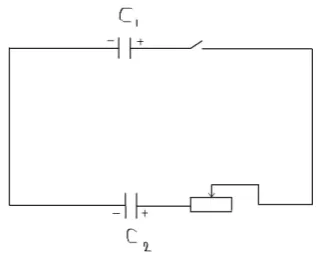
In her private space U, Alice has a capacitor C1 of the capacitance cA with the charge qA, while Bob in his private spaceV has a capacitorC2 of the capacitance cB with the charge qB, selected by Bob randomly. These capacitors are connected to form an electrical circuit (see Figure 1), in such a way that the capacitors’ plates holding positive charge are connected by one wire, and the plates holding negative charge are connected by another wire. Alice also has a switch that keeps the circuit disconnected until the actual transmission begins, and she has an ammeter to monitor the electric current in the circuit. Bob also has (in his private space) a rheostat(i.e., a variable resistor) included in the circuit. This allows him to randomly change the resistance of the whole circuit, and therefore also to change parameters of the electric current during the transmission. Now more formally:
Alice’s (sender’s) public key: capacitance cA Alice’s secret message: chargeqA
Bob’s (receiver’s) long-term private key: capacitancecB
Bob’s session private key: charge qB. This private key is selected by Bob randomly before each transmission from Alice.
Figure 1. Electrical circuit
Now here is the protocol itself:
(1) Alice uses her switch to connect the circuit, thereby starting re-distribution of electric charges between the capacitors C1 and C2.
(2) After re-distribution of the charges is complete, let QA be the new
charge of the capacitorC1, and QB the new charge of the capacitor
C2. Then:
QA=cA ·
qA+qB cA+cB
, QB =cB ·
qA+qB cA+cB
, QA
cA
= QB
cB
.
(3) Bob, who knowsQB, cB, qB, andcA, can now recover Alice’s secret
qA from the second formula above: qA =QB·(1 +
cA
cB)−qB.
Note that in the three equations displayed at Step 2 of the protocol above, there are 5 parameters unknown to the adversary (the only known parameter iscA), which yields many possible solutions forqA. In fact, one of the three equations is redundant (for example, equation 1 follows from the equations 2 and 3), so there are just 2 equations with 5 unknowns to the adversary!
The adversary may attempt to measure the electric currentIin the circuit during the transmission and use other laws of physics to try to recover some of the parameters. Relevant laws of physics include Ohm’s lawI = UR, where
U is the voltage andR the total resistance in the circuit. Since right after Alice turns her switch on, the initial voltageU is qA
cA − qB
cB,upon combining
these two formulas we get I = qA
cAR− qB cBR.
This formula introduces two more parameters, at least one of which, the total resistanceR, cannot be measured by the adversary because some parts of the circuit, including the rheostat with variable resistance, are hidden in the private space.
There are other formulas involving some of the parameters of our electrical circuit, but they all are similar to the formula above in the sense that they introduce new parameters, at least one of which cannot be evaluated by the adversary because it is relevant to properties of those circuit elements that are hidden in either Alice’s or Bob’s private space.
3.1. Yao’s millionaires’ problem. The “two millionaires problem” intro-duced by Yao in [9] is: Alice has a private number aand Bob has a private number b, and the goal of the two parties is to solve the inequality a≤b? without revealing the actual values of a or b, or more stringently, without revealing any information about aorbother than a≤bora > b.
We note that all known solutions of this problem (including Yao’s original solution) use one-way functions one way or another, which means security in all those solutions is complexity-based.
In this section, we offer a very simple solution of Yao’s millionaires’ prob-lem where security of the parties’ private numbers is decoy-based rather than complexity-based. Again, we use a simple physical principle to arrange for both parties’ private keys to contribute to the transmission at the same time. Our exposition here follows [5].
These vessels are connected by a horizontal pipe attached to their bottoms. The shapes of the vessels are part of the parties’ private keys.
In the beginning the system is “almost”, but not completely, filled with water. Then Alice starts pumping the water outof her vessel at the speed of a gallons (or whatever units) per second, while Bob starts pumping the water in his vessel at the speed of b gallons per second. The parties are just watching whether the level of water is decreasing or increasing. If it is decreasing, thena > b; if it is increasing, thena < b.
Note that the final level of water in the system depends not only on a
and b, but also on the shapes of both vessels. Also, quantities that can be measured outside of, say, Alice’s vessel (water pressure, speed of flow, etc.) depend only on the level of water in Alice’s vessel, whereas Alice’s private numberarepresents thevolumeof water that Alice pumps out of her vessel every second. The relation between this volume and the level of water in Alice’s vessel (and therefore the relation betweena and quantities that can be measured outside of Alice’s vessel) clearly depends on the shape of Alice’s vessel, which is unknown to anybody except Alice herself.
Therefore, neither party will be able to determine the other party’s num-ber based on the information available to them.
4. Secure delegation of computation: evaluatingxk
Our exposition in this section follows [2]. Here we show how to use the idea of decoy for secure delegation of computation to another party. A popular application of this functionality is outsourcing computations to a cloud, but the method of [2] also yields another interesting application, to the RSA encryption. Recall that in the RSA scenario, a secret plaintext is an integer xmodulo a public integerm; the latter is a product of two large primes. The plaintext x is encrypted as xk modulo m, where the exponent
k is public. For large kand m, computingxk may be too much for a small gadget like a car key, or an RFID tag, or an FPGA. With the method of [2], the sender can delegate most of the computation to the receiver (who is typically computationally superior). We describe the relevant protocol below.
Thus, suppose Alice (the sender) wants to computexk wherex∈Zm for
some large m. Suppose that 0 < k < m is so large that Alice lacks the computational power to compute it herself. Thus, Alice outsources some of the computations to Bob (the receiver) in the following way:
(1) Alice instructs Bob to select n distinct invertible elements in Zm,
call them x1, . . . , xn, where n > log log(k) and for each i, 2mn ≤
xi+1 −xi ≤ mn, i.e., xi are sufficiently “sparse”. (Without loss of
generality, we may assume thatnis invertible in Zm.)
(2) For each 1 ≤ i≤ n, Bob sends 2mn, xi, xki and x−i 1 to Alice. Alice
checks that the sparsity condition 2mn ≤ xi+1−xi ≤ mn is satisfied
(3) Among the elements xi she got from Bob, Alice chooses r random
elementsxij, where 1≤r≤log log(k) and 1≤i1,· · ·, ir ≤n. Then Alice computesy=xx−i 1
1 x
−1
i2 · · ·x
−1
ir and sends y to Bob. (4) Bob computes yk and sends it to Alice.
(5) Alice computes xk=xki 1· · ·x
k iry
k.
Thus, Alice has to do at most 2nmultiplications in Zm. The magnitude
ofndepends on how many decoys for her privatexAlice would like to have, see Section 4.1 below.
4.1. Security. The security of the above protocol relies on the fact that Bob, or any eavesdropper, will be facing many possibilities for xbecause of the many possible ways for Alice to build x out of xi and y. This is due to
the fact that out ofnpublic potential factors ofxonly at most log log(k) are “true factors”. Any choice of less than log log(k) of thexi would correspond
to a potentialx. We call each potentialxa decoy. The overall idea is that as Alice chooses largern, the number of decoys increases super-linearly. Hence, for a reasonably largen, the probability of guessingx is small enough to be considered negligible.
To compute the total number of decoys, we first count the number of ways to choose r elements fromn, with repetitions allowed. The formula is well known (see e.g. [8]):
(
n+r−1
r )
= (n+r−1)(n+r−2)· · ·(n+ 1)n
r!
Note that if we fixrand varyn, the above becomes a degreerpolynomial inn. We now vary r over 1 through log log(k). Therefore the total number of decoys is:
log log(∑k)
r=1 (
n+r−1
r )
.
Again, fixing k and varying n we have that this sum is a polynomial of degree log log(k) in n, so the number of decoys is O(nlog log(k)). To give some sample values with k= 22048, the number of decoys forn= 10 will be 352715, for n= 20 it will be about 8·107, and for n= 50 it will be about 4·1011.
Now let us see why no additional information about x is leaked during the execution of the protocol. First note that the xi are chosen (by Bob)
independently ofx, so no information aboutxcan possibly be leaked at this step. Only at Step 3, when Alice sendsy to Bob, can any information that pertains to x be possibly leaked. However, since x is unknown to Bob or any eavesdropper and is (supposedly) distributed uniformly inZm to begin
with, y is also distributed uniformly in Zm, and therefore cannot leak any
4.2. Complexity. We now show that by using the protocol in Section 4, Alice does logarithmically many multiplications compared to what she would do if she were computing xk by herself, without Bob’s help. To compute
xk, the fastest method Alice can use on her own is the “square and multi-ply” method, in which case she would have to perform between log(k) and log(k)·log log(k) multiplications, depending on k. This is without taking into account the complexity of reductions modulo m.
With Bob’s help, Alice performs approximately log log(k) multiplications at Step 3 and then another log log(k) multiplications at Step 5. Therefore, she performs logarithmically many multiplications compared to what she would without Bob’s help, i.e. with this protocol she can delegate most of the work to Bob.
Example: Let k ∼ m ∼ 22048. To compute xk for some x ∈ Zm using
the “square and multiply” method, one would need to do between log(k)∼ 2048 and log(k)·log log(k) ∼ 20,000 multiplications, i.e., about 10,000 multiplications on average (not counting reductions modulo m). By using the above protocol with n = 20, say, Alice would instead only need to do under 40 multiplications. Note that with n = 20, the number of decoys would be roughly 108 (see Section 4.1), so the probability of guessing the actualxis approximately 10−8, which can be considered negligible for most practical purposes.
In [2], the authors also reported on computer experiments comparing the actual performance time, on a typical desktop computer, of their method of delegating computation versus the standard “square-and-multiply” method. According to these experiments, computation of xk (using parameters as in the above example) with their method is about 200 times faster (for the sender). See [2] for more details.
The total time the RSA-2048 encryption took in their experiments was just under one second (on average), which may not be super fast, but is still practical. The point of using their method is that the sender’s share in this total time is just about 0.0003 seconds.
Finally, we mention that computation of arbitrary monomials can also be done by way of delegating it to a computationally superior party, see [2] for details.
References
[1] P. Barrett, Implementing the Rivest, Shamir and Adleman public key encryp-tion algorithm on a standard digital signal processor, in: Advances in Cryptology CRYPTO 1986, Lecture Notes Comp. Sc.263(1986), 311-323.
[2] B. Cavallo, D. Kahrobaei, V. Shpilrain,Decoy-based secure delegation of computa-tion, with application to RSA encryption, preprint.
[3] R. Gennaro, C. Gentry, and B. Parno, Non-interactive verifiable computing: Outsourcing computation to untrusted workers, in: Advances in Cryptology – CRYPTO 2010, Lecture Notes Comp. Sc.6223(2010), 465-482.
[5] D. Grigoriev and V. Shpilrain,Yao’s millionaires’ problem and decoy-based public key encryption by classical physics, J. Foundations Comp. Sci.25(2014), 409-417. [6] A. G. Myasnikov, V. Shpilrain, and A. Ushakov, Non-commutative cryptography and complexity of group-theoretic problems, Amer. Math. Soc. Surveys and Mono-graphs, 2011.
[7] D. Osin and V. Shpilrain,Public key encryption and encryption emulation attacks, in: Computer Science in Russia 2008, Lecture Notes Comp. Sc.5010(2008), 252-260.
[8] R. P. Stanley,Enumerative combinatorics.Cambridge University Press, 2011. [9] A. C. Yao,Protocols for secure computations.In: Proceedings of the 23rd Annual
Symposium on Foundations of Computer Science, pp. 160-164. IEEE Computer Society, 1982.
The City College of New York and CUNY Graduate Center