Dynamic Approach for Efficient Deployment of
Intelligent Tutoring Systems (ITSs)
Ruaa Ali Khamees1, Dr. R Satya Prasad2
1
Department of Computer Science & Engineering of Acharya Nagarjuna University, Andhra Pradesh,India,
2
Associate Professor in the Department of Computer Science & Engineering, Acharya Nagarjuna University, Andhra Pradesh,India,
Abstract—The use electronic and automatic systems for
online teaching and learning are becoming the common approach in education as growing requirement in many universities word wide. This type of education system is also referred as online learning. The advantage is that it saves time, efforts and costs. There are different frameworks or platform introduced for online learning such as LMS (Learning Management System), PLE (Personal Learning Environments) etc. Intelligent Tutoring Systems (ITSs) are most recent and automated framework introduced for online learning in universities. For such ITSs, deployment is very difficult task in different types of educational platforms due to the issues of compatibility and interoperability. Deploying ITSs is becomes an extra work for educational platforms to get in operating position. Already ITSs needs resources and time for its implementation. Also, also teachers on such platforms are having important value for education; it is must that they all should be shared and accessed by different students online easily over various operating platforms. In this paper we are presenting an efficient open framework for ITSs which can solves the limitations related to interoperability issues. Proposed solution is not requiring the resources like databases; hence the restriction on interoperability learning objects is removed. This approach overcomes the limitations of external resources dependencies. During this paper, we limited our working on designing ITSs components and use of new hybrid cryptography method for information security.
Index Terms—
LMS, ITS, Tutor, Interoperability, Educational
Platforms, Deployment, SCORMI. INTRODUCTION
he process of e-learning is nothing but online learning using the multimedia methods take places from any part of worldwide. This is web based approach which is performed to delivering the knowledge transfer, training, resources sharing from tutor to students using computer networks. E-learning is flexible learning platform in which anyone can learn anything, anytime and anywhere. As term E-learning includes concept of electronic media including other earlier education methods that uses the radio and television, however the most of current researches are limited to computer network and web based learning. This is the systematic method of learning to do planning, development, design, implementation, deployment, and performance evaluation in order to establish the live network in which learning is mainly focused and supported.
The use of e-learning resulted into many benefits to not only to student and tutors, but also different types of institutions, universities, support staffs etc. There are different types of e-learning systems presented such as LMSs and PLEs. These computed based learning methods are commonly used in many universities and teaching institutions. These methods are delivering the important aspects of sharing the didactic information. But the limitation of such learning systems is that they can only be used for sharing the non-interactive, non-intelligent information of education like word documents, PDFs, PPTs etc. The e-learning is getting high rewards to mentors only when the students showing the more interests and participation. And this can be achieved through interactive learning process only. The recently presented E-learning standard called ITS (Intelligent Tutoring System) offers the interactive, easy to use standard for education.
ITSs are nothing but the interactive learning methods which are designed by combining concepts of learning sciences as well as artificial intelligent methods. ITSs are showing the advantage for many domains of learning such as middle school math, different programming languages, as well as military applications. In addition to this ITSs delivering many other advantages for many education platforms. However, the limitations of ITSs are related to deployment of it to different education platforms. The currently available platforms of educational system are not supporting directly to the deployment of ITSs due to the problems of compatibility and interoperability. For successful deployment of ITS on education platform needs addition work and resources, which takes more time and costs to teaching institutions and universities. In addition to this, many teachers are not interoperable and hence they close there sessions without sharing information, therefore many end users are not accessible. This limitation of ITSs is very major we can further improve the efficiency of ITSs. Also, as ITSs needs the more time and resources for implementation at particular education platform, this can be solved by keeping the things shared manner so that used by many students from many different locations and deployed into various platforms [2].
Therefore in this paper we are addressing the problem of efficient accessibility of ITSs without requiring any
addition costs and efforts by implementing ITSs as interoperable mentor’s concepts. This can be achieved by using the existing SCORM (sharable content object reference) model. This SCORM is nothing but an e-learning standard [1]. Proposed approach of interoperable ITSs is web based implementation of ITSs for learning objective using the new structural design which focusing on essential features support of mentors, outer loop and inner loop. This method is solving the problems of existing ITSs systems by allowing the mentors fully compatible and confortable to different e-learning standards and free from the dependencies on extra resources. As this approach, atomic tutoring systems are grouped together in order to create the tree structures those covering the course details. These tree structures are called as molecular tree structure. This interoperable tutoring system resulting into the time saving, resource saving, costs saving and extra headache saving due to the deployment issues. Overall, in this paper we are presenting approach to solve first problem defined our on-going research study. The problem was designing improved Intelligent Tutoring System (ITS) for different types of educational platforms. In reminder of this paper, in section II we are presenting the related works on different types of ITSs, SCORM standard etc. In section III, framework and details for proposed interoperable framework for ITSs. In section IV, practical details and results achieved so far for this approach. Section V depicting the conclusion and future work.
II. RELATED WORK
In this section, we will first introducing the related studies presented by different authors with their limitations on E-learning systems. After that some related works over SCORM standards, intelligent tutoring system (ITS), and interoperable ITSs are discussed.
2.1. E-Learning Review
In [3], authors K. Sabbir Ahmed discussing about the e-learning fundaments. Web based e-learning methodology is now days common thing for various universities and institutions. However the plain materials of E-learning sharing are not contributing majorly for the purpose of students learning without using any good pedagogical technique for this process. There are large numbers of studies done in area of research called Dynamic and Flexible Intelligent Tutoring Systems in order to design the WILE (web based intelligent learning environments) in which current information of students about the subject data is saved in database of student model and hence presentation of materials is done as per the requirement of student learning. In many conditions, for learning platforms, contents are becoming the essential part and difficult task of reusing it to another learning platform.
In [4], authors S. Ritter, J.R. Anderson, K.R. Koedinger, and A. Corbett are discussing about online learning frameworks and standards. As mentioned in paper, authors had worked since from last 25 years in order to design the cognitive models for mathematics and this resulted into the
base for different levels of school curriculum. In this paper author discussed the theoretical research background for this method and evidence through which curriculum is more effective as compared to other types of methods. In addition to this, authors also discussed about process of well specified theory in proposed software of instructional that allows end users to evaluate the effectiveness of author’s instruction dynamically at deep level as compared to previous one. The recent use of software’s enabling to test the hypotheses over the huge number of end users or students.
In [5], authors K. Vanlehn, C. Lynch, K. Schulze, J. Shapiro, R. Shelby, and L. Taylor another interesting study over online learning technologies. They introduced the Andes as intelligent tutoring method. This method helped many students to improve their learning process at Physics University. This method solves the problems related to use of paper and pencil used to solve problems of mathematic equations. As mentioned in this paper, students did continue participation towards similar lectures, recitations and labs. The evaluation of this approach is done at United States Naval Academy for five years which indicating that this approach improves process of student learning significantly.
2.2. SCORM Review
The mechanism SCORM is nothing but group of standards as well as specifications for the web based learning. This standard was designed by ADL (advanced distributed initiative) at the start. However later SCORM becomes the product for other organizations such as AICC, IEEE, IMS global, Ariadne etc. The SCORM is a set of standards and specifications for web based learning [6]. There are three main phases of SCORM such as RTE (runtime environment specification), content packaging specification, and navigation and sequencing specification. According to the founder ADL, SCORM is fully designed standard for the learning methodologies [7]. The main advantages of using SCORM are durability, reusability, accessibility and interoperability [8].
2.3. Intelligent Tutoring Systems Review
ITSs are the educational learning methods which participating the students in interactive learning processes which needs the depth information about domain under the teaching. This also needs the considerable student’s behaviour comprehension. The intelligent mentors include the learning theory by doing it as well as applying the number of various technologies for implementation.
model pedagogical model gives the instructional interventions as well as feedback to the apprentices. Such traditional types of ITSs are widely acceptable to many communities. But the latest papers stress procedure on structure [9], [10], [11], discussing about ITSs which are having two loops such as inner loop and outer loop. The tasks of inner loop are giving personalized feedback, problem solving support to end users or students, hints etc. This loop also used to access the competence of students and store it into the student model. The information which obtained about the student is used by outer loop for the task selection.
2.4. Interoperable ITSs Review
In [12], [13], and [14] presented methods for interoperable and adaptive technique for online learning systems. These methods resulted into better approach for learning. The GRAPPLE project introduced is based on combining LMSs with adaptive learning conditions by building the generic adaptive webserver architecture. This gives the browser dependent authoring systems as well as distributed framework for user modelling. Web based adaptive education tool is created and supported by GRAPPLE. This also supports different types of adaptation like link, content, presentation etc. In addition to this, GRAPPLE has ability to support different kinds of under model knowledge.
In [1], authors Gustavo Soares Santos, Joaquim Jorge introduced the approach for discussing problems and challenges in ITSs. The framework introduced by authors is solves the problem of interoperability and compatibility. In this paper we considered this work as our base work for further research and extension. Extension related part is out of scope of this paper, rather aim of this paper is to describe the current ITSs problem and its current solution.
III. PROPOSED METHODOLOGY
3.1. Introduction
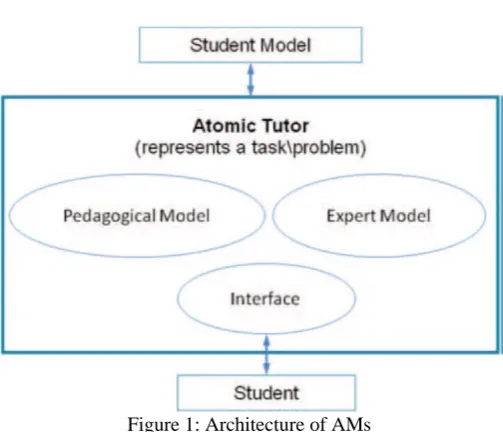
To solve the problem of interoperability, in this paper we presented the framework of ITSs with goal of easy deployment and access at any educational platform. The interoperability is achieved by designing the mentors as interoperable and those are open educational resources. There architecture of proposed approach is having two methods for building the ITSs such as atomic mentors (AMs) and Molecular Mentors (MMs). AMs are defined as small tutoring system which is representing the single activities. MMs are created by grouping the ATs. MMs are larger in size and hence presenting the entire educational systems that doing the task selection process. In short, the presented method aimed to deliver open source, intelligent learning objectives, adaptive learning objectives those are extracted from the educational content repositories, the further grouped whenever required, and then deployed on various educational platforms. Below section is showing the architectures for AMs and MMs in atomic ITSs.
3.2. Architectures and Processes
Figure 1: Architecture of AMs
Above figure 1 is showing the two models of ITSs such as expert model and pedagogical model. Those are integrated within the similar learning objectives. Most of functions given the instructions related to the expert model as well as pedagogical model. Off course, the designers of instruction attempting to write the code in manner that model of pedagogical is different from expert model. But the main thing is to keep in mind that AMs should work as per the previously defined models regardless of the things that how such models implemented internally. This entire process we followed from reference [1].
Figure 2: Architecture of MMs
determine the most suitable activity. Each time that a student starts a course or finishes working on an activity, MMs call the task selection rules and choose what AMs should be delivered next.
3.3. Algorithms Involved
Scope of this paper is limited to first part our research in which we are designing the ITS components and applying the efficient and faster cryptography method. Therefore below two algorithms showing process implemented so far in this research. The methods for interoperability, ontology extractions etc. are out of scope of this paper. For information security we proposed new hybrid security algorithm is based on combination AES and DES algorithms. The aim of new algorithm is to provide strong security against new attacks to preserve personal information safe. Also encryption takes less time as compared to existing methods for encryption. Algorithm 2 is explaining about this new cryptography algorithm. Algorithm 1: Designing ITS components
Step 1: If (Process==Admin)
Step 2: Then start designing admin process
Step 3: Designing Admin panel with admin rights set R. Step 4: Set R should be {view, add, delete, insert, update, arrange, and manage}
Step 5: Receive new registration details of student or teacher, and set its status.
Step 6: Upload information or materials to share among the registered students and teachers
Step 7: Download the information for processing Step 8: Results analysis for each student
Step 9: End Admin Process
Step 10: If (Process == Teacher) Step 11: Start designing teacher process Step 12: If (Teacher == Existing)
Step 13: Do login using his/her user id and password using Hybrid Cryptography
Step 14: Else do registration as new teacher using Hybrid Cryptography
Step 15: Adding upcoming exam details
Step 16: Sharing upcoming exam details to intended students and admin.
Step 17: Use of teacher roles set by admin such as {Edit, Change, View, Post, Add, Results}
Step 18: End Teacher Process
Step 19: If (Process == Student) Step 20: Start designing student process Step 21: If (Student == Existing)
Step 22: Do login using his/her user id and password using Hybrid Cryptography
Step 23: Else do registration as new student using Hybrid Cryptography
Step 24: Admin assigns role to student
Step 25: Role set includes {Edit data, Change password, view notice, Upload and download material, Post assignment, create blogs, add exam}
Algorithm 2: Hybrid Symmetric Key Cryptography
2.1. Algorithm for Encryption
Step 1: Receive Input data from source or intermediate node with n size bits
Step 2: Apply initial permutation by dividing input data equally with each of size as
L0 = n/2; R0 = n/2;
[Note: L for left side and R for right side]
Step 3: Apply second level permutation using below equations LL0 = L0/2;
LR0 = L0/2; RL0 = R0/2; RR0 = R0/2;
Step 4: Apply DES with Key on all four parts individually Key =Key size used here for DES is 128 bits
LL1 = DES (LL0, key); LR1 = DES (LR0, key); RL1 = DES (RL0, key); RR1 = DES (RR0, key);
Step 5: Combine Data at Second Level after DES fL0 = LL1 + LR1;
fR0 = RL1 + RR1;
Step 6: XOR first level data Out = (fL0 XOR fR0);
Step 7: Apply AES on output of XOR R1 = AES (Out, key);
Step 8: L1 = fR0
Step 9: Generate Encrypted Data Encrypt_d = R1+L1
2.2. Algorithm for Decryption
Step 1: Receiving input encrypted data from previous node in path.
Step 2: Apply initial permutation by dividing input data equally with each of size as
L0 = n/2; R0 = n/2;
[Note: L for left side and R for right side] Step 3: Apply AES on R0
Key = Key size used here for DES is 128 bits R1 = AES (R0, key);
Step 4: XOR R1 with L0 OutR = (R1 XOR L0);
Step 5: Generate left output using R0 OutL = R0;
Step 6: First Level Partition LL0 = OutL/2;
LR0 = OutL/2; RR0 = OutR/2; RL0 = OutR/2;
Step 7: Apply DES with Key on all four parts individually Key size used here for DES is 128 bits
LL1 = DES (LL0, key); LR1 = DES (LR0, key); RL1 = DES (RL0, key); RR1 = DES (RR0, key);
Step 8: Combine Decrypted Data L0 = (LL1+LR1);
R0 = (RL1+RR1);
IV. IMPLEMENTATION PLAN
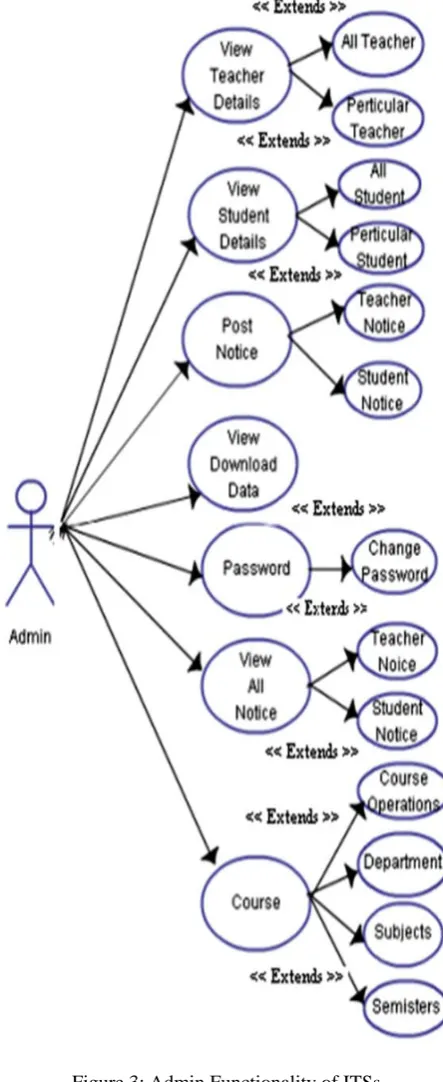
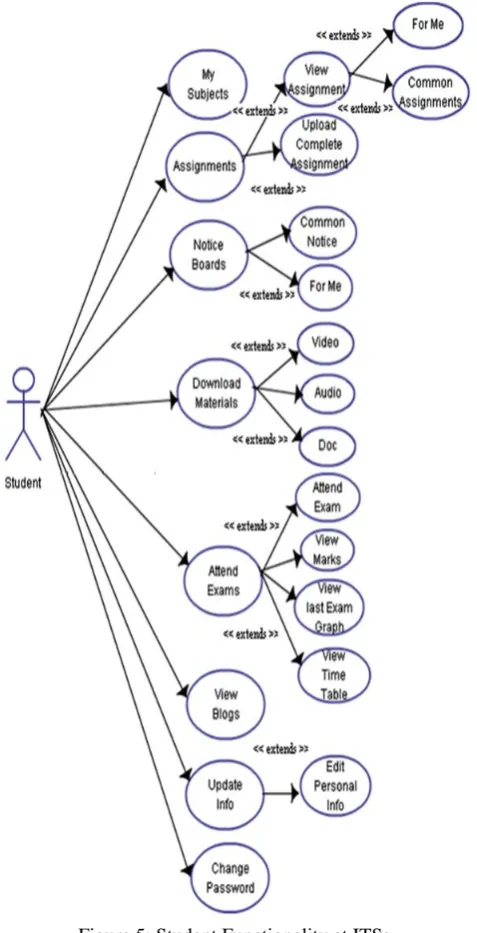
The implementation of this work is done using DOTNET platform and SCORM APIs to support the interoperability of intelligent mentors. Below diagrams are showing the design use cases for admin, student and mentor showing the implementation plan for ITSs.
Below figure 3 is showing the functionality for admin department at our designed ITSs. In figure 4, functionality for teacher department is showing. Finally in figure 5, architecture for student department is showing.
Figure 3: Admin Functionality of ITSs
Figure 4: Teacher Functionality ITSs.
Figure 5: Student Functionality at ITSs Results on Encryption Time
Below table 1 is showing the encryption time required for user login and registration between existing AES, DES methods and proposed Hybrid-AES-DES methods.
Table 1: Performance Analysis of Encryption Time
AES DES Proposed
Teacher Login 0.074 0.081 0.0675
Student Login 0.073 0.078 0.0643
Teacher Reg. 0.133 0.139 0.118
Student Reg. 0.126 0.129 0.102
Above table 1 is showing the performance analysis of encryption time. From the results, it is showing the proposed cryptography method taking less time for processing the encryption to secure their personal information’s such as userid and password.
V. CONCLUSION AND FUTURE WORK
The aim of this paper is to discuss the current problems of ITSs and present the efficient solution to solve those problems. Since from last few years, ITSs is having limitation of deployment as it is not supporting to current education platforms. Therefore for each deployment at educational platform, extra work is required which takes longer time and more costs to get operable. Therefore, goal was to present automatic, flexible and dynamic framework for using the ITSs at any platform by anyone with needing any addition resources. The problem is solved by using concepts of interoperable mentor system with help of SCORM educational standard. This paper solves out first objective in our research by presenting the efficient ITSs for educational systems. In this paper we introduced two algorithms one for designing ITSs components and other is for efficient cryptography method. A result for encryption time is showing that proposed work is outperforming the existing cryptography methods. For future work we suggest evaluate the performance of proposed approach under real time systems.
REFERENCES
[1] Gustavo Soares Santos and Joaquim Jorge, Senior Member, IEEE Computer Society, “Interoperable Intelligent Tutoring Systems as Open Educational Resources”, IEEE TRANSACTIONS ON LEARNING TECHNOLOGIES, VOL. 6, NO. 3, JULY-SEPTEMBER 2013.
[2] A.A. Pin˜ a, “An Overview of Learning Management Systems,” Learning Management System Technologies and Software Solutions for Online Teaching: Tools and Applications, Y. Kats, ed., pp. 1-19, Information Science Reference, 2010.
[3] K. Sabbir Ahmed, “A Conceptual Framework for Web-Based Intelligent Learning Environments Using SCORM-2004,” Proc. IEEE Int’l Conf. Advanced Learning Technologies, pp. 12-15, 2004.
[4] S. Ritter, J.R. Anderson, K.R. Koedinger, and A. Corbett, “Cognitive Tutor: Applied Research in Mathematics Education,” Psychonomic Bull. Rev., vol. 14, pp. 249-255, Apr. 2007. [5] K. Vanlehn, C. Lynch, K. Schulze, J. Shapiro, R. Shelby, L.
Taylor, D. Treacy, A. Weinstein, and M. Wintersgill, “The Andes Physics Tutoring System: Five Years of Evaluations,” Proc. 12th Int’l Conf. Artificial Intelligence in Education, pp. 678-685, 2005. [6] G. Santos and A. Figueira, “Reusable and Inter-Operable Web-Based Intelligent Tutoring Systems Using SCORM 2004,” Proc. Ninth European Conf. E-Learning, 2010.
[7] G. Santos and J. Jorge, “Interoperable Intelligent Tutoring Systems as SCORM Learning Objects,” Intelligent and Adaptive Educational-Learning Systems: Achievements and Trends, Pen˜ a-Ayala, ed., pp. 133-160, Springer-Verlag, 2012.
[8] ADL, “SCORM,” http://www.adlnet.gov/Technologies/scorm, 2011.
[9] V. Aleven, B.M. McLaren, and J. Sewall, “Scaling Up Programming by Demonstration for Intelligent Tutoring Systems Development: An Open-Access Web Site for Middle School Mathematics Learning,” IEEE Trans. Learning Technologies, vol. 2, no. 2, pp. 64-78, Apr.-June 2009.
[10] V. Aleven, B.M. McLaren, J. Sewall, and K.R. Koedinger, “A New Paradigm for Intelligent Tutoring Systems: Example-Tracing Tutors,” Int’l J. Artificial Intelligence in Education, vol. 19, pp. 105- 154, 2009.
[11] K. Vanlehn, “The Behavior of Tutoring Systems,” Int’l J. Artificial Intelligence in Education, vol. 16, pp. 227-265, 2006. [12] P. De Bra, D. Smits, K. Van der Sluijs, A. Cristea, J. Foss, and C.
Educational-Learning Systems: Achievements and Trends, A. Pen˜ a-Ayala, ed.,vol. 17, pp. 133-160, Springer-Verlag, 2012. [13] M. Rey-Lo´pez, P. Brusilovsky, M. Meccawy, R. Dı´az-Redondo,
A. Ferna´ndez-Vilas, and H. Ashman, “Resolving the Problem of Intelligent Learning Content in Learning Management Systems,” Int’l J. E-Learning, vol. 7, pp. 363-381, 2008.
[14] M. Rey-Lo´pez, R. Dı´az-Redondo, A. Ferna´ndez-Vilas, J. Pazos Arias, J. Garcı´a-Duque, A. Gil-Solla, and M. Ramos-Cabrer, “An Extension to the ADL SCORM Standard to Support Adaptivity: The T-Learning Case-Study,” Computer Standards & Interfaces, vol. 31, pp. 309-318, 2009.
RUAA ALI KHAMEES, working as Assist Lecturer in the Department of Information Technology & Communication (ITC)/Technology Institution/Middle Technical University (MTU),Iraq. She received MSc degree in Computer Science in 2012 from Bharati Vidyapeeth Deemed University, Pune, India. She is presently a research scholar in the Department of Computer Science & Engineering of Acharya Nagarjuna University, Andhra Pradesh, India.