Developing System to Filter Unwanted Texts and
Images from Social Network User Wall
Ravindra Takalikar #1, Mahesh Jadhav *2, Subhash Pingale #3 #
Department of Computer Science and Engineering, Solapur University SKN Sinhgad College of Engineering, Pandharpur, Maharashtra,India *
Department of Computer Science and Engineering, Solapur University SKN Sinhgad College of Engineering, Pandharpur, Maharashtra,India
Abstract
—
In these days, internet is spreading worldwide. One of the chief purpose of use of internet is online social networks (OSNs). OSNs are used on large basis to market products, promote brands, connect people with their family, friends, & society through online communication. But, due to the deficiency of categorization & filtering tools, user acquires all messages which are published on his private space. so, user do not have whole control on the contents that are being posted. So, proposed work explains rule based system that gives permission to users to channelize the filtering criterion applied to their private space, and machine learning classifier able to title the messages automatically based on their content. Unwanted images are possible to filter by extracting and classifying their features like edge, color and shape.Keywords— Online Social Networks (OSNs), Machine Learning, Information Filtering.
I. INTRODUCTION
OSNs is becoming indispensible thing in today’s modern internet generation. People can easily convey the information (photos, ideas, thoughts) to their members of household, friends and society. A lot of content is shared at each day and month. Due to this vast and variety of data ,secrecy of osn user can be violated ,i.e. User may receive unrequired content on his private space. Information filtering & access control is required to acquire selective information. Main motive of information filtering is to avoid user from useless data. But, in osns information filtering is required to use in different manner since unwanted content like vulgar ,offense, hate etc. can be published on user private space. So ,in case of osns, information filtering should give users entire and automatic control on the contents that are written on their private space. Most popular osns are facebook , twitter, google+ etc. Main point in question about todays osns is that they are not able to provide contentwise filtering of messages. Also ,most of the wall messages are built up of short texts that are difficult to categorize by traditional categorization methods, since they consists of low standard terms with smaller extent of occurrences. In this work, customized filtering rules specifies the filtering criteria which are applied to user private space in order to control the posting of unwanted contents. Filtering rules use attributes of user profile to specify filtering criteria. Machine learning classifier is trained with contents and their respective category (neutral, vulgar, political, offense etc.) So that it can autonomously categorize new input content into proper category based on training of preclassified contents. Also a
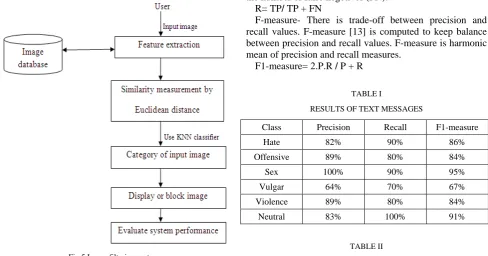
lot of messages shared between users of osn are in the form of images. To filter unwanted images first it is required to extract features from it by using various descriptors. Then compute the euclidean distance between input image feature and preclassified images features by using knn classifier. Based on euclidean distance input image can be recognized into proper category. Once category of image is recognized then we can take proper action (block, notify) on it.
II. RELATED WORK
done for long text, but in OSN most of the messages are of short length which are difficult to classify as they are not properly spelled and their representation is not proper. Sokolova [26] proposed statistical learning approach for short text classification. But proposed approach is for hard classifier and not for soft classifier that consider multimembership of content into classes. Filmtrust [28] is an application that customize the visit to website based on history data and social graph of user. But still here user cannot decide by how and upto which amount unrequired information is filtered out. Access control models [29] are also major part of proposed work. So, to apply filtering criteria we use relationship of message creator with resource owner and description of message content.
III.SCOPE
Through OSNs people can communicate with each other contentiously through exchange of contents like video, audio and text. Scope of this system is that it can control the contents that are published on user private space.
IV.OBJECTIVES
To apply customized filtering criteria to the
messages that are published on user private space.
To consider the challenges in short text
classification.
Once filtering system is deployed, then inspect
each message before message is received by an intended recipient in order to take a decision whether the message is published or not.
V. FILTERED WALL ARCHITECTURE
It consists of three layers i.e. graphical user interface (GUI), social network application (SNA), social network manager (SNM).
Fig. 1 Filtered wall architecture
SNM handles user profiles and their social graphs. SNA layer support various applications. In our system short text classifier and contentwise message filtering are two components deployed in this layer. Interaction with applications of social network is possible through GUI layer. Filtered wall is there in our system at GUI layer. Flow of message in our system is as follows-
Let Ram and Raj are friends on OSN. When raj opens the wall of Ram and post the message on his private space, then firstly that message is inspected by filtered wall as shown by 1. Machine learning categorization technique categorize that message by comparing its features with features of preclassified messages that are stored in dataset as shown by 2. Then filtered wall applies filtering criteria based on categorization of message performed by short text classifier and information extracted from social graph of user as shown by 3. Finally filtering criteria decides the message will be blocked or display on user private space as shown by 4.
VI.METHODOLOGY
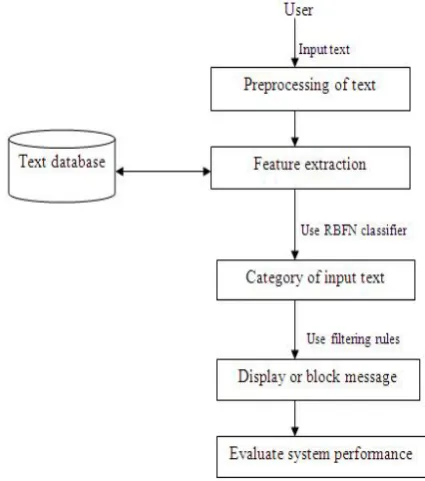
Components of text message filtering system are shown in fig.2 as-
Fig.2 Text message filtering system
A. Preprocessing of Information
To classify any information, it is necessary to preprocess that information so that it is easy to recognize semantics of that message. Preprocessing of text involves following tasks-
1) Tokenization: Here, information in document is separated into individual words. e.g. we’re reading a book now. After tokenization we get = we ‘re reading a book now.
3) Stemming: Here, suffix of words in document are removed to make each word as a root word in order to classification more accurately. e.g. Punishing->punish, teaching->teach.
4) Text Representation: It is the process of extraction of feature from information and representation of that information in the form of feature vector. It influences overall execution of classification. Feature of information can be extracted by different methods like bag of words, vector space model, document properties, contextual features. Bag of words treat each term in document as a word which is used as feature for classification. e.g. Document is- Bob watch cricket. John also watch cricket. So ,in context of above documents list of non-identical
words can be build as- { “Bob”,”watch”,”cricket”,”John”,”also”}. By using index
of list , above document is possible to represent as 5- entry vector- [1,2,2,1,1] . Each entry in vector represents no of times term appear in document. Finally weightage of each term tk in document dj can be calculated by tf-idf [30]
standard method of information retrieval.Document properties [1] represents statistics of message i.e. no of correct words, bad words, question marks etc. in that message so as to retrieve the features from it. Contextual features considers surrounding where the message is published.
B. Learning and Classification Procedure
Learning is the process of categorization of new information based on previous trained examples. We select neural network algorithm i.e. radial basis function network algorithm , since it is robust to hacker, quick and provides nonlinear mapping.
C. Radial Basis Function (RBF) Network
Radial basis function [25] is neural network as shown in fig.3. There are three layers of network- input layer, hidden layer, output layer.
Fig.3 Radial basis function network architecture
Input layer bears feature vector of input message which is to be categorized. It is nonprocessing layer. Hidden layer bears a set of RBF neurons. RBF Neurons are there which
are trained with precategorized examples from training set. Each neuron have its precategorized example (prototype) vector i.e. µ. Each hidden neuron finds the Euclidean distance [25] between the feature vector of input data and its precategorized example vector. Each neuron gives activation value based on this Euclidean distance by employing Gaussian function [25]. If input is more similar with class c example than class d example, then it is categorized as class c. If input is more similar with neuron example then hidden unit gives response close to 1. As the distance increases , then response exponentially drops towards 0. Shape of response of neurons is belly type curve as shown in fig.4 below.
Fig.4 Response curve of RBF neuron
Neurons example vector is nothing but center of belly curve , since it’s value is at center of belly curve. Output node bears nodes where every output node bears one category with a score. Input data is classified into that category which has highest score. Every output node receives activation value from every neuron and take their weighted sum to calculate its score. Output node assign positive weight to RBF neurons that belongs to its category and negative weight to remaining neurons . Every output node multiplies neurons activation value by this weight in order to calculate total response or weighted sum [25].
D. Filtering Rules
Contentspecification is of the form (c, ml) denotes minimum membership level threshold (ml) [27] required for message inorder to classify in class c. Action is {notify,block} denotes action taken on incoming messages. e.g. Let Ram want to block vulgar messages from friends whose trust value is below 1. For vulgar class threshold is set to 0.80. To block such messages filtering rule can be given as-((Ram, friendof, 1,1),(vulgar,0.80),block). Similarity between document and category can be determined by using two parameters i.e. membership value of each term of document into that category and membership value of each term in that document. This process is known as fuzzyfication [32] by which we can calculate membership of document into respective categories.
E. Image Filtering System
Components of image filtering system are shown in fig.5 as-
Fig.5 Image filtering system
For image classification , we have to preclassify the different images in different category. Then train the classifier with these preclassified images in order to categorize new incoming images. Features like color, shape, edge plays an important role to classify the image. So ,select appropriate feature extractor to extract features of image. Hue, Saturation , Value extractor [15] is used to extract color from image ,since each component of it directly considers the human virtual perception of colors. Shape of an image is an crucial feature which can be used to categorize image into proper category. GLCM extractor [15] accurately extracts properties of surface of image. Human eyes can easily sense edge feature of image. Edges accurately represent the content of image. By using EHD[15], we can accurately extract edge feature of an image, since edge histogram correctly represents frequency
and ordering of brightness variations of image correctly. Once features are drawn from image, then find the Euclidean distance of input image feature from each preclassified image feature in database. Classify the input image into that image category from which it have minimum Euclidean distance.
VII.RESULTS
Performance of proposed system can be evaluated by three parameters i.e. Precision (P) , Recall(R), and F1-measure [13]-
Precision- Precision [13] represents the fraction of messages that are correctly classified by classifier out of total classified messages. It evaluates the number of false positives (FP).
P= True positives (TP) / TP+ FP
Recall- Recall [13] represents fraction of messages of a class that are correctly classified by classifier out of total messages that are actually present in that class. It evaluates the number of false negetives (FN).
R= TP/ TP + FN
F-measure- There is trade-off between precision and recall values. F-measure [13] is computed to keep balance between precision and recall values. F-measure is harmonic mean of precision and recall measures.
F1-measure= 2.P.R / P + R
TABLE I
RESULTS OF TEXT MESSAGES
Class Precision Recall F1-measure
Hate 82% 90% 86%
Offensive 89% 80% 84%
Sex 100% 90% 95%
Vulgar 64% 70% 67%
Violence 89% 80% 84%
Neutral 83% 100% 91%
TABLE II
RESULTS OF IMAGES
Class Precision Recall F1-measure
Good image 63% 71% 68%
Bad image 88% 78% 83%
VIII.CONCLUSIONS
ACKNOWLEDGMENT
I am profoundly grateful to all people who helped me directly or indirectly during this course of work.
REFERENCES
[1] Marco Vanetti, Elisabetta Binaghi, Elena Ferrari, Barbara Carminati,
and Moreno Carullo, “A System to Filter Unwanted Messages from
OSN User Walls,” IEEE Transaction on Knowledge and Data
Engineering, vol. 25, 2013.
[2] P. W. Foltz and S. T. Dumais, “Personalized information delivery:
An analysis of information filtering methods,” Communications of
the ACM, vol. 35, no. 12, pp. 51–60, 1992.
[3] R.J. Mooney and L. Roy, “Content-Based Book Recommending
Using Learning for Text Categorization,” Proc. Fifth ACM Conf.
Digital Libraries, pp. 195-204, 2000.
[4] L.Yusuf and M.Othman, “Web Classification using Extraction and
Machine Learning Techniques,” IEEE Trans. DataMining, 2010.
[5] B. Sriram, D. Fuhry, E. Demir, H. Ferhatosmanoglu,and
M.Demirbas, “Short Text Classification in Twitter to Improve
Information Filtering,” Proc. 33rd Intl ACMSIGIR Conf. Research
and Development in Information Retrieval (SIGIR 10), pp. 841- 842,2010.
[6] N.J. Belkin and W.B. Croft, “Information Filtering and Information
Retrieval: Two Sides of the Same Coin?” Comm. ACM, vol. 35, no.
12, pp. 29-38, 1992.
[7] F. Sebastiani, “Machine learning in automated text categorization,”
ACM Computing Surveys, vol. 34, no. 1, pp. 1–47, 2002.
[8] P.W. Foltz and S.T. Dumais, “Personalized Information Delivery:
An Analysis of Information Filtering Methods,” Comm. ACM, vol.
35, no. 12, pp. 51-60, 1992.
[9] P.S. Jacobs and L.F. Rau, “Scisor: Extracting Information from On-
Line News,” Comm. ACM, vol. 33, no. 11, pp. 88-97, 1990.
[10] S. Pollock, “A Rule-Based Message Filtering System,” ACM Trans.
Office Information Systems, vol. 6, no. 3, pp. 232-254, 1988.
[11] M.J.D. Powell, “Radial Basis Functions for Multivariable
Interpolation: A Review,” Algorithms for Approximation, pp. 143-
167, Clarendon Press, 1987.
[12] Zhou Faguo, Zhang Fan, Yang Bingru and Yu Xingang, ”Research
on Short Text Classification Algorithm Based on Statistics and
Rules,” IEEE, Third International Symposium on Electronic
Commerce and Security,2010.
[13] Information Retrieval: Data Structures & Algorithms, W.B. Frakes and R.A. Baeza-Yates, eds., Prentice-Hall, 1992.
[14] S. Zelikovitz and H. Hirsh, “Improving Short Text Classification
Using Unlabeled Background Knowledge,” Proc. 17th Int’l Conf.
Machine Learning (ICML ’00), P. Langley, ed., pp. 1183-1190, 2000.
[15] Chich-Chin Lai, Ying-Chaun Chen, ”A User Oriented Image
Retrieval System Based on Interactive Genetic Algorithm,” IEEE
Transaction on Instrumentation and Measurement,Vol.60,No.10,2011.
[16] C. Apte, F. Damerau, S.M. Weiss, D. Sholom, and M. Weiss,
“Automated Learning of Decision Rules for Text Categorization,”
Trans. Information Systems, vol. 12, no. 3, pp. 233-251, 1994.
[17] S. Dumais, J. Platt, D. Heckerman, and M. Sahami, “Inductive
Learning Algorithms and Representations for Text Categorization,”
Proc. Seventh Int’l Conf. Information and Knowledge Management (CIKM ’98), pp. 148-155, 1998.
[18] D.D. Lewis, “An Evaluation of Phrasal and Clustered
Representations on a Text Categorization Task,” Proc. 15th ACM
Int’l Conf. Research and Development in Information Retrieval (SIGIR ’92), N.J. Belkin, P. Ingwersen, and A.M. Pejtersen, eds., pp. 37-50, 1992.
[19] Kathy Lee, Diana Palsetia, Ramanathan Narayanan, Md. Mostofa
Ali Patwary, Ankit Agrawal, and Alok Choudhary,”Twitter
Trending Topic Classification,” 11th IEEE International
Conference on Data Mining Workshops,2011.
[20] H. Schu¨ tze, D.A. Hull, and J.O. Pedersen, “A Comparison of
Classifiers and Document Representations for the Routing
Problem,” Proc. 18th Ann. ACM/SIGIR Conf. Research and
Development in Information Retrieval , pp. 229-237, 1995.
[21] E.D. Wiener, J.O. Pedersen, and A.S. Weigend, “A Neural Network
Approach to Topic Spotting,” Proc. Fourth Ann. Symp. Document
Analysis and Information Retrieval (SDAIR ’95), pp. 317- 332, 1995.
[22] T. Joachims, “Text Categorization with Support Vector Machines:
Learning with Many Relevant Features,” Proc. European Conf.
Machine Learning, pp. 137-142, 1998.
[23] T. Joachims, “A Probabilistic Analysis of the Rocchio Algorithm
with TFIDF for Text Categorization,” Proc. Int’l Conf. Machine
Learning, pp. 143-151, 1997.
[24] S.E. Robertson and K.S. Jones, “Relevance Weighting of Search
Terms,” J. Am. Soc. for Information Science, vol. 27, no. 3, pp. 129- 146, 1976.
[25] Oliver Buchtala, Manuel Klimek, and Bernhard Sick,” Evolutionary
Optimization of Radial Basis Function Classifiers for Data Mining
Applications,” IEEE transactions on systems, man, and
cybernetics—part b: cybernetics, vol. 35, no. 5, October 2005.
[26] V. Bobicev and M. Sokolova, “An Effective and Robust Method for
Short Text Classification,” Proc. 23rd Nat’l Conf. Artificial
Intelligence (AAAI), D. Fox and C.P. Gomes, eds., pp. 1444-1445, 2008.
[27] V. Leekwijck and W. Kerre, “Defuzzification: Criteria and
Classification,” Fuzzy Sets and Systems, vol. 108, pp. 159-178, 1999.
[28] J. Golbeck, “Combining Provenance with Trust in Social Networks
for Semantic Web Content Filtering,” Proc. Int’l Conf. Provenance
and Annotation of Data, L. Moreau and I. Foster, eds., pp. 101-108, 2006.
[29] F. Bonchi and E. Ferrari, Privacy-Aware Knowledge Discovery:
Novel Applications and New Techniques. Chapman and Hall/CRC Press, 2010.
[30] G. Salton and C. Buckley, “Term-Weighting Approaches in
Automatic Text Retrieval,” Information Processing and
Management, vol. 24, no. 5, pp. 513-523, 1988.
[31] YU, B. AND SINGH, M. P. A social mechanism for reputation
management in electronic communities. In Proceedings of the 4th
International Workshop on Cooperative Information Agents (CIA’00). Springer, 154–165,2000.
[32] Widyantoro ,D. H., Yen,J.: A Fuzzy Similarity Approach in Text
Classification Task. In:IEEE International Conference on Fuzzy