Rates, Polarizations, and Asymmetries in Charmless Vector-Vector
B
Meson Decays
B. Aubert,1R. Barate,1D. Boutigny,1J.-M. Gaillard,1A. Hicheur,1Y. Karyotakis,1J. P. Lees,1P. Robbe,1V. Tisserand,1 A. Zghiche,1A. Palano,2A. Pompili,2J. C. Chen,3N. D. Qi,3G. Rong,3P. Wang,3Y. S. Zhu,3G. Eigen,4I. Ofte,4 B. Stugu,4G. S. Abrams,5A.W. Borgland,5A. B. Breon,5D. N. Brown,5J. Button-Shafer,5R. N. Cahn,5E. Charles,5
C. T. Day,5M. S. Gill,5A.V. Gritsan,5Y. Groysman,5R. G. Jacobsen,5R.W. Kadel,5J. Kadyk,5L. T. Kerth,5 Yu. G. Kolomensky,5J. F. Kral,5G. Kukartsev,5C. LeClerc,5M. E. Levi,5G. Lynch,5L. M. Mir,5P. J. Oddone,5 T. J. Orimoto,5M. Pripstein,5N. A. Roe,5A. Romosan,5M. T. Ronan,5V. G. Shelkov,5A.V. Telnov,5W. A. Wenzel,5
K. Ford,6T. J. Harrison,6C. M. Hawkes,6D. J. Knowles,6S. E. Morgan,6R. C. Penny,6A. T. Watson,6N. K. Watson,6 T. Deppermann,7K. Goetzen,7H. Koch,7B. Lewandowski,7M. Pelizaeus,7K. Peters,7H. Schmuecker,7M. Steinke,7
N. R. Barlow,8J. T. Boyd,8N. Chevalier,8W. N. Cottingham,8M. P. Kelly,8T. E. Latham,8C. Mackay,8F. F. Wilson,8 K. Abe,9T. Cuhadar-Donszelmann,9C. Hearty,9T. S. Mattison,9J. A. McKenna,9D. Thiessen,9P. Kyberd,10
A. K. McKemey,10V. E. Blinov,11A. D. Bukin,11V. B. Golubev,11V. N. Ivanchenko,11E. A. Kravchenko,11 A. P. Onuchin,11S. I. Serednyakov,11Yu. I. Skovpen,11E. P. Solodov,11A. N. Yushkov,11D. Best,12M. Chao,12D. Kirkby,12
A. J. Lankford,12M. Mandelkern,12S. McMahon,12R. K. Mommsen,12W. Roethel,12D. P. Stoker,12C. Buchanan,13 D. del Re,14H. K. Hadavand,14E. J. Hill,14D. B. MacFarlane,14H. P. Paar,14Sh. Rahatlou,14U. Schwanke,14V. Sharma,14 J.W. Berryhill,15C. Campagnari,15B. Dahmes,15N. Kuznetsova,15S. L. Levy,15O. Long,15A. Lu,15M. A. Mazur,15 J. D. Richman,15W.Verkerke,15T.W. Beck,16J. Beringer,16A. M. Eisner,16C. A. Heusch,16W. S. Lockman,16T. Schalk,16 R. E. Schmitz,16B. A. Schumm,16A. Seiden,16M. Turri,16W. Walkowiak,16D. C. Williams,16M. G. Wilson,16J. Albert,17 E. Chen,17G. P. Dubois-Felsmann,17A. Dvoretskii,17 D. G. Hitlin,17I. Narsky,17 F. C. Porter,17A. Ryd,17A. Samuel,17
S. Yang,17S. Jayatilleke,18G. Mancinelli,18B. T. Meadows,18M. D. Sokoloff,18T. Abe,19T. Barillari,19F. Blanc,19 P. Bloom,19S. Chen,19P. J. Clark,19W. T. Ford,19U. Nauenberg,19A. Olivas,19P. Rankin,19J. Roy,19J. G. Smith,19
W. C. van Hoek,19L. Zhang,19J. L. Harton,20T. Hu,20A. Soffer,20W. H. Toki,20R. J. Wilson,20J. Zhang,20 D. Altenburg,21T. Brandt,21J. Brose,21T. Colberg,21M. Dickopp,21R. S. Dubitzky,21A. Hauke,21H. M. Lacker,21 E. Maly,21R. Mu¨ller-Pfefferkorn,21R. Nogowski,21S. Otto,21K. R. Schubert,21R. Schwierz,21B. Spaan,21L. Wilden,21
D. Bernard,22G. R. Bonneaud,22F. Brochard,22J. Cohen-Tanugi,22Ch. Thiebaux,22G. Vasileiadis,22M. Verderi,22 A. Khan,23D. Lavin,23F. Muheim,23S. Playfer,23J. E. Swain,23J. Tinslay,23M. Andreotti,24V. Azzolini,24 D. Bettoni,24C. Bozzi,24R. Calabrese,24G. Cibinetto,24E. Luppi,24M. Negrini,24L. Piemontese,24A. Sarti,24 E. Treadwell,25F. Anulli,26,* R. Baldini-Ferroli,26A. Calcaterra,26R. de Sangro,26D. Falciai,26G. Finocchiaro,26
P. Patteri,26I. M. Peruzzi,26,* M. Piccolo,26A. Zallo,26A. Buzzo,27R. Contri,27G. Crosetti,27M. Lo Vetere,27 M. Macri,27M. R. Monge,27S. Passaggio,27F. C. Pastore,27C. Patrignani,27E. Robutti,27A. Santroni,27S. Tosi,27 S. Bailey,28M. Morii,28W. Bhimji,29D. A. Bowerman,29P. D. Dauncey,29U. Egede,29I. Eschrich,29J. R. Gaillard,29
G.W. Morton,29J. A. Nash,29P. Sanders,29G. P. Taylor,29G. J. Grenier,30S.-J. Lee,30U. Mallik,30J. Cochran,31 H. B. Crawley,31J. Lamsa,31W. T. Meyer,31S. Prell,31E. I. Rosenberg,31J. Yi,31M. Davier,32G. Grosdidier,32A. Ho¨cker,32
S. Laplace,32F. Le Diberder,32V. Lepeltier,32A. M. Lutz,32T. C. Petersen,32S. Plaszczynski,32M. H. Schune,32 L. Tantot,32G. Wormser,32V. Brigljevic´,33C. H. Cheng,33D. J. Lange,33D. M. Wright,33A. J. Bevan,34J. P. Coleman,34
J. R. Fry,34E. Gabathuler,34R. Gamet,34M. Kay,34R. J. Parry,34D. J. Payne,34R. J. Sloane,34C. Touramanis,34 J. J. Back,35P. F. Harrison,35H.W. Shorthouse,35P. Strother,35P. B. Vidal,35C. L. Brown,36G. Cowan,36R. L. Flack,36
H. U. Flaecher,36S. George,36M. G. Green,36A. Kurup,36C. E. Marker,36T. R. McMahon,36S. Ricciardi,36 F. Salvatore,36G. Vaitsas,36M. A. Winter,36D. Brown,37C. L. Davis,37J. Allison,38R. J. Barlow,38A. C. Forti,38 P. A. Hart,38F. Jackson,38G. D. Lafferty,38A. J. Lyon,38J. H. Weatherall,38J. C. Williams,38A. Farbin,39A. Jawahery,39
D. Kovalskyi,39C. K. Lae,39V. Lillard,39D. A. Roberts,39G. Blaylock,40C. Dallapiccola,40K. T. Flood,40 S. S. Hertzbach,40R. Kofler,40V. B. Koptchev,40T. B. Moore,40S. Saremi,40H. Staengle,40S. Willocq,40R. Cowan,41 G. Sciolla,41F. Taylor,41R. K. Yamamoto,41D. J. J. Mangeol,42M. Milek,42P. M. Patel,42A. Lazzaro,43F. Palombo,43 J. M. Bauer,44L. Cremaldi,44V. Eschenburg,44R. Godang,44R. Kroeger,44J. Reidy,44D. A. Sanders,44D. J. Summers,44
H.W. Zhao,44C. Hast,45P. Taras,45H. Nicholson,46C. Cartaro,47N. Cavallo,47,†G. De Nardo,47F. Fabozzi,47,† C. Gatto,47L. Lista,47P. Paolucci,47D. Piccolo,47C. Sciacca,47M. A. Baak,48G. Raven,48J. M. LoSecco,49 T. A. Gabriel,50B. Brau,51T. Pulliam,51Q. K. Wong,51J. Brau,52R. Frey,52C. T. Potter,52N. B. Sinev,52D. Strom,52 E. Torrence,52F. Colecchia,53A. Dorigo,53F. Galeazzi,53M. Margoni,53M. Morandin,53M. Posocco,53M. Rotondo,53
J. Stark,54S. T’Jampens,54G. Therin,54P. F. Manfredi,55V. Re,55L. Gladney,56Q. H. Guo,56J. Panetta,56C. Angelini,57 G. Batignani,57S. Bettarini,57M. Bondioli,57F. Bucci,57G. Calderini,57M. Carpinelli,57F. Forti,57M. A. Giorgi,57 A. Lusiani,57G. Marchiori,57F. Martinez-Vidal,57,‡M. Morganti,57N. Neri,57E. Paoloni,57M. Rama,57G. Rizzo,57 F. Sandrelli,57J. Walsh,57M. Haire,58D. Judd,58K. Paick,58D. E. Wagoner,58N. Danielson,59P. Elmer,59C. Lu,59 V. Miftakov,59J. Olsen,59A. J. S. Smith,59H. A. Tanaka,59E.W. Varnes,59F. Bellini,60G. Cavoto,59,60R. Faccini,14,60
F. Ferrarotto,60F. Ferroni,60M. Gaspero,60M. A. Mazzoni,60S. Morganti,60M. Pierini,60G. Piredda,60 F. Safai Tehrani,60C. Voena,60S. Christ,61G. Wagner,61R. Waldi,61T. Adye,62N. De Groot,62B. Franek,62N. I. Geddes,62
G. P. Gopal,62E. O. Olaiya,62S. M. Xella,62R. Aleksan,63S. Emery,63A. Gaidot,63S. F. Ganzhur,63P.-F. Giraud,63 G. Hamel de Monchenault,63W. Kozanecki,63M. Langer,63G.W. London,63B. Mayer,63G. Schott,63G. Vasseur,63 Ch. Yeche,63M. Zito,63M.V. Purohit,64A.W. Weidemann,64F. X. Yumiceva,64D. Aston,65R. Bartoldus,65N. Berger,65
A. M. Boyarski,65O. L. Buchmueller,65M. R. Convery,65D. P. Coupal,65D. Dong,65J. Dorfan,65D. Dujmic,65 W. Dunwoodie,65R. C. Field,65T. Glanzman,65S. J. Gowdy,65E. Grauges-Pous,65T. Hadig,65V. Halyo,65T. Hryn’ova,65 W. R. Innes,65C. P. Jessop,65M. H. Kelsey,65P. Kim,65M. L. Kocian,65U. Langenegger,65D.W. G. S. Leith,65S. Luitz,65 V. Luth,65H. L. Lynch,65H. Marsiske,65S. Menke,65R. Messner,65D. R. Muller,65C. P. O’Grady,65V. E. Ozcan,65
A. Perazzo,65M. Perl,65S. Petrak,65B. N. Ratcliff,65S. H. Robertson,65A. Roodman,65A. A. Salnikov,65 R. H. Schindler,65J. Schwiening,65G. Simi,65A. Snyder,65A. Soha,65J. Stelzer,65D. Su,65M. K. Sullivan,65J. Va’vra,65
S. R. Wagner,65M. Weaver,65A. J. R. Weinstein,65W. J. Wisniewski,65D. H. Wright,65C. C. Young,65P. R. Burchat,66 A. J. Edwards,66T. I. Meyer,66C. Roat,66S. Ahmed,67M. S. Alam,67J. A. Ernst,67M. Saleem,67F. R. Wappler,67
W. Bugg,68M. Krishnamurthy,68S. M. Spanier,68R. Eckmann,69H. Kim,69J. L. Ritchie,69R. F. Schwitters,69 J. M. Izen,70I. Kitayama,70X. C. Lou,70S. Ye,70F. Bianchi,71M. Bona,71F. Gallo,71D. Gamba,71C. Borean,72 L. Bosisio,72G. Della Ricca,72S. Dittongo,72S. Grancagnolo,72L. Lanceri,72P. Poropat,72,xL. Vitale,72G. Vuagnin,72
R. S. Panvini,73Sw. Banerjee,74C. M. Brown,74D. Fortin,74P. D. Jackson,74R. Kowalewski,74J. M. Roney,74 H. R. Band,75S. Dasu,75M. Datta,75A. M. Eichenbaum,75H. Hu,75J. R. Johnson,75P. E. Kutter,75H. Li,75R. Liu,75
F. Di Lodovico,75A. Mihalyi,75A. K. Mohapatra,75Y. Pan,75R. Prepost,75S. J. Sekula,75 J. H. von Wimmersperg-Toeller,75J. Wu,75S. L. Wu,75Z. Yu,75and H. Neal76
(BABARCollaboration)
1Laboratoire de Physique des Particules, F-74941 Annecy-le-Vieux, France 2Dipartimento di Fisica, Universita` di Bari and INFN, I-70126 Bari, Italy
3Institute of High Energy Physics, Beijing 100039, China 4Institute of Physics, University of Bergen, N-5007 Bergen, Norway
5Lawrence Berkeley National Laboratory and University of California, Berkeley, California 94720, USA 6University of Birmingham, Birmingham B15 2TT, United Kingdom
7Institut fu¨r Experimentalphysik 1, Ruhr Universita¨t Bochum, D-44780 Bochum, Germany 8University of Bristol, Bristol BS8 1TL, United Kingdom
9University of British Columbia, Vancouver, British Columbia, Canada V6T 1Z1 10Brunel University, Uxbridge, Middlesex UB8 3PH, United Kingdom
11Budker Institute of Nuclear Physics, Novosibirsk 630090, Russia 12University of California–Irvine, Irvine, California 92697, USA 13University of California–Los Angeles, Los Angeles, California 90024, USA
14University of California–San Diego, La Jolla, California 92093, USA 15University of California–Santa Barbara, Santa Barbara, California 93106, USA
16Institute for Particle Physics, University of California–Santa Cruz, Santa Cruz, California 95064, USA 17California Institute of Technology, Pasadena, California 91125, USA
18University of Cincinnati, Cincinnati, Ohio 45221, USA 19University of Colorado, Boulder, Colorado 80309, USA 20Colorado State University, Fort Collins, Colorado 80523, USA
21Institut fu¨r Kern- und Teilchenphysik, Technische Universita¨t Dresden, D-01062 Dresden, Germany 22LLR, Ecole Polytechnique, F-91128 Palaiseau, France
23University of Edinburgh, Edinburgh EH9 3JZ, United Kingdom
24Dipartimento di Fisica, Universita` di Ferrara and INFN, I-44100 Ferrara, Italy 25Florida A&M University, Tallahassee, Florida 32307, USA
26Laboratori Nazionali di Frascati dell’INFN, I-00044 Frascati, Italy 27Dipartimento di Fisica, Universita` di Genova and INFN, I-16146 Genova, Italy
29Imperial College London, London, SW7 2BW, United Kingdom 30University of Iowa, Iowa City, Iowa 52242, USA 31Iowa State University, Ames, Iowa 50011-3160, USA 32Laboratoire de l’Acce´le´rateur Line´aire, F-91898 Orsay, France 33Lawrence Livermore National Laboratory, Livermore, California 94550, USA
34University of Liverpool, Liverpool L69 3BX, United Kingdom 35Queen Mary, University of London, E1 4NS, United Kingdom
36Royal Holloway and Bedford New College, University of London, Egham, Surrey TW20 0EX, United Kingdom 37University of Louisville, Louisville, Kentucky 40292, USA
38University of Manchester, Manchester M13 9PL, United Kingdom 39University of Maryland, College Park, Maryland 20742, USA 40University of Massachusetts, Amherst, Massachusetts 01003, USA
41Laboratory for Nuclear Science, Massachusetts Institute of Technology, Cambridge, Massachusetts 02139, USA 42McGill University, Montre´al, Quebec, Canada H3A 2T8
43Dipartimento di Fisica, Universita` di Milano and INFN, I-20133 Milano, Italy 44University of Mississippi, University, Mississippi 38677, USA
45Laboratoire Rene´ J. A. Le´vesque, Universite´ de Montre´al, Montre´al, Quebec, Canada H3C 3J7 46Mount Holyoke College, South Hadley, Massachusetts 01075, USA
47Dipartimento di Scienze Fisiche, Universita` di Napoli Federico II and INFN, I-80126, Napoli, Italy
48National Institute for Nuclear Physics and High Energy Physics (NIKHEF), NL-1009 DB Amsterdam, The Netherlands 49University of Notre Dame, Notre Dame, Indiana 46556, USA
50Oak Ridge National Laboratory, Oak Ridge, Tennessee 37831, USA 51The Ohio State University, Columbus, Ohio 43210, USA
52University of Oregon, Eugene, Oregon 97403, USA
53Dipartimento di Fisica, Universita` di Padova and INFN, I-35131 Padova, Italy 54Lab de Physique Nucle´aire H. E., Universite´s Paris VI et VII, F-75252 Paris, France
55Dipartimento di Elettronica, Universita` di Pavia and INFN, I-27100 Pavia, Italy 56University of Pennsylvania, Philadelphia, Pennsylvania 19104, USA
57Dipartimento di Fisica, Scuola Normale Superiore, Universita` di Pisa and INFN, I-56127 Pisa, Italy 58Prairie View A&M University, Prairie View, Texas 77446, USA
59Princeton University, Princeton, New Jersey 08544, USA
60Dipartimento di Fisica, Universita` di Roma La Sapienza and INFN, I-00185 Roma, Italy 61Universita¨t Rostock, D-18051 Rostock, Germany
62Rutherford Appleton Laboratory, Chilton, Didcot, Oxon OX11 0QX, United Kingdom 63DSM/Dapnia, CEA/Saclay, F-91191 Gif-sur-Yvette, France
64University of South Carolina, Columbia, South Carolina 29208, USA 65Stanford Linear Accelerator Center, Stanford, California 94309, USA
66Stanford University, Stanford, California 94305-4060, USA 67State University of New York, Albany, New York 12222, USA 68University of Tennessee, Knoxville, Tennessee 37996, USA
69University of Texas at Austin, Austin, Texas 78712, USA 70University of Texas at Dallas, Richardson, Texas 75083, USA
71Dipartimento di Fisica Sperimentale, Universita` di Torino and INFN, I-10125 Torino, Italy 72Dipartimento di Fisica, Universita` di Trieste and INFN, I-34127 Trieste, Italy
73Vanderbilt University, Nashville, Tennessee 37235, USA 74University of Victoria, Victoria, British Columbia, Canada V8W 3P6
75University of Wisconsin, Madison, Wisconsin 53706, USA 76Yale University, New Haven, Connecticut 06511, USA
(Received 11 July 2003; published 23 October 2003)
With a sample of approximately89106BBpairs collected with theBABARdetector, we perform a
search for B meson decays into pairs of charmless vector mesons (,, and K). We measure the branching fractions, determine the degree of longitudinal polarization, and search forCP violation asymmetries in the processesB!K,B0!K0,B!0K, andB!0. We also set an
upper limit on the branching fraction for the decayB0!00.
DOI: 10.1103/PhysRevLett.91.171802 PACS numbers: 13.25.Hw, 11.30.Er, 12.15.Hh
CharmlessBmeson decays provide an opportunity to measure the weak-interaction phases arising from the elements of the Cabibbo-Kobayashi-Maskawa quark-mixing matrix [1] and to search for phenomena outside
the standard model, including charged Higgs bosons and supersymmetric particles [2].
strong- and weak-interaction dynamics [3]. The asymme-tries constructed from the number ofBdecays with each flavor and with each sign of a triple product are sensitive to CP violation or to final-state interactions (FSI) [4]. The triple product is defined as q1q2 p1p2, where q1 and q2 are the momenta of the two vector particles in the B frame and p1 and p2 represent their polarization vectors.
The first evidence for the decays ofBmesons to pairs of charmless vector mesons was provided by the CLEO [5] and BABAR [6] experiments with the observation of B!K decays. The CLEO experiment also set upper limits on theBdecay rates for several other vector-vector final states [7]. The BELLE experiment recently an-nounced observation ofB!0 [8].
In this analysis, we use the data collected with the
BABAR detector [9] at the PEP-II asymmetric-energy ee collider [10]. These data represent an integrated luminosity of 81:9 fb1, corresponding to 88:9106 BB pairs, at the 4S resonance (on resonance) and 9:6 fb1 approximately 40 MeV below this energy (off resonance). The 4S resonance occurs at the ee center-of-mass (c.m.) energy,ps, of 10.58 GeV.
Charged-particle momenta are measured in a tracking system that is a combination of a silicon vertex tracker (SVT) consisting of five double-sided detectors and a 40-layer central drift chamber (DCH), both operating in a 1.5 T solenoidal magnetic field. Charged-particle identi-fication is provided by the energy loss (dE=dx) in the tracking devices (SVT and DCH) and by an internally reflecting ring-imaging Cherenkov detector covering the central region. Photons are detected by a CsI(Tl) electro-magnetic calorimeter.
We search for charmless vector-vectorBmeson decays involving,, andK892resonances. The event selec-tion and analysis technique have been discussed earlier [6]. We fully reconstruct the charged and neutral decay products including the intermediate states !KK, K0 !KandK00,K!K0andK0,0 ! , !0, with 0 ! and K0 !K0
S ! , where inclusion of the charge conjugate states is implied. Candidate charged tracks are required to origi-nate from the interaction point. Looser criteria are applied to tracks forming K0S candidates, which are required to satisfyjmmK0j<12 MeV with the cosine of the angle between their reconstructed flight and momentum directions greater than 0.995, and the measured proper decay time greater than 5 times its uncertainty. Charged-particle identification provides separation of kaon tracks from pion and proton tracks.
We reconstruct0 mesons from pairs of photons, each with a minimum energy of 30 MeV. The invariant mass of the0 candidates is required to be within 15 MeV of the nominal mass. The helicity angle of a , K, or is defined as the angle between the momentum (p1 or p2) of one of its two daughters (K,K, or, respectively) in
the resonance rest frame and the momentum (q1 orq2) of the resonance in the B frame. To suppress combinatorial background with low-energy 0 candidates we restrict the K !K0 and !0 helicity-angle range tocos <0:5.
We identify B meson candidates kinematically using two nearly independent variables [9]: the beam-energy-substituted mass mES s=2pi pB2=E2i pB21=2 and the energy difference E EiEBpi pBs=2=
s
p
, where Ei;pi is the initial state four-momentum obtained from the beam momenta, and EB;pB is the four-momentum of the reconstructed B candidate. Our initial selection requires mES>5:2 GeV and
jEj<0:2 GeV.
To reject the dominant quark-antiquark continuum background, we require jcosTj<0:8, where T is the angle between theB-candidate thrust axis and that of the rest of the tracks and neutral clusters in the event, calcu-lated in the c.m. frame. We also construct a Fisher dis-criminant that combines 11 event-shape variables defined in the c.m. frame [6,11].
Monte Carlo (MC) simulation [12] demonstrates that contamination from other Bdecays is negligible for the modes with a narrowresonance and is relatively small for other charmless B decay modes. We achieve further suppression of B-decay background by removing signal candidates that have decay products consistent with D!K; Kdecays. The remaining small background coming fromBdecays (about 6% of the total background) is taken into account in the fit described below. In this analysis we do not explicitly provide a fit component for other partial waves with the same final-state particles selected within vector resonance mass windows.
We use an unbinned, extended maximum-likelihood (ML) fit [6] to extract signal yields, asymmetries, and angular polarizations simultaneously. We define the like-lihood Li for each event candidate i as the sum of njkPjxx~i;~ over three event categories j, where Pjxx~i;~ are the probability density functions (PDF’s) for measured variables xx~i, njk are the yields to be ex-tracted from the fit, andkis the measured tag (1 or 2, as defined for asymmetry measurements later). There are three categories: signal (j1), continuum qq (j2), and BB combinatorial background (j3). The fixed numbers ~ parametrize the expected distributions of measured variables in each category. They are extracted from MC simulation, on-resonance E-mES sidebands, and off-resonance data.
joint PDF for the helicity angles, which accounts for the angular correlations in the signal and for detector accep-tance effects. We integrate over the angle between the decay planes of the two vector-particle decays, leaving a PDF that depends only on the two helicity angles and the unknown longitudinal polarization fraction fLL=. The differential decay width [3]d2=dcos
1dcos2 is 9
4 1
41fLsin 2
1sin22fLcos21cos22
: (1)
To describe the signal distributions, we use Gaussian functions for the parametrization of the PDF’s forEand mES, and a relativisticP-wave Breit-Wigner distribution, convoluted with a Gaussian resolution function, for the resonance masses. For the background, we use low-degree polynomials or, in the case ofmES, an empirical phase-space function [13]. The background parametrizations for resonance masses also include a resonant component to account for resonance production in the continuum. The background helicity-angle distribution is again separated into contributions from combinatorial background and from real vector mesons, both described by polynomials. The PDF for the Fisher discriminant is represented by a Gaussian distribution with different widths above and below the mean.
We denoteQtpas the sign of the triple product andQch as theB-flavor sign (Qch 1 forBand Qch 1for B). The charged B is intrinsically flavor tagged. The flavor of a neutral B is determined from the charge of the kaon in the final states with theK0 !K but is
undetermined for the decay modeK0!K00 and for the decayB0 !00.
We rewrite the event yieldsnjk(k1;2) in each cate-goryjin terms of the asymmetryAjand the total event yield nj: nj1 nj 1Aj=2 and nj2 nj 1 Aj=2. We define three signal asymmetries using the tags k: ACP (k1 for Qch>0, k2 for Qch<0), Atp (k1 for QchQtp>0, k2 for QchQtp< 0), and Asp (k1 for Qtp>0, k2 for Qtp<0). A nonzero value for ACP would provide evidence for direct-CPviolation, nonzeroAtpindicatesCPviolation even in the absence of FSI, andAspis sensitive to strong-interaction phases [4].
We allow for multiple candidates in a given event by assigning to each a weight of 1=Ni, where Ni is the number of candidates in the same event. The extended TABLE I. Summary of results for the measured B-decay modes;"denotes the reconstruction efficiency, and "tot is the total
efficiency including daughter branching fractions,nsigis the fitted number of signal events,Bis the branching fraction,fL is the longitudinal polarization, andACPis the signal charge asymmetry. The decay channels ofKare shown when more than one final state is measured for the sameBdecay mode. All results include systematic errors, which are quoted following the statistical errors. The errors are combined for the reconstruction efficiency. The upper limit on theB0!00branching fraction is given at 90%
confidence level including systematic uncertainties and conservatively assuming the efficiency forfL1.
Mode "(%) "tot (%) nsig B(106) fL ACP
K 5.0 12:72:2
2:01:1 0:460:120:03 0:160:170:03
!K0 23:92:1 2.7 33:37:2
6:41:2 13:9
3:0
2:71:2 0:50
0:14
0:150:03 0:020:200:03
!K0 14:31:4 2.3 22:37:5
6:53:2 10:7
3:6
3:11:8 0:40
0:20
0:190:06 0:63
0:25 0:310:05
K0 10.3 11:21:30:8 0:650:070:02 0:040:120:02
!K 29:72:6 9.7 10112
113 11:71:40:8 0:640:070:02 0:040:120:02
!K00 10:51:0 0.6 2:03:4
1:30:6 3:826::651:1 1:00 0:00 0:660:25
0K 4.8 10:63:0
2:62:4 0:96
0:04
0:150:04 0:20
0:32 0:290:04
!K0 12:32:0 2.8 35:711:8
11:03:6 14:3 4:7
4:42:9 0:90
0:10
0:160:04 0:17
0:34 0:310:04
!K0 6:01:4 2.0 8:58:2
6:65:2 4:8
4:6
3:73:2 1:00
0:00
0:200:03 0:28
0:72 0:820:19
0 4:70:9 4.6 9324
2210 22:5
5:7
5:45:8 0:97
0:03
0:070:04 0:190:230:03 00 17:61:5 17.6 9:711:9
9:4 2:0 <2:1
0 8 16 24 (a) 0 20 40 (b)
mES (GeV) 0
8 16
events / (2 MeV)
(c)
5.2 5.3 0 mES (GeV)
20
(d)
5.2 5.3
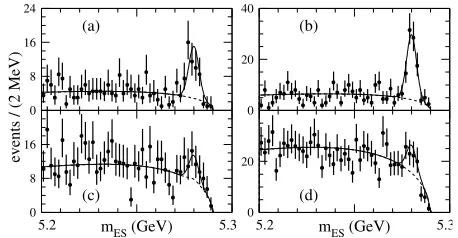
FIG. 1. Projections of the multidimensional fit onto the variable mES for (a) B!K, (b)B0!K0, (c)B! 0K, and (d)B!0 candidates after a requirement on
the signal-to-background probability ratio Psig=Pbkg with the
PDF for mES excluded. The points with error bars show the
likelihood for a sample ofNcandcandidates is
L exp X
3
j1 nj
! Y Ncand
i1 exp
ln Li Ni
: (2)
The event yieldsnj, asymmetriesAj, and polarization fL are obtained by minimizing the quantity $2
2 lnL. The dependence of $2 on a fit parameter nj, Aj, orfL is obtained with the other fit parameters float-ing, their values are constrained to the physical range0
fL1 and 0nj. We quote statistical errors corre-sponding to unit change in$2. When more than oneK
decay channel is measured for the same B decay, the channels are combined by adding their$2 distributions fornj,Aj, orfL. The statistical significance of a signal is defined as the square root of the change in $2 when constraining the number of signal events to zero in the likelihood fit. If no significant event yield is observed, we quote an upper limit for the branching fraction obtained by integrating the normalized likelihood distribution. Performance of the ML fit is tested with generated MC and control samples.
The results of our maximum-likelihood fits are sum-marized in Table I. For the branching fractions, we as-sume equal production rates ofB0B0andBB. We find
significant signals in0K(4:8%),0 (6:1%), and in
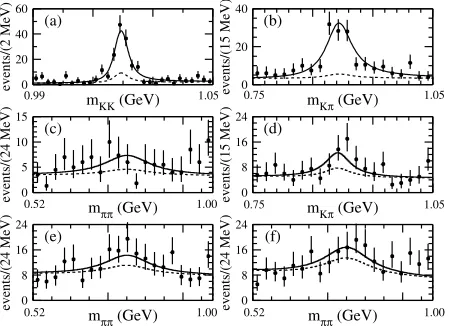
bothK(above10%each) decay modes. We measure the charge asymmetries and longitudinal polarizations in the above modes. The projections of the fit results are shown in Figs. 1 and 2. The asymmetries involving triple prod-ucts are obtained from separate fits. The results are shown in Table II.
Systematic uncertainties in the ML fit originate from assumptions about the PDF’s. We vary the PDF parame-ters within their respective uncertainties, and derive the
associated systematic errors. The signals remain statisti-cally significant under these variations. Additional sys-tematic errors in the number of signal events originate from uncertainty in the background component for K that peaks inmES, where we take the uncertainties to be the estimated values.
The systematic errors in the efficiencies are for track finding (0.8% per track), particle identification (2% per track), and KS0 and 0 reconstruction (5% each). Other minor systematic effects are from event-selection criteria, daughter branching fractions [14], MC statistics, and number of B mesons. We account for the fake combina-tions in signal events passing the selection criteria with a systematic uncertainty of 3% –12%, depending on the mode. The reconstruction efficiency depends on the decay polarization. We calculate the efficiencies using the po-larization measured in each decay mode [15] (combined for the two K modes) and assign a systematic error corresponding to the total polarization measurement er-ror. TheB0 !00branching fraction limit incorporates uncertainties in the PDF’s and in the reconstruction effi-ciency, while we conservatively assume fL1 for the efficiency (which is 29% forfL0and 18% forfL1). In the polarization and asymmetry measurements, we again include systematic errors from PDF variations that account for uncertainties in the detector acceptance and background parametrizations. The biases from the finite resolution in helicity-angle measurement and dilution due to the presence of the fake combinations are studied with MC simulation and are accounted for with a systematic error of 0.02 for polarization. We find the uncertainty on the charge asymmetry due to the track reconstruction efficiency to be less than 0.02 [6]. The asymmetry mea-surements are corrected by the small dilution factors.
In summary, we have observed the decays B!
K, B0!K0, B!0K, and B!0, measured their branching fractions and longitudinal po-larizations, and looked for asymmetries sensitive to CP violation and FSI. These results supersede the earlier
BABAR measurements of the B!K [6]. Our asym-metry results rule out a significant part of the physical region, providing constraints on models with hypotheti-cal particles, but are not yet sufficiently precise to allow detailed comparison with standard model predictions. Our measurement of longitudinal polarization is of in-terest for the study of decay dynamics.
TABLE II. Summary of asymmetry results with triple prod-ucts discussed in the text.
Mode Atp Asp
K 0:020:180:03 0:040:180:03
K0 0:060:120:02 0:070:120:02 0K 0:030:290:03 0:280:38
0:330:04 0 0:090:240:04 0:230:240:04 mKK (GeV)
0 20 40 60 events/(2 MeV) (a)
0.99 1.05 m
Kπ (GeV) 0
20 40
events/(15 MeV)
(b)
0.75 1.05
mππ (GeV)
0 5 10 15 events/(24 MeV) (c)
0.52 1.00 m
Kπ (GeV) 0 8 16 24 events/(15 MeV) (d)
0.75 1.05
mππ (GeV)
0 8 16 24 events/(24 MeV) (e)
0.52 1.00 m
ππ (GeV) 0 8 16 24 events/(24 MeV) (f)
0.52 1.00
FIG. 2. Invariant mass projections (a) , (b) K for B!
K; (c) 0, (d) K for B!0K; (e) 0, (f ) for
B!0 candidates after a requirement on the
signal-to-background probability ratioPsig=Pbkgwith the PDF for mass
We are grateful for the excellent luminosity and ma-chine conditions provided by our PEP-II colleagues, and for the substantial dedicated effort from the computing organizations that supportBABAR. The collaborating in-stitutions wish to thank SLAC for its support and kind hospitality. This work is supported by DOE and NSF (USA), NSERC (Canada), IHEP (China), CEA and CNRS-IN2P3 (France), BMBF and DFG (Germany), INFN (Italy), FOM (The Netherlands), NFR (Norway), MIST (Russia), and PPARC (United Kingdom). Individuals have received support from the A. P. Sloan Foundation, Research Corporation, and Alexander von Humboldt Foundation.
*Also with Universita` di Perugia, Perugia, Italy. †Also with Universita` della Basilicata, Potenza, Italy. ‡Also with IFIC, Instituto de Fı´sica Corpuscular,
CSIC-Universidad de Valencia, Valencia, Spain.
xDeceased.
[1] M. Kobayashi and T. Maskawa, Prog. Theor. Phys. 49, 652 (1973).
[2] Y. Grossman and M. P. Worah, Phys. Lett. B 395, 241 (1997); D. London and A. Soni, Phys. Lett. 407B, 61 (1997).
[3] G. Kramer and W. F. Palmer, Phys. Rev. D45, 193 (1992); H.-Y. Cheng and K.-C. Yang, Phys. Lett.511B, 40 (2001);
C.-H. Chen, Y.-Y. Keum, and H.-n. Li, Phys. Rev. D66, 054013 (2002).
[4] G. Valencia, Phys. Rev. D39, 3339 (1989); W. Bensalem and D. London, Phys. Rev. D64, 116003 (2001). [5] CLEO Collaboration, R. A. Briereet al., Phys. Rev. Lett.
86, 3718 (2001).
[6] BABARCollaboration, B. Aubertet al., Phys. Rev. Lett.
87, 151801 (2001);BABARCollaboration, B. Aubertet al., Phys. Rev. D65, 051101 (2002).
[7] CLEO Collaboration, R. Godanget al., Phys. Rev. Lett.
88, 021802 (2002).
[8] BELLE Collaboration, J. Zhanget al., hep-ex/0306007. [9] BABAR Collaboration, B. Aubertet al., Nucl. Instrum.
Methods Phys. Res., Sect. A479, 1 (2002).
[10] PEP-II Conceptual Design Report, SLAC Report No. SLAC-R-418, 1993.
[11] CLEO Collaboration, D.M. Asneret al., Phys. Rev. D53, 1039 (1996).
[12] TheBABARdetector Monte Carlo simulation is based on
GEANT: R. Brunet al., CERN Report No. DD/EE/84-1. [13] ARGUS Collaboration, H. Albrechtet al., Phys. Lett. B
241, 278 (1990).
[14] Particle Data Group, K. Hagiwaraet al., Phys. Rev. D66, 010001 (2002).