Calculation of Specific Absorption Rate (SAR)
of Patch antenna on Human Brain and Design
of Low SAR value Microstrip Patch Antenna
Lovika1, Jyoti2M.Tech Student, Electronics and Communications Deptt, SUS College of Engineering and Technology Mohali, Punjab, India1
Assistant Professor, Electronics and Communications Deptt, SUS College of Engineering and Technology Mohali, Punjab, India2
Abstract
Human exposure to artificial electromagnetic fields has raised many questions regarding potential adverse effects, particularly for the brain and eye exposure to high-frequency (HF) radiation. The assessment of HF exposure is based on the evaluation of specific absorption rate (SAR) distribution and related temperature rise in a tissue. As a measurement of fields induced in the body is not possible, human exposure assessment is carried out via sophisticated computational models. In this dissertation work, we propose to design a new type of microstrip patch antenna structure to reduce the specific absorption rate (SAR) in human brain. The design of low SAR handset antenna will be operating at 2.4 GHz and 6.4 GHz frequencies for wireless and medical applications. First we propose to calculate the value of SAR of antenna on a brain model. Then different techniques will be projected to reduce the value the SAR on human brain. Optimization and simulation would be carried out by placing antenna at different position to determine position that are more suitable and effectively reduced the SAR level. The statistical results will be compared and analyzed. The proposed low SAR value antenna operating at 2.4 GHz and 6.4 GHz will be designed with optimum parameters like return loss, VSWR, match impedance. The proposed antenna design should achieve 1.483 W/kg for 1 gm. SAR and 1.192 W/kg for 10 gm. After optimizations calculations will be made to have percentage change in new SAR value. Rogers RT5880 lossy material will be used as a substrate having 2.2 dielectric constant. All the simulations and designing will be done using user friendly CST Microwave Studio Software.
Keywords:
Specific Absorption Rate, Microstrip patch antenna, CST Microwave Studio, Rogers RT5880 material1. Introduction
With the growth of recent use and estimated supplementary increases in the use of mobile phones and other private communication services, there has been substantial research effort dedicated to the interaction between antennas on handsets and the human body. These behaviors are motivated by two factors: the need to evaluate the antenna performance in the presence of a human body, and the need to evaluate the rate of radio frequency (RF) energy declaration in the biological tissue, called specific absorption rates (SAR), in order to assess possible health effects and compliance with various RF exposure standards. Recently, the design of mobile handset antennas begins to move away from an omnidirectional type to a selective directivity type or a low SAR type. This is driven mostly by public concerns of potential health hazards of RF radiation into a user’s head. The interaction of the cellular handset with the human head has been explored by many published papers in this dissertation work considering; first, the effect of the human head on the handset antenna performance including the feed-point impedance, gain, and efficiency and second,the impact of the antenna electromagnetic (EM) radiation on the user’s head due to the absorbed power, which is measured by predicting the induced SAR in the head tissue.
somewhat less power is dissipated in the operator’s head but the orientation of the antenna with respect to the head and the position of the antenna inside the handset in relation to the electronics are likely to remain the major influence on SAR. SAR is influenced by many parameters and it was handled and took into consideration three parameters to reduce the SAR level. Substrate permittivity, position of the antenna, type and size of the antenna are those factors that reduced the SAR level of this antenna. In this dissertation work, we propose to design a new type of microstrip antenna structure to reduce the specific absorption rate (SAR) in human brain.
2. Microstrip Patch Antenna Design
The three essential parameters for the design of a rectangular microstrip patch antenna using traditional method are:
(i) Frequency of operation ( ):
The resonant frequency of the antenna must be selected appropriately. The resonant frequency selected for design is at 2.4 GHz.
(ii) Dielectric constant of the substrate ( ):
The dielectric material selected for the design is FR4- epoxy which has a dielectric constant of 4.3. A substrate with a high dielectric constant reduces the dimensions of the antenna.
(iii) Height of dielectric substrate (h):
For the microstrip patch antenna it is essential that the antenna is not bulky. Hence, the height of the dielectric substrate is selected as 1.574mm.The design parameters that are assumed and evaluated are shown in Fig.1 as below:
Figure 1 : Front view of Microstrip Patch Antenna using line feed
3. Low SAR Antenna Design with human head
Model Specifications
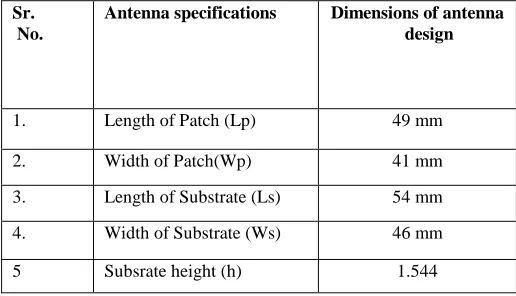
In the proposed system, micro strip antenna is designed using computer simulation software with finite difference time domain technique. Microstrip Patch Antenna Model development includes development of antenna model (micro strip patch antenna), human head model (consistes of brain, skin and skull) and hand held device model. In this work, Microstrip patch antenna is used with single excitation port is placed in free space. Antenna design specifications are given in the following table. In this work, Micro strip patch antenna is used with single excitation port is placed in free space. In the design of micro-strip antenna, there are a few different steps involved in the process using CST STUDIO SUITE in that we have to select a template depending upon application; here we are selecting Antenna (mobile phone).The ground plane is implemented, the length of ground plane is 54 mm and the material used for this is PEC (Perfect Electric Conductor). There is a substrate sheet between patch and ground plane and dimensions of substrate and ground plane are same and the material used here is FR-4 (lossy). FR-4(lossy) is selected because of its low cost and easy availability in market for fabrication purpose. The length of the antenna is 49 mm and different dimensions are given in the X and Y direction. For analyzing SAR and thermal distributions, the near field environment may include a human head and antenna enclosed by a plastic frame, which may influence on antenna performance. After following the design procedure explained in 1.3.2 values shown in Table 1 are calculated.
Table 1:Antenna Design Specifications
Sr. No.
Antenna specifications Dimensions of antenna
design
1. Length of Patch (Lp) 49 mm
2. Width of Patch(Wp) 41 mm
3. Length of Substrate (Ls) 54 mm
4. Width of Substrate (Ws) 46 mm
4. HUMAN HEAD MODEL:
The user’s head was modeled as a sphere with three layers such as skin, skull and brain, using CST software. Human body tissues have different values of dielectric properties that is,permittivity and conductivity .A handheld device model used for human interaction was modeled by CST. Figure shows the interaction of handheld geometric model which has a maximum dimension 96 mm with spherical human head. Components considered for simulation are feeding port (patch antenna), plastic cover (eε =2.2) and plastic cover was modeled as dielectric materials
Figure 2: Geometrical view of low value SAR Antenna with Human Head Model
Computer simulation technology is used to generate animations of the electric surface currents with feeding port excited. Feeding port is used to generate power supply for patch antenna. Current distribution is different for 4 years child, 8 years child and adult, which depends upon the water content this, differs from people to people. The excitation of the port induces high-magnitude surface currents in the proximity of each feed, but a null-current area is clearly shown to exist at the open circuit end.
Figure 3: Complete view of Head Model showing skin,skull and brain
5. Results and Discussion:
1. Return Loss:
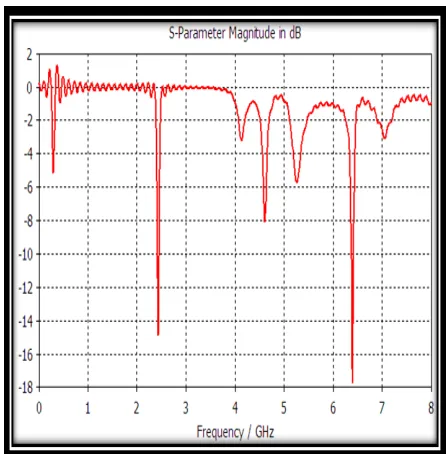
The proposed antenna was fabricated on FR4 substrate with dielectric constant 4.3, loss tangent 0.02, and thickness 1.574 mm. The result (Fig 4.1)indicates that, for frequency band of interest (2.4 GHZ and 6.2 GHz), feeding port provides a better return loss suitable for ISM (Industrial, Scientific and Medical applications).The simulated 3-D gain pattern for patch antenna, for the operating frequency of 2.4 and 6.4GHz. During the simulation process of dual band patch antenna various parameters are considered for example length (Ls) and width (Ws) of substrate, shape of slots and their dimesions, feeding point, dimensions of patch in order to give desired dual frequency response with matched impedance, wide bandwidth, low return loss and VSWR values.The radiation patterns of the proposed antenna were measured in anechoic chamber.
Figure 4: Retun loss versus resonant frequency Plot
2. Specific Absorption Rate (SAR):
calculated from the electric field within the tissue as: SAR can be related to the electric field at any point by
SAR = Watt/kg
Where E is the electric field in V/m, is conductivity of
tissue in S /m and is the density of tissue in g/cm3
Figure 4. : Patch Antenna with human model showing SAR values averaged over 1 gm and 10 gm tissues
Above figure shows the SAR values of patch antenna
averaged over 1 gm and 10 gm tissues.These values
are 3.54 and 2.54 respectively. These SAR values are
not acceptable as per international standards and
have dangerous effect on human head.So we need to
design such an antenna which gives very low SAR
values lesser than 1.56. In the next stage of design
patch antenna design specifications are optimized to
give desired results.Following figure shows the new
design of antenna in which human head is very close
to hand held device.It gives SAR value of 0.0052
which is very less than standard value of SAR.In
present dissertation work,testing of antenna on
human brain depicts that shape,design of antenna and
distance of antenna have great effect on SAR value.
Figure 5 : Low SAR value Antenna design with Human Head Model
Figure 6: Patch Antenna Design having very low SAR value.
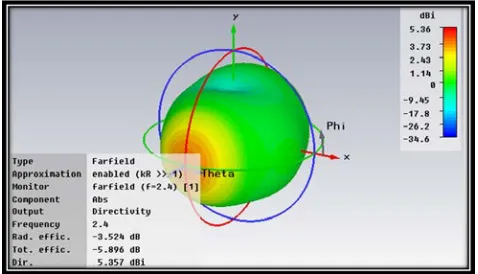
The radiation pattern or directivity of antenna is depends on the shape of the radiating patch and the slot which is cut away from the radiating patch, so by the changing the shape of the radiating patch or the slot of the radiating patch the radiation pattern of antenna can be changed. The radiation pattern of antenna can also be changed by changing the dielectric loss of the FR-4 substrate and changing the distance between the ground plane and the substrate.The result (Figure 4.1 )indicates that, for frequency band of interest (2.4 GHz and 6.2 GHz), feeding port provides a better return loss suitable for wireless communication applications. The simulated 3-D gain pattern for patch antenna, for the operating frequency of 2.4 GHz. The total efficiency of an antenna is defined as the ratio of total radiated power to the incident power at the feed. The original radiated pattern of patch antenna gets altered due to human head interaction shown in fig 5
Figure 6 : Directivity Pattern of antenna
Conclusion
absorption rate (SAR) in human brain. The design of low SAR handset antenna is operating at 2.4 GHz frequency for ISM applications (Industrial,Medical and Scientific) by considering some parameters that determine the performance of the antenna. First we calculated the value of SAR of antenna on a brain model.After that,different methods or techniques will be proposed to reduce the value the SAR on human brain.Optimization and simulation carried out by placing antenna at different position to determine position that are more suitable and effectively reduced the SAR level. The numerical results will be compared and analyzed. The proposed low SAR value antenna operating at the range of frequency from 2373 to 2435 MHz designed with optimum parameters like return loss, VSWR, bandwidth and directivity. The proposed antenna design achieve 0.0052 W/kg averaged over 1 gm tissue. The resultant SAR value is very lesser than optimum value of SAR.After optimizations calulations will be made to have percentage change in new SAR value.The low SAR value antenna will be designed on Rogers RT5880 lossy substrate having 2.2 dielectric constant. All the simulations and designing are done using user friendly CST Microwave Studio Software. When the antenna is very close to the human head, all antennas types under study deposit in the near-surface tissues of the head power levels that exceed the FCC standard. The patch antenna is most likely to meet the safety standard. Due to different location with respect to the radiating antenna and different conductivities, not all the tissues experience the same power absorption. SAR must be calculated and averaged separately for each identified tissue volume for accurate and significant assessment of potential risky implications of the absorbed radiated power.So in this dissertation work, dual band antenna for ISM applications with low SAR has been designed using novel techniques. In this present dissertation work, we analyzed that by changing the dimesions, position of antenna we can have low value of SAR.SAR value gets reduced with the distance of antenna with human head.
Future Scope
As in this dissertation work, we designed low SAR value antenna by varing the dimesions and position of antenna with human head.In future work ,we can design low SAR value antenna by using metamaterial as a substrate instead of using Roggers substrate.Impedance and bandwidth of
low SAR value antenna design can be improved further by using more novel techniques.also.
REFRENCES
[1] C. A. Balanis, “AntennaTheory” JohnWiley & Sons, 3rd edition, 2005 chp-4 pp. 722-784
[2] H Singh, “Electromagnetics and Antennas”, Katson
publication, New Delhi, 2nd edition.
[3] Sudhir Shrestha, Mangilal Agarwa,” Microstrip Antennas
for Direct Human Skin Placement for Biomedical Applications”, Progress In Electromagnetics Research Symposium Proceedings, Cambridge, USA, July 5-8, 2010
[4] Mohammad Rashed Iqbal Faruque, Mohammad Tariqul
Islam “SAR Analysis in Human Head Tissues for Different Types of Antennas” World Applied Sciences Journal 11 (9) : 1089-1096, 2010 ISSN 1818-4952 ,IDOSI Publications, 2010
[5] Zhi Hao Jiang, Member, IEEE, Donovan E. Brocker,
Student Member, IEEE, “A Compact, Low-Profile Metasurface-Enabled Antenna for Wearable Medical Body-Area Network Devices”, IEEE TRANSACTIONS ON ANTENNAS AND PROPAGATION, VOL. 62, NO. 8, AUGUST 2014
[6] Sakshi Kumari and Vibha Rani Gupta,” Measurement of
Specific Absorption Rate of Monopole Patch Antenna on Human Arm”,International journal of microwave and optical technology, VOL.10, NO.3, MAY 2015
[7] Mohammad Rashed Iqbal Faruque, Norbahiah Misran,
Mohammad Tariqul Islam,“ New low specific absorption rate (SAR) antenna design for mobile handset”, International Journal of the Physical Sciences Vol. 6(24), pp. 5706-5715, 16 October, 2011
[8] Taheri M.M.S., Hassani H.R., Nezhad S.M.A., “UWB Printed Slot Antenna With Bluetooth and Dual Notch Bands”, IEEE Antennas and Wireless Propagation Letters, Vol-10, pp: 255-258, 2010,
[9] Asma Lak and Homayoon Oraizi “Evaluation of SAR
Distribution in Six-Layer Human Head ModelHindawi Publishing Corporation International Journal of Antennas and Propagation Volume 2013, Article ID 580872, 8 pages
[10] http://dx.doi.org/10.1155/2013/580872Nguyen T. D., Lee D. H., Park H. C., “Design and Analysis of Compact Printed Triple Band-Notched UWB Antenna” IEEE Antennas and Wireless Propagation Letters, pp-403, 2011.
[11] Natarajamani.S, S K Behera& S K Patra, “A compact wide band patch antenna for WLAN aaplications”, Second International conference on Computing, Communication and Networking Technologies, pp: 1-4 ,2010.
International Conference on Communication Control and Computing Technologies (ICCCCT) pp:9-11, 2010
[13] Sobhan Saravani*, Chandan K. Chakrabarty, and
Norashidah M. Din”Compact Bandwidth-Enhanced
Center-Fed CPW Zeroth-Order” Progress In
Electromagnetics Research Letters, Vol. 66, 1–8, 2017
[14] Gui Liu, Mengli Fang, Ruixing Zhi, Jin Bai, and Zhe Zeng “Compact CPW-Fed Multiband Antenna for
TD-LTE/WLAN/WiMAX Applications”Vol. 65, 9–14, 2017
[15] Abdullah M. Zobilah, Noor A. Shairi, and Zahriladha Zakaria” Fixed and Selectable Multiband Isolation of Double Pole Double Throw Switch Using Transmission
Line Stub Resonators for WiMAX and LTE”Vol. 72, 95–
110, 2017
[16] Azadeh Pirooj1, Mohammad Naser-Moghadasi1, Ferdows
B. Zarrab and Alireza Sharifi1“A Dual Band Slot Antenna for Wireless Applications with Circular Polarization”Vol. 71, 69–77, 2017.
[17] Mohammad El Ghabzouri1,Abdenacer Es Salhi,Pedro
Anacleto and Paulo M. Mendes” Enhanced Low Profile, Dual-Band Antenna via Novel Electromagnetic Band Gap Structure”, 71, 79–89, 2017
[18] Josiel do Nascimento Cruz, Raimundo Carlos Silvério Freire, Alexandre Jean René Serres“Parametric Study of Printed Monopole Antenna Bioinspired on the Inga Marginata Leaves for UWB Applications” Vol. 16, No. 1 March 2017
[19] M. Abdollahvand, G. Dadashzadeh, and D. Mostafa
,“Compact Dual Band-Notched Printed Monopole Antenna for UWB Application”, IEEE Antennas and Wireless Propagation Letters, Vol. 9, pp:1148-1151, 2010.
[20] Eun-Seok Jang,Che-Young Kim,Dae-Geun Yan and