ISSN 2286-4822 www.euacademic.org
Impact Factor: 3.4546 (UIF)
DRJI Value: 5.9 (B+)
Analysis of Micro Entrepreneurs Dependency on
Informal Money Lenders: Basis for Developing
Micro Financing Program
YURI WALTER D. AKIATE, Ph. D
Don Honorio Ventura Technological State University Bacolor, Pampanga, Philippines
Abstract:
This paper investigated the dependency of micro entrepreneurs on informal money lenders that will be a basis in developing micro financing program. The study was conducted in one of the public markets of City of San Fernando, Pampanga. Purposive sampling was used because it was only focused on the micro entrepreneurs who experienced borrowing money from the informal money lenders. The results showed that that those who are less educated, married, and have large household size are more likely to borrow from the informal lenders. Moreover, loan procedure, no collateral, cost of loan, amount of loan, uses of loan, accessibility, and credibility of the lender seems to be the main factors that the borrowers consider in borrowing from the money lenders. On the other hand, results also showed that the fast release of loan is the number one reason of borrowers in borrowing money from informal money lenders. Therefore, microfinance programs focused in this underserved sector were recommended.
Key words: Informal moneylending, formal moneylending, micro-entrepreneurs, micro-financing institutions, microfinance programs
INTRODUCTION
business are just scattered in all directions like the “talipapa” and sidewalk vending. Offhand, these are unlawful in the context of underground economy (Villegas, 2002).
The informal economy is composed of entrepreneurs engaged in economic activities that typically fail to comply with the legal requirements, even as the objectives of their endeavor are perfectly lawful. They tend to violate at least one or more formal legal requirements like government’s licensing, minimum wage, tax, sanitation and reporting (Geron, 1991). According to Larson (1988), underground economy is also known as unreported economic activity. This includes otherwise legal activities not reported to the taxing authorities. The existence of this activity is due to the desire of the concerned individuals to meet their interest that they could not get when they engage in formal economic activity.
The existence of an unorganized, unregistered informal sector was recognized in the early 1970s, following observations in several developing countries that massive addition of the urban labor force failed to show up in formal modern-sector unemployment statistics (Todaro, 2001). These are the activities of economically handicapped persons who are forced to create personal income-generating activities because they simply cannot afford the cost of being formal. Being formal means having to register the business, get the requisite permits and accomplish the appropriate forms. In other words, they have to face the often complex network of the government’s bureaucracy (Floro & Ray, 1997).
Underground economy is not only confined to selling goods or items and extending services to other people. Informal money lending or informal financing is also considered part of the underground business or underground economy (Lamberte, 2003). According to the book, financial institutions by Fajardo Manasala, and Altarez (1994), the structure, objectives and functions of this business are not defined and are not based on government laws and policies. They are unregulated and unsupervised by the Bangko Sentral ng Pilipinas. They are actively engaged in the business of money lending. They provide loans mostly to the poor consumers and small producers and merchants. Such groups or individuals have no officers, employees, and other similar facilities, which the banks have.
The informal money lending has become a prime alternative source of credit because the “needy” could just borrow money easily and anytime from the informal lenders without submitting complex requirements. This borrowing activity from the informal lenders is very common to individuals whose income is not sufficient for the family and to small entrepreneurs who need additional working capital to make their business grow in order to provide the basic needs of their family (Villegas, 2002).
These poor and small borrowers are forced to patronize the informal money lenders because they simply do not have any asset large enough to function as collateral. If they apply for loans in formal financial sectors, they are generally ignored and considered “credit risks” and “unbankable” by the formal lending business (Atieno, 2001).
In the City of San Fernando, Pampanga, money lending is numerous. To name some are banks, cooperatives, government and private insurance, lending investors as well as pawnshops. Banking industry leads the business and it is growing in number and expanding its operations. In this city, the following banks are Banco de Oro, Bank of the Philippine Islands, Philippine National Bank, Landbank of the Philippines, China Bank, Metro Bank, Allied Bank, UCPB, Robinsons Bank, Planters Bank, RCBC, Postal Bank, Bank of Commerce, PS bank, Eastwest Bank, and Security Bank. They are key players in the banking sectors, thrift and specialized government banking. Aside from banks, there are cooperatives such as Golden Group Gabay Puhunan Brotherhood Multipurpose Cooperative, Serbiz Multi-Purpose Cooperative, Apung Jose Multipurpose Cooperative, Buklod Yaman Ng Bulaon
Multipurpose Cooperative, CSFP Employees Credit
Cooperative, Coops for Christ Multipurpose Cooperative, Kilusang Nueve Primary Multipurpose Cooperative, Inc., and Minukyat Banua Multipurpose Cooperative, Radiant Shine Multipurpose Cooperative. Moreover, there are government and private financing institutions like Government Service Insurance System, Social Security System, Pag-ibig and some other non-bank financial institutions are also in the city as loan sources.
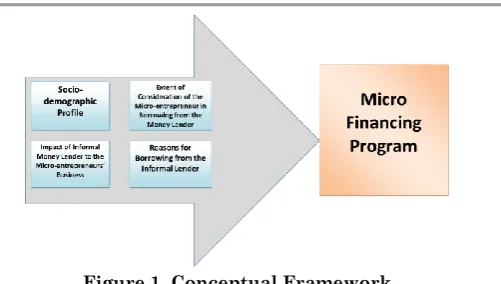
Figure 1. Conceptual Framework
The aim of this study is to present an empirical analysis of micro entrepreneurs’ dependency on informal money lenders that will be a basis for developing micro finance program. Most studies on this subject focused on the agricultural and the household sectors. The micro-enterprises sector of the economy relies on financial services to expand their earning capacity and in some cases meet emergency needs of the family. The respondents of the study were meat, vegetable, seafood, fruit, dry goods, sari-sari and rice vendors in one of the public markets of City of San Fernando, Pampanga who have experienced borrowing from the informal money lender. This paper will look at the extent of consideration of the borrowers in borrowing from the money lender and the reasons for borrowing from the informal money lender.
Statement of the Problem
money lending in terms of the borrowers’ asset purchases, increase of sales, and increase on the net income of the business?; d.) what are the reasons for borrowing from the informal moneylender?
Scope and Delimitation
The study was conducted on micro entrepreneurs at one of the public markets of City of San Fernando, Pampanga, Philippines. The respondents were meat, vegetable, seafood, fruit, dry goods, sari-sari and rice vendors who have experienced borrowing from the informal money lender.
RESEARCH DESIGN AND METHODOLOGY
This study utilized descriptive method of research to assess the micro entrepreneurs’ dependency on informal money lenders. The descriptive method was undertaken in order to ascertain, and be able to describe the relevant aspects of the phenomena of interest from an individual (Sekaran & Bougie, 2010).
The research study was conducted in one of the public markets of City of San Fernando, Pampanga, Philippines. Purposive sampling was used because it was only focused on the micro entrepreneurs who experienced borrowing money from the informal moneylenders. The samples from the borrowers included 72 respondents from a total of 192 registered retailers in the said market. The respondents of the study were meat, vegetable, seafood, fruit, dry goods, sari-sari and rice vendors.
The researchers use a set of questionnaire which they developed to gather the necessary data. Tagalog and English languages were prepared to be easily understood by the respondents.
A dry run was also conducted for this study to find out
whether the instrument were clearly stated and
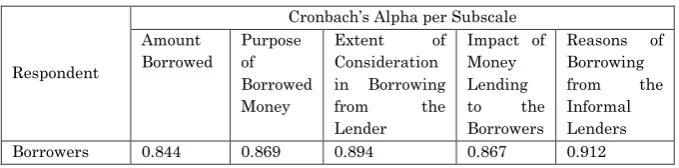
micro entrepreneurs in Angeles City Public Market. It was found out that all the survey questions were comprehensible to all respondents (see Table 1). The group was not included in the study.
In order to measure the reliability of the instrument, Cronbach’s Alpha coefficient was computed. A minimal alpha coefficient of 0.70 is required to claim that all instruments and its subscale scores are internally consistent and reliable though the alpha value between 0.80 and 0.90 is preferred (Guyatt et al., 1993).
Table 1: Instrument Reliability Test Results
The researchers distributed personally the questionnaires to the respondents. Adequate care was undertaken while distributing the questionnaires to make sure that these are given to the micro entrepreneurs who experienced borrowing money from the informal lenders. The collection of data was accomplished by the researcher. Since most of the time they were busy, the researchers distributed the questionnaires and retrieved them during their free and most convenient time most likely at six o’clock in the afternoon. In all cases, verbal instructions were highlighted that there were no right or wrong responses and participants should answer questions as honestly as possible. Emphasis was also given to the confidentiality of responses since only the researchers would have direct access to them.
The gathered data were encoded, analyzed, and interpreted using the frequency and percentage distribution, and arithmetic Mean. The mean was used to determine the Respondent
Cronbach’s Alpha per Subscale Amount Borrowed Purpose of Borrowed Money
Extent of Consideration in Borrowing from the Lender
Impact of Money Lending to the Borrowers
extent of consideration the borrowers have in relation to the factors involved in availing credit from the lenders.
RESULTS AND DISCUSSIONS
This chapter presents, analyzes and interprets the data gathered in the study. The study was conducted mainly to present an analysis of micro entrepreneurs’ dependency on informal money lenders that will be a basis for developing micro finance program.
Profile of the Borrowers
The bulk of borrowers are 41- 50 (36.11%) years old, followed by 31-40 (19.44%) years old. The civil status of borrowers where 45 (62.50%) are married, 16 (22.22%) are single, 8 (11.11%) are widows and widowers, and 3 (4.17%) are separated. It is rational to say that many of the borrowers are married since all of them fall under the economically productive age. This age group typically belongs to the marriageable age. Moreover, it reflected that married people have many obligations to settle, many basic needs of the family to provide, and greater responsibility to face.
individual. Accordingly, they will opt for the formal financial institutions (e.g. banks, lending institutions) that offer lower effective interest rate.
It is noteworthy to know that most of the respondents earn Php 5,001- Php 10,000 (47.22%) per month, followed by Php 10,001- Php 15,000 (29.17%). However, it is also alarming to know that some micro-entrepreneurs earn less than Php 5,000 (7 9.72%) per month. Twenty three respondents borrowed Php 20,001- Php 25,000 (31.94%), followed by fourteen respondents that borrowed Php 10,001- Php 15,000 (19.44%). It reflects that with little amount of income, it results to insufficient basic needs. The micro-entrepreneur looks for other sources of money to meet other needs of the family as a result of limited means or earnings.
All of the respondents (100%) borrowed from the informal lender for business purposes. Portion of the loaned money was used for daily subsistence with forty five and eighty three percent (45.83%), education for children with twenty seven and seventy eight percent (27.78%), and others (e.g. hospitalization/ medication of a member of the family, repayment of a previous loan, house improvements) with twelve and fifty percent (12.50 %). From these findings, it is evident then that the income of these respondents is not enough to support the basic and capital needs for their business.
Extent of Consideration in Borrowing Money
It shows that the overall descriptive rating to all the factors is “Very Much Considered”. It means that micro-entrepreneurs greatly consider these factors before borrowing.
doing. The borrowers prefer procedures of borrowing where there is no formal processing of loan papers and application.
The amount of loan is also rated “Very Much Considered” by the micro-entrepreneurs. Since most of the small borrowers need small amount of funds, they run to the informal lenders who provide immediately.
Borrowers rated purposes of loan such as business (production and trade), daily subsistence/needs, and education of children as “Very Much Considered”. It reflects that the borrowers seek loan from the lenders because of urgency of financial needs, usually for emergency like payment for inventory or asset purchases, tuition fees and some kinds of purposes. The borrower needs easy money or easy loans. If there are unplanned expenditures, the borrower does not have time in processing loan with the formal lending institutions; therefore, the preference is on the informal moneylender.
On the aspect of interest rate or cost of loan, the borrowers also rated “Very Much Considered”. The borrowers would seek a lender who would impose a lower interest rate as possible. The debtors are often taken advantage of by the informal lenders because of paying high interest rates. Since they are on financial crisis, borrowers are forced to go to the informal lenders.
The borrowers also rated “Very Much Considered” the item on accessibility of loan from the lenders. The transaction is often informal and easy processing because of the approachability and personalized services of the informal lender. This could be a good factor of informal lending that makes the operation of informal lenders successful.
Lastly, in terms of credibility of the lender, the borrowers rated “Very Much Considered” this factor. It means that borrowers look for a trusted lender that could give the needed money immediately; a lender that could help them in some way or another, like giving consideration and grace period or extension of payment in case of failure to meet the due date.
Impact of Informal Moneylending in Terms of Asset Purchases Majority of the respondents (68.06%) used over 80.1% up to 100% of the borrowed money for asset purchases and twenty and eight three percent (20.83%) of the respondents used 60.1% up to 80% of the money loaned for the same purpose. It is reflected that borrowers were able to procure different kinds of assets out of the borrowed money on cash basis and pay back the informal money lender through installment basis.
Impact of Informal Moneylending in Terms of Increase of Sales Majority of the respondents (84.72%) affirmed that there is an increase of sales in their business and eleven respondents (15.28%) reported that there was no increase of sales. It reflects that the micro-entrepreneurs are expanding their operation.
Impact of Informal Moneylending in Terms of Increase on the Net Income of the Business
It is alarming to know that thirty nine respondents (54.17%) answered that there was no increase of net income generated from the business even if there was an increase in sales. This is may be due to the fact that they still need to pay for the cost of loan which is being deducted to their net income.
Reasons in Borrowing from the Informal Lender
where and when the borrower needs it. The informal lenders are usually open to any kind of borrower, no business hours to follow, simple operation and personalized services to the borrowers. The formal lending institutions like banks cannot do these and therefore the informal money lending businesses boom. Formal moneylenders consider the small borrowers as credit risks and “unbankable” so the borrowers prefer to avail loan from the informal moneylenders. Other than the fast release of loan, as shown in the table, it is safe to conclude the most of the borrowers said that all of the below mentioned factors are reasons in borrowing from the informal lenders such as accessibility, no complex requirement, easy to approach and no collateral. Another reason why borrowers prefer to borrow from informal lenders is approachability and caring attitudes of the informal lenders because the borrowers do not have to be well-dressed and they may come anytime and any day for emergency loans. It reflects that borrowers prefer to borrow money from the informal money lenders with the least difficulty and least time to transact business with them.
Summary of Findings
The study aimed to assess micro entrepreneurs’ dependency on informal money lenders that will be a basis for developing micro finance program.
The salient findings of the study are presented hereunder.
Extent of Consideration of Factors of Borrowing Money. The seven factors in borrowing money from informal money lenders were rated within the range “Very Much Considered” with a mean rating from 4.22 to 4.75, These are ranked as follows: 1.) loan procedure, 2.) no collateral, 3.) cost of loan, 4.) amount of loan, 5.) uses of loan, 6.) accessibility, and 7.) credibility.
Impact of Informal Lending to the Business. Majority of the respondents (68.06%) used over 80.1% up to 100% of the borrowed money for asset purchases and affirmed that there is an increase of sales in their business. 54.17% of the respondents claimed that there was no increase of net income generated from the business even if there was an increase in sales.
Reasons for Borrowing Money from Informal Money Lenders. A great percentage of the respondents (94.44%) affirmed that the most common reason in borrowing from the informal money lender is the fast release of loan in times of financial needs. The rest are accessibility (86.11%), no complex requirements (90.28%), approachability of the lenders (84.72%) and no need for collateral (77.78%).
CONCLUSION
The following conclusions were drawn from the study:
1.As to personal profile, there are more married respondents aged 41-50 years old, more males, mostly high school graduates, with one to five dependents and an average monthly income ranging from five thousand and one pesos to ten thousand pesos (Php 5,001 – Php 10,000). Most of them borrowed Php 20,001- Php 25,000 that was used for business purposes.
3.On the impact of informal money lending to the business, all micro entrepreneurs used a portion of the borrowed money for asset purchases that increased sales but has not increased the net income of the business.
4.Fast release of loan is the number one reason of borrowers in borrowing money from informal money lenders.
RECOMMENDATIONS:
Based on the findings and conclusions of the study, the researchers forward the following recommendations.
1.It is apparent from the study that less educated entrepreneurs are easy prey for the informal lenders. The less-educated entrepreneurs are not aware of the high effective cost implied by the nominal rate. Microfinance institutions (MFIs) should provide funds with favorable terms.
2.MFIs should encourage micro entrepreneurs to become members to their organization to avoid usurious interests demanded by informal money lenders.
3.Enterprises with increase of sales but same net business earnings is usually experienced due to exorbitant interest rates from informal lenders. It is a reason why it is more difficult for micro entrepreneurs to expand their earning capacity. Therefore, MFI should focus in empowering this underserved sector. Entrepreneurial skills enhancement by the MFIs is recommended.
4.MFIs should provide loans without collateral to small-scale borrowers, specifically microenterprises. Instead of collateral, they can use guarantors.
5.The MFIs should also be reaching borrowers who have viable businesses but have limited financial resources.
7.MFIs should streamline operations to simplify documentation and procedures. A simple procedure design will be easier for the borrowers to understand and for the staff to implement.
8.Loan agents of the MFIs are needed to deliver the loans at the doorsteps of micro entrepreneurs in a specific area. MFIs must clearly define geographic areas assigned to loan agents. Efficient planning of travel schedules of loan agents can reduce costs
9.Maintain inexpensive offices close to borrowers. Preferably, select staff from the communities.
10.Decentralize loan approval through a branch-level credit committee. For instance, a loan agent presents and defends his/her loan recommendation to a credit committee.
11.MFIs should reward clients who pay on time through interest rebates, bigger loans and/or longer terms.
12.MFIs should sponsor seminars and conferences that would influence the small time borrowers in their awareness on the negative effects of informal lending-borrowing activity.
13.MFIs should maintain regular contact with clients.
Other Recommendations:
14.The local officials of the city should provide measures to minimize the prevalence of informal money lending business in the city by implementing accessible micro-financing project to micro-entrepreneurs.
15.The Bureau of Internal Revenue should monitor and check the existence of informal money lenders and have them be formally registered so that they will also pay taxes to the government.
Acknowledgement
REFERENCES CITED:
1. Aleem, I. (1990). Imperfect information, screening, and the costs of informal lending: A study of a rural credit market in Pakistan. The World Bank Economic Review, 4(3), pp. 329-349.
2. Basu, K., Rural credit markets: The structure of interest rates, exploitation, and efficiency.
3. Danao, R.A. (2002). Introduction to statistics and econometrics. Quezon City: University of the Philippines Press.
4. Dutta, D. & Mangableh, I. (2004). A socio-economic study of the borrowing process: The case of microentrepreneurs in Jordan. School of Economics and Political Science Working Papers ECON 2004-7, The University of Sydney.
5. Floro, S.L. & Yotopoulos, P.A. (1991). Informal credit markets and the new institutional economics: The case of Philippine agriculture. San Francisco: Westview Press. 6. Godquin, M. & M. Sharma (2005). If only I could borrow
more! Production and Consumption Credit Constraint in the Philippines.
7. Gujarati, D. (2003). Basic Econometrics, 4th ed. New York: McGraw-Hill.
8. Lamberte, M.B. & Manlagnit, M.C.V. (2003). Household poverty: Addressing the core of microfinance. PIDS Policy Notes No. 2003-15.
9. Llanto, G.M. (2003). A microfinance promise: To provide the poor access to finance services. PIDS Policy Notes No. 2003-06.
10.Llanto, G.M. (2001). Sustainable rural finance: Policy and design issues. PIDS Policy Notes No. 2001-04.
12.Patalinghug, E.E. (2006). The microfinance promise: The Philippine experience. UPCBA Professorial Chair Paper. 13.Stiglitz, K. E. & Weiss, A. (1981). Credit rationing in
markets with imperfect information. The American Economic Review, 71(3), pp. 393-410.
14.Valiente, M.J.B. (2001). Role and impact of credit on the public market retailers in Los Banos, Laguna.
Unpublished Special Problem in Agribusiness
Management. UP Los Baños.
15.Zeller, M. (1994). Determinants of credit rationing: A study of informal lenders and formal credit groups in Madagascar. Food Consumption and Nutrition Division Discussion Paper No. 2. Washington.