Analysis DC Motor Non linear Behavior Using
Modeling and Simulation
Sandeep Goyat
1, Dr.Meena Tushir
2Ph.D Research Scholar, Dept. of Electrical., JJT University, Jhunjhunu, Rajasthan, India1
Associate Professor, Dept. of Electrical, MSIT college, New Delhi, (India)2
ABSTRACT: - DC motors have been widely used in the electromechanical systems due to its simple structure, ease of implementing variable speed control and low cost. In high accuracy servo control system, high control performance of DC motor is needed. DC motors have traditionally been modeled as IInd order linear system, which ignores the dead nonlinear zone of the motor. Unfortunately, the dead zone caused by the nonlinear friction would bring great effect to servo systems. This paper studies the non linear model of the DC motor and the effects of different types of friction in determining motor dynamics at low speeds using modeling and simulation with MATLAB Simulink.
KEYWORDS: DC Motor Non linearity, Friction, Modeling, MATLAB Simulink
I. INTRODUCTION
Most mechanical systems used in industry are composed of masses moving under the action of position and velocity dependent forces. These forces exhibit nonlinear behaviour in certain regions of operation. For a multi-mass rotational system, the nonlinearities, like Coulomb friction and dead zone, significantly influence the system operation. A sound knowledge of the system characteristics is of primary importance in any industrial application [1]. For process control and automation purposes, a detailed analysis of the plant with its every component should be performed. Especially, control selection and design for high performance electromechanical systems such as weigh feeders requires the availability of detailed information about the components of the plant, with its linear and nonlinear, static and dynamic characteristics [1,2]. For such systems, the assumption that the nonlinearities are negligible leads to loss in the generality of the results obtained [3].
DC motors, as components of electromechanical systems, are widely used as actuating elements in industrial applications for their advantages of easy speed and position control and wide adjustability range [3]. Consequently, examination of DC motor behaviour constitutes a useful effort for analysis and control of many practical applications [1– 3]. In modeling a DC motor connected to a load via a shaft, the general approach is to neglect the nonlinear effects and build a linear transfer function representation for the input–output relationship of the DC motor and the load it drives [1,4]. This assumption is satisfactorily accurate and valid as far as conventional control problems are concerned[5].
However, when the DC motor operates at low speeds and rotates in two directions, or when it has a wide range of operation and high precision control is needed for the application, the assumption that the nonlinear effects on the system are negligible may lead to intolerably high modeling errors and result in poor control performance [1,3]. This paper basically focuses on nonlinear modeling and proposes an innovative MATLAB model to study of dynamic response of DC motors in open loop for changes in load torque and armature voltage to identify the effects of Coulomb friction and dead zone nonlinearities[6]. The results of the MATLAB model shall prove to be very useful in designing the control strategy for applications involving DC motors
II. NON LINEAR MODEL OF DC MOTOR
effects are difficult to predict and vary with the plant load[7-9]. Modelling is difficult, and control strategies that work in “textbook” cases often fail to work in the real world. Two of the factors that often contribute to this difficulty are friction and backlash. These effects are highly nonlinear, difficult to model and analyze even with a „fully nonlinear‟ model, yet cannot be ignored[10].
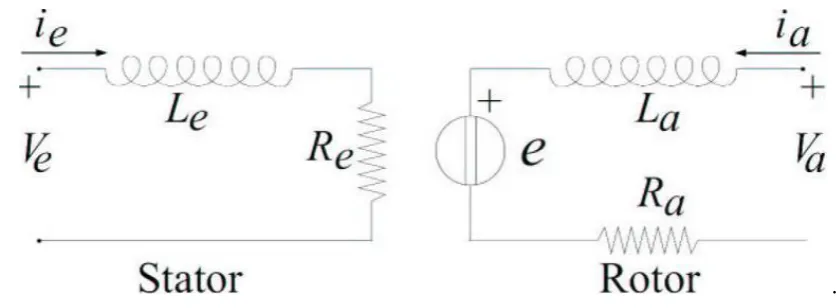
The DC motor which is typically employed in electromechanical systems such as weigh feeder for low speed control also has significant friction. Figure below depicts the electrical and mechanical model of a typical shunt wound,
.
Fig 1: Equivalent circuit of Shunt wound separately excited DC Motor
The equations associated with electrical circuits are given by:
Ve (t) = Le d ie/ dt + Re ie for the stator side Va (t) = La d ia/ dt + Ra ia for the rotor side
The motor exerts a torque, due to voltages supplied on the stator and on the rotor. The following two equations hold for the back EMF e and the torque TM:
TM = K ie ia e = K ie ω,where K is the torque constant of the motor
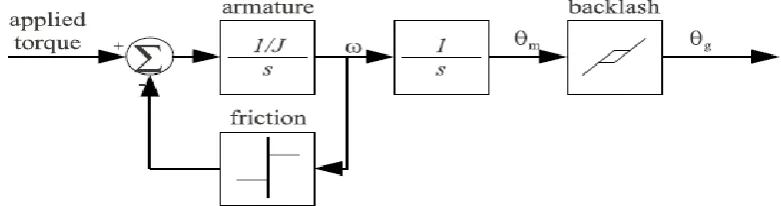
This torque acts on the mechanical structure, which is characterized by the rotor inertia J and the viscous friction coefficient F [11]. It has also to be taken into account that in any operating environment a load torque is exerted on the motor; then, if TL is the load torque, the following equation may be written:
TM – TL = J dω/ dt + F ω where ω is the angular velocity of the motor rotor
By implementing the above equations in a nonlinear block diagram, the result shown in Figure 8 is obtained. In the block diagram, the variable θ represents the rotor angular position[7-8]. The nonlinear model results in a two-input, one-output map, having a disturbance input TL
Fig 3: Force Vs Velocity Plot for Friction with ξ representing small threshold value indicating discontinuity
The main characteristics of a mechanical interface with friction. The stiction (or starting friction) is the amount of force required to break the interface loose. Most interfaces with friction also exhibit stiction (or starting friction). Stiction is the effect where, if the interface has remained still for any length of time, the amount of force required to start the relative motion is greater than the amount required to sustain it. The Coulombic (or “dry”) friction is that portion of the running friction that is dependent only on the direction of motion but has constant magnitude. Finally most mechanisms with friction also display some viscous drag that is more or less proportional to velocity[12].
Further, the speed required by the load is too low as compared to the nominal speed of the motor. In such cases, gears are introduced between the motor and the load, thus reducing by a factor n the angular velocity of the load itself. When a gear is inserted in an actuator system, backlash is experienced on its output due to the coupling between the cogwheels of the gear[13]. This gives rise to nonlinearities and discontinuities in the force/velocity relationships.
Figure 4: Input Vs Output displacement for an element with Backlash.
Typically, in an electromechanical system with DC Motor the friction effects are dominant at low motor speeds and gradually get less prominent with higher motor[14].
Theoretically in DC motor speed control using armature voltage variation, the relationship between angular speed ω and armature voltage Va is given by a linear equation:
ω = Va / KΦ, as Va = Eb
as drop across armature is small as compared to back emf Eb. Therefore, if the field flux is held constant, motor speed should vary linearly with Va. However, in actual practice the motor speed shall be dependant of friction torques opposing the electromechanical torque developed by the motor[13-15]. The non –linear behaviour of DC motor, especially at low speeds with changes in load torque can be studied using modelling and simulation as depicted in next section[15].
Fig.5 Simulink Model For Dc Motor Without Controller (Motor 5hp, 240v, 1750rpm, Field: 150v Dc)
III. RESULT AND CONCLUSION
behaviour, it is difficult to tune a PI controller as the friction effects are difficult to predict and vary with the plant load. Modelling is difficult, and control strategies that work in “textbook” cases often fail to work in the real world.
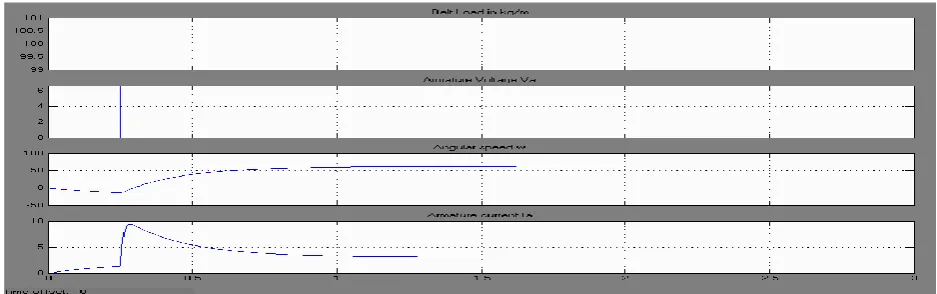
(A) Scopes For Simulation Of Dc Motor Response In Open Loop
Fig 3 Scopes For Simulation Of Dc Motor Response In Open Loop
(B) Scope For Dc Motor With No Load & Va = 100v Dc
Fig 4.Scope With Step Change Of Load & Va = 100v Dc
IV. CONCLUSIONS AND ANALYSIS OF RESULTS
Following observations and conclusions can be drawn from the results of the simulations:
1. The response of motor speed and armature voltage is non-linear for 1.5-2 sec after the step change due to moment of interia and friction effects
2. The maximum motor speed drops in response to the increase in load torque and also the dynamic response gets sluggish even for the same Va.
or Fuzzy logic based PI controller where the gain of PI controller gets adjusted continuously based on dynamic response of the DC motor. The results of the present study are meant to constitute a starting point for ongoing studies on identification of non linearity in DC motor based electromechanical systems and adaptive and Fuzzy control applications for nonlinear systems.
REFERENCES
[1] Sandeep Goyat,”To Control The Characteristics Of Ac Motor Using Fuzzy Logic Controller”, in IJEEE, Vol. No.7, Issue No. 01, Jan-June, 2015
[2] Aasha Chauhan, „Hysteresis Control For Current Harmonics Suppression Using Shunt Active Filter‟, in IJOART Volume 1, Issue 6 November, 2012, ISSN 2278-7763
[3] Sandeep Goyat, “Recent trend in generation of electricity” in “International Conference on science and engineering contribution in world development, DRDO ,Delhi”held in Dec, 2013.
[4] Yavin Y, Kemp PD, “Modeling and control of the motion of a rolling disk: Effect of the motor dynamics on the dynamical model”, Comput Meth Appl Mech Eng 2000;188:613–24.
[5] Sandeep Goyat“Brief Study & Analysis Of Static Noise Margin For Sub-Threshold SRAM In CMOS” In NCMCN-2011 Held At University Of Rajasthan, Jaipur.
[6] Aasha Chauhan, „A Study Paper based on Space Vector Pulse Width Modulation technique for Power Quality Improvement‟,in International Journal of Science Technology & Management (IJSTM), Volume No.04, Special Issue No.01, February 2015 ISSN (Print) 2394-1529, (Online) 2394-1537.
[7] Tolgay Kara, IIlyas Eker,” Nonlinear modeling and identification of a DC motorfor bidirectional operation with real time experiments”, Energy Conversion and Management xxx (2003) xxx–xxx
[8] Sandeep Goyat “Roll of science in society development” in “International Conference on science and engineering contribution in world development, DRDO ,Delhi” held in Dec, 2013.
[9] Shuang Cong, Guodong Li, Xianyong Feng, ”Parameter identification of Non linear DC Motor model using compound evolution Algorithms, Proceedings of the World Congress on Engineering 2010 Vol I WCE 2010, June 30 - July 2, 2010, London, U.K.
[10] Sandeep Goyat “Effect of Grid connected Photovoltaic power Grant on Electricity Market in India”, NCCE ,israna panipat” 20-22feb,2014. [11] Sandeep Goyat “Speed Control Of Induction Motor Using Vector ” In “International Journal Of Advance In Engineering And Technology”
In july,2012.
[12] N. Muruganantham, S. Palani, “ Hybrid Fuzzy-PI Controller based Speed Control of PMBLDC Motor using soft switching inverter”, European Journal of Scientific research, ISSN 1450-216 X Vol 78, No 2 (2012), pp. 259-272
[13] Y. Zhao and E. G. Collins, Jr., "Fuzzy PI Control Design for an Industrial Weigh Belt Feeder," IEEE Transactions on Fuzzy System, vol. 11, no.3, pp. 311-319, June 2003.
[14] T. Sato and K. Kameoka, "Adaptive Control System for Weigh Feeder", in 2008 International Conference on Modeling, Identification and Control, Shanghai, China, 2008, S4-12.line-to-line voltage pulses is sinusoidal since all phase signals are shifted (up or down) equally.