State and perspectives
of the concept of large-scale conditioning
of regional climate modelling
Hans von Storch
1, Leone Cavicchia
2, Frauke Feser
1, and Delei Li
31
Institute of Coastal Research, Helmholtz Center Geesthacht,
Germany
2
School of Earth Sciences, University of Melbourne, Australia
3
Key Laboratory of Ocean Circulation and Waves, Institute of
Oceanology, Chinese Academy of Sciences, Qingdao, China
Abstract
We review the state of dynamical downscaling with scale-constrained regional and global models. The methodology, in particular spectral nudging, has become a routine and well-researched tool for hindcasting climatologies of sub-synoptic atmospheric disturbances in coastal regions. At present, the spectrum of applications is expanding to other phenomena, but also to ocean dynamics and to extended forecasting. Also new diagnostic challenges are appearing such as spatial characteristics of small-scale phenomena such as Low Level Jets.
1.
Introduction
Polar Lows, Medicanes, Coastal Low levels Jets and other meso-scale storms phenomena represent significant cases of dangerous weather phenomena. The large-scale atmospheric dynamical state conditions the occurrences and features of such events. They are particularly prevalent and energetic above coastal waters, so that for planning coastal infrastructure as well as offshore activity, knowledge about the statistics, including extreme value statistics, are needed. Because of the large-scale conditioning, such statistics vary in time, reflecting not only decadal variability but also long-term climate change.
Deriving such statistics represents a challenge not only because of the size of such disturbances, but also because of the changing quality and density of the observational basis. Satellite products provide a good source of data (e.g., Blechschmidt, 2008) but working with them is labour-intensive, and statistics based on such data may be compromised by subjective choices and the limited lifetimes of different satellites.
An alternative approach of processing is dynamical downscaling, which extrapolates in the state space from large to smaller scales. A climatology of Polar Lows in the North Atlantic was obtained by implementing this method (Zahn and von Storch, 2008), and later of Polar Lows in the North Pacific (Chen and von Storch, 2013), of Medicanes in the Mediterranean Sea (Cavicchia et al., 2014a), and of Coastal Low Level Jets in the Bohai / Yellow sea region (Li et al., 2018). The methodology has matured now and is routinely used in many applications – mainly for deriving atmospheric states in the past decades.
We review past developments, address the present state and prospect of such approaches, with • simulating dynamical properties of small scale cyclones like Polar Lows (e.g., Zahn et al.
(2008), and
• the option of implementing such methodology in global models (Yoshimura and Kanamitsu, 2008)
2.
Simulating small synoptic features conditioned by
the large
‐
scale state constraining by spectral nudging
The idea to constrain regional dynamical models to follow the large-scale trajectory provided by weather analysis scheme, was introduced into atmospheric sciences in the 1990s. Earlier methods involved nudging spatial means (Kida et al. (1991), Sasaki et al. (1995), and McGregor et al. (1998)); Waldron et al. (1996) introduced the term “spectral nudging” into weather forecasting contexts, and von Storch et al. (2000), independently of the earlier work, suggested and tested the usage in climate simulations, extending to seasonal and decadal timescales. Later contributions and tests were provided by Miguez-Macho et al. (2004).
The basic idea is related to the downscaling-concept, according to which the large-sale state
together with smaller scale physiographic detail, such as mountain ranges or coastal configurations, would condition the smaller scale dynamical state. Originally, the concept was introduced as an empirical variant (e.g., von Storch, 1995), while simulations with limited area models were later recognized as representing a dynamical variant of downscaling (e.g., Giorgi et al., 2001). In a strict sense, however, limited area modelling employing the conventional boundary forcing does not induce consistent smaller scales by processing large-scale states. Instead, the states along the narrow strips along the lateral boundaries of the considered region are processed in the spirit of boundary value problems, even if it is known that in this case this mathematical concept is not well posed (Davies, 1976; Oliger and Sundström, 1978; Staniforth, 1997; Laprise, 2008).
This changed when a constraining of the larger-scales was introduced. Trigonometric expansions, or cosine expansions (Denis et al., 2001), but also spherical harmonics expansion allow the needed separation of scales. “Nudging terms” were added to the equations, which penalize deviations from a given state on large scales, but leaves small scales unconstrained.
Constraining the large scales in a model simulation represents a kind of data assimilation (e.g., Robinson et al., 1998), but in different manner than conventionally done. In data assimilation two equations are formulated, “the state space equation” describing the forward development of the systems trajectory, and “the observation equations”, which relates observables to state variables in the state space equation. Both equations represent a kind of knowledge, namely theoretical
observed quantities); both types of knowledge are incomplete, and the two equations are
integrated forward in tandem for combining the two types of knowledge efficiently. First the state space equation is used to estimate the future state; this suggested state is then transformed into an observable using the observation equation. Eventually, the estimated future state is corrected by a term proportional to the difference of the actual observable and the estimated observable – and so forth. In most cases, the observables are local observations, but in the case of downscaling it is the large scale state, e.g. states in a coordinate system spanned by orthogonal functions sorted
according to scale. The assumption is that the driving coarse resolution data is of satisfactory quality for large scales; thus the dynamical model (featured in the state space equation) is supposed to follow these states closely, while it is asked to provide additional detail for those smaller scales, where the coarse resolution data are considered to need improvement.
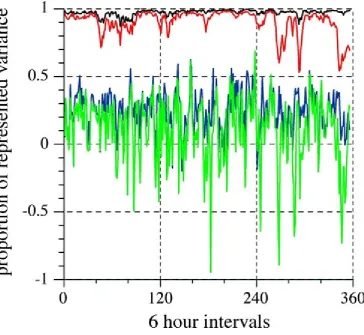
Figure 1 illustrates the success in a spectrally constrained 3-months simulation. The curves describe the similarity of the state of the driving re-analysis (here: NCEP/NCAR) and the constrained limited area model simulations (here: REMO). The two upper curves show the
similarity of the large scales in a constrained run and another free run. Obviously, the constrained simulation follows the trajectory of the re-analysis closely, whereas the free run intermittently simulates significant deviations (for details, refer to von Storch et al., 2000). The lower two curves show the same similarity measure but for medium scales (medium scales are here: all non-large scales, excluding the smallest scales affected by the truncation of the finite grids). In both the constrained and unconstrained simulation the deviation from the global re-analyses is large, which indicates that the limited area model is generating additional detail on such scales. That this additional detail is indeed realistic, and thus represents an added value over the re-analysis was shown by Feser et al. (2011).
When the simulation region is large (such as all of contiguous US), the improvements can be dramatic (Rockel et al. 2008) but when the region is small then the effect becomes insignificant (Schaaf et al., 2017).
Sometimes, the argument is brought forward that such a correction would violate principles of conservation, e.g., mass or momentum. This is indeed true, but accepted in all re-analyses schemes; also the violations are not large, when employed regularly, and the systems are not closed, at least in terms of energy and momentum.
Obviously, a number of choices have to be made when implementing the spectral nudging method in particular referring to the variables, the intensity of the nudging, conditional upon wave length and height, frequency of spectral nudging; in the classical paper by von Storch et al. (2000), the variables were the two components of the wind above 850 hPa (so that surface details are
permitted to influence the lower part of the atmosphere, with less and less influence higher up in the troposphere and stratosphere). Several sensitivity experiments were conducted since then, for instance by Alexandru et al., (2009), Omrani et al., (2009), Kang et al. (2005), Miguez-Macho et al. 2004, 2005;Park et al., (2017), Radu et al. (2008), Ramzan et al (2017) or Tang et al., (2010). Schubert-Frisius et al. (2017) tested extensively different setting for employing spectral nudging in a global model (see Section 4).
In recent years further re-analyses entered the “market”, usually covering at best 2 or 3 decades of years.
Generally, the global re-analysis are not homogeneous, since the observational data, which are processed in the (frozen) analysis-schemes are non-stationary in terms of coverage, density and quality. However, the development of the large-scale features of the atmospheric dynamics, are plausibly homogenous, because less data are needed to determine their state. Thus, the spectral nudging methods employs a qualitatively stationary part of the re-analysis, and determines a consistent and homogeneous addition to the re-analyses.
Besides spectral nudging, there is also another nudging technique, which forces a simulation to follow a given trajectory in phase space, namely “grid nudging” or “analysis nudging”. Obviously such a constraint is limiting the development of the state much more than the selective nudging, since not only the large-scales, which are supposed to be less affected by the finite grid resolution, but all scales including those heavily affected by the grid truncation and the interrupted energy cascade are
affected. A number of studies have considered the two techniques (e.g., Liu et al., 2012; Ma et al., 2016; Spero et al., 2018). The latter, the grid-point ansatz, is useful, when sub-grid-scale processes are examined and fitted, while for hindcasting the spectral nudging is to be preferred, as it allows the improved small-scale dynamics and better descriptions of physiographic detail.
3 6 9 12 15 18 21 24 27 30 33 36
3 6 9 12 15 18 21 24 27 30 33 36
Figure 2: Simulated sea level pressure (hPa; isobars) and near surface wind speed fields (ms-1;
shaded) of typhoon Winnie in August 1997.
Top: With constraining. Bottom: Two simulations without constraining.
(Model: COSMO-CLM; forcing: NCEP 1; 50 km grid resolution; Feser and von Storch, 2008a)
3.
Issue: Divergence in phase space
From predictability studies it is long known that global models starting from the same modified initial conditions and subject to the same forcing, end up in very different trajectories, albeit within a corridor given by climatology, if somewhere in the process a miniscule change is introduced (e.g., Chervin et al., 1974). Interestingly, it was not recognized for another 20 years that limited area models exhibit a similar property, namely that the state in the interior of the area is not determined by the lateral boundary conditions, but that different trajectories may form. When initiated with very slightly different initial conditions, significant variability emerges in the model region, as demonstrated by Ji and Vernekar (1995), Rinke and Dethloff (2000), Weisse et al. (2001) or Alexandru et al. (2007).
The examples demonstrate that the different trajectories of the simulated systems are for extended times similar, but that every now and then a major split takes place, which results in significant differences for a limited time. It means, regional models generate intermittently different
developments („divergence in phase space“) – which is not indicating „falseness“ of a model, but is rightly reflecting the stochastic character of „weather formation“.
when in reality a typhoon formed in East Asia (Feser and von Storch, 2008a). In one simulation, not one but three typhoons formed, in the second one major storm plus a secondary storm.
When the large-scales in a simulation are constrained the effect is largely suppressed, and the differences are mostly insignificant. Figure 2 shows the result of a constrained simulation, and only one typhoon emerges, at the right location and time (however, with a too shallow depth).
4.
Simulating small synoptic features conditioned by
the large
‐
scale state in regional models
Spectrally nudged regional models have been used to construct climatologies, and scenarios of possible future changes, of small-scale synoptic phenomena in various regions, among them Europe, Southern Atlantic, East Asia, Mediterranean Sea, Yellow Sea, North Pacific. Of course, also other phenomena were described and studied, such as precipitation connected with the East Asian summer monsoon (Lee et al, 2004).
A first case was Polar Lows in the North Atlantic (Zahn and von Storch, 2008; Zahn et al., 2008) and North Pacific (Chen et al., 2012; Chen and von Storch, 2013). These relatively small energetic
storms form over the subarctic sea, mostly in cold air outbreaks and can be identified well only since the advents of satellites. Using NCEP/NCAR reanalysis as driving data, a history of the formation of such storms could be constructed beginning in 1948. The annual cyclogenesis frequency was found to be mostly stationary, with no remarkable trends towards more or less storms. The used grid resolution of about 50 km was seemingly not sufficient to allow for realistic deepening of the storms. Future scenarios were also constructed; in both regions, North Atlantic and North pacific, the frequency of storms occurrence decreased due to more stable atmospheric
conditions as the higher atmosphere warmed faster than the surface; an assessment of the change in intensity was not made (Chen at al., 2014; Zahn and von Storch, 2010).
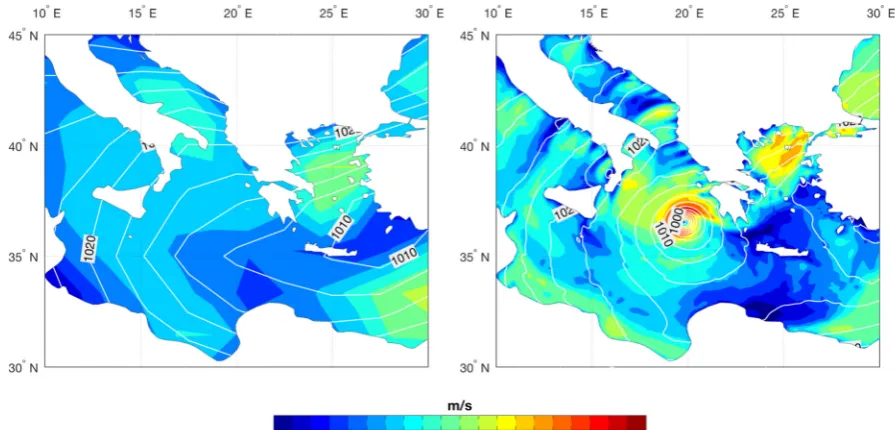
Figure 3: Snapshots of January 1995 Medicane on 15 January at 18 UTC. Left: sea level pressure (2hPa contours) and wind field (m/s, color shaded) from the forcing NCEP reanalysis. Right: as left panel but from COSMO-CLM simulation at 10 km resolution.
Figure 4: Track density of simulated medicanes in the 1948-2010 period (COSMO -CLM, 10 km grid resolution, forcing: NCEP; Cavicchia et al., 2014a).
Low Level Jets and other phenomena in the Bohai and Yellow Sea region: Coastal areas are featured with plenty types of meso- or small-scale atmospheric processes. A simulation with resolution of about 7 km was conducted over the Bohai and Yellow Sea region in East Asia during 1979 – 2013, forced by ERA-Interim reanalysis dataset (Li et al. 2016). Li (2016) revealed that the simulation outperforms ERA-Interim in capturing the detailed spatial and temporal structures of cases of meso-scale phenomena such as a typhoon and a cold surge. Vortex street, an orography-related phenomenon, can be realistically generated by the simulation rather than by the ERA-Interim. Furthermore. Li et al. (2018) proved the hindcast can reproduce the climatology, the
10° W 5° W 0° 5° E 10° E 15° E 20° E 25° E 30° E 35° E 40° E 45° E
25° N 30° N 35° N 40° N 45° N 50° N
T rack d en sity
diurnal cycle, the variability of wind profiles, and specific low level jet (LLJ) cases, which are mesoscale-flow phenomena with horizontal wind maxima within the lowest few kilometers of the troposphere. Long-term statistics of LLJs reveal that they feature a strong diurnal cycle, intra-annual, and interannual variability but weak decadal variability. LLJs are more frequent in April, May and June (defined as LLJ season) and less frequent in winter season. Fig. 5 shows that LLJs are mostly at height of 200 – 400 m, with intensities generally less than 16 m/s. The dominant wind directions are southwesterly and southerly. Li et al. (2018) also identified that a low-frequency link between anomalies of LLJ occurrence over the Bohai and Yellow Sea and regional large-scale barotropic circulation over the East Asia-northwest Pacific region.
Figure 5: Low-level jets statistics over the Bohai Sea and Yellow Sea during April, May, and June (1979–2013): (a) Jet height histogram (%), (b) jet wind speed histogram (%), (c) jet height-wind
speed distribution, and (d) jet wind rose. (Li et al. 2018)
lateral boundaries and not using spectral nudging in the model domain’s interior by about half, but generally retains the ones which were observed (Feser and Barcikowska, 2012). The TC generation and development is very dependent on the quality of the forcing data set and storm intensity is sensitive to the model’s resolution. A TC climatology for the last decades (Barcikowska et al., 2017) shows largest similarity to observation-derived best track data (Barcikowska et al., 2012) for the most recent times which feature the best measurement quality and availability. Both modelled and observation-based data sets show an increase in TC activity, in terms of annually accumulated TC days for the last three decades. For earlier decades statistics differ between the model and
observations. An upward shift in TC intensities in the regional model is apparent around the end of the 1970s which is presumably based on the introduction of satellite measurements in the forcing reanalysis at that time. This shows the large dependency of the regional climate model on its global forcing data and that for some cases spectral nudging cannot completely cure data inhomogeneities, which were presumably inherent in the forcing.
5.
Simulating small synoptic features conditioned by
the large
‐
scale state constraining in global models
It was Yoshimura and Kanamitsu (2008) who noticed that the idea of spectral nudging may also be implemented into global models. Indeed, conceptually the implementation in global models is more attractive than in regional models, as in this case the downscaling concept is applying in a purer sense, namely a forcing of only the larger scales and not a hybrid of forcing along the lateral boundaries and of large-scale components.
Figure 7: Brier Skill Scores (red: improvements; blue: no improvement) of a regional hindcast (55km grid resolution on the left; 7 km on the right) with the constrained global model over the period of Dec. 1999 – Nov. 2009 for marine surface wind speeds of (left panel) 3 – 25 m/s relative to observational reference data (“truth”) QuikSCAT (von Storch et al., 2017).
The concept was also tested and implemented by Schubert-Frisius et al., (2017) and von Storch et al. (2017), using the ECHAM6 global atmospheric models with a T255 grid resolution
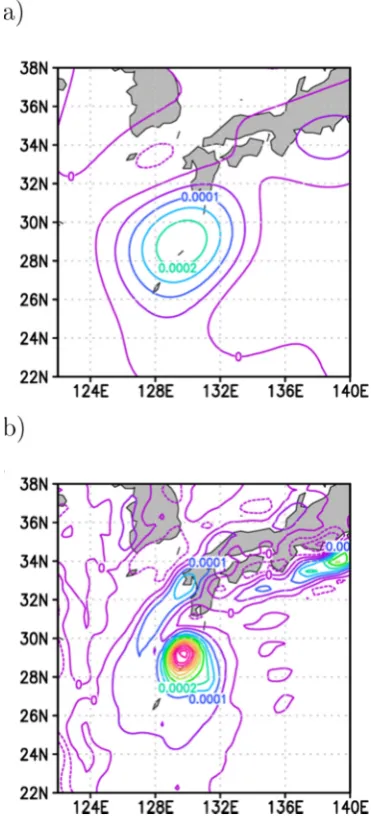
(corresponding to about 60 km), and the large-scale NCEP/NCAR reanalysis as constraint. As an example, Figure 6 shows the description of a typhoon in the NCEP/NCAR reanalysis together with the downscaling achieved by the constrained global simulation.
A variety of parameters, such as the vertical profile of the nudging parameters, were tested (Schubert-Frisius et al., 2017). Also the performance of the global simulation with respect to regional simulations was confirmed (von Storch, et al., 2017) – it turned out that if the global and the regional models had a comparable grid resolution, also the hindcasts were similar, as
regions marked in red, the regional model performs better than the global model, whereas blue regions mark a superiority of the global model. The global model is a bit better than the regional model when a comparable grid resolution is employed, but the reduction of the grid resolution to 7 km in the regional model leads to a significant improvement. It remains to be seen what the
situation is if the global model is run with such a resolution which is close to being convection-permitting (<4 km according to Prein et al., 2015).
Thus, instead of running many regional simulations in different domains, introducing further potential sources of inhomogeneity due to boundary conditions, it may be sufficient to run the global simulations for all regions at the same time. In conclusion: running a global model with enforced global (large-scale) circulations allows the simulations of all regional climates at the same time.
6.
Concluding outlook: purposes and challenges
Constraining large-scales in simulations, but letting small-scales develop freely, conditional upon the state of the large scales, may be used for a variety of purposes.
The most common application is the construction of regional climatologies for different parts of the world, namely Europe (Geyer, 2013) including the Mediterranean region (Cavicchia et al. 2014a), East Asia and the Northwestern Pacific (Feser and von Storch, 2008a, b; Barcikowska et al., 2017; Li et al, 2016; Plantonov et al., 2017), the South Atlantic (Tim et al., 2015), Central Siberia (Klehmet et al., 2013); other applications are for studying meteorological processes (Kolstad et al., 2016) and regional detail in forecasting (Zhao et al., 2016). These climatologies have been used to study changing weather-related phenomena, such as storms, ocean waves, storm surges, atmospheric deposition and transport of chemical elements, marine biota modelling, carbon cycle studies, plant productivity analyses, but also for economic applications such as oil spill simulations or ship routing and design.
The usage of a scale-dependent constraining, with the better observed large scales limiting the space of possible developments of the smaller scales, may also be applied in other dynamical systems, which include a downscaling hierarchy. Consistently, recent approaches for using this method in ocean models are implemented and tested (e.g., Wright et al., 2006; Katavouta and Thompson (2013, 2016).
Modelling of regional weather streams across several decades of years permits the construction of climatologies of certain phenomena. We have discussed Polar Lows, medicanes and typhoons above, and briefly touched Low Level Jets. Identifying and characterizing the members of such climatological ensembles of phenomena may pose new challenges in describing such phenomena (say, counting, determining scales, intensities and tracks). This challenge grows when dealing with the output of convection-permitting resolutions, simply because of more detailed output.
An example are Low Level Jets, which have been studied mostly as local phenomena, namely
connected to certain vertical profiles. After having gridded data, Low Level Jets should be described by their full 3- or 4-dimensional structure. Figure 8 shows the developments of two Low Level Jets in the Bo Hai/Yellow Sea region, for illustrating the challenge. The LLJs do not represent a
Figure: Two Coastal Low Level Jets (A and B) simulated in a constrained COSMO-CLM simulation with a grid resolution of 7 km, forced by ERA-Interim. The arrows indicate the sequence of 3-hourly increments. The dotted area features maximum wind speed larger than 10 m/s at height below ~3 km,
the colored area stands for low level jets, with difference between the wind maximum and minimum above or the wind speed at ~3 km greater than 5 m/s.
A: Starting from weak and small LLJ, then growing and becoming strong LLJ, then decay and disappear.
Acknowledgement
7.
References
Alexandru, A., R. de Elía, and R. Laprise, 2007: Internal variability in regional climate downscaling at the seasonal scale. Monthly Wea. Rev. 135, 3221-3238
Alexandru, A., R. De Elia, R. Laprise, L. Separovic, and S. Biner, 2009: Sensitivity study of regional climate model simulations to large-scale nudging parameters. Mon. Wea. Rev., 137, 1666–1686, doi:10.1175/2008MWR2620.1.
Barcikowska, M., F. Feser, and H. von Storch, 2012: Usability of best track data in climate statistics in the western North Pacific. Mon. Wea. Rev., 140, 2818-2830, DOI: 10.1175/MWR-D-11-00175.1.
Barcikowska, M., F. Feser, W. Zhang, and W. Mei, 2017: Changes in intense Tropical Cyclone Activity for the Western North Pacific during the last decades derived from a Regional Climate Model Simulation. Climate Dynamics, 49(9-10), pp 2931-2949, DOI: 10.1007/s00382-016-3420-0
Blechschmidt, A.-M. , 2008: A 2-year climatology of polar low events over the Nordic Seas from satellite remote sensing. Geophys. Res. Lett., 35, L09815, doi:10.1029/2008GL033706.
Cavicchia, L., and H. von Storch, 2013: Medicanes simulation in a high resolution regional climate model. Clim. Dyn. 39, 2273-2290; DOI: 10.1007/s00382-011-1220-0
Cavicchia, L., H. von Storch, and S. Gualdi, 2014a: A long-term climatology of medicanes, Clim.
Dyn. 43, Page 1183-1195 DOI: 10.1007/s00382-013-1893-7
Cavicchia, L., H. von Storch, and S. Gualdi, 2014b: Mediterranean tropical-like cyclones in present and future climate. J. Climate, 27, 7493-7501; doi: http://dx.doi.org/10.1175/JCLI-D-14-00339.1 Chen F., B. Geyer, M. Zahn and H. von Storch, 2012: Towards a multidecadal climatology of North Pacific Polar Lows employing dynamical downscaling. Terrestrial, Atmospheric and Oceanic
Sciences, 23, 291-30
Chen F., and H. von Storch, 2013 : Trends and variability of North Pacific Polar Lows, Advances in
Meteorology 2013, ID 170387, 11 pages, http://dx.doi.org/10.1155/2013/170387
Chen F., H. von Storch, Du Y., and Wu L.L., 2014: Polar Low genesis over North Pacific under different scenarios of Global Warming, Clim. Dyn. DOI 10.1007/s00382-014-2117-5
Chervin, R. M., W.L. Gates, and S.H. Schneider, 1974: The effect of time averaging on the noise level of climatological statistics generated by atmospheric general circulation models. J. Atmos. Sci. 31, 2216–2219.
Davies, H.C., 1976: A lateral boundary formulation for multi-level prediction models, Q. J. Roy.
Meteorol. Soc. 102 405–418.
Denis, B., J. Cote and R. Laprise 2001: Spectral decomposition of two-dimensional atmospheric fields on limited area domains using the discrete cosine tranform. Mon. Wea. Rev.
Feser, F. and M. Barcikowska, 2014: Changes in typhoons over the last decades as given in observations and climate model simulations. In 'Natural Disasters - Typhoons and Landslides -
Risk Prediction, Crisis Management and Environmental Impacts', Nova Science Publishers,
Feser, F. and M. Barcikowska, 2012: The Influence of Spectral Nudging on Typhoon Formation in Regional Climate Models. Environ. Res. Lett., 7, 014024, doi:10.1088/1748-9326/7/1/014024. Barcikowska, M., F. Feser, and H. von Storch, 2012: Usability of best track data in climate statistics in the western North Pacific. Mon. Wea. Rev., 140, 2818-2830, DOI: 10.1175/MWR-D-11-00175.1.
Feser, F. and H. von Storch, 2008a: A dynamical downscaling case study for typhoons in SE Asia using a regional climate model. Mon. Wea. Rev., 136 (5), 1806-1815, doi:
http://dx.doi.org/10.1175/2007MWR2207.1.
Feser, F. and H. von Storch, 2008b: Regional modelling of the western Pacific typhoon season 2004. Meteorolog. Z., 17 (4), 519-528, DOI 10.1127/0941-2948/2008/0282.
Feser, F., B. Rockel, H. von Storch, J. Winterfeldt, and M. Zahn, 2011: Regional climate models add value. Bull. Amer. Meteor. Soc. 92: 1181–1192
Geyer, B., 2013: High resolution atmospheric reconstruction for Europe 1948–2012: coastDat2. Earth System Science Data (ESSD), doi:10.5194/essdd-6-779-2013
Giorgi, F., B. Hewitson, J. Christensen, M. Hulme, H. von Storch, P. Whetton, R. Jones, L. Mearns and C. Fu, 2001: Regional climate information - evaluation and projections. In J.T. Houghton et al (eds.): Climate Change 2001. The Scientific Basis, Cambridge University Press, 583-638
Ji, Y.M, and A.D. Vernekar, 1997: Simulation of the Asian summer monsoons of 1987 and 1988 with a regional model nested in a global GCM, J. Clim. 10: 1965-1979
Kang, H.-S., D.-H. Cha and D.-K. Lee, 2005: Evaluation of the mesoscale model/land surface model (MM5/LSM) coupled model for East Asian summer monsoon simulations. J. Geophys. Res. 110, D10105, 10.1029/2004JD005266, 18 pp.
Katavouta, A., and K.R. Thompson, 2013: Downscaling ocean conditions: Experiments with a quasi-geostrophic model. Ocean Modelling 72, 231–241
Katavouta, A., and K.R. Thompson, 2016: Downscaling ocean conditions with application to the Gulf of Maine, Scotian Shelf and adjacent deep ocean. Ocean Modelling 104, 54–72
Kida, H., T. Koide, H. Sasaki and M. Chiba, 1991: A new approach to coupling a limited area model with a GCM for regional climate simulation. J. Meteor. Soc. Japan 69, 723-728
Klehmet K, Geyer B, Rockel B, 2013: A regional climate model hindcast for Siberia: analysis of
snow water equivalent. The Cryosphere 7:1017–1034. doi: 10.5194/tc-7-1017-2013
Kolstad, E. W., T. J. Bracegirdle, and M. Zahn (2016), Re-examining the roles of surface heat flux and latent heat release in a “hurricane-like” polar low over the Barents Sea, J. Geophys. Res.
Atmos., 121, 7853–7867, doi:10.1002/2015JD024633.
Laprise, R., 2008: Regional climate modelling. J. Comp. Phys.227, 3641–3666
Lee,D.-K., D.-H. Cha and H.-S. Kang, 2004: Regional climate simulation of the 1998 summer flood over East Asia. J. Meteor. Soc. Japan, 82, 1735-1753
Li D., 2016: Added value of high-resolution regional climate model: selected cases over the Bohai Sea and Yellow Sea areas. Int. J. Climatol., doi:doi: 10.1002/joc.4695.
Li D., H. von Storch, Yin B., Xu Z., Donglin Guo D., and Wei W., 2018: Climatology of coastal low level jets over the Bohai Sea and Yellow Sea and the relationship with regional atmospheric circulations, Journal of Geophysical Research: Atmospheres, 123, 5240–5260.
https://doi.org/10.1029/2017JD027949
Liu, P., A. P. Tsimpidi, Y. Hu, B. Stone, A. G. Russell, and A. Nenes, 2012: Differences between downscaling with spectral and grid nudging using WRF. Atmos. Chem. Phys., 12, 3601–3610, 2012
Ma Y., Yi Y., X. Mai, C. Qiu, X. Long, and C. Wang, 2016: Comparison of Analysis and Spectral Nudging Techniques for Dynamical Downscaling with the WRF Model over China. Advances in
Meteorology 2-3:1-16
McGregor J.L., J. J. Katzfey, and K. C. Nguyen, 1998: Fine resolution simulations of climate change for southeast Asia. Southeast Asian Regional Committee for START Research Project Final Report, 51 pp. [Available from CISRO Atmospheric Research, PMB 1, Aspendale, VIC 3195, Australia.].
Miguez-Macho, G., G.L. Stenchikov, and A. Robock, 2004: Spectral nudging to eliminate the effects of domain position and geometry in regional climate model simulations. J. Geophys. Res., 109, No. D13, D13104, 10.1029/2003JD004495
Miguez-Macho, G., G. L. Stenchikov, and A. Robock, 2005: Regional climate simulations over North America: Interaction of local processes with improved large-scale flow. J. Climate, 18, 1227–1246, doi:10.1175/JCLI3369.1.
Oliger, J. and Sundström, A. 1978 Theoretical and practical aspects of some initial boundary value problems in fluid dynamics. SIAM J. Appl. Math., 35, 419–446
Omrani, H., , P. Drobinski and T. Dubos, 2009: Spectral nudging in regional climate modeling: how strong should we nudge? Q. J. R. Meteorol. Soc.: 1–6, DOI: 10.1002/qj.000
Park, J., Hwang, S.-O., 2017: Impacts of spectral nudging on the simulated surface air
temperature in summer compared with the selection of shortwave radiation and land surface model physics parameterization in a high-resolution regional atmospheric model, Journal of
Atmospheric and Solar-Terrestrial Physics, doi: 10.1016/j.jastp.2017.09.001
Platonov, P., A. Kislov, G. Rivin, M. Varentsov, I.Rozinkina, M. Nikitin, and M. Chumakov, 2017: Mesoscale atmospheric modelling technology as a tool for creating a long-term meteorological dataset. IOP Conf. Series: Earth and Environmental Science 96, doi
:10.1088/1755-1315/96/1/012004
Prein, A., W. Langhans, G. Fosser, F. Andrew, N. Ban , K. Goergen, M. Keller, M. Tölle, O. Gutjahr, F. Feser, E. Brisson, S. Kollet, J. Schmidli, N. van Lipzip, and L. R. Leung, 2015: A review on
convection permitting climate modeling: demonstrations, prospects, and challenges. Reviews of Geophysics, 53, 2, 323-361, doi: 10.1002/2014RG000475.
Ramzan, M., S. Ham, M. Amjad, E.-C. Chang, and K. Yoshimura, 2017: Sensitivity Evaluation of Spectral Nudging Schemes in Historical Dynamical Downscaling for South Asia. Advances in
Meteorology 7560818, https://doi.org/10.1155/2017/7560818
Rinke, A., and K. Dethloff, 2000: On the sensitivity of a regional Arctic climate model to initial and boundary conditions. Clim. Res. 14, 101-113.
Robinson, A.R., P.F.J. Lermusiaux and N. Q. Sloan III, 1998: Data assimilation. In: K.H. Brink, A.R. Robinson (eds): The Global Coastal Ocean. Processes and Methods. The Sea Vol. 10. John Wiley & Sons Inc, New York, 541-593
Rockel, B., C.L. Castro, R.A. Pielke Sr., H. von Storch, and G. Leoncini, 2008: Dynamical
downscaling: Assessment of model system dependent retained and added variability for two different regional climate models, J. Geophys. Res., 113, D21107, doi:10.1029/2007JD009461 Sasaki, H., J. Kida, T. Koide, and M. Chiba, 1995: The performance of long term integrations of a limited area model with the spectral boundary coupling method. J. Meteor. Soc. Japan 73, 165-181
Schaaf, B., H. von Storch, and F. Feser, 2017: Has spectral nudging an effect for dynamical downscaling applied in small regional model domains? Mon. Wea. Rev. 145, 4303-4311 [https://doi.org/10.1175/MWR-D-17-0087.1
Schubert-Frisius, M., F. Feser, H. von Storch, and S. Rast, 2017: Optimal spectral nudging for global dynamic downscaling. Mon. Wea. Rev.145, 909-927; DOI: 10.1175/MWR-D-16-0036.1 Spero, T., C. Nolte, M. Mallard, and J. Bowden, 2018: A Maieutic Exploration of Nudging Strategies for Regional Climate Applications using the WRF Model. J. Appl. Meteor. Climatol.
doi:10.1175/JAMC-D-17-0360.1
Staniforth, A., 1997: egional modelling: a theoretical discussion, Meteorol. Atmos. Phys. 63 (1–2), 15–29.
Takayabu, I., H. Kanamaru, K. Dairaku, R. Benestad, H. von Storch and J. Hesselbjerg Christensen, 2016: Reconsidering the quality and utility of downscaling. J. Meteor. Soc. Japan. 94, 31-45 doi:10.2151/jmsj.2015-042
Tang, J., S. Song and J. Wu, 2010: Impacts of the spectral nudging technique on simulation of the East Asian summer monsoon. Theor. Appl. Climatol. 101, 41–51, DOI 10.1007/s00704-009-0202-1
Tim, N., Zorita, E., and Hünicke, B., 2015: Decadal variability and trends of the Benguela
upwelling system as simulated in a high-resolution ocean simulation, Ocean Sci., 11, 483-502,
doi:10.5194/os-11-483-2015
von Storch, H., 1995: Inconsistencies at the interface of climate impact studies and global climate research. Meteor. Z. 4 NF, 72-80
von Storch, H., Langenberg, H., and Feser, F. 2000: A spectral nudging technique for dynamical downscaling purposes. Mon. Wea. Rev., 128(10), 3664-3673.
von Storch, H., F. Feser, B. Geyer, K. Klehmet, Li D., B. Rockel, M. Schubert-Frisius, N. Tim, and E. Zorita, 2017: Regional re-analysis without local data - exploiting the downscaling paradigm. J.
Waldron, K. M., J. Peagle and J.D. Horel, 1996: Sensitivity of a spectrally filtered and nudged limited area model to outer model options. Mon. Wea. Rev. 124, 529-547
Weisse, R., H. Heyen and H. von Storch, 2000: Sensitivity of a regional atmospheric model to a sea state dependent roughness and the need of ensemble calculations. Mon. Wea. Rev. 128: 3631-3642
Wright, D.G., K.R. Thompson and Y. Lu, 2006: Assimilating long-term hydrographic information into an eddy-permitting model of the North Atlantic. J Geophys. Res. 111 (C9), C09022
Yoshimura, K., and M. Kananitsu, 2008: Dynamical global downscaling of global reanalysis. Mon.
Wea. Rev. 136: 2983-2998
Zahn, M., H. von Storch, and S. Bakan, 2008: Climate mode simulation of North Atlantic Polar Lows in a limited area model, Tellus A, DOI: 10.1111/j.1600- 0870.2008.00330.
Zahn, M., and H. von Storch, 2008: A longterm climatology of North Atlantic Polar Lows. Geophys.
Res. Lett., 35, L22702, doi:10.1029/2008GL035769
Zahn, M., and H. von Storch, 2010: Decreased frequency of North Atlantic polar lows associated to future climate warming, nature 467, 309-312
Zhao Y., Wang D., Liang Z and Xu J., 2016: Improving numerical experiments on persistent severe rainfall events in southern China using spectral nudging and filtering schemes. Q. J. R. Meteorol.