On the Limits of Authenticated Key Exchange Security
with an Application to Bad Randomness
Mich`ele Feltz1 and Cas Cremers2
1Institute of Information Security, ETH Zurich, Switzerland, [email protected] 2University of Oxford, United Kingdom, [email protected]
Abstract
State-of-the-art authenticated key exchange (AKE) protocols are proven secure in game-based security models. These models have considerably evolved in strength from the original Bellare-Rogaway model. However, so far only informal impossibility results, which suggest that no protocol can be secure against stronger adversaries, have been sketched. At the same time, there are many different security models being used, all of which aim to model the strongest possible adversary. In this paper we provide the first systematic analysis of the limits of game-based security models. Our analysis reveals that different security goals can be achieved in different relevant classes of AKE protocols. From our formal impossibility results, we derive strong security models for these protocol classes and give protocols that are secure in them. In particular, we analyse the security of AKE protocols in the presence of adversaries who can perform attacks based on chosen randomness, in which the adversary controls the randomness used in protocol sessions. Protocols that do not modify memory shared among sessions, which we call stateless protocols, are insecure against chosen-randomness attacks. We propose novel stateful protocols that provide resilience even against this worst case randomness failure, thereby weakening the security assumptions required on the random number generator.
Keywords. authenticated key exchange (AKE), security models, impossibility results, stateless protocols, stateful protocols, bad randomness, chosen-randomness.
1
Introduction
security model covers practically relevant attack scenarios. We argue that rigorous impossibility results for key exchange protocol design and subsequent systematic security models are still missing in the context of ever stronger AKE security guarantees.
In this paper we show that many of the restrictions posed on the behavior of the adversary in the models stem from unstated assumptions on the considered protocol class. Specifically, our impossibility results reveal a previously unstated assumption on the protocols analyzed in AKE security models: the protocols do not modify memory shared among sessions, i.e., they only modify session-specific memory. It turns out that lifting this assumption enables the design of protocols that are secure against stronger adversaries that control the randomness used in protocol sessions. In particular, our results enable us to weaken the security assumptions on the random number generator (RNG) used to produce session-specific randomness. This is particularly timely given the recently discovered security vulnerabilities that involve either flawed [1, 26, 28, 35] or weakened [29, 31, 32, 36] RNGs. In 2008, Bello discovered a randomness vulnerability in Debian’s OpenSSL package; keys generated by the RNG of this package were predictable [1]. As a consequence, protocol sessions of the DHE variant of SSL, e. g., might have been compromised as attackers were able to predict the ephemeral secret keys used to establish the shared session key and hence to decrypt further communication between client and server [1, 35]. In August 2013, attackers took control of Bitcoin transactions due to flaws in Android’s Java and OpenSSL RNG [26]. As multiple transactions were signed using the same randomness in the ECDSA signature generation, an attacker was able to recover the long-term secret signing key of the user initiating the transactions and perform transactions on its behalf. Further, it seems that the security of certain cryptographic systems such as RNGs has been deliberately weakened to, e. g., eavesdrop on private communication [31]. We introduce new security models that incorporate the worst-case scenario of adversaries controlling the randomness involved in protocol sessions and propose countermeasures against such attacks. Security in our new models implies security under repeated or predictable randomness.
Contributions. First, we perform the first systematic analysis of the limits of game-based AKE security. We identify several relevant protocol classes for which we provide formal impossibility results. That is, given an arbitrary protocol from a certain class, we specify attacks that can be applied to this protocol. Our impossibility results (a) clarify which security guarantees cannot be achieved by any protocol in the respective class, and (b) allow us to systematically develop strong security models for each class. We give for each class a concrete protocol that is secure in the corresponding strong model.
Second, some of the models that we derive from our impossibility results allow the adversary to perform chosen-randomness attacks even against the target session: these attacks go far beyond attacks covered in earlier security models. While stateless protocols fail to achieve security against such adversaries, we present stateful protocols, which modify memory that is shared among sessions, and achieve security against attacks based on choosing session-specific randomness. We thereby significantly reduce the assumptions needed from the RNG.
Third, our exploration of the limits of game-based security leads to a protocol hierarchy based on the constructed protocols. Our hierarchy highlights the security guarantees that can be achieved by each class, and provides a novel way of selecting an optimal trade-off between the type of protocol and the security it offers.
model for analyzing two-message AKE protocols [24, 25]. However, in [18], it is shown that two-message protocols can achieve PFS even for eCK-like adversaries.
Yang et al. state that no protocol can be secure againstreset-and-replay attacks on the target session [34, p. 120]. In a reset-and-replay attack the adversary first sets the randomness of a session to the same randomness as used in a previous session of the same user and then replays messages to the session so that both sessions compute the same session key [34]. Based on their impossibility result, they design a security model in which reset attacks are disallowed on the target session. As we see in Section 5.2, their result only holds for a particular class of protocols, namely the class of stateless protocols, which do not modify memory that is shared among sessions. Since we consider a wider range of protocols, we arrive at the conclusion that there are protocols that are secure against reset-and-replay attacks on the target session. In particular, we construct variants of the NAXOS protocol [24] that are secure against such attacks.
Similarly, Boyd and Gonz´alez Nieto [10] show that one-round AKE protocols that do not provide message replay detection cannot achieve PFS if the adversary can also reveal session-specific randomness of the target session’s peer. Their argument is based on a variant of Krawczyk’s PFS attack [22]. They note that protocols that provide replay detection via timestamps or counters are not vulnerable to this attack. We show in Section 7 that there are one-round protocols that do not require replay detection and are only vulnerable to Boyd and Gonz´alez Nieto’s [10] attack if the target session is activated with a message replayed from the first session of its peer. We construct a protocol that achieves security even under compromise of the target session’s randomness and the actor of that session’s long-term secret key as long as the randomness of at least one of the previous sessions of the same user has not been compromised.
Randomness failures. The first models addressing the leakage of session-specific information include the eCK model [24] and the CK model [12]. The eCK model considers an information-leaking RNG that leaks values after they have been generated, which is modelled via the query ephemeral-key. Intermediate protocol computations are assumed to be outside of the adversary’s control. In contrast, the CK model considers long-term keys stored in secure memory (e.g., an HSM), whereas protocol computations are (partly) done in less-protected memory. The adversary has read-only access to the less-protected memory through a query session-state. However, in the vast majority of proofs in the CK model, the less-protected memory has been defined to contain exactly the randomness, thereby effectively modeling an information-leaking RNG. Unlike our work, CK and eCK do not consider predictable, failing, or compromised RNGs.
Yang et al. [34] first analyzed AKE security w.r.t. adversaries who can manipulate random values. They define two security models: Reset-1 and Reset-2. In the Reset-1 model the adversary controls the randomness of each session, with the restrictions that the adversary (a) does not issue corrupt queries to the actor and peer of the test session, and (b) the randomness used in the test and partner session is not used in any other session. Thus, the Reset-1 model captures neither weak perfect forward secrecy nor reset-and-replay attacks on the target session or its partner session. In contrast, the models that we develop in Section 5 and Section 6 capture reset attacks on the target session, reset attacks on its partner session, and weak perfect forward secrecy. The Reset-2 model captures repeated secret randomness in multiple sessions due to reset attacks, but no chosen-randomness attacks. Whereas the Reset-2 model captures weak perfect forward secrecy, it does not allow the adversary to perform reset attacks against either the target session or its partner session. In Section 5.3 we design a similar model to the Reset-2 model, which we callXAKE. In the XAKE model, the adversary is allowed to perform reset attacks
even against the target session and its partner session. We show that security in a model that captures chosen-randomness attacks implies security in the XAKE model. Yang et al. [34] provide
a transformation that turns a protocol secure in the Reset-2 model into a protocol that is secure in both models, by replacing the randomness x used in the original protocol byFK(x), where F
is a pseudorandom function family, and K is an additional long-term secret key.
attacks. As a countermeasure, they propose a framework forhedging cryptographic operations based on preprocessing potentially bad RNG-supplied randomness together with additional inputs with HMAC to provide pseudorandomness for the cryptographic operation; their framework uses hedging techniques for public-key encryption of Bellare et al. [3]. Hedging a cryptographic operation means designing it in such a way that, given good randomness, the operation provably achieves strong security goals, and, given bad randomness, the operation achieves weaker, but still meaningful, security goals [3]. Our models cover VM reset attacks on stateless protocols, i.e., resettable randomness, and we thereby address some of their future work.
Stateless and stateful AKE protocols. Most AKE protocols (e. g., HMQV [22], NAXOS [24], CMQV [33]) are stateless, i.e., they only modify session-specific memory, whereas the memory that is shared among sessions is invariant under protocol execution. Furthermore, the security of stateful AKE protocols, which update the memory that is shared among sessions during execution of the protocol, has not been considered in the context of randomness failures.
A few stateful protocols have been suggested. For example, Blake-Wilson et al. [7] propose to modify their Protocol 2 by concatenating the secret value that is used as the secret material to derive the session key with the value of a counter. We denote this new protocol by Protocol 2C. Instead of running the protocol each time a session key is required, a new session key is obtained by simply incrementing the counter and computing a new hash value [7]. The idea of using a counter variable is presented in the context of special applications for which it might not be desirable to run the protocol whenever a new session key has to be established. However, no security proof of Protocol 2C has been given. In Section 7.1 we prove the security of the CNX protocol, a stateful variant of the NAXOS protocol. The CNX protocol includes a global counter value, which is shared across the sessions of a user, as input to the hash functionH1 used in the computation of the outgoing messages.
2
Authenticated key exchange framework
In this section we define a framework to reason about the security of AKE protocols belonging to different classes against adversaries with diverse capabilities. This framework allows to express existing AKE security models such as the eCK model [24], the eCKw model [18] and the eCK-PFS model [18] as well as extensions of these models that permit the adversary to choose the randomness used in protocol sessions.
2.1 Security model
actor the session’s actor (the user running the session)
peer the session’s peer (the intended communication partner)
role taken role; eitherI (initiator) orR(responder)
sent,recv concatenation of all messages sent, respectively received, in the session
status session status; eitheractive,accepted, orrejected
key key established in the session
rand randomness used in the session
data any additional session-specific or protocol-specific data
step protocol step to be executed (in the session)
Table 1: Elements of session state
memory related to session s. The session-specific memory contains the session-specific variables of Table 1. Initially we assume that each session-specific variable is undefined, denoted by ⊥.
User memory. The user memory of some user stores the user’s long-term public/secret key pair, the public key of all other users ˆQ∈ P as well as additional variables that might be required by the protocol. The information stored in the user memory is accessed and possibly updated by sessions of the user according to the protocol specification. In contrast to session-specific information, data stored in the user memory of some user ˆP is shared among different sessions of the user ˆP. We denote bystPˆ the user memory of user ˆP ∈ P.
Game state and game behaviour (see also [11]). The adversary, modeled as a probabilistic polynomial-time algorithm, interacts with the users in the set P within a game through queries in a set Q. The state of the game (or game state) contains session-specific state informationsts
for all sessions s, user-specific informationstPˆ for each user ˆP ∈ P as well as other information related to the game such as some bit that the adversary attempts to guess. The game behaviour, which we denote by Φ, describes how the game processes the queries in Q. More precisely, the game behaviour Φ is an algorithm taking as input the current state of the game GST, a query
q ∈Q, a protocolπ, and a security parameter 1k, and returning a new stateGST0 as well as a responseresponse∈ {0,1}∗∪ {⊥, ?} to the adversary’s query q.
Definition 1 (h-message protocol). Let 1k be the security parameter. An h-message protocol π, where h is the sum of the number of messages sent and received during a protocol session, consists of
a set of domain parameters,
a probabilistic polynomial-time key generation algorithm KeyGen, which takes as input the security parameter and outputs a public/secret key pair, and
a deterministic polynomial-time algorithm Ψexecuted by a user in a session. This algorithm takes as input the security parameter 1k, the session-specific memory sts of a session s, the
user memory stPˆ of the actorPˆ of sessions, and a message m∈ {0,1}∗, and outputs a triple of elements(m0,st0s,st0ˆ
P), where m
0 ∈ {0,1}∗∪ {?} is a message, st0
s is an updated internal
session state, and st0ˆ
P is an updated state of the user memory of user
ˆ
P.
If h is even, then the number of messages m06=? output by Ψ during a protocol session is h2 for both roles initiator and responder. If h is odd, then the number of messages m0 6=? output by Ψ during a protocol session is h+12 for the initiator role and h−21 for the responder role.
The output of the key exchange algorithm Ψ (see Definition 1) may include the value?to indicate that the session does not generate an outgoing message.
Setup of the game. A setup algorithm SetupG is used to generate a set of a fixed number
1. generate a set P ={Pˆ1, ...,PˆN}of N distinct binary strings (representing user identifiers),
2. for all users ˆP ∈ P: generate a long-term public/secret key pair (pkPˆ,skPˆ) using algorithm KeyGen,
3. for all users ˆP ∈ P: store the key pair (pkPˆ,skPˆ) together with the set{( ˆP ,pkPˆ)|Pˆ ∈ P \{Pˆ}} in the user memorystPˆ, and
4. initialize all other user-specific variables if such variables are used by the protocol.
Queries. The specification of some of the queries that we define below is similar to queries defined in the framework of Boyd et al. [9]. Thepublic-infoquery, which was informally introduced in [11, p. 4], allows the adversary to obtain information that was generated during the setup phase of the game such as the users’ identifiers and their public keys.
public-info(). The query returns a set Lof information which contains the set{( ˆP ,pkPˆ)|Pˆ ∈
P}as well as the initial values of all other variables stored in the user memory of each user, except for the users’ long-term secret key, if such variables are used by the protocol.
The queries in the setQR ={create,send} model regular execution of the protocol.
create( ˆP , r[,Qˆ]). The query models the creation of a new sessionsfor the user with identifier ˆP. It requires that ˆP ∈ P,Qˆ∈ P, and thatr∈ {I,R}; otherwise, it returns⊥. Session variables are initialized as
(sactor, srole, ssent, srecv, sstatus, skey, sstep)←( ˆP , r, , ,active,⊥,1) .
A bit string in {0,1}k is sampled uniformly at random and assigned to s
rand; we assume
that all randomness required during the execution of sessionsis deterministically derived from srand. If the optional peer identifier ˆQis provided, the variable speer is set to ˆQ.
The key exchange algorithm Ψ is executed on input (1k,sts,stPˆ, ). The algorithm returns a triple of elements (m0,st0s,st0ˆ
P). We set sts←st
0
s andstPˆ ←st0Pˆ. The query returns m
0.
send( ˆP , i, m). The query models sending message m to thei’th session of user ˆP, which we denote bys. It requires thatsstatus =active; otherwise it returns⊥. The algorithm Ψ is run
on input (1k,st
s,stPˆ, m), and outputs a triple of elements (m0,st0s,st0Pˆ). We setsts ←st
0
s
and stPˆ ←st0Pˆ. The query returnsm0.
The queries in the setQC={session-key,corrupt,randomness,cr-create}that we define next model
the corruption of a user’s secrets. The randomnessquery models the adversary’s capability of learning the randomness srand of a particular session s. In contrast, the cr-createquery models
the adversary’s capability of choosing the randomness used within a session. Note that we do not explicitly model repeated randomness, i. e. secret uniform bits that have been used in previous key exchange sessions. However, we show in Section 5.3 that security in the model that we present in Section 5.1 implies security in a similar model capturing repeated randomness. The significance of session-key queries is threefold. First, key exchange protocols are required to provide security against known-key attacks [27], which can be ensured through key independence among different sessions. Known-key attacks are captured in security models via session-key queries on non-matching sessions. Second, in an unknown-key share (UKS) attack, the adversary establishes two sessions which compute the same session key even if both sessions have different intended communication partners. The relevance of UKS attacks is discussed, e. g., in [8]. A formal definition of a UKS attack and how it is reflected in a security model via session-key queries is given in [16]. Third,session-key queries capture replay attacks combined with chosen-randomness attacks. In these replay attacks, the adversary causes two non-matching sessions to compute the same session key by setting the randomness of the second session to the same randomness as used in the first session and replaying the messages received by the first session to the second session [34].
In the definition of the queriessession-key andrandomness we denote the i’th session of user ˆP
session-key( ˆP , i). The query requires thatsstatus =accepted; otherwise, it returns ⊥. The
query returns the session key skey of sessions.
corrupt( ˆP). If ˆP /∈ P, thenS returns⊥. Otherwise the query returns the long-term secret key skPˆ of user ˆP.
randomness( ˆP , i). If sstatus 6= ⊥, then the randomness srand used in session s is returned.
Otherwise, the query returns⊥.
cr-create( ˆP , r, rnd[,Qˆ]). The query models the creation of a new sessions, using randomness
rnd chosen by the adversary, for the user ˆP. The query requires that ˆP ∈ P,Qˆ ∈ P, rnd∈ {0,1}k, and thatr∈ {I,R}; otherwise, it returns ⊥. Session variables are initialized as
(sactor, srole, ssent, srecv, sstatus, skey, srand, sstep)←( ˆP , r, , ,active,⊥, rnd,1) .
If the optional peer identifier ˆQis provided, the variable speer is set to ˆQ.
The key exchange algorithm Ψ is executed on input (1k,sts,stPˆ, ). The algorithm returns a triple (m0,st0s,st0ˆ
P). We set sts←st
0
s and stPˆ ←st0Pˆ. The query returnsm
0.
The setQnoCR=QR∪(QC\ {cr-create}) contains all execution and corruption queries, except
the query cr-create.
The notion of matching sessions specifies when two sessions are supposed to be intended communication partners. It is formalized below via matching conversations as in [18, 24].
Definition 2 (Matching sessions). Let π be an h-message protocol. We say that two sessions s
ands0 ofπare matchingifsstatus =s0status =acceptedandsactor =s0peer∧speer =s0actor∧ssent = s0recv∧srecv =ssent0 ∧srole 6=s0role.
We next define a parameterized family of AKE security models. The parameters for each model consist of a subset Qof the above adversary queries and a freshness predicateF, which restricts the adversary from performing certain combinations of queries.
Definition 3 (AKE security model). Letπ be anh-message protocol. Let Qbe a set of adversary queries such that QR ⊆Q⊆QR∪QC. Let F be a freshness predicate, that is, a predicate that
takes a session of protocol π and a sequence of queries (including arguments and results) in Q. We call(Q, F) an AKE security model.
Remark 1. In this work we fix a particular definition for matching sessions (namely, Definition 2) and construct strong security models with respect to this definition. It is straightforward to adapt these models to other definitions of matching sessions that are suitable for analyzing protocols such as (H)MQV that allow two sessions performing the same role to compute the same session key.
2.2 Security experiment
We associate to each AKE security model X = (Q, F) a security experiment W(X), defined below, played by an adversary E against a challenger. To win the experiment, the adversary aims to distinguish a real session key from a random key, modelled through the following query. test-session(s). This query requires that sstatus =accepted; otherwise, it returns ⊥. A bit b
is chosen at random. Ifb= 0, thenskey is returned. Ifb= 1, then a random key is returned
according to the probability distribution of keys generated by the protocol.
Definition 4 (Security experimentW(X)). Let π be an h-message protocol. Let X= (Q, F) be an AKE security model. We define experiment W(X), between an adversary E and a challenger who implements all the users, as follows:
2. The adversary E first issues the querypublic-info, and then performs any sequence of queries from the setQ.
3. At some point in the experiment,E issues atest-sessionquery to a sessionsthat has accepted and satisfies F at the time the query is issued.
4. The adversary may continue with queries from Q, under the condition that the test session must continue to satisfy F.
5. Finally, E outputs a bit b0 as his guess for b.
The adversaryE wins the security experimentW(X) if he correctly guesses the bit bchosen by the challenger during thetest-sessionquery (i. e., ifb=b0, whereb0 isE’s guess). Success ofE in the experiment is expressed in terms of E’s advantage in distinguishing whether he received the real or a random session key in response to the test-sessionquery. The advantage of adversary E
in the above security experiment against a key exchange protocol π for security parameter k is defined as AdvWπ,E(X)(k) =|2P(b=b0)−1|.
Definition 5 (AKE security). A key exchange protocol π is said to be secure in AKE security model (Q, F) if, for all PPT adversariesE, it holds that
if two users successfully complete matching sessions, then they compute the same session key, the probability of event Multiple-MatchWπ,E(X)(k) is negligible, where
Multiple-MatchWπ,E(X)(k) denotes the event that there exists a session that has accepted with at least two matching sessions, and
E has no more than a negligible advantage in winning the W(X) security experiment, that is, there exists a negligible function negl in the security parameter k such that AdvWπ,E(X)(k)≤
negl(k).
Informally, the second requirement in Definition 5 (see also [5]) states that, for a given session of protocolπ that has accepted, it holds that its matching session, if it exists, is unique.
3
Protocol Classes
In this section we define a series of relevant protocol classes. The largest protocol class includes, e. g., one-round protocols and Diffie-Hellman type protocols. As we see in Section 4 and Section 6, the distinction between these classes allows the systematic development of strong security models for analyzing protocols belonging to the respective classes.
3.1 Classes AKE,INDP, and INDP-DH
We start by defining a global class of AKE protocols. Such protocols are required to be executable, i. e., if the messages of two users ˆAand ˆB are faithfully relayed to each other, then both users end up with a shared session key (see also [4–6]). A second requirement ensures that protocol messages depend on session-specific randomness. Both properties are used for proving impossibility results in Section 4.
Definition 6 (Protocol class AKE). We defineAKE as the class of all h-message protocols that meet the following requirements: In the presence of an eavesdropping adversary,
two usersAˆand Bˆ can complete matching sessions, in which case they hold the same session key, and
the probability that two sessions of the same user output in all protocol steps identical messages is negligible in the security parameter.
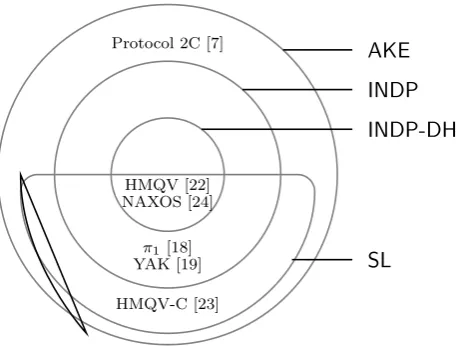
Protocol 2C [7]
HMQV [22] NAXOS [24]
π1[18]
YAK [19]
HMQV-C [23]
AKE
INDP
INDP-DH
SL
Figure 1: Venn Diagram of the protocol classes and example protocols
Definition 7(Protocol classINDP). The protocol classINDPconsists of all two-message protocols in AKE for which the outgoing message of any session s with statussstatus 6=rejecteddoes not
depend on the incoming message.
We define the class INDP-DH of one-round Diffie-Hellman type protocols as a subclass of INDP as follows.
Definition 8(Protocol classINDP-DH). LetG=hgibe a cyclic group of prime orderpgenerated by g. Let KeyGenbe the key generation algorithm defined as KeyGen(): Choose a∈R[0, p−1];
Set A←ga; Return secret key sk=aand public key pk=A.
The protocol classINDP-DHconsists of all protocols in the classINDPwith domain parameters (G, g, p), key generation algorithm KeyGen, and where the outgoing message of any initiator
sessionsin statussstatus 6=rejectedis of the form(δ, gfI(1
k,st
s,stAˆ))and the outgoing message of
any responder sessions0 in statuss0status 6=rejectedis of the form(δ0, gfR(1k,sts0,stBˆ)), whereAˆis
the actor of session s, Bˆ is the actor of sessions0,fI, fR:{0,1}∗ →Zp are two polynomial-time
computable functions, and δ, δ0 is optional publicly available information such as the identifiers of actor and peer of the session.
3.2 Stateless and stateful protocols
We distinguish between stateless and stateful protocols. Stateless protocols leave the state of a user’s memory (i.e., the memory that is shared among sessions) invariant under execution of the protocol. In contrast, the state of a user’s memory is modified when executing a protocol that is not stateless. Examples of stateless and stateful protocols are given in Figure 1 and in Section 7.
We define the class of stateless AKE protocols as a subclass of the classAKEas follows.
Definition 9 (Stateless protocol). Let A,B, and C be sets. Let proj3 :A × B × C → C be the map given by proj3(a, b, c) =cfor all (a, b, c)∈ A × B × C. Let π be a protocol in the classAKE. We say that π is a stateless protocol if
proj3 Ψ(1k,sts,stPˆ, m)
=stPˆ,
for all (k,sts,stPˆ, m)∈N× {sts |s∈ P ×N} × {stPˆ |Pˆ ∈ P} × {0,1}∗. We denote by SL the subclass of AKE containing all stateless protocols.
Remark 2. Stateless protocols cannot provide message replay detection to reject messages that have been received in earlier sessions of the same user as this would require storing all previously received messages in a table in the user memory and, upon receipt of a valid message in a session, accessing the table in the user memory and checking whether the message corresponds to a message in the table.
Most recently proposed strong AKE protocols fall into the narrow classINDP-DH∩SL. As we illustrate next, protocols from the wider classes can achieve stronger security.
4
Impossibility results and strong models for stateless protocols
In this section we provide impossibility results for protocols in the classesAKE∩SL,INDP∩SL and INDP-DH∩SL with respect to an adversary who is given access to the queries in the set
QnoCR = QR∪(QC\ {cr-create}). We then derive strong security models for reasoning about the security of protocols in the respective classes from these impossibility results. Each of our models can be satisfied by existing stateless protocols. In Section 5 we show that no stateless protocol can achieve security in stronger models, in which the adversary can additionally perform chosen-randomness attacks via thecr-create query.
We start by defining the notion of partially matching sessions in a similar way as matching conversations in [5, Definition 4.1].
Definition 11 (Partially matching sessions). Let π be an h-message protocol, where h≥2. Let
s denote a session of π with sstatus =accepted. We say that sessions is partially matching
session s0 in status s0status 6=⊥ if the following conditions hold: srole 6=s0role ∧sactor =s0peer ∧speer =s0actor and either
srole =I ∧ssend[1..m] =s0recv[1..m]∧srecv[1..m] =s0send[1..m] with m= h2 if h is even and
m= h−21 if h is odd, or
srole =R ∧ssend[1..(m−1)] =s0recv[1..(m−1)]∧srecv[1..m] =s0send[1..m]with m= h2 if h
is even and m= h+12 if h is odd,
wheressend[1..l]denotes the concatenation of the firstlmessages sent by session sand srecv[1..l]
denotes the concatenation of the first l messages received by session s.
Remark 3. In contrast to the notion of matching sessions (see Definition 2), which is only defined for completed sessions, the notion of partially matching sessions does not require the last message sent by one session to be received by the partner session. This allows us to capture combinations of randomnessand corrupt attacks on such sessions as well.
To relate a received message that was not constructed by the adversary to the session it originates from, we use the concept of origin-session, which was first introduced in [17]. The existence of an origin-session for a given session implies integrity of the received messages.
Definition 12 (origin-session). We say that a session s0 with s0status 6=⊥ is an origin-session for a session swith sstatus =accepted if s0send =srecv.
Theorem 1 (Impossibility result for AKE∩SL). Let π be an arbitrary protocol in the class AKE∩SL. Let X = (QnoCR, F) be the AKE security model with F being true for all sessions s and all sequences of queries. Let s∗ denote the test session and let s0 denote a session such that s∗ is partially matching session s0. There exist adversaries who win the security experiment
W(X) against protocol π with non-negligible probability by issuing either 1. a query session-key(s∗), or
4. a query corrupt(s∗peer) as well as a query randomness(s0), or
5. a query corrupt(s∗peer) before creation of sessions∗ via a create query or as long as s∗status = activeand s∗recv =, and impersonating the peer to session s∗.
Proof. Letπ∈AKE∩SL. There exist PPT adversaries who win the security gameW(X) against protocolπ with non-negligible probability, as follows.
Scenario 1: AdversaryE1 establishes two sessionssand s0 that are matching (via a sequence of createand send queries) and chooses sessionsas the test session. Issuing a session-key(s) query reveals the session key of sessions.
Scenario 2: Since π ∈ AKE, adversary E2 can establish via a sequence of create and send queries two sessions sands0 that are matching according to Definition 2. He then issues the test-sessionquery to one of the two sessions, say to sessions, and issues asession-key query to session s0. E2 thereby learns the session key of session s.
Scenario 3: Adversary E3 establishes two sessions s and s0 that are matching and chooses session sas the test session. Issuing the queries corrupt(sactor) and randomness(s) reveals
the long-term secret key of sactor = ˆP and the randomness srand of session s, respectively.
Together with the setL returned as response to the query public-infoand the last message received during session s, which we denote by m0, the adversary can compute the session key of sessionsby executing the algorithm Ψ on input (1k,sts,stPˆ, m0). Note that the user state remains unchanged during protocol execution as π∈SL.
Scenario 4: Assume thatπ∈AKE∩SLis an h-message protocol withh even. The proof works similarly for the case whereh is odd.
Case 1: test session in initiator role. First E4 establishes via a sequence of create and send queries an initiator session s and a responder session s0 such that s and s0 are matching sessions (this is possible sinceπ ∈AKE). Clearly, session sis also partially matching session
s0. He then chooses session s as the test session. Issuing the queries corrupt(speer) and
randomness(s0) reveals the long-term secret key of speer = ˆP and the randomness s0rand of
sessions0, respectively. Since π∈SL and the initial values of additional variables in the user memory are returned as response to the query public-info, the user state stPˆ is known to the adversary. Hence, the adversary can emulate the session key computation of a matching session and compute the session key of session sby executing Ψ on input (1k,st
s0,stˆ P, m),
where m denotes the last incoming message to sessions0.
Case 2: test session in responder role. FirstE4 establishes via a sequence ofcreate andsend queries an incomplete initiator sessionsand a responder session s0 such thats0 is partially matching session s(this is possible since π ∈AKE). He then chooses session s0 as the test session. Issuing the queries corrupt(s0peer) and randomness(s) reveals the long-term secret key of s0peer and the randomness of session s, respectively. Similar to the previous case, the adversary is able to compute the session key of session s0.
Scenario 5: AdversaryE5 issues acorrupt query to some user, say user ˆQ. He then creates a responder sessionsby issuing the querycreate( ˆP ,R,Qˆ). The adversary now impersonates user ˆQtosactor as follows. E5 chooses randomness r∈R{0,1}k and runs the protocol with
ˆ
P on behalf of ˆQby executing the algorithm Ψ. The algorithm Ψ executed by the adversary takes as input, among others, the user state of user ˆQcontaining its long-term secret key skQˆ and the setL returned as response to the public-infoquery. Once session shas accepted, he chooses the latter as the test session. The adversary can compute the session key of sessions, for which no origin-session exists, by emulating a matching session. Note that a similar attack also works against (a) an initiator session, (b) an initiator sessionssuch thatsstatus =active
and srecv =, and (c) a responder sessionssuch thatsstatus =activeand srecv =.
Theorem 1 gives rise to the security model ΩAKE∩SLdefined as follows. The associated freshness
Definition 13 (ΩAKE∩SL). The ΩAKE∩SL model is defined by (Q, F), where Q= QnoCR and a
session is said to satisfy F if all of the following conditions hold: 1. no session-key(s) query has been issued,
2. for all sessions s∗ such that s∗ matches s, no session-key(s∗) query has been issued, 3. not both queries corrupt(sactor) and randomness(s) have been issued,
4. for all sessions s0 such thats is partially matching session s0, not both queries corrupt(speer)
and randomness(s0) have been issued, and
5. if there exists no origin-session for session s, then nocorrupt(speer) query has been issued
before creation of session svia a create query or as long as sstatus =activeand srecv =.
To see that there exist protocols in the classAKE∩SLthat are secure in the model ΩAKE∩SL,
consider the protocol SIG∗(NAXOS) obtained by applying the signature transformation SIG with optional fields from [18] to the NAXOS protocol. Clearly, protocol SIG∗(NAXOS) does not belong to the class INDP∩SL since the outgoing message of a responder session depends on the Diffie-Hellman exponential contained in the incoming message. Adapting the proof of [18, Theorem 1], it can be shown that protocol SIG∗(NAXOS) is secure in model ΩAKE∩SL.
Even though security in model ΩAKE∩SL can be achieved by protocols in the classAKE∩SL,
we next show that no protocol in the classINDP can provide these strong security guarantees.
Proposition 1(Impossibility result forINDP). No protocol in the classINDPcan satisfy security in the model ΩAKE∩SL.
Proof. Let π be an arbitrary protocol in INDP. There exists an adversary E who wins the
W(ΩAKE∩SL) experiment against the challenger with non-negligible probability as follows. The
adversary E first reveals the long-term secret key of some user ˆAby issuing the query corrupt( ˆA). Since E knows the values of all the variables stored in the user memory of user ˆA (through the queries public-info andcorrupt( ˆA)),E can run the first protocol execution step on behalf of ˆA
by executing the deterministic algorithm Ψ on input (1k,sts,stAˆ, ), where the values of the state sts of the emulated session s are as follows, sactor = ˆA, speer = ˆB, srole = I, ssent = , srecv = ,sstatus =active, skey = ⊥, srand = z (with z ∈R {0,1}k), sdata = ⊥, and sstep = 1.
The algorithm Ψ outputs a messagem, an updated session state, and an updated state of the user memory. The adversary then creates an initiator session s1 of user ˆAwith peer ˆB via the query create( ˆA,I,Bˆ). The latter query returns a message m1. He then creates a responder session s2 of user ˆB via the querycreate( ˆB,R,Aˆ), and sends the messagem, previously obtained by executing Ψ, to session s2 via the query send( ˆB,1, m). As a response, the adversary receives the message m2, which he sends to session s1 via a send query. Upon receiving message m2 in session s1, ˆA executes Ψ(1k,sts1,stAˆ, m2) and thereby completes the session. E now chooses
the completed session s1 as the test session, and reveals the long-term secret key of the peer of the test session, namely user ˆB, as well as the randomness of sessions2. This enables him to compute the session key of the test session by executing Ψ on input (1k,sts,˜ stBˆ, m1), where
m1 is the outgoing message of session s1 and the values of the session state sts˜ are as follows,
sactor = ˆB, speer = ˆA, srole = R, ssent = , srecv = , sstatus = active, skey =⊥, srand is the
randomness of session s2,sstep = 2, and sdata is obtained by executing the first protocol step. E thereby emulates a matching session of user ˆB. The previous attack shows that protocol π
is insecure in the ΩAKE∩SL model. Note that the test session is fresh in ΩAKE∩SL since there is
no freshness condition on a session that is an origin-session for the test session but no partially matching session for the test session in the definition of FΩAKE∩SL. Also, there is no matching
session for the test session s1 since the messagem sent by the adversary to sessions2 is different, with overwhelming probability, from the messagem1 output by sessions1, by Definition 6.
Definition 14 (c-origin-session). We say that a session s0 with s0status 6=⊥is a c-origin-session for a sessionswithsstatus =acceptedifsactor =s0peer∧speer =s0actor∧srecv =s0sent∧srole 6=s0role.
Note that for protocols in the classINDP the last condition of Definition 13 can be simplified. This follows from the fact that a created initiator sessions of any protocol in the classINDP completes upon receipt of a valid message m and the variable srecv = is then updated with
message m, i. e.srecv ←(srecv, m). Consequently, the point in time of receipt of the first message m in an initiator session scoincides with the completion of session s. The same reasoning is applicable to responder sessions. It follows from (a) the previous observation, (b) the model ΩAKE∩SL, and (c) Proposition 1 that a strong model for analyzing protocols in the classINDP∩SL
is model ΩINDP∩SL defined as follows.
Definition 15 (ΩINDP∩SL). TheΩINDP∩SL model is defined by (Q, F), where Q=QnoCR, and a
session s is said to satisfyF if all of the following conditions hold: 1. no session-key(s) query has been issued,
2. for all sessions s∗ such that s∗ matches s, no session-key(s∗) query has been issued, 3. not both queries corrupt(sactor) and randomness(s) have been issued,
4. for all sessions s0 such thats0 is a c-origin-session for sessions, not both queriescorrupt(speer)
and randomness(s0) have been issued, and
5. if there exists no origin-session for session s, then nocorrupt(speer) query has been issued
before the completion of session s.
It is not difficult to verify that protocol SIGt(NAXOS) obtained by applying a tagged version of the signature transformation SIG from [18] to the NAXOS protocol is secure in model ΩINDP∩SL. The outgoing message of a SIGt(NAXOS) initiator session of user ˆA is of the form (X,SignAˆ(0, X,Bˆ)) while the outgoing message of a SIGt(NAXOS) responder session of user ˆB
is of the form (Y,SignBˆ(1, Y,Aˆ)).
We next show that any protocol in the classINDP-DH is insecure in ΩINDP∩SL.
Proposition 2 (Impossibility result for INDP-DH). No one-round Diffie-Hellman type protocol in the class INDP-DH can satisfy security in the model ΩINDP∩SL.
Proof. Letπ be an arbitrary protocol in INDP-DH. There exists an adversary E who wins the
W(ΩINDP∩SL) experiment against the challenger with non-negligible probability as follows. The
adversary E first creates an initiator session s at ˆA with peer ˆB via the query create( ˆA,I,Bˆ) and receives as a response the message m= (δ, X), whereX is the Diffie-Hellman exponential generated in session s and δ denotes optional public information. E chooses a value z∈RZq,
computes Z =gz, and sends message ˜m= (δ0, Z) to session s. Upon receiving message ˜m in sessions, ˆAexecutes Ψ(1k,sts,stAˆ,m˜). E then chooses the completed sessionsas the test session and reveals the long-term secret key of user ˆB via the querycorrupt( ˆB). This enables him to compute the session key of the test session by executing Ψ on input (1k,sts˜,stBˆ, m), wherests˜is the state of the emulated matching session ˜s. Note that the querypublic-inforeturned the initial values of additional variables stored in the user memory. This attack shows that π is insecure in ΩINDP∩SL. It is a generalized version of the attack described by Krawczyk in [22, p. 15].
Remark 4. Any protocol π ∈INDP-DH∩SL that does not contain sufficient public information in the outgoing message is insecure in the model derived from model ΩINDP∩SL and Proposition 2.
This follows from the fact that a redirect event of a message from a session of a different user than the test session’s peer can cause the existence of an origin-session that is not a c-origin-session for the test session. However, we do not distinguish between the relative strength of AKE protocols based on public information within the outgoing messages; adding such information does not provide additional security guarantees as it can be altered by the adversary.
Definition 16 (ΩINDP-DH∩SL). The ΩINDP-DH∩SL model is defined by (Q, F), where Q=QnoCR
and a session s is said to satisfyF if all of the following conditions hold: 1. no session-key(s) query has been issued, and
2. for all sessions s∗ such that s∗ matches s, no session-key(s∗) query has been issued, and 3. not both queries corrupt(sactor) and randomness(s) have been issued, and
4. for all sessionss0 such that s0 is an origin-session for sessions, not both queries corrupt(speer)
and randomness(s0) have been issued, and
5. if there exists no origin-session for session s, then nocorrupt(speer) query has been issued.
The model ΩINDP-DH∩SL is very similar to the eCKw model defined in [18]. The NAXOS
protocol [24] provides an example of a protocol in the class INDP-DH∩SL that is secure in the eCKw model.
5
Models capturing chosen-randomness attacks
5.1 Deriving models with chosen-randomness
As an immediate consequence of Theorem 1, we obtain Theorem 2, which generalizes our impossibility results on protocol class AKE∩SL to adversaries who are in addition given access to the query cr-create.
Theorem 2(Impossibility result for AKE∩SLunder chosen-randomness). Let π be an arbitrary protocol in the class AKE∩SL. Let X= (QnoCR∪ {cr-create}, F) be the AKE security model with
F being true for all sessionssand all sequences of queries. Let s∗ denote the test session and let
s0 denote a session such that s∗ is partially matching session s0. There exist adversaries who win the security experiment W(X) against protocol π with non-negligible probability by issuing
1. a query session-key(s∗), or
2. a query session-key(˜s), where s˜and s∗ are matching sessions, or
3. a query corrupt(s∗actor) and a (randomness or cr-create) query to session s∗, or 4. a query corrupt(s∗peer) as well as a (randomnessor cr-create) query to sessions0, or
5. a query corrupt(s∗peer)before creation of session s∗ via a (create orcr-create) query or as long as s∗status =activeand s∗recv =, and impersonating the peer to the test session s∗.
The previous theorem gives rise to the security model Ω−AKE defined as follows.
Definition 17 (Ω−AKE). The Ω−AKE model is defined by (Q, F), where Q=QnoCR∪ {cr-create},
and a session s is said to satisfyF if all of the following conditions hold: 1. no session-key(s) query has been issued,
2. for all sessions s∗ such that s∗ matches s, no session-key(s∗) query has been issued,
3. not both queries corrupt(sactor) and (randomness(s) or cr-create(.) creating session s) have
been issued,
4. for all sessions s0 such thats is partially matching session s0, not both queries corrupt(speer)
and (randomness(s0) or cr-create(.) creating session s0) have been issued, and
5. if there exists no origin-session for session s, then nocorrupt(speer) query has been issued
before creation of session s via a (create orcr-create) query or as long assstatus =active
and srecv =.
The models Ω−INDP and Ω−INDP-DH, defined below, are obtained from the models ΩINDP∩SL and
ΩINDP-DH∩SL, respectively, in a similar way as model Ω−AKE is obtained from model ΩAKE∩SL.
Definition 18 (Ω−INDP). TheΩ−INDP model is defined by(Q, F), where Q=QnoCR∪ {cr-create}, and a session s is said to satisfyF if all of the following conditions hold:
2. for all sessions s∗ such that s∗ matches s, no session-key(s∗) query has been issued,
3. not both queries corrupt(sactor) and (randomness(s) or cr-create(.) creating session s) have
been issued,
4. for all sessions s0 such thats0 is a c-origin-session for sessions, not both queriescorrupt(speer)
and (randomness(s0) or cr-create(.) creating session s0) have been issued, and
5. if there exists no origin-session for session s, then nocorrupt(speer) query has been issued
before the completion of session s.
Definition 19 (Ω−INDP-DH). The ΩINDP− -DH model is defined by (Q, F), where Q = QnoCR ∪
{cr-create} and a session sis said to satisfy F if all of the following conditions hold: 1. no session-key(s) query has been issued, and
2. for all sessions s∗ such that s∗ matches s, no session-key(s∗) query has been issued, and 3. not both queries corrupt(sactor) and (randomness(s) or cr-create(.) creating session s) have
been issued, and
4. for all sessionss0 such that s0 is an origin-session for sessions, not both queries corrupt(speer)
and (randomness(s0) or cr-create(.) creating session s0) have been issued, and
5. if there exists no origin-session for session s, then nocorrupt(speer) query has been issued.
We show in Section 5.3 that security in our extended models, which additionally capture attacks based on chosen randomness, implies security against attacks exploiting repeated ran-domness failures.
5.2 Insecurity of stateless protocols against chosen-randomness attacks
Even though the following proposition states that no stateless protocol is secure in model Ω−INDP-DH, we show in Section 7 that stateful protocols can in fact achieve these stronger security guarantees.
Proposition 3 (Impossibility result for AKE∩SL under chosen-randomness). No protocol in the class AKE∩SL can satisfy security in the model Ω−INDP-DH.
Proof. Letπ be an arbitrary protocol inAKE∩SL. There exists an adversaryE that wins the Ω−INDP-DHgame against the challenger with non-negligible probability as follows. The adversaryE
first completes a regular execution between two users ˆA and ˆB, i.e. ˆA and ˆB complete matching sessionssands0, respectively. He then issues arandomnessquery against the responder sessions0
of user ˆB. E creates another responder sessions00 of user ˆB via the query cr-create( ˆB,R, str,Aˆ), wherestr denotes the randomness that he revealed from session s0, and replays the messages from session sto sessions00. As the randomness used in sessions00 is identical to the randomness used in sessions0 andπ ∈SL, the messages that E receives from sessions00 are the same as the messages sent by session s0. Now, E chooses the completed sessions0 as the test session, and reveals the session key computed in session s00 via a session-key(s00) query. As the session keys computed in sessionss0 ands00 are the same and both sessions are non-matching, the adversary learns the session key of the test session. Hence, the protocol πis insecure in the Ω−INDP-DH model. A similar attack that involvescr-createqueries on both sessionss0 ands00 is sketched in [34, p. 119].
Corollary 1. No protocol in the class AKE∩SL can satisfy security in either model Ω−INDP or model Ω−AKE.
5.3 Repeated randomness failures
In this section we show that security in the Ω−AKE model implies security against repeated randomness. To this end, we compare the relative strength of security between the model Ω−AKE and a very similar model to Ω−AKE, where the adversary is not given access to the query cr-create, but to the query reset-create. The latter query allows the adversary to create a session that uses the same randomness as used in a previous session of the same user. Practically, this models a flawed RNG that produces the same value more than once.
The queryreset-create creates a new session with the same randomness as used in a previous session of the same user.
reset-create( ˆP , r, i[,Qˆ]). The query models the creation of a new session s, using the same randomness as in session s0 = ( ˆP , i), for the user ˆP. The query requires that ˆP ∈ P,Qˆ ∈ P, r∈ {I,R}, and that s0status 6=⊥; otherwise, it returns⊥. Session variables are initialized as
(sactor, srole, ssent, srecv, sstatus, skey, srand, sstep)←( ˆP , r, , ,active,⊥, s0rand,1) .
If the optional peer identifier ˆQis provided, the variable speer is set to ˆQ.
The key exchange algorithm Ψ is executed on input (1k,st
s,stPˆ, ). The algorithm returns a triple (m0,st0s,st0ˆ
P). We set sts←st
0
s and stPˆ ←st0Pˆ. The query returnsm0.
Consider the security model XAKE= (QnoCR∪ {reset-create}, F), where a session s= ( ˆP , i) is
said to satisfy F if all of the following conditions hold: 1. no session-key(s) query has been issued,
2. for all sessionss∗ such that s∗ matchess, no session-key(s∗) query has been issued,
3. not both queries corrupt( ˆP) and (randomness(s) or reset-create(.) creating session s) have been issued,
4. for all sessionss0 such that sis partially matching session s0, not both queries corrupt(speer)
and (randomness(s0) or reset-create(.) creating sessions0) have been issued, and
5. if there exists no origin-session for session s, then no corrupt(speer) query has been issued
before creation of sessions or as long assstatus =activeand srecv =.
The relative strength of security between security models, first discussed by Choo et al. [14], is formally defined by Cremers and Feltz [18] as follows. Let secure(M, π) be a predicate that is true if and only if the protocol π is secure in security model M.
Definition 20. Let Π be a class of AKE protocols. We say that a security model M0 is at least as strong as a security model M with respect to Π, denoted by M ≤Π
Sec M
0, if
∀ π ∈Π. secure(M0, π)⇒secure(M, π). (1)
Proposition 4. LetΠ = AKE. The model Ω−AKE is at least as strong as the model XAKE with
respect to Π according to Definition 20.
Proof. The first condition of Definition 5 is satisfied since matching is defined in the same way for both models Ω−AKE andXAKE. Letπ ∈Π. To show that the second and third condition of
Definition 5 hold, we construct an adversary E0 attacking protocol π in model Ω−AKE using an adversary E attackingπ in modelXAKE. AdversaryE0 proceeds as follows. WheneverE issues a
query create, corrupt, randomness, session-key or test-session, adversary E0 issues the same query and forwards the answer received to E. Whenever E issues a query reset-create( ˆP , r, i[,Qˆ]) to create a new session of user ˆP, adversary E0 first checks whether the status of sessions= ( ˆP , i) is different from ⊥. If this is the case, then E0 issues the following sequence of queries: 1. randomness( ˆP , i), and 2. cr-create( ˆP , r, srand[,Qˆ]). At the end of E’s execution, i. e. after it has
matching session for the test session and the actors of both sessions are the same, then there is no corrupt query on that user in case a query reset-create was issued to create either of the two sessions. If there exists a partially matching session for the test session and the actors of both sessions are different, then a reset-create query on the test session only involves a query cr-createand a query randomnesson another session of the test session’s actor; issuing a corrupt query on the test session’s peer does not render the test session un-fresh in model Ω−AKE as long as there is no query randomness on the partially matching session. Hence, it holds that
AdvWπ,E(X
AKE)(k)≤Adv π,E0
W(Ω−AKE)(k), wherek denotes the security parameter. Since by assumption protocol π is secure in Ω−AKE, there is a negligible function gsuch that Advπ,E0
W(Ω−AKE)(k)≤g(k). It follows that protocol π is secure in XAKE.
We obtain the following corollary as an immediate consequence of Proposition 4.
Corollary 2. Let Π = AKE. The model Ω−AKE is at least as strong as the model YAKE =
(QR∪ {corrupt,session-key,reset-create}, F0) with respect to Π according to Definition 20, where F0 is obtained from predicate F above by removing the randomnessquery from the conditions. Proof. SinceXAKE≤ΠSec Ω
−
AKE (by Proposition 4) and YAKE ≤
Π
Sec XAKE (by a similar reduction
proof as in the proof of Proposition 4), it follows that YAKE ≤Π
Sec Ω
−
AKE by transitivity of
Implication (1).
6
Impossibility results and strong models for stateful protocols
We next present a generalized impossibility result and its derived model for the broad class AKE taking into account the adversary’s ability to choose session-specific randomness. Recall that the completion of a session occurs at the time at which the status of the session is set to accepted.
Corollary 3 (Impossibility result forAKE). Letπ be an arbitrary protocol in the classAKE. Let
X = (QnoCR∪ {cr-create}, F) be the AKE security model with F being true for all sessions sand
all sequences of queries. Let s∗ denote the test session and let s0 denote a session such that s∗ is partially matching session s0. There exist adversaries who win the security experiment W(X) against protocol π with non-negligible probability by issuing either
1. a query session-key(s∗), or
2. a query session-key(˜s), where s˜and s∗ are matching sessions, or
3. a query corrupt(s∗actor) as well as (randomness or cr-create) queries on all sessions s with
sactor =s∗actor, where the querycreateorcr-createcreating sessionsoccurred before completion
of session s∗, or
4. a query corrupt(s∗peer) as well as (randomness or cr-create) queries on all sessions s with
sactor =s0actor, where the querycreateorcr-createcreating sessionsoccurred before completion
of session s0, or
5. a query corrupt(s∗peer)before creation of session s∗ via a query (createor cr-create) or as long as s∗status =activeand s∗recv =, and impersonating the peer to the test session s∗.
Proof. Corollary 3 follows from Theorem 1 and the following observation. Given the initial value of all the variables stored in the user memory of user ˆP returned as response to the query public-info, the randomness used in all sessions of user ˆP that are created before completion of the test session, and the long-term secret key of ˆP, the adversary can emulate the protocol execution steps on behalf of user ˆP by executing Ψ sequentially to recompute the session-specific and user-specific data from the first session of user ˆP to the relevant session of user ˆP.
s0, the user memory of user sactor gets updated after receiving this message. Thus, if another
session s00 of usersactor, created beforeswas created, is activated via a query send with the same
message m later on, then session s00 is aborted as it detected a previously received message (even if the session was created before session s). Similar situations might occur if updates of the user state occurring in later steps of the protocol execution involve the randomness of the session. Therefore, some of the attacks in Corollary 3 require the randomness of all sessions created prior to completion of the target session or its partially matching session.
Corollary 3 gives rise to the model ΩAKE defined as follows.
Definition 21 (ΩAKE). The model ΩAKE is defined by (Q, F), where Q=QnoCR∪ {cr-create}
and a session s is said to satisfyF if all of the following conditions hold: 1. no session-key(s) has been issued,
2. for all sessions s∗ such that s∗ matches s, no session-key(s∗) query has been issued,
3. not all queries corrupt(sactor) as well as (randomnessor cr-create) queries on all sessions s˜
with s˜actor = sactor, where the query create or cr-create creating session ˜s occurred before
completion of session s, have been issued,
4. for all sessions s0 such that sis partially matching session s0, not all queries corrupt(speer) as
well as (randomnessor cr-create) on all sessionss˜with s˜actor =s0actor, where the querycreate
or cr-create creating session s˜occurred before completion of sessions0, have been issued, and 5. if there exists no origin-session for session s, then nocorrupt(speer) query has been issued
before creation of session s via a query (create or cr-create) or as long as sstatus =active
and srecv =.
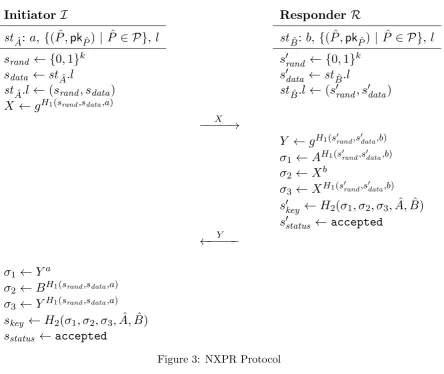
In this work we restrict ourselves to the subclass ISM (Initial State Modification) of the class AKE and provide strong models for analyzing protocols in this subclass. The class ISM contains all AKE protocols that may only access and update user memory upon creation of sessions. It contains, e. g., the CNX protocol as well as the NXPR protocol, which we present in Section 7.1 We leave the analysis of protocols that update user memory at later steps in the protocol execution as future work.
From the definition of the classISMand from Corollary 3, we derive the following model.
Definition 22 (ΩAKE∩ISM). The model ΩAKE∩ISM is defined by (Q, F), where Q = QnoCR ∪
{cr-create} and a session sis said to satisfy F if all of the following conditions hold: 1. no session-key(s) has been issued,
2. for all sessions s∗ such that s∗ matches s, no session-key(s∗) query has been issued,
3. not all queries corrupt(sactor) as well as (randomness or cr-create) on all sessions s˜ with
˜
sactor =sactor, where the query create orcr-create creating session s˜occurred before or at
creation of session s, have been issued,
4. for all sessions s0 such that s is partially matching sessions0, not all queries corrupt(speer)
as well as (randomness orcr-create) on all sessions s˜with ˜sactor = s0actor, where the query
create or cr-create creating session ˜soccurred before or at creation of session s0, have been issued, and
5. if there exists no origin-session for session s, then nocorrupt(speer) query has been issued
before creation of session s via a query (create or cr-create) or as long as sstatus =active
and srecv =.
Whereas in the models that we defined in Section 4 and Section 5, the adversary is not allowed to compromise both the randomness of the target session and the long-term secret key of the actor of the target session, the adversary is allowed to compromise the latter values in the
1
ΩAKE∩ISM model and its descendants as long as the randomness of at least one of the previous
sessions of the actor of the target session has not been compromised.
Definition 22 and Proposition 1 give rise to the model ΩINDP∩ISM defined below. The third
condition in Definition 23 prevents the adversary from both corrupting the actor of the target session and revealing the randomness of all sessions of this user that were created prior to creation of the target session as well as the randomness of the target session itself. As the user memory is accessed and updated upon creation of sessions only, the responses for the previous queries would allow the adversary to emulate the protocol execution steps for the target session. The fourth condition specifies a similar requirement for sessions that are c-origin-sessions for the target session.
Definition 23 (ΩINDP∩ISM). The model ΩINDP∩ISM is defined by (Q, F), where Q = QnoCR ∪
{cr-create} and a session sis said to satisfy F if all of the following conditions hold:
1. no session-key(s) has been issued,
2. for all sessions s∗ such that s∗ matches s, no session-key(s∗) query has been issued,
3. not all queries corrupt(sactor) as well as (randomness or cr-create) on all sessions s˜ with
˜
sactor =sactor, where the query create orcr-create creating session s˜occurred before or at
creation of session s, have been issued,
4. for all sessions s0 such that s0 is a c-origin-session for sessions, not all queriescorrupt(speer)
as well as (randomness orcr-create) on all sessions s˜with ˜sactor = s0actor, where the query
create or cr-create creating session ˜soccurred before or at creation of session s0, have been issued, and
5. if there exists no origin-session for session s, then nocorrupt(speer) query has been issued
before the completion of session s.
Definition 22 and Propositions 1 and 2 give rise to the model ΩINDP-DH∩ISM defined as follows.
Definition 24(ΩINDP-DH∩ISM). The modelΩINDP-DH∩ISMis defined by(Q, F), whereQ=QnoCR∪
{cr-create} and a session sis said to satisfy F if all of the following conditions hold:
1. no session-key(s) has been issued,
2. for all sessions s∗ such that s∗ matches s, no session-key(s∗) query has been issued,
3. not all queries corrupt(sactor) as well as (randomness or cr-create) on all sessions s˜ with
˜
sactor =sactor, where the query create orcr-create creating session s˜occurred before or at
creation of session s, have been issued,
4. for all sessions s0 such that s0 is an origin-session for sessions, not all queries corrupt(speer)
as well as (randomness orcr-create) on all sessions s˜with ˜sactor = s0actor, where the query
create or cr-create creating session ˜soccurred before or at creation of session s0, have been issued, and
5. if there exists no origin-session for session s, then nocorrupt(speer) query has been issued.
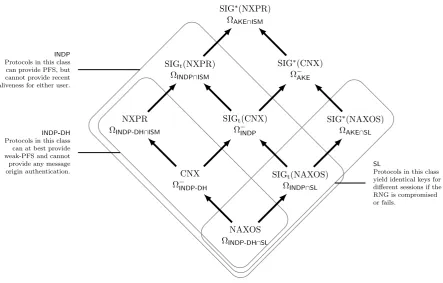
We formally study the relations between the different security models that we derived from impossibility results in Section 8.
Remark 6 (comparison with [10]). Boyd and Gonz´alez Nieto [10] show that one-round AKE protocols that do not provide message replay detection cannot achieve PFS if the adversary can reveal session-specific randomness of the target session’s peer. The attack on which their argument is based is disallowed in model ΩINDP∩ISM, but only if the replayed message originates
first session of the target session’s peer. In particular, the attack in the proof of Theorem 1 from which we derived the fourth condition in Definition 13 can be seen as a generalized version of Boyd and Gonz´alez Nieto’s attack.
7
Construction of strongly secure stateful protocols
In the previous sections we derived strong models capturing chosen-randomness attacks from impossibility results on given protocol classes. We have seen that stateless protocols fail to achieve security in these models. In this section we provide stateful variants of the NAXOS protocol [24], which are secure against attacks based on chosen randomness.
7.1 Protocol CNX
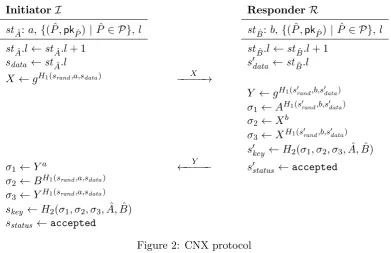
The CNX protocol (“Counter-NaXos”), shown in Figure 2, is a variant of the NAXOS protocol [24] and provides an example of a protocol from the classINDP-DH\SL, whereH1:{0,1}∗ →Zp and H2 :{0,1}∗→ {0,1}k denote two hash functions. In contrast to the NAXOS protocol, protocol CNX additionally includes a global counter value, which is shared across the sessions of a user, as input to the hash function H1. We assume that each user maintains a counterl, taking values in N, initialized with 0 and incremented by one upon creation of a new session. This counter
variable is stored in the user memory. We write stPˆ.l to access the counter variable lof user ˆP. The CNX protocol proceeds as follows.
1. Upon creation of a new initiator session s = ( ˆA, i) with a create( ˆA,I,Bˆ) query, user ˆA
increments the counter variable stAˆ.l←stAˆ.l+ 1, sets sdata ←stAˆ.l, computes an outgoing public key X←gH1(srand,a,sdata), and returnsX as an outgoing message.
2. Upon creation of a new responder sessions0 = ( ˆB, j) with acreate( ˆB,R,Aˆ) query, user ˆB
increments the counter variable stBˆ.l ←stBˆ.l+ 1 and sets s0data ←stBˆ.l.
3. When the responder receives message X via asend( ˆB, j, X) query, he computes an outgoing public keyY ←gH1(s0rand,b,s0data) and returnsY as an outgoing message. He computes a session
key s0key ←H2(AH1(s0rand,b,s 0
data), Xb, XH1(s0rand,b,s 0 data), ˆ
A,Bˆ) and acceptss0status ←accepted.
4. When the initiator receives messageY via a send( ˆA, i, Y) query, he computes a session key
skey ←H2(Ya, BH1(srand,a,sdata), YH1(srand,a,sdata),A,ˆ Bˆ) and acceptssstatus ←accepted.
Remark 7. In the specification of the CNX protocol given in Figure 2, the variable sdata stores
the current value of the counter. The H1 values, which depend on the value of the counter, are recomputed in the session key computation. In particular, it is essential for initiator sessions to store the counter value in the variable sdata to prevent the use of a different counter value in
the session key computation due to other activations of sessions of the same user in between creation of the session and completion of the session. As an alternative specification of the CNX protocol, one could consider storing the exponent H1(srand, a,stAˆ.l) in the variable sdata. Then
users would not need to recompute the H1 value in the session key computation.
The following proposition states that the CNX protocol is secure in model Ω−INDP-DH.
Proposition 5. Under the GAP-CDH assumption in the cyclic group G of prime order p, the CNX protocol is secure in model Ω−INDP-DH, when H1, H2 are modeled as independent random oracles.
We refer the reader to Appendix A for the proof of Proposition 5.