Mcm Based Digital Filter for Audio Applications
S.SaiSri & M.Venkateswarlu,M.Tech, (VLSI Design) Department of ECE, Aditya College of Engineering (JNTUK),Surampalem,A.P
M.Tech, Assistant Professor, Department of ECE, Aditya College of Engineering (JNTUK),Surampalem,A.P
Abstract
In Digital signal processing, the concept of digital filter plays a major role. To design efficient filter the order should be small. A minimum order Finite Impulse Response (FIR) digital filter is designed for filtering noise from audio signal [5].
In this paper we propose the computationally efficient, low memory, low area and low delay FIR filter design using multiplier less multiple
constant multiplication technique and
synthesized using Xilinx ISE 13.2. The extended architecture of Digital filter is capable of filtering 16 bit of input data signal by using delays, adders and MCM. This architecture shows reduction in memory, area utilization and delay. The depth of operation reduced to avoid glitches.
Key Words:Multiple constant multiplication
(MCM), FIR filter, Digital Filter.
I. Introduction
The development in electronic technology is taking place at a mind boggling speed. Digital
Signal Processing (DSP) finds applications in almost all walks of life [10]. Now a day’s multimedia requires the processing of the signal to be very fast with less power consumption. In multimedia audio signal processing is an important area. Many times we need to remove noise from the audio signals. Therefore Digital Filter is to be designed for removing noise.
As multipliers consume additional power [5] in multiply and Accumulate (MAC) operation many multiplier less schemes are projected. Figure 1 shows the FIR filter.
Fig.1: FIR Filter
There are 2 forms of constant multiplication. One is Single Constant Multiplication and another one is Multiple Constant Multiplication. Input is increased with single specific constant to supply output is termed SCM. A variable can be multiplied by a given set of fixed-point constants using a multiplier block that consists exclusively of additions, subtractions, and shifts. The generation of a multiplier block from the set of constants is known as the multiple constant multiplication (MCM).
II. Existing System
Distributed Arithmetic technique is bit-serial in nature. It is actually a bit-level rearrangement of the MAC operation. DA replaces
multiplication with a high number of look up tables and a scaling accumulator [5].
Drawbacks:
Area will be more by using LUT.
Delay is high.
The LUT in DA uses more memory.
III. Proposed System
Main objective is to eliminate the multiplier block and introducing the MCM design in FIR filter for reducing the requirement of number of multiplications and reduce area, delay, memory. Within the variety of shift and add operations [3].
Multiple constant multiplication (MCM) is a computation technique to replace multiplications with adders and shifts. Shifts can be hardwired [4] so the final cost is measured in terms of adders and subtractors. Multiple constant multiplication (MCM) has proven its use certainly benefits in efficient filter design [7].
Advantages:
Area will be minimized.
Delay is minimized.
A.
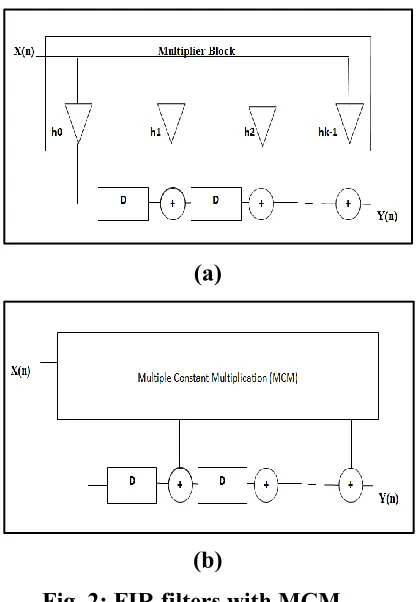
MCM Based Filter DesignThe constant multiplications are implemented by add/sub and shift operations [6]. Firstly, the constants are represented in binary format. The variable is shifted and adds up the shifted variable to get result. This chapter explains about MCM.
(a)
(b)
Fig. 2: FIR filters with MCM
Figure 2 shows the FIR filter with multiplier less MCM. To get the optimized solution, the original coefficients are multiplied by constant values as shown in figure 3 Variable x is multiplied by several constants C1, C2, C3...Cn in the multiplier block and results in C1x, C2x, C3x...Cnx. This can be done using multiplier
block which consists of multiplier less techniques like addition, subtraction and shifts. Realizing such coefficients from multiplications of constant is known as Multiple Constant Multiplication (MCM) [2].
Fig. 3: MCM Operation
An MCM circuit results in significant improvement in digital designs since reduces the overall structure of the circuit and hence price.
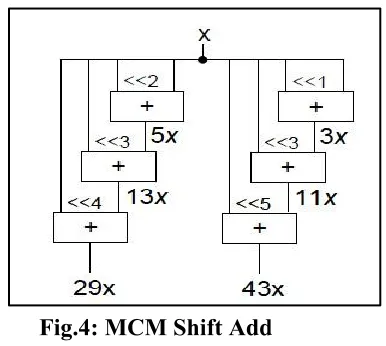
Fig.4: MCM Shift Add
figure 4 shows MCM implementation of add shift for {29,43}.
B
.
Cumulative Benefit HeuristicThis chapter explains HCUB algorithm of MCM. The Cumulative Benefit Heuristic
(HCUB) presented by Voronenko [1] to improve performance for multiplications by longer constants. HCUB is graph based algorithm and outperforms other algorithms under most conditions. The disadvantage of previous algorithms is they use more add/sub/shift operations and they are not effective for constant with more than 19 bits. HCUB performs better for constants with more than 19 bits.
HCUB is also divided into two parts: optimal solution and heuristic solution [1]. The optimal part of the algorithm is almost the same as RAG-n; the big difference is the heuristic part.
Fig.5: No Sharing (n-RAG)
By using sharing partial products reduces number of shifts from 4 to 3 and add/sub from 4 to 3. Finally figure 5 reduced as figure 6 using HCUB.
Fig.6: Sharing (HCUB)
HCUB outperforms RAG-n for coefficients with 32 to 100 bits. And it gives 20% improvement over RAG-n[1,7].
IV. Simulation Results
All the synthesis and simulation results are performed by Xilinx ISE 13.2 using Verilog HDL. The simulation results are shown below figures.
Fig.7: RTL Schematic
Fig.9: Simulation Result
Fig.10: Device Utilization
Table1. Comparison of DA and MCM
Name DA MCM
Number Of Slice 193 80
Number Of FF 144 156
Number of LUTs 224 159
Frequency(MHz) 41.544 249.719
Delay(ns) 24.071 4.005
Memory(kb) 249728 239744
Area 561 395
Fig.11: Comparison of area, delay,
frequency
V. Conclusion
FIR filter using multiplier less multiple constant multiplication method is designed using Hcub algorithm. The design shows reduction in memory, area utilization and delay. The cost is reduced because of lower depth operation. Our proposed system uses 80 slices, 156 flip flops and 159 LUTs. Still there is a scope to apply appropriate techniques to reduce the number of resources utilized and reduction in the computation complexity.
References
[1] Yevgen Voronenko and Markus
Püschel Multiplierless Multiple Constant
Multiplication ACM Transactions on Algorithms, Vol. 3, No. 2, 2007
[2] Govardhan Patil, Abhijit. (2010). FPGA Implementation Of Digital Filters Using MCM.
[3] S. Sai Sreelekha 1, C. Vijaya Bhaskar,” An Area Efficient Mcm Based Digital Fir Filter For Signal
Processing System”Volume: 02 Issue: 02 | May-2015.
[4] N. Goel and A. Nandi, "Design of FIR Filter Using
FCSD Representation," 2015 IEEE International
Conference on Computational Intelligence &
Communication Technology, Ghaziabad, 2015, pp. 617-620.
doi: 10.1109/CICT.2015.85
Pune, 2015, pp. 906-910. doi: 10.1109/ICCUBEA.2015.180
[6] A. G. Dempster, S. S. Dimirsoy and I. Kale, "Designing multiplier blocks with low logic depth," 2002 IEEE International Symposium on Circuits and Systems. Proceedings (Cat. No.02CH37353), 2002,
pp. V-773-V-776 vol.5.doi:
10.1109/ISCAS.2002.1010818
[7] T. Sandhya Pridhini*, Diana Aloshius, Aarthi
Avanthiga, Rubesh Anand, Design Of Multiple Constant
Multiplication AlgorithmFor Fir Filter,
[8] Vincent Lefèvre. Multiplication by an Integer Constant. [Research Report] RR-4192, INRIA. 2001.
[9] K. K. Parhi, VLSI Digital Signal Processing Systems: Design and Implementation. New York: Wiley, 1999.
[10] Wiley: Digital Audio Signal Processing, 2nd