DESIGN OF 64-BIT ALU USING VEDIC
MATHEMATICS FOR HIGH SPEED SIGNAL
PROCESSING RELEVANCE’S
Srikanth Yellampalli
1, V. J Koteswara Rao
21
Pursuing M.tech (VLSI),
2Asst. Professor (ECE),
Nalanda Institute of Engineering and Technology
(NIET), Siddharth Nagar, Kantepudi (V),
Sattenpalli (M), Guntur Dist, A.P. (India)
ABSTRACT
Nowadays due to the growing demand for improving processor performance in handling the complex algorithms and multi functioning making the all processor cores are going to integrate on single chip. Even though the burden on the processor is not reducing. In order to reduce this we should provide the coprocessor for supporting operations done by main processor, these coprocessors will perform numeric operation like addition, multiplication, DSP application, etc. The speed of the processor will depend on the speed of the coprocessors. Vedic mathematics is the ancient type of mathematics which are having unique technique of 16 formulas to find solution of various application in the fast way. Here we are designing an ALU which was based on these maths using Verilog HDL and synthesised in Xilinx ISE 13.2, found that it’s having enhanced performance.
Keywords
:
ALU, Vedic Mathematics, MAC, Nililam sutra
I.
INTRODUCTION
Vedic mathematics is the powerful mechanism provided by the ancient Indian scientists. This mathematics usually depicted in our Vedas by various sages. Swami Bharathi Krishna Acharya who was studied the Vedas and inspired from the mathematics and wrote a book concluding all the formulae’s together from basic elementary maths to modern mathematics. Vedic maths is faster than modern maths, which provides calculation orally at faster rate, we can also done this on the paper. Vedic maths will work on the basis of 16 sutras and their upa sutras which allow students to compute in their own methods not only in specified way as like as in modern maths. It will allow us calculate solutions for all types of mathematical problems like basic maths to nonlinear partial differential equations etc.
4. Ekanyunena Purvena – By one less than the previous one
5. Gunakasamuchyah – The factors of the sum is equal to the sum of the factors. 6. Gunitasamuchyah – The product of the sum is equal to the sum of the product. 7. Nikhilam Navatashcaramam Dashatah – All from 9 and the last from 10. 8. Paraavartya Yojayet – Transpose and adjust.
9. Puranapuranabyham – By the completion or Non completion. 10. Sankalana-vyavakalanabhyam – By addition and by subtraction. 11. Shesanyankena Charmaine – The remainders by the last digit.
12. Shunyam Saamyasamuccaye – When the sum is the same that sum is zero. 13. Sopaantyadvayamantyam – The ultimate and twice the penultimate. 14. Urdhva-tiryakbyham – Vertically and crosswise.
15. Vyashtisamanstih – Part and Whole.
16. Yaavadunam – Whatever the extent of its deficiency
II. PROPOSED VEDIC TECHNIQUE
2.1 Urdhva-Tiryakbyham
2.2 Nikilam Sutra
96 X 98
96 (100-96)
98 (100-97)
Column1 Column2
96 4
98 2
94 08
Common Multiplication Difference result
From the above we can explain the procedure as follows first we have to find compliments of the given numbers, compliments are nothing but result by subtracting the given number from its nearest base. We can say the bases as 10,100,100 etc. For the above nearest base is 100 so subtract the given numbers from 100, we get 2, 4, then we form 2 columns. Column 1 having given numbers and column 2 having their compliments. In the second step we form common difference by subtracting one number compliment with another number, make multiplication of their compliments. Results of common difference and multiplication together form overall result.
Nikilam sutra was described above by using example in decimal. it can be effectively applied for the instance of where operands are larger so that their compliments was smaller and we can easily find the result of them. For finding compliments we choose base as 10, 100, 1000...etc. We can also apply this type of multiplication to the binary number system, we have designed an ALU which will work on the these principles.
2.3 Implementation of Higher Order Multipliers
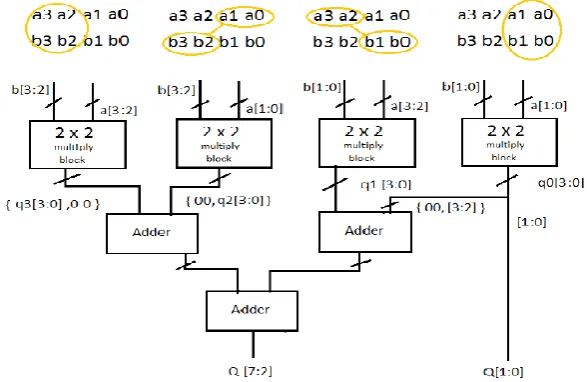
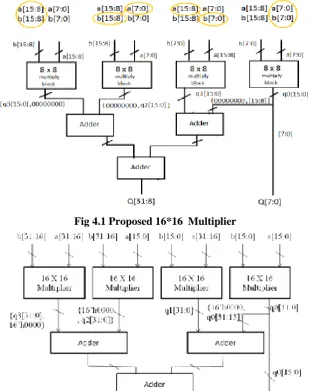
Similarly for 8*8 multiplier, we will use 4*4 multiplier as well and few adders with two different number of bits. To design n*n bit multiplier, we have to design n/2 bit multipliers first then we should have an n-bit adder, 2n+2n-1 bit adders. First divide the string of data into two parts upper part and lower part of two operands. The first operand upper parts with two parts of the second operands are applied to n/2 multiplier. Similarly other parts will be applied to remaining two n/2 multipliers. Then products from the n/2 multiplier are shown added with simple addition structure to get the final product. The 64*64 bit multiplier needs 32*32 multiplier, 16*16 multiplier and 8*8 all architectures with simple mechanisms are presented below
Fig 4.1 Proposed 16*16 Multiplier
Fig 4.1 Proposed 32*32 Multiplier
III.
MULTIPLY
AND
ACCUMULATE
UNIT
Fig 3.2 Block diagram of ALU
IV.
IMPLEMENTATION
OF
ALU
The Proposed ALU consist of logical and unit and arithmetic units. The logical operators and arithmetic operators are connected to the Multiplexer. They possess same inputs and produces output based on the selection line of the user. We mainly concentrating in the design of the ALU with proposed Vedic multiplier which has very simple architecture with compared to the conventional Vedic multiplier. The proposed ALU has very sufficient amount of speed, area and power improvement.
V.
SYNTHESIS
RESULTS
The Vedic mathematics is the powerful tool that can optimize the performance of the whole ALU design. The Vedic mathematics will have less number of calculations as compared with the regular mathematics hence the hardware resources are less, hence it will be efficient in area at the same time requires less propagation delay due to the less number of calculations. This leads to fast calculation which makes efficient in power. The ALU design consists of modules like Multiply-Accumulate unit and adder/sub tractor. The Mac is main module that consists of adder and multiplier. The 64 bit multiplier designed with Verilog HDL. The RTL design is simulated in Xilinx ISE 13.2i. The modules synthesis reports are presented below
Fig5
.1
Fig 5.3 Synthesis timing report of ALU
5.1 Simulation Reports
To check the behavior of the multiplier and ALU we have given inputs A, B are the inputs and, multiplication is selected, the multiplication result is given in wave from, which equal to theoretical value
VI.CONCLUSION
REFERENCES
[1]. An IEEE journal on Low power ALU design using ancient Mathematics by Anvesh kumar, NIT
Jalandhar, Ashish Raman, NIT Jalandhar.
[2] Swami Bharati Krishna Tirtha, Vedic Mathematics. Delhi: Motilalm Banarsidass Publishers, 1965
[3] Vedic Maths Sutras - Magic Formulae [Online]. Available:
http://hinduism.about.com/library/weekly/extra/bl vedicmathsutras. https://Vedic maths.org.
[4] Koren Israel, ”Computer Arithmetic Algorithms,” 2nd Ed, pp. 141-149, Universities Press, 2001.
[5] L. Sriraman, T.N. Prabakar, “Design and Implementation of Two Variable Multiplier Using KCM and Vedic Mathematics,” 1st Int. Conf. on Recent Advances in Information Technology, Dhanbad, India,
2012, IEEE Proc., pp. 782-787.
[6] M. Ramalatha, K. Deena Dayalan, S. Deborah Priya, “High Speed Energy Efficient ALU Design using
Vedic Multiplication Techniques,” Advances in Computational Tools for Engineering Applications, 2009,
IEEEProc., pp 600-603.
[7] Jagadguru Swami Sri Bharati KrisnaTirthaji Maharaja, “Vedic Mathematics: Sixteen Simple
Mathematical Formulae from the Veda,” pp. 5-45, Motilal Banarasidas Publishers, Delhi, 2009.
[8] Himanshu Thapliyal and M. B. Srinivas, “An efficient method of elliptic curve encryption using Ancient
Indian Vedic Mathematics,” 48th IEEE Int. Midwest Symp.on Circuits and Systems, 2005, vol. 1, pp.
826-828.
[9] Tiwari, Honey Durga, et al., "Multiplier design based on ancient Indian Vedic Mathematics, "Int. SoC Design Conf., 2008, vol. 2. IEEE Proc., pp. II-65 - II-68.
[10] Hsiao, Shen-Fu, Ming-Roun Jiang, and Jia-SienYeh, "Design of high speed low-power 3-2 counter and 4-2 compressor for fast multipliers,” IEEE Electronics Letters, vol. 34, no.4, pp. 341-343, Feb. 1998.
[11] D. Radhakrishnan and A. P. Preethy, "Low power CMOS pass logic 4-2 compressor for high-speed multiplication," Circuits and Systems, Proc. 43rd IEEE Midwest Symp., vol. 3, pp. 1296-1298, 2000.
AUTHOR DETAILS
SRIKANTH YELLAMPALLI, Pursuing M.tech (VLSI) from Nalanda institute of Engineering and Technology (NIET),He completed his Bachelors of Technology from Electronics and communication Engineering. His area of interest includes CMOS analog, CMOS digital and Low power VLSI design