Available Online atwww.ijcsmc.com
International Journal of Computer Science and Mobile Computing
A Monthly Journal of Computer Science and Information Technology
ISSN 2320–088X
IJCSMC, Vol. 3, Issue. 8, August 2014, pg.451 – 456
RESEARCH ARTICLE
Bi-Orthogonal Wavelet Transform Based 3-D
Image Watermarking on Colour
Image
Neha Ganjir
M.Tech. Digital Electronics
Rungta College of Engineering and Technology, Bhilai, Chhattisgarh, India
[email protected]
Nivedita Singh
Assistant Professor, Department of ECE
Rungta College of Engineering and Technology, Bhilai, Chhattisgarh, India
[email protected]
Abstract— Watermarking technology is an effective approach to image content authentication and copyright protection, which has got notable achievements in recent years. Watermarking has been utilized by researchers for the security of digital documents. Due to the problems of data amount and color shifted, watermarking techniques on color image was not so widespread studied, although the color image is the principal part for multi-medium usages. In this paper we have proposed a method for watermarking color image on color image using Bi-Orthogonal Wavelet Transform. It consists of both a watermark stamping process which embeds a watermark in a source image, and a watermark extraction process which extracts a Watermark from a stamped image. As to the watermark image, pre-processing is applied first, in which the watermark image is decomposed by one level wavelet transformations. The experiment shows that the algorithm can guarantee the unperceivability and transparency of the digital image.
Keywords- Digital Image Watermarking, Bi-Orthogonal Wavelets Transform, Copyright Protection
INTRODUCTION
An analogy of digital watermark is the paper watermark. Paper watermarks on currency notes and corporate letter heads are used to prove their authenticity. Similarly digital watermark is embedded into digital media to validate their contents. Although cryptographic methods have long been applied in digital content security, the decrypted content requires further protection. For instance a piece of artwork may be obtained legitimately but distributed to others unlawfully through peer sharing networks. Digital watermarks can provide extra protection to the decrypted content since it is embedded into the content.
The watermarking technique is the process of embedding a signal in to other signal robustly and invisibly at the same time, the embedded signal is called watermark and the other signal is called cover or host signal. The insertion is made in such a way that it must not cause serious degradation to the original digital media. Embedding must be done either in spatial or frequency domain. Frequency Domain Methods are the most popular in comparison with Spatial Domain Methods because when an image is inverse transformed, watermark is distributed irregularly over the image. Recently, for transforming images into frequency domain, Fourier transform, discrete cosine transform, wavelet transform etc are used. The energy of the embedded signal in the transform domain will be spread over all pixels in the spatial domain. This is advantageous to invisibility. Digital watermarking provides a way of protecting the rights of the owner of a file. Even if the file is copied and then changed with minor alterations and transformations, the owner can still prove it is his or her original file
As we know that watermark images with more information and good perception, such as color watermark images, are more attractive. However, this type of watermark has too much data, which limits its applications. So the practical watermarking techniques such as color image watermarking techniques cannot meet the practical need, especially for embedding color watermark to color host image. The main objective of this paper is to present a novel watermarking technique that utilizes the Bi-Orthogonal wavelet transform to embed and extract the color watermark. This method seems ideal, in that it promises to embed watermarks that cannot be detected by the eye. It takes a color watermark image and hide it in a color cover image after performing DWT on both image. The Bi-Orthogonal wavelet transform is an invertible transform. The property of perfect reconstruction and symmetric wavelet functions exist in Bi-Orthogonal wavelets because they have two sets of low pass filters (for reconstruction), and high pass filters (for decomposition). One set is the dual of the other. This technique embeds information so that it is not easily perceptible; Human visual system is not able to see any information embedded in the contents.
Grey Verses Color Image
Grey scale images are the product of simple sampling where each pixel is assigned a value. Typical grey scale images used for experimentation in the research community use 8-bits per pixel thus each pixel has 28 =256 grey levels. Color images usually consist of three color channels i.e. red, green and blue. Each channel is conceptually similar to grayscale.
BI-ORTHOGONALWAVELETTRANSFORM
The wavelet transform is based on small waves. Wavelets became the base of the resolution analysis in 1987. The multi-resolution analysis (MRA) represents and analyzes signals (images) at different frequencies with different multi-resolutions [6]. The basic thought of wavelet transform is using the same function by expanding and shifting to approach the original signal. The wavelet coefficients carry the time-frequency information in certain areas. It has good local characteristics both in time domain and frequency domain i.e. they have the desirable time-frequency localization property. This means that using wavelets enables representing the signal in the time and frequency domain at the same time, in order to cut the signal into numerous parts then analyze these parts separately.
Figure 1. One level 2D DWT decomposition of an input image using filtering approach
Fig.1 shows the 2D DWT of the image pixels by performing low-pass and high- pass filtering. In this figure, the low-pass and high-pass filters are denoted by G1 (Z) and G2 (Z) respectively. This figure depicts the one level of the 2D DWT decomposition. At
each level, the high-pass filter generates detailed image pixel information, while the low-pass filter produces the coarse approximations of the input image.
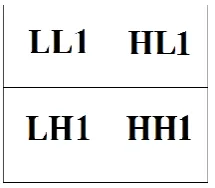
At the end of each low-pass and high-pass filtering, the outputs are down-sampled by two (↓ 2). In order to compute 2D DWT, 1D DWT is applied twice in both horizontal and vertical dimension. In other words, a 2D DWT can be performed by first performing a 1D DWT on each row, which is referred to as horizontal filtering, of the image followed by a 1D DWT on each column, which is called vertical filtering. Fig.2 shows the structure of one level 2D wavelet decomposition. Where LL represents lower resolution, HL shows Horizontal, LH vertical and HH diagonal resolution respectively.
Figure 2. Two level 2D Wavelet based transforms
In Bi-Orthogonal wavelets, the decomposition and reconstruction filters are obtained from two distinct scaling functions associated with two multi-resolution analyses in duality. Another advantageous property of Bi-Orthogonal over orthogonal wavelets is that they have higher embedding capacity if they are used to decompose the image into different channels [8]. All mentioned properties make Bi-Orthogonal wavelets promising in the watermarking domain.
PERFORMANCEEVALUATION
A.Peak signal to noise ratio: Peak signal to noise ratio can be defined as the ratio between the maximum possible power of the signal and the power of the noise that affects the signal‟s fidelity of representation. It can be easily defined by mean squared error i.e. MSE.
B.Mean Squared Error: Let‟s take two m*n images „I‟ and „K‟ where one of them is considered as the noisy approximation of the
PROPOSEDWATERMARKINGMETHOD
Watermark image is embedded in cover image by breaking the cover image into series and adding pixel by pixel watermark image into it. In embedding process, first separate the red(R), green (G) & blue (B) channels of the color image both watermark and cover. The R, G, B channels of cover and watermark image is decomposed into 2-level and 1-level respectively using Bi-Orthogonal Wavelet Transform [5].
Watermark embedding steps of proposed techniques are as follows:
1. The intensity values of original image or Host image or cover image are obtained and the R, G & B channels are separated.
2. The values of color watermark image to be hidden are obtained and R, G & B channels are separated. 3. Perform one level Bi-Orthogonal Wavelet Transform on watermark image.
4. Perform two level Bi-Orthogonal Wavelet Transform on cover image. 5. Set the gain factor alpha.
6. Add the red part of watermark image multiplied by gain factor to red part of cover image and repeat same for green and blue part.
7. Recover cover image by inverse wavelet transform.
8. Calculate the quality of watermarked image by using PSNR function as per the equation (2).
Watermark extraction steps of proposed techniques are as follows:
1. Read in the watermarked image. 2. Read the original cover image.
3. Separate the R, G, & B parts of both the images.
4. Set the gain factor to the same value as in embedding part.
5. Perform two levels Bi-Orthogonal Wavelet Transform on watermarked image and cover image.
6. Subtract the red part of cover image from red part of watermarked image and divide the result by gain factor (alpha) and repeat the same for green and blue part.
7. Recover the image by inverse wavelet transform.
8. Calculate the quality of recovered image by using PSNR function as per the equation (2).
EXPERIMENTAL RESULTS
Baby.jpg color image of size 512×512 is selected as a host and apple.bmp color image of size 256×256 is chosen as a watermark. Figure 3 shows the original host image, watermark image, watermarked image and extracted watermark on the receiver side.
a) Original host image (b) original watermark
(c) Watermarked image (d) extracted watermark
The proposed technique performed better than the other wavelet-based techniques. This is due to the reason of wavelet we use in our technique is the bi-orthogonal wavelet transform, which involves certain properties like the perfect reconstruction and the linear phase properties. So, our technique produces more accurate results in most cases.
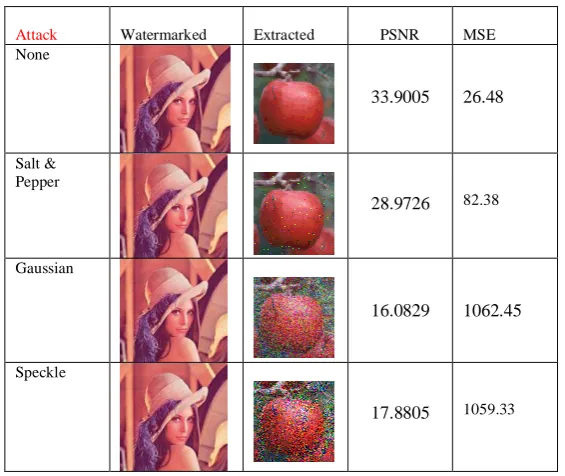
The performance of the proposed method is tested by applying different geometric and image processing attacks, such as Gaussian noise ,Salt and pepper noise & speckle noise on watermarked image is studied and experimentally obtained with noise density for baby.jpg & lena.jpg with watermark apple.bmp(bitmap image) at fixed embedding factor (Alpha= 0.1). The proposed method, with stands for salt & pepper noise but do not give better result in case of Gaussian and speckle noise.
An efficient and useful watermarking scheme should have some properties such as robustness, capacity and imperceptibility. The owner of the image wants to prove his/her ownerships as long as the quality of the digital content remains. Hence, the watermark should be detected after the digital content passes from any signal operation that does not distort the image quality considerably. This refers to robustness. On the other hand, the capacity is directly related with the robustness. It refers to the ability of detecting watermark with a low probability of error as the number of differently watermarked versions of an image increases. Finally, the imperceptibility refers to visual similarity between the original content and the watermarked content. Therefore, it is required that the watermarked image have the same visual quality as the original one. The above mentioned requirements are fulfilled in our proposed method.
To better illustrate the superiority of our algorithm the Peak Signal to Noise Ratio (PSNR) and Mean Square Error (MSE) values obtained from two different original host images with same watermark image with embedding strength (alpha=0.1 ) are studied and experimentally obtained. The comparison of PSNR measurements is shown in TABLE 1 and TABLE 2.
TABLE I. Robustness test result: noise, watermarked and extracted watermarked images on baby.jpg
Attack Watermarked Extracted PSNR MSE None
34.3043 24.13
Salt & Pepper
29.5076 72.83
Gaussian
16.011 1629.17
Speckle
15.7279 1738.97
TABLE II. Robustness test result: noise, watermarked and extracted watermarked images on lena.jpg
Attack Watermarked Extracted PSNR MSE
None
33.9005 26.48
Salt & Pepper
28.9726 82.38
Gaussian
16.0829 1062.45
Speckle
17.8805 1059.33
CONCLUSION
In this paper watermark is embedded into second level sub-band of DWT decomposition. This method is implemented using bi-orthogonal wavelet transform for analysis. If we use Bi-orthogonal wavelets for decomposition then distortion in the watermarked image is less compared with the Haar wavelet transform. The technique makes use of DWT; it aims to improve the robustness of other watermarking techniques for color image hiding..
Due to use of color host as well as watermark image it is a bit difficult to hide as compared to grey image watermarking. To hide grey image on color image it is sufficient to consider only blue color of host image, but for watermarking color image we have to consider red, blue and green all three colors and this makes the algorithm complex. In the proposed method we work on red and green channels along with blue channel but red and green channels are not more resistant to changes hence affecting visibility.
R
EFERENCESMunesh Chandra , Shikha Pandey “A DWT Domain Visible Watermarking Techniques for Digital Images” 2010 International Conference on
Electronics and Information Engineering (ICEIE 2010)
Li Chunhua , Fu Li “ Adaptive Image Watermarking Algorithm Based on Biorthogonal Wavelet Transform”978-1-4244-8694-6/11/$26.00
©2011 IEEE
[1] Nirupma Tiwari ,Manoj Kumar Ramaiya ,Monika Sharma “Digital Watermarking using DWT and DES”978-1-4673-4529-3/12/$31.00 c
_2012 IEEE
[2] Rajendra S. Shekhawat ,Sivavenkateswara RaoV ,V. K. Srivastav “A Biorthogonal Wavelet Transform Based Robust Watermarking
Scheme”978-1- 4673-1515-9/12/$31.00 ©2012 IEEE 2012 IEEE Students‟ Conference on Electrical, Electronics and Computer Science
[3] Hajjara, S., M., Abdallah, and A., Hudaib, 2006. “Image information hiding using second order biorthogonal wavelets”, ICIA Int. Conf.,
Sri Lanka, Colombo, pp. 403-406.
Dr. Vipula Singh “Digital Watermarking: A Tutorial” Cyber Journals: Multidisciplinary Journals in Science and Technology, Journal of Selected Areas in Telecommunications (JSAT), January Edition, 2011
Zhicheng Wei1,Hao Li1, Jufeng Dai ,Sashuang Wang1 “Image watermarking based on genetic algorithm” 142440367- 7/06/$20.00 ©2006 IEEE
Samir Kumar Bandyopadhyay, Tuhin Utsab Paul, Avishek Raychoudhury “Invisible Digital Watermarking Through Encryption” International Journal of Computer Applications (0975 – 8887) Volume 4– No.8, August 2010